Fifty-three years ago…10:38am. I did a post last year with more background information and some nostalgia.
I stopped posting on July 15, as the following day, I wound up in the ER. As my maternal grandmother would say “I had a spell with my heart.” Luckily, it turned out to be nothing life threatening but, it scared me. After six weeks of rest and some lifestyle changes, I’m good.
I’m not fond of a lot of fanfare regarding my birthday. I prefer to have the day to myself. I’m mostly an introvert but, I can be extroverted for short periods of time. Here is a personal toast to still being upright and walking.
My likeness was sketched by artist Wendy T. Wallace of Greensboro, back in November of 1994. I sat for her at a Christmas shopping festival at the Greensboro Coliseum…as I recall. This was ten years after high school graduation.
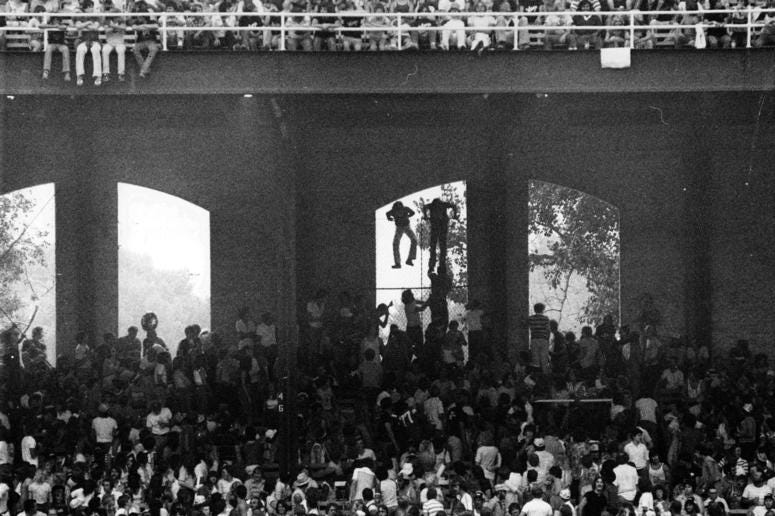
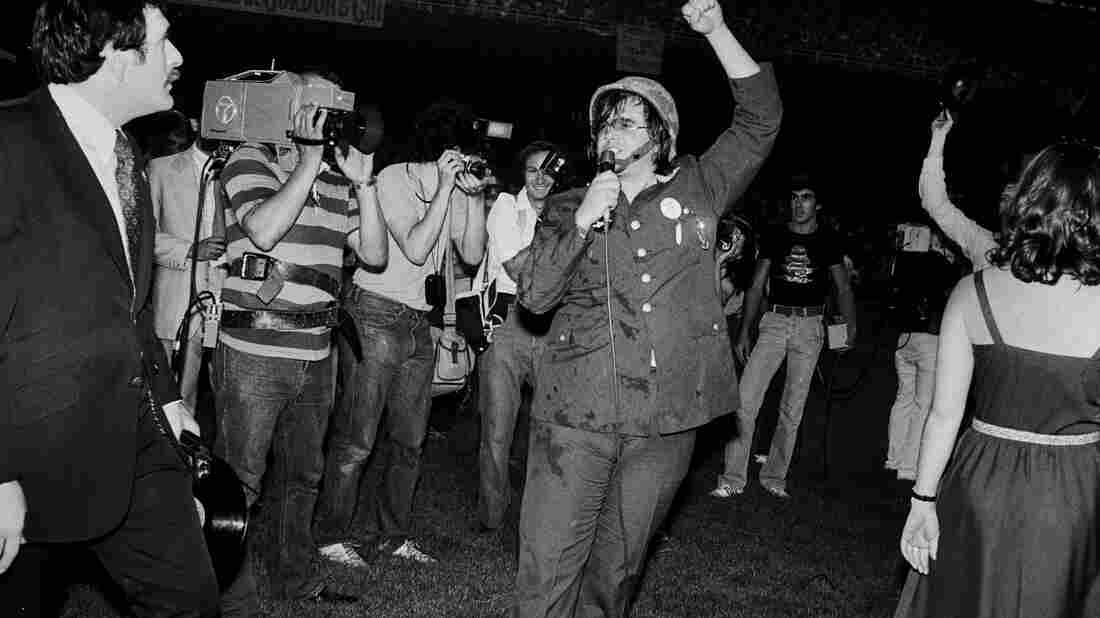
Forty years ago, today, the Disco Demolition took place at Chicago’s Comiskey Park. What started out as a baseball promotion turned into a mêlée that damaged the field.
[..] disco didn’t quite die a natural death by collapsing under its own weight. Instead, it was killed by a public backlash that reached its peak on this day in 1979 […]. That incident, which led to at least nine injuries, 39 arrests and, the cancellation and forfeit of a Major League Baseball game, is widely credited […] or, blamed for […] dealing disco its death blow.
The event was the brainchild of Steve Dahl and Garry Meier, popular disk jockeys on Chicago’s WLUP “The Loop” FM. […] many […] rock DJs were displaced by disco [but], only Dahl was inspired to launch a semi-comic vendetta aimed at “the eradication and elimination of the dreaded musical disease.”
On May 2, the rainout of a game between the Chicago White Sox and the Detroit Tigers led to the scheduling of a doubleheader on July 12. Dahl and Meier approached the White Sox with a rather unorthodox idea for an attendance-boosting promotion […]. […] allow Dahl to blow up a dumpster full of disco records between games of the doubleheader. White Sox executive Mike Veeck embraced the idea […].
[…] organizers […] grossly [underestimated] the appeal of the 98-cent discount tickets offered to anyone who brought a disco record to the park to add to the explosive-rigged dumpster. WLUP and the White Sox expected perhaps 5,000 more fans than the average draw of 15,000 or so […]. What they got, instead, was a raucous sellout crowd of 40,000+ and an even more raucous overflow crowd of as many as 40,000 more outside on Shields Avenue.
What followed was utter chaos, as fans by the thousands stormed the field, […] began to wreak havoc, shimmying up the foul poles, tearing up the grass and lighting vinyl bonfires on the diamond while the stadium scoreboard implored them to return to their seats. Conditions were judged too dangerous for the scheduled game to begin and the Detroit Tigers were awarded a win by forfeit.
In the weeks before the event, Dahl invited his listeners to bring records they wanted to see destroyed to Comiskey Park. Owner Bill Veeck was concerned the promotion might become a disaster […]. His fears were substantiated when he saw the people walking towards the ballpark that afternoon. […] many carried signs that described disco in profane terms.
Some leapt turnstiles, climbed fences and entered through open windows. Attendees were supposed to deposit their records into a large box [but], once the box was overflowing, many people brought their discs to their seats. Many of the records were not collected by staff and were thrown like flying discs from the stands. Tigers designated hitter Rusty Staub remembered that the records would slice through the air and land sticking out of the ground. He urged teammates to wear batting helmets when playing their positions. “It wasn’t just one, it was many. Oh, God almighty, I’ve never seen anything so dangerous in my life.” Attendees also threw firecrackers, empty liquor bottles and lighters onto the field. The game was stopped several times because of the rain of foreign objects.
Dozens of hand-painted banners with such slogans as “Disco Sucks” were hung from the ballpark’s seating decks. Dahl set off the explosives, destroying the records and tearing a large hole in the outfield grass. […] the first of 5,000 to 7,000 attendees rushed onto the field […]. The batting cage was destroyed and, the bases were pulled up and stolen. Among those taking to the field was 21-year-old aspiring actor Michael Clarke Duncan […]. Duncan slid into third base, had a silver belt buckle stolen and went home with a bat from the dugout. Some attendees danced in circles around the burning vinyl shards.
Chicago police in full riot gear arrived (9:08pm) to the applause of the baseball fans remaining in the stands. Those on the field hastily dispersed upon seeing the police. Tigers manager Sparky Anderson refused to allow his players to take the field […] due to safety concerns. Anderson […] demanded that the game be forfeited to the Tigers. He argued that, under baseball’s rules, a game can only be postponed due to an Act of God, and that, as the home team, the White Sox were responsible for field conditions.
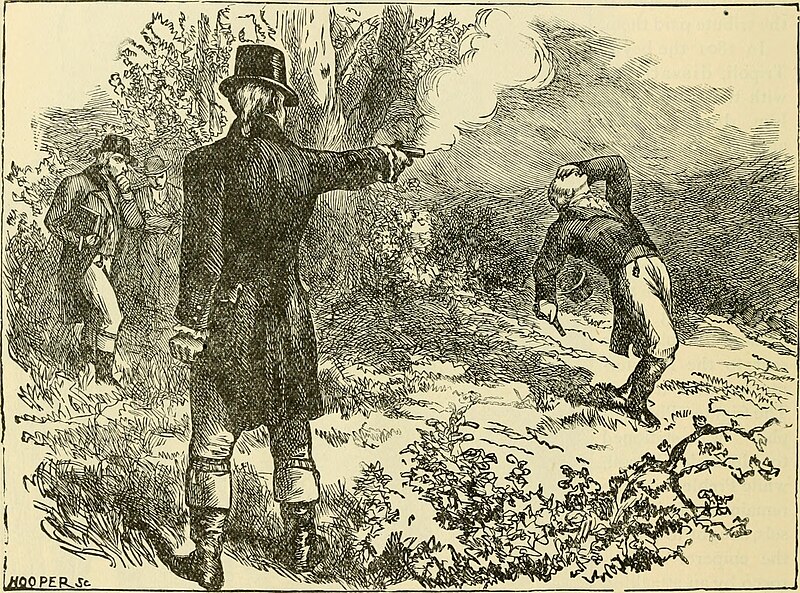
Two-hundred, fifteen years ago, today, Vice President Aaron Burr shot former Secretary of the Treasury Alexander Hamilton in a duel in Weehawken, New Jersey.
At dawn on the morning of July 11, […] political antagonists, and personal enemies, Alexander Hamilton and Aaron Burr met on the heights of Weehawken […], to settle their longstanding differences with a duel. The participants fired their pistols in close succession. Burr’s shot met its target immediately, fatally wounding Hamilton and leading to his death the following day. Burr escaped unharmed. This tragically extreme incident reflected the depth of animosity aroused by the first emergence of the nation’s political party system. Both men were political leaders in New York: Burr, a prominent Republican, and Hamilton, leader of the opposing Federalist Party. Burr had found himself the brunt of Hamilton’s political maneuvering on several occasions, including the unusual presidential election of 1800, in which vice-presidential candidate Burr almost defeated his running mate, presidential candidate Thomas Jefferson. In 1804, Hamilton opposed Burr’s closely fought bid for governor of New York. On the heels of this narrow defeat, Burr challenged Hamilton to a duel on the grounds that Hamilton had publicly maligned his character.
Alexander Hamilton, the chief architect of America’s political economy, was born on the Caribbean island of Nevis [and] came to the American colonies in 1773 as a poor immigrant. (There is some controversy as to the year of his birth, but it was either 1755 or 1757.) In 1776, he joined the Continental Army in the American Revolution and his […] remarkable intelligence brought him to the attention of General George Washington. Aaron Burr, born into a prestigious New Jersey family in 1756, was also intellectually gifted and [..] graduated from the College of New Jersey (later Princeton) at the age of 17. He joined the Continental Army in 1775 […]. In 1790, he defeated Alexander Hamilton’s father-in-law in a race for the U.S. Senate. Hamilton came to detest Burr, whom he regarded as a dangerous opportunist, and […] often spoke ill of him.
In the 1800 election, Jefferson and Burr became running mates […]. Under the electoral procedure then prevailing, president and vice president were voted for, separately. […] the candidate who received the most votes was elected president, and the second in line, vice president. What at first seemed but an electoral technicality […] developed into a major constitutional crisis when Federalists in the lame-duck Congress threw their support behind Burr. After a remarkable 35 tie votes, a small group of Federalists changed sides and voted in Jefferson’s favor. Alexander Hamilton, who had supported Jefferson as the lesser of two evils, was instrumental in breaking the deadlock.
The duel was fought at a time when the practice was being outlawed in the northern United States and it had immense political ramifications. Burr survived the duel and was indicted for murder in both New York and New Jersey, though these charges were later either dismissed or resulted in acquittal. The harsh criticism and animosity directed toward him following the duel brought an end to his political career. The Federalist Party was already weakened by the defeat of John Adams in the presidential election of 1800 and was further weakened by Hamilton’s death.
[Burr] spent [many] years in Europe. He finally returned to New York City in 1812, where he resumed his law practice and spent the remainder of his life in relative obscurity.
SN 1054 is a supernova that was first observed on 4 July 1054 and remained visible for around two years. The event was recorded in contemporary Chinese astronomy [..]. [There is] a pictograph associated with the Ancestral Puebloan (Anasazi) culture found near the Peñasco Blanco site in New Mexico. The remnant of SN 1054, which consists of debris ejected during the explosion, is known as the Crab Nebula (M1). It is located in the sky near the star Zeta Tauri (ζ Tauri) The core of the exploding star formed a pulsar called the Crab Pulsar. When the French astronomer Charles Messier watched for the return of Halley’s Comet in 1758, he confused the nebula for the comet as he was unaware of the former’s existence. Motivated by this error, he created his catalogue of non-cometary nebulous objects, the Messier Catalogue, to avoid such mistakes in the future. The nebula is catalogued as the first Messier object […].
Chinese astronomers watching the sky on July 4, 1054, noted the appearance of a new or guest star just above the southern horn of Taurus. Other observations of the explosion were recorded by Japanese, Arabic and Native American stargazers. In 1731, British astronomer John Bevis observed a cloudy blob in the sky and added it to his star atlas. Although [Messier] credited himself with its discovery in his first publication of the Messier Catalog, he acknowledged Bevis’ original finding in subsequent versions after receiving a letter from the astronomer. Around 1844, [Irish] astronomer William Parsons, the third Earl of Rosse, sketched the nebula. The resemblance of the image to a crustacean led to M1’s other name, the Crab Nebula. In the early 20th century, astronomers (Carl Lampland/1921 & Edwin Hubble/1928, included) were able to take more detailed measurements of M1 and determined that it is expanding. Working backwards, they determined its origination date and matched the explosion up with observations from Chinese and Native American records.
Photo Credit:
Alex Marentes
flickr.com
earthsky.org
It is likely that skywatchers of the Anasazi People in the American Southwest also viewed the bright new star in 1054. Historic research shows that a crescent moon was visible in the sky very near the new star on the morning of July 5, the day following the observations by the Chinese. The pictograph above, from Chaco Canyon in New Mexico, is believed to depict the event. The multi-spiked star to the left represents the supernova near the crescent moon. The handprint above may signify the importance of the event, or may be the artist’s “signature.”
Much like June 14, June 28 is also a very interesting day. It marks the beginning and ending of The Great War or, The War to End All Wars. Though true that the guns fell silent on the eleventh hour of the eleventh day of the eleventh month with the signing of the Armistice in a railroad car in Compiègne, France, today’s date serves as solid markers in the timeline. ~Vic
Image Credit: smithsonianmag.com
On this day in 1914, Archduke Franz Ferdinand of Austria and his wife Sophie are shot to death by a Bosnian Serb nationalist during an official visit to the Bosnian capital of Sarajevo. The archduke traveled to Sarajevo […] to inspect the imperial armed forces in Bosnia and Herzegovina, annexed by Austria-Hungary in 1908. The annexation had angered Serbian nationalists, who believed the territories should be part of Serbia. A group of young nationalists hatched a plot to kill the archduke during his visit to Sarajevo and, after some missteps, 19-year-old Gavrilo Princip was able to shoot the royal couple at point-blank range, while they traveled in their official procession, killing both, almost instantly.
The assassination set off a rapid chain of events, as Austria-Hungary immediately blamed the Serbian government for the attack. As large, powerful Russia supported Serbia, Austria asked for assurances that Germany would step in on its side against Russia, and its allies, including France and possibly Great Britain. On July 28, Austria-Hungary declared war on Serbia and the fragile peace between Europe’s great powers collapsed, beginning the devastating conflict now known as the First World War.
World War I officially ended with the signing of the Treaty of Versailles [on this day in] 1919. The treaty, negotiated between January and June […] in Paris, was written by the Allies with almost no participation by the Germans. The negotiations revealed a split between the French, who wanted to dismember Germany to make it impossible for it to renew war with France and, the British and Americans, who did not want to create pretexts for a new war. The eventual treaty included 15 parts, […] 440 articles, […] reassigned German boundaries and assigned liability for reparations.
The German government signed the treaty under protest. The U.S. Senate refused to ratify the treaty and the U.S. government took no responsibility for most of its provisions.
For five years the French and the Belgians tried to enforce the treaty quite rigorously […]. In 1924, however, Anglo-American financial pressure compelled France to scale down its goals and end the occupation. […] The French assented to modifying important provisions of the treaty in a series of new agreements. Germany in 1924, and 1929, agreed to pay reparations under the Dawes Plan and the Young Plan but, the Great Depression led to the cancellation of reparations in 1932. Hitler denounced the treaty altogether in 1935.
One can never know whether either rigorous Franco-British enforcement of the original treaty or a more generous treaty would have avoided a new war.
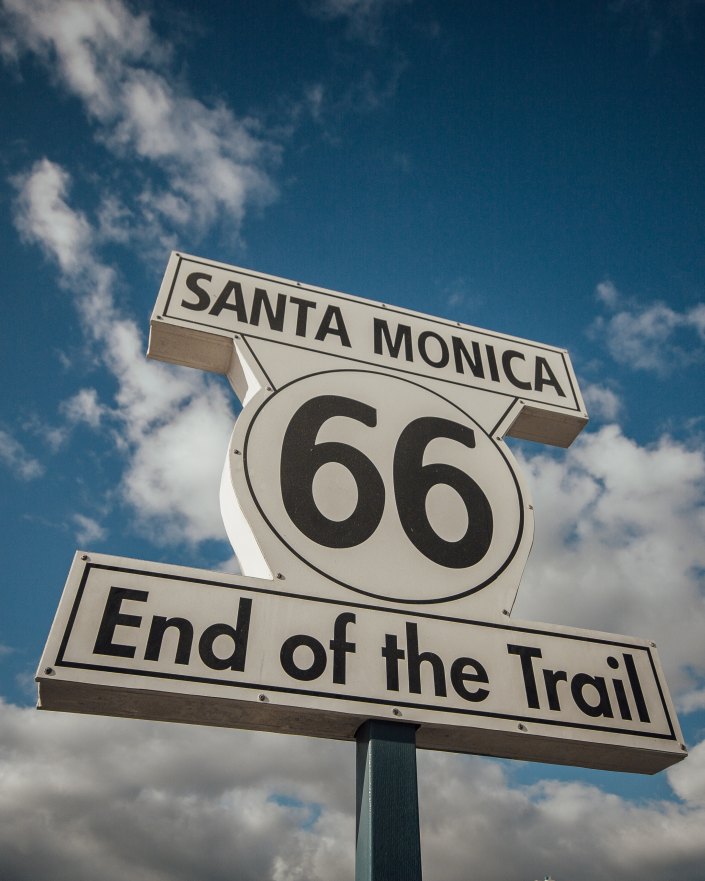
After 59 years, the iconic Route 66 enters the realm of history on this day in 1985, when the American Association of State Highway and Transportation Officials decertifies the road and votes to remove all its highway signs. Measuring some 2,200 miles in its heyday, Route 66 stretched from Chicago, Illinois to Santa Monica, California, passing through eight states. According to a New York Times article about its decertification, most of Route 66 followed a path through the wilderness forged in 1857 by U.S. Navy Lieutenant Edward Beale at the head of a caravan of camels. Over the years, wagon trains and cattlemen eventually made way for trucks and passenger automobiles.
The idea of building a highway along this route surfaced in Oklahoma in the mid-1920s as a way to link the state to cities like Chicago and Los Angeles. Highway Commissioner Cyrus S. Avery touted it as a way of diverting traffic from Kansas City, Missouri and Denver. In 1926, the highway earned its official designation as Route 66. The diagonal course of Route 66 linked hundreds of mostly rural communities to the cities along its route, allowing farmers to more easily transport grain and other types of produce for distribution. The highway was also a lifeline for the long-distance trucking industry, which by 1930 was competing with the railroad for dominance in the shipping market.
Route 66 was the scene of a mass westward migration during the 1930s, when more than 200,000 people traveled from the poverty-stricken Dust Bowl to California. John Steinbeck immortalized the highway, which he called the “Mother Road”, in his classic 1939 novel The Grapes of Wrath. Beginning in the 1950s, the building of a massive system of interstate highways made older roads increasingly obsolete and, by 1970, modern four-lane highways had bypassed nearly all sections of Route 66. In October 1984, Interstate-40 bypassed the last original stretch of Route 66 at Williams, Arizona and, the following year, the road was decertified. According to the National Historic Route 66 Federation, drivers can still use 85 percent of the road and Route 66 has become a destination for tourists from all over the world.
Often called the Main Street of America, Route 66 became a pop culture mainstay over the years, inspiring its own song (written in 1947 [sic] by Bobby Troup, Route 66 was later recorded by artists as varied as Nat King Cole, Chuck Berry and The Rolling Stones) as well as a 1960s television series. More recently, the historic highway was featured prominently in the hit animated film Cars (2006).
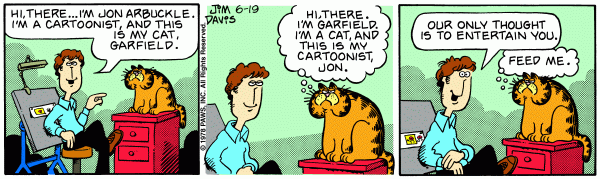
Forty-one years ago, today, the Garfield Comic Strip debuted. Created by cartoonist Jim Davis, it chronicles the daily life and adventures of Garfield, a large orange (or ginger) Tabby cat, his human Jonathan Q. ‘Jon’ Arbuckle and, Odie, the dog, originally owned by Jon’s friend and roommate, Lyman. Davis named the cat after his grandfather, Jon Arbuckle came from a 1950s coffee commercial and Odie was based on a car dealership commercial written by Davis, which featured Odie the Village Idiot. Set in Muncie, Indiana (Jim Davis’s home), the strip showcases Garfield’s laziness, sarcastic humor, love of lasagna & coffee and, his dislike of Mondays.
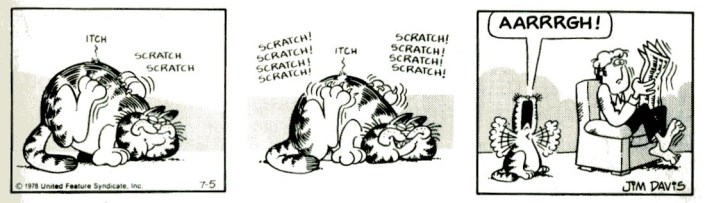
In 2002, it became the most syndicated comic strip, reaching 263 million readers, worldwide. From 1978 to 1983, Garfield looked more like this picture but, went through some changes and became more cartoonish-looking from 1984, forward. Lyman was written out in 1982. Other notable characters are Dr. Liz Wilson (Garfield’s vet), Arlene (a pink stray cat), Pooky (Garfield’s teddy), Nermal (a grey Tabby kitten that Garfield is jealous of) and Jon’s family members.
Image Credit: ucomics.com
Garfield’s First Appearance
June 14 was a banner day for the countries of France, Lithuania and Poland. Except for reading the words, we, today, have no clue what these people went through. ~Vic
Paris started mobilizing for war in September 1939 when Nazi Germany, and their allied Soviet Union, according to the Ribbentrop-Molotov Treaty, invaded Poland. […] the war seemed far away until May 10, 1940, when the Germans attacked France and quickly defeated the French army. The French government departed Paris on June 10 and the Germans occupied the city on June 14.
In the spring of 1939, war with Germany already seemed inevitable. On March 10, the city began to distribute gas masks to civilians and on March 19, signs were posted guiding Parisians to the nearest shelters. On August 31, anticipating bombardment, the French government began to evacuate 30,000 children out of the city […]. On September 1, news reached Paris that Germany had invaded Poland, and France, as expected, promptly declared war on Germany. […] in February 1940, ration cards for food were issued [..].
The French defense plan was purely passive, waiting for the Germans to attack. After eight months of relative calm, […] the Germans struck France on May 10, 1940, bypassing the Maginot Line and slipping through the Ardennes. On June 3, the Germans bombed Paris and its suburbs for the first time […]. On June 8, the sound of distant artillery fire could be heard in the capital. On 10 June, the French government fled Paris […]. On June 12, the French government, in Tours, declared Paris to be an open city [and] that there would be no resistance. At 5:30 in the morning of June 14, the first German advance guard entered the city […]. By the end of the afternoon, the Germans had hung a swastika flag at the Arc de Triomphe […].
Image Credit: wikipedia.org & Renata3
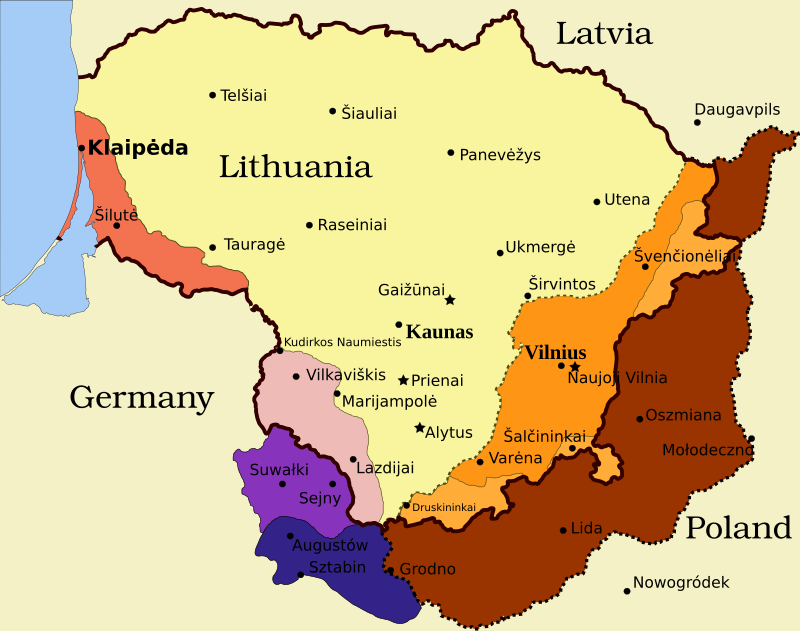
According to the Soviet–Lithuanian Mutual Assistance Treaty, Lithuania agreed to allow Soviet military bases (marked in black stars) in exchange for a portion of the Vilnius Region (in orange).
The Soviet Union issued an ultimatum to Lithuania before midnight of June 14, 1940. The Soviets, using a formal pretext, demanded to allow an unspecified number of Soviet soldiers to enter the Lithuanian territory and to form a new pro-Soviet government […]. The ultimatum and subsequent incorporation of Lithuania into the Soviet Union stemmed from the division of Eastern Europe into the German and Russian spheres of influence in the Molotov–Ribbentrop Pact of August 1939. Lithuania, along with Latvia and Estonia, fell into the Russian sphere. Despite the threat to the independence, Lithuanian authorities did little to plan for contingencies and were unprepared for the ultimatum. With Soviet troops already stationed in the country according to the Mutual Assistance Treaty, it was impossible to mount effective military resistance. On June 15, Lithuania unconditionally accepted the ultimatum and lost its independence.
The first mass transport of prisoners by Nazi Germany to Auschwitz Concentration Camp was organized in occupied Poland on June 14, 1940, during World War II. The transport departed from the southern Polish city of Tarnów and, consisted of 728 Poles and 20 Polish Jews. They were dubbed ‘political prisoners’ and members of the Polish resistance. Most were Catholics, since the mass deportations of Jews had not yet begun. All were sent to Auschwitz by the German Security Police. They were transported there from a regular prison in Tarnów where they had been incarcerated as enemies of the Nazi regime. Numbers were tattooed on the prisoners’ arms in the order of their arrival […]. These inmates were assigned the numbers 31 through 758, with numbers 1 through 30 having been reserved for a group of German criminals who were brought to Auschwitz from Sachsenhausen on May 20 and became the first Auschwitz kapos.
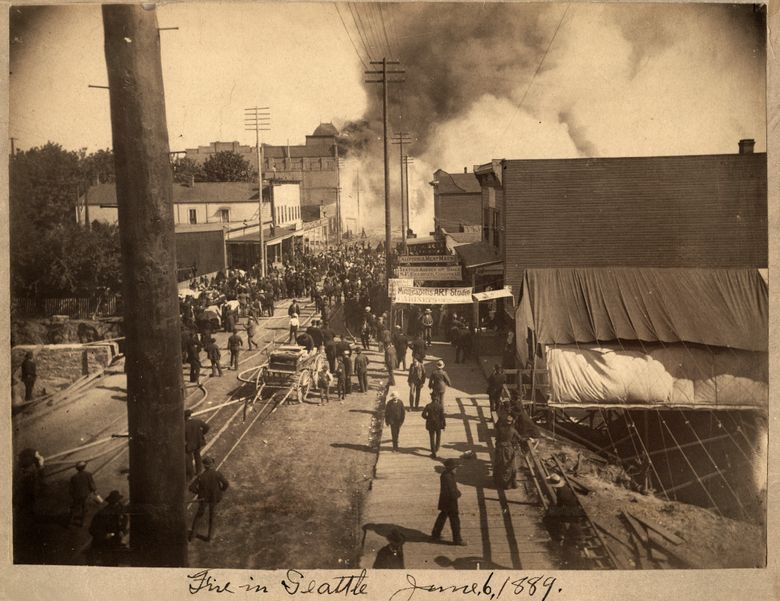
While the whole world discusses the Allied Invasion of Normandy, best known as D-Day, on this same date, fifty-five years prior, the Great Seattle Fire destroyed 29 city blocks, nearly all of its wharves and its railroad terminals. Because of the devastation, downtown Seattle is 20 feet above its original street level. The state of Washington suffered a trifecta of fires that summer as July 4th brought the Great Ellensburg Fire and August 4 brought the Great Spokane Fire, with a fourth fire occurring April 18 in Cheney, Washington.
At approximately 2:30 pm on June 6, 1889, an accidentally overturned glue pot in a carpentry shop started the most destructive fire in the history of Seattle. The next day, the Seattle Post-Intelligencer, operating out of temporary facilities in the wake of the fire, reported, incorrectly, that the incident began in “Jim McGough’s paint shop, under Smith’s Boot and Shoe Store, at the corner of Front and Madison streets, in what was known as the Denny block.” [A] correction two weeks later said that it “actually started in the Clairmont and Company cabinet shop, below McGough’s shop in the basement of the Pontius building.” but, the original error was often repeated, including in Murray Morgan‘s bestselling Seattle history book Skid Road (1951).
[…] a man named John E. Back, inadvertently, started a fire in the basement of a downtown building at the southwest corner of Madison Street and Front Street (later renamed 1st Avenue). Five men were working in the cabinet shop including […] Back, age 24, described as a “short, thick-set blonde of mediocre intelligence.” [He] arrived in the United States from Sweden in 1887 and moved to Seattle in October 1888. The following day [he] was located and interviewed by a Post-Intelligencer reporter. […] shortly after the interview, [he] left Seattle.
British poet Rudyard Kipling happened to be touring Puget Sound at the time and arrived in Seattle by steamer shortly after the fire. He described the remains as “a horrible black smudge, as though a Hand had come down and rubbed the place smooth. I know, now, what being wiped out means.”
The spring of 1889 in Seattle had been beautiful. There had been little rain and temperatures were consistently in the 70s. Unfortunately, the unusually good weather proved to be disastrous, as the dry conditions conspired with a handful of other elements to allow for the worst fire in city history.
[…] John Back was heating glue over a gasoline fire. Sometime after 2:15p, the glue boiled over, caught fire and, spread to the floors, which were covered by wood chips and turpentine. He tried to put the fire out with water but, that only served to thin the turpentine and spread the fire further. Everyone got out of the building safely and the fire department got to the fire by 2:45p. By that time, there was so much smoke that it was hard to find the source of the fire and by the time it was found, the fire was out of control. The fire quickly spread to the Dietz & Mayer Liquor Store, which exploded […].
Photo Credit: seattlepi.com
Seattle’s water supply proved to be a major problem in fighting the fire. Firemen tried to keep the fire from spreading further by pumping water from Elliott Bay onto the Commercial Mill but, the tide was out and the hoses were not long enough to reach the side of the building closest to the fire. To add insult to injury, crowds harassed the fire fighters as the water pressure fell.
The fire burned until 3:00 am. When it was done, the damage was enormous. Thousands of people were displaced and 5,000 men lost their jobs. The city didn’t take much time to mourn. Within a month of the fire over 100 businesses were operating out of tents. Instead of relocating, most businesses decided to rebuild where they had been and rebuilding began almost immediately. Within a year, 465 buildings had been built, most of the reconstruction was complete and the businesses had reopened.
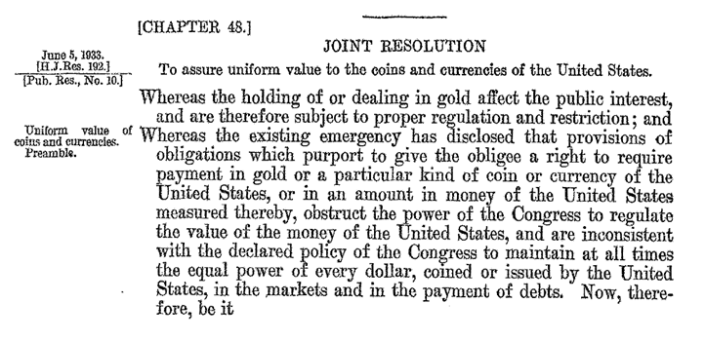
On June 5, 1933, the United States went off the gold standard, a monetary system in which currency is backed by gold, when Congress enacted a joint resolution nullifying the right of creditors to demand payment in gold. The United States had been on a gold standard since 1879 […] but, bank failures during the Great Depression of the 1930s frightened the public into hoarding gold […].
Soon after taking office in March 1933, Roosevelt declared a nationwide bank moratorium in order to prevent a run on the banks by consumers lacking confidence in the economy. He also forbade banks to pay out gold or to export it. According to Keynesian economic theory, one of the best ways to fight off an economic downturn is to inflate the money supply. And, increasing the amount of gold held by the Federal Reserve would in turn increase its power to inflate the money supply. Facing similar pressures, Britain had dropped the gold standard in 1931 and Roosevelt had taken note.
On April 5, 1933, Roosevelt ordered all gold coins and gold certificates in denominations of more than $100 turned in for other money. It required all persons to deliver all gold […] owned by them to the Federal Reserve by May 1 for the set price of $20.67 per ounce. In 1934, the government price of gold was increased to $35 per ounce, effectively increasing the gold on the Federal Reserve’s balance sheets by 69 percent. This increase in assets allowed the Federal Reserve to further inflate the money supply.
After the bombing of Pearl Harbor, President Franklin D. Roosevelt called Dec. 7, 1941, “A date that will live in infamy.” When it comes to the US monetary system, June 5, 1933, should share that ignoble title because that date marks the beginning of a slow death of the dollar.
Roosevelt signed Executive Order 6102 […] touted as a measure to stop hoarding but, was, in reality, a massive confiscation scheme. Even in the heat of Roosevelt’s confiscation scheme, government troops did not break into people’s homes… Ironically, all the gold actually collected by the Treasury was willfully surrendered in a wave of misguided patriotism, while many ‘law-breakers’ simply kept their gold.
The purpose of Roosevelt’s executive order was to remove constraints on inflating the money supply. The Federal Reserve Act required all notes have 40% gold backing [but], the Fed was low on gold and up against the limit. By increasing its gold stores, the Fed could circulate more notes.
Roosevelt’s [actions] in 1933 set off a dollar devaluation that continues to this day. In 1913, prices were only about 20% higher than in 1775 and around 40% lower than in 1813, during the War of 1812. Whatever the mandates of the Federal Reserve, it is clear that the evolution of the price level in the United States is dominated by the abandonment of the gold standard in 1933 and the adoption of fiat money, subsequently. One hundred years after its creation, consumer prices are about 30 times higher than what they were in 1913.
In 1964, the minimum wage stood at $1.25. To put it another way, a minimum wage worker earned five silver quarters for every hour worked. Today, you can’t even buy a cup of coffee with those five quarters [but], the melt-value of those five silver quarters, today, stands close to $15! Roosevelt’s moves, culminating in the June 5 congressional resolutions, initiated a process of monetary deformation that led straight to Nixon’s abomination at Camp David, Greenspan’s panic at the time of the 1998 Long-Term Capital Management crisis and, the final destruction of monetary integrity and financial discipline during the BlackBerry Panic of 2008.
The legacy of June 5, 1933 continues today. The dollar continues to devalue. That means over the long-term, the price of gold in US dollars will almost certainly continue to rise.
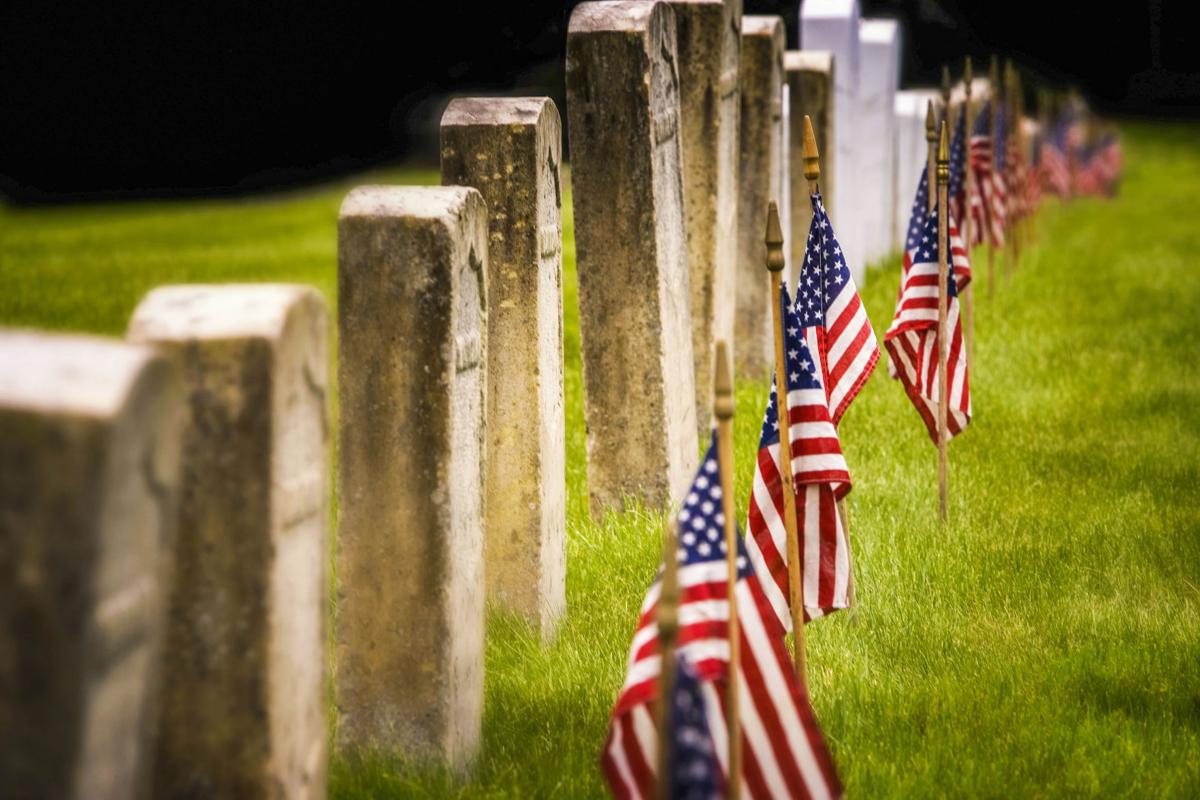
Memorial Day, as celebrated, has come and gone. The weekend BBQs and party gatherings are over. Some folks have returned to work after their Monday off while others took the entire week off and, possibly, headed to the beach to herald the “summer season”. I am posting, today, because from 1868 to 1970, Memorial Day was observed on May 30.
So, what IS the origin of our Memorial Day? That’s a good question and the following took two days to research.
May we remember them, ALL. ~Vic
Warrenton, Virginia 1861
A newspaper article from the Richmond Times-Dispatch in 1906 reflects Warrenton‘s claims that the first Confederate Memorial Day was June 3, 1861…the location of the first Civil War soldier’s grave ever to be decorated.
Arlington Heights, Virginia 1862
On April 16, 1862, some ladies and a chaplain from Michigan […] proposed gathering some flowers and laying them on the graves of the Michigan soldiers that day. They did so and the next year, they decorated the same graves.
Savannah, Georgia 1862
Women in Savannah decorated soldiers’ graves on July 21, 1862 according the the Savannah Republican.
Gettysburg, Pennsylvania 1863
The November 19, 1863, cemetery dedication at Gettysburg was a ceremony of commemoration at the graves of dead soldiers. Some have, therefore, claimed that President Abraham Lincoln was the founder of Memorial Day.
Jackson, Mississippi 1865
The incident in Mrs. [Sue Landon Adams] Vaughan’s life, which assured her name a permanent place in history, occurred at Jackson […] when she founded Decoration Day by first decorating the graves of Confederate and Federal soldiers alike, in a Jackson cemetery on April 26, 1865.
Kingston, Georgia 1865
An historic road-side marker indicates Kingston as the location of the “First Decoration, or Memorial Day” (Late April 1865).
Columbus, Georgia 1866
To the State of Georgia belongs the credit of having inaugurated what has since become the universal custom of decorating annually the graves of the heroic dead. The initial ceremonies which ushered Memorial Day into life were held in Linnwood Cemetery, at Columbus, on April 26, 1866.
Memphis, Tennessee 1866
Yesterday was the day appointed throughout the South as a day of sweet remembrance for our brothers who now sleep their last long sleep, the sleep of death. That day (the 26th day of April) has, and will be, set apart, annually, as a day to be commemorated by all the purely Southern people in the country, as that upon which we are to lay aside our usual vocations of life and, devote to the memory of our friends, brothers, husbands and sons, who have fallen in our late struggle for Southern independence.
Carbondale, Illinois 1866
A stone marker in Carbondale claims that place as the location of the first Decoration Day, honoring the Union soldiers buried there. General John A. Logan, who would later become commander-in-chief of the Grand Army of the Republic, the largest of the Union veterans’ organizations, officiated at the ceremony (April 29, 1866).
Richmond, Virginia 1866
The anniversary of the death of Stonewall Jackson was observed to-day by floral decorations of the graves of Confederate soldiers at Hollywood and Oakwood (May 10, 1866).
May 3, 1866 [they] formed the Ladies’ Hollywood Memorial Association, with the immediate aim of caring for and commemorating the graves of Confederate soldiers. All disposed to co-operate with us will repair, in such groups and at such hours as may be convenient, on Thursday, May 31st, 1866, to Hollywood Cemetery, to mark, by every appropriate means in our power, our sense of the heroic services and sacrifices of those who were dear to us in life and we honored in death.
Petersburg, Virginia 1866
It was in May of this year, 1866, that we inaugurated, in Petersburg, the custom, now universal, of decorating the graves of those who fell in the Civil War. Our intention was simply to lay a token of our gratitude and affection upon the graves of the brave citizens who fell June 9, 1864, in defence of Petersburg…
Dinner on the grounds is not a phrase I hear these days. Just reading the phrase takes me back to those times with my grandmother at her church on […] Decoration Day Sunday. I grew up in north Alabama in the 1960s. Dinner on the grounds was a special occasion that followed the work of cleaning up the graveyard and placing fresh flowers beside the headstones. It provided a time to remember and celebrate the lives of the dear departed. ~Betsy Sanders
Today, we are here to eat, remember and bask in the Southern fascination of death […]. It’s Decoration Day. The South claims death with as much loyalty as we claim our children. J.T. Lowery, a former pastor […] misses when Decoration Day meant keeping company with headstones during dinner on the ground. Opal Flannigan is depending on women […] to uphold a tradition so old it’s hard to say when it emerged. German and Scots-Irish immigrants who birthed much of the Southern Appalachia’s culture in Virginia, Tennessee and the Carolinas likely brought these traditions [with them]. ~Jennifer Crossley Howard
Many rural community cemeteries in western North Carolina hold “decorations.” A decoration is a religious service in the cemetery when people decorate graves to pay respect to the dead. The group assembles at outdoor tables, sometime in an outdoor pavilion, for the ritual “dinner on the ground.” There are variations of this pattern but, the overall pattern is fairly consistent.
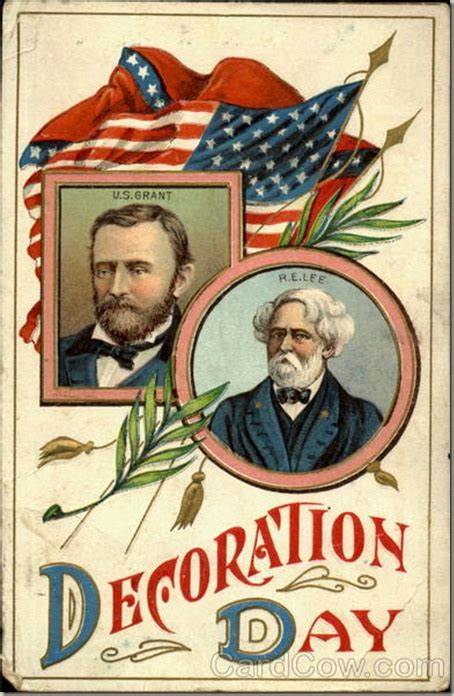
By proclamation of General John A. Logan of the Grand Army of the Republic, the first major Memorial Day observance is held to honor those who died “in defense of their country during the late rebellion.” Known to some as “Decoration Day,” mourners honored the Civil War dead by decorating their graves with flowers. On the first Decoration Day, General James Garfield made a speech at Arlington National Cemetery, after which 5,000 participants helped to decorate the graves of the more than 20,000 Union and Confederate soldiers buried in the cemetery.
The 1868 celebration was inspired by local observances that had taken place in various locations in the three years since the end of the Civil War. In fact, several cities claim to be the birthplace of Memorial Day, including Columbus, Mississippi; Macon, Georgia; Richmond, Virginia; Boalsburg, Pennsylvania; and Carbondale, Illinois. In 1966, the federal government, under the direction of President Lyndon B. Johnson, declared Waterloo, New York, the official birthplace of Memorial Day. They chose Waterloo, which had first celebrated the day on May 5, 1866, because the town had made Memorial Day an annual, community-wide event, during which businesses closed and, residents decorated the graves of soldiers with flowers and flags.
A vignette of a bar-room/liquor-store in the West [with] no plot, per se. However, this short is usually regarded as the first “Western” in the sense that it depicts a western scene.
Shows tap room of the “Miners Arms”, stout lady at the bar and three men playing stud horse. Old toper with a silk hat asleep by the stove. Rough miner enters, bar maid serves him with Red Eye Whiskey and he proceeds to clean out the place. Barmaid takes a hand with a siphon of vichy and, bounces the intruder with the help of the card players, who line up before the bar and take copious drinks on the house.
An actual Cripple Creek, Colorado, bar.
Photo Credit: silentology.wordpress.com & pinterest.com
So the film’s supposed to be set in one of the rough mining towns that were part of the Wild West. Also, it was definitely named “Cripple Creek” for a reason. Cripple Creek, Colorado, was a real-life ranch town that experienced a major gold rush in the late 19th century. In 1890, Robert Miller Womack struck gold and, six years later, the town had swelled from a mere 500 souls to well over 30,000 gold-fevered prospectors. All in all, something in the range of a half-billion dollars worth of gold would be extracted from the area.
The Black Maria was completed in early 1893 in West Orange, NJ and, when Edison built a new, rooftop movie studio in New York City, it ceased operation in January 1901. It was torn down in 1903.
One of four Admiral-class battlecruisers ordered in mid-1916, [she was] commissioned in 1920 [and] named after 18th-century Admiral Samuel Hood. Despite the appearance of new and, more modern ship designs over time, Hood remained the largest and most powerful warship in the world for 20 years after her commissioning. […] her prestige was reflected in her nickname, “The Mighty Hood”. She was scheduled to undergo a major rebuild in 1941 to correct [some] issues but, the outbreak of World War II in September 1939 forced the ship into service without the upgrades.
In May, [she and] the battleshipPrince of Wales were ordered to intercept the German battleship Bismarck and, the heavy cruiserPrinz Eugen, which were en route to the Atlantic where they were to attack convoys. When Bismarck sailed for the Atlantic […], Hood, together with […] Prince of Wales, was sent out in pursuit along with several other groups of British capital ships to intercept the German ships before they could break into the Atlantic […]. Hood was commanded by Captain Ralph Kerr and was flying the flag of Vice-Admiral Lancelot Holland. The German ships were spotted by two British heavy cruisers (Norfolk & Suffolk) on 23 May and Holland‘s ships intercepted Bismarck, and her consort, Prinz Eugen, in the Denmark Strait between Greenland and Iceland.
Bismarck
Image Credit: pinterest.com
On 24 May 1941, early in the Battle of the Denmark Strait, less than 10 minutes after the British opened fire, a shell from Bismarck struck Hood near her aft ammunition magazines. Soon afterwards, Hood exploded and sank within three minutes, with the loss of all but three of her crew. Prince of Wales continued to exchange fire with Bismarck but, suffered serious malfunctions in her main armament. The British battleship had only just been completed in late March 1941 and used new quadruple gun turrets that were unreliable. [She] soon broke off the engagement.
Due to [the] perceived invincibility of the Hood, the loss affected British morale.
On this day in 1941, Germany’s largest battleship, the Bismarck, sinks the pride of the British fleet, HMS Hood.
The Bismarck was the most modern of Germany’s battleships, a prize coveted by other nation’s navies, even while still in the blueprint stage (Hitler handed over a copy of its blueprints to Joseph Stalin as a concession during the days of the Hitler-Stalin Neutrality Pact). The HMS Hood, originally launched in 1918, was Britain’s largest battlecruiser (41,200 tons) but, also capable of achieving the relatively fast speed of 31 knots. The two met in the North Atlantic, northeast of Iceland, where two British cruisers had tracked down the Bismarck. Commanded by Admiral Gunther Lutjens, Commander-in-Chief of the German Fleet, the Bismarck sunk the Hood, resulting in the death of 1,500 of its crew. Only three Brits survived. Captain Kerr was one of the casualties.
During the engagement, the Bismarck‘s fuel tank was damaged. Lutjens tried to make for the French coast but, was sighted, again, only three days later. Torpedoed to the point of incapacity, the Bismarck was finally sunk by a ring of British war ships. Admiral Lutjens was one of the 2,300 German casualties.
Having grown up listening to Johnny Horton, one of my favorite songs of his is, of course, Sink the Bismarck, released in 1960 (a #1 single in Canada). ~Vic
Lyrics In May of 1941 the war had just begun
The Germans had the biggest ship that had the biggest guns
The Bismarck was the fastest ship that ever sailed the sea
On her decks were guns as big as steers and shells as big as trees
Out of the cold and foggy night came the British ship the Hood
And every British seaman he knew and understood
They had to sink the Bismarck the terror of the sea
Stop those guns as big as steers and those shells as big as trees
We’ll find the German battleship that’s makin’ such a fuss
We gotta sink the Bismarck ’cause the world depends on us
Yeah hit the decks a runnin’ boys and spin those guns around
When we find the Bismarck we gotta cut her down
The Hood found the Bismarck and on that fatal day
The Bismarck started firing fifteen miles away
We gotta sink the Bismarck was the battle sound
But when the smoke had cleared away the mighty Hood went down
For six long days and weary nights they tried to find her trail
Churchill told the people put every ship asail
Cause somewhere on that ocean I know she’s gotta be
We gotta sink the Bismarck to the bottom of the sea
We’ll find the German battleship that’s makin’ such a fuss
We gotta sink the Bismarck ’cause the world depends on us
Yeah hit the decks a runnin’ boys and spin those guns around
When we find the Bismarck we gotta cut her down
The fog was gone the seventh day and they saw the morning sun
Ten hours away from homeland the Bismarck made its run
The Admiral of the British fleet said turn those bows around
We found that German battleship and we’re gonna cut her down
The British guns were aimed and the shells were coming fast
The first shell hit the Bismarck they knew she couldn’t last
That mighty German battleship is just a memory
Sink the Bismarck was the battle cry that shook the seven seas
We found the German battleship ’twas makin’ such a fuss
We had to sink the Bismarck cause the world depends on us
We hit the deck a runnin’ and we and spun those guns around
Yeah we found the mighty Bismarck and then we cut her down
We found the German battleship ’twas makin’ such a fuss
We had to sink the Bismarck cause the world depends on us
We hit the deck a runnin’ and we and spun those guns around
We found the mighty Bismarck and then we cut her down
Yes. He’s dead…by his own admission. I heard him say he was born in 1735 when addressing his tour subjects. He was pleased that I wished to photograph him. I guess the lantern adds to the spookiness.
The town I live in is haunted…in some places. It’s pretty common knowledge. It is an old town. During the summer, there are ghost tours. I’m not kidding. I might take a tour one day. ~Vic
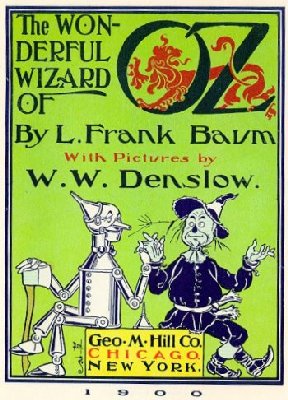
The story chronicles the adventures of a young farm girl named Dorothy in the magical Land of Oz after she and her pet dog Toto are swept away from their Kansas home by a cyclone.
The book is one of the best-known stories in American literature and has been widely translated. The Library of Congress has declared it “America’s greatest and best-loved homegrown fairytale.” Its groundbreaking success and the success of the Broadway musical adapted from the novel led Baum to write thirteen additional Oz books that serve as official sequels to the first story.
Baum dedicated the book “to my good friend & comrade, My Wife,” Maud Gage Baum. In January 1901, George M. Hill Company completed printing the first edition, a total of 10,000 copies, which quickly sold out. It sold three million copies by the time it entered the public domain in 1956.
Image Credit: wikipedia.org
The Wonderful Wizard of Oz is considered the first American fairy tale because of its references to clear American locations such as Kansas and Omaha. Baum agreed with authors such as Carroll that fantasy literature was important for children, along with numerous illustrations but, he also wanted to create a story that had recognizable American elements in it such as farming and industrialization. Baum did not offer any conclusive proof that he intended his novel to be a political allegory.
The Wonderful Wizard of Oz has become an established part of multiple cultures, spreading from its early young American readership to becoming known throughout the world. It has been translated or adapted into well over fifty languages, at times being modified in local variations. For instance, in some abridged Indian editions, the Tin Woodman was replaced with a horse. In Russia, a translation by Alexander Melentyevich Volkov produced six books, The Wizard of the Emerald City series, which became progressively distanced from the Baum version, as Ellie and her dog Totoshka travel throughout the Magic Land. More recently, the story has become an American stage production (The Wiz) with an all-black cast, set in the context of modern African-American culture.
Here in North Carolina, we have the Land of Oz at Beech Mountain. I went there in 1973 with my parents and, again, in 2017. ~Vic














 Cosmic-Observation