Movies
Movie Monday: Cripple Creek Bar Room Scene 1899

Photo Credit: pinterest.com
One-hundred, twenty years ago, in May, Edison’s Black Maria Studio, considered to be the first movie studio in America, produced the short, non-actuality film Cripple Creek Bar-Room Scene.
An IMDB Summary:
A vignette of a bar-room/liquor-store in the West [with] no plot, per se. However, this short is usually regarded as the first “Western” in the sense that it depicts a western scene.
The film lasted one minute, had no action and the role of a barmaid was played by a man.
Summary From The Library of Congress:
Shows tap room of the “Miners Arms”, stout lady at the bar and three men playing stud horse. Old toper with a silk hat asleep by the stove. Rough miner enters, bar maid serves him with Red Eye Whiskey and he proceeds to clean out the place. Barmaid takes a hand with a siphon of vichy and, bounces the intruder with the help of the card players, who line up before the bar and take copious drinks on the house.

Photo Credit: silentology.wordpress.com & pinterest.com
From Silentology:
So the film’s supposed to be set in one of the rough mining towns that were part of the Wild West. Also, it was definitely named “Cripple Creek” for a reason. Cripple Creek, Colorado, was a real-life ranch town that experienced a major gold rush in the late 19th century. In 1890, Robert Miller Womack struck gold and, six years later, the town had swelled from a mere 500 souls to well over 30,000 gold-fevered prospectors. All in all, something in the range of a half-billion dollars worth of gold would be extracted from the area.
The Black Maria was completed in early 1893 in West Orange, NJ and, when Edison built a new, rooftop movie studio in New York City, it ceased operation in January 1901. It was torn down in 1903.
Movie Monday: Eugen Sandow 1894

Specific dates are a little hard to come by but, one-hundred, twenty-five years ago in May, Edison Studios produced three silent actuality films of German bodybuilder Eugen Sandow (born Friedrich Wilhelm Müller). It was directed by Scottish mutoscope inventor, photographer and Edison employee William K. L. Dickson.
From Wikipedia:
Florenz Ziegfeld wanted to display Sandow at the 1893 World’s Columbian Exposition in Chicago. Ziegfeld found that the audience was more fascinated by Sandow’s bulging muscles than by the amount of weight he was lifting so, Ziegfeld had Sandow move in poses which he dubbed “muscle display performances”…and the legendary strongman added these displays in addition to performing his feats of strength with barbells. He added chain-around-the-chest breaking and other colorful displays to Sandow’s routine and Sandow quickly became Ziegfeld’s first star. The [Edison] film was of only part of his act and featured him flexing his muscles rather than performing any feats of physical strength.

From Film Threat:
Did you ever stop and say to yourself: “Hey, who was the very first movie star?” You never did? That’s funny, because I did. In researching the answer, I found myself going all the way back to the dawn of motion pictures, where a scantily clad muscleman flexing his biceps was the unlikely pioneer in the realm of celluloid stardom. The year was 1894 and the American motion picture industry consisted solely of Thomas Edison and his team of inventors. Edison had the technology in place but, he was missing one key element: the film contents. […] there was one man who had no problem filling that void. In between the expected presentations for feats of strength, there were posing sequences where Sandow arched and twisted his body in a manner that detailed the excesses of his musculature. Today, we call that bodybuilding, and no one thinks twice about it but, in the 1890s, it was a startling and exciting physical display. Reportedly, Sandow made a nice side business by accepting money from women who wanted to feel his mighty muscles! Sandow’s fame in the United States grew fairly quickly and he became a major headliner on the vaudeville circuit. Edison realized he could also cash in on Sandow’s fame and, in early 1894, he sent word to Ziegfeld about having Sandow appear in a kinetoscope film. Edison then handed Sandow over to William K.L. Dickson, who was in charge of the film production at Edison’s studio. Sandow stripped off his clothing, donned his tighty-whitey posing trunks and stood before the hand-cranked kinetoscope camera. And, to employ the ultimate cliché, history was made.
Movie Monday: Leisurely Pedestrians 1889

I am going WAY back this time…back to the days of moving pictures and short films. Sticking with my five year increments, one-hundred & thirty years ago, William Friese-Greene, an English inventor, and professional photographer, shot a silent, actuality film in the Autumn of 1889. It was titled Leisurely Pedestrians, Open Topped Buses and Hansom Cabs with Trotting Horses.
From Wikipedia:
[…] shot by inventor and film pioneer William Friese-Greene on celluloid film using his ‘machine’ camera, the 20 feet of film […] was shot […] at Apsley Gate, Hyde Park, London. [It] was claimed to be the first motion picture [but] Louis Le Prince successfully shot on glass plate before 18 August 1887 and on paper negative in October 1888. It may, nonetheless, be the first moving picture film on celluloid and the first shot in London.
It is now considered a lost film with no known surviving prints and only one possible still image extant.

An article in This Is Bristol UK from December 17, 2009, (via The Wayback Machine) has an interview with David Friese-Greene, the great-grandson. From the article:
My great-grandfather was an idealist and a brilliant inventor, with 71 patents to his name but, he was a dreadful businessman. He died without ever having made a penny out of his inventions. He married his first wife Helena Friese when he was just 19 and incorporated her surname with his, because he felt it sounded more impressive. Tragically, Helena died at the age of 21 […].
It was during the late 1880s, shortly after Helena’s death, that Friese-Greene first began to experiment with the idea of creating moving pictures. […] in 1890, he patented [a] new device, which he dubbed the chronophotographic camera. Unfortunately, he was so pleased with his creation that, he wrote to the great American inventor, Thomas Edison, telling him what he had come up with and, even, included plans and designs […]. William never heard back from the inventor of the electric light bulb, though, the following year, Edison patented his own version of a movie camera and went down in many history books as the inventor of cinema.
In fact, William died a pauper but, [was] still passionate about his most famous creation. He was at a cinema industry meeting in London, which had been called to discuss the poor state of the British film industry in 1921. He had got to his feet to speak about his vision of how film could be used to create educational documentaries when he fell down dead. It is said he had just 21 pence in his pockets when he died.
In 1951, the movie The Magic Box was released. Starring Robert Donat, it was a biographical piece about Friese-Greene’s life.
There is additional information on this WordPress blog: William Friese-Greene & Me
Movie Monday: The Other Woman 2014

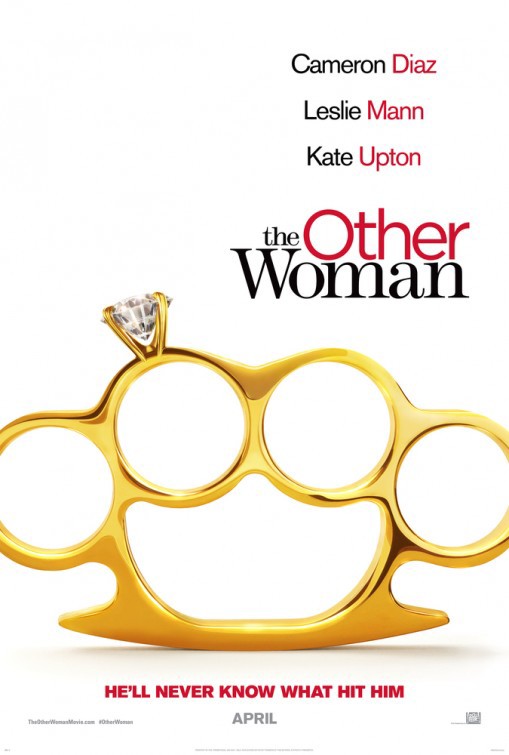
Five years ago, today, the #1 movie at the box office was The Other Woman, a comedy starring Cameron Diaz, Leslie Mann, Nikolaj Coster-Waldau, Don Johnson, Kate Upton, Taylor Kinney and Nicki Minaj. Released April 25, it was directed by Nick Cassavetes (the son of John Cassavetes & Gena Rowlands). Melissa Stack was hired to write a screenplay that was based on the 1996 movie The First Wives Club.
After discovering her boyfriend is married, Carly Whitten tries to get her ruined life back on track. But, when she accidentally meets the wife he’s been cheating on, she realizes they have much in common and her sworn enemy becomes her greatest friend. When yet another affair is discovered, all three women team up to plot mutual revenge on their cheating, lying, three-timing SOB.
Quotes
From Justin Chang (Variety):
[…] an ungainly, often flat-footed yet weirdly compelling romantic dramedy about two gals who become unlikely best friends when they realize they’re being screwed (literally) by the same man. Like a watered-down “Diabolique” or a younger-skewing “First Wives Club,” this latest mainstream rebound from director Nick Cassavetes taps into the pleasures of sisterly solidarity and righteous revenge. Beneath the wobbly pratfalls and the scatological set pieces, there’s no denying the film’s mean-spirited kick, or its more-than-passing interest in what makes its women tick.
From Todd McCarthy (The Hollywood Reporter):
A female solidarity adultery comedy that’s three parts embarrassing farce to one part genuinely comic discharge.
From Christy Lemire (Roger Ebert):
Trouble is, Cassavetes, working from a script by Melissa K. Stack, veers wildly between cautionary tale, revenge comedy, scatological raunchfest and female empowerment drama. In theory, the joy of watching this kind of movie comes from seeing such a smooth operator squirm as his schemes are revealed and destroyed. […] plot contrivances abound […], along with not one but, two instances of characters, um, graphically relieving themselves at inopportune moments. The joke isn’t funny the first time and this kind of gross-out strain of comedy clangs uncomfortably with the feel-good message […]. Any semblance of intelligent humor or insight into female aging that may have existed gets tossed out the window of Carly’s high-rise office by the end […]
There are, literally, NO good trivia bits for this movie. ~Vic
Movie Monday: 17 Again 2009

Ten years ago, today, the #1 movie at the box office was 17 Again, a comedy starring Zac Efron, Matthew Perry, Leslie Mann, Thomas Lennon, Michelle Trachtenberg, Jim Gaffigan, Margaret Cho & Melora Hardin. Released April 17, it was directed by Burr Steers (Gore Vidal‘s nephew).

At 17 Mike O’Donnell is on top of the world: he’s the star of his high school basketball team, is a shoo-in for a college scholarship, and is dating his soul-mate, Scarlet. But, at what’s supposed to be his big game where a college scout is checking him out, Scarlet reveals that she’s pregnant. Mike decides to leave the game and asks Scarlet to marry him, which she does. During their marriage, Mike can only whine about the life he lost because he married her so, she throws him out. When he also loses his job, he returns to the only place he’s happy at, his old high school. While looking at his high school photo, a janitor asks him if he wishes he could be 17 again and he says yes. One night while driving he sees the janitor on a bridge ready to jump and goes after him. When he returns to his friend Ned’s house, where he has been staying, he sees that he is 17 again. He decides to take this opportunity to get the life he lost.
Trivia Bits:
♦ Visual effects were not used when Zac Efron does the basketball tricks during the cafeteria scene. He really did accomplish them on his own.
♦ This is a remake of the 1986 Disney TV movie “Young Again” starring a very young Keanu Reeves in one of his earliest roles.
♦ In one scene, Mike wakes up and begins describing his “dream” of being in high school again only to find his daughter, Maggie, caring for him. This is an homage to the counterpart scene in Back to the Future (1985), in which Marty McFly wakes up and finds his teen-aged mother caring for him.
Movie Monday: The Passion of The Christ 2004

Fifteen years ago, today, the #1 film at the box office was The Passion of the Christ, a biblical drama starring Jim Caviezel, Maia Morgenstern, Monica Bellucci, Claudia Gerini and Sergio Rubini. Directed by Mel Gibson, the screenplay was co-written by Gibson and Benedict Fitzgerald. Released February 25, it was based on The Passion of Jesus in the New Testament and Clemens Brentano‘s The Dolorous Passion of Our Lord Jesus Christ, the first volume of his records (notes) from conversations regarding meditations by Anne Catherine Emmerich, a canoness, mystic, visionary and stigmatist. John Debney was composer and cinematographer was Caleb Deschanel (father of Emily & Zooey Deschanel).
The Passion of the Christ focuses on the last twelve hours of Jesus of Nazareth’s life. The film begins in the Garden of Gethsemane where Jesus has gone to pray after sitting [at] the Last Supper. Jesus must resist the temptations of Satan. Betrayed by Judas Iscariot, Jesus is then arrested and taken within the city walls of Jerusalem where leaders of the Pharisees confront him with accusations of blasphemy and, his trial results in a condemnation to death.

Quotes
From Roger Ebert:
If ever there was a film with the correct title, that film is Mel Gibson’s “The Passion of the Christ.” The movie is 126 minutes long and, I would guess that at least 100 of those minutes, maybe more, are concerned, specifically and graphically, with the details of the torture and death of Jesus. This is the most violent film I have ever seen.
What Gibson has provided for me, for the first time in my life, is a visceral idea of what the Passion consisted of. That his film is superficial in terms of the surrounding message — that we get only a few passing references to the teachings of Jesus — is, I suppose, not the point. This is not a sermon or a homily but, a visualization of the central event in the Christian religion. Take it or leave it.
David Ansen, a critic I respect, finds in Newsweek that Gibson has gone too far. “The relentless gore is self-defeating,” he writes. “Instead of being moved by Christ’s suffering or awed by his sacrifice, I felt abused by a filmmaker intent on punishing an audience, for who knows what sins.” This is a completely valid response to the film, and I quote Ansen because I suspect he speaks for many audience members, who will enter the theater in a devout or spiritual mood and emerge deeply disturbed. You must be prepared for whippings, flayings, beatings, the crunch of bones, the agony of screams, the cruelty of the sadistic centurions, the rivulets of blood that crisscross every inch of Jesus’ body. Some will leave before the end.
*David Edelstein with Slate Magazine
* Jami Bernard with New York Daily News
Trivia Bits
♦ On February 11, 2008, Benedict Fitzgerald filed a lawsuit against Mel Gibson and the production company Icon Productions, alleging the unfair deprivation of compensation and deception on the overall expense of the film production budget after the blockbuster box office success of the film The Passion of the Christ, including, but not limited to, “fraud, breach of contract & unjust enrichment” seeking unspecified damages.
♦ Jim Caviezel experienced a shoulder separation when the 150lbs cross dropped on his shoulder. The scene is still in the movie.
♦ In an interview with Newsweek magazine, Jim Caviezel spoke about a few of the difficulties he experienced while filming. This included being accidentally whipped twice, which has left a 14-inch scar on his back. Caviezel also admitted he was struck by lightning while filming the Sermon on the Mount and during the crucifixion, experienced hypothermia during the dead of winter in Italy.
Nominations, Awards & Other Accolades
Movie Monday: The Matrix 1999

Twenty years ago, today, the #1 film at the box office was The Matrix, a science-fiction action film starring…Keanu Reeves, Laurence Fishburne, Carrie-Anne Moss, Hugo Weaving, Gloria Foster and Joe Pantoliano. Produced by Joel Silver, it was written and directed by The Wachowskis.
From Wikipedia:
[The movie] depicts a dystopian future in which humanity is unknowingly trapped inside a simulated reality called the Matrix, created by thought-capable machines (artificial beings) to control humans while using their bodies as an energy source. Hacker and computer programmer, Neo, learns this truth and “is drawn into a rebellion against the machines”, which involves other people who have been freed from the Matrix.
The film is an example of the cyberpunk subgenre. The Wachowskis’ approach to action scenes drew upon their admiration for Japanese animation and martial arts films and, the film’s use of fight choreographers and wire fu techniques from Hong Kong action cinema, influenced subsequent Hollywood action film productions. The Matrix is known for popularizing a visual effect known as “bullet time“, in which the heightened perception of certain characters is represented by allowing the action within a shot to progress in slow-motion while the camera’s viewpoint appears to move through the scene at normal speed. The film contains numerous allusions to philosophical and religious ideas, including existentialism, Marxism, feminism, Buddhism, nihilism and postmodernism.

Quotes
From Roger Ebert:
“The Matrix” is a visually dazzling cyberadventure, full of kinetic excitement but, it retreats to formula just when it’s getting interesting. It’s kind of a letdown when a movie begins by redefining the nature of reality and ends with a shoot-out. We want a leap of the imagination, not one of those obligatory climaxes with automatic weapons fire.
I’ve seen dozens if not hundreds of these exercises in violence, which recycle the same tired ideas: Bad guys fire thousands of rounds but, are unable to hit the good guy. Then, it’s down to the final showdown between good and evil…a martial arts battle in which the good guy gets pounded until he’s almost dead, before he finds the inner will to fight back. Been there, seen that (although rarely done this well).
“The Matrix” did not bore me. It interested me so much, indeed, that I wanted to be challenged even more. I wanted it to follow its material to audacious conclusions, to arrive not simply at victory but, at revelation.
From Darren Aronofsky:
“I walked out of The Matrix with Jared and I was thinking, ‘What kind of science fiction movie can people make now?'” Aronofsky says. “The Wachowskis basically took all the great sci-fi ideas of the 20th century and rolled them into a delicious pop culture sandwich that everyone on the planet devoured. Suddenly Philip K. Dick‘s ideas no longer seemed that fresh. Cyberpunk? Done.”
From M. Night Shyamalan:
[…] Mr. Shyamalan is not much of a cinema historian. Among the directors he admires are Peter Weir, Cameron Crowe, Alfred Hitchcock and the Wachowski Brothers. “Whatever you think of ‘The Matrix,’ every shot is there because of the passion they have! You can see they argued it out!”
Trivia Bits:
♦ For the cell phone conversation scene between Neo and Morpheus in the MetaCortex office, Keanu Reeves actually climbed up the window without a stuntman, which was 34 floors up.
♦ Will Smith was approached to play Neo but, turned down the offer in order to star in Wild Wild West (1999). He later admitted that, at the time, he was “not mature enough as an actor” and that, if given the role, he “would have messed it up”. He had no regrets, saying that “Keanu was brilliant as Neo.”
♦ In an online interview when the film was first released, the Wachowskis revealed that they’d both take the Blue Pill when given Neo’s choice.
♥ Four Academy Awards & Others
♥ More Awards & Nominations
Movie Monday: Major League II 1994
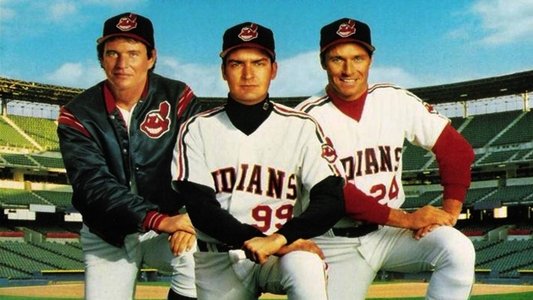
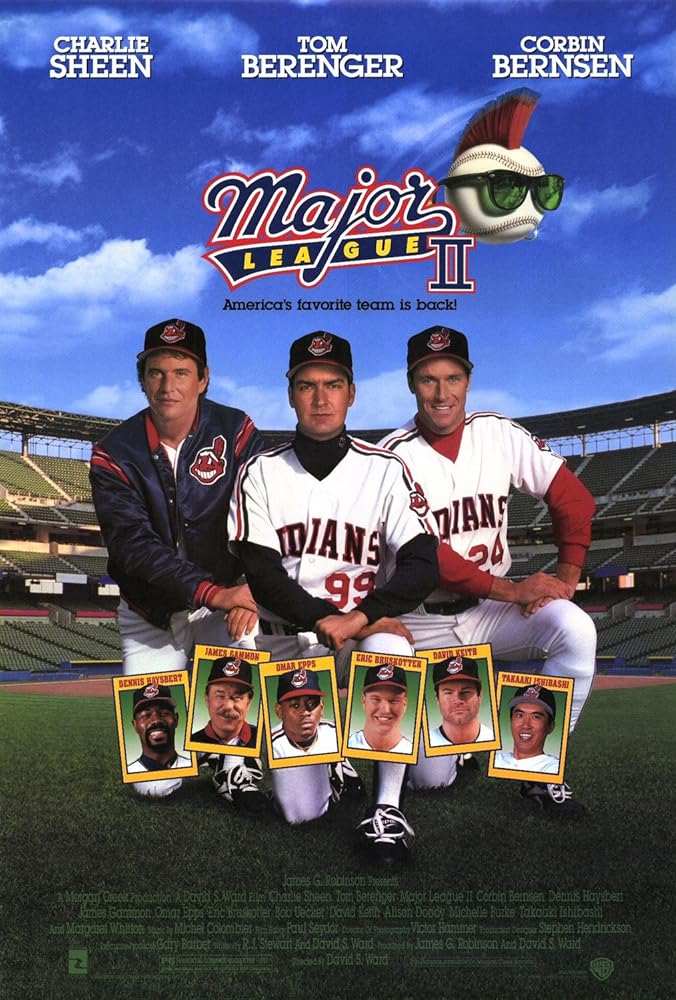
Twenty-five years ago, today, the #1 film at the box office was Major League II, a sports-comedy starring Charlie Sheen, Tom Berenger, Corbin Bernsen, Dennis Haysbert, James Gammon, Omar Epps, Alison Doody, David Keith, Bob Uecker, Jay Leno (as himself), Jesse Ventura (as himself), Randy Quaid (uncredited) and Rene Russo (uncredited). Released on March 30, it was a sequel to Major League (1989). David Ward directed both and most of the same cast remained. Omar Epps replaced Wesley Snipes in the role of Willie Mays Hayes.
After winning the division the previous year, the Cleveland Indians return the following season with a new-found confidence. Their previously ragtag players are now stars. Roger Dorn has gone from player to owner, removing the unhealthy management and influence of Rachel Phelps. New players have been contracted and the team roster looks stronger than ever. What could possibly go wrong?
Quote
From Peter Rainer (Los Angeles Times):
Except for the fact that it was a commercial hit, the 1989 baseball movie “Major League” was not the sort of film that cried out to be sequelized. But, a lot can happen in five years…for one thing, baseball movies seem to be hanging in there. So, here’s another go-round with the cloddy, come-from-behind Cleveland Indians sluggers who once again stumble in pursuit of the American League Eastern Division championship. Bob Uecker, as the Indians’ perpetually bedraggled play-by-play radio announcer, puts in another appearance, dressing down from his Liberace-like duds to a T-shirt as the Indians slide into the cellar. (His aghast expostulations are the film’s highlight.) We learn all sorts of homiletic life lessons about the value of sportsmanship and Being True to Yourself. Why do sports movies always have to devolve into civics lessons? To its credit, “Major League II” doesn’t go in for a lot of moony sentiment about America’s past-time but, it ends up tenderized anyway.
Trivia Bits:
♦ Opened the same weekend as D2:The Mighty Ducks, a sports comedy sequel which starred Charlie Sheen’s brother Emilio Estevez.
♦ In the outfield during their second game there is a sign that says “Emilio’s Repo Depot“. Charlie Sheen’s brother Emilio Estevez was in the movie Repo Man (1984).
♦ One of two films released in 1994 to feature the Chicago White Sox as the arch-rival team. The other was Angels In The Outfield.
Award
♠ Worst Sequel (David S. Ward & James G. Robinson/1994 The Stinkers Bad Movie Awards)
Nomination
♠ The Sequel Nobody Was Clamoring For (David S. Ward & James G. Robinson/1994 The Stinkers Bad Movie Awards)
Movie Monday: Fletch Lives 1989

Chevy Chase
Julianne Phillips
R. Lee Ermey
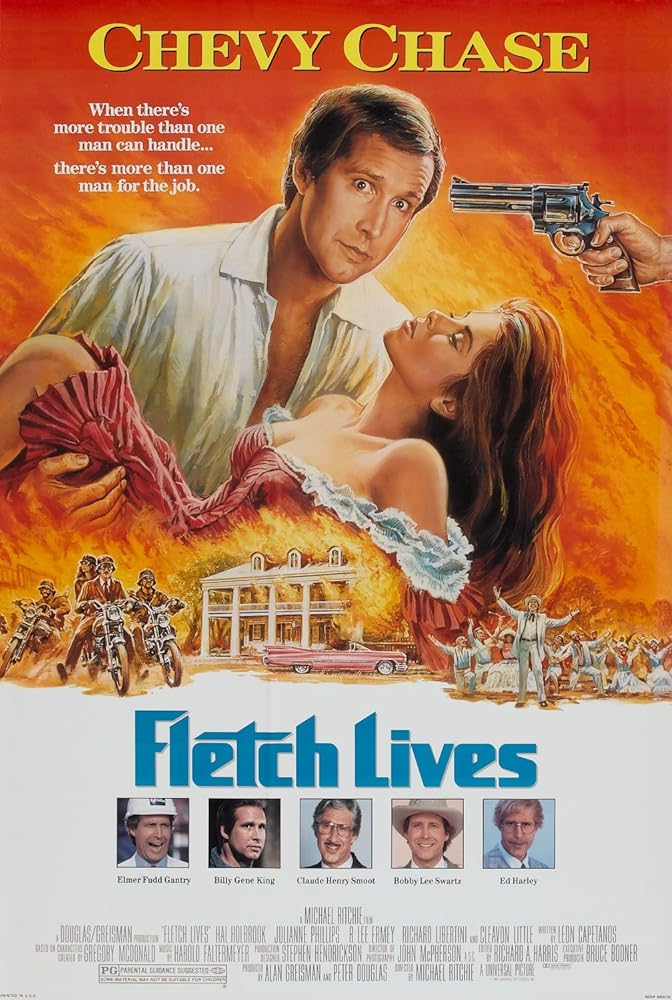
Thirty years ago, today, the #1 film at the box office was Fletch Lives, starring Chevy Chase, Hal Holbrook, Julianne Phillips, R. Lee Ermey, Richard Libertini, Randall ‘Tex’ Cobb, Cleavon Little, George Wyner, Patricia Kalember, Geoffrey Lewis, Richard Belzer, Phil Hartman and Noelle Beck. Released March 17, it was a sequel to Fletch (1985), a movie about an investigative reporter named Irwin Maurice “Fletch” Fletcher, a character created in 1974 by mystery writer Gregory McDonald. It was directed by Michael Ritchie with music by Harold Faltermeyer.
Fletch fans rejoice! The reckless I.M. Fletcher, investigative reporter, returns to the screen. This time, the chameleon-like reporter ventures to Belle Isle, a sprawling 80-acre Louisiana plantation which Fletch inherits from his aunt. Trouble begins when a lovely attorney mysteriously turns up dead, a neighborly lawyer warns him to leave town and a ravishing real estate agent comes calling with a persistent offer he may not be able to refuse. Fletch must unravel the reasons for the mad land scramble with his trademark bag of hilarious disguises.
Quotes
From Chris Willman:
[…] a movie with a hero whose every other line of dialogue is a snide wisecrack directed at a fool. In this meager sequel, as in its popular predecessor, Chevy Chase demolishes every easy target in sight with a quip of the tongue. Some of the lines are funny but, after a while, you just want to smack him. […] Chevy, who isn’t playing a character (least of all the character first created by novelist Gregory McDonald) so much as reprising his nonplussed, punchline-spouting “Weekend Update” anchor role. […] Ritchie lets sophomoric scatology predominate over satire at every turn and, […] the gags are more crass than corrosive. […] moviegoers might think twice about signing on as the film makers’ partners in put-down when they’re clearly also its targets. Beware: [the movie] may assume that all Southerners are dim bulbs but, it doesn’t think you’re so bright yourself.
From Roger Ebert:
[The movie] is one more dispirited slog through the rummage sale of movie clichés […] If you were writing a screenplay, would you think a movie involving […] pathetic clichés had the slightest chance of interesting anyone? Chase’s assignment is to bring an angle, an edge, to plot materials that are otherwise completely without interest. And it’s theoretically possible for that to happen […] But, Chase is wrong for this material because of the pose of detachment and indifference that he brings to so many roles. He seems to be visiting the plot as a benevolent but, indifferent outsider. […] sometimes he seems to be covering himself, playing detached so that nobody can blame him if the comedy doesn’t work. In this film he seems to have no emotions at all […] Chase is at arm’s length from the plot, making little asides and whimsical commentaries while his hapless supporting cast does what it can with underwritten roles. A mystery is concealed somewhere in the folds of the movie’s plot but, one that will not surprise anyone who has seen half a dozen other mysteries. The identity of the bad guy can be deduced by applying the Law of Character Economy, which states that the mystery villain is always the only character in the plot who seems otherwise unnecessary. It admittedly takes a little more thought than usual to apply the law in this case, since so many of the characters seem unnecessary.
Trivia Bits
♦ The original character from the novel was a Marine veteran.
♦ Though there were eight sequels, and prequels, written by Gregory McDonald that could have been used as the basis for the second “Fletch” movie at the time, Universal decided to write a completely new story.
♦ The last name of televangelist Jimmy Lee Farnsworth is the same as that of the widely acknowledged inventor of television, Philo T. Farnsworth.
Movie Monday: Splash 1984

“She was the woman of his dreams… she had large dark eyes, a beautiful smile and a great pair of fins.”
Thirty-five years ago, today, the #1 film at the box office was Splash, starring Tom Hanks, Daryl Hannah, Eugene Levy, John Candy, Dody Goodman, Shecky Greene, Rance Howard, Cheryl Howard, Clint Howard and Bill Smitrovich. A Rom-Com fantasy, it was directed by Ron Howard, produced by Brian Grazer and, the story was developed by Grazer and Bruce Jay Friedman. The screenplay was written by Lowell Ganz and Marc ‘Babaloo’ Mandel with music by Lee Holdridge.
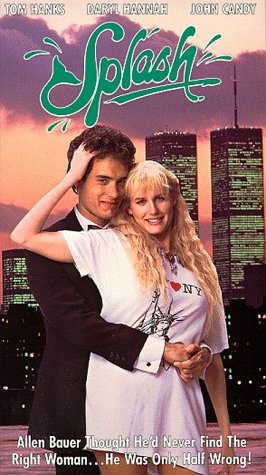
Alan [sic] Bauer nearly drowned as a child but, has memories of being saved by a young mermaid. He manages his family’s wholesale fruit and vegetable business and, continues his search to find true love. Along with his feelings, Allen must also contend with his womanizing older brother Freddie, who takes love less seriously than his brother. When he is jilted as an adult and loses his wallet in the surf, the young mermaid tries to return it. They are soul mates who have been meant for each other but, Madison fears how he will react when he finds out she is not human.
Quotes
From Brian Grazer:
“Tom came in wearing these 501 Levi’s and construction boots and a T-shirt. He wasn’t nervous at all – and here’s a guy who had never had a major movie. I thought, why is this guy so calm? But we read him and we liked him and we hired him right away.”
On Hannah’s abilities, Grazer states “[…] while we were testing Daryl [Hannah] in her tail underwater, we noticed how well she swam. Then we realized that she was as good, if not better, than her stunt doubles. Her endurance was actually better than theirs. We began wondering if Daryl couldn’t do all the scenes herself and she happily agreed, which certainly helped the movie’s credibility.
From Tom Hanks:
“They’re very, very funny guys (Candy & Levy). But my job in Splash was not to be particularly funny. That’s what Ron [Howard] kept drilling into me.”
Learning a valuable lesson from Howard, he recalls being unprepared…”It took longer to shoot than it should have, and when we were done with the scene, Ron said, “You know, you should have been a little more prepared.” He didn’t yell at me. He probably knew that if he had yelled, I’d be paste for the rest of the day. He just let me know in no uncertain terms that I was starring in this movie and with that comes huge responsibilities, and one of them is to be ready to go. I’ve never forgotten that.”
From Daryl Hannah:
[…] having to lie still for three hours every day for technicians to put her into the 35 lbs. rubber fin, she states “At lunch they’d yank me out on a crane and plop me on the deck. I couldn’t eat because I couldn’t go to the bathroom. I just lay there shivering with barnacles in my hair, soaking wet. And underwater it was difficult because I was not able to see since I couldn’t wear a mask. I had to trust the guys to get air to me. It was difficult and we worked long hours but, it seemed more like playing than work. It was real magical down there.”
Trivia Bits:
♦ This film was the first to be released by the new Touchstone Films.
♦ According to the Biography Channel, Bill Murray and P.J. Soles (Stripes) were considered for the roles of Allen and Madison, but Murray turned it down.
♦ Daryl Hannah swam with the mermaid tail so fast that her safety team could not keep pace with her.
♦ A vegetarian, Hannah refused to eat real lobster for the restaurant scene. The crew scooped out the insides of real, cooked lobsters and filled them with a thick, tofu-like paste. Ron Howard said [she] cried after each take over the deaths of the lobsters for their shells.
♦ Tom Hanks had trouble with the water scenes, partly because he was a smoker.
The movie received twelve nominations including the Academy Award for Best Original Screenplay and the Golden Globe for Best Motion Picture – Musical or Comedy. It won a National Society of Film Critics (NSFC) award for Best Screenplay and Daryl Hannah won the Saturn Award for Best Actress.
Love Came For Me Theme Song by Rita Coolidge
Wayback Wednesday: Lecherous Little Elf

Two days, ago, I posted my routine Movie Monday piece. For the date I chose, I highlighted Blazing Saddles, a #1 movie at that time and, when calculated in 1974, was the highest grossing movie of that year. The movie is laugh-out-loud funny and an absolute scream. That being said, in my comment section, it was dutifully pointed out that, in this day and age, the movie would never get made. I was provided with a link to a UK article from September 22, 2017. Here is the headline:
Our PC world is the death of comedy, says Mel Brooks: Veteran comedian claims society is ‘stupidly politically correct’ and that many of his films could not be made today
Quotes from the article:
‘We have become stupidly politically correct, which is the death of comedy,’ Brooks said.
‘It’s not good for comedy. Comedy has to walk a thin line, take risks.’
‘Comedy is the lecherous little elf whispering in the king’s ear, always telling the truth about human behaviour.’
He basically said the very same thing back in 2016.
This afternoon, while searching for a music video, I stumbled across The Dave Cullen Show. On Wednesday, August 16, 2017 he posted this:
On his other channel, he posted this back on September 15, 2015, which adds more films to the list:
Quote:
“If you take this film seriously, you missed the point.”
And, if you take my post seriously, you’re missing the point. ~Vic
Movie Monday: Blazing Saddles 1974

Forty-five years ago, today, the most popular film at the box office was Blazing Saddles, a satirical Mel Brooks-directed western starring Cleavon Little, Gene Wilder, Slim Pickens, Harvey Korman, Madeline Kahn, Mel Brooks (three on-screen characters), Alex Karras, David Huddleston, John Hillerman, Dom DeLuise, Count Basie (as himself), Rodney Allen Rippy (as a young Bart), with uncredited appearances by Anne Bancroft, Aneta Corsaut (Helen Crump) and Patrick Labyorteaux (JAG TV series). Released February 7, it was produced by Michael Hertzberg and based on a story by Andrew Bergman. Bergman collaborated with Brooks, Richard Pryor, Norman Steinberg and Al Uger to craft the screenplay and, John Morris (The Woman in Red & Dirty Dancing) was composer.
The Ultimate Western Spoof. A town where everyone seems to be named Johnson is in the way of the railroad. In order to grab their land, Hedley Lemar [sic] (Harvey Korman), a politically connected nasty person, sends in his henchmen to make the town unlivable. After the sheriff is killed, the town demands a new sheriff from the Governor (Mel Brooks). Hedley convinces him to send the town the first Black sheriff (Cleavon Little) in the west. Bart is a sophisticated urbanite who will have some difficulty winning over the townspeople.
Quotes:
From Vincent Canby (The New York Times):
“[…] comedies, like Mel Brooks’s “Blazing Saddles,” the best title of the year to date, are like Chinese food. A couple of hours later you wonder where it went. You wonder why you laughed as consistently as you did. [It] is every Western you’ve ever seen turned upside down and inside out, braced with a lot of low burlesque […]. The trouble is that [it] has no real center of gravity. Harvey Korman, a gifted comic actor who is so fine as Carol Burnett’s television co‐star, tries very hard to be funny as a crooked businessman and sometimes succeeds. But, it’s apparent that he’s hard put to keep up with the movie’s restless shifting from satire to parody to farce to blackout sketch. [It] has no dominant personality and, it looks as if it includes every gag thought up in every story conference. Whether good, bad or mild, nothing was thrown out.”

From Roger Ebert:
“It’s a crazed grab bag of a movie that does everything to keep us laughing except hit us over the head with a rubber chicken. At its best, his comedy operates in areas so far removed from taste that (to coin his own expression) it rises below vulgarity. One of the hallmarks of Brooks’ movie humor has been his willingness to embrace excess.”
From Mel Brooks (Interview at Creative Screen Writing):
“The writing process on Blazing Saddles was the complete opposite of the writing process on Young Frankenstein. Blazing Saddles was more or less written in the middle of a drunken fistfight. There were five of us all yelling loudly for our ideas to be put into the movie. Not only was I the loudest but, luckily, I also had the right as director to decide what was in or out.”
Trivia Bits:
♦ James Earl Jones was to be the original Sheriff. Richard Pryor was next in line but, the studio wouldn’t finance it due to Pryor’s background.
♦ Gig Young was originally cast as the “Waco Kid” but, collapsed on set and was replaced with Wilder.
♦ Warner Bros. almost didn’t release the film. The executives thought it too vulgar for the American public.
♦ Governor William J. Le Petomane (Brooks) was a take-off on the stage name of a French Flatulist.
Nominated for three Academy Awards and two BAFTAs. It won three awards. Recognized by the American Film Institute, it is listed as #6 of the 100 funniest American films.
Movie Monday: The Wrecking Crew 1969

Fifty years ago, today, the most popular film at the box office was The Wrecking Crew, a comedy Spy-Fi starring Dean Martin, Elke Sommer, Sharon Tate (Polanski), Nancy Kwan, Nigel Green, Tina Louise and Chuck Norris, making his film début. Opening in the U.S. (NYC) on February 5, it was directed by Phil Karlson, produced by Irving Allen, written by (screenplay) William P. McGivern with music by Hugo Montenegro and Dean Martin serving as Executive Producer, uncredited. Bruce Lee was listed as the ‘Karate Advisor’, choreographing the fight scenes.
The movie was based on Donald Hamilton’s novel of the same name, his second spy thriller about Matt Helm, a fictional U.S. Agent & assassin. Martin played Helm in three previous films and this movie was the last of the series despite the announcement at the end of the film of a fifth installment. Hamilton has written 27 Helm novels spanning 1960 to 1993 with #28 still unpublished, though, finished in the late 1990s.
This was the second to the last movie Sharon Tate (Polanski) made before her murder on August 9, 1969 and the last one released before her death. The Thirteen Chairs was released two months afterwards.

Summary from Rotten Tomatoes:
Secret agent Matt Helm is called on to stop a plan to steal over one billion dollars in gold. With the help of the fumbling female [British] agent Freya, the two race against time to stop the devious plan of Count Contini and his henchmen. The Count is aided by a bevy of beauties who attempt to throw the world economy into chaos with the heist. Helm is constantly interrupted just before his amorous adventures can be set in motion by the overzealous […] Freya.
Trivia Bits:
♦ The working title of the film was House of 7 Joys.
♦ Dean Martin was so distraught over the murder of his co-star and friend, Sharon Tate, that he abandoned the next, already announced, “Matt Helm” motion picture series installment (to be titled “The Ravagers”) and, never played the character again. This is contrary to the post that the series ended due to poor ratings.
♦ Bruce Lee was the martial arts adviser for this film. He also was brought in to train and teach Sharon Tate with her martial arts scenes.
♦ Karate champion Mike Stone was Dean Martin’s fight double. Stone was Priscilla Presley’s boyfriend after she left Elvis.
I can’t find an actual trailer for this movie but, I did find some snippets.
Movie Monday: Sleeping Beauty 1959

Sixty years ago, today, the most popular film at the box office was Sleeping Beauty.
Voice Cast:
☆ Mary Costa…….Princess Aurora
☆ Bill Shirley…….Prince Phillip
☆ Eleanor Audley…….Maleficent
☆ Verna Felton…….Flora/Queen Leah
☆ Barbara Luddy…….Merryweather
☆ Barbara Jo Allen…….Fauna
☆ Taylor Holmes…….King Stefan
☆ Bill Thompson…….King Hubert
After a beautiful princess, Aurora, is born in to royalty everyone gathers to exchange gifts. Everything is perfectly fine until an unwanted guest appears, Maleficent. Maleficent casts a spell on the young princess and announces that she will die by pricking her finger on the spindle of a spinning wheel on the evening of her 16th birthday. Fortunately, one of the good fairies, Merryweather, changes the spell so Aurora will fall asleep, and that the only way to wake her from her sleep is true love’s kiss. Finally the day comes.
The Sleeping Beauty story has many variations and has deep, medieval roots. Disney’s movie was based on French author Charles Perrault’s La Belle Au Bois Dormant (German: Dornröschen or Little Briar Rose) or, in English, The Sleeping Beauty in the Woods, written in the late 1600s.

Other Perrault works include Le Petit Chaperon Rouge (Little Red Riding Hood), Cendrillon (Cinderella), Le Chat Botté (Puss in Boots) and Barbe Bleue (Bluebeard). Perrault’s literary tales predate the Brothers Grimm material by 100+ years but, The Sleeping Beauty, in particular, was based on the Sun, Moon & Talia (Sole, Luna, e Talia) piece by Italian writer Giambattista Basile, published, posthumously, in the early 1600s. This would NOT be a good children’s fairy tale.
Perceforest, a collection of six French books from the middle 1300s, with ties to the Arthurian Legend, appears to be the earliest written form of the story.
Trivia Bits:
♦ Princess Aurora’s long, thin, willowy body shape was inspired by that of Audrey Hepburn.
♦ The prince is named after Prince Philip, the Duke of Edinburgh and husband of Queen Elizabeth II of Great Britain, as well as Prince Philip of Belgium (now King Philip).
♦ This is the only Disney movie with square trees.
♦ Famed Warner Bros. animation director Chuck Jones worked on the film, briefly, when Termite Terrace closed temporarily during the late 1950s. He found the atmosphere at Walt Disney Productions oppressive because everything anyone did there had to be approved by Walt Disney before, during and, after the process of production. He was more than happy when Warner’s animation department re-opened, where he stayed until it closed again in 1964.
Movie Monday: It Should Happen To You 1954

Sixty-five years ago, today, the most popular film at the box office was It Should Happen to You. I am changing my wording from “#1” to “most popular” as I am having great difficulty determining if my “older movie” posts are actually number ones. It is hard to tell.
Starring Judy Holliday, Peter Lawford, Jack Lemmon and Michael O’Shea, this romantic comedy (Rom-Com) was written by Garson Kanin, directed by George Cukor, was originally titled A Name For Herself and was supposed to be a Danny Kaye movie.
Holliday is Gladys Glover of Binghamton, N.Y., who has come to N.Y.C. to make a name for herself and does so by plastering her moniker across a Columbus Circle billboard.
Gladys Glover has just lost her modelling job when she meets filmmaker Pete Sheppard shooting a documentary in Central Park. For Pete, it’s love at first sight but, Gladys has her mind on other things…like making a name for herself. Through a fluke of advertising, she winds up with her name plastered over 10 billboards throughout city. Suddenly, all of New York is clamoring for Gladys Glover without knowing why and playboy Evan Adams III is making a play for Gladys that even Pete knows will be hard to beat.
Trivia Bits:
♦ This film was the début of actor Jack Lemmon.
♦ Teenage John Saxon has an uncredited cameo in Central Park.
♦ Gossip columnists reported that during the filming of It Should Happen to You, Holliday dated her co-star Peter Lawford. The actress was having marital problems at the time and did, reportedly, enjoy a romantic fling with Lawford (it only lasted until the production wrapped) which may be why their scenes together have a genuine spark.
♦ The same year of the movie release, co-star Peter Lawford married Patricia Kennedy, daughter of Joseph P. Kennedy and sister of the future President. Of the extended Kennedy clan, Lawford was closest to his brother-in-law Robert.
Nominations
♢ Best Costume Design/Black & White (Jean Louis/1955 Academy Awards)
♢ Best Written American Comedy (Garson Kanin/1955 Writer’s Guild of America (WGA) Award)
 Cosmic-Observation