As described in a film magazine review, Count Gorfa, anarchist leader, steals the private records of a Senate Investigative Committee, the loss of which threatens the political fortunes of Senator Belgrave, whose daughter the Count wishes to wed. The Senator’s son, the young George Washington Belgrave and his friend Robert Lee Hopkins trail the anarchists. After many adventures and burlesques of historical fables, the documents are recovered and the Senator is saved.
A senator is trying to get his niece to marry a foreign count. The senator’s teenage son finds out that the count is not only a phony but, an international criminal. The boy sets out to break up the impending marriage, save his father from ruin and, his cousin from marrying a man she doesn’t love.
IMDb Storyline
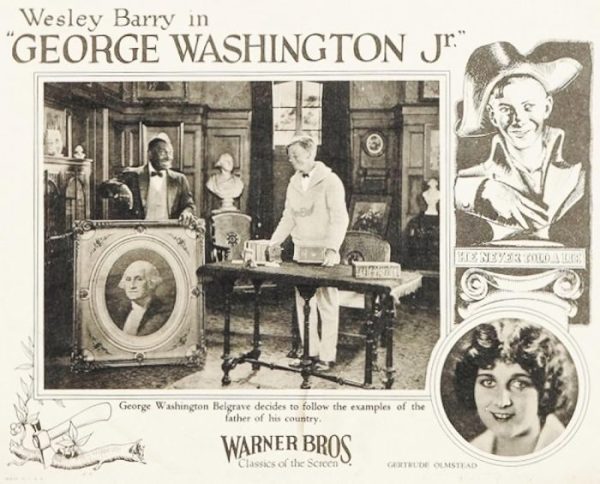
George Belgrave is guided by George Washington’s principles of integrity and honesty. He exposes his cousin Dolly’s fiancé, Count Tyrola, to be a bogus count and an internationally sought criminal. [As] the leader of the Vassalini gang, [he] steals a secret treaty from George’s father, a United States senator. It is Tyrola’s intention to use the treaty to cause political strife in Bessarabia. George, his friend Bob, and Ham, the negro butler, subdue the Vassalini gang and, after recovering the treaty, lock them up. Tyrola’s treachery is revealed seconds before the wedding ceremony. George, to save his father embarrassment, tells his only lie in giving him credit for the whole “plan” to capture Tyrola. Cousin Dolly marries friend Bob.
“After the half-breed daughter of a Comanche Chief falls for a young engineer who deserts her, she turns to a white Indian agent who marries her.”
IMDb Short
“Wetona, the daughter of Indian Chief Quannah and a white mother, returns to her tribe after an education in a white school in the East, [only] to find herself torn between the two cultures of her heritage.”
IMDb Storyline
“The film tells the story of some Comanche Indians and their preparations for a Corn Dance. The father of Wetona finds out she loves a white man.
I got lucky, today and found a Friday The 13th movie that had nothing to do with Jason or Camp Crystal Lake. Ninety years, ago, Friday The Thirteenth was released in the UK, at some point in November of 1933. The movie opened in New York on May 14, 1934. Curiously, this movie seems more science-fiction than spook. ~Vic
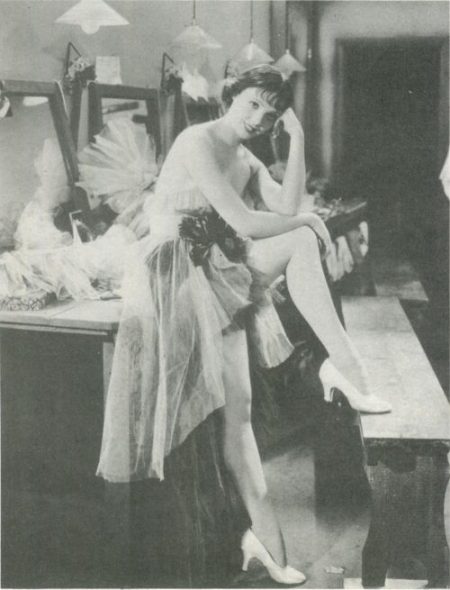
Jessie Matthews as Millie
Photo Credit: IMDb & Amazon
It is pouring with rain at one minute to midnight on Friday the thirteenth and the driver of a London bus is peering through his blurred windshield as his vehicle sails down an empty road. Suddenly, lightning strikes and a vast crane above topples into the path of the oncoming bus. Then, Big Ben begins to wind backwards. Time recedes and we discover the lives of all of the passengers, and the events that brought them to that late-night bus journey, from the con man with a hundred pound cheque to the businessman’s distraught elderly wife. Time flows on, inevitably, to the crash and past it, as some live and some die.
IMDb Storyline
The complicated lives of twelve people travelling on a bus are traced up to the point when the bus crashes into a shop, killing two of the passengers.
BFI Screen Online
In London, near midnight, as a rain storm rages, several people travel across the city on a bus. Of the passengers, one elderly woman seems anxious and upset, a young man who has just been robbed by a pickpocket gratefully accepts money for his fare from another passenger, another man boasts of his knowledge of art, and a young woman angrily destroys a photo of a man. When a lightning strike causes the bus to crash, each passenger recalls what brought them on the ill-fated journey.
Rotten Tomatoes Movie Info
After a London bus crash leaves two people dead and several injured, the clock is turned back twenty-four hours to show the lives of the bus passengers, how they happened to be on that bus at that time, and the effect of the crash upon their lives.
Comedy drama series. A group of kids manage to get involved in adventures with spies and the like.
IMDb Storyline
Well trained, highly organised and working from a secret H.Q., The Queen Street Gang were, undoubtedly, an attempt by Thames television to create a modern day Famous Five. There were even comparisons to be drawn with the Enid Blyton created characters, including one of the children being the daughter of a top secret researcher. The series was based on a 1966 children’s adventure book called The Case of the Silver Egg by Desmond Skirrow and adapted for TV by Roy Russell. The first of the two stories made involved a silver egg that was able to hold all the electricity in the world, which was then stolen by a group of criminals […]. It was up to the gang to recover it, rescue the kidnapped professor and make the world a safer place for us all.
One hundred years, ago, today, the black & white silent film [The] Forbidden Lover was released. Brackets around “THE” is a product of the differences of the title from data sources. This film is an edited version of The Power of Love, the very first 3-D movie, released on September 27, 1922 at the Ambassador Hotel Theater in Los Angeles. Both films are believed lost.
Yankee sea captain lands on the coast during the old Spanish days to trade with the ranch owners. He meets a girl who is betrothed to a man she loathes. After a series of adventures and narrow escapes, he shows up the unscrupulous ranch owner and wins the girl.
Still Image
The Power Of Love
Image Credit: IMDb & Amazon
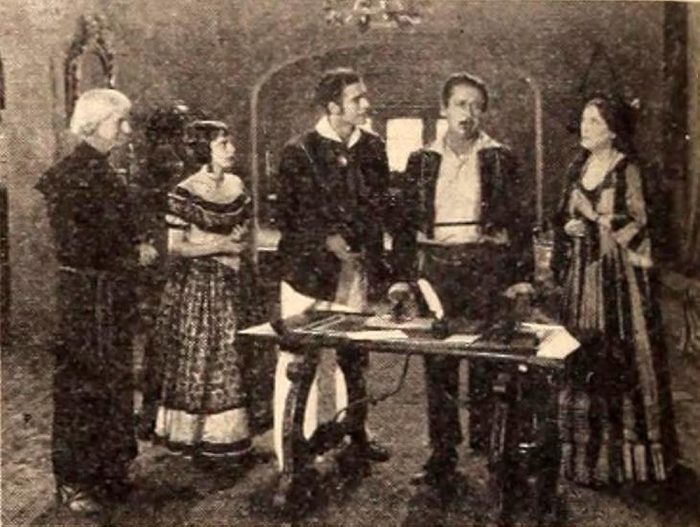
Because of his financial trouble, Don Almeda promises his daughter, Maria, to Don Alvarez but, Maria does not love [him]. In fact, she falls in love with Terry O’Neil, a stranger who has been wounded by robbers associated with Alvarez. O’Neil takes Alvarez’s place at a masked ball. Alvarez, in turn, robs the old Padre of some pearls and stabs him to death with O’Neil’s knife. He then accuses O’Neil of the murder and tries to shoot him but, wounds Maria instead, having thrown herself in front of him. Maria recovers and, after proving that Alvarez is a thief and a killer, weds O’Neil.
IMDb The Power of Love Storyline Moving Picture World
October 1922 Production Company:Perfect Pictures Tagline: A pair of spectacles will be handed to you as you enter the theatre, through which you will view the new sterescopic pictures.
The Power of Love was screened in front of a live audience at the Ambassador Hotel Theater […]. It was projected dual-strip in the red/green anaglyph format, making it both the earliest known film that utilized dual strip projection and the earliest known film in which anaglyph glasses were used. The camera rig used to shoot the film was made by the producers themselves and as you can imagine, it was far from perfect. Simply put, the film was not a success. It was screened, again, for exhibitors, and press, in New York City and, then, almost immediately fell out of sight. It was not booked again by other exhibitors. Unfortunately, we may never see what this movie looked like.
3-D TV & Movies
The first stereoscopic image dates to 1844, which makes 3-D images as old as the art of photography. [No] less a personage than Queen Victoria was photographed in 1854 in stereoscopic 3-D. 3-D stereoscopic moving images date to the 1850s with what was called the Kinetamatoscope [sic]. The first public display of a 3-D movie came in 1922 with The Power of Love […]. The film received a decent review in Moving Pictures World, then promptly disappeared from history by changing its title to Forbidden Lover and touring the country in a 2-D version. It was too complex and costly at the time to take 3-D on the road.
Randome
Looking Up/My Daily Plant Blogspot (Blogger) Cirque de 3-D
March 6, 2009
You’ve probably heard of ChatGPT, a computer program that is trained to follow your instruction and provide a variety of wide ranging responses. As someone that has spent some time actually using the AI, I have to say, the results it produces can be eerily human but, did you know that computer scientists have been working alongside chatbots as early as the 1960s?
It was the late 1960’s and Joseph Weizenbaum, an MIT computer scientist, had just completed work on his revolutionary chatbot ELIZA. Weizenbaum was born in Berlin, Germany, in 1923 and fled the country with his family in 1935 to escape the political turmoil. Weizenbaum came to the United States where his road to computer science would ultimately begin. After time spent in the Air Force, Weizenbaum would go on to study as a computer scientist and eventually work in the industry. You have to remember, computers at that time were not portable devices that could fit in our pockets. In fact, they often barely fit into a room! As an associate Professor at MIT, Weizenbaum became obsessed with the way computers could directly interact with humans through language. It was this early through line between computers and human language that would work to lay the foundation for his own chatbot and eventually lay the groundwork for the AI development of programs such as ChatGPT, Siri and Alexa.
Eliza was completed in 1966 and Weizenbaum offered MIT students the opportunity to interact with the chatbot. This process consisted of messages typed into the computer by students and, responses would then be provided by ELIZA, […] routed to an electronic typewriter and printer. Weizenbaum was initially happy with the response that was garnered from users’ experience with ELIZA but, there was one thing he did begin to notice that he viewed as considerably concerning. Overtime, Weizenbaum made note of users starting to divulge deep personal information, looking for help similar to that of a therapy session. This observation ended up pushing Weizenbaum to advocate for caution when relying too heavily on computers for human thought…
“There are aspects to human life that a computer cannot understand—cannot. It’s necessary to be a human being. Love and loneliness have to do with the deepest consequences of our biological constitution. That kind of understanding is in principle impossible for the computer.”
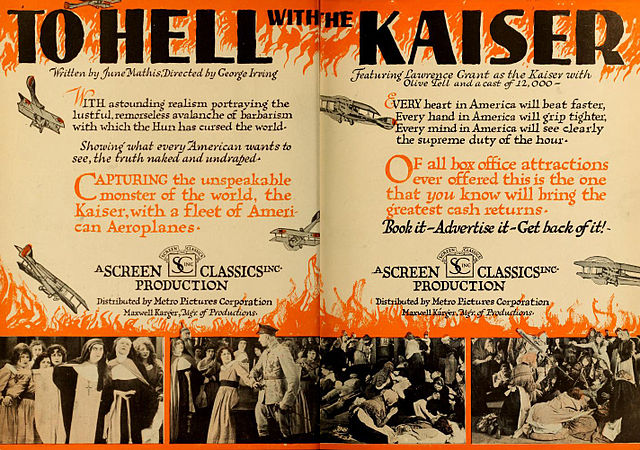
Following the death of his father, Frederick III of Germany, Wilhelm Hohenzollern becomes the German Kaiser and forms a pact with the devil that, he will conquer the globe in exchange for his soul. During the Kaiser’s invasion of Belgium, the Crown Prince enters a church and rapes Ruth Monroe, the daughter of an American inventor who has perfected a noiseless communications device. When the professor denounces the Crown Prince, he immediately is shot, whereupon his other daughter Alice vows to obtain revenge. While Alice’s sweetheart, Winslow Dodge, fights with the Americans as an aviator, she arranges to meet the Crown Prince through her friend Robert Graubel, an actor who impersonates the Kaiser at public functions. With her father’s wireless [device], Alice informs Winslow of the Kaiser’s whereabouts and, as he captures the German emperor, she kills the Crown Prince. Now a prisoner, the Kaiser drowns himself and wakes up in Hell, where Satan abdicates in his favor, saying that the Kaiser’s tortures are more fiendish than any he ever devised.
Lawrence Grant, who spent his lengthy career playing odious villains, appeared in the dual role of Kaiser Wilhelm II and his look-alike, German actor Robert Graubel. Terrified of being assassinated, the Kaiser hires Graubel to impersonate him at various political functions. In the film, the Kaiser achieves military success through an infernal pact with Satan. Once this is established, the film concentrates on the seemingly endless tally of misdeeds perpetrated by the Kaiser during his quarter-century reign over Germany. His “partner in crime” is the Crown Prince […], who thinks nothing of casually raping convent girls and gunning down protesting nuns. The Crown Prince’s latest conquest is Ruth Monroe […], the daughter of an American inventor. When Ruth’s father protests this outrage, he is brutally murdered, whereupon Ruth’s sister Alice […] vows revenge. Using her father’s newest invention, a wireless machine whose coded messages cannot be intercepted, Alice directs a battalion of planes to bomb the small German village where the Kaiser is hiding. Captured by the Allies, the Kaiser is ignominiously dumped in a POW camp but, not before enduring a well-aimed sock on the jaw from a pugnacious dough-boy. In despair, the Kaiser commits suicide and sends his soul to hell. In hell, the devil […] gives up his throne, confessing that the Kaiser is far more sinister than he could ever hope to be.
[On June 8, 1918], Motography ran a Screen Classics press release explaining that To Hell With The Kaiser “reveals the machinations of Europe’s military monster before and during the war, his contempt for Americans […], his elaborate plans to crush France, […] destroy Russia, […] partition the world, […] his [order] to employ deadly gases in the war, the true circumstances under which he ordered the sinking of the Lusitania, the raiding of hospitals […].” Years before the war, Mr. Grant’s physical likeness to the German ruler was noted by a high official of the Kaiser’s court and a proposition was made for Grant to play the Kaiser in a dramatization […]. The war broke out before discussions went any further.
Actor John Sunderland, playing American pilot Winslow Dodge, was himself “an aviator who has seen service in Belgium.”
[It] had been released in the press that Kaiser Wilhelm II had half a dozen doubles who were employed to pose for him in various parts of the country, where there might be danger of assassination, while the real Kaiser, himself, remained safe behind this cloak.
To Hell With The Kaiser opened in New York City at the Broadway Theatre on June 30, 1918, immediately after it had emerged from the cutting and editing rooms […].
The film turned out to be an effective propaganda tool […]. Not only has the picture been shown in munitions plants and training camps […] but, this power has now been demonstrated in a new way…to convert conscientious objectors.
The National Film Preservation Board (NFPB) included this film on its list of Lost U.S. Silent Feature Films as of February 2021.
I found the building of this post fascinating. What started out as a simple movie post, turned into a history lesson. It’s a shame that it is lost. There are photographs of still pictures on IMDb. ~Vic
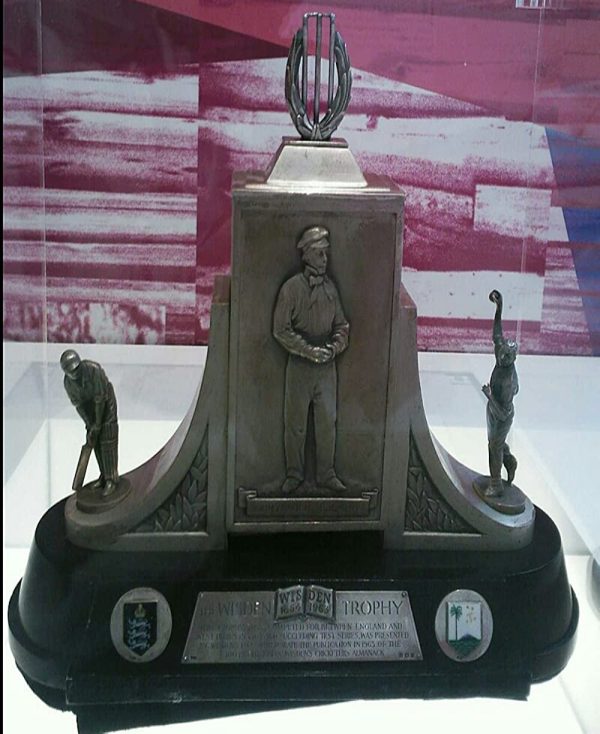
Sixty years, ago, today, the British TV Series Wisden Trophy debuted.
The trophy is named after the famous cricketing publisher Wisden and was presented by John Wisden & Co. after gaining the approval of the Marylebone Cricket Club (MCC) and the West Indies Cricket Board (WICB). The [trophy] was presented to the victorious team as a symbol of its victory but, then, returned to the MCC Museum at Lord’s.
The [trophy was] awarded to the winner of the Test cricket series, played between England and the West Indies. It was first awarded in 1963 to commemorate the hundredth edition of Wisden Cricketers’ Almanack. Series were played in accordance with the future tours programme, with varying lengths of time between tours. If a series was drawn, then, the country holding the [trophy] retained it. In 2020, it was announced that the trophy would be replaced by the Richards–Botham Trophy, named after Sir Vivian Richards and Sir Ian Botham.
Virtuous Mabel rejects the improper advances of a villainous cad. The furious villain, and his henchmen, then seize Mabel and chain her to a railroad track. Mabel’s anxious boyfriend turns for help to the great Barney Oldfield, who jumps in his racing car and speeds to the rescue.
IMDb Storyline
A lady, Mabel Sweet and Lovely, is courted by a gentleman, A Bashful Suitor. He offers her a corsage, which she accepts. They coyly share a kiss. After the Suitor leaves, the Villain appears and grabs the lady. She hits him and escapes. This angers the Villain and he vows to get his way. At the next opportunity, the Villain, once again, kidnaps the lady, this time with the help of two henchmen and chains her to the railway tracks.
The three villains travel by handcar to the station, where they assault two workers and steal a locomotive engine. The villains drive the train back towards the location of Mabel, who is still tied to the tracks. The railyard worker alerts the Suitor about the situation, who then rushes to ask his friend, racecar driver, Barney Oldfield for help.
The two friends jump in the automobile and race the speeding hi-jacked locomotive to rescue the damsel in distress. Mabel is dramatically saved at the last moment and is carried away to safety. The foiled villain kills his accomplice and shoots five Keystone Cops arriving by handcar to arrest him. Finally, he turns the gun on himself but, upon discovering the bullet chamber empty, he drops dead in a rage.
Yes, I am still alive. I took a break for health reasons. ~Vic
Image Credit: Amazon
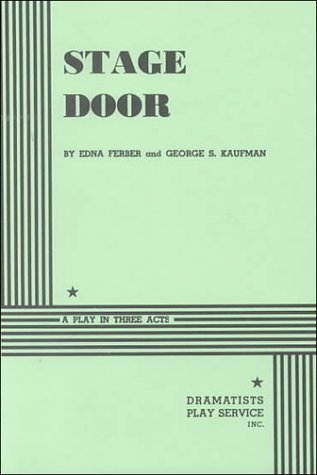
Seventy-five years, ago, today, the TV movie Stage Door aired. The information on this movie is limited but, there is a record of it in the IMDb. Based on a 1936 stage play, written by Edna Ferber and George S. Kaufman…
[It is] about a group of struggling actresses who room at the Footlights Club, a fictitious theatrical boardinghouse in New York City, modeled after the real-life Rehearsal Club. The three-act comedy opened on Broadway on October 22, 1936, at the Music Box Theatre and ran for 169 performances. The play was adapted into the 1937 film of the same name and was also adapted for television.
An additional one-hour television adaption aired on CBS in April of 1955. There are plenty of clips on YouTube from the 1937 movie but, nothing from either television version.
The opening scenes of this production are laid in Egypt, five hundred years before Herodotus, the Father of History, visited that country. Three thousand years ago, there dwelt in Egyptian Memphis, the ancient capital of the Pharaohs, a wealthy prince, whose wife in beauty was likened to [Hathor], the Egyptian Venus, with [a] heart as cold as Egyptian marble. The prince, worried and suspicious, seeks the royal seer, who tells him the princess has a lover and, in a vision, shows him the princess in the arms of that lover, a Theban warrior. Instant death is the punishment meted out to the guilty pair. The princess is placed on a bier and carried out in front of the Temple, under the very shadow of the Pyramids of Gizah. Here, the High Priest, with a flambeau, sets fire to the pyre and her body is burned as an offering, with prayers, to mighty Osiris, beseeching that he overcome Typhon, who seems to hold sway. Alongside the pyre is placed a vase, decorated with hieroglyphics, which is to be the sarcophagus, of that ethereal, of the unfortunate princess. The smoke and vapor, as it arises from the body, enters the vase in a most mysterious manner. The vase is then sealed and the cavalcade proceeds with it to the tomb, where it is deposited and the door of the tomb closed, it was thought forever. Three thousand years later, there came to the “Land of Ruins” a Boston professor, student of the illustrious Jean Francois Chainpollion, discoverer of the key to Egyptian hieroglyphics, who unearthed the vase and took it to his home in Boston. Vague, indeed, was the story he learned about the treasure and, while sitting in his study, cudgeling his brain to lift the veil of mystery from it, falls to sleep. [In] this psychological condition, [he] imagines the maid, while dusting, knocks the vase from the tabouret on which it stands. Bursting into bits, it emits a dense vapor, from which the reincarnated princess appears. Here is trouble. Our friend, the professor, is a married man, whose better-half is a buxom, unethereal person, who doesn’t believe in the “Soul Sister” tommyrot. She, of course, wants an explanation, which the nervous professor is unable to give, so he bolts and runs hatless out of the house, followed by the princess, both followed by Mrs. Professor. Into a restaurant he rushes, with the princess at his heels. At the restaurant, as they sit enjoying a repast, the reincarnated Theban lover appears and claims the princess. This, the old professor resents and is run through by the Egyptian just as the wife enters. Mortally wounded, he falls to the floor, from the sofa, [as] the scene changes and we find the professor awakening from a horrible dream, the pain of the sword thrust being induced by a severe attack of indigestion.
There are no videos of this or any pictures. Since the movie was about a Princess, I grabbed a photo of Linda Arvidson from her IMDb profile. She also has a nice picture on Wikipedia, linked, above. The film is listed for 1908 releases and there is a note/citation referencing a mention of this short in Horror In Silent Films: A Filmography 1896-1929, though IMDb does not tag this as a horror. The production company was American Mutoscope & Biograph Company, the first company in the US devoted entirely to film production and exhibition. There is a survival status of some print in the Library of Congress. I wish I had more. ~Vic
The beautiful Princess Giselle is banished by evil Queen Narissa from her magical, musical, animated land and finds herself in the gritty reality of the streets of modern-day Manhattan. Shocked by this strange new environment, that doesn’t operate on a “happily ever after” basis, Giselle is now adrift in a chaotic world, badly in need of enchantment. [When] Giselle begins to fall in love with a charmingly flawed divorce lawyer, who has come to her aid, even though she is already promised to a perfect fairy tale Prince back home, she has to wonder…can a storybook view of romance survive in the real world?
IMDb Storyline
In the animated fairy tale kingdom of Andalasia, Narissa, the corrupt, ruthless queen and dark sorceress, schemes to protect her claim to the throne, which she will lose once her stepson, Prince Edward, finds his true love and marries. Giselle, a young woman, dreams of meeting a prince and experiencing a “happily ever after”. Edward hears Giselle singing and sets off to find her. She and Edward are instantly attracted to each other and plan to be married the following day. Disguised as an old hag, Narissa intercepts Giselle on her way to the wedding and pushes her into a well, where Giselle is magically transformed into a live-action version of herself, [then] transported to New York’s Times Square in the real reality.
Bilbo Baggins is swept into a quest to reclaim the lost Dwarf Kingdom of Erebor from the fearsome dragon Smaug. Approached out of the blue by the wizard Gandalf the Grey, Bilbo finds himself joining a company of thirteen dwarves led by the legendary warrior, Thorin Oakenshield. Their journey will take them into the wild, through treacherous lands, swarming with Goblins, Orcs, deadly Wargs, giant spiders, Shapeshifters and Sorcerers. Although their goal lies to the East and the wastelands of the Lonely Mountain, first they must escape the goblin tunnels, where Bilbo meets the creature that will change his life forever…Gollum. Here, alone with Gollum, on the shores of an underground lake, the unassuming Bilbo Baggins not only discovers depths of guile and courage that surprise even him, he also gains possession of Gollum’s “precious” ring that holds unexpected and useful qualities…a simple gold ring that is tied to the fate of all Middle-Earth in ways Bilbo cannot begin to know.
Bodies are turning up around the city, each having met a uniquely gruesome demise. As the investigation proceeds, evidence points to one suspect: John Kramer, the man known as Jigsaw, who has been dead for over 10 years.
IMDb Summary
The plot follows a group of people who find themselves forced to participate in a series of deadly “games” inside a barn. Meanwhile, the police investigate a new series of murders that fit the modus operandi of the eponymous Jigsaw Killer, who has been dead for almost a decade.
Honestly, I’ve never seen a “Saw” movie and have never wanted to. Blood and gore torture movies are not my choice for a good movie. It’s hard to watch, peeking out from behind the couch. ~Vic
One hundred, ten years ago, today, the B&W silent, short comedy film Suffrage and the Man was released. Produced by the French company Eclair, in conjunction with the Women’s Political Union, its original title was Suffrage Wins Herbert.
A young man learns that his betrothed is leaning toward the suffragette cause. He remonstrates with her father to be told “My butler and my bootblack may vote, why not my wife and daughter?” He cannot agree, however and their quarrel brings about a broken engagement. Disappointed and unhappy, he seeks forgetfulness by going to a summer resort. There, he succumbs to the wiles of a designing mother and, caught in an embarrassing position, her daughter “feinting a faint” in his arms, he permits their engagement to be announced. He learns, by an accidental eavesdropping, of the mother’s trickery. He loses no time to denounce the deception and withdraw his offer of marriage. The mother and daughter promptly start suit tor breach of promise. In the meantime, votes have been won for women. The trial of the suit comes up before a mixed jury of men and women with the old sweetheart as forewoman of the twelve peers. Their verdict is acquittal and, as might be expected, “Suffrage Wins Herbert” with a permanently happy result in his reconciliation and marriage.
According to Silent Era, the director is unknown, the cast is unknown and the film’s survival status is unknown. There is one trivia bit…it is based on a story written by playwright Dorothy Steele. ~Vic










 Cosmic-Observation