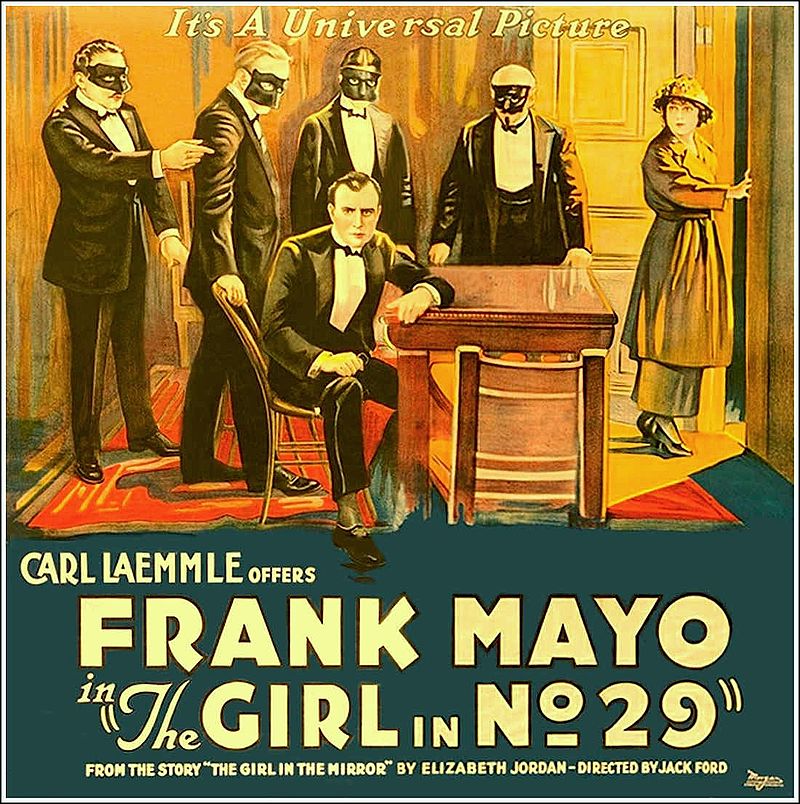
After turning out a successful drama, young playwright Laurie Devon settles down to a life of idleness. Alarmed and disgusted, his friends make every effort to get him to work again but, he refuses. One evening, while glancing into his mirror, Laurie sees a beautiful girl in the apartment across the way, holding a revolver to her head. Dashing out of his apartment house, he prevents her from pulling the trigger. He learns that her name is Doris Williams and discovers that her plight is caused by a man named Shaw. Soon after, Shaw and his thugs abduct her, and Laurie comes to her rescue, shooting her tormentor. Returning home, he confesses his crime to his sister and friends, and learns that the whole incident was a trick to restore his interest in life. The plot succeeds and Laurie writes another hit play in which his new wife Doris is the star.
Laurie Devon (Mayo) is a New York playwright who, having had one success, refuses to work on another play. One night he sees a woman (Anderson) in an apartment across the street take out a gun and place it to her forehead. He reaches her in time to save her and she tells him that she is under some terrible evil influence, which she will not disclose. Devon attempts to untangle the mystery and is led on an adventure. The woman is taken to a house on Long Island, where Devon, after a fight, rescues her. He takes out the revolver and shoots one of the pursuers, who falls to the ground. On returning home, he is heartbroken and tells his sister Barbara (Fair) and his friends that he is a murderer. His sister, and two of his friends, then confess that the whole thing was a frame-up. [T]hey had hired some actors to stage everything and that it was an attempt to get the ambitionless [sic] author to write again. The revolver used in the suicide attempt by the woman, and in the later shooting, had blanks. Devon and the woman from the apartment melt into each other’s arms at the final fade-out.
Oh, it has been work looking for a film for today’s date. IMDB had plenty to choose from but, I couldn’t seem to get any further information from the others…Wikipedia, American Film Institute, Turner Classic Movies… Even the Silent Era site and Silent Hollywood were slim pickings and, Silentology had nothing.
The discovery that detectives are on their trail causes Doyle, Broden and Etzer, counterfeiters, to pack their paraphernalia into a trunk and express it to Lone Point. Upon its arrival at that station, a corner of the trunk is smashed. Helen thus learns of its contents. The telegrapher immediately wires to Savage, a railroad detective. The latter, accompanied by Duncan, a Secret Service detective, hastens to the scene. At their suggestion, Helen arranges a trap for the counterfeiters. When the latter appear, they are set upon by the officers. Etzer is captured but, his pals get away. Doyle eludes pursuit but, Broden later falls into Savage’s hands. Helen, watching the pursuit, ventures on the high trestle which crosses the dry bed of the Loro River. Doyle, who is hiding, sees Helen. Overpowered by a desire for revenge, the man attacks the telegrapher and makes her a prisoner. A rope lies nearby. Binding Helen, Doyle suspends his victim from the trestle and fastens the end of the line around the rails. Duncan sees this from afar. Although he rushes forward, he knows that the Keene local, due any moment, will cut the rope as it crosses the trestle. Meanwhile, Helen, after a tremendous effort, frees her hands. There is one chance for life. The girl commences swinging her body. Each time, she [manages] a wider arc. The train is crossing the trestle when Helen swings toward a beam. The engine wheels sever the rope. Helen flies through the air and reaches the beam. Doyle is captured. Savage and Duncan raise Helen to the tracks and find her uninjured.
Moving Picture World
This is one of the lost pieces so, there isn’t a YouTube clip and I could only find one picture. ~Vic
Perhaps the most attractive feature of this picture is the reproduction of early Roman costumes and Roman surroundings. It is a story of political intrigue, with all the contests and disagreeable features, connected therewith in the ancient city. But, the reproduction of manners and customs and, the historically correct scenery and settings, add immensely to the interest and, insure attention when, perhaps, the mere political story would scarcely be considered. The greatest service the motion picture can do is in the direction of educating the people, and a film like this, which faithfully illustrates long past and, perhaps, partially forgotten life, is of vast importance and, deserves a cordial reception. The Selig players have brought enthusiasm to their work and, have put much ability and life into the interpretation of this play.
This film may have been based on the 1835 novel Rienzi, the Last of the Tribunes, by Edward Bulgar-Lytton [sic]. An advertisement in the [February] 19, 1910, Film Index billed Bosworth above the title, “Hobart Bosworth in The Roman,” and labeled the movie “Film De Art of the Classics,” declaring: “Its teachings are based upon the scriptures and traditions of the early history of the eternal city.” The advertisement also suggested that theater owners book The Roman as a “Special Lenten Picture.”
A young woman [orders] her girl slave to deposit in the waters of the Tiber a child which she has cause to be rid of. The infant is found by one of the aristocracy and adopted. In later years she is betrothed but, just before the wedding, the ruler of the land claims the young woman, on the ground that she was born in slavery. By military force, she is torn from the arms of her foster father and taken to the ruling house where she is held captive for only a few hours, as the father and young lover, have aroused a popular rebellion which overthrows the ruler, end[ing] in his death and the defeat of his defenders. (Variety February 19, 1910)
One Trivia Bit:
♦ Per [Hobart] Bosworth, first picture made at Selig’s (Studio at 1845 Allesandro Street, now Glendale Blvd.) in the Edendale (now Silver Lake) plant of Los Angeles.
[There was not much written about this film and no video clip(s). The image, above, doesn’t seem to jive with the TCM synopsis. But, that is all I could find.
Addendum: I continued to dig and found the, above, write-ups via the Internet Archive database and AFI. Turner Classic Movies synopsis was WAY off. ~Vic]
I usually do movie posts in five year increments but, this one kinda fell in my lap. Sixty-three years ago, today, Elvis Presley made his acting debut in the film Love Me Tender. Directed by Robert D. Webb, it was originally titled The Reno Brothers and was based on a story written by Maurice Geraghty. When Presley’s single Love Me Tender passed one million copies, a first for a single, the title to the film was changed. This was the only movie in which Presley played an historical figure and the only movie in which he did not receive top billing.
Elvis plays Clint Reno, one of the Reno Brothers who stayed home while his brother went to fight in the Civil War for the Confederate army. When his brother Vance comes back from the war, he finds that his old girlfriend Cathy has married Clint. The family has to struggle to reach stability with this issue. Vance is involved in a train robbery, while a Confederate soldier, of Federal Government money. There is a conflict of interest, when Vance tries to return the money, against the wishes of some of his fellow Confederates.
Trivia Bits:
♦ Originally, this movie had no singing in it. Songs were added to cash in on Elvis Presley’s stardom.
♦ Priscilla Presley reportedly copied Debra Paget’s unique hairstyle from this film to attract Elvis in 1959.
♦ According to Penny Stallings‘ “Flesh and Fantasy”, Presley developed a crush on co-star Debra Paget, which went unreciprocated because she was seeing Howard Hughes at the time.
♦ When the film played in theaters, Elvis Presley’s fans were screaming so loud that audiences couldn’t hear any of his lines.
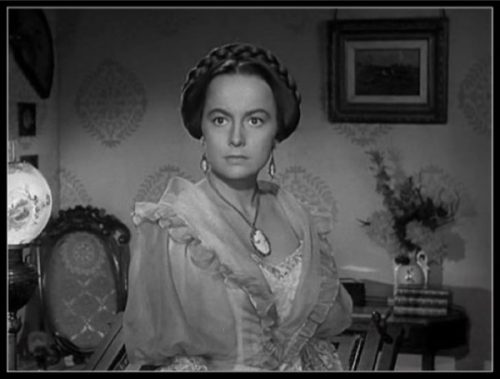
Catherine Sloper is a shy and backwards young woman who lives with her father, Dr. Austin Sloper, in 1849 New York. By all accounts, Catherine’s mother was a beautiful and graceful creature with the charm of queens. Catherine never knew her mother since she died while in childbirth but, her father often reminds her of all the things her mother was and that she is not. Catherine inherited a great deal of money after her mother passed and will inherit twice as much more at the passing of her father. So, when a poor but handsome and well-bred man, Morris Townsend, begins to court Catherine, her father becomes suspicious that he must be after her money. After all, Catherine is plain and boring. What could she possibly offer to this young man other than her money? When she refuses to give up her new beau, her father threatens to disinherit her. Will her father eventually convince her to give him up and wait for a suitable husband? Will Catherine and Morris elope and, live on the money left to her by her mother? Or, could it be that Catherine finally finds all the grace and charm of her mother only to use it against the men in her life?
Trivia Bits:
♦ Montgomery Clift was so unhappy with his performance, he walked out of the Premiere.
♦ Cary Grant was interested in playing Morris Townsend but, William Wyler turned him down.
♦ Montgomery Clift took some piano lessons for the scene where he sings “Plaisir d’Amour” to Olivia de Havilland.
♦ William Wyler wanted Erroll Flynn for the role of Morris Townsend.
♦ This movie was selected to the National Film Registry, Library of Congress, in 1996.
An English lady bored with London society brings her [two] children to their country home. Her servant William is also working for a French pirate who holds up with his ship and crew off the coast. They soon meet and she embarks on an adventure with the pirates!
As a beautiful, learned lady of means, Dona St. Columb had it all…and a loveless marriage. After years of being royally subjected to mistreatment, she retreats with her most prized possessions, her two children, to a secluded manor overlooking Britain’s Atlantic shoreline. [She] is enthralled with the tall tales of a scoundrel of a pirate, who has been plundering nearby coastal villages. Full of adventure and fueled by years of neglect, she sets forth to seek him out and, it is not long before she finds him…
Tagline: “A Lady of Fire and Ice…A Rogue of Steel and Gallantry”
Trivia Bits:
♦ The only film featuring Basil Rathbone and Nigel Bruce in which they do not play Sherlock Holmes and Dr. Watson.
♦ To make Arturo de Córdova appear taller than Joan Fontaine, he had to wear lifts in his shoes, causing him to teeter when he walked.
A mad doctor named Zanoff uses a drug to bring himself back from the dead after his execution in prison. Dick Tracy sets out to capture Zanoff before he can put his criminal gang back together again.
International spy, Zarnoff, in the employ of “The Three Powers” (presumably a fictionalized reference to the Axis) is captured by Dick Tracy at the start of the serial, [then] tried and sentenced to death. However, through the use of a rare drug embedded by his agents in[to] the evening newspaper, he escapes from the gas chamber. His men pick up his “corpse” by ambushing the hearse and, administering another counter-drug. He continues his espionage plans, while taking the opportunity of revenge on Tracy.
[Dick Tracy serials were] “unexcelled in the action field” [and] “in any listing of serials released after 1930, the four Dick Tracy adventures from Republic must stand out as classics of the suspense detective thrillers and the models for many others to follow.”
In a New York hotel, the body of Steven Humbolt is discovered and Chief Inspector Decker Dawes is called to investigate. After a brief inspection of Humbolt’s belongings, Dawes and Sergeant Meed determine that Humbolt had fifteen wives, three of whom…Sybilla Crum, a well-known reformer, wealthy Carol Arnold, and Ruby Cotton…live in New York. Dawes first questions the still devoted Sybilla, then quizzes Jason Getty, a florist who had sent Humbolt a funeral wreath hours before his death was discovered. While Meed checks out Getty’s lead that the wreath was ordered in Philadelphia, Dawes interrogates Carol Arnold. Carol tells Dawes that Humbolt had robbed, and deserted her, after three weeks of marriage and, that, a year later, she had received a letter from South America informing her of his demise. Just after Carol had married wealthy Gregory Arnold, Humbolt contacted her with blackmail demands but, according to Carol, she never saw him before his murder. Although Dawes doubts Carol’s story, he leaves her to talk to a chemist about a broken glass globe that was found near Humbolt’s body.
Image Credit: imdb.com
The chemist reveals that the globe, a Helmholtz Resonator, contained a lethal dose of hydrocynanic acid gas that was released when the glass was broken. Once Dawes determines that the globe came from Philadelphia, he demonstrates how a radio performer known as The Electric Voice, whose fiancée is Ruby Cotton, could have broken the globe during a broadcast. Dawes arrests The Voice and Ruby but, returns to question Carol, who he discovers is hiding a child she had by Humbolt. Then, Dawes receives a message from Sybilla about a clue she unearthed at Humbolt’s funeral. While at Sybilla’s home, Dawes discovers that florist Getty is impersonating the reformer and that he is wearing a pair of gloves similar to a pair Humbolt was wearing in his coffin. Suspicious, Dawes orders Humbolt’s coffin exhumed, which causes Getty, who needed the gloves to hide his amputated fingers, to panic. [He] confesses that he killed Sybilla and had used The Electric Voice’s broadcast to kill Humbolt out of revenge for stealing his wife in Australia. After thwarting Getty’s escape attempt, Dawes telephones Carol, who is divorcing [Gregory] Arnold and proposes that they leave for Europe together.
Disclamer:
The Internet Movie Database (IMDB) and Wikipedia state that this film was released July 15, 1934. The American Film Institute (AFI) and Turner Classic Movies (TCM) state that it was released June 1, 1934. I have no way of verifying either. I also can’t find any video clips. ~Vic
Lon Chaney plays Grumpy Anderson, a railroad engineer with an obsession for running his train on time. His slavishness to promptness causes several tragedies which alienate him from his family. By the story’s end, the engineer restores their faith in him and validates his obsession by forcing his train through a flood to bring badly needed Red Cross supplies to the victims.
“Grumpy” Anderson is an old railroad engineer that is obsessed with keeping his train on schedule, no matter the cost. His two sons are also railmen but, don’t share his single mindedness, which leads to one son’s death and a fight with the other on the first son’s funeral car. [This] leads to a crash and demotion of Grumpy to mechanic in the yards. His redemption comes during the Mississippi flood when he is, again, pressed into service to pilot a relief train along with his surviving son.
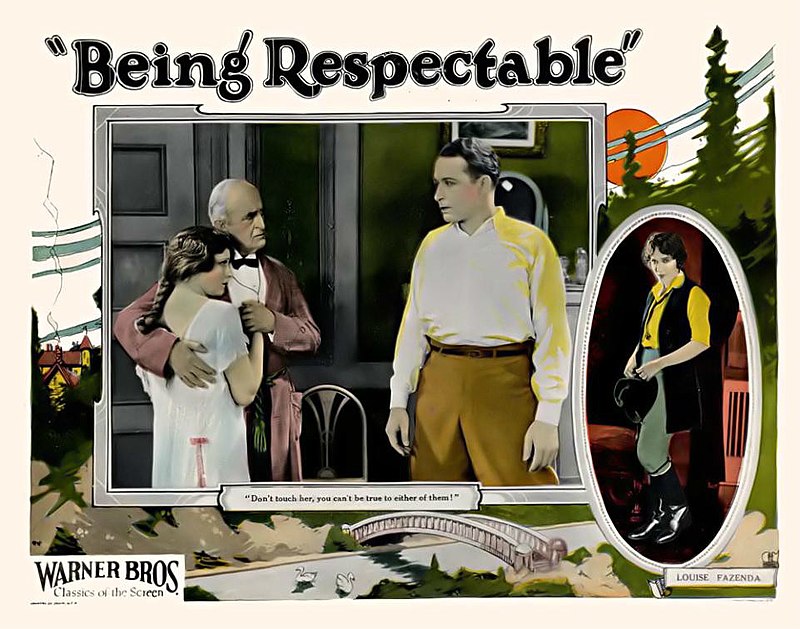
Wealthy young Charles Carpenter is pressured by his family to marry Suzanne, even though he is really in love with young “flapper” Valerie. He gives in to his family’s pressure, however and marries Suzanne, after which Valerie leaves town. Years later, after Charles and Suzanne have had a child, Valerie comes back to town and, Charles realizes he is still in love with her…and she with him. Complications ensue. [Source]
Through the scheming of his respectable, and wealthy family, Charles Carpenter is obliged to marry Suzanne, although he is in love with young flapper Valerie Winship. Years later, when Valerie is back in town, they renew the affair and, Carpenter plans to leave his wife and child for her. […] in the end, he yields to family duty and respectability. [Source]
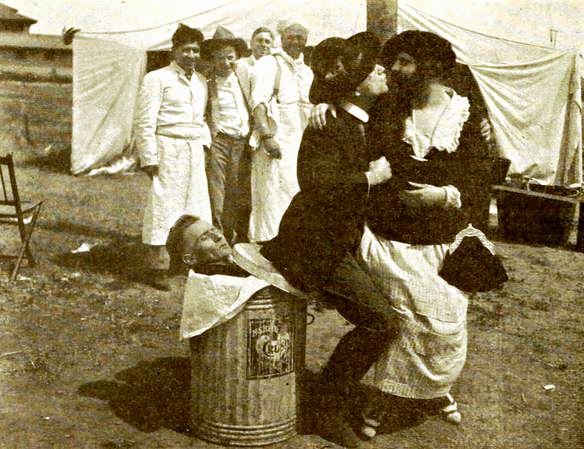
A serious-minded boob named Stradivarious O’Day, because his music-loving mother says he “fiddles his time away”, acquires his nickname because of his motto of “one thing at a time and that done well.” Falling in love when he first sees circus bareback rider Prairie-Flower Marie, O’Day, living off his inheritance, follows the circus until the pestered manager gives him a job cleaning his Ford. With the help of a manual, O’Day learns to drive and secures employment with the circus as a chauffeur. After strong man Gorilla Lawson, who also loves Marie, beats him up, O’Day contacts his friend, boxer Roughneck M’Dool, to teach him to fight. Lawson, frightened by O’Day’s daily development, steals the circus receipts, and the Ford, on the day of their scheduled fight but, O’Day overtakes and whips him. After O’Day weds Marie, he unwittingly goes against his motto when he becomes the father of twins.
Gabby Gus made the town regularly every month. He was a swell guy and thought he could cop most any Jane that he took a liking to. Clara Louise Willoughby, a farmer’s daughter with a pretty face and figure, took the salesman’s eye. He looked the old gent up in Dunn and Bradstreet and, discovered that the old boy was worth some coin. Then, he set his traps for the daughter. Dad, however, sent her away to boarding school and when she returned, she was the swellest peach in the orchard. They all fell for her. Gus hastened to her home where he discovered she was some lemon when it came to the country stuff and that she was a real ‘highfalutin’ society butterfly now. […] her aspirations were higher than a poor hick drummer. She made him feel awfully small. [Source]
I can’t find a video clip of this film but, I did find Ade’s Fables in Slang in audio book form. It has 26 stories and was published in 1899. [Disclaimer: It is nearly two hours long.] ~Vic
D. W. Griffith and Mary Pickford, along with Charlie Chaplin and Douglas Fairbanks, founded United Artists on February 5, 1919, as a studio where actors could control their own interests instead of being beholden to commercial studios. It is now a subsidiary of MGM and Annapurna Pictures and, as of February 5, 2019 (its 100th anniversary), it was rebranded as United Artists Releasing.
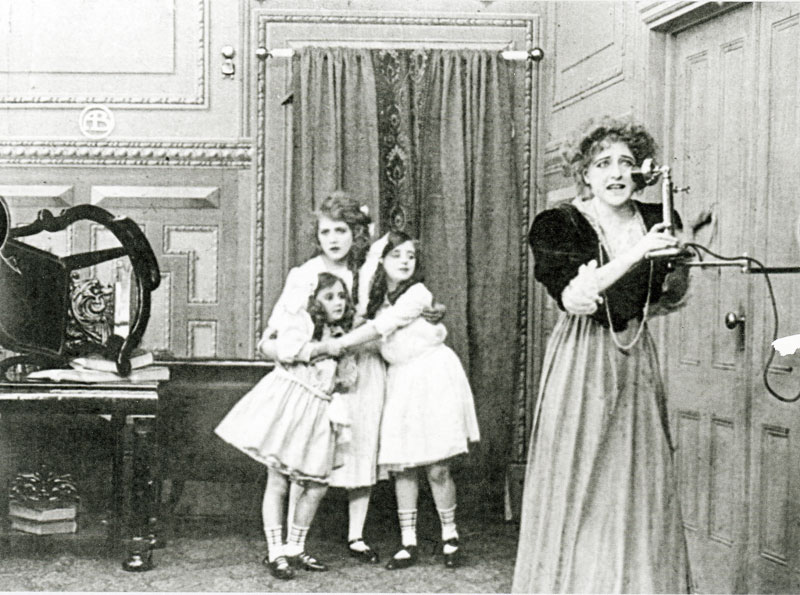
A gang of thieves lure a man out of his home so that they can rob it and, threaten his wife and children. The family barricade themselves in an interior room but, the criminals are well-equipped for breaking in. When the father finds out what is happening, he must race against time to get back home.
Trivia Bit
♦ During the shot of the father leaving the hotel, a dip can be seen in the road in the background. Today, that is currently the exit for the George Washington Bridge and the location of the hotel is now an apartment complex.
This was the second single from the Footloose soundtrack, following the “title track,” which was recorded by Kenny Loggins. In the film, the song was used in a scene where Kevin Bacon tries to teach Christopher Penn how to dance and Penn is having a hard time.
Once the song was written, Pitchford asked Deniece Williams and her producer George Duke to record the song. Kenny Loggins was onboard for the title track, which gave the project credibility and, Williams loved the song and the story idea for the film. She grew up in a small Indiana town with a religious environment similar to the one described in Footloose. When she saw the film, she thought the scene where they used her song was incredible. “If I had come to the film without the music in and they asked me what segment I wanted my song to be in, I would have chosen that segment.” said Williams.
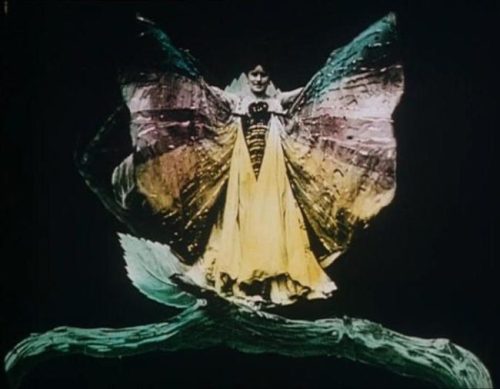
Gaston Velle was a French silent film director, and pioneer of special effects, who was prominent in early French and Italian cinema during the first two decades of the 20th century. Gaston began his career as a travelling magician before putting his illusionist skills to work in cinema and, ultimately, creating more than fifty films between 1903 and 1911. He worked under Auguste and Louis Lumière before serving as the head of production for the Italian film studio Cines. […] he is best remembered for his work at Pathé where he was hired to produce trick films that might rival those of his contemporary, Georges Méliès […]. Velle also created some of the first Féerie films […]. [He] mysteriously retired from film production in 1913 and little is known about the last several decades of his life.
[Disclaimer: Very little is known about this film and the above Wikipedia information is presented without any citations.]








 Cosmic-Observation