Update:
Thanks to blogger J. T. Twissel, this is an insect trap, used to study insect infestations. Thank you, dear!
We have a small kids’ park called Turnip Patch Park. It has a little stream running through it with a covered wooden bridge, park benches, a butterfly garden and, at one time, a piece of artwork on a concrete slab. On the back side of it, adjacent to someone’s home is this lovely box. Out of curiosity, I opened it, expecting to see guano, thinking it was a bat box but, instead, I found wasps. Hm. ~Vic
Photo Credit: Library of Congress
Historic American Buildings Survey
February 1965
Twin Chimneys, so named for the paired chimneys in each gable end, is sited on a hill on West King Street, directly across from the Colonial Inn and the Parks-Richmond House […]. An iron gate from Stewart Iron Works in Cincinnati, Ohio, separates the house from the pedestrian traffic of the sidewalk. [It] is reputedly a pre-Revolutionary house, however, the exact date of construction is not known. It is important to note that a house is sited at the exact location on the 1768 Sauthier Map of Hillsborough but, it cannot be assumed that the houses are the same.
05-20-201907-14-2020Left side gate.
Photo Credit: Pinterest
This is a most delightful old house, with four huge chimneys and a second-floor balcony, from which a view of the busy thoroughfare, King Street, may have been enjoyed down through the years. The lot on which it stands was once owned by Edmund Fanning.
It is interesting to know that this house was the setting for the old romantic novel, “Joscelyn Cheshire.” According to the story, the heroine concealed her lover in the attic to protect him from Cornwallis’ army. The house served at one time as Hillsborough’s Post Office.
Archibald DeBow Murphey was a North Carolina politician known as the “Father of Education” in his state for his proposals that benefited public works and public education. [Murphey] died at Twin Chimneys in Hillsborough on February 1, 1832. He is buried at the Presbyterian Church […]. The town of Murphy, North Carolina (despite its spelling) was named after him.
This Sunday night’s playlist submission was never released. The 8th track from her album Fumbling Towards Ecstasy, it has no chart information. Sarah was already a star in her native Canada but, this album was her breakthrough in the US, exploding on the scene when her first track, Possession, was released. Born in Halifax, Nova Scotia in 1968, she was playing music, early, starting with a ukulele at age four. In high school, she was the singer for the short-lived band The October Game and, after finishing a year in college, signed a recording contract with Nettwerk without having written a single song.
This is another album/CD I have worn out. I can remember when Possession showed up on the radio and I first heard it. I was driving home from work and immediately went looking for her album. Her music has been used in many television shows and I remember her being on Charmed. Notable movies using her songs are City of Angels, Message in a Bottle, The Brave One and Four Christmases.
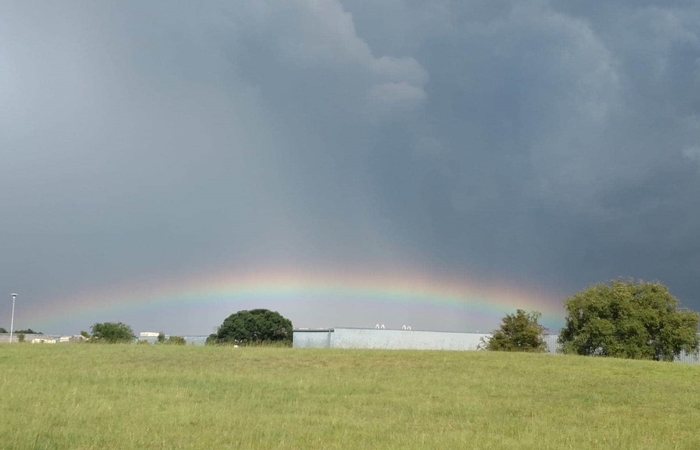
We’ve been having rolling thunderstorms over the last two weeks. My buddy Ray captured this at work. Two years, ago, I captured another July Rainbow. ~Vic
Up until this point, the only TV shows I have been posting were American. I will be branching out a bit. Naturally, the first non-American show I choose doesn’t have a lot of information written about it…or a video. ~Vic
[This was] an early series from the pen of actor/writer Donald Churchill, focused on Albert Curfew, […] a young man unable to hold down a job for any length of time. The title came from a regular saying of Curfew’s every time he lost his job. Churchill (who also starred as well as wrote the scripts) claimed he based the series on a close friend of his. Guest stars in the single season show included Liz Fraser, Bill Kerr and Kate O’Mara.
These flowers are frequently found in teas. They have a high Vitamin C content. I’ve tried them but, the flavor does not appeal to me that much. I lean more towards ginger and peppermint teas. ~Vic
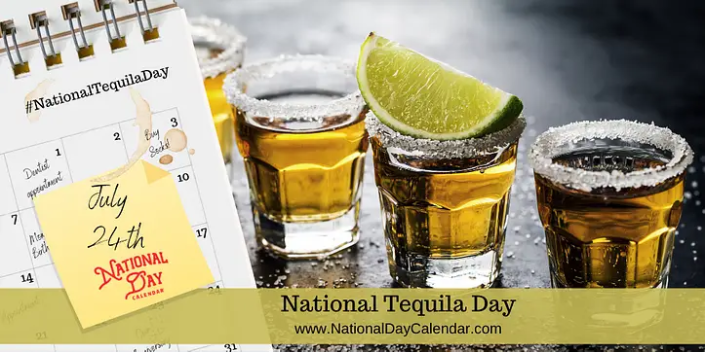
Well (scratching head), Flick Friday is a complete bust. There are no movie releases for today from 1950. Instead, I will highlight National Tequila Day. No, I’m not kidding. As a side note to the below, the listed Mamasita or Mamacita appears to be a Rum drink, not Tequila. But, who am I to argue. Drink up! ~Vic
Image Credit: National Day Calendar
One tequila, two tequila, three tequila, floor!
On July 24th, commemorate National Tequila Day with a little lime and salt. Mix up a Margarita, Paloma or a Mamasita to celebrate the day! People have been making Tequila for centuries and it was once known as mezcal wine. In fact, Tequila is mezcal but, mezcal isn’t Tequila. That’s because Tequila is distilled from a specific type of agave plant. Also, the law protects its production. Take a sip and we’ll travel into Tequila’s history.
History
It all started around the 16th century. Cortez [sic] arrived on the North American continent with his Spanish conquistadors. They didn’t care much for the fermented mezcal wine served to them. However, the Spanish introduced copper stills to the population. Enter the distilling process.
Image Credit: Win Calendar
Now, our story takes us to Tequila, Jalisco, Mexico. Located in a valley west of Guadalajara in Jalisco, Mexico, the town made a name for themselves by distilling Blue Agave. Even though a variety of succulents in Mexico produce mezcal, only one delivers the nectar to distill Tequila. Blue Agave grows in the highland region. Indeed, the unique growing conditions contribute to a larger size and sweeter tasting agave. In contrast, agave grown in the lowland regions taste and smell more herbal. In Mexico, the law protects the production of Tequila. The rule states Tequila is only Tequila if it is made within Jalisco. Additionally, the law limits production to regions in the states of Guanajuato, Michoacan, Nayarit and Tamaulipas. However, the same ingredients distilled anywhere else cannot be labeled Tequila.
Interestingly, many names in the Tequila business, today, were the very first commercial producers of Tequila. For example, José Antonio Cuervo held the first license for making the favored beverage. He kept a well-known company, too. Two other names include Don Cenobio Sauza and Félix López, whose businesses continue in some form today. Equally enjoyed in cocktails such as the margarita or Tequila Sunrise, connoisseurs savor a good Tequila like a good whiskey. As a result, savvy drinkers experience the smooth renaissance of Tequila. Surprisingly, it’s not the firewater they remember from their youth.
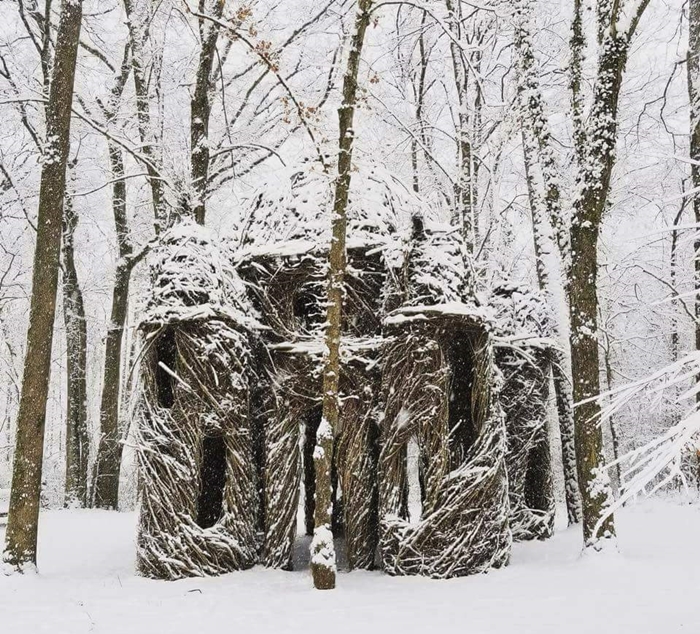
I’ve posted this sculpture twice, before…here & here. This will be my last installment as I only had a few shots and this shot isn’t even mine. This photo was part of a larger group of snow shots I posted about here & here.
Since it is SO HOT outside, I thought I would cool your mind a bit. ~Vic
Photo Credit: Tim Woody
(I have no idea who he is despite searching.)
From the January 2018 Snow Bomb
01-18-2018
Local cattle farm.
Lovely rolling hills.
09-04-2019Curious little one.
Moo.What?
05-02-2020Gotta go!Well…hello!
05-25-2020This little guy watched me walk by him. I got within six feet of him.
Photo Credit: Ken Lund
History & Headlines
Wikimedia
This was going to be a post on the highest recorded heat level, listed in the Guinness (Book) of World Records. Supposedly, one-hundred and seven years ago, today, Death Valley got up to 134.4℉. I read Wikipedia, I read Guinness and I read History & Headlines. If it made it into Guinness, someone must have thought it was legitimate. Well, after taking a dive into Weather Underground‘s investigation of this record (this is a very long read), posted by weather historian Christopher Burt on October 24, 2016, I’m not so sure this event ever happened.
I have contacted Guinness for a challenge. We shall see how this plays out. ~Vic
Update:
As it turns out, thanks to Pl@ntNet, this is an Iberis Umbellata or, Globe Candytuft. I think it may have already bloomed and the center colors are all that is left. It appears to be the same thing as my previous post.
This looks like a tiny bird nest with eggs. If anyone knows what this is, let me know. ~Vic
The adjective kaput:
“ruined, done for, out of order”
is used only in [a] predicate position, not in [an] attributive position. [T]hat is, you can only say “My car is kaput” but, not “I’ve got a kaput car.”
Kaput comes from the German colloquial adjective kaputt:
“broken, done for, out of order, (of food) spoiled”
which was taken from the German idiom capot machen, a partial translation of the French idioms faire capot and être capot:
“to win (or lose) all the tricks (in the card game piquet).”
Faire capot literally means “to make a bonnet or hood” and its usage in Piquet may be from an image of throwing a hood over or hoodwinking one’s opponent. Unsurprisingly, kaput became widely used in English early in World War I.
I find the word’s description, above, apropos to today’s insanity. And, if you are so inclined, a video for five minutes of your time. ~Vic














 Cosmic-Observation