wikipedia
Music Monday: Wait (Sarah McLachlan) 1994

Returning to my Samsung playlist, submitted for your approval…
“You know if I leave you now
It doesn’t mean that I love you any less
It’s just the state I’m in
I can’t be good to anyone else like this…”
The second track from the album Fumbling Towards Ecstasy, the song was never released as a single, so there is no chart data. The album, itself, reached #5 on the Canada Top Albums/CDs (RPM), #6 on the Canadian Albums (The Record), #50 on the US Billboard 200 and #102 on the Australian Albums (ARIA) chart.
The song “Wait” by Sarah McLachlan is a deeply emotional and poignant composition that delves into themes of love, loss and the passage of time. With her heartfelt lyrics and soulful melodies, McLachlan pulls at the heartstrings of listeners, conveying a raw sense of vulnerability and longing. The song explores a complex range of emotions, offering a profound reflection on the bittersweet nature of human connections.
BeatCrave
Bob Larson
October 9, 2023
This was a great album in totality. She is touring for the album’s 30th anniversary.
Lyrics (and meanings)
Throwback Thursday: Frank Eugene Corder 1994


Thirty years ago, today, Frank Eugene Corder stole a Cessna 150 and crashed it on the South Lawn of White House. He did not survive.
Born in Perry Point, Maryland, he was the son of an aircraft mechanic. Dropping out of high school in the 11th grade, he enlisted in the Army in October 1974 and was stationed in Kentucky & Colorado, trained as a mechanic. Honorably discharged in 1975, he was a truck driver from 1976 until 1993. Arrested for theft & drug dealing in the same year, he spent 90 days in rehabilitation. His third wife left him, shortly thereafter.
Apparently, Corder wanted the attention of, then, President Bill Clinton. It was speculated that Corder was trying to emulate Mathias Rust. On September 11, Corder, severely intoxicated, stole the plane from Hartford County Airport and was picked up by radar at Reagan National Airport just minutes before he steered into the White House wall. He died on impact at 1:49am. This event brought procedures to the forefront, as Corder was in restricted airspace.
Clinton was not in the White House at the time, due to renovations. He was staying at the Blair House.
Additional:
♦ Frank Eugene Corder: Crashing His Cessna (History On The Net)
♦ Crash At The White House (NYTimes)
♦ Suicide Suspected In Plane Crash (Los Angeles Times).
Story Sunday: Panjandrum Weapon

The Great Panjandrum at Westward Ho!
Wacky WW2-Era Failed Weapon
In 1941, the Government of the United Kingdom established a temporary wartime body called the Department of Miscellaneous Weapons Development (DMWD) to find new and unconventional ways to kill the enemy. Efforts from this department led to such useful inventions such as the Hedgehog anti-submarine weapon and Squid anti-submarine mortar, as well as the Holman Projector, an anti-aircraft rocket battery—and a system of degaussing used to protect ships against magnetic mines. It also led to the invention of the bouncing bomb that could skip across water to avoid torpedo nets and was used in the very successful Dambusters Raid of 1943. Above all, it played an important role in developing parts of the Mulberry Harbour used in the D-Day landings.
Despite these successes, not all of the DMWD’s projects were fruitful. An attempt to conceal the River Thames from German bombers, by covering it with soot, failed due to the effects of wind and tides, although it did cause some confusion when the coal-covered waters were mistaken for [a] tarmac during blackouts. The most disastrous project, however, was the Panjandrum. With a name inspired by a character in a nonsensical piece of prose from the 18th-century British dramatist Samuel Foote, the Great Panjandrum was doomed from inception. Constructed as a pair of large wheels, each approximately 10 feet in diameter, it featured a central steel drum carrying over a ton of explosives. Around the rims of the wheels were cordite rocket charges, designed to spin the entire device, propelling it towards the concrete beach defenses along the French coast with the intent of creating a substantial breach. The designers estimated that a fully loaded, 1,800-kg Panjandrum could reach speeds of around 60 mph (100 km/h), with enough momentum to crash through any obstacles between its launch point and target.
Trials began with only a handful of cordite rockets attached to the wheels and the payload was simulated by an equivalent weight of sand. The rockets were ignited and the Panjandrum catapulted itself forward, out of the landing craft used as a launchpad […] a fair distance up the beach. However, a number of rockets on one of the wheels failed, causing the weapon to careen off course. Despite several further attempts with more rockets, the Panjandrum consistently lost control before reaching the end of the beach.
Amusing Planet
Kaushik Patowary
July 5, 2024
Flick Friday: George Washington, Jr. 1924
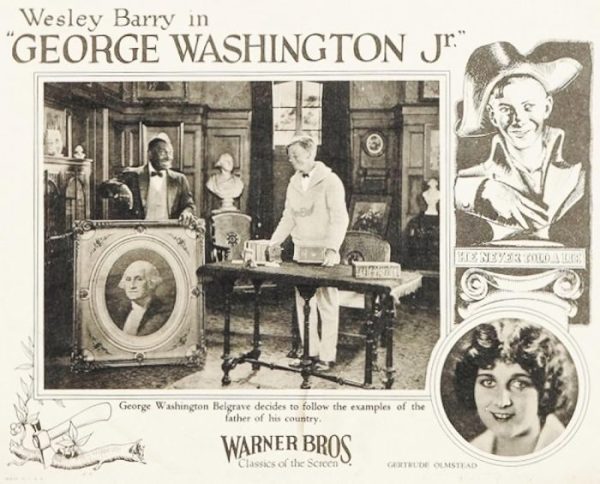
One hundred years, ago, today, the movie George Washington, Jr., was released. A black & white silent comedy film, it starred Wesley Barry, Gertrude Olmstead, Léon Bary, Heinie Conklin, Otis Harlan, William Courtright and Eddie Phillips. Based on the 1906 play by George M. Cohan, it was directed by Malcolm St. Clair, with the screenplay & story by Rex Taylor.
As described in a film magazine review, Count Gorfa, anarchist leader, steals the private records of a Senate Investigative Committee, the loss of which threatens the political fortunes of Senator Belgrave, whose daughter the Count wishes to wed. The Senator’s son, the young George Washington Belgrave and his friend Robert Lee Hopkins trail the anarchists. After many adventures and burlesques of historical fables, the documents are recovered and the Senator is saved.
A senator is trying to get his niece to marry a foreign count. The senator’s teenage son finds out that the count is not only a phony but, an international criminal. The boy sets out to break up the impending marriage, save his father from ruin and, his cousin from marrying a man she doesn’t love.
IMDb Storyline
George Belgrave is guided by George Washington’s principles of integrity and honesty. He exposes his cousin Dolly’s fiancé, Count Tyrola, to be a bogus count and an internationally sought criminal. [As] the leader of the Vassalini gang, [he] steals a secret treaty from George’s father, a United States senator. It is Tyrola’s intention to use the treaty to cause political strife in Bessarabia. George, his friend Bob, and Ham, the negro butler, subdue the Vassalini gang and, after recovering the treaty, lock them up. Tyrola’s treachery is revealed seconds before the wedding ceremony. George, to save his father embarrassment, tells his only lie in giving him credit for the whole “plan” to capture Tyrola. Cousin Dolly marries friend Bob.
This is a lost film. ~Vic
Trivia Bits:
♦ The original Broadway production of George Washington, Jr. opened at the Herald Square Theatre on February 12, 1906 and ran for 81 performances.
♦ The role of the servant Eton Ham was played by Conklin in blackface.
TCM: George Washington, Jr.
AFI: George Washington, Jr.
Exibitors Trade Review (Internet Archive)
Music Monday: Bedelia 1904
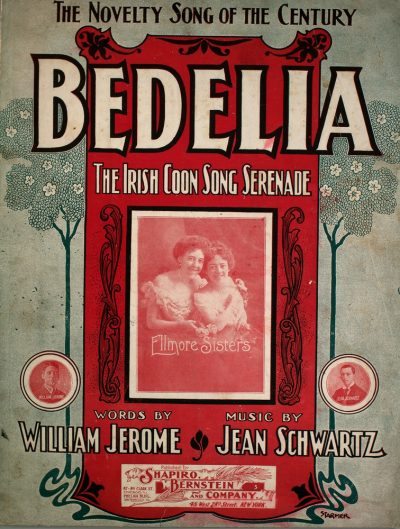
One hundred, twenty years ago, the Irish coon song serenade Bedelia was a number one song for the Haydn Quartet. According to TSort, this version of the song topped Billboard for eleven weeks. Written in 1903 by Jean Schwartz and William Jerome (Flannery), the song has been recorded many times by many singers.
Building songs around girls’ names has always been popular and this one may have been the most popular of this era. The sheet music bills the song as The Novelty Song of the Century and An Irish Coon Song Serenade. Coon songs were popular at the time but, steeped in racial stereotypes about African Americans. The song has more Irish influence than African American, so one assumes the publisher was trying to capitalize on the coon craze with the latter billing. The song was introduced by Blanche Ring playing the character of Liliandra in The Jersey Lily, which opened in September 1903. It was her first starring role on Broadway.
It is unclear who first recorded the song. Billy Murray [did a version that] went to #1. Considering his parents were Irish immigrants, it was fitting that Murray tackled the song, affecting a thick Irish accent to emphasize the song’s comedic nature. Murray’s was among four versions to chart in January 1904. It was quickly followed by a recording by the Haydn Quartet, which spent seven weeks at #1.
Throwback Thursday: Edward III 1327

Author: William Bruges (1375-1450)
Date: 1430 to 1440
Description: Illuminated Manuscript Miniature
Six hundred, ninety-seven years ago, today…
Edward III, also known as Edward of Windsor before his accession, was King of England from January 25, 1327, until his death in 1377. He is noted for his military success and for restoring royal authority after the disastrous and unorthodox reign of his father, Edward II. Edward III transformed the Kingdom of England into one of the most formidable military powers in Europe. His fifty-year reign was one of the longest in English history and saw vital developments in legislation & government, in particular, the evolution of the English Parliament, as well as the ravages of the Black Death. He outlived his eldest son, Edward the Black Prince and the throne passed to his grandson Richard II.
Edward was crowned at age fourteen after his father was deposed by his mother, Isabella of France and her lover Roger Mortimer. At the age of seventeen, he led a successful coup d’état against Mortimer, the de facto ruler of the country and began his personal reign. After a successful campaign in Scotland, he declared himself rightful heir to the French throne, starting the Hundred Years’ War. The first phase of the war […] would become known as the Edwardian War. Victories at Crécy and Poitiers led to the highly favorable Treaty of Brétigny […] and Edward renounced his claim to the French throne. Edward’s later years were marked by international failure and domestic strife, largely as a result of his inactivity and poor health.
Edward was born at Windsor Castle on November 13, 1312 and was described in a contemporary prophecy as “the boar that would come out of Windsor“.Wiki Summary
Flick Friday: The Heart Of Wetona 1919

One hundred, five years ago, today, the silent, adventure film The Heart Of Wetona was released. Directed by Sidney Franklin, it was written by Mary Murillo, basing it on a theatrical work by George Scarborough. Produced by Joseph M. Schenck, it starred Norma Talmadge (as Wetona), Fred Huntley, Thomas Meighan, Gladden James, F. A. Turner and Charles Edler.
“After the half-breed daughter of a Comanche Chief falls for a young engineer who deserts her, she turns to a white Indian agent who marries her.”
IMDb Short
“Wetona, the daughter of Indian Chief Quannah and a white mother, returns to her tribe after an education in a white school in the East, [only] to find herself torn between the two cultures of her heritage.”
IMDb Storyline
“The film tells the story of some Comanche Indians and their preparations for a Corn Dance. The father of Wetona finds out she loves a white man.
Wikipedia Plot
♦ Heart Of Wetona (World War One era song, sung by Wetona’s soldier)
Complete Movie
Music Monday: Victim Of Love (Eagles) 1976
For the New Year, I will be doing some blog-housekeeping. I have a tendency to stretch myself thin with headings and posts. I will be doing some consolidating. Song Sunday, News of the Day (NOTD) & Word of the Day (WOTD) are gone. I jettisoned some other headings about a year, ago. On to the show…~Vic

Returning to my Samsung playlist, submitted for your approval…
“Tell me your secrets, I’ll tell you mine…”
The second track, on side two, from the album Hotel California, Victim of Love was never released as a single. It was the B-Side to New Kid in Town, released December 7, 1976 and did get some airplay as an album track over the years.
By the time the Eagles reached the mid-1970s, they were on top of the world. They had been sorting their way through every rock trope they could think of and the album One of These Nights spawned three different singles. With success also comes pressure, though and the band had their backs against the wall when it came time to make Hotel California. When talking about making the concept for the album, Don Henley mentioned wanting to say something about the state of Hollywood, saying, “There’s a fine line between the American dream and the American nightmare.” The rest of the band were more than willing to comply, with Joe Walsh coming up with the original lick for Life in the Fast Lane on a whim.
Walsh had claimed to use the lick as a warm-up exercise but, it turned into its own piece once Glenn Frey got the title for the song. While guitarist Don Felder came up with the main chord progression for the title track, he had his sights on another song that he wrote for the album. Midway through recording, Felder said that he wanted to sing the track Victim of Love, which he claimed to have written by himself. As Henley remembers, what Felder presented the band with was just a collection of riffs, which was then turned into a song by Frey and J.D. Souther.
After one butchered take after the next, the band told Felder that it would be better if he didn’t sing the song, only for Felder to put his foot down. The band acquiesced and let Felder do his own take on the song but, they were also keeping a close eye on their manager as well. As the sessions were winding down, the band gave manager Irving Azoff a job…take Felder out to dinner while they re-recorded the entire track. When Felder found out that he was being erased from the song, he mentioned feeling betrayed…”It was like Don was taking that song from me. I had been promised a song on the next record.”
While Henley, to this day, disputes that there were no promises made to Felder, this started the dividing line between the band. As the touring got bigger and bigger, Felder started to get more resentful towards Frey and Henley for getting all of the songwriting royalties. By the time the band pulled into Long Beach for a benefit concert, Felder took it one step too far after making an off-handed remark to Senator Alan Cranston about the free show. Compared to the petty squabbling behind the scenes, there was audio taken of the infamous gig, which led to Frey and Felder threatening to kill each other onstage. When the house lights went out that night, Felder took his guitar, smashed it and drove off, never to be heard from again.
Once bassist Timothy B. Schmidt called Frey about the next rehearsals, he confirmed the worst. The band was history. The Eagles’ music may have reeked of California sunshine but, their final days ended with plotting, resentment and some of the worst drama a band could ask for.
Victim Of Love: The Song That Broke Up The Eagles
Tim Coffman
Far Out Magazine UK
February 12, 2023
♦The Treacherous Feud (Far Out Magazine UK/Arun Starkey/September 24, 2022)
Wayback Wednesday: Invasion Of Grenada 1983

Getty Image
Phil Kukielski
IINSTP
Forty years ago, today…this happened during my senior year of high school. I remember it well. I also enjoyed Heartbreak Ridge in 1986, even though the scene with the pay telephone and the credit card call for fire support, that actually happened, was the 82nd Airborne Division, not the Marines. ~Vic
The United States Invasion of Grenada began at dawn on October 25, 1983. The United States and a coalition of six Caribbean nations invaded the island nation of Grenada, 100 miles north of Venezuela. Code-named Operation Urgent Fury by the U.S. military, it resulted in military occupation within a few days. It was triggered by the strife within the People’s Revolutionary Government, which resulted in the house arrest and execution of the previous leader, [the] second Prime Minister of Grenada, Maurice Bishop, [leading to] the establishment of the Revolutionary Military Council, with Hudson Austin as chairman. The invasion resulted in the appointment of an interim government, followed by elections in 1984.
Wikipedia Summary
Grenada gained independence in 1974. Maurice Bishop became [Prime Minister] as a result of a coup in 1979 and, he had pursued left-wing policies with Soviet and Cuban aid since then. In Washington, D.C., he was seen as a communist collaborator and a new airport under construction in Grenada was deemed a transfer point for weapons destined for Latin American revolutionaries. Bishop’s assassination, by a more hard-line Military Revolutionary Council on October 19, 1983, was taken as the signal to act. Publicly justified by the need to protect U.S. students in Grenada, Operation Urgent Fury was hastily thrown together. The only resistance was likely to come from a contingent of Cubans, claimed to be construction workers by Havana.
♦ The Invasion of Grenada (The History Guy/April 20, 2019)
♦ Operation Urgent Fury: The 1983 US Invasion of Grenada (War History Online/Nikola Budanovic/December 2, 2017)
♦ How Grenada Reshaped The US Military (Informal Institute For National Security Thinkers & Practitioners/Phil Kukielski/September 8, 2013)
US Invades Grenada AP Archive
Heartbreak Ridge Trailer
Music Monday: T’ain’t Nobody’s Business If I Do 1923
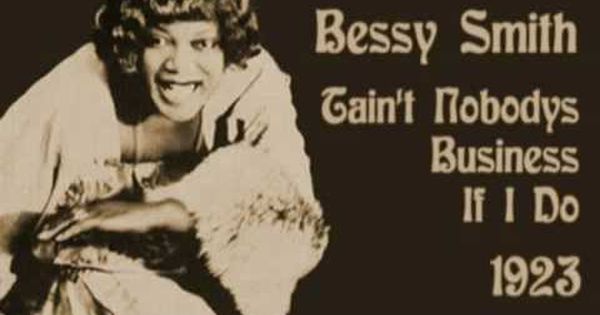
Digging around in Tsort, I was looking for something in 1923 in October. I was not disappointed. T’ain’t Nobody’s Business If I Do was published, originally, in 1922 by Porter Grainger and Everett Robbins, according to the Encyclopedia of the Blues. It was first recorded by an Anna Myers with the Original Memphis Five.
Other recordings were done by Alberta Hunter, Sara Martin and Billie Holiday but, Bessie Smith did her own take.
The most popular of the classic blues singers was Tennessee-born Bessie Smith, who first recorded in 1923. Known as the Empress of the Blues, she possessed a large voice. Smith had toured on the T.O.B.A. circuit since 1912, originally as a chorus girl. By 1918, she was appearing in her own revue in Atlantic City, New Jersey. She struggled, initially, to be recorded. Three companies turned her down before she was signed by Columbia. She eventually became the highest-paid black artist of the 1920s and recorded over 160 songs. Inducted into the Rock and Roll Hall of Fame in 1989, she is often regarded as one of the greatest singers of her era and was a major influence on fellow blues singers, as well as jazz vocalists.
Wikipedia Summaries
With a theme of freedom of choice, some of the lyrics are pretty tough. Per Tsort, this was the top song for a week per US Billboard 9, October 1923. In 1928, guitarist Frank Stokes recorded a country blues version. In 1947, jump blues singer Jimmy Witherspoon did a version titled Ain’t Nobody’s Business, reviving the song and it was the best selling record of 1949. Hank Williams, Jr. recorded his own version of the song for his 1990 album Lone Wolf, peaking at #15 on Billboard’s Hot Country Singles & Tracks chart. In 1996, a version by H2O, featuring Billie Piper got to #19 on the UK Singles chart. ~Vic
The B.B. King Reader: Six Decades of Commentary
Ain’t Nobody’s Business (The Blues Foundation)
NOTD: Taylor Swift Amnesia
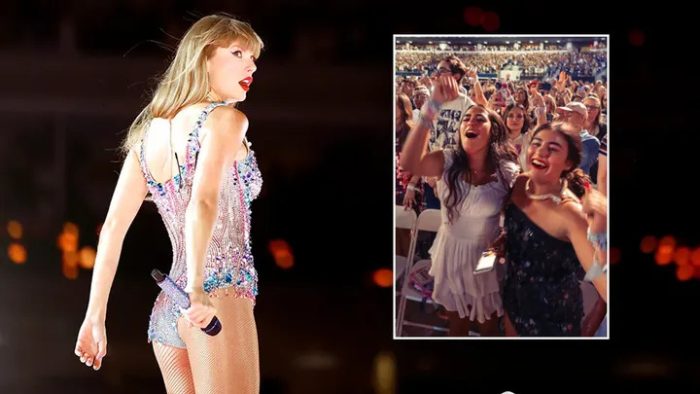
Many Swifties are experiencing a post-concert “blank space.” Fans of international pop star Taylor Swift have reported a lack of memory after attending Eras Tour concerts, with some saying they’re even forgetting chunks of her performance. Experts at Hackensack Meridian Health in New Jersey researched why concertgoers are experiencing blackouts after their big night out. Dr. Nathan Carroll, associate chief resident psychiatrist at Hackensack Meridian Jersey Shore University Medical Center, linked the memory loss after concerts to a neurological condition called transient global amnesia (TGA).
“TGA is a rare phenomenon impacting memory,” the researcher told Fox News Digital. “Individuals who experience TGA will attend an event, like a concert, wedding or festival and, later, report undeniable gaps in their memory,” he said. “This type of memory loss is different from normal forgetfulness,” Carroll said. “For example, during the event, it may look like you’re acting normally and answering questions but, later, you may not recall some of your conversations,” he said. “Unlike other amnesias, memory loss is very limited, only lasting about a day and, people don’t forget [autobiographical] information.” TGA can develop due to elevated blood pressure, strenuous physical activity and emotional excitement, which Carroll said are all “theorized to temporarily impair the functioning of the memory center of our brain, the hippocampus.” “What’s interesting is that the concertgoers are only recognizing the memory loss post-event,” he said. “They actually experience TGA during the event but don’t realize it at the time.”
What Is Taylor Swift Amnesia?
Angelica Stabile
Fox News
October 7, 2023
So, concertgoers are experiencing undeniable gaps in their memories. Poor Taylor. All that work to entertain and no one remembers seeing her perform. It brings a tear to me eye. ~Vic
News of the Day
Wayback Wednesday: Leaning Tower Of Pisa 1173

Photographer
Source
Wikimedia Commons
04-02-2022
Eight hundred, fifty years ago, today…
The Leaning Tower of Pisa (torre pendente di Pisa…in Italian) is the campanile or freestanding bell tower of Pisa Cathedral. It is known for its nearly four-degree lean, the result of an unstable foundation. The tower is one of three structures in the Pisa’s Cathedral Square, which includes the cathedral and Pisa Baptistry. The tower has 296 or 294 steps. [The] seventh floor has two fewer steps on the north-facing staircase.
The tower began to lean during construction in the 12th century, due to soft ground, which could not properly support the structure’s weight. It worsened through the completion of construction in the 14th century. By 1990, the tilt had reached 5.5 degrees. The structure was stabilized by remedial work between 1993 and 2001, which reduced the tilt to 3.97 degrees.
Construction of the tower occurred in three stages over 199 years. On January 5, 1172, Donna Berta di Bernardo, a widow and resident of the house of dell’Opera di Santa Maria, bequeathed sixty soldi to the Opera Campanilis petrarum Sancte Marie. The sum was then used toward the purchase of a few stones which still form the base of the bell tower. On August 9, 1173, the foundations of the tower were laid. Work on the ground floor of the white marble campanile began on August 14 of the same year, during a period of military success and prosperity.
The tower began to sink after construction had progressed to the second floor in 1178. This was due to a mere three-meter foundation, set in weak, unstable subsoil, a design that was flawed from the beginning. Construction was subsequently halted for the better part of a century, as the Republic of Pisa was almost continually engaged in battles with Genoa, Lucca and Florence. This allowed time for the underlying soil to settle […], [otherwise], the tower would almost certainly have toppled.
There has been controversy surrounding the identity of the architect […]. For many years, the design was attributed to Guglielmo and Bonanno Pisano […]. A 2001 study seems to indicate Diotisalvi was the original architect, due to the time of construction and affinity with other Diotisalvi works, notably the bell tower of San Nicola and the Baptistery, both in Pisa.
Between 1589 and 1592, Galileo Galilei, who lived in Pisa at the time, is said to have dropped two cannonballs of different masses from the tower to demonstrate that their speed of descent was independent of their mass, in keeping with the law of free fall.
During World War II, the Allies suspected that the Germans were using the tower as an observation post. Leon Weckstein, a U.S. Army sergeant sent to confirm the presence of German troops in the tower, was impressed by the beauty of the cathedral, and its campanile and […] refrained from ordering an artillery strike, sparing it from destruction.
The tower has survived at least four strong earthquakes since 1280. A 2018 engineering investigation concluded that the tower withstood the tremors because of dynamic soil-structure interaction. [The] height and stiffness of the tower, combined with the softness of the foundation soil, influences the tower’s vibrational characteristics in such a way that it does not resonate with earthquake ground motion. The same soft soil, that caused the leaning and brought the tower to the verge of collapse, helped it survive.
Wikipedia Summary
***The ceremony, for the 850th anniversary of the foundation of the Tower of Pisa, was started, today and runs all year to August 9, 2024.
850th Anniversary (Turismo.Pisa.it)
OPE (Opapisa.it/en/)
The Leaning Tower Of Pisa Was Once Tilting Dangerously (CNN/Sharon Braithwaite/August 9, 2023)
NOTD: Found Pearl Becomes Engagement Ring
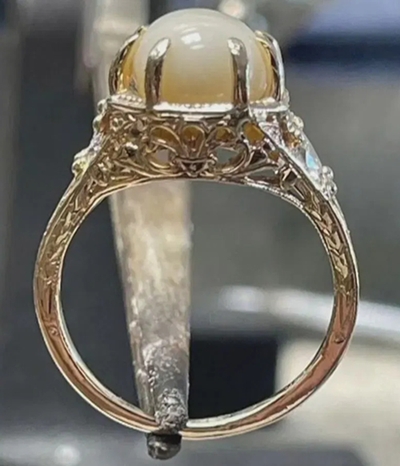
A Rhode Island woman found a pearl in a clam she was served at a restaurant and it ended up becoming her engagement ring. Sandy Sikorski and Ken Steinkamp said they were dining at The Bridge Restaurant and Raw Bar in downtown Westerly, with Sikorski’s brother and his wife in December 2021, when Sikorski ate the last of the quahog clams.
“That’s when I tasted this big round thing in my mouth. I’m thinking, ‘What the heck is this?’ So, I take it and spit it down on the table, in my hand, and my sister-in-law says, ‘Is that a tooth?'”
Sikorski’s sister-in-law, a jewelry enthusiast, soon surmised [that] the object was a 9.8 millimeter pearl. Marc Fishbone of Black Orchid Jewelers examined the object and confirmed the suspicions.
“He said it is called a Mercenaria pearl, which is a mollusk type of little animal, which makes what looks like a little pearl. It’s made out of the same material, calcite, and another mineral […]. [It] takes years and years to grow,” Sikorski said. “He said the weight of this and the size of this, [it} probably [took] 50 years to make.”
Sikorski and Steinkamp agreed that, if they ever decided to get married, they would have the pearl made into an engagement ring. That plan came to pass when Steinkamp proposed July 8, using a ring Fishbone had fashioned with the pearl as its stone. The couple celebrated their engagement by returning to the restaurant […].
UPI Odd News
Pearl Found In Clam
Ben Hooper
July 27, 2023
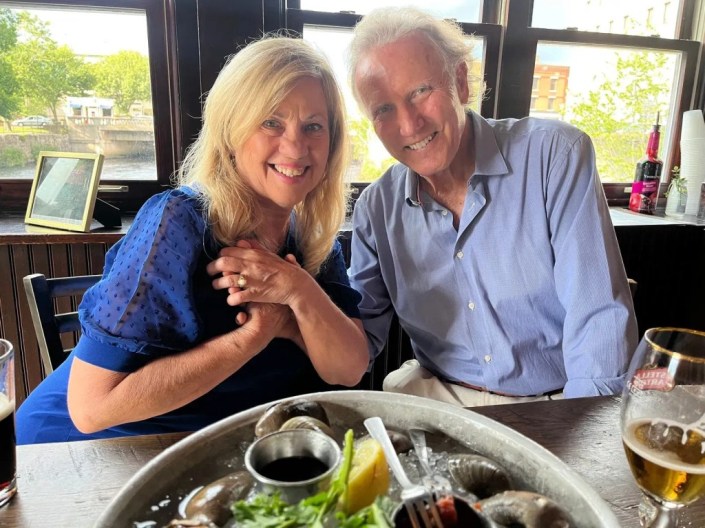
A Westerly woman feels like the luckiest girl in the world for two reasons. For the past four years, Sandy Sikorski and Ken Steinkamp have been regulars at The Bridge Restaurant and Raw Bar in downtown Westerly. For years, the restaurant, which looks over the Pawcatuck River, has offered deals on seafood.
“We come here often to get the clams,” said Sikorski. “They’re bigger, they come on platters, upraised, they have great horseradish and everything I love about it…they taste delicious.”
There was one [clam] left.
“What are the odds of a pearl being inside of this shell?” said Sikorski.
The perfectly shaped oval had been hiding in the meat of the clam. Sikorski held on to the […] pearl and became curious about it. First, she brought it to The Compass Rose in Westerly. The owner there took a look and referred her to their jewelry maker, Marc Fishbone, of Black Orchid Jewelers.
“Wow, you got a beauty there. It’s heavy,” stated Fishbone. “It’s probably one in a million, one in a million to have it perfect […]. [U]sually, there’s pieces of them missing and it looks like a tooth or something […]. [I]t is never like a whole, perfect little oval. Plus, it’s big.”
According to several online articles, the odds of finding one in a clam are about one in 100,000.
They wanted Fishbone to make the setting.
“[I] want it to be the most beautiful setting you’ve ever made and I like gold,” said Sikorski. “I didn’t want a hole in the bottom of the stone, I just wanted it secured.”
Steinkamp, who asked Sikorski’s dad for approval first, got down on one knee and popped the question with the beautiful ring in hand.
“[W]e’re not getting any younger and we felt, in a way, that this was kind of a signal or an odd bit of synchronicity,” said Sikorski. “It’s beautiful. It has diamonds, and a sparkle, and I know minerals are becoming more fashionable gemstones vs. a big diamond thing.”
She hopes to eventually pass the ring off to her 8-year-old granddaughter, Nora.
Westerly Woman Finds Rare Pearl
Sam Read
NBC 10 News
July 25, 2023
News of the Day
Music Monday: Hello Central! Give Me No Man’s Land 1918

One hundred, five years, ago…
Hello Central! Give Me No Man’s Land is a World War I era song released in 1918. Lyrics were written by Sam M. Lewis and Joe Young. Jean Schwartz composed the music. The song was published by Waterson Berlin & Snyder, Co. of New York City. Artist Albert Wilfred Barbelle designed the sheet music cover, which features a photo of Al Jolson next to a shadow of a child on the phone. Explosions in No Man’s Land take up the rest of the red background. The song was written for both voice and piano. It was first introduced in the 1918 musical Sinbad.
The song tells the story of a child attempting to call her father in No Man’s Land. She is unable to reach him over the telephone because her father has been killed fighting on the Western Front.
Wikipedia Summary
There is very little else written about this song. When I have gone to the Tsort charts, with these older pieces, I have usually chosen whatever was at the top of the particular chart, for the particular year. This time, I looked, specifically, for this month in 1918. According to (old) US Billboard 1, this song was on the chart for eight weeks. ~Vic
♦ The New York Public Library Digital Collections
♦ Library of Congress
♦ Smithsonian: National Museum Of American History
♦ WorldCat
♦ First World War: Multimedia History (Web Archive)
Throwback Thursday: Japan Airlines Flight 404 1973

Date: August 19, 1983
Source: Air Britain Photo Library
Similar plane to the hijacked one.
Acquired: Wikimedia Commons
Fifty years ago, today…
Japan Air Lines Flight 404 was a passenger flight which was hijacked by Palestinian and Japanese terrorists on July 20, 1973. The flight departed Amsterdam-Schiphol International Airport, Netherlands, […], en route to Tokyo International Airport […], Japan, via Anchorage International Airport, Alaska. The aircraft was a Boeing 747-246B, with 123 passengers and 22 crew members on board. The passenger complement included five terrorists, led by Osamu Maruoka, a member of the Japanese Red Army and the other four were members of the Popular Front for the Liberation of Palestine.
The flight was hijacked shortly after takeoff from Schiphol. In the course of the hijacking, a grenade carried by one of the skyjackers detonated, killing her and injuring the flight’s chief purser. The lead hijacker […] immediately announced himself to air traffic control as El Kassar, hijacking the aircraft in the name of the Palestinian Liberation movement. After several Middle Eastern governments refused to permit Flight 404 to land, the plane eventually touched down in Dubai, in the United Arab Emirates. After several days on the ground, the terrorists demanded the release of Kozo Okamoto, survivor of the JRA’s attack on Tel Aviv’s Lod Airport.
After the Israeli government refused to release Okamoto, the hijackers flew the aircraft first to Damascus, Syria, and then to Benghazi, in Libya. On July 23, 89 hours after the hijacking began, the passengers and crew were released. [The] hijackers then blew up the aircraft, making the incident the second hull loss of a Boeing 747. The first hull-loss was also the result of hijackers. Maruoka escaped and in 1977, led the hijacking of Japan Air Lines Flight 472. He remained a fugitive, until 1987, when he was arrested in Tokyo after entering Japan on a forged passport. Given a life sentence, he died in prison on May 29, 2011.
Wikipedia Summary
The Skyjackers Strike Again (Time Magazine/07-30-1973/Wayback Machine)
Skyjackers: Part II (Time Magazine/07-30-1973/Wayback Machine)
Chronology Of Aviation Terrorism: 1968-2004 (Skyjack Chronology/Dr. Hillel Avihai/Wayback Machine)
Aviation Safety Network Database (JL404/Aviation Letter 184/07-23-1973)
Ex-Red Army Member Maruoka Dies (The Japan Times/05-30-2011)
July 22
July 25
July 26
 Cosmic-Observation