Author: The Hinoeuma
POTD: Smoke Break

08-30-2020
Picture of the Day
I want Carrie’s boots…
Music Monday: Premier Livre de Pièces de Clavecin 1706
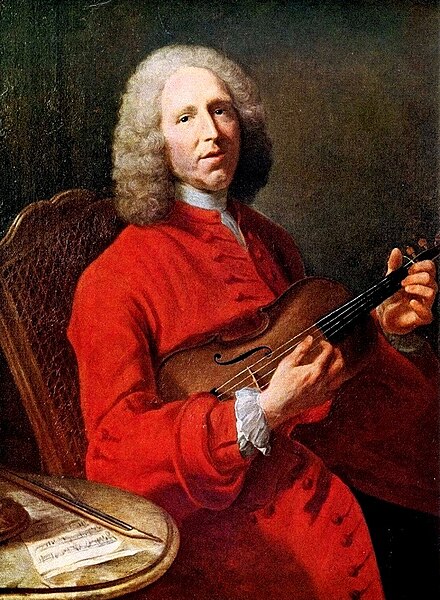
Collection: Musée des Beaux-Arts de Dijon
Image Credit: Wikipedia & Wikimedia
The French Baroque composer Jean-Philippe Rameau wrote three books of Pièces de clavecin for the harpsichord. The first, Premier Livre de Pièces de Clavecin (first book of harpsichord pieces), was published in 1706. [T]he second, Pièces de Clavessin, [was] in 1724. [T]he third, Nouvelles Suites de Pièces de Clavecin, [was] in 1726 or 1727. They were followed in 1741 by Pièces de clavecin en concerts, in which the harpsichord can either be accompanied by violin (or flute) and viola da gamba or played alone. An isolated piece, La Dauphine, survives from 1747.
Jean-Philippe Rameau was one of the most important French composers and music theorists of the 18th century. He replaced Jean-Baptiste Lully as the dominant composer of French opera and is also considered the leading French composer of his time for the harpsichord, alongside François Couperin.
Little is known about Rameau’s early years. It was not until the 1720s that he won fame as a major theorist of music with his Traité de L’harmonie Réduite à ses Principes naturels (1722…Treatise on Harmony reduced to its natural principles) and also in the following years as a composer of masterpieces for the harpsichord, which circulated throughout Europe. He was almost 50 before he embarked on the operatic career on which his reputation chiefly rests today.
Rameau’s music had gone out of fashion by the end of the 18th [C]entury and it was not until the 20th [Century] that serious efforts were made to revive it. Today, he enjoys renewed appreciation with performances and recordings of his music ever more frequent.
Wikipedia Summaries
Additional Reading:
Jean Philippe Rameau (Atlanta Symphony Orchestra)
Jean-Philippe Rameau (Britannica)
Treatise On Harmony (CMuse)
Jean Philippe Rameau (Find A Grave)
Jean-Philippe Rameau Biography (The Famous People)
POTD: Dimorphotheca
In the Asteraceae family, the species is Ecklonis but, known, commonly, as Cape marguerite, Van Staden’s river daisy, Sundays river daisy (apropos), white daisy bush, blue-and-white daisy bush or star of the veldt. Whew! ~Vic

Picture of the Day
Shutterbug Saturday: Land of Oz 2.0

Previous Post: Land of Oz
When the Land of Oz opened, Debbie Reynolds and her daughter, Carrie Fisher, were on hand for the ribbon cutting. Sadly, the owner of the park, Grover Cleveland Robbins, Jr., passed away due to cancer in March, prior to the opening in June 1970. His brother Harry carried on in their company Carolina Caribbean Corporation. Robbins created the Tweetsie Railroad Wild West Amusement Park.
Their father, Grover Cleveland Robbins, Sr., was the Mayor of Blowing Rock, NC (several terms), served as the postmaster, started the Chamber of Commerce in 1922 and helped start the first high school there. Our Blue Ridge Parkway, here in NC, is because Robbins, Sr., was sent to Washington, D.C., by our, then, Governor, to make sure it would not be built in Tennessee.
The designer of the Theme Park was Jack Pentes, a Korean War veteran and, creator of Carolina Clowns and soft-play equipment.


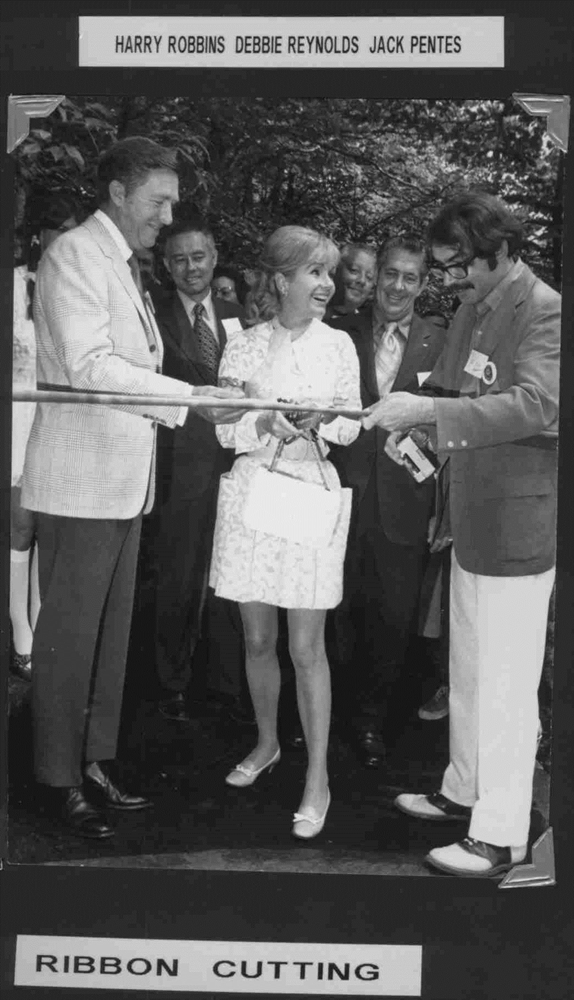

Land of Oz (Official Site)
Additional Reading:
Five Interesting Things (North Carolina Field & Family)
That Abandoned Wizard of Oz Theme Park? (Popsugar)
Ribbon Cutting: The Robbins Trail (Watauga Democrat)
Throwback Thursday: Mumtaz Mausoleum 1631

Wikipedia
Mumtaz Mahal (exalted one of the palace), born Arjumand Banu Begum, was the Empress consort of the Mughal Empire, from January 19, 1628 to June 17, 1631, [and] chief consort of the Mughal emperor Shah Jahan.
[Born] to a family of Persian nobility, [she] was the daughter of Abu’l-Hasan Asaf Khan […]. She was married at the age of 19 [in 1612] to Prince Khurram, [later named] Jahan, [becoming] his second wife. [They] had fourteen children, including Jahanara Begum […] and the Crown prince Dara Shikoh [..]. Shikoh was, eventually, deposed by younger sibling Aurangzeb.
Three hundred, ninety years ago, today, Mumtaz Mahal died [from a postpartum hemorrhage] in Burhanpur, Deccan (present-day Madhya Pradesh), during the birth of her fourteenth child, a daughter named Gauhar Ara Begum. Her body was temporarily buried at Burhanpur in a walled pleasure garden known as Zainabad […].
[The] emperor was reportedly inconsolable. Apparently, after her death, he went into secluded mourning for a year. When he appeared again, his hair had turned white, his back was bent and his face worn. Mumtaz’s eldest daughter, Jahanara […], gradually brought her father out of grief and took her mother’s place at court.
[Shah Jahan] began planning the design and construction of a suitable mausoleum and funerary garden in Agra for his wife. It was a task that would take 22 years to complete: The Taj Mahal.
Wikipedia Summaries
Additional Reading:
The Myth of the Taj Mahal and a New Theory of It’s Symbolic Meaning (College Art/Wayne E. Begley/PDF)
POTD: Montiaceae
Genus is Claytonia, species is Virginica and common names are Virginia springbeauty, Eastern spring beauty, grass-flower or fairy spud. I like the last one. ~Vic

Picture of the Day
TV Tuesday: Nat Hurst, MD 1976

School of Medicine & Dentistry
Photo Credit: Dread Pirate Westley
Wikipedia
Forty-five years ago, today, the one-hour documentary Nat Hurst, MD: 20th Century American Physician aired on TV (network unknown). Written and directed by Raúl daSilva, it was produced and narrated by Jerry Carr.
The life of prominent African American medical doctor, Nathaniel Hurst, who rose from a poor family to the presidency of both a major hospital and the Monroe County Medical Association.
There is very little written about this production but, I did manage to dig up some data on Nat. ~Vic
Nat received his M.D. from the University of Rochester School of Medicine and Dentistry in 1954. He did his internship and residency in internal medicine at Rochester General Hospital. He entered private practice in 1958.
In 1976, Nat was installed as the first African-American president of the Monroe County Medical Society. In 1981, he received the Edward Mott Moore Award, the Medical Society’s highest honor and The Community Leadership Award of the Urban League of Rochester.
Nat was an expertise [sic] in geriatrics, pioneering a number of innovative programs. His interests included giving time to such projects as the Sickle Cell Anemia Project, the Inner City Health Council and the Catholic Interracial Council
Nat left an indelible imprint on Rochester’s medical community, first as an internist in the late 1950s and then as vice president, and president, of the former Park Avenue Hospital medical staff. He is credited with major involvement in the planning, building and operating of Park Ridge Hospital and Nursing Home. He later became director of the hospital’s internal medicine department and subsequently medical director of Park Ridge Hospital.
Birth: December 11, 1919, Suffolk City, VA
Death: December 22, 2000, North Carolina
Buried: White Haven Memorial Park, Pittsford, NYDr. Nathaniel John Hurst
Find A Grave Memorial
POTD: Strange Fish
On an evening walk, I passed by our local Board of Elections. This was sitting at the corner of the steps. I wasn’t sure if I was going to laugh or run away. ~Vic

Picture of the Day
Snapshots Sunday: Old Car
Update: I found a couple more pictures…
These were taken in downtown Georgetown, Texas, the County Seat of Williamson County. About a month later, I left Texas and returned to NC. ~Vic

04-09-2011




1931

POTD: Lavandula
This is broad-leaved lavender or spike lavender or Portuguese lavender. ~Vic

05-26-2019
Picture of the Day
Hans 2021 Movie Draft: Round Twelve-Pick Four-Tron 1982

Hanspostcard has a movie draft challenge. This is my Round Twelve and final pick. Thanks for the invitation, Hans!
Category: Sci-Fi/Fantasy
Film: Tron
This has been my worst category as I love science fiction anything. I have struggled over these past six months trying to pick just one. My choice would change, daily. I finally settled on one that is part of my teen years and became a cultural cult classic. I still have the sticker that I got when I went to see this at the theater in 1982. Like The Breakfast Club, this movie means something to me. Released the summer before my junior year, this movie got me interested in computers and graphics. There is also the memory of a scene I saw in the original release at the theater, that disappeared in subsequent showings on HBO, TV and the VHS tapes, and made me crazy:
The 20th Anniversary DVD edition includes a deleted love scene: Tron and Yori go to her apartment, where she pushes a button on the wall. [T]he walls [disappear] and her uniform changes into a different costume. Also included are a partially completed “morning after” scene…(all dialog tracks for this short scene are lost).
All the data on the Internet states that the scene was removed from the final cut. I beg to differ. I distinctly remember seeing them go to her “apartment.” That being said, what I remember from the scene is a little different from the “official deleted scene” (she glowed, her hair was blowing around and her helmet floated off her head). I think a shortened version of that scene was released to theaters and when the movie was released to HBO & VHS tapes, they wiped all of it out. This is a very clear memory. The prologue to the movie, when released to theaters, was also removed. The “original” opening monologue (that I’ve never heard) was restored in the 20th Anniversary DVD. ~Vic

Directed by Steve Lisberger, the screenplay was written by Charles S. Haas & Lisberger, adapted from the original story by Bonnie MacBird (whom is married to DARPA-connected computer scientist Alan Kay). Produced by Donald Kushner, it starred Jeff Bridges, Bruce Boxleitner, David Warner, Cindy Morgan, Barnard Hughes, Dan Shor and Peter Jurasik and, was released July 9.
Kevin Flynn is a software engineer and an ex-employee at ENCOM. He runs a video arcade and tries to hack into ENCOM’s mainframe, looking for proof that his video games were plagiarized. The Master Control Program stops him. Programmer Alan Bradley and engineer Dr. Lora Baines, his girlfriend, discover that they have lost access to their projects. When Alan questions Senior Exec. VP Ed Dillinger about the restriction, Dillinger states that extra security is needed to stop outside hacking. When Alan leaves, Dillinger asks the MCP about the issues and realizes that the MCP has become a power-hungry virtual intelligence. Dillinger is blackmailed into complying with the MCP’s wishes due to his theft of Flynn’s material. Alan, Lora & Flynn break into ENCOM and Flynn winds up digitized inside the mainframe when the MCP uses an experimental laser to dissect him. Flynn must navigate his way around a strange digital landscape where all the programs resemble the users that created them and find his way back out.

(high school classmate).
Trivia Bits:
♦ [T]he Motion Picture Academy refused to nominate Tron for a special-effects award because, as director Steven Lisberger put it, “The Academy thought we cheated by using computers”.
♦ Originally MacBird envisioned Flynn more comedically, suggesting the then-30-year-old Robin Williams for the role.
♦ Bruce Boxleitner and Peter Jurasik would later work together on Babylon 5.
♦ Nine script revisions caused bitter credit disputes.
♦ Though it made $50 million from a $17 million budget and had $70 million in merchandise sales, it was considered a financial failure.
♦ The ENCOM laser bay was real. It was actually the target bay for the twenty-beam SHIVA solid-state laser facility at the Lawrence Livermore National Laboratory
♦ The soundtrack was primarily composed by Wendy Carlos with two additional tracks provided by Journey after Supertramp had to leave the project.
Additional Reading:
Bruce & Cindy Discuss Deleted Scenes (Beyond The Marquee/12-24-2013)
Tron Then and Now (Digital Content Producer/Archive/07-07-2012)
Deleted Love Scene (Fandom Wiki)
Tron 30th Anniversary Screening Review (Nuke The Fridge/10-30-2012)
Tron’s 20th Anniversary (SFGate/01-09-2002)
End of line…
Opening Scene (Missing Prologue)
Officially Deleted Scene
Bruce Boxleitner & Cindy Morgan @ California Convention
(helmets coming off mentioned) 11-16-2013
POTD: Big Chair

I think it is this rocking chair.
I could only photograph from a distance.
10-21-2020
Picture of the Day
Wayback Wednesday: Athenian Coup 411
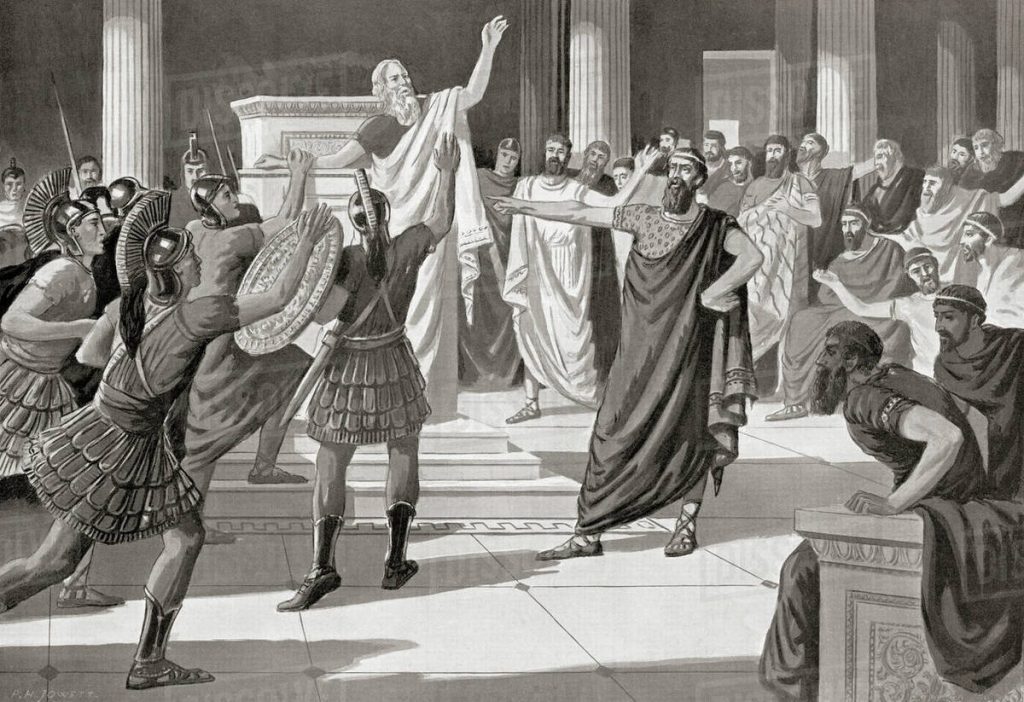
The Athenian Coup of 411 BC was a revolutionary movement during the Peloponnesian War between Athens and Sparta that overthrew the democratic government of ancient Athens and replaced it with a short-lived oligarchy known as The Four Hundred. The movement was led by a number of prominent and wealthy Athenians who held positions of power in the Athenian army at Samos, in coordination with Alcibiades (and Antiphon) who promised to deliver Persian support to Athens if the democracy was overthrown. Negotiations with Alcibiades eventually broke down as he proved incapable of delivering his promise. Nevertheless, the leaders of the oligarchic movement went forward with their plans to overthrow Athenian democratic government.
The Four Hundred government in Athens suffered from instability as conflict soon arose between moderates and extremists among the oligarchs. The moderates, led by Theramenes and Aristocrates, called for the replacement of The Four Hundred with a broader oligarchy of “the 5,000” […]. After the leader of the extremists Phrynichus was assassinated, the moderates grew bolder and arrested an extremist general in Piraeus. A confrontation ensued, which ended with the hoplites in Piraeus tearing down the new fortification. Several days later, the Four Hundred were officially replaced by “the 5,000”, who ruled for several more months until after the Athenian victory at Cyzicus.
Additional Reading:
The Oligarchic Coup in Athens (Brewminate Blog)
Council of the Four Hundred (Britannica)
The Oligarchic Coup of 411 (Thomas R. Martin/Tufts University)
Athenian Coup of 411 (Wikipedia)
POTD: Silk Tree
Fabaceae family, Mimosoideae clade, Albizia genus and Julibrissin species. It is commonly referred to as a Mimosa tree but, that isn’t quite right. It’s also called a Persian silk tree, a pink silk tree and a pink siris. North Carolina State University considers it to be invasive. It’s still pretty and it smells so good. ~Vic

Picture of the Day
 Cosmic-Observation