As we begin our return to being a full “Human Being”, many people’s thoughts are turning to the Earth and wanting to help to re-awaken Her consciousness. Whilst these thoughts are, on the face of it, admirable, the question arises as to whether the Earth actually requires our assistance or not? Does She require to be re-awoken or have some people misread the situation? The main problem is one of scale. If you look at the photograph, above, you will see, through the clouds, North and South America in their place within the oceans and, the sphere of the Earth. What is not shown in the photograph is any thing to do with man. Even our cities are too small to register within the continents, let alone individual people. Yet, the photograph encompasses the whole of the Earth. In other words, on the scale at which the Earth exists, humans, along with all of our endeavours, do not even register.
The Earth is a soul, a consciousness, who has survived through many trials and disasters in order to fulfil Her promise. She is an immense consciousness capable of acts of Creation unseen in any other region of our Universe. Throughout the whole of Her existence, She has nurtured life and, in particular, nurtured humanity to the point where we can fulfil our own promise and potential. We are tiny, insignificant souls in comparison to the immensity of the Earth’s own soul and, yet, human arrogance has led many to believe that the Earth needs our help at this time of change.
All loving thoughts that humans direct towards the Earth are, obviously, appreciated by Her but, we must remember the difference in scale, the difference in soul potential, that exists between humans and the Earth. In all of the [many] millennia of Her existence, She has never slept and, She has never forgotten the life that relies on Her for their physical presence and well-being. As humans begin to fulfil our potential, in terms of soul re-integration, She is with us. She is supporting us and, She is providing all of the love and nurture that we humans will allow Her to give to us. But, we live in a Universe that is founded on the energies of freedom of choice and, so, Her activities and support are limited by how much we choose to let Her do on our behalf.
If we throw back Her help, such as by attempting to build “portals”, it holds Her back. If there was a need for “portals” that opened gateways to regions outside of the solar system, She would have already built them for us. The fact that they do not exist is very clear evidence that those who have asked for the portals to be built are not working with the Earth but, against Her. Another recent request that has arisen from those who are not working with the Earth has been to “charge up the Earth’s crystal deposits”. In order to help us with all of the energies we require to make our consciousness change, the Earth energised all of Her crystal deposits on the 2nd of August 2004. The recent call to “charge up the crystals” was an attempt to take control of the energies, that are helping people, away from the control of the Earth and transfer all of that energy into the control of a race that does not have the Earth’s, or humanity’s, best interests at heart.
To understand just how much the Earth is doing to help and guide people through our soul re-integration, we need to take a brief look at what She has done in the past to bring us to the point where we can now, at long last, begin to be ourselves and, return to being true Human Beings once again. In understanding Her role and the extent of Her desire for true Human life, we can also begin to understand that we are the masters of our own destiny and, that, we do not need help from anywhere or anyone other than from the Earth Herself.
Earth History
Our solar system was deliberately designed to be an experiment. The purpose of this experiment was to determine whether life at the energies we consider to be physical could actually exist. Throughout the Universe, many, many billions of souls exist. Some are souls that make up galaxies, some are souls that make up solar systems, some souls are more or less “human sized” but, have no physical density at all and some are also more or less “human sized” but, do have physical bodies that are considerably less dense than human bodies. So, there was a form of life that was missing…“physical” life-forms that live on “physical” planets. This is the purpose of our solar system…to explore the possibilities offered by being physical.
A region of an outlying galaxy was selected to be the host for this physical experiment where a sun already existed. This lone sun was also a consciousness, a soul. This solar soul agreed to provide the nurturing energies to a solar system that was formed from thirteen souls who wished to take on “physical” energy densities and explore the different forms of life that being physical could conjure up. This all happened 40 million years ago. This time-scale is greatly at odds with current “scientific” thinking but, this is the time frame that is recorded in the Akashic. The scientific time scale, that of 4 billion years, is based on the assumed age of a meteor that could have arrived on Earth from anywhere within the Universe and, so, is no more than a false assumption.
Our solar system is contained within an energy “envelope” that is shaped a little like a rugby ball. This envelope was necessary in order to keep out all of the other energy patterns that exist within our galaxy and within our Universe. There is not much point in creating an experimental region of space if it could be contaminated by energy patterns that could make the experiment pointless. So, we exist in a controlled and protected “envelope” that originally contained thirteen souls who had taken on the role of forming physical planets that could create and nurture as diverse a range of physical forms of life as possible.
All were successful.
All thirteen planets began to form 40 million years ago, each expressing the “personality” of their soul in the forms of life they created. Individual souls are Created by the Creator, planetary life is created by the soul of the planet. However, the soul that is the Earth took Her time to consider all options before She settled down to experiment with the type of life-forms She wanted to develop. In this way, life on Earth only began to develop 25 million years ago. Again, this is very much at odds with the scientific view of life on Earth. However, if you research back through the history of scientific thinking, you will find that this figure of 25 million years is one which was favoured by scientists for a number of years. It only changed when the “new” science of geology came along and tried to find answers to the ages of rock strata. Most of the assumptions made by these early geologists turn out to be based on false premises but, scientists being scientists, they have not admitted to their mistakes and, have maintained the false theories and incorporated these false dates into current thinking. When the meteorite, mentioned above, was found, they came up with this new age of 4 billion years for the Earth. The technique used to arrive at this date has never been explained, adequately. It seems to have primarily been conjecture and wishful thinking.
To continue reading, download the PDF version (it’s nine pages) HERE.
[Note: This PDF was originally posted on the One-Vibration Forum Blog on January 6, 2012.]
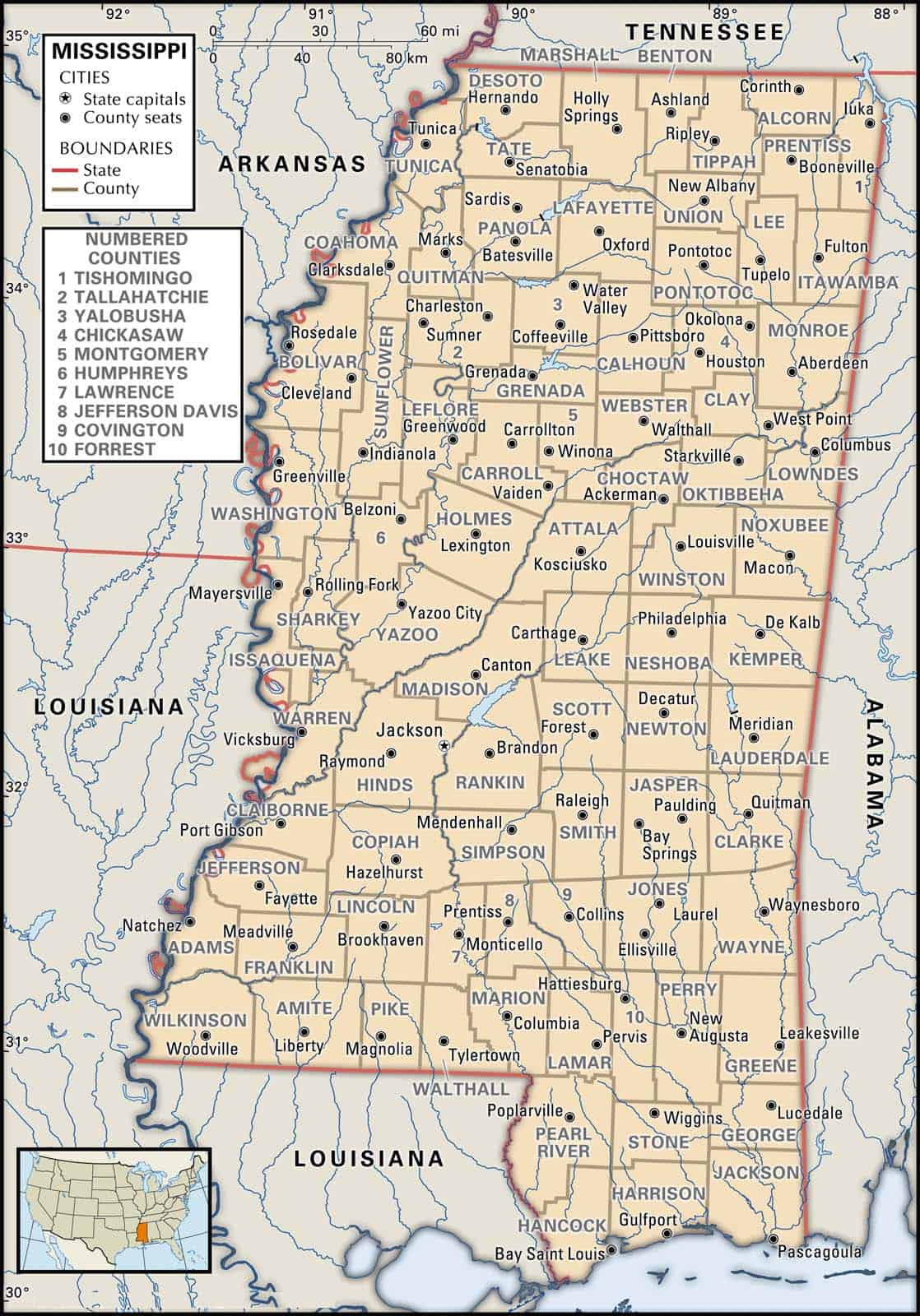
Mississippi […] only got around to officially ratifying the amendment last month — 148 years later — thanks to the movie “Lincoln.” The state’s historical oversight came to light after Mississippi resident Ranjan Batra saw the Steven Spielberg-directed film last November […]. After watching the film, which depicts the political fight to pass the 13th Amendment, Batra did some research. He learned that the amendment was ratified after three-fourths of the states backed it in December 1865. Four remaining states all eventually ratified the amendment — except for Mississippi. Mississippi voted to ratify the amendment in 1995 but failed to make it official by notifying the U.S. Archivist. Batra spoke to another Mississippi resident, Ken Sullivan, who contacted Mississippi Secretary of State Delbert Hosemann about the oversight. Finally, on Jan. 30, Hosemann sent the Office of the Federal Register a copy of the 1995 resolution, and on Feb. 7, the Federal Register made the ratification official.
Two medical school colleagues, one an immigrant from India, the other a life-long Mississippian, joined forces to resolve a historical oversight that until this month had never officially been corrected. Dr. Ranjan Batra, professor of Neurobiology and Anatomical sciences at the University of Mississippi Medical Center, told ABC News he was inspired to investigate the history of the Thirteenth Amendment in his state after a viewing of the film “Lincoln.” […] Batra proceeded to do some investigating of his own, noticing on the website usconstitution.net, that there was an asterisk next to the state of Mississippi in connection with the ratification of the Thirteenth Amendment.
Batra: “Mississippi gets a lot of bad press about this type of stuff and I just felt that it is something that should be fixed, and I saw every reason that could be done.” “Everyone here would like to put this part of Mississippi’s past behind us and move on into the 21 st century rather than the 19th.”
[…] Batra enlisted the help of University of Mississippi Medical Center colleague Ken Sullivan, who took an immediate interest in the story, calling the national archives to confirm that they had in fact never received the proper paperwork.
Batra: “The last paragraph [of the bill] directs the Secretary of State of Mississippi to inform the national archives of the law of the ratification which is exactly the way ratification is supposed to proceed, but that hadn’t been done for whatever reason.”
Sullivan: “For me it was just important that this part of history was done from our state.” “I know we have some dark spots in our history through the south, it still affects people’s opinions about Mississippi today.”
Sullivan and Batra are thankful the ratification question has finally been resolved. Now, that asterisk next to Mississippi can finally be removed.
The Mississippi Legislature had actually formally ratified the historic amendment in 1995, which even then was more than a century late […]. Throughout 1865, 26 states ratified the critical law, and in December of that year, the amendment was formally adopted into U.S. law after Georgia’s approval brought the number the required 27. Several states, including Kentucky and Delaware, waited decades to ratify the amendment, the last being Mississippi in 1995 — or so the state thought.
Sixty-eight years ago, today, radio legend Paul Harvey did something no one expected and got into a bit of trouble over it. In the wee hours of February 6, 1951, without any authorization, Harvey trespassed on the Argonne National Laboratory grounds, engaging in what reporters term as participatory journalism.
Conducting classified research, the laboratory was heavily secured; all employees and visitors needed badges to pass a checkpoint, many of the buildings were classified, and the laboratory itself was fenced and guarded. Such alluring secrecy drew visitors both authorized […] and unauthorized. Shortly past 1 a.m. on February 6, 1951, Argonne guards discovered reporter Paul Harvey near the 10-foot (3.0 m) perimeter fence, his coat tangled in the barbed wire. Searching his car, guards found a previously prepared four-page broadcast detailing the saga of his unauthorized entrance into a classified “hot zone.” He was brought before a federal grand jury on charges of conspiracy to obtain information on national security and transmit it to the public, but was not indicted.
Harvey’s “escapade” prompted the U.S. attorney for Illinois to empanel a grand jury to consider an espionage indictment; Harvey “went on the air to suggest he was being set up”; the grand jury subsequently declined to indict Harvey.
Previously confidential files show that Harvey […] enjoyed a 20-year friendship with FBI Director J. Edgar Hoover, often submitting advance copies of his radio script for comment and approval. […] the real twist, suitable for one of Harvey’s signature “Rest of the Story” vignettes, is how they met…on opposite sides of an espionage investigation.
The news is contained in nearly 1,400 pages of FBI files, released to The Washington Post in response to a one-year-old Freedom of Information Act request.
The Cold War beginning of the Harvey-Hoover bond was an incident from 1951, when Harvey was 32. He routinely hammered officials for being lax on security, in particular those in charge of the Argonne National Laboratory, which conducted nuclear testing 20 miles west of Chicago. After wrapping up his television broadcast on the evening of Feb. 5, 1951, Harvey set out to prove his case and make some career-enhancing headlines for himself.
Harvey guided his black Cadillac Fleetwood toward Argonne, arriving sometime past midnight. He parked in a secluded spot, tossed his overcoat onto the barbed wire topping a fence, then scampered over. […] seconds after Harvey hit the ground, security officers spotted him, documents show. Harvey ran until, caught in a Jeep’s headlights, he tripped and fell. As guards approached, Harvey sprang to his feet and waved.
Guards asked whether Harvey realized he was in a restricted area. “Harvey replied no, that he thought he might be at the airport because of the red lights,” one report says. Under questioning, Harvey eventually dropped his cover story but refused to elaborate, saying he wanted to tell his tale before a congressional committee.”
Two months after the incident, a federal grand jury officially declined to indict Harvey. Nothing in Harvey’s file suggests Hoover did anything to help. But Harvey appears to have been grateful for something.
It’s a long, in-depth article and, apparently, Harvey intended to lie to the audience about ‘how it went down’.
January 31 doesn’t appear to be a day where anything really Earth-shattering happened. I have gathered up a few noteworthy thingys…
1940…….Ida May Fuller was issued the very first Social Security check (numbered 00-000-001) for the amount of $22.54.
1958…….The very first satellite put into Earth orbit by the United States was Explorer I. Launched at 10:48pm EST, it was the first to detect the Van Allen radiation belt.
1971…….Apollo 14, the third mission to land on the Moon, was launched at 4:03pm EST. Mission Commander was Alan Shepard, Command Module Pilot was Stuart Roosa and Lunar Module Pilot was Edgar Mitchell. They landed in the Fra Mauro formation, the aborted Apollo 13 mission’s destination.
2000…….Dr. Harold Shipman, British serial killer, was found guilty of murdering 15 patients under his care. The Shipman Inquiry estimated the total victim count to be 250. Known as The Angel of Death, he hung himself in prison in 2004, one day before his 58th birthday.
“One of the paradoxes of the Nazi terror was that SS officers themselves demonstrated a fondness for swing (Vogel, 1962).
Mike Zwerin (1985), in his exploration of jazz under the Nazis, described a Luftwaffe pilot who switched on the BBC hoping to catch a few bars of Glenn Miller before bombing the antenna from which these forbidden sounds were being broadcast. Allied propagandists recognised the potential for exploiting the contradictory allure that jazz possessed with Nazi society.
The sound barrier of 1944 was marked on the one hand by the music of the Nazi marches and on the other by the big band swing of Glenn Miller. The Allies attempted to exploit the popularity of swing inside Germany. On October 30, 1944, Miller’s swing tunes were aimed at German soldiers through the American Broadcast Station in Europe (ABSIE) in an effort to persuade them to lay down their arms.
Major Miller addressed German soldiers in their own language with the assistance of Ilse Weinberger, a German compere and translator. Ilse introduced Glenn Miller as the ‘magician of swing’ and, through a strange act of cultural alchemy, tunes like Long Ago and Far Away and My Heart Tells Me were rendered in German by vocalist Johnny Desmond.”
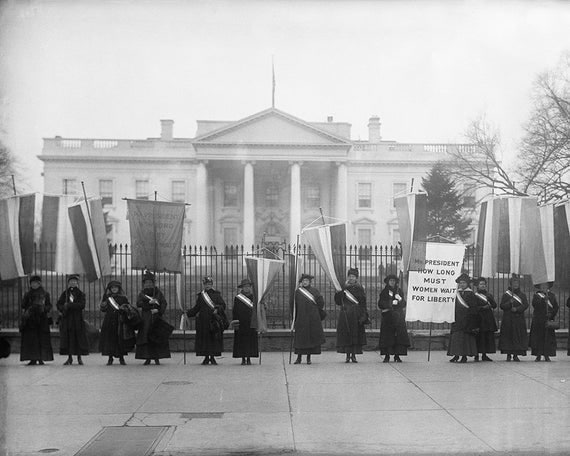
One hundred and two years ago, today, a group of women, organized by Women’s Rights Activist Alice Paul and the National Woman’s Party (NWP), began a picketing and protest campaign in front of the White House during the Wilson Presidency. Known as the Silent Sentinels, the protest began after a meeting with the President regarding suffrage proved fruitless with Wilson stating to the women to “…concert public opinion on behalf of women’s suffrage.” The silent protest was a new strategy for the National Suffrage Movement and served as a constant reminder of Wilson’s lack of support.
Photo Credit: equalmeansequal.org
Originally founded as the Congressional Union for Woman Suffrage (CUWS) after the 1913 woman suffrage parade, they broke away from the National American Woman Suffrage Association (NAWSA), a more moderate group. CUWS only lasted three years and morphed into the NWP. The Suffragist was their weekly newsletter, containing essays, progress reports and notes on the President’s continuing indifference.
There were differing public reactions. Some approved, assisting with holding banners, bringing beverages and donating money. Some opposed their actions, including the leader of the NAWSA, Carrie Chapman Catt, whom preferred political tactics via individual states instead of a national amendment. She feared a male voter backlash.
Photo Credit: pinterest.com
Anti-suffragist mobs could be violent (worsening after the US entered World War I) spurred by the more insulting banners that compared Wilson to Kaiser Wilhelm. The New York Times called the protests “…silly, silent and offensive.” Massachusetts Representative Joseph Walsh referred to them as “…bewildered, deluded creatures with short skirts and short hair…” and “…nagging, iron-jawed angels.”
They were harassed, arrested, tortured and abused. Hunger strikes were met with forced feeding. On the night of November 14, 1917, known as the “Night of Terror“, the superintendent of the Occoquan Workhouse (prison), W.H. Whittaker, ordered the nearly forty guards to brutalize the suffragists. The treatment stories angered many Americans, creating more support. The protesters were finally released November 27 & 28, 1917, Alice Paul having spent five weeks there.
President Wilson finally announced his amendment support on January 8, 1918. The House barely passed the amendment the next day but, the Senate waited until October to vote. It failed by two votes. Protester arrests resumed August 6, 1918 and, by December, protestors were starting fires and burning Wilson effigies in front of the White House. Alice Paul encouraged people to vote against anti-suffrage Senators during the 1918 elections. The House, again, passed the amendment on May 21, 1919 and the Senate followed June 4 ending the six-day-a-week protest. The Nineteenth Amendment was adopted August 18, 1920.
January 9 has been a very special day to Apple, Inc. On this day in 2001, Apple announced iTunesat MacWorld San Francisco, an application for Internet radio, music playing, ripping music from CDs and maintaining a library. The software ran on MacOS and Windows and, in 2003, you could download media from the iTunes Store. In 2005, Apple extended functionality for video and podcasts…University lectures in 2007 and, books in 2010. iTunes Radio, free music streaming, came in 2013 followed by Apple Music, paid music streaming, in 2015.
“This is a day that I have been looking forward to for two and a half years. Today, Apple is going to reinvent the phone.”
From Wikipedia:
Apple created the device during a secretive and unprecedented collaboration with AT&T, formerly Cingular Wireless. The development cost of the collaboration was estimated to have been $150 million over a thirty-month period. Apple rejected the “design by committee” approach that had yielded the Motorola ROKR E1, a largely unsuccessful collaboration with Motorola. Instead, Cingular Wireless gave Apple the liberty to develop the iPhone’s hardware and software in-house. The whole effort was called Project Purple 2 and began in 2005. Six weeks before the iPhone was to be released, the plastic screen was replaced with a glass one, after Jobs was upset that the screen of the prototype he was carrying in his pocket had been scratched by his keys.
With the iPhone X costing $1,000 dollars, Apple rules the world.
Forty-five years ago, today, President Richard Nixon signed The Emergency Highway Energy Conservation Act which created the National Maximum Speed Law, prohibiting speed limits higher than 55 miles per hour (90 km/h). If states wished to receive any federal funds for highway repair, they were forced to comply.
The legislation was created in an effort to conserve gasoline after the OPECoil crisis embargo started the previous October. This oil shock had its roots in two issues:
(1) The US pull-out of the Bretton Woods Accord, detaching the dollar from the price of gold, depreciated the currency and oil producers lost money.
(2) Nations supporting Israel during the Yom Kippur War were targeted.
The first part tells the story of Moses leading the Jews from Egypt to the Promised Land, his receipt of the tablets and the worship of the golden calf. The second part shows the efficacy of the commandments in modern life through a story set in San Francisco. Two brothers, rivals for the love of Mary, also come into conflict when John discovers Dan used shoddy materials to construct a cathedral.
Trivia Bits:
♦ Most of the chariot crashes in the prologue were real and unplanned.
♦ After production, the enormous movie sets were bulldozed and buried in sand. It is now the legendary “Lost City of DeMille” and the site is recognized as an official archaeological site by the state of California.
♦ Midway through production, the film ran out of money and Cecil B. DeMille’s original backers pulled out. The production was saved when DeMille called in a personal favor from his friend Amadeo Giannini, one of the founders of Bank of America. Giannini’s $500,000 investment allowed the production to continue without stopping.
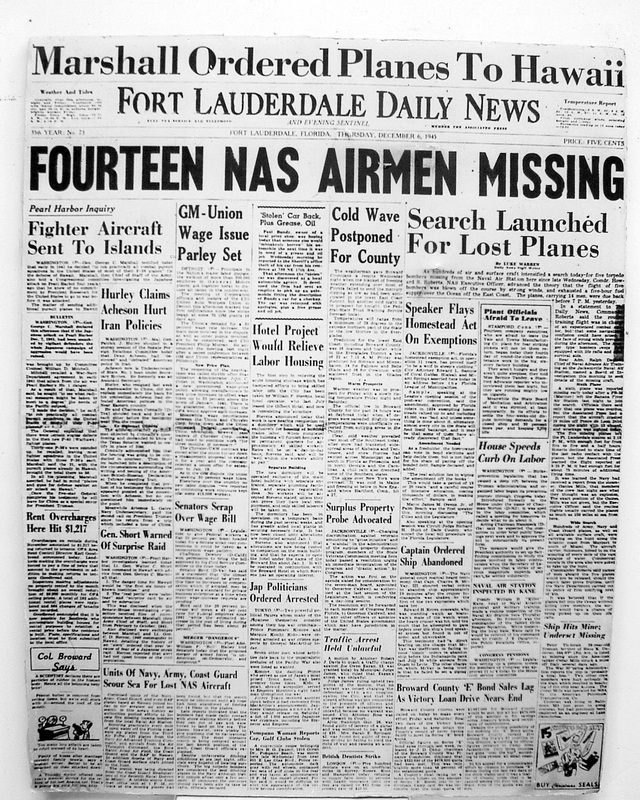
Seventy-three years ago, today, the infamous Flight 19 disappeared over the Bermuda Triangle in what was supposed to be a routine, three-hour exercise of combat training and navigation. Four TBM-1Cs and one TBM-3 Grumman Avenger torpedo bombers took off from NAS Fort Lauderdale at 14:10pm. Twenty-seven year old Navy Lieutenant Charles Carroll Taylor was the flight leader and pilot of FT-28, the TBM-3.
“Two hours after the flight began, the leader of the squadron, who had been flying in the area for more than six months, reported that his compass and back-up compass had failed and, that his position was unknown. The other planes experienced similar instrument malfunctions. Radio facilities on land were contacted to find the location of the lost squadron but, none were successful. After two more hours of confused messages from the fliers, a distorted radio transmission from the squadron leader was heard at 18:20pm, apparently calling for his men to prepare to ditch their aircraft simultaneously because of lack of fuel.”
“Radio conversations between the pilots were overheard by base and other aircraft in the area. The practice bombing operation is known to have been carried out because at about 15:00pm, a pilot requested and was given permission to drop his last bomb. Forty minutes later, another flight instructor, Lieutenant Robert F. Cox in FT-74, forming up with his group of students for the same mission, received an unidentified transmission.
Photo Credit: nasflmuseum.com
An unidentified crew member asked Powers (Marine Corps Captain Edward Joseph Powers, Jr., pilot of FT-36), for his compass reading. Powers replied: “I don’t know where we are. We must have got lost after that last turn.” Cox then transmitted: “This is FT-74, plane or boat calling ‘Powers’ please identify yourself so someone can help you.” The response after a few moments was a request from the others in the flight for suggestions. FT-74 tried again and a man identified as FT-28 (Lt. Taylor) came on. “FT-28, this is FT-74, what is your trouble?” “Both of my compasses are out”, Taylor replied, “and I am trying to find Fort Lauderdale, Florida. I am over land but it’s broken. I am sure I’m in the Keys but, I don’t know how far down and, I don’t know how to get to Fort Lauderdale.”
FT-74 informed the NAS that aircraft were lost, then advised Taylor to put the sun on his port wing and fly north up the coast to Fort Lauderdale. […] no bearings could be made on the flight and the IFF (transmitter) could not be picked up. Taylor was told to broadcast on 4805 kHz. This order was not acknowledged so he was asked to switch to 3000 kHz, the search and rescue frequency. Taylor replied: “I cannot switch frequencies. I must keep my planes intact.”
As the weather deteriorated, radio contact became intermittent and it was believed that the five aircraft were actually, by that time, more than 200 nmi (230 mi; 370 km) out to sea east of the Florida peninsula. Taylor radioed “We’ll fly 270 degrees west until landfall or running out of gas” and requested a weather check at 17:24pm. By 17:50pm, several land-based radio stations had triangulated Flight 19’s position as […] north of the Bahamas and well off the coast of central Florida.”
There is some question as to the exact time of Taylor’s last transmission (18:20pm or 19:04pm) but, he was heard saying “All planes close up tight…we’ll have to ditch unless landfall…when the first plane drops below 10 gallons, we all go down together.” By that time, the sun had set and the weather was much worse.
“Two PBM Mariner flying boats were dispatched from NAS Banana River in Melbourne, Florida (now Patrick Air Force Base), carrying rescue equipment. Less than a half hour after take-off (at approximately 19:27), one of the PBM’s (Trainer 49/BuNo 59225) radioed the tower that they were nearing Flight 19’s last assumed position. The rescue plane with a crew of 13 men was never heard from again.”
“At 21:15pm, the tanker SS Gaines Mills reported it had observed flames from an apparent explosion leaping 100 ft (30 m) high and burning for 10 minutes. Captain Shonna Stanley reported unsuccessfully searching for survivors through a pool of oil and aviation gasoline. The escort carrier USS Solomons also reported losing radar contact with an aircraft at the same position and time.”
A 500 page Navy investigation was published a few months later. Initially, blame was placed upon Lt. Taylor for mistaking the Bahamas for the Florida Keys and not listening to his subordinate officers. The report was amended to ’cause unknown’ when Taylor’s mother stated that the Navy had no evidence for their conclusions…no planes and no bodies. Lt. Taylor was listed as ‘not at fault’ as his compasses were not working. The disappearance of PBM-5 Trainer 49 was attributed to a mid-air explosion.
Well, so much for capturing this evening’s Beaver Moon. I guess I should have tried last night. Tonight is way too foggy. Instead, I present to you my shots from last November.
Also known as the Frosty Moon, it can be referred to as a Mourning Moon if it happens to be the last full moon before the Winter Solstice, as is the case this year.
November’s Full Moon was one of the most important of the year for Northern American communities. Most commonly known as the Full Beaver Moon, this Full Moon marked a time when rivers would begin to freeze over, making it impossible to set out traps. Many Native American tribes, including the Cree, Arapaho and, Abenaki tribes, called November’s full moon the “Moon When Rivers Start to Freeze”.
With the changing of the seasons, November’s full moon marks the beginning of the end. This year, it is the very last full moon before the winter solstice, which makes it the Mourning Moon according to Pagan tradition. In many different cultures, November’s full moon is intimately connected with death and loss, on both a literal and symbolic level. The Celts, for instance, called it the Reed Moon, comparing the mournful music made by wind instruments to the ghoulish sounds of spirits being drawn into the underworld. And, not without good reason…the Full Mourning Moon marks a dangerous time of the year where people could easily slip into the underworld with a single misstep.
We may enjoy the luxury of winter coats and central heating, now but, freezing to death during the long, dark winters used to be a very real threat to early inhabitants of Northern America. In order to survive, making warm winter clothing out of beaver fur was crucial for American colonists and Native American tribes. This is why November’s full moon is also known as the Beaver Moon. During this month, beavers are very active, working hard on dam construction and this was a good time to start harvesting their fur. Missing the timing for this would mean death for these early Northern American communities. This name drives home the importance of November’s full moon as a signal for these Native American tribes to begin trapping beavers before it was too late, as well as to complete their preparations for the darkest depths of winter.
For the Pagans, on the other hand, the final stage of their winter preparations involved the very important process of “mourning”, which is why they call the last moon before the winter solstice the Mourning Moon. After a full year of accumulating possessions, both physically and otherwise, the Mourning Moon is the perfect time to let go of old, unnecessary things, while giving yourself permission to mourn their passing. Practicing Pagans may perform a moonlit ritual where they write down the things they want to rid themselves of and ask their Goddess for help in removing unwanted burdens.
Pagan traditions aside, anyone can benefit from taking the time to self-reflect and to let go. Take advantage of the Full Mourning Moon this November to look back on your year. Take stock of your desires, ambitions, mental and behavioral habits and, the people you spend your energy on. Clean your living and work spaces and, sort out the physical objects that are not contributing to your well-being. Take the time to fully mourn and let go of anything, or anyone, that does not bring you joy, so that you can begin to move forward, unfettered, towards a lighter and happier new year.
Two months ago, on Friday, September 14, fellow blogger Bottomless Coffee 007 requested I answer the following 26 questions. I got busy and I forgot all about it (Sorry, Coffee). Here we go…
[1.] Who are you named after?
The first name is for the second longest reigning British Monarch. My second name came from my paternal-paternal great-grandmother…and my father misspelled it! My last name is English-Welsh.
[2.] Do you like your handwriting?
Sometimes.
[3.] What’s your favorite lunchmeat?
I don’t eat that stuff. I’ve watched it being made.
[4.] Longest relationship?
That depends…
♡ The longest is my dad.
♡ Friend? A girl I met in nursery school. Still friends after 49 years. Graduated HS together. My dad dated her mom when they were in HS, together. Oh, the parties and boyfriends…
♡ Significant other? My Vietnam vet. We met 26 years ago but, were otherwise ‘engaged’. We have been a permanently-attached-at-the-hip pair for 7 1/2 years.
[5.] Do you still have your tonsils?
Yep.
[6.] Would you bungee jump?
Never.
[7.] Do you untie your shoes when you take them off?
If they have laces, yes…most of the time. I have a tall pair of boots that have laces & a zipper. I just use the zipper. Lacing those things are a pain in the ass.
[8.] Favorite ice cream?
I don’t eat ice cream. I like Italian sorbeto or frozen coconut milk with chocolate & peanut butter.
[9.] What’s the first thing you notice about people?
Stature, demeanor and gait…then the clothes.
[10.] Football or baseball?
I loathe professional sports but, local, AAA/AA baseball is really fun to go to.
[11.] What color pants are you wearing?
Dark olive-green.
[12.] Last thing you ate?
Cereal.
Photo Credit: pinterest.com
[13.] If you are a crayon, what color are you? Cornflower blue. That was always my favorite crayon in the big box.
[14.] Favorite smell?
Burning white sage.
[15.] Who is the last person you spoke to on the phone?
My buddy, Ray.
[16.] Hair color?
Very dark brown.
[17.] Eye Color?
Hazel.
[18.] Favorite food to eat?
Organic dark chocolate with mint.
[19.] Scary movie or happy ending?
I prefer science fiction, action, suspense or a thought-provoking drama.
[20.] Last movie you watched?
At a movie theatre, Darkest Hour. There is a reason why Gary Oldman won an Academy Award for Best Actor. He becomes Churchill. I have been following Oldman ever since Dracula.
[21.] Favorite holiday?
Halloween. BOO.
[22.] Beer or wine?
Between those two, wine. But, I’d rather have a Margarita with Anejo tequila or a Flying Grasshopper with aged, single-barrel rum.
[23.] Favorite day of the week?
They are all the same to me.
[24.] Three favorite bloggers you want to learn about?
I already know quite a bit about my three fave bloggers.
[25.] The additional info you didn’t know you wanted?
I drive a gun-metal gray 2008 Nissan Frontier 4 x 4 with suicide doors.
[26.] When’s the last time you got on the scale?
At my chiro’s office on Wednesday.
[Bonus Question (that’s more than 26…)] Who’s your favorite superhero? That is tough. I have so many. I am a Marvel geek for sure. On the screen, I like what Chris Evans has done with Captain America and I like what Hugh Jackman did with Wolverine, even if he was a foot too tall. In the comics, Jean Grey (originally Marvel Girl, 1963)…all day, everyday.
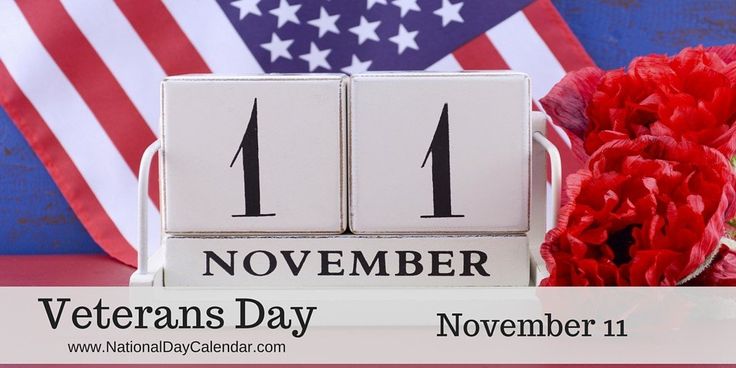
“The first minute of silence was to indicate gratitude for those who had returned alive…the second to remember the fallen.”
Edward George Honey, an Australian journalist, was the gentleman whom first proposed a moment of silence. The two-minute silence, practiced today, originated in Cape Town, South Africa, via that town’s then Mayor, Sir Harry Hands.
We, here in the U.S., at the behest of several veterans organizations, changed Armistice Day to Veterans Day in 1954 to honor all veterans, regardless of a specific war. It is a national holiday and different from Memorial Day (last Monday in May), which honors those whom died while serving and, Armed Forces Day (also in May but, the third Saturday), honoring those currently serving.
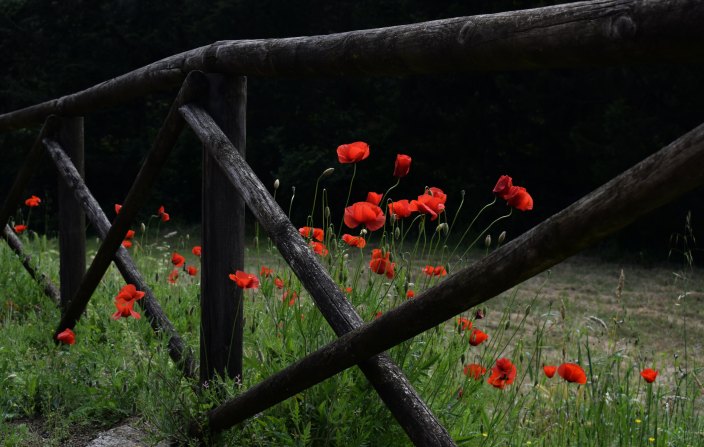
Image Credit: Pinterest
In Flanders Fields
In Flanders fields the poppies blow
Between the crosses, row on row,
That mark our place; and in the sky
The larks, still bravely singing, fly
Scarce heard amid the guns below.
We are the Dead. Short days ago
We lived, felt dawn, saw sunset glow,
Loved and were loved, and now we lie
In Flanders fields.
Take up our quarrel with the foe:
To you from failing hands we throw
The torch; be yours to hold it high.
If ye break faith with us who die
We shall not sleep, though poppies grow
In Flanders fields.
Oh! you who sleep in Flanders Fields,
Sleep sweet – to rise anew!
We caught the torch you threw
And holding high, we keep the Faith
With All who died.
We cherish, too, the poppy red
That grows on fields where valor led;
It seems to signal to the skies
That blood of heroes never dies,
But lends a lustre to the red
Of the flower that blooms above the dead
In Flanders Fields.
And now the Torch and Poppy Red
We wear in honor of our dead.
Fear not that ye have died for naught;
We’ll teach the lesson that ye wrought
In Flanders Fields.
November 2 has four celebrations. Today is National Ohio Day and recognizes the 17th state to join the U.S. Nicknamed the Buckeye State, Ohioans also claim Birthplace of Aviation (North Carolinians dispute this, good-naturedly) and The Heart of It All. It’s largest city, Columbus, is also its capital and, apparently, it is the only state with a State Rock Song.
Personal CollectionPersonal CollectionPersonal CollectionPersonal CollectionPersonal Collection
The leaves are falling. The deer have grown fat for the winter. Hunters can move more easily over cleared fields, spotting the smaller animals. Also known as the Blood Moon or Sanguine Moon, Native Americans named the moon for the hunt and the storing of meat for the winter. Traditionally, it was a feasting day in Western Europe and among many tribes. From Moon Giant:
Contrary to popular belief, the Hunter’s Moon isn’t actually bigger or brighter than usual. It simply rises earlier, soon after sunset, which would give hunters plenty of bright moonlight to hunt by during the early evenings. To Neo-Pagans, however, the Hunter’s Moon is known by a far more morbid name – the Blood Moon.
Humans through the ages have always found autumn’s full moons to be creepy and not without good reason. There’s a reason why English folks in the Middle Ages called October’s full moon the Blood Moon and it’s the exact same reason why even Halloween imagery today often features a large, low-hanging moon with an eerie reddish glow. The Hunter’s Moon rises early in the evening, which means that you are more likely to see it near the horizon. When you observe the moon while it’s near the horizon, it gives off the illusion of being bigger while it’s in fact the same size. In addition, observing the moon at the horizon makes it look redder. This is because you’re seeing it through a thicker atmosphere, which scatters more blue light and lets more red light pass through to reach your eyes.
Scientific explanations aside, the Hunter’s Moon or Blood Moon still holds an undeniable aura of mystique and power. As October’s full moon occurs right before Samhain, the Gaelic mid-autumn festival that has evolved into Halloween today, Neo-Pagans consider the month of the Blood Moon to be a special time denoting the change of seasons and, a prime opportunity to contact dead loved ones, given the thinning of the veil between the physical world and the spiritual world. Precious stones such as amethyst are used to ward off evil and, sacred flowers like chrysanthemum are used when working with spirits, such as in rituals to commune with long-dead ancestors.
Despite the Blood Moon’s spooky associations, it rarely actually happens on Samhain or Halloween night itself. The next time you’ll get to see the full moon on Halloween is 2020, and if you miss that, you’ll have to wait 15 years to see it in 2035. Sometimes, October’s full moon even happens early enough in the month that it becomes the Harvest Moon, which is defined as the full moon that’s closest to the fall equinox. In Chinese culture, the Harvest Moon is celebrated during the Mid-Autumn Festival, where people gather to celebrate by eating mooncakes. There is also a harvest festival in India that celebrates October’s full moon called Sharad Purnima. Devotees fast all day before offering delicacies to the Moon God under the moonlight.
In contrast to the day-long fast of India’s moonlight festival, the Hunter’s Moon was a very important feast day in Europe as well as for many Native American tribes. Appropriately, the Ponca tribe’s name for the Hunter’s Moon is “the moon when they store food in caches”. Taking advantage of the fact that the fields have been reaped, hunters would capture foxes and other small animals who come out to graze on the fallen grains as well as hunt down deer in the moonlight. They would butcher their prey and preserve their meat. Blood Moon is an excellent name for this month’s full moon, given that it was a final, bloody harvesting of meat before the winter months.
Sadly, the tradition of feasting during the Hunter’s Moon was lost around the year 1700, but its spirit still lives on in historical reenactments like the Feast of the Hunter’s Moon, or even the feast of candy enjoyed by trick-or-treaters everywhere on Halloween.
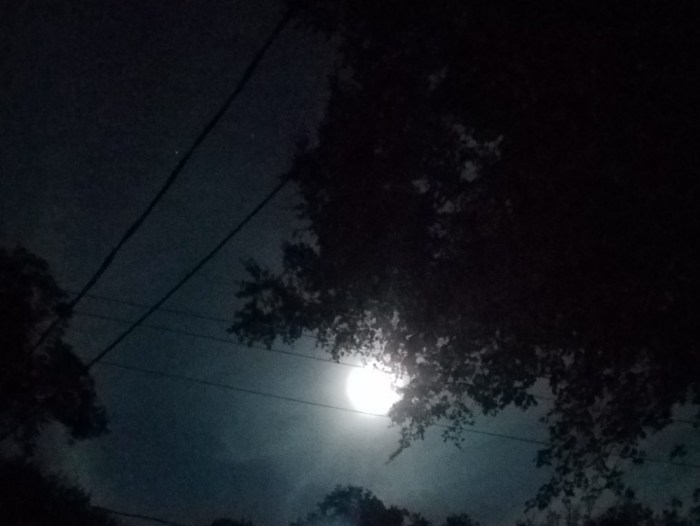
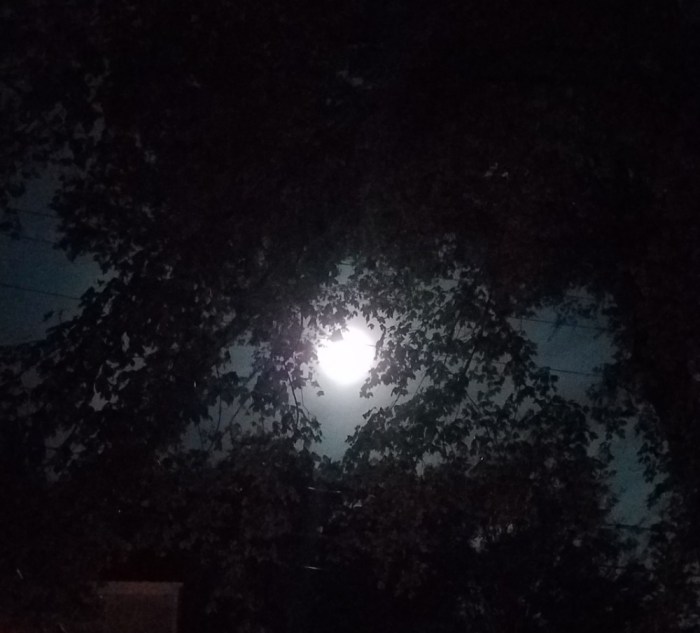
This Hunter’s Moon reached 100% illumination at 12:45pm EDT.




















 Cosmic-Observation