History
Wayback Wednesday: Great Fire Of Meireki 1657

One of the greatest disasters in Japanese history began in the Japanese capital city of Edo (original name of Tokyo) on March 2, 1657, 365 years ago, today. Legend has it that the fire was accidentally started by a priest who was supposedly trying to cremate a cursed kimono. The kimono had been owned in succession by three teenage girls who all died before ever being able to wear it. When the garment was being burned, a large gust of wind fanned the flames causing the wooden temple to ignite.
The fire spread quickly through the city, due to hurricane force winds, which were blowing from the northwest. Edo, like most Japanese cities, […] the buildings were especially dry due to a drought the previous year. [The] roads and other open spaces between buildings were small and narrow, allowing the fire to spread and grow particularly quickly.
The Great Fire of Meireki
Naked History
February 21, 2016
[The] city of Tokyo, Japan, then known as Edo, suffered a catastrophic fire that lasted three days, and killed 100,000 Japanese people, a death toll greater than either of the atomic bomb attacks on Hiroshima and Nagasaki in 1945.
The carnage caused by the Great Fire of Meireki (or sometimes known as the Furisode Fire) combined to destroy about 60% to 70% of the buildings in Edo.
[The] wind spread the flames across a city that was built almost entirely of wood and paper buildings [and], firefighters [were] unable to keep up with the rapid spread of flames caused by the wind. The fire brigade established in Edo was a novel idea but, the force was nowhere near large enough to deal with a conflagration of this magnitude.
Reconstruction of the city lasted the next 2 years.
Great Fire Kills More Japanese Than Atom Bomb
History & Headlines
March 2, 2017
Additional Reading:
Japanese Tales: The Fire of the Furisode (Elle Of A Kind Blog/01-07-2022)
Furisode Fire
The Great Fire Of Meireki/Destruction of Tokyo
Meeting Canadians
Phil suggested that I try to write more so…

I lived in Virginia Beach for a year (July 2001 – July 2002) with my, then, Marine Corps husband. I don’t remember the exact date but, one evening, we happened to be wandering the streets of Norfolk, near Norfolk Harbor. We saw a neon sign in a window of a bar: O’Malley’s. The place was full of what appeared to be sailors but, they weren’t Americans. They were busy drinking and singing Irish drinking songs. The Marine and I did manage to find a couple of empty bar stools, way at the end of the bar, deep into the establishment. The Marine took the very last stool to my left and I tried to position myself into the remaining empty stool. It was a tight squeeze and I began to think to myself… “How in the hell am I going to get my big ass thru that narrow space to get onto that stool?” For the split-second pondering it took, the full-bearded gentleman to my right, turned to me and said “Do you not want to sit next to me for some reason? I know I look rough but…” I immediately jumped in to reassure him that, that was not the case and shared my “OMG, I won’t fit…” fears, out loud, right there in front of God and everybody. He threw his head back and roared. “Have a seat, my dear…and, have drink.” He turned out to be the COTB (Chief of the Boat) of the Canadian Frigate HMCS St. John’s, that was in Norfolk for degaussing. It was a fun evening and that COTB invited us to tour the ship the next day.
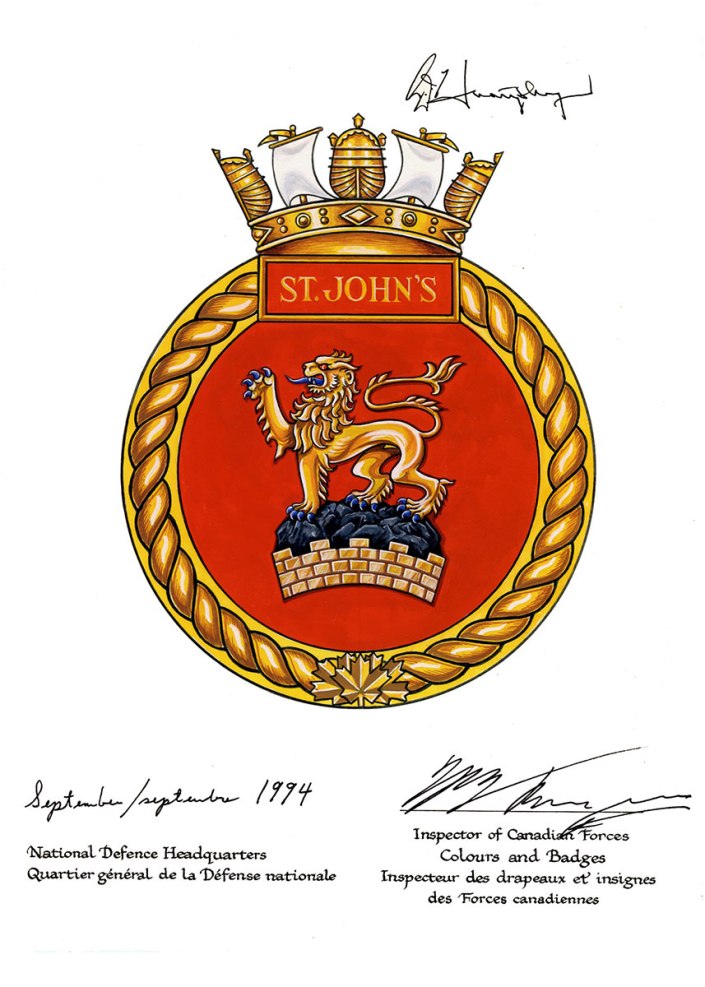
We arrived around 4:00pm and I noticed that a Canadian Frigate really stands out next to American Navy vessels. It’s an odd green color, next to the blue of the American ships and I was told that it doesn’t have any right angles on it. We boarded the ship and asked for the Chief. They retrieved him and he rolled out looking like he’d been on a three day drunk. He was clearly hung over. He called for a much younger seaman to give us the tour of the ship and joined us later.
One neat thing aboard a Canadian vessel is…the bar. They had a beautiful, stained wooden bar and, a full stock of beer and wine. They also had a few women on board, which I found odd, even though women were allowed on board American war ships, beginning in 1994. It was still a rare sight back then.
We were invited to stay for dinner. It was a simple meal for sailing men but, I’m pretty sure that, not many people can say that they dined with the entire crew of a Canadian Frigate…and not been a crew member. It was really cool. I wish I could remember the name of that COTB. He offered me a St. John’s sweatshirt and I declined because I didn’t have any money. I intended to return to the ship with money but, we never made it back. That would have been a cool souvenir.
HMCS St. John’s (Facebook)
HMCS St. John’s (FFH-340) (Military History Fandom)
HMCS St. John’s (Wikipedia)
Foto Friday: Land of Oz 3.0
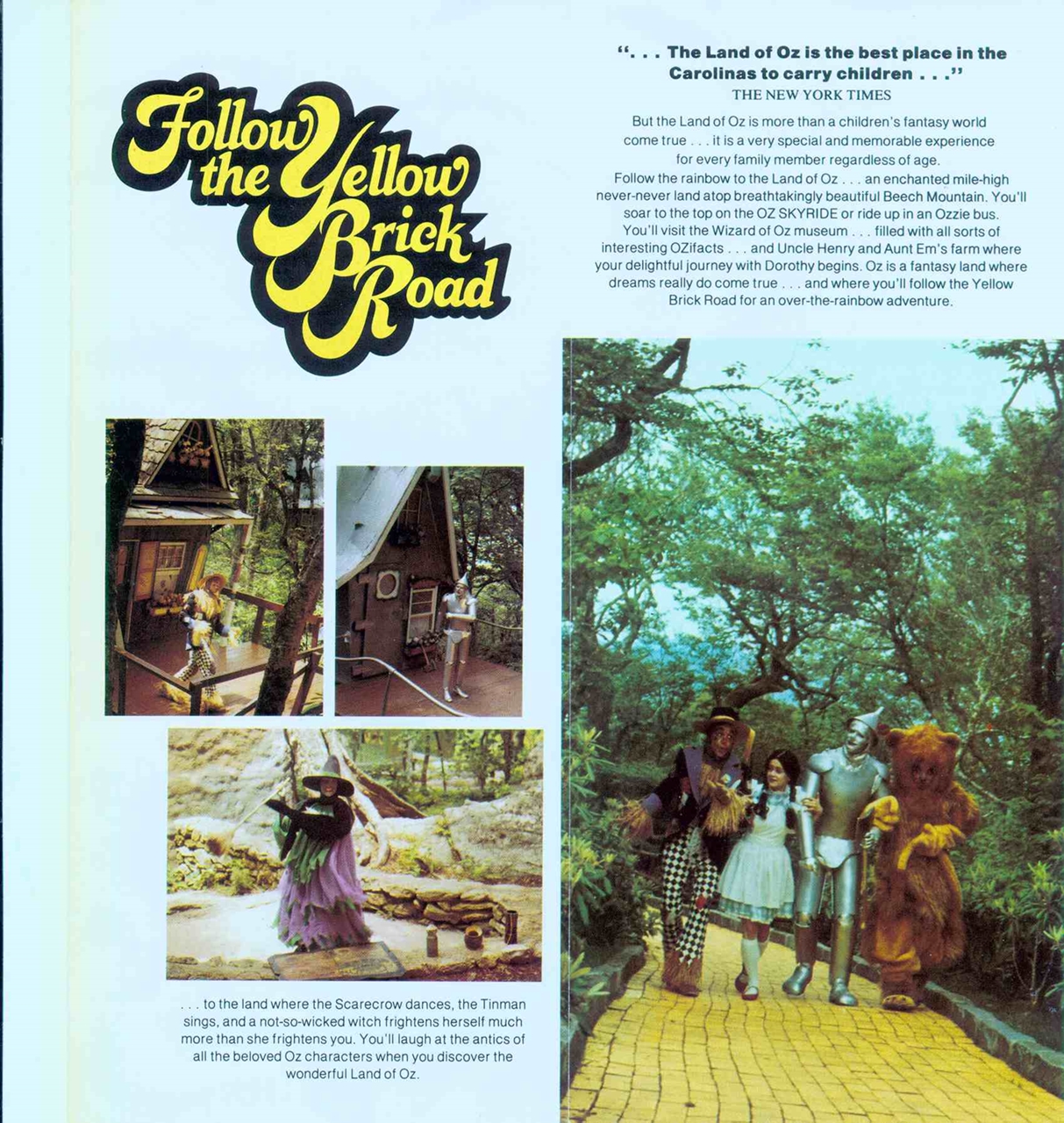
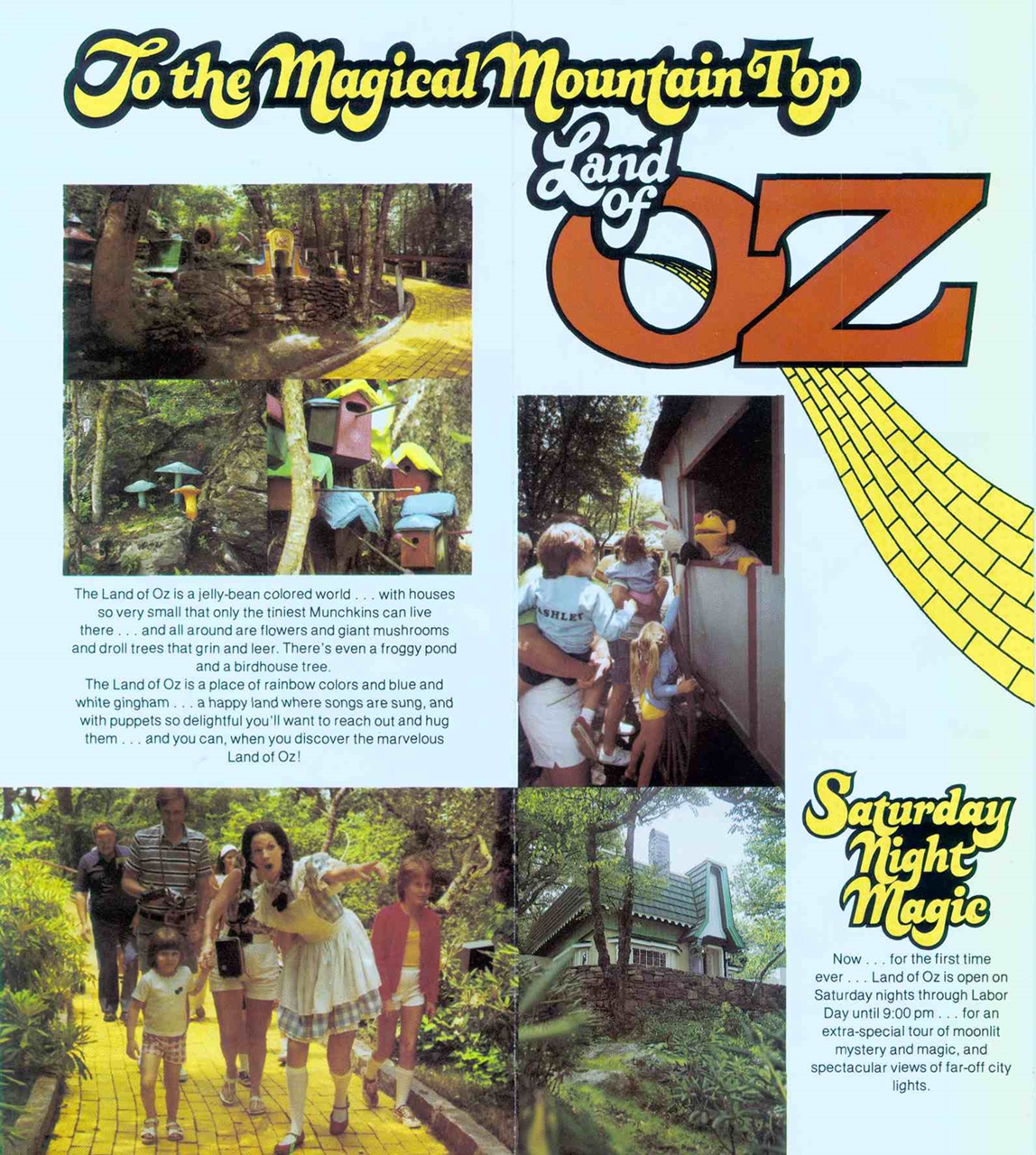
More shots from the Land of Oz in the 70s. ~Vic
Previous posts are here and here. Images are from Emerald Mountain Realty.

Click for a larger view.

The dress was stolen in the 1980s.
Click for a larger view.

Click for a larger view.
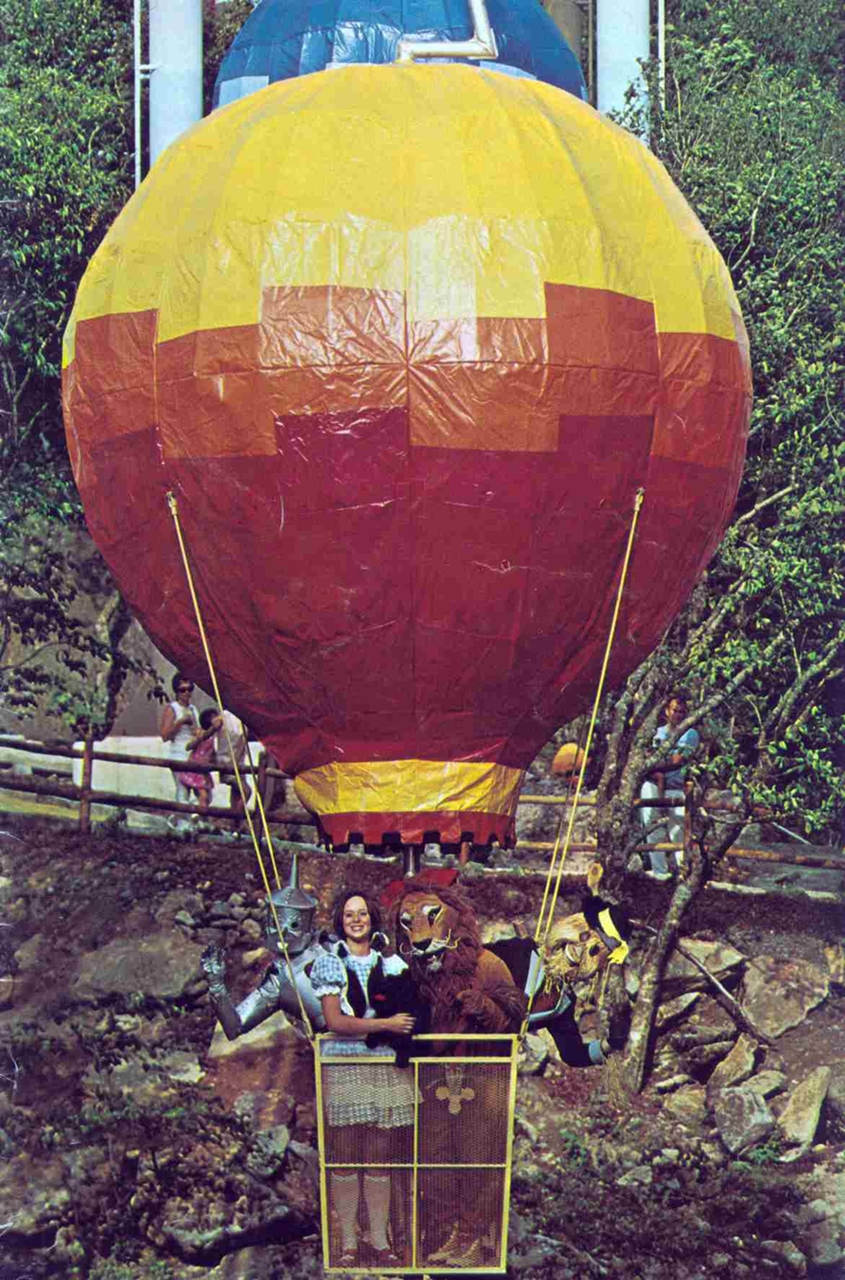
I rode it, once, with my parents in a blinding rain storm.
Click for a larger view.
Click for a larger view.
Click for a larger view.

Click for a larger view.
Additional Reading:
Land of Oz (Romantic Asheville)
Land of Oz (My Home/UNC-TV)
Land of Oz Theme Park (Wikipedia)
Throwback Thursday: Susan B. Anthony’s Arrest 1872
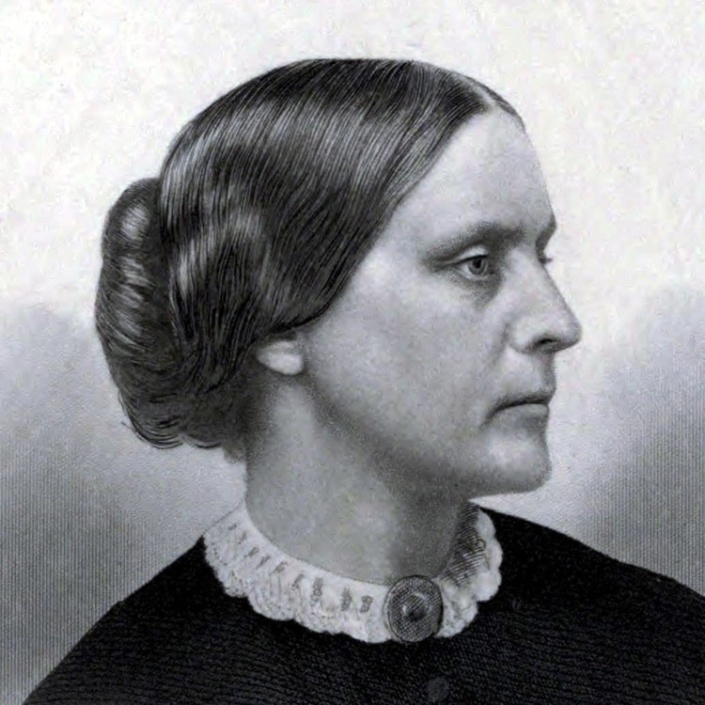
Champion of temperance, abolition, the rights of labor and equal pay for equal work, Susan Brownell Anthony became one of the most visible leaders of the women’s suffrage movement. Along with Elizabeth Cady Stanton, she traveled around the country delivering speeches in favor of women’s suffrage.
[She] was born on February 15, 1820 in Adams, Massachusetts. Her father, Daniel, was a farmer and, later, a cotton mill owner and manager, […] raised as a Quaker. Her mother, Lucy, came from a family that fought in the American Revolution and served in the Massachusetts state government. From an early age, Anthony was inspired by the Quaker belief that everyone was equal under God. That idea guided her throughout her life.
National Women’s History Museum
Susan B. Anthony
Nancy Hayward
2018
On November 1, 1872, Susan B. Anthony and [three] other women attempted to register to vote in the U.S. presidential election. When registrars hesitated, Anthony overwhelmed them with legal arguments and the men relented. On Election Day, November 5, Anthony voted for Ulysses S. Grant. She was one of fifteen women from her Rochester ward to cast a ballot. Attempting to vote was actually a common tactic among suffrage activists. Anthony’s action commanded outsized attention because she and her colleagues actually voted.
Anthony was arrested on November 18, 1872, for violating the federal Enforcement Act of 1870 […].
Freethought Trail
The Arrest of Susan B. Anthony
Robert Green Ingersoll Memorial Committee
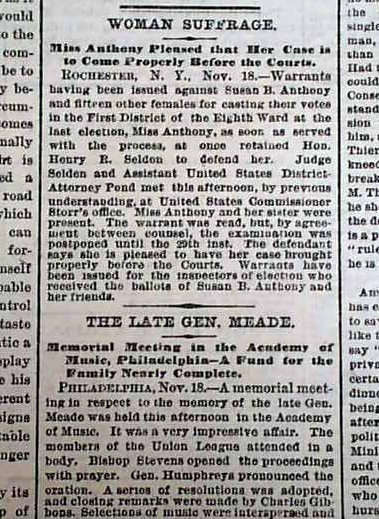
Nine days after the election, U.S. Commissioner William C. Storrs, an officer of the federal courts, issued warrants for the arrest of Anthony and the fourteen other women who voted in Rochester. Three days later […] a deputy federal marshal called on Anthony. He asked her to accompany him downtown to see the commissioner.
Anthony’s trial began in Canandaigua, New York, on June 17, 1873. Before pronouncing the sentence for her crime, Justice [Ward] Hunt asked Anthony if she had anything to say. She did. In the most famous speech in the history of the agitation for [women’s] suffrage, she condemned [the] proceeding that had “trampled under foot every vital principle of our government.” She had not received justice under “forms of law all made by men…” “…failing, even, to get a trial by a jury not of my peers.” Sentenced to pay a fine of $100 and the costs of the prosecution, she swore to “never pay a dollar of your unjust penalty.” Justice Hunt said Anthony would not be held in custody awaiting payment of her fine.
The Trial of Susan B. Anthony
Federal Judicial Center
Web Archive
May 31, 2010
A month after the trial, a deputy federal marshal was dispatched to collect Anthony’s fine. He reported that a careful search had failed to find any property that could be seized to pay the fine. The court took no further action.
Flashback Friday: Ellis Island 1954
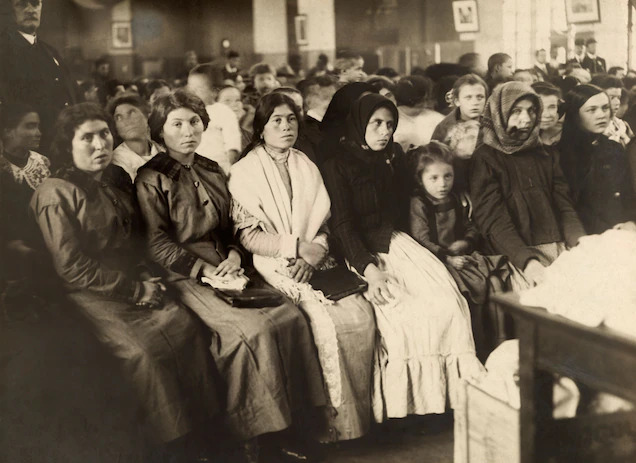
when they first entered the building on Ellis Island.
Photograph by Paul Thompson
Credit: National Geographic
Sixty-five years ago, [today] on November 12, 1954, a Norwegian merchant seaman named Arne Peterssen became the last immigrant to pass through Ellis Island. Later that month, the ferry Ellis Island made its final stop at the island in New York Harbor and the immigration facility closed for good, ending its run as a gateway to the United States for generations of immigrants.
These days Ellis Island is a national symbol remembered in sepia tones but, while it was in active service, the station reflected the country’s complicated relationship with immigration, one that evolved from casual openness to rigid restriction. “It was not a great welcoming place for immigrants but, it was not a place of horrors either,” says Vincent Cannato, author of American Passage: The History of Ellis Island.
Until the end of the 19th century, individual states handled immigration with rules varying by jurisdiction. [T]hen, immigration soared. In light of the influx, the federal government decided in 1891 that it had to take charge.
New York was immigration’s epicenter. Some 75 percent of the country’s steamship traffic came through New York Harbor and so did 75 percent of the nation’s immigrants, according to Cannato. New York state ran an immigration facility called Castle Gardens at the tip of Manhattan but, the new federal Office of Immigration wanted an intake and inspection station in a more controlled location. It selected Ellis Island, a three-acre spot of land in the harbor between New York and New Jersey […].
The immigrants who eventually passed through Ellis Island started their journey by buying passage on a steamship, usually sailing from Europe. Between 1892 and 1924, 12 million people successfully traversed this highly efficient conveyor-belt immigration system. Most immigrants were processed through Ellis Island in a few hours and only 2 percent that arrived on the island were prevented from entering the United States.
[T]his era of mass immigration came to an end with the passage in 1921 and 1924 of new laws that severely limited immigration by establishing quotas for individual countries and requiring immigrants to obtain visas from American consulates. Since most official immigration screening now happened at U.S. consulates abroad, Ellis Island became increasingly irrelevant. The facility, which had once teemed with thousands of hopeful immigrants, transformed into “a major center for deportation and for holding enemy alien spies,” says [Barry] Moreno. “It was like night and day.” President Eisenhower quietly closed Ellis Island in 1954.
How Ellis Island Shepherded Millions of Immigrants Into America
Rachel Hartigan
National Geographic
November 13, 2019
Wayback Wednesday: World Series 1903
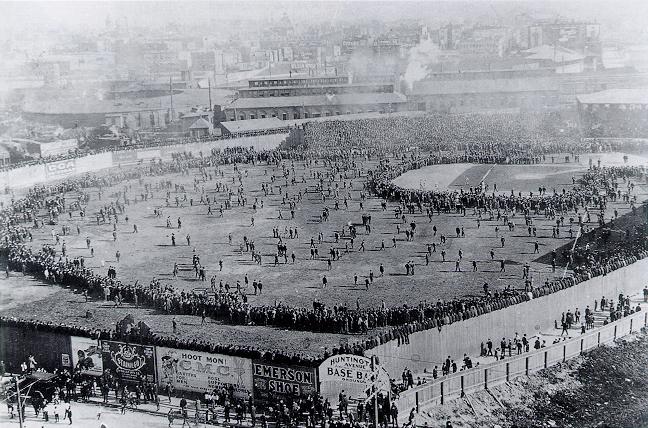
The 1903 World Series was the first modern World Series to be played in Major League Baseball. It matched the American League champion Boston [Americans] against the National League champion [Pittsburg Pirates] (spelled without an “H” from 1891 to 1911) in a best-of-nine series, with Boston prevailing five games to three, winning the last four. The first three games were played in Boston, the next four in Allegheny (home of the Pirates), and the eighth (last) game in Boston.
Pittsburgh pitcher Sam Leever injured his shoulder while trap-shooting, so his teammate Deacon Phillippe pitched five complete games. Phillippe won three of his games but, it was not enough to overcome the club from the new American League. Boston pitchers Bill Dinneen and Cy Young led Boston to victory. In Game #1, Phillippe struck out ten Boston batters. The next day, Dinneen bettered that mark, striking out 11 Pittsburgh batters in Game #2.
Honus Wagner [was] bothered by injuries […] and committed six errors. The shortstop was deeply distraught by his performance. The following spring, Wagner […] refused to send his portrait to a “Hall of Fame” for batting champion:
“I was too bum last year. I was a joke in that Boston-Pittsburgh Series. What does it profit a man to hammer along and make a few hits, when they are not needed, only to fall down when it comes to a pinch? I would be ashamed to have my picture up now.”
Due to overflow crowds at the Exposition Park games in Allegheny City, if a batted ball rolled under a rope in the outfield that held spectators back, a “ground-rule triple” would be scored. [Seventeen] ground-rule triples were hit in the four games played at the stadium.
In the series, Boston came back from a three-games-to-one deficit, winning the final four games (on October 13) to capture the title…(118 years ago). Such a large comeback would not happen again until the Pirates came back to defeat the Washington Senators in the 1925 World Series […]. […] Much was made of the influence of Boston’s Royal Rooters, who traveled to Exposition Park and sang their theme song Tessie to distract the opposing players […]. Boston wound up winning three out of four games in Allegheny City.
Pirates owner Barney Dreyfuss added his share of the gate receipts to the players’ share, so the losing team’s players actually finished with a larger individual share than the winning team’s.
The Series brought the new American League prestige and proved its best could beat the best of the National League, thus strengthening the demand for future World Series competitions.
Wikipedia Summary
Additional:
Baffling Baseball Trivia (Dom Forker/Wayne Stewart/Michael J. Pellowski/2004/Sterling Publishing Company/Web Archive)
Baseball Almanac (World Series History/The Official Baseball History Site)
Honus Wagner: A Biography (Dennis DeValeria/Jeanne Burke DeValeria/1996/1998/GoodReads)
Retro Sheet (Pre-1984 Baseball Analysis)
The First World Series and the Baseball Fanatics of 1903 (Roger L. Abrams/2003/Northeastern University Press/Web Archive)
Throwback Thursday: John Ball & The Peasants’ Revolt 1381

Image Credit: British Library
Wikipedia & Wikimedia
John Ball was an English priest who took a prominent part in the Peasants’ Revolt of 1381. Ball […] actively [preached] “articles contrary to the faith of the church” […]. Ball trained as a priest in York and referred to himself […] as “Seynte Marie priest of York”. [During his time], England was exhausted by death on a massive scale and crippling taxes. The Black Death was followed by years of war, which had to be paid for. The population was nearly halved by disease, and overworked, and onerous flat-rate poll taxes were imposed.
Ball was imprisoned in Maidstone, Kent, at the time of the […] Revolt. He […] gained considerable fame as a roving preacher without a parish or any link to the established order […] and [was known] especially [for] his insistence on social equality. He delivered radical sermons in many places […]. His utterances brought him into conflict with Simon of Sudbury, Archbishop of Canterbury, and he was thrown in prison on several occasions. He also appears to have been excommunicated […] and, in 1366, it was forbidden for anyone to hear him preach. These measures, however, did not moderate his opinions, nor diminish his popularity, and he took to speaking to parishioners in churchyards after official services.
Shortly after the Peasants’ Revolt began, Ball was released by the Kentish rebels from his prison. He preached to them at Blackheath in an open-air sermon that included the following:
“When Adam delved and Eve span, Who was then the gentleman? From the beginning all men by nature were created alike, and our bondage or servitude came in by the unjust oppression of naughty men. For if God would have had any bondmen from the beginning, He would have appointed who should be bond, and who free. And therefore I exhort you to consider that now the time is come, appointed to us by God, in which ye may (if ye will) cast off the yoke of bondage, and recover liberty.”
When the rebels had dispersed, Ball was taken prisoner at Coventry, given a trial in which, unlike most, he was permitted to speak. (Six hundred, forty years ago) [he] was hanged, drawn and quartered at St Albans in the presence of King Richard II on July 15, 1381. His head was displayed stuck on a pike on London Bridge and the quarters of his body were displayed at four different towns. Ball, who was called […] “the mad priest of Kent” seems to have possessed the gift of rhyme. He voiced the feelings of a section of the discontented lower orders of society at that time, who chafed at villeinage and the lords’ rights of unpaid labour, or corvée.
Wikipedia Summary
Hmmm…it appears that we are still in bondage all these centuries later and censorship still reigns supreme from the overlords. There are a lot of parallels to today in the above. And, there are those that would like to see others cancelled (or, hanged, drawn & quartered) for refusing to be poisoned. ~Vic
Shutterbug Saturday: Land of Oz 2.0

Previous Post: Land of Oz
When the Land of Oz opened, Debbie Reynolds and her daughter, Carrie Fisher, were on hand for the ribbon cutting. Sadly, the owner of the park, Grover Cleveland Robbins, Jr., passed away due to cancer in March, prior to the opening in June 1970. His brother Harry carried on in their company Carolina Caribbean Corporation. Robbins created the Tweetsie Railroad Wild West Amusement Park.
Their father, Grover Cleveland Robbins, Sr., was the Mayor of Blowing Rock, NC (several terms), served as the postmaster, started the Chamber of Commerce in 1922 and helped start the first high school there. Our Blue Ridge Parkway, here in NC, is because Robbins, Sr., was sent to Washington, D.C., by our, then, Governor, to make sure it would not be built in Tennessee.
The designer of the Theme Park was Jack Pentes, a Korean War veteran and, creator of Carolina Clowns and soft-play equipment.


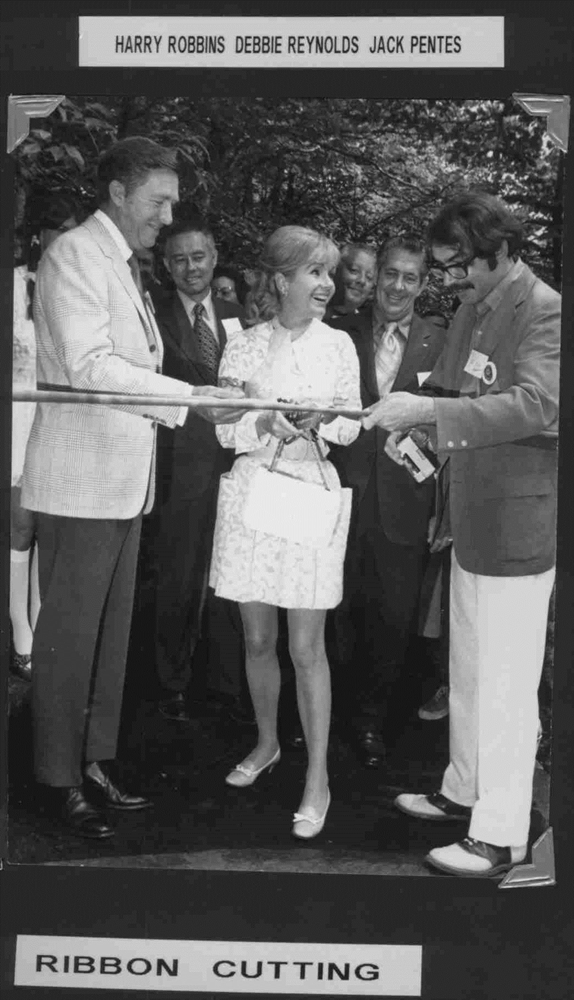

Land of Oz (Official Site)
Additional Reading:
Five Interesting Things (North Carolina Field & Family)
That Abandoned Wizard of Oz Theme Park? (Popsugar)
Ribbon Cutting: The Robbins Trail (Watauga Democrat)
Throwback Thursday: Mumtaz Mausoleum 1631

Wikipedia
Mumtaz Mahal (exalted one of the palace), born Arjumand Banu Begum, was the Empress consort of the Mughal Empire, from January 19, 1628 to June 17, 1631, [and] chief consort of the Mughal emperor Shah Jahan.
[Born] to a family of Persian nobility, [she] was the daughter of Abu’l-Hasan Asaf Khan […]. She was married at the age of 19 [in 1612] to Prince Khurram, [later named] Jahan, [becoming] his second wife. [They] had fourteen children, including Jahanara Begum […] and the Crown prince Dara Shikoh [..]. Shikoh was, eventually, deposed by younger sibling Aurangzeb.
Three hundred, ninety years ago, today, Mumtaz Mahal died [from a postpartum hemorrhage] in Burhanpur, Deccan (present-day Madhya Pradesh), during the birth of her fourteenth child, a daughter named Gauhar Ara Begum. Her body was temporarily buried at Burhanpur in a walled pleasure garden known as Zainabad […].
[The] emperor was reportedly inconsolable. Apparently, after her death, he went into secluded mourning for a year. When he appeared again, his hair had turned white, his back was bent and his face worn. Mumtaz’s eldest daughter, Jahanara […], gradually brought her father out of grief and took her mother’s place at court.
[Shah Jahan] began planning the design and construction of a suitable mausoleum and funerary garden in Agra for his wife. It was a task that would take 22 years to complete: The Taj Mahal.
Wikipedia Summaries
Additional Reading:
The Myth of the Taj Mahal and a New Theory of It’s Symbolic Meaning (College Art/Wayne E. Begley/PDF)
Wayback Wednesday: Athenian Coup 411
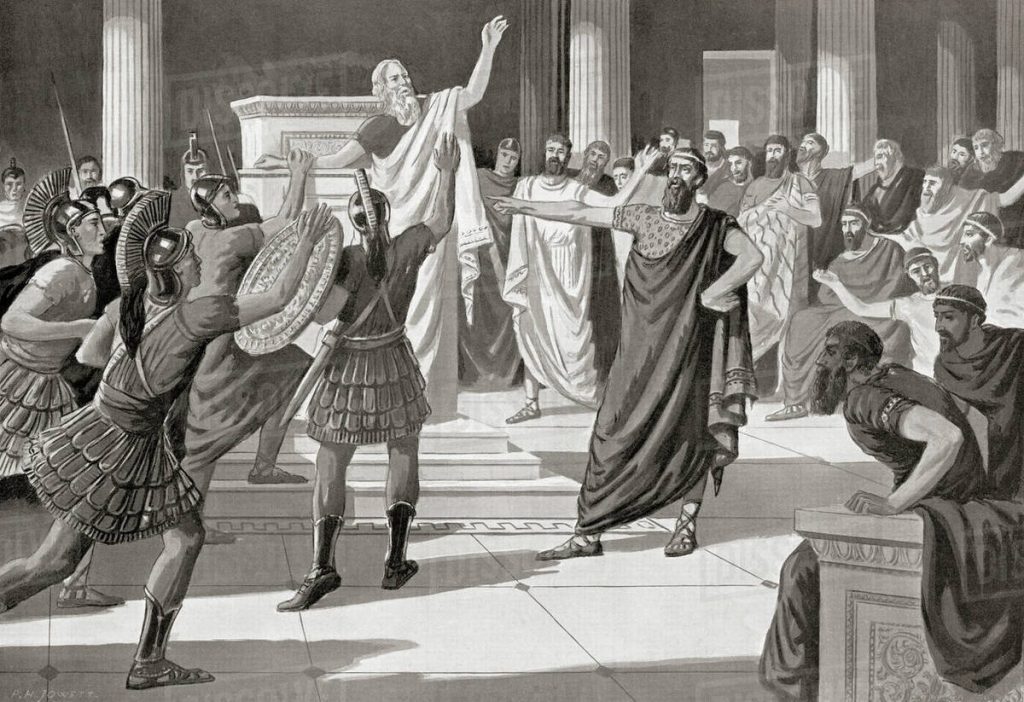
The Athenian Coup of 411 BC was a revolutionary movement during the Peloponnesian War between Athens and Sparta that overthrew the democratic government of ancient Athens and replaced it with a short-lived oligarchy known as The Four Hundred. The movement was led by a number of prominent and wealthy Athenians who held positions of power in the Athenian army at Samos, in coordination with Alcibiades (and Antiphon) who promised to deliver Persian support to Athens if the democracy was overthrown. Negotiations with Alcibiades eventually broke down as he proved incapable of delivering his promise. Nevertheless, the leaders of the oligarchic movement went forward with their plans to overthrow Athenian democratic government.
The Four Hundred government in Athens suffered from instability as conflict soon arose between moderates and extremists among the oligarchs. The moderates, led by Theramenes and Aristocrates, called for the replacement of The Four Hundred with a broader oligarchy of “the 5,000” […]. After the leader of the extremists Phrynichus was assassinated, the moderates grew bolder and arrested an extremist general in Piraeus. A confrontation ensued, which ended with the hoplites in Piraeus tearing down the new fortification. Several days later, the Four Hundred were officially replaced by “the 5,000”, who ruled for several more months until after the Athenian victory at Cyzicus.
Additional Reading:
The Oligarchic Coup in Athens (Brewminate Blog)
Council of the Four Hundred (Britannica)
The Oligarchic Coup of 411 (Thomas R. Martin/Tufts University)
Athenian Coup of 411 (Wikipedia)
Story Sunday: The War On Computers
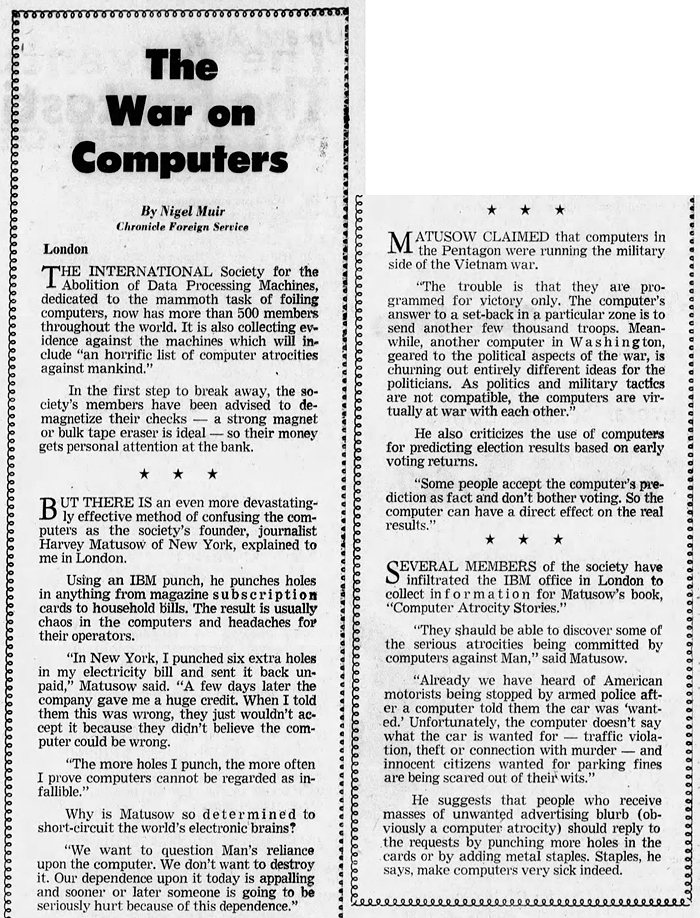
San Francisco Examiner
10-27-1968
The International Society for the Abolition of Data-Processing Machines […] was founded by Harvey Matusow in the late 1960s. Its aim was “to conduct guerrilla warfare against the computer by such means as sending a penny too much or too little when paying a utility bill.”
Matusow also authored The Beast of Business, which was supposed to serve as a manual for the guerrilla warfare against the computer. I wonder if any of the techniques he detailed would still work today?
However, Matusow is best known for giving evidence in court against individuals during the McCarthy era. Later, he claimed that the FBI had paid him to give false testimony and he detailed these allegations in his book False Witness.
He seems to have had a rather eccentric life and career. Some other highlights of it, from the University of Sussex’s page about him:
♦ Founded a band called the Harvey Matusow’s Jew’s Harp Band
♦ Married approximately twelve times
♦ Is possibly part of the reason The Beatles broke up – he held the party where John Lennon met Yoko Ono
♦ Worked as a children’s TV clown called Cockyboo in Tucson, Arizona
♦ Converted to Mormonism and spent his last years known as Job MatusowAlex Boese
Weird Universe
May 29, 2021
Additional Reading:
Frustrations: Guerrilla War Against Computers (Time Magazine/09-12-1969)
Snapshots Sunday: Land of Oz
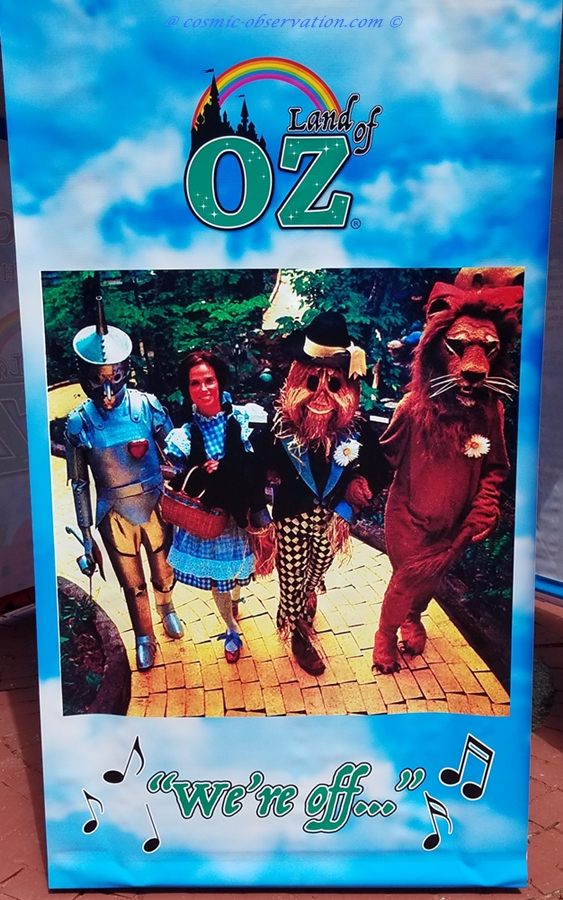
Image is from the early 1970s
09-08-2017
In September of 2017, I paid a visit to a place I had not seen since I was about six years old…the Land of Oz. I remember bits and pieces of the trip. My parents took me in 1972 and two of my strongest memories are of riding on the balloon ride (a converted ski-lift) in a blinding mountain rainstorm and the wet ride in a bus, with no windows, down the mountain, leaving. For years, I wondered what had become of that park.
Originally opening on June 15, 1970, it was a grand place to visit and managed to stay open for a decade, even after a fire in 1975, before falling into disrepair and abandonment. Many things were stolen, vandalized or left to nature.
Appalachian State University had a cultural museum, at one time, that showcased saved pieces from the park including the yellow bricks, some munchkin houses, costumes, parts of the witch’s castle and other assorted props. All artifacts were eventually returned to the park.
In 1991, the park was included in a celebration for Independence Day for Beech Mountain. Watauga High School students dressed in costume. Emerald Mountain, Inc., purchased the property in 1994 and a slow restoration began. An “Autumn at Oz” was started as a reunion for former employees and became a yearly event. By 2010, the park drew 8,000 people.
By the 80th anniversary of The Wizard of Oz movie, 12,000 guests had come through in June of 2019. I have tons of pictures of this place, old and new and, I will be posting them over time. ~Vic
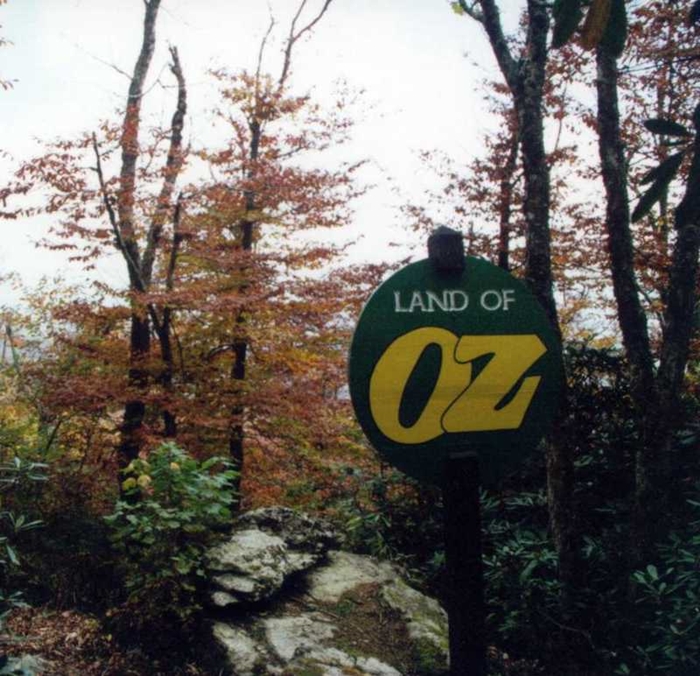
Photo Credit: Emerald Mountain Realty
Land of Oz (Official Website)
 Cosmic-Observation