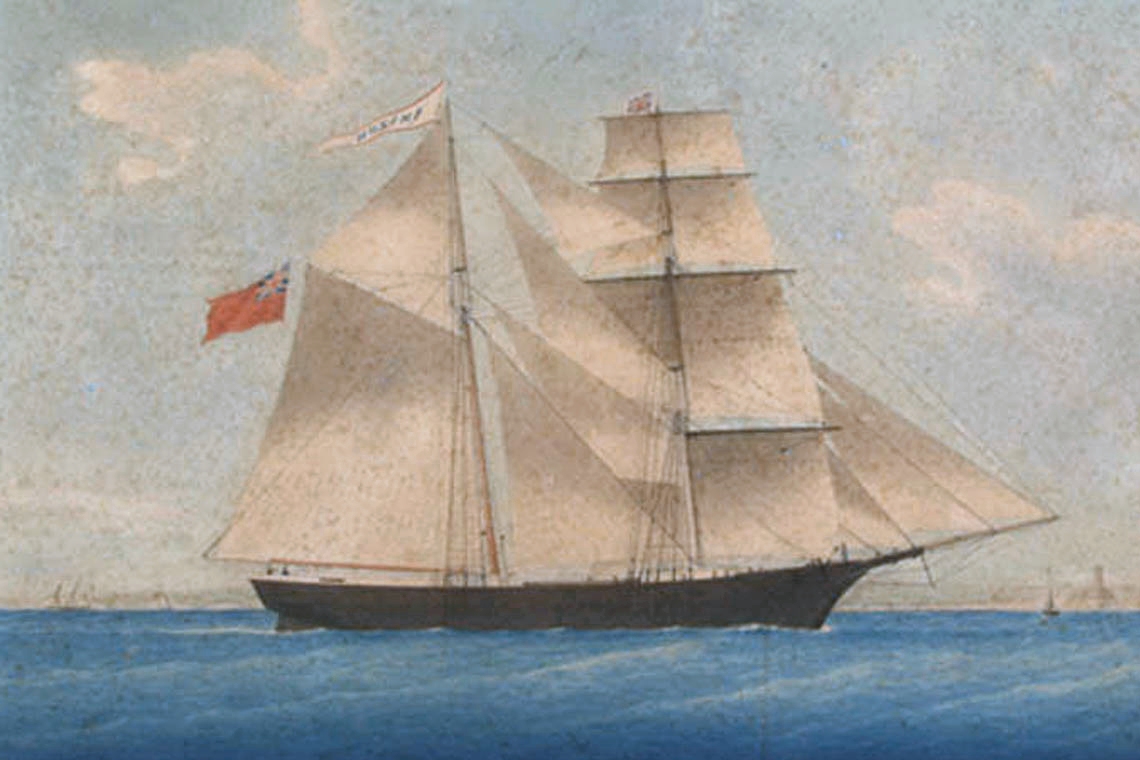
A merchant brigantine, the Mary Celeste was built at Spencer’s Island, Nova Scotia and launched under British registration as Amazon in 1861. She was transferred to American ownership and registration in 1868 when she acquired her new name. Thereafter, she sailed, uneventfully, until her 1872 voyage.
[She was] discovered adrift and deserted in the Atlantic Ocean off the Azores Islands on December 4, 1872. The Canadian brigantine Dei Gratia found her in a disheveled but seaworthy condition under partial sail and with her lifeboat missing. The last entry in her log was dated ten days earlier.
She left New York City for Genoa on November 7 and [the] Dei Gratia departed for Gibraltar on November 15, following the same general route eight days [later]. [She] was still amply provisioned when found. Her cargo of denatured alcohol was intact and, the captain’s and crew’s personal belongings were undisturbed. None of those who had been on board were ever heard from again.
Image Credit: gutenberg.org
At the salvage hearings in Gibraltar following her recovery, the court’s officers considered various possibilities of foul play, including mutiny by Mary Celeste’s crew, piracy by the Dei Gratia crew or others and conspiracy to carry out insurance or salvage fraud. No convincing evidence supported these theories but, unresolved suspicions led to a relatively low salvage award.
The inconclusive nature of the hearings fostered continued speculation as to the nature of the mystery and, the story has repeatedly been complicated by false detail and fantasy. Hypotheses that have been advanced include the effects on the crew of alcohol fumes rising from the cargo, submarine earthquakes (seaquakes), waterspouts, attack by a giant squid and paranormal intervention. The story of her 1872 abandonment has been recounted and dramatized many times in documentaries, novels, plays and films and, the name of the ship has become a byword for unexplained desertion.
[Were] it not for Dr. Arthur Conan Doyle, struggling to establish himself as a writer prior to creating Sherlock Holmes, perhaps the world would not have ever known or cared [about the ship]. Conan Doyle’s short story about the ‘Marie Celeste‘ (he changed the name from Mary) turned a minor puzzle into one of the most famous legends of the sea. Nevertheless, we should recognise it was fiction, for which his editor paid 30 Pounds, […] a respectable sum in 1884.
Eight-four years ago, today, Austrian physicist Erwin Schrödinger published his first of three essays on a Thought Experiment regarding a hypothetical cat:
[A] cat, a flask of poison and a radioactive source are placed in a sealed box. If an internal monitor (e.g. Geiger counter) detects radioactivity (i.e. a single atom decaying), the flask is shattered, releasing the poison, which kills the cat. The Copenhagen interpretation of quantum mechanics implies that, after a while, the cat is simultaneously alive and dead. Yet, when one looks in the box, one sees the cat either alive or dead, not both alive and dead. This poses the question of when, exactly, quantum superposition ends and reality collapses into one possibility or the other.
[Schrödinger] intended the example [above] to illustrate the absurdity of the existing view of quantum mechanics:
One can even set up quite ridiculous cases. A cat is penned up in a steel chamber, along with the following device (which must be secured against direct interference by the cat): in a Geiger counter, there is a tiny bit of radioactive substance, so small, that perhaps in the course of the hour one of the atoms decays, but also, with equal probability, perhaps none. [If] it happens, the counter tube discharges and, through a relay, releases a hammer that shatters a small flask of hydrocyanic acid. If one has left this entire system to itself for an hour, one would say that the cat still lives if, meanwhile, no atom has decayed. The first atomic decay would have poisoned it. The psi-function of the entire system would express this by having in it the living and dead cat (pardon the expression) mixed or smeared out in equal parts.
It is typical of these cases that an indeterminacy originally restricted to the atomic domain becomes transformed into macroscopic indeterminacy, which can then be resolved by direct observation. That prevents us from so naively accepting as valid a “blurred model” for representing reality. In itself, it would not embody anything unclear or contradictory. There is a difference between a shaky or out-of-focus photograph and a snapshot of clouds and fog banks.
Schrödinger’s famous thought experiment poses the question, “when does a quantum system stop existing as a superposition of states and become one or the other?”
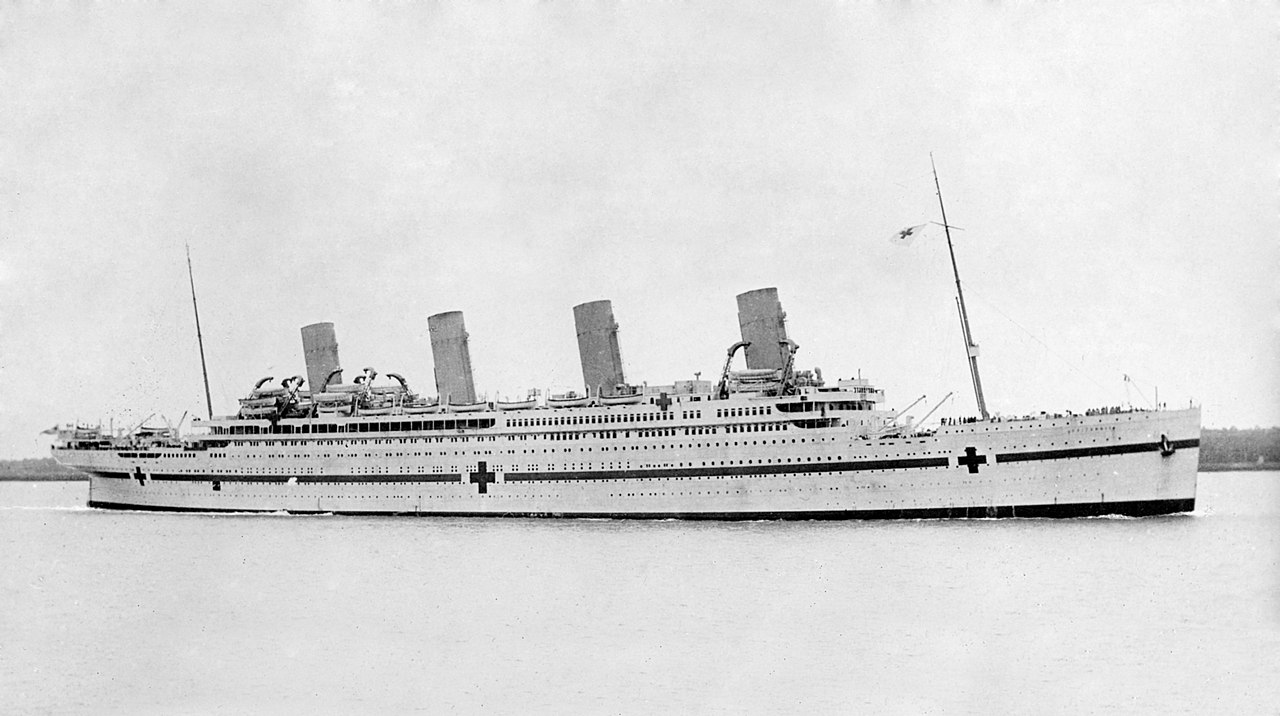
One-hundred, three years ago, today, the HMHS Britannic, sister ship to the RMS Titanic, sank in the Aegean Sea. On its way to pick up more wounded soldiers near the Gulf of Athens, a loud explosion shook the ship at 8:12am.
In the wake of the Titanic disaster on April 14, 1912, the White Star Line made several modifications in the construction of its already-planned sister ship. First, the name was changed from Gigantic to Britannic and the design of the hull was altered to make it less vulnerable to icebergs. In addition, it was mandated that there be enough lifeboats on board to accommodate all passengers, which had not been the case with the Titanic.
Postcard of the Britannic showing her intended purpose. Image Credit: wikipedia.org & wikimedia.org & ibiblio.org
[Immediately after the explosion], Captain Bartlett ordered the closure of the watertight doors and sent out a distress signal. However, the blast had already managed to flood six whole compartments, even more extensive damage than that which had sunk the Titanic. Still, the Britannic had been prepared for such a disaster and would have stayed afloat except for two critical matters.
First, Captain Bartlett decided to try to run the Britannic aground on the nearby island of Kea. This might have been successful but, earlier, the ship’s nursing staff had opened the portholes to air out the sick wards. Water poured in through the portholes as the Britannic headed towards Kea. Second, the disaster was compounded when some of the crew attempted to launch lifeboats without orders. Since the ship was still moving as fast as it could, the boats were sucked into the propellers, killing those on board.
Less than 30 minutes later, Bartlett realized that the ship was going to sink and ordered it abandoned. The lifeboats were launched and even though the Britannic sank at 9:07, less than an hour after the explosion, nearly 1,100 people managed to make it off the ship. In fact, most of the 30 people who died were in the prematurely launched lifeboats.
Violet Jessop (who was also one of the survivors of Britannic’s sister-ship Titanic and had even been on the third sister, Olympic, when it collided with HMS Hawke) described the last seconds:
“She dipped her head a little, then a little lower and still lower. All the deck machinery fell into the sea like a child’s toys. Then, she took a fearful plunge, her stern rearing hundreds of feet into the air until with a final roar, she disappeared into the depths, the noise of her going resounding through the water with undreamt-of violence…”
Britannic was the largest ship lost in the First World War.
The cause, whether it was a torpedo from an enemy submarine or a mine, was not apparent. It would later be revealed that the mines were planted in the Kea Channel on October 12, 1916, by SM U-73 under the command of Gustav Sieß (German language link).
One hundred, nine years ago, today, aviatorEugene Ely made naval aviation history, taking off from a wooden platform secured to the bow of the light cruiserUSS Birmingham. Captain Washington Chambers, USN, was tasked by the Secretary of the Navy George von Lengerke Meyer to investigate uses for aviation in the Navy. Ely successfully took off in a Curtiss Pusher from the Birmingham, barely. The airplane rolled off the platform, plunged downward, skipping the water, which damaged the propeller but, he managed to stay airborne, landing two and a half miles away on Willoughby Spit. Two months later, on January 18, 1911, Ely landed his Curtiss Pusher airplane on a platform on the armored cruiserUSS Pennsylvania anchored in San Francisco Bay.
Ely communicated with the United States Navy requesting employment but, United States naval aviation was not yet organized. Ely continued flying in exhibitions while Captain Chambers promised to “keep him in mind” if Navy flying stations were created.
On October 19, 1911, while flying at an exhibition in Macon, Georgia, his plane was late pulling out of a dive and crashed. Ely jumped clear of the wrecked aircraft but, his neck was broken and he died a few minutes later.
On February 16, 1933, Congress awarded the Distinguished Flying Cross posthumously to Ely, “for extraordinary achievement as a pioneer civilian aviator and for his significant contribution to the development of aviation in the United States Navy.”
Last year, I did a post on World War I for Veterans Day as it had been 100 years, exactly, since the end of that war. I also covered how other countries memorialize and/or celebrate and, ended the post with two poems. I’ve written in a previous post about my almost Army brat status and referred to my significant other in this post.
Hargrave Military Academy Circa 1958
Ken’s first foray into the ‘military’ was the Hargave Military Academy in Virginia. His mother sent him there for summer school to assist with grades after a poor eighth grade year. He stayed for his ninth grade year and did very well. Unfortunately, it was extremely expensive and he returned to regular high school for tenth grade.
At the end of his junior year, he’d had enough of regular high school and made it clear to his mother that he wanted to go into the Navy. The military was all he was interested in. So, at the tender age of 17, his mother signed him into service. He went into the reserves for two years and began to train as a Corpsman. His sea duties were aboard the USS Robinson (DD-562), a Fletcher Class destroyer, the second ship in the Navy to be named after Captain Isaiah Robinson (Continental Navy). The “Robbie” received eight battle stars for World War II service and appeared in the movie Away All Boats.
The Robbie
Circa 1953Circa 1961
After two years of training, he went active duty…and the Navy lost its mind. Orders to report to his new ship in hand, he was sent to Charleston, SC, to be assigned to the USS Canisteo (AO-99), a Cimarron Class fleet oiler, named for the Canisteo River in New York and the only ship to bear that name. It’s crew received nine medals.
Unfortunately, upon his arrival, there was no ship to board. The Charleston Naval Base had no record of it being there and, in the meantime, he was sent to the transit barracks. While waiting, he volunteered to be a lifeguard for a week. The remaining time was spent waiting at the barracks. After three weeks, the Navy adjusted his orders and sent him to Norfolk Naval Base, the home port of the Canisteo. Upon arrival, no ship. He was, again, assigned to the transit barracks…until they could find the ship. After a four-day wait, the Navy adjusted his orders a second time and he was sent to the Brooklyn Naval Shipyard. The shipyard had no record of the Canisteo being there so, he was sent…a-gain…to the transit barracks. His ship was finally found at the Todd Shipyards in Red Hook Brooklyn, a civilian shipyard. With his orders in hand (now, a rather large portfolio of paperwork), stamped by the Navy (adjusted a third time), he headed to his ship. He reported to the Officer of the Deck and was told that he had been reported AWOL. The OOD examined the orders, informed him that his Corpsman striker slot had been filled due to his (unintended) absence and, just like that, he was transformed into part of the deck force, wiping out two years of training. He became a Bosun’s Mate striker. *facepalm*
The Canisteo
Circa 1961Circa 1962
While on board the Canisteo, he participated in the Cuban Blockade
He left active service in 1964 and rolled into the IRR, waiting for the end of his contract to expire. On March 8, 1965, Marines landed near Da Nang, marking the beginning of the ground war in Vietnam. Ken was working a full time job and was watching what was going on. By the summer of 1966, he decided that he was going to go back to the Navy, interested in the River Patrol (and PBRs) and went to see a prior service recruiter. The recruiter told him that the Navy would not give him his rank back. Ken left his office and was stopped by a Marine recruiter in the hallway. He told him to go back in and ask about the Seabees. He did so and the Navy prior service recruiter changed his tune. Off he went to Camp Endicott in Rhode Island for training. He was assigned to Naval Mobile Construction Battalion 74 and sent to Gulfport, Home of the Seabees.
He arrived in Vietnam in July of 1967. His base was Camp Haskins on Red Beach in Da Nang. The Marines were on Monkey Mountain across the bay and at Da Nang Air Base in the opposite direction, across the highway. At the beginning of the Tet Offensive, the bombing of the Air Base in January of 1968 nearly knocked Ken out of a guard tower. He was designated a builder and did his share of such but, spent most of his time running patrols with the Marines.
Gulfport, MS
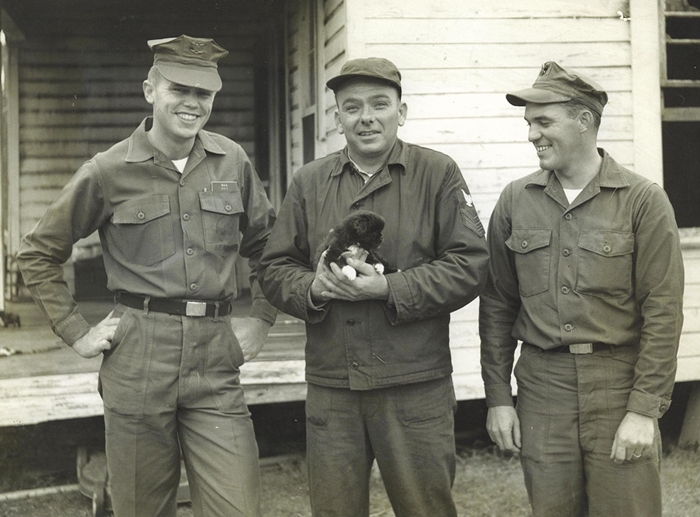
Ken on the left.
The puppy had been rescued from a house fire.
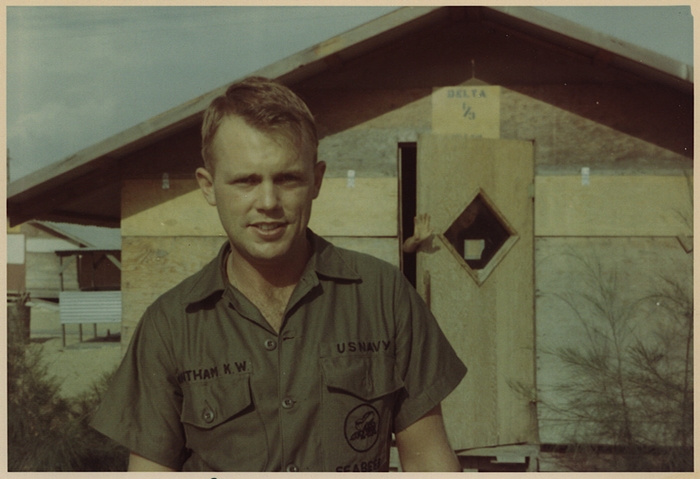
Circa 1967Camp Haskins
Notice the guy waving in the background.
On November 3, 1967, a fellow Seabee had an accident with a saw while cutting some wood. A sawhorse shifted and the man injured himself, accidentally. The blade cut an artery in his thigh and Ken’s Corpsman training kicked in. He, literally, stuck his hand into the guy’s thigh to clamp the artery with his thumb and forefinger. When the rescue helicopter arrived, the coagulated blood on Ken’s arm prevented him from being able to remove his hand from the guy’s thigh. Ken got a free ride in the helicopter to the hospital with his charge. A life was saved (the actual details are pretty gruesome).
A life saved…
And, this concludes my long-ass tribute to my Fleet Navy/Vietnam Seabee veteran. If you have a veteran in your life…hug them. ~Vic
[Addendum: When I moved in with Ken some years ago, I was looking at his DD-214. He swore he only had one and I saw from the data that he had two. We sent off for his records and, sure enough, there were two. I discovered that, when he went to the prior service recruiter, the guy didn’t bother to check to see if Ken was still on contract. He was and, had he checked, Ken could have returned to the Navy, with rank intact, and left for Vietnam as part of the Brown Water Navy…and most likely died. The life span of PBR guys was fairly short.]
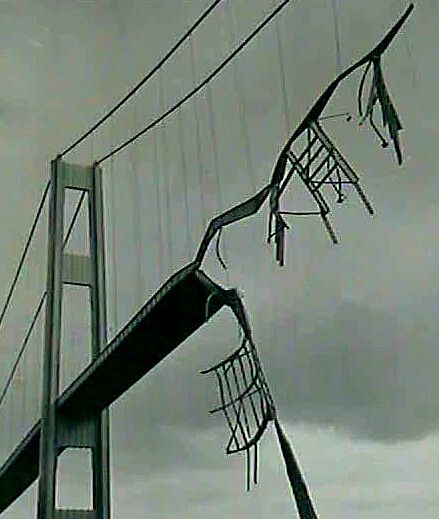
On July 1, 1940, the Tacoma Narrows Bridge was opened to traffic. This picture, taken from the air during dedication ceremonies, plainly shows three unusual characteristics of design: (1) Extremely narrow deck – 39′; (2) extreme length of suspension span – 2800′; (3) the solid stiffening girders used in the place of orthodox truss girders. Use of the solid girders is commonly blamed for the collapse.
Image Credit: tacomanarrowsbridge.org
Notice the view of the car in the center of the twist.
Construction began in September 1938. From the time the deck was built, it began to move vertically in windy conditions, so, construction workers nicknamed the bridge Galloping Gertie. The motion continued after the bridge opened to the public, despite several damping measures. The bridge’s main span finally collapsed in 40-mile-per-hour (64 km/h) winds on the morning of November 7, 1940. Efforts to replace the bridge were delayed by the United States’ entry into World War II […]. The portion of the bridge that fell into the water now serves as an artificial reef.
The bridge’s collapse had a lasting effect on science and engineering. In many physics textbooks, the event is presented as an example of elementary forced resonance. [The] bridge collapsed because normal speed winds produced aeroelastic flutter that matched the bridge’s natural frequency. The collapse boosted research into bridge aerodynamics-aeroelastics, which has influenced the designs of all later long-span bridges.
I saw the Narrows bridge die today and only by the grace of God, escaped dying with it…
I drove on the bridge and started across. Just as I drove past the towers, the bridge began to sway violently from side to side. Before I realized it, the tilt became so violent that I lost control of the car…I jammed on the brakes and got out, only to be thrown onto my face against the curb. Around me I could hear concrete cracking. The car, itself, began to slide from side to side on the roadway. I decided the bridge was breaking up and my only hope was to get back to shore. On hands and knees most of the time, I crawled 500 yards or more to the towers. My breath was coming in gasps…my knees were raw and bleeding, my hands bruised and swollen from gripping the concrete curb. Toward the last, I risked rising to my feet and running a few yards at a time. Safely back at the toll plaza, I saw the bridge in its final collapse and saw my car plunge into the Narrows.
Some Bridge Facts:
♦ [The] entire 1940 bridge did not collapse into the water, though most of the center span did fall. The side spans were badly damaged and the 2 big towers got bent beyond repair […]. It would be 10 years before the bridge was replaced.
♦ [Due] to the undulating motions up and down […], you could be driving across it and, the car ahead of you might dip out of view. Sometimes the roadway would rise above the height of a car […].
♦ The 1940 bridge remains at the bottom of the water have provided a place for sealife [sic] that was not there, before and much of the life includes the giant Pacific octopus as well as lingcod, wolf eels and black seabass [sic].
♦ (Referencing the image at the very top…) Did a ship go under the bridge for opening day in 1940? Yes, it is true…the ship Atlanta was a Coast Guard Cutter. Ironically, not only was it the first ship to go under the bridge on opening day July 1, 1940, it was also the last ship to travel under the bridge before it collapsed […]. When the concrete started to crumble and fall off, the ship was underneath and pieces fell on her deck. Luckily, no pieces were big enough to cause any damage to the ship and the ship’s Commander was one of the first to report the collapse.
William the Conqueror established the system of Norman law, proclaiming forests as ‘preserves’, restricting hunting and use by local inhabitants not of the monarchy or aristocracy. Grasslands and wetlands were included, as well as villages and towns that resided within. His heirs continued to enforce the laws. King Richard I and King John extended the forests, taking larger and larger areas, eventually covering one third of southern England.
This charter re-established free men rights of access, alleviating the hardship on the common people to farm, hunt, forage and generally use, and tend to, the land they lived on. It was reissued in 1225 with wording changes and then joined with the Magna Carta in the Confirmation of Charters (Confirmatio Cartarum) in 1297 by King Edward I.
A suicide bomber drives a truck packed with explosives into the U.S. Marine barracks in Beirut, killing 241 U.S. military personnel. That same morning, 58 French soldiers were killed in their barracks two miles away in a separate suicide terrorist attack. The U.S. Marines were part of a multinational force sent to Lebanon in August 1982 to oversee the Palestinian withdrawal from Lebanon.
In 1975, a bloody civil war erupted in Lebanon, with Palestinian and leftist Muslim guerrillas battling militias of the Christian Phalange Party, the Maronite Christian community and other groups. During the next few years, Syrian, Israeli and United Nations interventions failed to resolve the factional fighting and, on August 20, 1982, a multinational force including 800 U.S. Marines was ordered to Beirut to help coordinate the Palestinian withdrawal.
[Following] the massacre of Palestinian refugees by a Christian militia, [the] next day, the first U.S. Marine to die during the mission was killed while defusing a bomb. Other Marines fell prey to snipers. On April 18, 1983, a suicide bomber driving a van devastated the U.S. embassy in Beirut, killing 63 people, including 17 Americans. Then, on October 23, a Lebanese terrorist plowed his bomb-laden truck through three guard posts, a barbed-wire fence and into the lobby of the Marines Corps headquarters in Beirut. [He] detonated a massive bomb killing 241 Marine, Navy and Army personnel. The bomb, which was made of a sophisticated explosive enhanced by gas, had an explosive power equivalent to 18,000 pounds of dynamite. The identities of the embassy and barracks bombers were not determined but, they were suspected to be Shiite terrorists associated with Iran.
Serious questions also arose over the quality of security in the American sector of war-torn Beirut. The U.S. peacekeeping force occupied an exposed area near the airport but, for political reasons, the Marine Commander had not been allowed to maintain a completely secure perimeter before the attack.
On February 26, 1984, the main force of Marines left Lebanon, leaving just a small contingent to guard the U.S. embassy in Beirut.
This one hits home. One of the Marines killed in that bombing graduated from my high school. He graduated in 1982 (two years ahead of me) and I never got to meet him but, I knew his younger brother whom was a year behind me. Many years later, I wound up married to the Corps for 12 years. My ex and I visited the Beirut Bombing Memorial in Jacksonville when he returned from Iraq War duty. I took pictures but, I don’t remember what happened to them. ~Vic
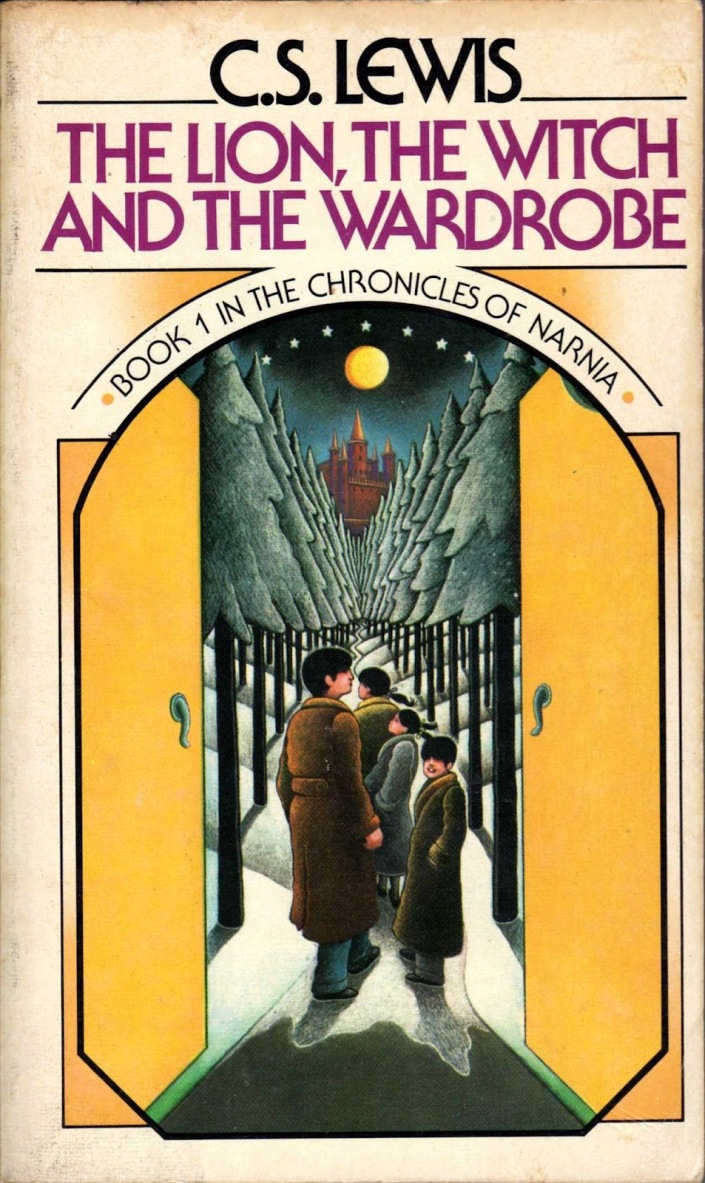
Most of the novel is set in Narnia, a land of talking animals and mythical creatures that is ruled by the evil White Witch. In the frame story, four English children are relocated to a large, old country house following a wartime evacuation. The youngest, Lucy, visits Narnia three times via the magic of a wardrobe in a spare room. Lucy’s three siblings are with her on her third visit to Narnia. In Narnia, the siblings seem fit to fulfill an old prophecy and find themselves adventuring to save Narnia and their own lives. The lion Aslan gives his life to save one of the children. He, later, rises from the dead, vanquishes the White Witch and crowns the children Kings and Queens of Narnia.
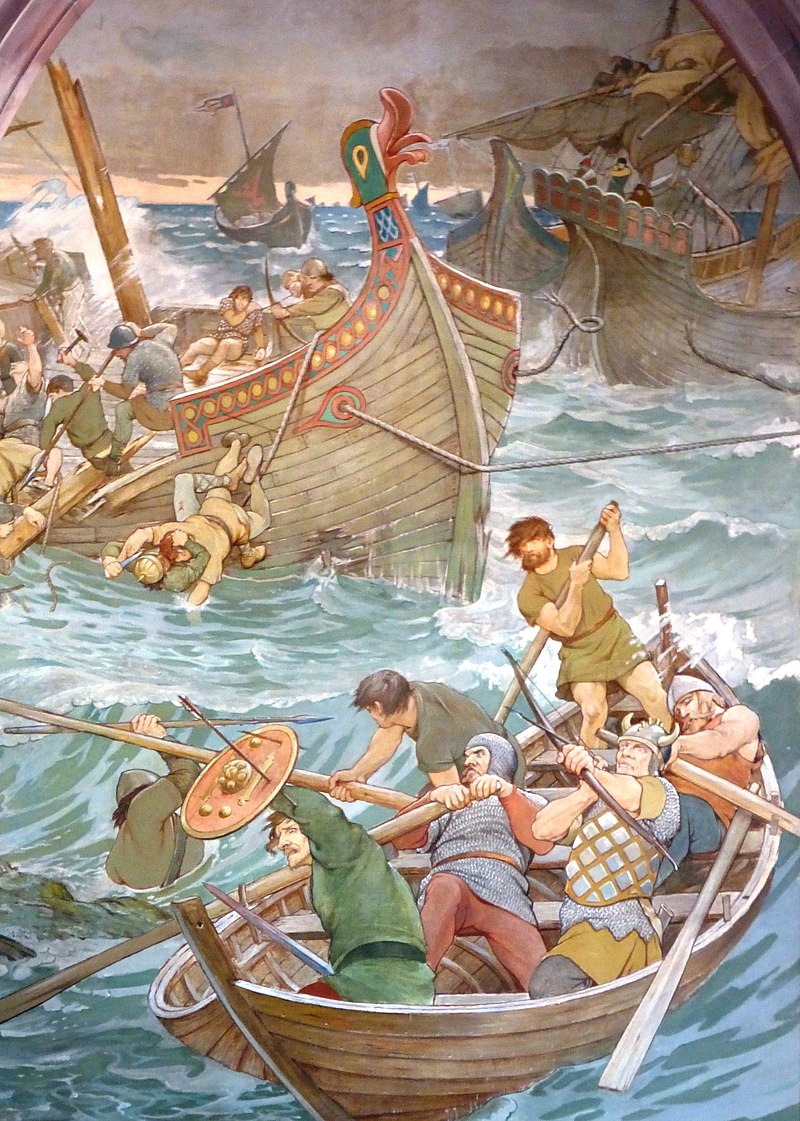
The Battle of Largs was an indecisive engagement between the kingdoms of Norway and Scotland, on the Firth of Clyde near Largs, Scotland. The conflict formed part of the Norwegian expedition against Scotland in 1263, in which Haakon Haakonsson, King of Norway, attempted to reassert Norwegian sovereignty over the western seaboard of Scotland. Since the beginning of the 12th century, this region had lain within the Norwegian realm, ruled by magnates who recognised the overlordship of the Kings of Norway. In the mid-13th century, two Scottish kings, Alexander II and his son, Alexander III, attempted to incorporate the region into their own realm. Following failed attempts to purchase the islands from the Norwegian king, the Scots launched military operations. Haakon responded to the Scottish aggression by leading a massive fleet from Norway, which reached the Hebrides in the summer of 1263. By the end of September, Haakon’s fleet occupied the Firth of Clyde, and when negotiations between the kingdoms broke down, he brought the bulk of his fleet to anchor off The Cumbraes.
On the night of September 30, during a bout of stormy weather, several Norwegian vessels were driven aground on the Ayrshire coast, near present-day Largs. On October 2 , while the Norwegians were salvaging their vessels, the main Scottish army arrived on the scene. Composed of infantry and cavalry, the Scottish force was commanded by Alexander of Dundonald, Steward of Scotland. The Norwegians were gathered in two groups:
the larger main force on the beach and a small contingent atop a nearby mound.
The advance of the Scots threatened to divide the Norwegian forces, so the contingent on the mound ran to rejoin their comrades on the beach below. Seeing them running from the mound, the Norwegians on the beach believed they were retreating, and fled back towards the ships. There was fierce fighting on the beach, and the Scots took up a position on the mound formerly held by the Norwegians. Late in the day, after several hours of skirmishing, the Norwegians recaptured the mound. The Scots withdrew from the scene and the Norwegians re-boarded their ships. They returned the next morning to collect their dead. With the weather deteriorating, Haakon’s fleet sailed to Orkney to overwinter.
The Battle of Largs has been romanticised by [some] later historians as a great Scottish victory but, it only involved a small part of the Norwegian fleet. [Another] saga described the Norwegian campaign as a triumph [but], in reality, it had not achieved anything […]. With his fleet and forces intact, Haakon planned to continue to campaign after spending the winter in Orkney but, he was unexpectedly taken ill and, died there before he had the chance to resume operations. The campaign had started too late and the Scottish king had successfully prolonged negotiations to his own advantage. With Haakon’s death, his successor, Magnus Haakonarson, King of Norway, signed the Treaty of Perth three years after the battle (July 2, 1266), leasing Scotland’s western seaboard to Alexander III in return for a yearly payment. This lease became permanent but, the Kingdom of Scotland eventually stopped paying the Norwegian crown for the islands when Norway became distracted by civil wars.
One-hundred, ninety-nine years ago, today, the realDaniel Boone passed away. Two days prior, I posted about the television show Daniel Boone that was hardly accurate in its portrayal or his frame of life despite being a popular show.
On September 26, 1820 the great pioneering frontiersman Daniel Boone dies quietly in his sleep at his son’s home near present-day Defiance, Missouri.
The indefatigable voyager was 86. Boone was born in 1734 (he has two different dates of birth due to the 1752 Gregorian calendar switch) to Quaker parents living in Berks County, Pennsylvania. Following a squabble with the Pennsylvania Quakers, Boone’s family decided to head south and west for less crowded regions and they eventually settled in the Yadkin Valley of North Carolina. There the young Daniel Boone began his life-long love for wilderness, spending long days exploring the still relatively unspoiled forests and mountains of the region. An indifferent student who never learned to write more than a crude sentence or two, Boone’s passion was for the outdoors, and he quickly became a superb marksman, hunter and woodsman. (It should be noted here that historian John Mack Faragher stated that Boone “acquired a level of literacy that was the equal of most men of his times. He was often the only literate person in groups of frontiersmen.”)
In May of 1769, Boone and five companions crossed over the Cumberland Gap and explored along the south fork of the Kentucky River. Boone returned in 1773 with his family, hoping to establish a permanent settlement. An Indian attack prevented that first attempt from succeeding (Boone’s eldest son James and, William Russell‘s son Henry were captured and tortured to death, a prelude to Dunmore’s War.) but, Boone returned two years later to open the route that became known as Boone’s Trace (or the Wilderness Road) between the Cumberland Gap and a new settlement along the Kentucky River called Fortress Boonesboro. Boonesboro eventually became one of the most important gateways for the early American settlement of the Trans-Appalachian West.
After the French and Indian War (1754–1763) broke out between the French and British, and their respective Indian allies, North Carolina Governor Matthew Rowan called up a militia, for which Boone volunteered. He served under Captain Hugh Waddell on the North Carolina frontier. Waddell’s unit was assigned to serve in the command of General Edward Braddock […].
Boone served in the North Carolina militia during [the] “Cherokee Uprising“. His militia expeditions went deep into Cherokee territory beyond the Blue Ridge Mountains and he was separated from his wife for about two years.
On December 22, 1769, Boone and a fellow hunter, Benjamin Cutbirth, were captured by a party of Shawnees, who confiscated all of their skins and told them to leave and never return.
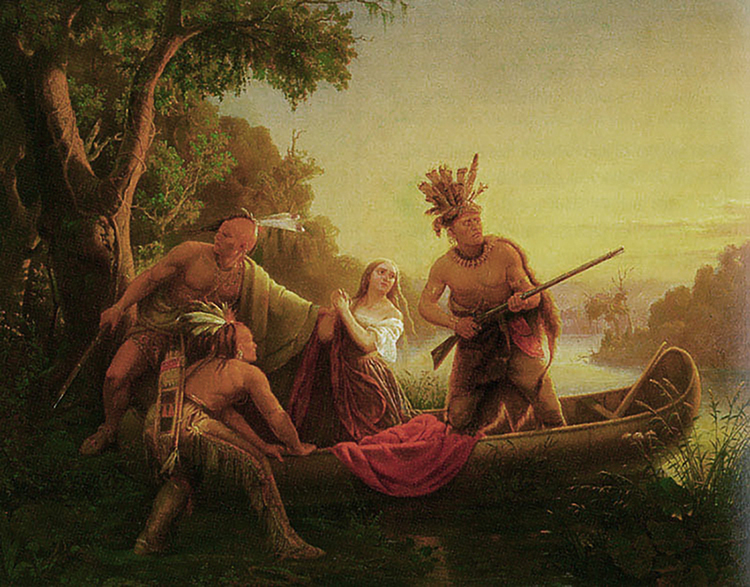
Image Credit: wikipedia.org & wikimedia.org Charles Wimar 1853
[During the Revolutionary War], Boone’s daughter Jemima and two other teenaged girls were captured outside Boonesborough by an Indian war party on July 5, 1776. The incident became the most celebrated event of Boone’s life. James Fenimore Cooper created a fictionalized version of the episode in his classic novel The Last of the Mohicans (1826).
He lived quite an eventful life.
♦ In February 1778, Boone was adopted into the Shawnee tribe as a prisoner to replace a fallen warrior (a Shawnee custom) and was named Sheltowee (Big Turtle), eventually escaping.
♦ In September 1778, he was court-martialed due to misunderstandings during the Siege of Boonesborough.
♦ There is some indication that Boone crossed paths with Abraham Lincoln’s grandfather.
♦ In 1780, Boone was [a] Lieutenant Colonel in the Fayette County militia. In October, his brother Ned was killed by Shawnees and beheaded for a trophy, as the they thought they had killed Boone.
♦ In 1781, he was elected as a representative to the Virginia General Assembly.
♦ [Traveling] to Richmond to take his seat in the legislature, […] British dragoons under Banastre Tarleton captured Boone and several other legislators near Charlottesville. The British released Boone on parole several days later.
♦ In 1782, he was elected sheriff of Fayette County.
♦ By 1787, he owned seven slaves.
♦ In 1798, a warrant was issued for Boone’s arrest after he ignored a summons to testify in a court case, although the sheriff never found him.
♦ Also in 1798, the Kentucky assembly named Boone County in his honor.
♦ From 1799 to 1804, he served as syndic and commandant, appointed by the Spanish governor of Spanish Louisiana (now St. Charles County, Missouri).
♦ American painter John James Audubon claimed to have gone hunting with Boone in the woods of Kentucky around 1810 (some historians believe Boone visited his brother Squire near Kentucky in 1810).
♦ Boone died of natural causes at his son Nathan’s home. He was 85.
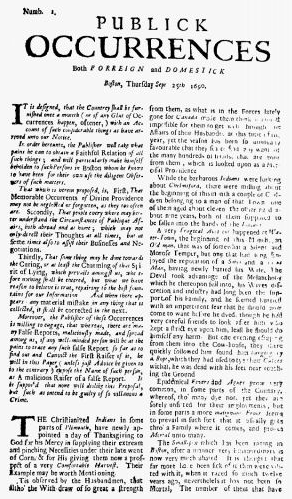
Three hundred, twenty-nine years ago, today, the multi-page newspaperPublick Occurrences Both Forreign and Domestick was published in the Americas. Edited by Benjamin Harris and printed by Richard Pierce, it was the first of its kind.
Before [the multi-page], single-page newspapers, called broadsides, were published in the English colonies and printed in Cambridge in 1689. The first edition was published September 25, 1690, in Boston, then a city in the Dominion of New England, and was intended to be published monthly, “or, if any Glut of Occurrences happen, oftener.”
No second edition was printed because the paper was shut down by the Colonial government on September 29, 1690, who issued an order as follows:
“Whereas some have lately presumed to Print and Disperse a Pamphlet, Entitled, Publick Occurrences, both Forreign and Domestick: Boston, Thursday, Septemb. 25th, 1690. Without the least Privity and Countenace of Authority. The Governour and Council having had the perusal of said Pamphlet, and finding that therein contained Reflections of a very high nature: As also sundry doubtful and uncertain Reports, do hereby manifest and declare their high Resentment and Disallowance of said Pamphlet, and Order that the same be Suppressed and called in; strickly forbidden any person or persons for the future to Set forth any thing in Print without License first obtained from those that are or shall be appointed by the Government to grant the same.”
Without a license, it was closed down after a single issue, Harris was jailed, and the next newspaper did not appear until 1704, when John Campbell’s Boston News-Letter was the first American newspaper to last beyond the first issue.
Benjamin Harris [was an] English bookseller and writer who was the first journalist in the British-American colonies. An ardent Anabaptist and Whig, Harris published argumentative pamphlets in London, especially ones attacking Roman Catholics and Quakers […]. His newspaper, Publick Occurrences, Both Foreign and Domestick (Sept. 25, 1690), the first newspaper printed in the colonies, was suppressed by Boston authorities after one issue. Harris returned to London and journalism in 1695. His London Post appeared regularly from 1699 to 1706.
I was struck by the spelling of the times when I stumbled across this. The fact that he was shut down by the government for daring to speak out (in London & in Boston) also caught my attention. The more things change, the more they stay the same. ~Vic
Sixty-seven years ago, today, Flatwoods, WV, in Braxton County, was the site of a reported encounter with a scary entity. At 7:15pm:
[May] brothers Ed, 13, and Freddie, 12, had been playing in their schoolyard with their 10-year-old friend Tommy Hyer. After noticing a pulsing red light streak across the sky and crash on a nearby farm, the three youngsters ran to grab the Mays boys’ mother, then high-tailed it up that hill to check out where the light had landed. A few other boys, one with a dog, showed up, too.
Image Credit: history.com
Original drawing by a New York sketch artist.
They ran back down, in sheer and credible terror.
“Seven Braxton County residents on Saturday reported seeing a 10-foot Frankenstein-like monster in the hills above Flatwoods,” a local newspaper reported afterward. “A National Guard member, [17-year-old] Gene Lemon, was leading the group when he saw what appeared to be a pair of bright eyes in a tree.”
Lemon screamed and fell backward, the news account said, “when he saw a 10-foot monster with a blood-red body and a green face that seemed to glow.” It may have had claws for hands. It was hard to tell because of the dense mist.
The story made the local news, then got picked up by national radio and big papers all over the country […]. Mrs. May and the National Guard kid ended up going to New York to talk to CBS […].
But, rattled eyewitnesses weren’t the only reason the story took off. Americans were truly frightened in 1952, made anxious by atomic bombs and what seemed like a new world made by mad scientists. Even LIFE magazine, probably the most popular publication in the nation at the time, had, just a few months earlier, published a seemingly credible trend story about flying saucers. Spook stories sprout best when the seed lands in a bed fertile with anxiety and that was 1952 Cold War America […]. [I]t prompted a U.S. Air Force UFO inquiry, part of a project called Project Blue Book that dispatched a handful of investigators around the country to look into such claims.
One writer who stoked the story (a lot) was Gray Barker, a Braxton County native who investigated the monster and, then, became one of the more prominent UFO myth makers, ever. It was Barker who wrote about Flatwoods, then introduced the mythology of government “Men in Black” after he heard that two Air Force investigators had “reportedly” shown up in Flatwoods, posing as magazine writers.
People grin about it now and take Monster souvenir money from hundreds of Monster tourists every week. But, it scared people plenty back then […]. “One of the boys peed his pants,” said John Gibson, a high-school freshman at the time, who knew them all. “Their dog (Rickie) ran with his tail between his legs.”
To this day, tourists come out of their way to Flatwoods to visit its monster museum and buy Green Monsters and t-shirts. Freddie and Ed are still alive and, still standing by their story. They are in their late 70s now. They are no longer talking to reporters. They got tired after 100,000 interviews […]. [T]he brothers did appear in a recent documentary about the Flatwoods Phantom.
[The Air Force] concluded that bright, but common, meteors had streaked across the eastern U.S. at dusk that night, seen by many in Baltimore, among other places. And, the monster with the claw-like arms? Likely an owl, they said.
And, so, the Flatwoods Monster, also known as the Green Monster, [or] the Phantom of Flatwoods, who was reportedly seven feet tall, or 10 feet tall, or 13 feet tall, or 17 feet tall, became that most peculiar American invention…a legend emblazoned on t-shirts. [Source]
I realize that September 11 is usually reserved for the remembrance of 9/11 but, that seems to be all over the news as it is. There are other things that have happened on September 11. ~Vic
Carla was the most intense hurricane to make landfall on the Texas coast in the 20th century and second in recorded history only to the Indianola hurricane of 1886. Carla was the last of 6 hurricanes to make landfall on the Texas coast as a Category 4 hurricane on the Saffir-Simpson scale, with sustained winds stronger than 130 mph, in the 20th century. Carla ranks as the 9th most intense hurricane to affect the United States since 1851.
Carla made landfall on the afternoon of the 11th on the northeast part of Matagorda Island as a strong Category 4 hurricane […]. The eye of Carla moved across Port O’Connor and Port Lavaca and, then, inland just east of Victoria. Carla weakened to a tropical storm on the morning of the 12th just east of Austin.
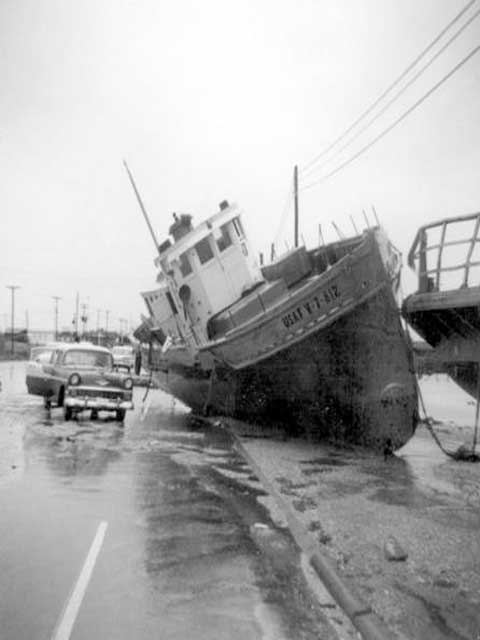
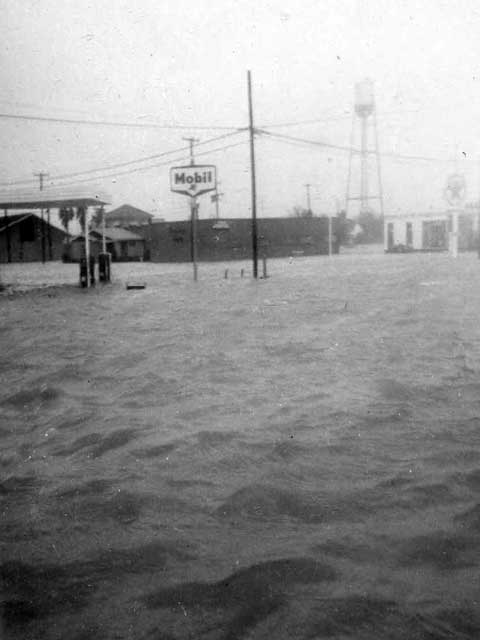
Carla was an extremely large hurricane with devastating effects from the winds and storm surge […]. The extreme tides inundated downtown Port Lavaca with 2 feet of flood water and displaced fishing boats and tug boats on Highway 35. With the slow movement of Carla, the hurricane pushed a storm surge of 22 feet above mean sea level at the head of Lavaca Bay in Port Lavaca. This is the highest storm surge in Texas hurricane history.
[Little-known] newsman Dan Rather reported live from the second floor of a building in Texas City during the storm, an act that would be imitated by later reporters. This marked the first live television broadcast of a hurricane. Rather also alerted the public of the size of Carla in a way that “literally changed the way the world sees hurricanes”, according to a fellow reporter. Broadcasting live at the Weather Bureau Office in Galveston, Rather asked a meteorologist to draw an outline of the Gulf of Mexico on a transparent sheet of plastic. He then held the map over the black and white radar screen, which put the size of Carla into perspective, saying that Carla was the size of the Gulf of Mexico. CBS was so impressed with Rather’s work that he was offered the position of correspondent.
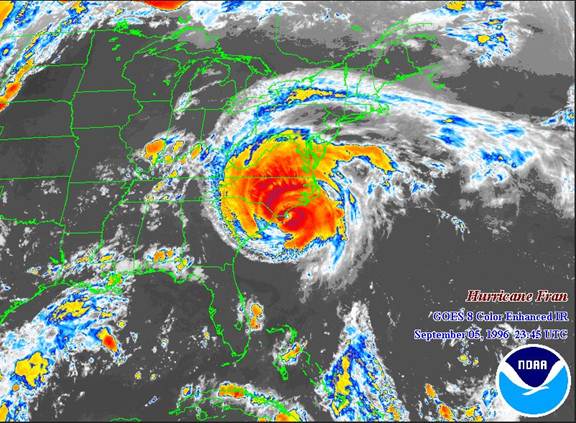
While many folks are suffering from the damage brought about by Hurricane Dorian, including my own state, twenty-three years ago, today, another hurricane made landfall between 7:17 & 9:03pm EDT…Hurricane Fran. The eye passed over Bald Head Island and Southport.
Fran was the second hurricane to slam into the North Carolina coast in the same season. Bertha was a Category 2 hurricane when she hit just two months earlier. There wasn’t much time to recover from the first disaster before the second hit.
Due to a low pressure centered over Tennessee and the western extension of the subtropical ridge over the northwest Atlantic, Fran was steered onto a north-northwesterly track and gained speed. Moving around 17 mph, the center of Fran made landfall over the Cape Fear area on September 5th around 8:30 p.m., just southwest of Wilmington. At landfall, sustained winds were 115 mph […].
Image Credit: noaa.gov
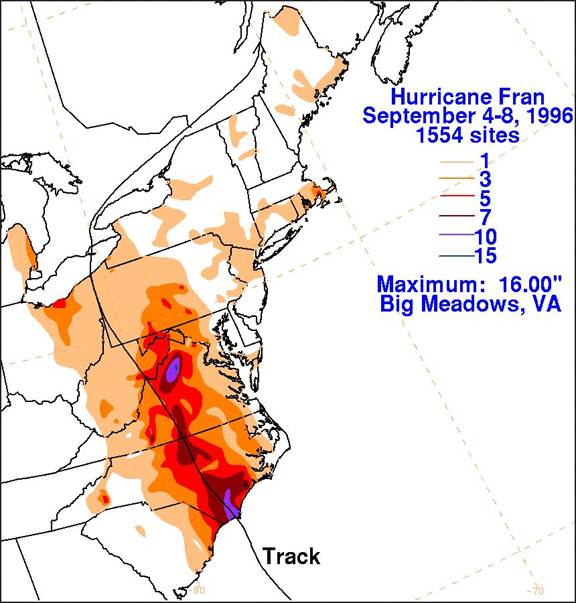
Fran caused major flooding from North Carolina to Maryland [to] West Virginia. The damage from Fran was so extensive that the name “Fran” was removed from the hurricane name list and replaced by Fay. North Carolina got the worst of the storm […]. The North Topsail Beach police station was washed away by a 12 foot storm surge. The police station was being temporarily housed in a double wide since Bertha wiped out the original building just a few months prior. Kure Beach Pier was destroyed along with the Emerald Isle fishing pier, while Bogue Inlet Pier lost 150 feet. Storm surge in North Topsail Beach created a 100-foot wide inlet. Topsail Island lost 40 feet of beach due to erosion. Swansboro and New Bern experienced 10 feet of storm surge […].
Hurricane force wind gusts were experienced as far inland as Raleigh. High winds damaged historical buildings. Classes at the University of North Carolina were canceled for a day and it was almost a week before the water was drinkable again. Strong winds and a saturated ground led to many trees being uprooted inland. This led to numerous houses being destroyed by trees falling on them. Over a million people were left without power. Almost two weeks after the storm, 150 secondary roads were still closed due to flooding and downed trees.
In the same way that residents of Columbia and Charlotte remember Hurricane Hugo‘s devastating inland winds, residents of Raleigh and most of the North Carolina inland coastal plain think back to Fran when discussing the strong wind a hurricane can bring well away from the coast. Fran was the worst storm to strike southeastern North Carolina since Hurricane Hazel in 1954.
My dad was nine years old when Hazel hit. He remembered being underneath his desk in elementary school. I was living in Durham when Fran hit. I thought the roof of the house was going to come off (I was living in an attic studio apartment on the west side of town, close to Duke Hospital and Duke University). That hurricane came straight up thru the middle of NC. Working in Law Enforcement, I was considered “necessary personnel” and when I got up to head in, Durham looked like a war zone. Interstate 85 was completely shut down and I wound my way thru town, west to east. Oh, the devastation. The Trooper Station I worked in had power but, my apartment went without for a week. I need to dig up the pictures of the damage and post them. They are in a box…somewhere. ~Vic
















 Cosmic-Observation