Born in Perry Point, Maryland, he was the son of an aircraft mechanic. Dropping out of high school in the 11th grade, he enlisted in the Army in October 1974 and was stationed in Kentucky & Colorado, trained as a mechanic. Honorably discharged in 1975, he was a truck driver from 1976 until 1993. Arrested for theft & drug dealing in the same year, he spent 90 days in rehabilitation. His third wife left him, shortly thereafter.
Apparently, Corder wanted the attention of, then, President Bill Clinton. It was speculated that Corder was trying to emulate Mathias Rust. On September 11, Corder, severely intoxicated, stole the plane from Hartford County Airport and was picked up by radar at Reagan National Airport just minutes before he steered into the White House wall. He died on impact at 1:49am. This event brought procedures to the forefront, as Corder was in restricted airspace.
Clinton was not in the White House at the time, due to renovations. He was staying at the Blair House.
Photo Credit: Amusing Planet
The Great Panjandrum at Westward Ho!
Wacky WW2-Era Failed Weapon
In 1941, the Government of the United Kingdom established a temporary wartime body called the Department of Miscellaneous Weapons Development (DMWD) to find new and unconventional ways to kill the enemy. Efforts from this department led to such useful inventions such as the Hedgehog anti-submarine weapon and Squid anti-submarine mortar, as well as the Holman Projector, an anti-aircraft rocket battery—and a system of degaussing used to protect ships against magnetic mines. It also led to the invention of the bouncing bomb that could skip across water to avoid torpedo nets and was used in the very successful Dambusters Raid of 1943. Above all, it played an important role in developing parts of the Mulberry Harbour used in the D-Day landings.
Despite these successes, not all of the DMWD’s projects were fruitful. An attempt to conceal the River Thames from German bombers, by covering it with soot, failed due to the effects of wind and tides, although it did cause some confusion when the coal-covered waters were mistaken for [a] tarmac during blackouts. The most disastrous project, however, was the Panjandrum. With a name inspired by a character in a nonsensical piece of prose from the 18th-century British dramatist Samuel Foote, the Great Panjandrum was doomed from inception. Constructed as a pair of large wheels, each approximately 10 feet in diameter, it featured a central steel drum carrying over a ton of explosives. Around the rims of the wheels were cordite rocket charges, designed to spin the entire device, propelling it towards the concrete beach defenses along the French coast with the intent of creating a substantial breach. The designers estimated that a fully loaded, 1,800-kg Panjandrum could reach speeds of around 60 mph (100 km/h), with enough momentum to crash through any obstacles between its launch point and target.
Trials began with only a handful of cordite rockets attached to the wheels and the payload was simulated by an equivalent weight of sand. The rockets were ignited and the Panjandrum catapulted itself forward, out of the landing craft used as a launchpad […] a fair distance up the beach. However, a number of rockets on one of the wheels failed, causing the weapon to careen off course. Despite several further attempts with more rockets, the Panjandrum consistently lost control before reaching the end of the beach.
If you fancy swimming with the sharks without the worry of them taking a chunk out of you, a dip in Lake Neuchâtel would be ideal. Lurking in the depths of the murky water is a terrifying shark statue that’s been scaring divers half to death in Switzerland. The monstrous model sports a truly chilling grin that flashes every inch of its huge jaws while its pectoral fins look as though they are in flight mode. So, it’s no wonder those poor divers have been startled. The shark statue sits at the bottom of the lake in Romandy and appears to be floating, thanks to its supporting structure. It has been suggested that it was dumped there by a prankster, keen to convince locals the film Jaws is actually real. Their stunt hasn’t been doing a bad job at that either, as it’s forced a host of divers to do a panicked double take. Footage of a gang of underwater explorers coming across the petrifying prop has been doing the rounds on social media. [P]eople have been left in stitches by the creativeness of the alleged mischief maker. Then, again, it would hardly have the same effect if you parked it at a bus stop, would it? Sleuths on Reddit somehow managed to recognise the shark and said it was used as a prop in the film Choc au Lac! It is featured in one of the scenes from the 1975 movie, which was created by a group of 176 kids from Neuchâtel. The flick was, of course, about a giant shark that [terrorized] the town but, was unfortunately never finished.
Photo Credit: Reddit & LadBible
[Even] the amateur detectives on Reddit can’t work out how the shark statue made its way down to the bottom of the lake. It is suspected that the 20ft long replica, made of [fiberglass], was probably dumped in the lake as a prank. Other theories include that it was put there as an unofficial tourist attraction or to create a hype for the unfinished film. To be fair, it has become a hot-spot for divers who want to see how scary it actually is, in the flesh, since 2002. Social media users haven’t been as enthusiastic about taking a trip down to the depths, even if it is just a statue.
One said: “Good thing the water is so murky so nobody can see me s**t my pants.”
Another wrote: “Now, imagine being the first dude that came across this.”
A third added: “This picture makes me feel sick to my stomach, like, visceral fear inside me is telling me to run as far as I can.”
Others were more intrigued by the elaborate plan behind abandoning the shark [in the lake], nicknamed Bruce by locals, .
Someone said: “I can’t tell if I want to shake the hand of whoever made it or run away from them.”
Another added: “What sick f**k thought this was a good idea?!”
At least you now know that thing whipping around your legs in Lake Neuchâtel is just a prop. Or is it?
Many Swifties are experiencing a post-concert “blank space.” Fans of international pop star Taylor Swift have reported a lack of memory after attending Eras Tour concerts, with some saying they’re even forgetting chunks of her performance. Experts at Hackensack Meridian Health in New Jersey researched why concertgoers are experiencing blackouts after their big night out. Dr. Nathan Carroll, associate chief resident psychiatrist at Hackensack Meridian Jersey Shore University Medical Center, linked the memory loss after concerts to a neurological condition called transient global amnesia (TGA).
“TGA is a rare phenomenon impacting memory,” the researcher told Fox News Digital. “Individuals who experience TGA will attend an event, like a concert, wedding or festival and, later, report undeniable gaps in their memory,” he said. “This type of memory loss is different from normal forgetfulness,” Carroll said. “For example, during the event, it may look like you’re acting normally and answering questions but, later, you may not recall some of your conversations,” he said. “Unlike other amnesias, memory loss is very limited, only lasting about a day and, people don’t forget [autobiographical] information.” TGA can develop due to elevated blood pressure, strenuous physical activity and emotional excitement, which Carroll said are all “theorized to temporarily impair the functioning of the memory center of our brain, the hippocampus.”“What’s interesting is that the concertgoers are only recognizing the memory loss post-event,” he said. “They actually experience TGA during the event but don’t realize it at the time.”
So, concertgoers are experiencing undeniable gaps in their memories. Poor Taylor. All that work to entertain and no one remembers seeing her perform. It brings a tear to me eye. ~Vic
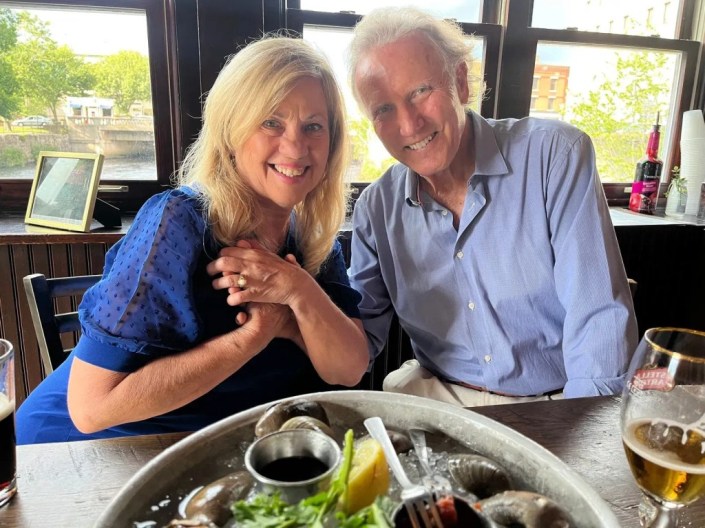
A Rhode Island woman found a pearl in a clam she was served at a restaurant and it ended up becoming her engagement ring. Sandy Sikorski and Ken Steinkamp said they were dining at The Bridge Restaurant and Raw Bar in downtown Westerly, with Sikorski’s brother and his wife in December 2021, when Sikorski ate the last of the quahog clams.
“That’s when I tasted this big round thing in my mouth. I’m thinking, ‘What the heck is this?’ So, I take it and spit it down on the table, in my hand, and my sister-in-law says, ‘Is that a tooth?'”
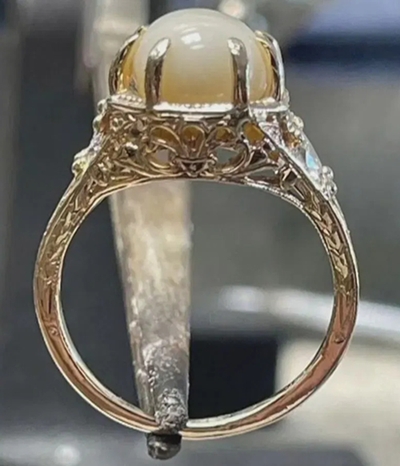
Sikorski’s sister-in-law, a jewelry enthusiast, soon surmised [that] the object was a 9.8 millimeter pearl. Marc Fishbone of Black Orchid Jewelers examined the object and confirmed the suspicions.
“He said it is called a Mercenaria pearl, which is a mollusk type of little animal, which makes what looks like a little pearl. It’s made out of the same material, calcite, and another mineral […]. [It] takes years and years to grow,” Sikorski said. “He said the weight of this and the size of this, [it} probably [took] 50 years to make.”
Sikorski and Steinkamp agreed that, if they ever decided to get married, they would have the pearl made into an engagement ring. That plan came to pass when Steinkamp proposed July 8, using a ring Fishbone had fashioned with the pearl as its stone. The couple celebrated their engagement by returning to the restaurant […].
A Westerly woman feels like the luckiest girl in the world for two reasons. For the past four years, Sandy Sikorski and Ken Steinkamp have been regulars at The Bridge Restaurant and Raw Bar in downtown Westerly. For years, the restaurant, which looks over the Pawcatuck River, has offered deals on seafood.
“We come here often to get the clams,” said Sikorski. “They’re bigger, they come on platters, upraised, they have great horseradish and everything I love about it…they taste delicious.”
There was one [clam] left.
“What are the odds of a pearl being inside of this shell?” said Sikorski.
The perfectly shaped oval had been hiding in the meat of the clam. Sikorski held on to the […] pearl and became curious about it. First, she brought it to The Compass Rose in Westerly. The owner there took a look and referred her to their jewelry maker, Marc Fishbone, of Black Orchid Jewelers.
“Wow, you got a beauty there. It’s heavy,” stated Fishbone. “It’s probably one in a million, one in a million to have it perfect […]. [U]sually, there’s pieces of them missing and it looks like a tooth or something […]. [I]t is never like a whole, perfect little oval. Plus, it’s big.”
According to several online articles, the odds of finding one in a clam are about one in 100,000.
They wanted Fishbone to make the setting.
“[I] want it to be the most beautiful setting you’ve ever made and I like gold,” said Sikorski. “I didn’t want a hole in the bottom of the stone, I just wanted it secured.”
Steinkamp, who asked Sikorski’s dad for approval first, got down on one knee and popped the question with the beautiful ring in hand.
“[W]e’re not getting any younger and we felt, in a way, that this was kind of a signal or an odd bit of synchronicity,” said Sikorski. “It’s beautiful. It has diamonds, and a sparkle, and I know minerals are becoming more fashionable gemstones vs. a big diamond thing.”
She hopes to eventually pass the ring off to her 8-year-old granddaughter, Nora.
You’ve probably heard of ChatGPT, a computer program that is trained to follow your instruction and provide a variety of wide ranging responses. As someone that has spent some time actually using the AI, I have to say, the results it produces can be eerily human but, did you know that computer scientists have been working alongside chatbots as early as the 1960s?
It was the late 1960’s and Joseph Weizenbaum, an MIT computer scientist, had just completed work on his revolutionary chatbot ELIZA. Weizenbaum was born in Berlin, Germany, in 1923 and fled the country with his family in 1935 to escape the political turmoil. Weizenbaum came to the United States where his road to computer science would ultimately begin. After time spent in the Air Force, Weizenbaum would go on to study as a computer scientist and eventually work in the industry. You have to remember, computers at that time were not portable devices that could fit in our pockets. In fact, they often barely fit into a room! As an associate Professor at MIT, Weizenbaum became obsessed with the way computers could directly interact with humans through language. It was this early through line between computers and human language that would work to lay the foundation for his own chatbot and eventually lay the groundwork for the AI development of programs such as ChatGPT, Siri and Alexa.
Eliza was completed in 1966 and Weizenbaum offered MIT students the opportunity to interact with the chatbot. This process consisted of messages typed into the computer by students and, responses would then be provided by ELIZA, […] routed to an electronic typewriter and printer. Weizenbaum was initially happy with the response that was garnered from users’ experience with ELIZA but, there was one thing he did begin to notice that he viewed as considerably concerning. Overtime, Weizenbaum made note of users starting to divulge deep personal information, looking for help similar to that of a therapy session. This observation ended up pushing Weizenbaum to advocate for caution when relying too heavily on computers for human thought…
“There are aspects to human life that a computer cannot understand—cannot. It’s necessary to be a human being. Love and loneliness have to do with the deepest consequences of our biological constitution. That kind of understanding is in principle impossible for the computer.”
A runaway bull, that was spotted running down Main Street in Kutztown (Pennsylvania), prompted the Kutztown UniversityPolice Department to issue an aggressive cow alert after the animal made its way onto campus, Sunday night. The bovine appeared scared because it was unfamiliar with its surroundings, police said in the alert that went out via its emergency notification system, about 7:15p. It advised recipients to avoid the North Campus and to not approach the bull, if encountered.
About 30 minutes later, campus police sent an update saying the animal’s owner, from the Fleetwood area, was on his way to retrieve the runaway. A third update, sent about 8:45p, indicated the threat to the campus community had ended but, the bull was, reportedly, still on the loose, last seen in Fleetwood. A video taken by Aaron Merkel and, shared to YouTube, showed the bovine as it trotted down Main Street in Kutztown, trailed by a police car. It could not be verified Monday morning with Fleetwood Police whether there were any livestock sightings in the borough and whether the bull was back in its owner’s possession.
The bovine’s owner was contacted but, the cow left the scene before it could be captured. University spokesman Matt Santos said the cow made a second visit to campus on Tuesday night. He said police caught up with the animal near Lytle Hall but, it fled into the nearby woods before it could be wrangled.
A university professor, who spent 100 days living underwater at a Florida Keys lodge for scuba divers, resurfaced Friday and raised his face to the sun for the first time since March 1. Dr. Joseph Dituri set a new record for the longest time living underwater without depressurization during his stay at Jules’ Undersea Lodge, submerged beneath 30 feet of water […] in a Key Largo lagoon. The diving explorer and medical researcher shattered the previous mark […] set by two Tennessee professors at the same lodge in 2014. Dituri, who also goes by the moniker “Dr. Deep Sea“, is a University of South Florida educator who holds a doctorate in biomedical engineering and is a retired U.S. Naval officer.
Guinness World Records listed Dituri as the record holder on its website after his 74th day underwater last month. Dituri’s undertaking, dubbed Project Neptune 100, was organized by [The Marine Resources Development Foundation]. Unlike a submarine, which uses technology to keep the inside pressure about the same as at the surface, the lodge’s interior is set to match the higher pressure found underwater. The project aimed to learn more about how the human body, and mind, respond to extended exposure to extreme pressure [in] an isolated environment. [It] was designed to benefit ocean researchers and astronauts on future long-term missions.
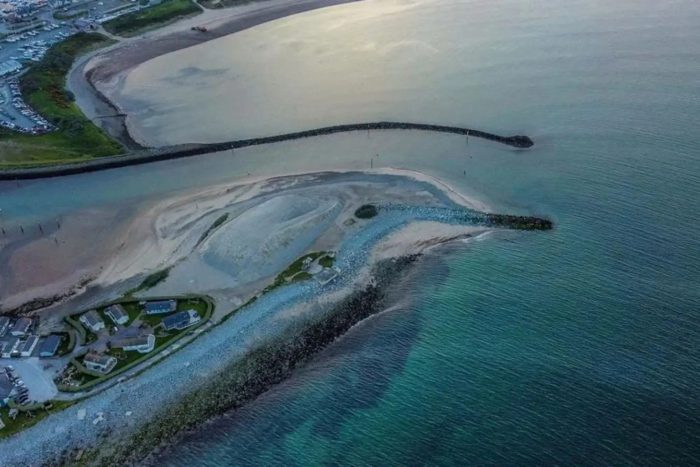
This will make you flip out. Shocking new drone footage reveals a Wales marina is the spitting image of a dolphin, stunning viewers online. Photographer Rhys Jones was capturing images with his drone over Pwllheli, Wales, (Llŷn Peninsula, Gwynedd County) realizing for the first time that the UK harbor bears [a] resemblance to the beloved aquatic creature.
“In all my flight time over the Pwllheli harbor, I have never noticed this as much as last night. Spectacular! Once seen, it cannot be unseen. I have taken many photos of the beautiful area we live in. I have been over the marina many times but, only just noticed this amazing landscape on this occasion.”
Rhys Jones
For two years, Jones has used his drone to take photos as a hobby, flying over this marina several times and never noticing its mammalian shape. The photos made waves on his Facebook page, Pwllheli Drone Photos, this month.
News Release:
On May 09, 2023, a suspect, later identified as Joshua Russell Minton, age 34, of Millers Creek, NC, fled from Boone Police Officers during a traffic stop. The suspect led Boone police and deputies of the Watauga County Sheriff’s Office in a chase. The suspect abandoned his vehicle in the area of U.S. Hwy. 421 and U.S. Hwy. 221 in Deep Gap and fled into an undeveloped area. Due to the suspect’s fast and reckless driving, our officers were not close enough to see exactly where the suspect ran.
As officers began to search the area, they received some unexpected, but welcomed assistance from some local cows. Apparently, cows do not want suspected criminals loitering in their pasture and quickly assisted our officers by leading them directly to where the suspect was hiding. The cows communicated with the officers as best they could and finally just had the officers follow them to the suspect’s location.
In addition to thanking our officers and deputies for putting themselves in harm’s way, obviously, we want to express our gratitude to the cows for their assistance. This opens up all kinds of questions as to the bovines’ role in crime fighting. Honestly, it is something that we have not considered before now. As we examine the obvious next steps of incorporating a Bovine Tracking Unit into our department’s law enforcement capabilities, there are many factors that we will have to consider:
♦ How adaptable are cows to a variety of police work or can they just find hiding suspects?
♦ Are cows more cost effective than K-9 dogs?
♦ How will we transport cows to the scenes and is this compatible with the Town’s sustainability goals in terms of types of vehicles needed [since], obviously, there are methane issues?
♦ Cost of training, vet care, ballistic vests, etc.?
We at the Boone Police Department are always looking for better ways to serve our community. We may be a small town but, we are a progressive, forward thinking law enforcement agency. For rural law enforcement, we want to be the tip of the spear.
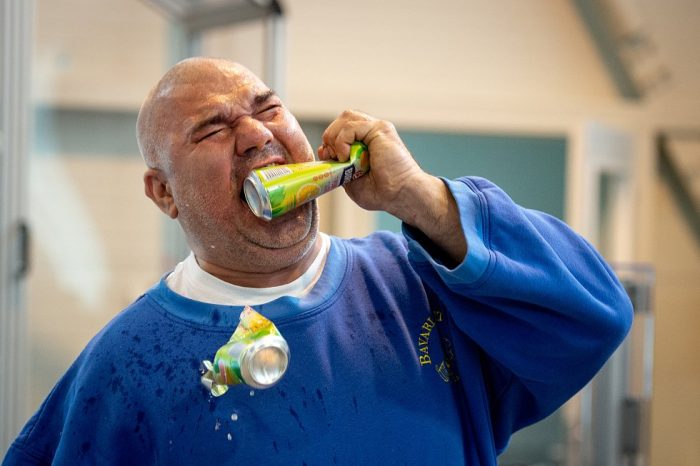
A Czech Republic man showed off his powerful jaws by biting 36 drink cans in half in one minute, earning a Guinness World Record.
René Richter, appearing on Italy’s Lo Show Dei Record, took on the Guinness World Record for most drink cans ripped in half with the teeth in one minute.
The aluminum cans were filled with water for the attempt and Richter was allowed to use only one hand, and his teeth, for each can. [He] chomped through 36 cans in the allotted time, successfully setting the record.
When Canadian doctor Samuel Bean lost his first two wives, Henrietta and Susanna, within 20 months of each other, he decided that the best way to honor them would be to create a tombstone dedicated to a hobby they both enjoyed…solving puzzles. The doctor had them buried side by side in Rushes Cemetery near Crosshill, Wellesley Township, Ontario and a single gravestone was placed over their graves. The gravestone bore a puzzle, one that kept historians stumped and amateur cryptologists busy for the next eighty years.
A replica of the gravestone can still be seen in Rushes Cemetery. The original stone was badly weathered and was replaced with this durable granite replica in 1982. The stone is about three feet high and features a finger pointed skyward with the words “Gone Home” above the two women’s names. Underneath the names is a grid carved with 225 seemingly random numbers and letters.
Without doubt, Dr. Samuel Bean must have received many requests to reveal the meaning of the cryptic message but, he would have none. Then, in 1904, while [on holiday] in Cuba, Dr. Bean fell overboard from a sailboat and drowned. The secret of the coded gravestone was forever lost.
Photo Credit: Amusing Planet
Photo Author: Mark Clifton
Click for a larger view.
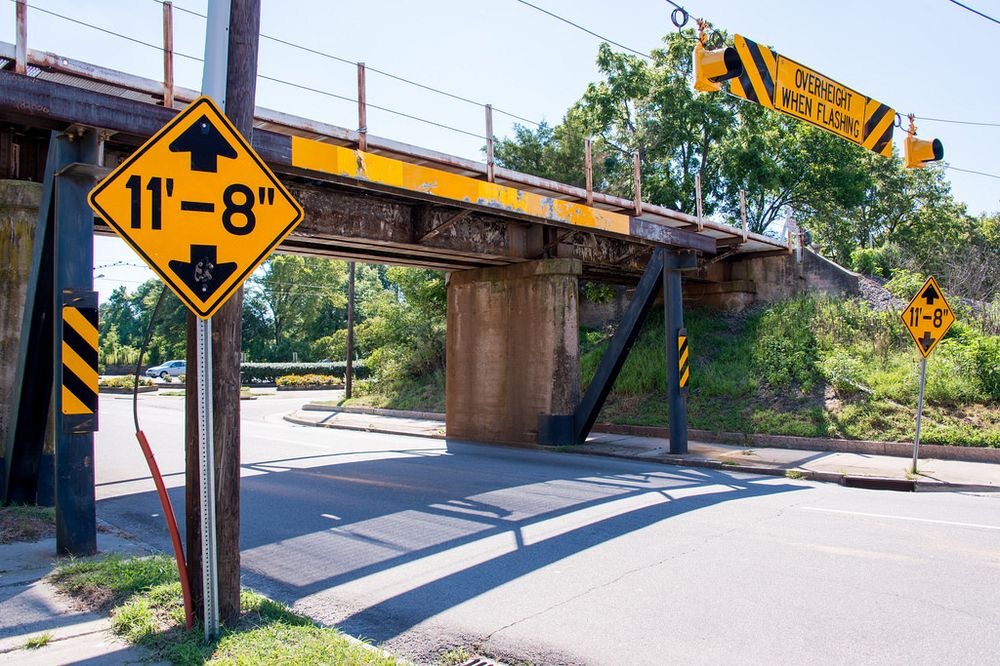
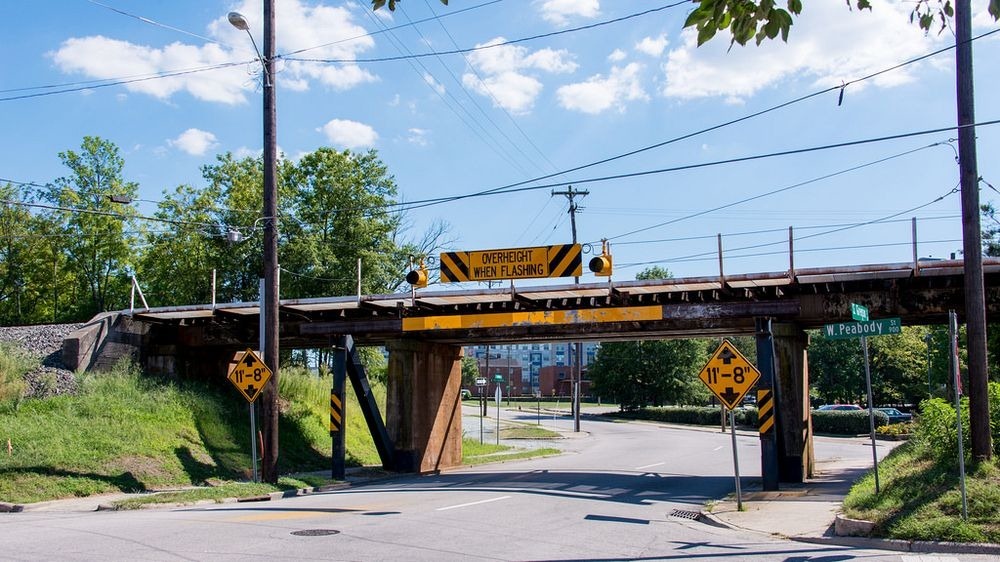
At 11 foot 8 inches [sic], the Norfolk Southern-Gregson Street Overpass, located in Durham, [NC] […], is a bit too short. The federal government recommends that bridges on public roads should have a clearance of at least 14 feet [but], when this railroad trestle was built in the 1940s, there were no standards for minimum clearance. As a result, trucks would frequently hit the bridge and get its roof scrapped [sic] off.
Durhan resident Jürgen Henn has been witnessing these crashes for years from across the street where he worked. Wishing to share these hilarious mishaps with the rest of the world, Henn set up a video camera in April 2008 and began recording them for his ever popular website 11foot8.com. By the end of 2015, more than one hundred trucks had their tops violently ripped off. These scalping videos, which are also available on his YouTube Channel, have racked up millions of views bringing this particular bridge, nicknamed “the can opener”, a fair amount of international fame.
As Jürgen Henn explains in his website [sic], the bridge cannot be raised because doing so would require the tracks to be raised for several miles to adjust the incline. North Carolina Railroad doesn’t want to pay for the enormous expense it would entail. The bridge cannot be lowered either because there is a major sewer line running only four feet under the street.
Photo Credit: Amusing Planet
Photo Author: Mark Clifton
Click for a larger view.
Instead, the city authorities installed an alert system that detects when an over-height truck tries to pass under and flashes yellow warning lights several feet ahead of the bridge. [However], many drivers either do not pay attention or fail to heed the warning and crash into the bridge. The railroad department, who owns the bridge, installed a heavy steel crash beam in front of the bridge that takes most of the impact, protecting the actual structure of the train trestle. This crash beam is hit so often that it had to be replaced at least once.
As far as both parties are concerned, the city of Durham and North Carolina Railroad, adequate steps have been taken to solve the problem. The railroad authorities’ concern is with the bridge and the rails above, not the trucks, [hence], the beam. The city, on the other hand, has posted prominent “low clearance” signs from [three] blocks away, leading up to the trestle, over and above the automatic warning system that is triggered by vehicles that are too tall. Apparently, these measures are not enough to prevent accidents. On average there is one crash every month.
When Henn interviewed a few drivers as they deflated their tires to lower their vehicles enough to free them, some told him that they didn’t know their trucks’ heights, while others insisted they didn’t see the signs. Durham officials are now trying out a new tactic. A few months ago, they installed a traffic signal at the intersection before the bridge and hooked up the height sensor to it. When an over-height truck approaches the intersection, the light turns red and stays red for a long time. The light eventually turns green but, the city hopes that the long delay will give the drivers enough time to realize their truck will not fit under the bridge. Unfortunately for the drivers, and to the delight of the rest, the bridge continues to shave the tops of over-height vehicles.
The Infamous Can Opener Bridge Amusing Planet Kaushik Patowary
December 17, 2016
I can attest to this bridge, personally. I lived in Durham for two years in the middle 90s. Why those folks don’t turn off onto Peabody Street or Pettigrew Street, coming from the other side, I don’t know. They just plow right under it. It is right behind Brightleaf Square. ~Vic
A Delta Airlines flight carrying 198 passengers had to land in Denver on Thursday after its windshield shattered when the jet was over 30,000 feet in the air.
The flight departed Salt Lake City and was destined for Washington, D.C., when the windshield mysteriously shattered and the pilots decided to land the aircraft. Although it was cracked from top to bottom, the glass stayed intact and the pilots were able to safely land the aircraft in Denver. No passengers or crew were harmed.
“They came on the loudspeaker saying that the windshield had shattered and we were diverting to Denver in about 10 minutes. I was sure I had misheard them but, I hadn’t,” passenger Rachel Wright told KUTV. She claimed that the crew announced the diverted landing an hour and a half after takeoff. “They kept coming on saying for everyone to stay calm, to be calm and we were calm, so being told to stay calm while we were calm made us feel a little panicky,” Wright explained.
Another passenger took a photo of the shattered glass after landing and posted it to Twitter.
Photo Credit: Kirk Knowlton/Twitter
A Delta spokesperson confirmed the aircraft’s windshield cracked but was unable to confirm what caused it to shatter mid-air, according to the Associated Press. Contact with birds is doubtful as most birds don’t fly above 10,000 feet.
KUTV reported that “several experienced commercial airline pilots” told them “windshields can be two inches thick and have several layered panes of glass.” As of now, it’s unknown if the cockpit lost pressure resulting from the shattered windshield.










 Cosmic-Observation