Image Credit: Weird Universe
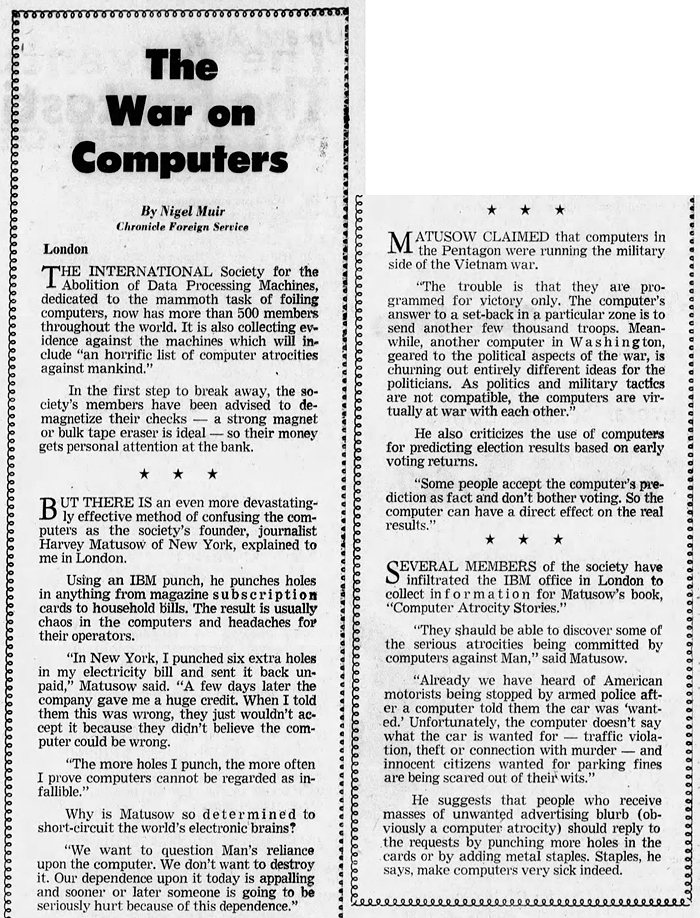
San Francisco Examiner
10-27-1968
The International Society for the Abolition of Data-Processing Machines […] was founded by Harvey Matusow in the late 1960s. Its aim was “to conduct guerrilla warfare against the computer by such means as sending a penny too much or too little when paying a utility bill.”
Matusow also authored The Beast of Business, which was supposed to serve as a manual for the guerrilla warfare against the computer. I wonder if any of the techniques he detailed would still work today?
However, Matusow is best known for giving evidence in court against individuals during the McCarthy era. Later, he claimed that the FBI had paid him to give false testimony and he detailed these allegations in his book False Witness.
If you haven’t finished your holiday shopping, the North Carolina Department of Transportation is offering up a piece of Americana but, it’s going to cost you a pretty penny.
When the Ringling Bros. and Barnum & Bailey Circus closed their doors, NCDOT saw an opportunity to add to its fleet. That plan was derailed before the cars could hit the rails and, now, they’re being put up for public auction.
NCDOT spent just over $380,000 on [the] Ringling Brothers rail cars.
“These cars have a great and amazing history,” said Jason Orthner, director of the NCDOT rail division.
However, plans to refurbish the cars were quickly put on hold when NCDOT calculated the costs. “This was more on the long-term play of really looking into our rail program and how we take it into the future,” said Orthner.
Image Credit: New York Public Library
Wikimedia & Wikipedia
Funding from two federal grants totaling $157 million rendered the rehab of the Ringling Bros. cars obsolete and will soon allow the NCDOT to replace their entire fleet.
“If we hadn’t been successful at winning those grants, we would’ve taken a really hard look at putting these in service,” said Orthner. “We really want to do the best thing for the citizens of North Carolina with the limited funding that we have available.”
That’s why they’re listing the rail-cars on the state surplus site for a minimum price that’s $32,000 more than the NCDOT paid for all of the cars but, without any bids, it’s unclear if anyone will actually buy them.
“Tourist railroad operations, car collectors and other enthusiasts would certainly be interested in these cars,” said Orthner. “There are operations around the country that run train service for excursion purpose, or other purposes, that would be interested in equipment like this.”
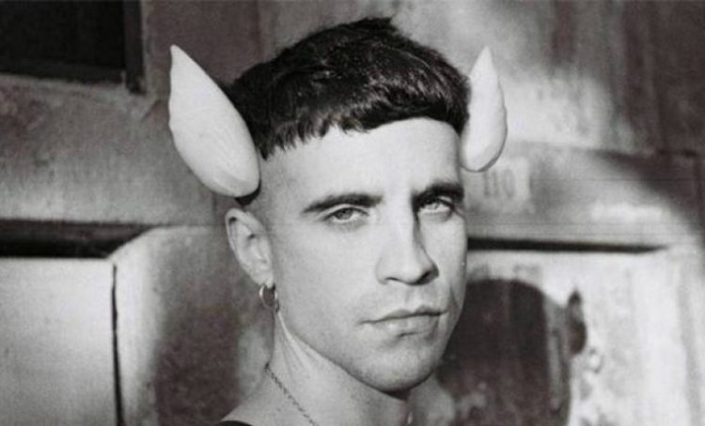
Spanish artist Manel de Aguas doesn’t consider himself human but, something else. A founding member of the Trans-Species Society (a now defunct website), he uses technological implants to experience the world differently than the rest of humanity. Twenty-four-year-old Manel […] first made international news headlines in August of 2017 when he built the first prototype of a device that allowed him to feel atmospheric vibrations. At the time, it was nothing more than an exposed circuit board that hung on a headband at the back of his head. The following year, he started attaching a pair of fins to the sides of his head and announced his intention to have them implanted into his skull. Earlier this year, de Aguas did just that, turning those decorative fins into functional organs that perceive the temperature, humidity and atmospheric pressure and, send sounds to Manel’s brain via bone conduction.
In June of 2019, the […] artist sat down with VICE Magazine and explained his intention to have [the] artificial [organs] […] implanted:
“The atmosphere will sound inside my head, and depending on the atmospheric conditions in any given moment, I will have the experience of being submerged in one type of medium or another. As for the outer part, the organ will have an appearance inspired by the fins of flying fish and I will implant a fin on each side of my head, at the same level as the temple bone in my skull.”
“I have always felt a special connection to the rain, so when I found out that there was a way to feel this sense within me, I thought it would be good to create [an organ] that would connect me even more to rain, as well as other atmospheric phenomena. As for the shape of the organ, I have always been interested in marine species, both real and mythological, so the idea of creating a fin-shaped organ simply came from within.”
“I will be exploring the weather through this new sensory organ,” […] de Aguas posted on Instagram, where his new look has been getting a lot of attention.
Manel described himself as a propioespecie, or his own species, his response to the anthropocentrism of today’s society, which puts human beings on the highest echelon of a false hierarchy of species. In January of this year, [he] was finally able to make his dream a reality. He had the artificial fins implanted into his skull at a clinic in Japan, after being refused by several doctors in Spain. The fins weigh 500 grams, can be recharged with solar energy and can connect to various devices via WiFi.
August 25, 1930 ~ October 31, 2020
Bond. James Bond.
Photo Credit: Far Out Magazine UK
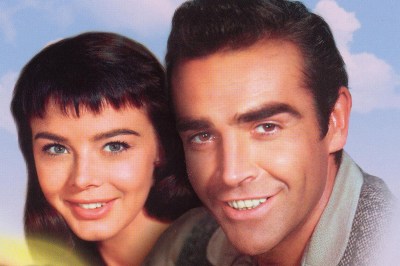
I just found out about the passing of actor Sean Connery. There are certain actors I have a thing for and he is one of them. Our birthdays are five days apart and we both have Scottish (and Irish) ancestry. He enlisted in the Royal Navy at the age of 16, was assigned to the HMS Formidable as an Able Seaman and was medically discharged at 19 for ulcers.
Darby O’Gill & The Little People
Image Credit: Time
“[I] realised that a top-class footballer could be over the hill by the age of 30 and I was already 23. I decided to become an actor and it turned out to be one of my more intelligent moves.”
He managed to make it all the way to 90 but, according to his son Jason, he had been unwell for some time. He passed peacefully in his sleep at his home in the Bahamas. I think it altogether fitting and proper that Sir Sean left on Halloween during a full Blue Moon. Godspeed. ~Vic
Awards:
♥ 1987 Academy Award (Best Supporting Actor/The Untouchables)
♥ 1987 BAFTA (Best Actor/The Name of the Rose)
♥ 1998 BAFTA Fellowship
♥ 1972 Golden Globe (Henrietta Award/World Film Favorite-Male)
♥ 1987 Golden Globe (Best Supporting Actor/The Untouchables)
♥ 1995 Golden Globe (Cecil B. DeMille Award)
Indiana Jones and the Last Crusade
Photo Credit: Pinterest
Nominations:
♦ 1987 BAFTA (Best Supporting Actor/The Untouchables)
♦ 1989 BAFTA (Best Supporting Actor/Indiana Jones and the Last Crusade)
♦ 1990 BAFTA (Best Actor/The Hunt for Red October)
♦ 1965 Golden Globe (Henrietta Award/World Film Favorite-Male)
♦ 1968 Golden Globe (Henrietta Award/World Film Favorite-Male)
♦ 1989 Golden Globe (Best Supporting Actor/Indiana Jones and the Last Crusade)
“Alligator sucking on helium wins parody Ig Nobel Prize”
Scientists are answering a question no one is asking. What would it sound like if an alligator sucked up helium? When a team of international researchers wanted to find out whether a gator’s vocalizations relate to its body size, they devised an experiment that would earn them the 2020 Ig Nobel (a wordplay on “Nobel” and “ignoble”) Prize for acoustics. Researchers captured footage of the snorting alligator in a helium-filled tank. In perhaps one of the biggest letdowns in the history of scientific study, it sounded nothing like a cartoon chipmunk. Now in its 30th year, the annual Ig Nobel Prize awards ceremony, usually presented at Harvard University’s Sanders Theatre, was conducted remotely due to pandemic restrictions.
Among this year’s other elite competitors, a study which demonstrated that meticulously groomed eyebrows are a reliable indicator of grandiose narcissism took home the prize in psychology. The prize in economics went to an international team of creeps (presumably) who wanted to know whether the rate of French kissing correlated with national income inequality. Based on data from 13 countries across six continents, they found that where kissing was more frequent, income inequality was also more likely to occur. Go figure. American Richard Vetter took home the prize in entomology for his brave study on spiders (which aren’t technically insects) that revealed most of his peers are, allegedly, arachnophobic. And, the award for materials science went deservedly (because it’s gross) to a collaboration between the US and the UK to study whether frozen human feces could be made into usable knives. Spoiler alert: It certainly cannot.
But, who could forget the most Ig Nobel moment in recent history? The medical education prize went to a roundup of sometimes ill-advised world leaders for showing that “politicians can have a more immediate effect on life and death than scientists and doctors can” during the global coronavirus pandemic.
“[The] lock of hair and telegram, which provides details of Lincoln’s assassination in 1865, are expected to fetch up to $75,000.”
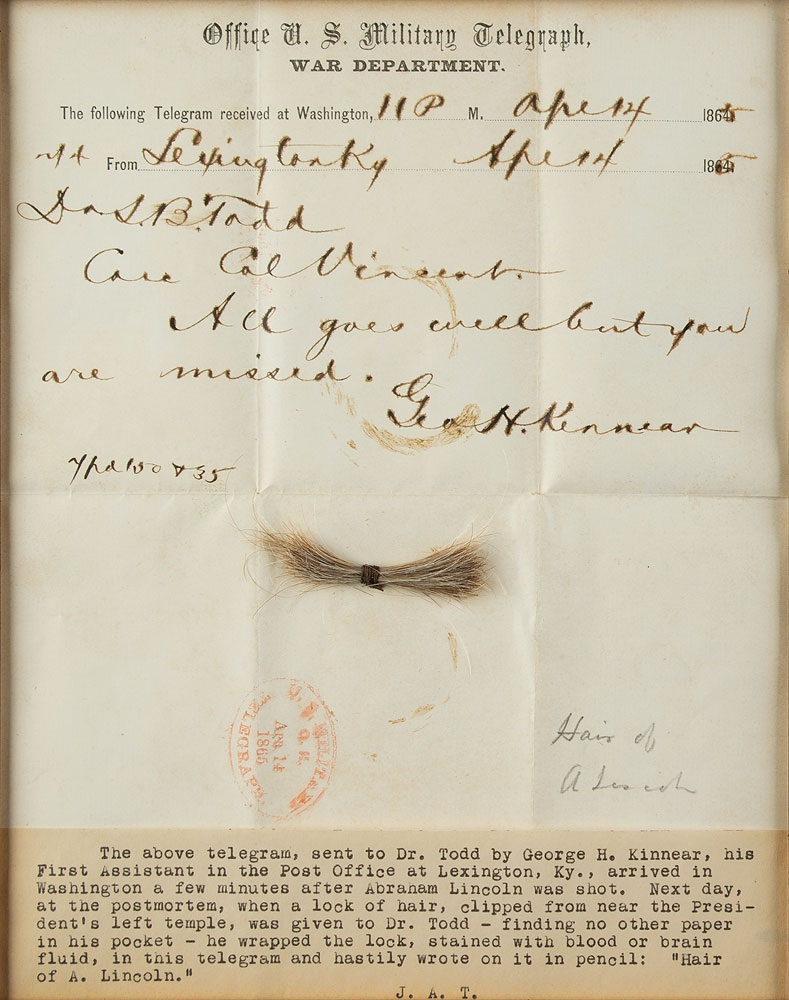
A lock of Abraham Lincoln’s hair wrapped in a telegram stained with the 16th president’s blood is up for auction online. [From RR Auction, based in Boston], [the two} inches of Lincoln’s hair was removed during his postmortem examination after the president was fatally shot by John Wilkes Booth.
The hair ended up in the custody of Dr. Lyman Beecher Todd, a cousin of Lincoln’s widow, Mary Todd Lincoln. The doctor was present at the postmortem examination and is believed to have wrapped the lock of hair in the telegram which had been sent to him the previous day by his assistant, George Kinnear. The telegram is stained with what is believed to be the slain president’s blood.
The hair is mounted to an official War Department manuscript telegram sent to Dr. Todd by George H. Kinnear, his assistant in the Post Office at Lexington, Kentucky, received in Washington at 11:00pm on April 14, 1865 […]. [A] typed caption prepared by Dr. Todd’s son reads, in part: “The above telegram […] arrived in Washington a few minutes after Abraham Lincoln was shot.
Image Credit: Kentucky Kindred Genealogy
Next day, at the postmortem, when a lock of hair, clipped from near the President’s left temple, was given to Dr. Todd. [Finding] no other paper in his pocket […] he wrapped the lock, stained with blood or brain fluid, in this telegram and hastily wrote on it in pencil […] ‘Hair of A. Lincoln.’”
Dr. Lyman Beecher Todd‘s own account of the autopsy, now preserved in an 1895 manuscript held in the Ida Tarbell collection of Lincoln papers at Allegheny College in Meadville, PA, differs slightly from his son’s, noting that he clipped the lock himself: “When all was over, General Hardin entered and handed me a pair of scissors, requesting me to cut a few locks of hair for Mrs. Lincoln. I carefully cut and delivered them to General Hardin and, then, secured one for myself which I have preserved as a sacred relic.”
“A report warns that fleets of new communication satellites in low-Earth orbit will spoil some astronomical observations, even if all known mitigation strategies are taken.”
Astronomers and the operators of new, thousands-strong […] low-orbiting satellites will have to work together to prevent them from having a devastating impact on ground-based observations of planets, stars and other celestial objects, says a [recent] report […]. Even then, there is no escaping some harm from the fleets of commercial orbiters.
“All optical and infrared observatories will be affected to some degree,” [stated] astronomer Anthony Tyson of the University of California, Davis, […] at a briefing on the report.
The satellites, designed to provide internet access in remote areas, now number in the hundreds. [Following] the launch of the first batch by SpaceX in May 2019, astronomers were alarmed by how bright they appear in the sky. If all the planned [launches] go ahead, the number of satellites will grow beyond 100,000. Since last year, there have been a number of independent studies of [satellites’] possible impact. [The] workshop’s report is the first time the satellite companies, and those who would be affected (astronomers to the agencies that fund them and their telescopes), have pooled their results and worked out a strategy for the future.
The satellite trails are very bright, and out of focus slightly, so they’re wide and cover several pixels on images taken with a test version of the (soon to open Vera C.) Rubin Observatory’s camera, notes Tyson. [Telescopes] that need to work during twilight will also run into problems. Because the satellites are in low orbits, they will often be seen close to the horizon and will be most visible when they are still in sunlight but, the observer is not. If, however, satellite operators choose orbits above 600 kilometers, the situation gets worse because, then, their spacecraft are visible for more of the night, and in [the] summer, all night long. Astronomers should also develop software tools to remove satellite trails from images and the companies should make accurate orbital data available for their orbiters so telescopes can try to avoid them.
The only measure the report could offer to totally eliminate the damage to astronomy was to launch fewer or no low-orbiting satellites…likely not an option given the financial investments the companies are making in the [satellites] and the lucrative market they foresee.
Tyson and his colleagues have been working with SpaceX engineers to modify their satellites to reduce their brightness. His team has also modeled trying to steer the Rubin Observatory telescope to avoid passing satellites but, Tyson says there are simply too many. Astronomers are already actively pursuing image processing solutions but, he says “the jury’s out” on how much that can help.
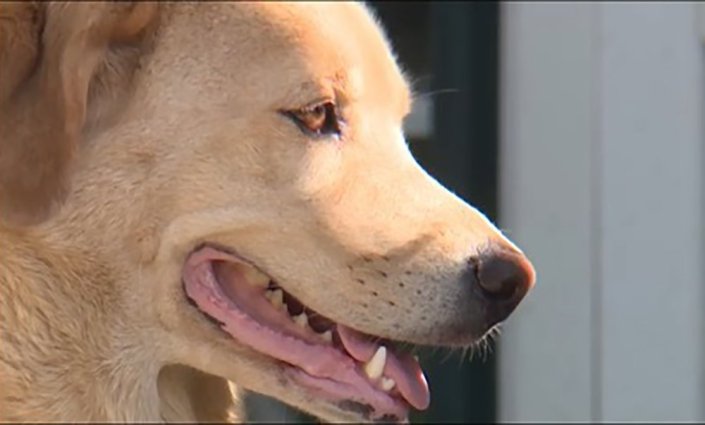
A dog from Olathe, that went missing, showed up at her old home about 60 miles away […].
“Where did the dog come from?” said [Colton Michael’s wife].
The 4-year-old Labrador, named Cleo, feels right at home on the front porch. The only thing is, it’s not her front porch, anymore and hasn’t been for nearly two years. As it turns out, Cleo’s owners had posted on Facebook a week earlier about the missing dog. They couldn’t believe it when Michael called and said Cleo had walked home. “It’s the most bizarre story. Really, she’s everything to us and to my mother,” said Drew, Cleo’s owner. It is 57 miles door-to-door from Olathe to Lawson and neither family knows exactly how Cleo made the trip. “That’s a hike for anybody,” Michael said. “Now that we know who she belongs to, if she pops up again, we know who to call.”
Both said they may never know anything about her journey.
A dog named Cleo, who disappeared from her home in Kansas earlier this month, turned up a few days later at her old home in Missouri […]. Colton Michael told television station KMBC that the 4-year-old Labrador [R]etriever-[Border Collie] mix showed up on the front porch of his family’s home in Lawson […]. “At first, she wouldn’t let anyone get near her,” said Michael, who has lived in the home for nearly two years. “She finds her way home and there’s some strangers living in it. That would be scary for anybody,” he said. Eventually, he was able to gain Cleo’s trust and to get her checked for a microchip, which showed that she belonged to the former owners of his house.
It’s a tale as old as time for any early ’90s child. An adventurous golden retriever worries that they will never see their home again, embarking on a treacherous wilderness journey to find their way back. Believe It or Not!, the plot of Homeward Bound: The Incredible Journey just turned from fiction to fact. [Both] parties are at a loss trying to explain Cleo’s long journey. [She] would have had to cross a river to make it back…just like in the movie!
Update:
“The hammer finally fell at £2,500 and the item was purchased by a private UK buyer.”
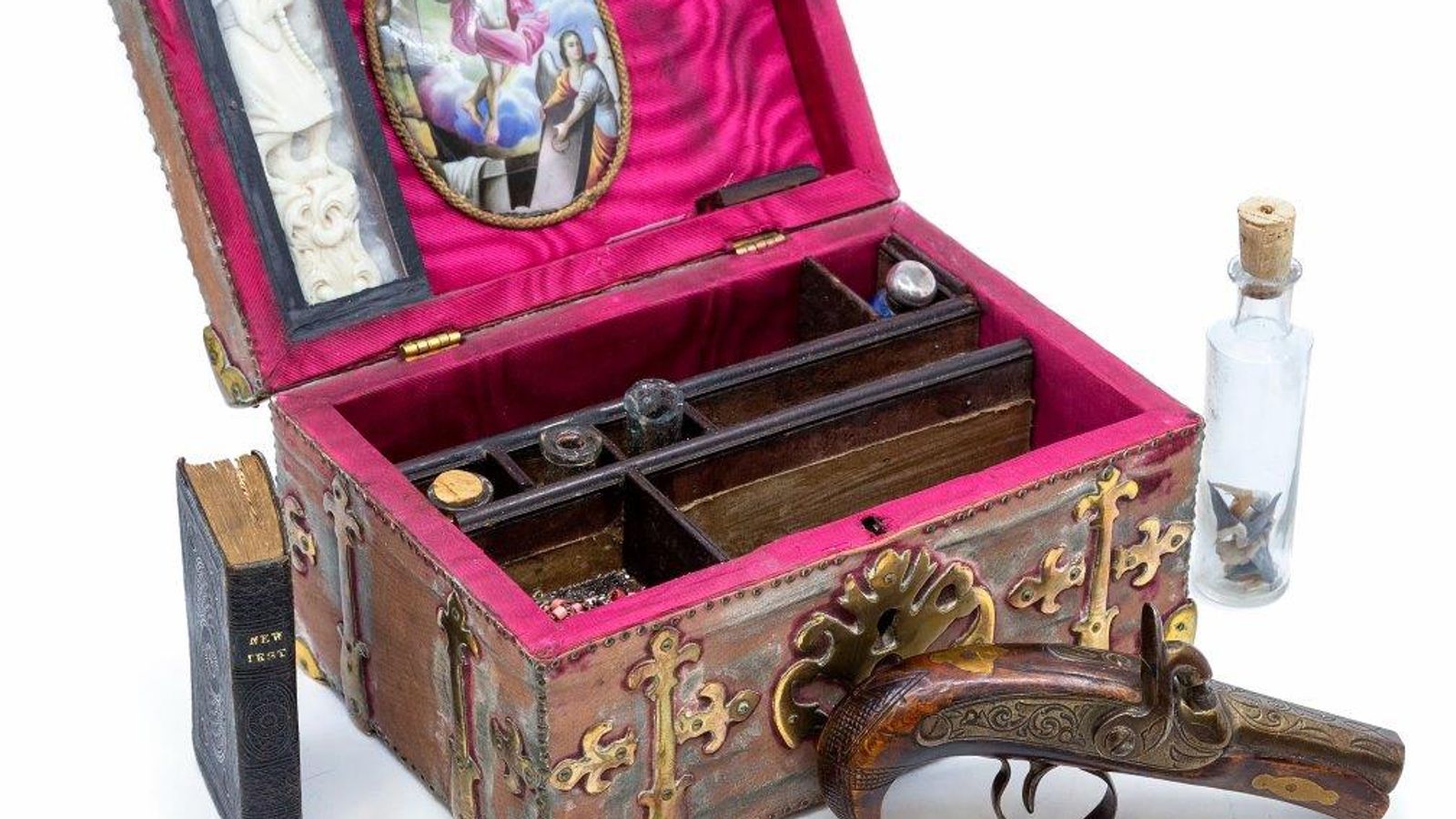
“The box has been valued at up to £3,000 and, includes a glass phial with unknown contents and a bottle of shark’s teeth.”
A “vampire-slaying kit”, containing a pocket-sized pistol and a 19th century copy of the New Testament, is going under the hammer. The gothic-looking container, worth between £2,000 and £3,000, also comes packed with pliers, [a] rosary and a bottle of shark’s teeth. Also inside the metal-bound box is an ivory-robed wolf carrying rosary beads, as well as a blue phial with mysterious contents, and a silver-bladed pocket knife. And inside the lid is an oval enamel painting that depicts the resurrection of Jesus Christ.
There’s no record of the box’s origin but, the 1842 copy of the New Testament within does bear the inscription of an Isabella Swarbrick. The current owner from the West Midlands, who wishes to remain anonymous, said that they do not know very much about its history. “I have had it in my own collection for three years now,” they said. “I bought it from a large antiques fair in Newark-on-Trent. I loved the look of the Gothic box and, when I opened it, I just had to have it. I thought it was so interesting…a great conversation piece.”
Photo Credit: news.sky.com
Charles Hanson, owner of the Derbyshire-based Hansons Auctioneers, the firm selling the box, said: “People are fascinated by stories of vampires, hence their continued appearance in films and on TV today. They have been part of popular culture for more than 200 years. The publication of John Polidori‘s The Vampyre in 1819 had a major impact and that was followed by Bram Stoker‘s 1897 classic Dracula.”
He added: “However, a belief in vampires and strange superstitions goes back even further and persists to this day. The task of killing a vampire was extremely serious and historical accounts suggested the need for particular methods and tools. Items of religious significance, such as crucifixes and Bibles, were said to repel these monsters, hence their strong presence in the kit we have found.”
The box will be sold online on [July 16] as part of a five-day-long antiques and collector’s auction.
A 25-year-old man clad in “Joker” makeup “menacingly waved” a pocketknife at several teenagers as he drove past them Tuesday in Haddon Township, authorities said. Assoumou Diby was stopped a short time [after] cruising past the group on the 400 block of West Crystal Lake Avenue on Tuesday, the Camden County Prosecutor’s Office and Haddon Township police said in a statement Wednesday.
It’s blurry but, here’s a visual…a man in joker makeup arrested by Haddon Twp, NJ, police after allegedly waving a pocketknife at children. The arrest followed days of sightings, scares and calls to police, who say, until last night, the behavior wasn’t criminal. @FOX29philly
Diby, of Haddon Township, was charged with unlawful possession of a weapon following his arrest. Earlier in the week, police said they received multiple reports from people who saw a man in Joker makeup walking around town, noting it’s not a crime [to] simply do that.
Diby is due to make a first appearance in municipal court July 16.
In the crystal clear waters of Shark Bay in Western Australia, scientists have noticed bottlenose dolphins engaging in an unusual behavior. They guide fish into the empty shells of giant snails, bring the shells to the surface and, then, shake them vigorously to dislodge the prey into their open mouths like a person polishing off a bag of popcorn. That extra effort, known as shelling, gets them a guaranteed meal.
Because the dolphins […] use the shells as a trap, this is the second known case of these marine mammals using tools. The first was reported in [1984] when researchers found that bottlenose dolphins wear marine sponges like protective gloves over their beaks to forage for fish on the sea floor. Now, researchers have shown that the dolphins of Shark Bay learn shelling from their friends. It’s the first time social learning involving a tool has been discovered in these mammals and a rare example of such learning in the animal kingdom.
Though scientists noticed the shelling behavior more than 10 years ago, it became more frequent following an unusual marine heat wave (PDF) off Western Australia in 2011. The high temperatures roiled Shark Bay’s ecosystem and many gastropods, including sea snails, are believed to have died. “We think the dolphins took advantage of this die-off,” says Sonja Wild, a behavioral ecologist at the Max Planck Institute of Animal Behavior. “The next season,” she says, “there was an incredible increase in shelling”, which made it possible for her to tease out how young adult dolphins learn to do it.
Wild says shelling starts among the adults [but], the more time a young dolphin spends around an accomplished sheller […], “the more likely it is to learn” the technique and pass it on to others later. Still, because dolphin calves spend more than 30,000 hours with their mothers, it’s possible that some learned the trick from their moms, [states] Janet Mann, a dolphin expert at Georgetown University. It’s considered more cognitively demanding to learn a skill like shelling from an unrelated individual because both learner and demonstrator must be socially tolerant, especially while hunting.
I picked this up from UPI. Poor baby. I’m so glad they rescued him. ~ Vic
“The bird was trapped in the bumper and injured. The officers rescued it and gave it to wildlife rehabilitation experts.”
Two off-duty Nassau County police officers saved a hawk that was trapped in the front bumper of a truck in Freeport early Wednesday morning. According to police, Marine Bureau officers Schwaner and Leek were on their way to work, together, around 6:20am, when they drove by a black Dodge Ram pickup truck, parked near the intersection of Merrick Road and Buffalo Avenue, that had a bird in its front bumper. The officers stopped to investigate and found that the bird was a red-tailed hawk and, that it was still alive.
The officers were able to remove the bird from the bumper and brought it to the Nassau County Police Marine Bureau base in Bay Park where they contacted the Volunteers for Wildlife in Locust Valley. The volunteers came and took the bird from the police back to their facility where it is being treated for its injuries.
“[It can] meow out of one mouth and eat out of the other.”
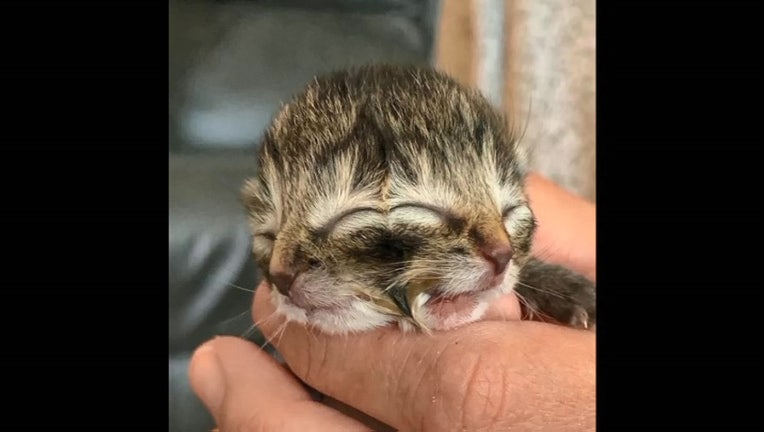
Meet Biscuits & Gravy: The Two-Faced Oregon Kitten
When Kyla King got up Wednesday morning to check on her pregnant cat, she knew there was a good chance she’d find a litter of newborn kittens. She walked outside to the special crate she had put the expectant mother into overnight and noticed four tiny kittens. But, then she noticed two more hiding behind their mom. So, Kyla picked one up and set it down with the rest of the litter. She picked up the last kitten and found herself face-to-face with two tiny noses, four eyes tightly shut and two mewing mouths.
Kyla said she sent a picture to her husband, BJ King, with a text that read: “We have 6-1/3 kitty cats now!”
Kyla reached out to their vet to learn more about the kitten’s condition, how to care for it and its odds of survival. She learned there wasn’t much to be done medically for the tiny creature. All she could do was make it comfortable and help it eat. “It doesn’t really know how to nurse properly because it has two mouths so, I’ve been trying to feed it,” Kyla said. “And, I mean, I’m gonna do the best I can but, these animals don’t usually live too long.”
Photo Credit: dailyhive.com
Cats with two faces are known as Janus cats, after the Roman god Janus, often depicted with two faces in mythology. They suffer from a rare congenital defect called diprosopus, or cranial duplication. Most Janus cats don’t live longer than a day but, one defied the odds. His name was Frank and Louie and he passed away in 2014 at the age of 15. The Guinness Book of World Records named him the world’s longest surviving Janus cat.
In looking thru odd stories, this caught my attention. From Oddity Central:
A Creepy Art Installation Freaking People Out on Google Maps
By Spooky on May 15th, 2020
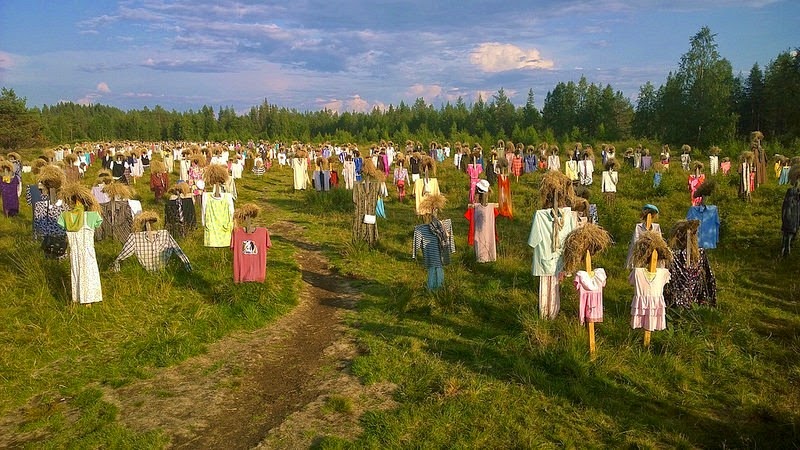
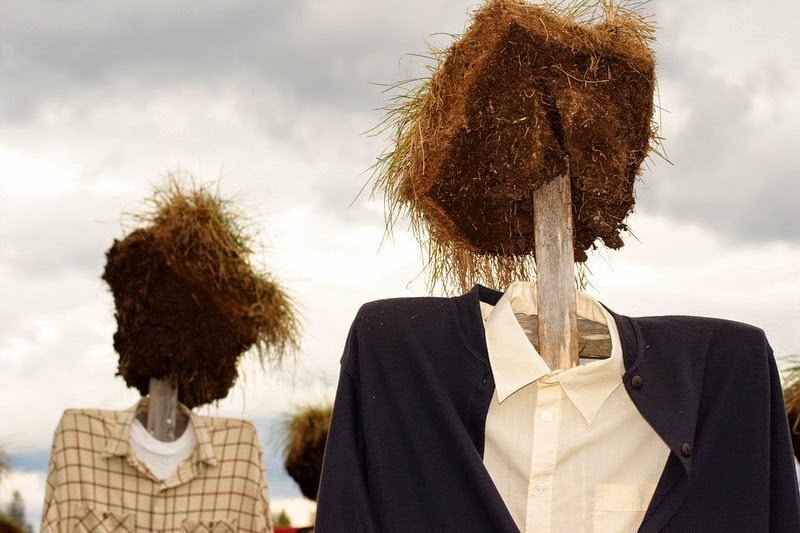
An eerie art installation located in a barren field in the Finnish countryside recently went viral after someone accidentally stumbled upon it while searching on Google Maps. With quarantine and isolation measures still in place in many countries around the world, people are spending a lot of time online looking for cool places to visit once they can travel again. Many are using free tools, like Google Maps, and end [up] going deeper down the rabbit hole than they originally anticipated. That’s probably how some people recently discovered The Silent People, […] creepy-looking [figures] that left them scratching their heads about why anyone would fill a field with hundreds of scarecrows and dress them as real people.
Seen from afar, The Silent People [site] looks like a perfectly still army of people all facing the same way. It’s only when you take a closer look that you realize it’s made up of wooden frames covered in human clothes and heads made of [peat], which does a surprisingly good job of emulating human hair. Even knowing that it’s an art installation, you still feel uneasy looking at the almost one thousand still [bodies] but, knowing absolutely nothing about it and [suddenly] finding it on Google Maps can really freak a person out.
Hiljainen Kansa: The Silent People of Suomussalmi, Finland
By Kaushik Patowary on March 28, 2015
Motorists driving along Highway 5, about 30 km north of the small town of Suomussalmi, in north-eastern Finland, are greeted by a peculiar sight. A crowd of almost a thousand figures stand silently on a field near the road. In the morning with light behind them, this motionless army appears morose, even menacing. But, when a light breeze picks up their colorful dresses and blows them around their still bodies, they appear to have sprung into life.
This army of scarecrow-like figures called “The Silent People” or “Hiljainen Kansa” in Finnish, were the creation of local artist Reijo Kela. They were first displayed in 1988 in a field in Lassila, a neighbourhood of Helsinki. Later in 1994, these were on display in the Market Place of Helsinki’s Senate Square, then on the banks of the river Jalonuoma, Ämmänsaari and finally moved to this location in 1994 itself.

















 Cosmic-Observation