Source: prodigi.bl.uk
Author: William Bruges (1375-1450)
Date: 1430 to 1440
Description: Illuminated Manuscript Miniature
Six hundred, ninety-seven years ago, today…
Edward III, also known as Edward of Windsor before his accession, was King of England from January 25, 1327, until his death in 1377. He is noted for his military success and for restoring royal authority after the disastrous and unorthodox reign of his father, Edward II. Edward III transformed the Kingdom of England into one of the most formidable military powers in Europe. His fifty-year reign was one of the longest in English history and saw vital developments in legislation & government, in particular, the evolution of the English Parliament, as well as the ravages of the Black Death. He outlived his eldest son, Edward the Black Prince and the throne passed to his grandson Richard II.
Edward was crowned at age fourteen after his father was deposed by his mother, Isabella of France and her lover Roger Mortimer. At the age of seventeen, he led a successful coup d’état against Mortimer, the de facto ruler of the country and began his personal reign. After a successful campaign in Scotland, he declared himself rightful heir to the French throne, starting the Hundred Years’ War. The first phase of the war […] would become known as the Edwardian War. Victories at Crécy and Poitiers led to the highly favorable Treaty of Brétigny […] and Edward renounced his claim to the French throne. Edward’s later years were marked by international failure and domestic strife, largely as a result of his inactivity and poor health.
The Leaning Tower of Pisa (torre pendente di Pisa…in Italian) is the campanile or freestanding bell tower of Pisa Cathedral. It is known for its nearly four-degree lean, the result of an unstable foundation. The tower is one of three structures in the Pisa’sCathedral Square, which includes the cathedral and Pisa Baptistry. The tower has 296 or 294 steps. [The] seventh floor has two fewer steps on the north-facing staircase.
The tower began to lean during construction in the 12th century, due to soft ground, which could not properly support the structure’s weight. It worsened through the completion of construction in the 14th century. By 1990, the tilt had reached 5.5 degrees. The structure was stabilized by remedial work between 1993 and 2001, which reduced the tilt to 3.97 degrees.
Construction of the tower occurred in three stages over 199 years. On January 5, 1172, Donna Berta di Bernardo, a widow and resident of the house of dell’Opera di Santa Maria, bequeathed sixty soldi to the Opera Campanilis petrarum Sancte Marie. The sum was then used toward the purchase of a few stones which still form the base of the bell tower. On August 9, 1173, the foundations of the tower were laid. Work on the ground floor of the white marble campanile began on August 14 of the same year, during a period of military success and prosperity.
The tower began to sink after construction had progressed to the second floor in 1178. This was due to a mere three-meter foundation, set in weak, unstable subsoil, a design that was flawed from the beginning. Construction was subsequently halted for the better part of a century, as the Republic of Pisa was almost continually engaged in battles with Genoa, Lucca and Florence. This allowed time for the underlying soil to settle […], [otherwise], the tower would almost certainly have toppled.
There has been controversy surrounding the identity of the architect […]. For many years, the design was attributed to Guglielmo and Bonanno Pisano […]. A 2001 study seems to indicate Diotisalvi was the original architect, due to the time of construction and affinity with other Diotisalvi works, notably the bell tower of San Nicola and the Baptistery, both in Pisa.
Between 1589 and 1592, Galileo Galilei, who lived in Pisa at the time, is said to have dropped two cannonballs of different masses from the tower to demonstrate that their speed of descent was independent of their mass, in keeping with the law of free fall.
During World War II, the Allies suspected that the Germans were using the tower as an observation post. Leon Weckstein, a U.S. Army sergeant sent to confirm the presence of German troops in the tower, was impressed by the beauty of the cathedral, and its campanile and […] refrained from ordering an artillery strike, sparing it from destruction.
The tower has survived at least four strong earthquakes since 1280. A 2018 engineering investigation concluded that the tower withstood the tremors because of dynamic soil-structure interaction. [The] height and stiffness of the tower, combined with the softness of the foundation soil, influences the tower’s vibrational characteristics in such a way that it does not resonate with earthquake ground motion. The same soft soil, that caused the leaning and brought the tower to the verge of collapse, helped it survive.
Wikipedia Summary
***The ceremony, for the 850th anniversary of the foundation of the Tower of Pisa, was started, today and runs all year to August 9, 2024.
The flight was hijacked shortly after takeoff from Schiphol. In the course of the hijacking, a grenade carried by one of the skyjackers detonated, killing her and injuring the flight’s chief purser. The lead hijacker […] immediately announced himself to air traffic control as El Kassar, hijacking the aircraft in the name of the Palestinian Liberation movement. After several Middle Eastern governments refused to permit Flight 404 to land, the plane eventually touched down in Dubai, in the United Arab Emirates. After several days on the ground, the terrorists demanded the release of Kozo Okamoto, survivor of the JRA’s attack on Tel Aviv’s Lod Airport.
After the Israeli government refused to release Okamoto, the hijackers flew the aircraft first to Damascus, Syria, and then to Benghazi, in Libya. On July 23, 89 hours after the hijacking began, the passengers and crew were released. [The] hijackers then blew up the aircraft, making the incident the second hull loss of a Boeing 747. The first hull-loss was also the result of hijackers. Maruoka escaped and in 1977, led the hijacking of Japan Air Lines Flight 472. He remained a fugitive, until 1987, when he was arrested in Tokyo after entering Japan on a forged passport. Given a life sentence, he died in prison on May 29, 2011.
You’ve probably heard of ChatGPT, a computer program that is trained to follow your instruction and provide a variety of wide ranging responses. As someone that has spent some time actually using the AI, I have to say, the results it produces can be eerily human but, did you know that computer scientists have been working alongside chatbots as early as the 1960s?
It was the late 1960’s and Joseph Weizenbaum, an MIT computer scientist, had just completed work on his revolutionary chatbot ELIZA. Weizenbaum was born in Berlin, Germany, in 1923 and fled the country with his family in 1935 to escape the political turmoil. Weizenbaum came to the United States where his road to computer science would ultimately begin. After time spent in the Air Force, Weizenbaum would go on to study as a computer scientist and eventually work in the industry. You have to remember, computers at that time were not portable devices that could fit in our pockets. In fact, they often barely fit into a room! As an associate Professor at MIT, Weizenbaum became obsessed with the way computers could directly interact with humans through language. It was this early through line between computers and human language that would work to lay the foundation for his own chatbot and eventually lay the groundwork for the AI development of programs such as ChatGPT, Siri and Alexa.
Eliza was completed in 1966 and Weizenbaum offered MIT students the opportunity to interact with the chatbot. This process consisted of messages typed into the computer by students and, responses would then be provided by ELIZA, […] routed to an electronic typewriter and printer. Weizenbaum was initially happy with the response that was garnered from users’ experience with ELIZA but, there was one thing he did begin to notice that he viewed as considerably concerning. Overtime, Weizenbaum made note of users starting to divulge deep personal information, looking for help similar to that of a therapy session. This observation ended up pushing Weizenbaum to advocate for caution when relying too heavily on computers for human thought…
“There are aspects to human life that a computer cannot understand—cannot. It’s necessary to be a human being. Love and loneliness have to do with the deepest consequences of our biological constitution. That kind of understanding is in principle impossible for the computer.”
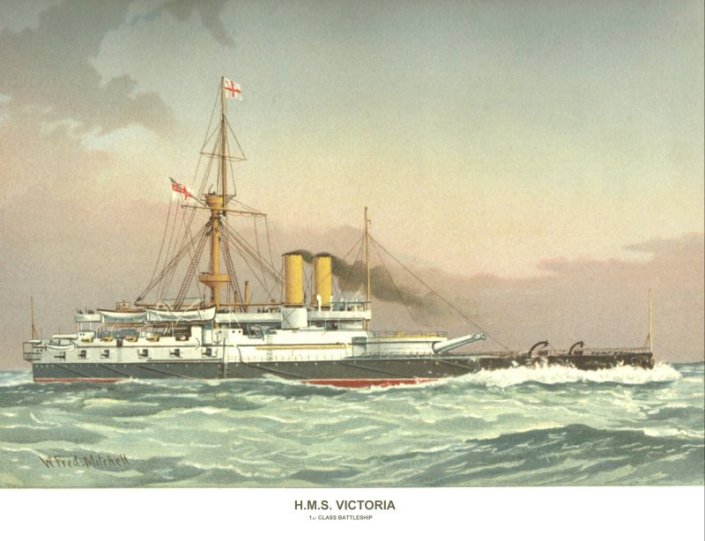
Victoria was constructed at a time of innovation and rapid development in ship design. Her name was originally to be Renown but, this was changed to Victoria while still under construction to celebrate Queen Victoria‘s Golden Jubilee, which took place the year the ship was launched. Her arrival was accompanied by considerable publicity. She was the largest, fastest and most powerful ironclad afloat, with the heaviest guns. Despite the ship’s many impressive features, compromises in the design meant that she proved less than successful in service.
Scale Model As Launched In Elswick 1887
Discovery Museum
Newcastle-Upon-Tyne
Image Credit: Hammersfan
May 18, 2015
A detailed model of the ship was exhibited at the Royal Navy exhibition in 1892 and another in silver was given to Queen Victoria by the officers of the Royal Navy and Royal Marines as a Jubilee gift.
The ship was nicknamed The Slipper (or when with her sister ship, [the] HMS Sans Pareil […] The Pair of Slippers) because of a tendency for her low fore-deck to disappear from view, in even slight seas, especially as a result of the low forward deck and raised aft superstructure…the two ships [had a] humorously perceived resemblance to the indoor footwear.
HMS Camperdown’s Bow Damage
Source: Royal Navy
1893
Image Credit: Wikimedia
The officer in command, Vice Admiral Sir George Tryon, was a fearsome martinet with a reputation as a master of complicated ship handling. He had an elaborate plan for bringing his fleet to anchor, providing onlookers a spectacle of precision maneuvering. [Ten] battleships of the Mediterranean fleet were drawn up in two parallel columns, 1200 yards apart, heading directly away from port out to sea. Tryon then ordered a crash 180-degree turn in succession. The intention, apparently, was for each pair of ships…in order…to turn inwards and create a breathtaking view of the ships’ wakes fanning out, while the ships came about, only 400 yards from each other, [then proceeding] in the opposite direction from their original course, heading towards the land. Then, the ships were to turn 90 degrees to form one column and anchor in unison.
[The] Victoria capsized just 13 minutes after the collision, rotating to starboard with a terrible crash, as her boats and anything, free fell to the side and, as water, entering the funnels, caused explosions when it reached the boilers. With her keel uppermost, she slipped down into the water, bow first, propellers still rotating and threatening anyone near them. Most of the crew managed to abandon ship, although those in the engine room never received orders to leave their posts and were drowned. Those who escaped had to contend with the suction from the sinking ship. A circular wave spread out from it which repeatedly drew down those in the water. All manner of items broke loose from the ship as it sank and came shooting up among the men. Onlookers watched as the number of live men in the water steadily reduced.
[On August 22, 2004], the wreck of the Victoria was discovered by Lebanese-Austrian diver Christian Francis, aided by British diver Mark Ellyatt. She was found in [460 feet] of water off the coast near Tripoli […] and was located using sonar. The most amazing aspect of the wreck is that, unlike all others, she sits vertically with about two thirds of her above the sea bed. The upright position is assumed to have been caused by the huge weight of her fore guns, which would have dragged her down, bow first. The wreck has already been declared a war grave and an exclusion zone has been imposed around her, while the English and Lebanese authorities determine her legal status.
On May 17, 1673, Louis Jolliet and Jacques Marquette departed from St. Ignace, Michigan, with two canoes and five other voyageurs of French-Indian ancestry. The group sailed to Green Bay. They paddled upstream (southward) on the Fox River to the site now known as Portage, Wisconsin. There, they portaged a distance of slightly less than two miles through marsh and oak forest to the Wisconsin River. Europeans eventually built a trading post at that shortest convenient portage between the Great Lakes and Mississippi River basins. On June 17, the canoeists ventured onto the Mississippi River near present-day Prairie du Chien, Wisconsin.
The Jolliet-Marquette expedition paddled along the west bank of the Mississippi until mid-July. When they passed the mouth of the Arkansas River, they became satisfied that they had established that the Mississippi flowed into the Gulf of Mexico.
The voyageurs then followed the Mississippi back to the mouth of the Illinois River, which friendly natives told them was a shorter route back to the Great Lakes. Following the Illinois river upstream, they turned up its tributary, the Des Plaines River near modern-day Joliet, Illinois. They continued up the Des Plaines River and portaged their canoes, and gear, at the Chicago Portage. They followed the Chicago River downstream until they reached Lake Michigan near the location of modern-day Chicago. Father Marquette stayed at the mission of St. Francis Xavier at the southern end of Green Bay, which they reached in August. Jolliet returned to Quebec to relate the news of their discoveries. On his way through the Lachine Rapids, Jolliet’s canoe overturned and his records were lost. His brief narrative, written from memory, is in essential agreement with Marquette’s, the chief account of the journey.
While Hernando de Soto was the first European to make official note of the Mississippi River by discovering its southern entrance in 1541, Jolliet and Marquette were the first to locate its upper reaches and, travel most of its length, about 130 years later. De Soto had named the river Rio del Espiritu Santo but, tribes along its length called it “Mississippi”, meaning “Great River” in the Algonquian languages.
The Haydn Quartet was originally formed in 1896 as the Edison Quartet. They eventually changed their name to Haydn, an homage to Joseph Haydn and as a way to record for other companies besides Edison Records.
In The Good Old Summer Time was a very popular song for its time and John Scantlebury MacDonald, a replacement member of the Edison Quartet, went on to record the song, solo. It was the Haydn Quartet’s biggest commercial success while contracted with the Victor Talking Machine Company.
Johann Sebastian Bach‘s Magnificat, BWV 243, is a musical setting of the biblical canticle Magnificat. It is scored for five vocal parts (two sopranos, alto, tenor and bass) and a Baroque orchestra including trumpets and timpani. It is the first major liturgical composition on a Latin text by Bach. In 1723, after taking up his post as Thomaskantor in Leipzig, Bach set the text of the Magnificat in a twelve movement composition in the key of E-flat major. For a performance at Christmas he inserted four hymns (laudes) related to that feast. This version, including the Christmas interpolations, was given the number 243.1 in the catalogue of Bach’s works.
Likely for the feast of Visitation of 1733 or another feast in or around that year, Bach produced a new version of his Latin Magnificat, without the Christmas hymns…instrumentation of some movements were altered or expanded and, the key changed from E-flat major to D major for performance reasons of the trumpet parts. This version of Bach’s Magnificat is known as BWV 243.2 (previously BWV 243). After publication of both versions in the 19th century, the second became the standard for performance. It is one of Bach’s most popular vocal works.
In Leipzig, the Magnificat was regularly part of Sunday services, sung in German on ordinary Sundays but more elaborately and in Latin on the high holidays (Christmas, Easter and Pentecost) and on the three Marian feasts Annunciation, Visitation and Purification.
Apart from an early setting of the Kyrie, on a mixed Greek and German text (BWV 233a), all of Bach’s known liturgical compositions in Latin were composed during his tenure as Thomaskantor in Leipzig, from 1723 until his death in 1750. Compared to Lutheran practice elsewhere, an uncharacteristic amount of Latin was used in church services in Leipzig. An early account of Bach showing interest in liturgical practices in Leipzig dates from 1714 when he noted down the order of the service on the first Sunday in Advent during a visit to the town.
Image Credit: Wikipedia
Date: March 1972
Author: Jon Proctor
Source: Airline Fan
Fifty years ago, today…
Eastern Air Lines Flight 401 was a scheduled flight from [New York] JFK to [Miami/Wilcox Field] MIA. Shortly before midnight on December 29, 1972, the Lockheed L-1011-1 TriStar crashed into the Florida Everglades, causing 101 total fatalities. Three of the [four] cockpit crew members, two of the [ten] flight attendants and 96 of the 163 passengers were killed. [T]here were 75 survivors.
Flight 401 departed JFK Airport […] at 9:20pm EST. The flight was routine until 11:32pm EST, when the plane began its approach into Miami International Airport. After lowering the [landing] gear, First Officer Stockstill noticed that the landing gear indicator (nose gear is properly locked) had not illuminated (burned out bulb). [Captain] Loft, who was working the radio during this leg of the flight, told the tower that they would discontinue their approach to their airport and requested to enter a holding pattern. The approach controller cleared the flight to climb to 2,000 feet and then hold west over the Everglades.
Fifty seconds after reaching their assigned altitude, Captain Loft instructed First Officer Stockstill to put the L-1011 on autopilot. For the next 80 seconds, the plane maintained level flight. Then, it dropped 100 feet and, then, again, flew level for two more minutes, after which it began a descent so gradual, it could not be perceived by the crew.
Wikipedia Summary
The plane continued to drop, triggering the altitude warning. The CVR did not record any indication that the pilots heard the warning chimes. As Stockstill started another turn [of] 180°, he noticed the discrepancy. The CVR captured the last, confused conversation between Stockstill and Loft. Less than ten seconds later, the plane crashed into the Everglades. ~Vic
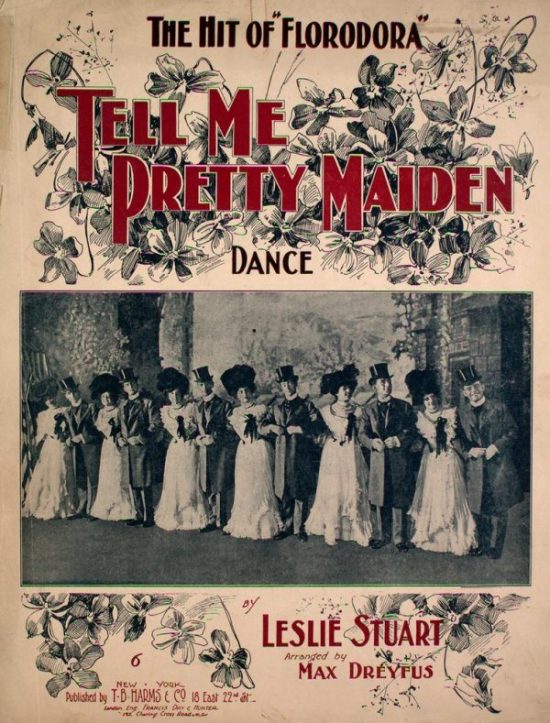
One hundred & twenty years ago, the #1 song of 1902 was Tell Me Pretty Maiden by Byron G. Harlan, whistler Joe Belmont and the Florodora Girls. According to Tsort, there are almost NO charts from before 1920. I plugged in today’s date on Playback FM and this is what I got. You can peruse Tsort’s Site Generation Page, describing source charts and consolidation. They seem to have their own method for old stuff and, apparently, Playback FM agrees.
Florodora is an Edwardian musical comedy. After its long run in London, it became one of the first successful Broadway musicals of the 20th Century. The book was written by Jimmy Davis, under the pseudonym Owen Hall, the music was by Leslie Stuart with additional songs by Paul Rubens and, the lyrics were by Ernest Boyd-Jones, George Arthurs and Rubens.
The original London production opened in 1899, where it ran for a very successful 455 performances. The New York production, which opened the following year, was even more popular, running for 552 performances. After this, the piece was produced throughout the English-speaking world and beyond. The show was famous for its double sextet and its chorus line of “Florodora Girls“.
Wikipedia Summary
It appears that the Harlan & Belmont version, with the Florodora Girls was very, very popular. Second Hand Songs also lists a Frank Stanley as part of the team. UC Santa Barbara lists Frank Banta on piano and calls the group the Edison Sextette.
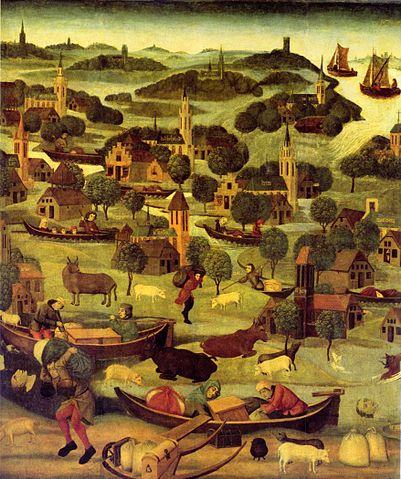
The St. Elizabeth’s flood of 1421 was a flooding of the Grote Hollandse Waard, an area in what is now the Netherlands. It takes its name from the feast day of Saint Elisabeth of Hungary which was formerly [November 19th]. It ranks 20th on the list of worst floods in history. During the night of [November 18th-19th] 1421, a heavy storm near the North Sea coast caused the dikes to break in a number of places and the lower-lying polder land was flooded. A number of villages were swallowed by the flood and were lost, causing between 2,000 and 10,000 casualties. The dike breaks and floods caused widespread devastation in Zeeland and Holland.
This flood separated the cities of Geertruidenberg and Dordrecht, which had previously fought against each other during the Hook and Cod (civil) wars. Most of the land remains flooded even since that day.
Most of the area remained flooded for several decades. Reclaimed parts are the island of Dordrecht, the Hoeksche Waard island and north-western North Brabant. Most of the Biesbosch area has been flooded since.
The cause of the flood was a powerful extratropical cyclone. Water from the storm in the North Sea surged up the rivers causing the dikes to overflow and break through. The flood reached a large sea arm between south Holland and Zeeland, destroying the Grote Hollandse Waard.
Wikipedia
I tried to find a video about this but, all I got was a creepy AI voice reading what I posted, above. As an interesting addendum, there was a St. Elizabeth’s flood of 1404, on or about November 19, also, affecting Holland, Zeeland and Flanders. History Calendar on Twitter posted about it, too. ~Vic
November 18, 1421 — A seawall at the Zuiderzee dike in the Netherlands breaks, flooding 72 villages and killing about 10,000 people. This event will be known as St Elizabeth's flood.
George Frideric Händel was a German-British Baroque composer well known for his operas, oratorios, anthems, concerti grossi and organ concertos. Händel received his training in Halle and worked as a composer in Hamburg and Italy before settling in London in 1712, where he spent the bulk of his career and became a naturalised British subject in 1727. He was strongly influenced both by the middle-German polyphonic choral tradition and by composers of the Italian Baroque. In turn, Händel’s music forms one of the peaks of the “high baroque” style, bringing Italian opera to its highest development, creating the genres of English oratorio and organ concerto and introducing a new style into English church music. He is consistently recognized as one of the greatest composers of his age. Händel started three commercial opera companies to supply the English nobility with Italian opera. In 1737, he had a physical breakdown, changed direction creatively, addressed the middle class and made a transition to English choral works. After his success with Messiah (1742), he never composed an Italian opera again. Almost blind, he died in 1759, a respected and rich man, and was given a state funeral at Westminster Abbey.
Händel Summary
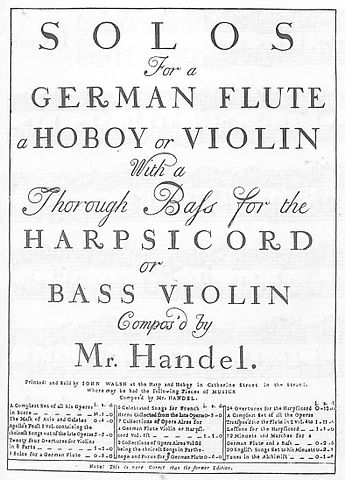
Date: Published by Walsh in 1732
Source: IMSLP
Author: Händel
Two hundred, ninety years ago, Händel Solo Sonatas was published by John Walsh in 1732. It contains a set of twelve sonatas, for various instruments, composed by George Frideric Händel. The 63 page publication includes the sonatas that are generally known as Händel’s Opus 1. The 1732 edition was mostly reprinted from the plates of an earlier 1730 publication […]. Each sonata displays the melody and bass lines […]. By modern-day standards, the music in the publication has a primitive appearance, with squashed notes and irregular spacings, stems and bar widths […]. Despite the titles in both editions, four of the sonatas in each are for a fourth instrument: the Recorder.
Eighty-seven years ago, today, Robert Smith drank his last drink, the date marked by AA for its anniversaries.
Alcoholics Anonymous (AA) is an international mutual aid fellowship dedicated to abstinence based recovery from alcoholism through its spiritually inclined Twelve Step program. Following its Twelve Traditions, AA and autonomous AA groups are self-supporting through the strictly voluntary contributions from members only. The Traditions also establish AA as non-professional, non-denominational and apolitical, with an avowed desire to stop drinking as its sole requirement for membership. Though AA has not endorsed the disease model of alcoholism, to which its program is nonetheless sympathetic, its wider acceptance is partly due to many members independently promulgating it. A recent scientific review shows that by many measures AA does as well or better than other clinical interventions or no treatment. In particular, AA produces better abstinence rates with lower medical costs. As of 2020, having spread to diverse cultures, including geopolitical areas normally resistant to grassroots movements, AA has estimated its worldwide membership to be over two million with 75% of those in the U.S. and Canada.
AA marks 1935 for its founding when Wall Street analyst and newly recovering alcoholic Bill Wilson, then reeling from a failed proxy fight, sought to stay sober by commiserating with detoxing surgeon Bob Smith. After leaving the Oxford Group to form a fellowship of alcoholics only, Wilson and Smith, along with other early members, wrote Alcoholics Anonymous: The Story of How More Than One Hundred Men Have Recovered From Alcoholism, from which AA acquired its name. Published in 1939 and commonly called “the Big Book”, it contains AA’s Twelve Step recovery program. Later editions included the Twelve Traditions, first adopted in 1946 to formalize and unify the fellowship as a “benign anarchy”.
Attila was the ruler of the Huns from 434 until his death in March 453. He was also the leader of a tribal empire consisting of Ostrogoths, Alans and Bulgars, among others, in Central and Eastern Europe. He is also considered one of the most powerful rulers in world history.
Attila [invaded] and [ravaged] Italy on June 8, 452, one-thousand, five hundred and seventy years, ago, today. Communities became established in what would later become Venice as a result of these attacks when the residents fled to small islands in the Venetian Lagoon. His army sacked numerous cities and razed Aquileia so completely that it was afterwards hard to recognize its original site. Aëtius lacked the strength to offer battle, but managed to harass and slow Attila’s advance with only a shadow force. Attila finally halted at the River Po. By this point, disease and starvation may have taken hold in Attila’s camp, thus hindering his war efforts and potentially contributing to the cessation of invasion.
Wiki Summary
Attila, by-name Flagellum Dei (Latin: “Scourge of God”) [ruled] jointly with his elder brother Bleda until 445. In legend, he appears under the name Etzel in the Nibelungenlied and under the name Atli in Icelandic sagas. The empire that Attila and his elder brother Bleda inherited seems to have stretched from the Alps and the Baltic in the west to somewhere near the Caspian Sea in the east.
In 452, the Huns invaded Italy and sacked several cities, including Aquileia, Patavium (Padua), Verona, Brixia (Brescia), Bergomum (Bergamo), and Mediolanum (Milan). Aetius could do nothing to halt them but, the famine and pestilence raging in Italy in that year compelled the Huns to leave without crossing the Apennines.
Attila invaded northern Italy in 452 but, spared the city of Rome due to the diplomacy of Pope Leo I and the rough shape of his own troops. Legend has it that St. Peter and St. Paul appeared to Attila, threatening to strike him dead if he did not settle with Pope Leo I. Attila died the following year, in 453, before he could try once again to take Italy.
One thousand, five hundred and sixty-seven years ago, today…
The Sack of 455 was the third of four ancient sacks of Rome. [It] was conducted by the Vandals, who were then at war with the usurping Western Roman Emperor Petronius Maximus.
In the 440s, the Vandal king Genseric and the Roman Emperor Valentinian III had betrothed their children, Huneric and Eudocia, to strengthen their alliance, reached in 442 with a peace treaty (the marriage was delayed as Eudocia was too young). In 455 Valentinian was killed and Petronius Maximus rose to the throne. Petronius married Valentinian’s widow, Licinia Eudoxia and had his son Palladius marry Eudocia. [In] this way, Petronius was to strengthen his bond with the Theodosian Dynasty. Unhappy, however, with her husband’s murder and the usurpation of Maximus, Eudoxia turned to aid from the Vandals to remove Maximus from his undeserved throne. The overture was favorably met because Maximus’ revolution was damaging to Genseric’s ambitions. The king of the Vandals claimed that the broken betrothal between Huneric and Eudocia invalidated his peace treaty with Valentinian and set sail to attack Rome, landing at Ostia at the mouth of the Tiber.
Wiki Summary
On this day in 455, the Vandals sacked Rome. It wasn’t too awful, as sackings go, because the Vandal king Genseric agreed to refrain from slaughtering all the inhabitants and burning down the entire city if the Romans didn’t put up any military resistance…which, they didn’t. They just threw the gates right open. So, for the next two weeks, the Vandals merely drank all the wine, stole all the treasure, enslaved an unlucky few thousand locals and generally vandalized the place. A few hundred of the impromptu wine-tastings, as it were, got out of hand and some buildings, or some people, ended up on fire but, hey…relatively speaking, the Romans got off pretty easy.









 Cosmic-Observation