wikipedia
TV Tuesday: A Good Idea, Son! 1953

Seventy years, ago, today, the TV Special A Good Idea, Son! aired on BBC at 9:30pm. A musical comedy, written by Eric Sykes, it starred Max Bygraves (host & presenter), Belita (The Ice Maiden), Bob Dixon (pianist), the George Mitchell Singers, Peter Glover, The King Brothers, Lillemor Knudsen and Jean Marsh. It was an hour long program in black & white. There are no pictures from the show but, I did manage to find a short YouTube clip of Max Bygraves singing the title song. Bygraves is also associated with the Educating Archie Radio Show. As with many early television shows, there is not much written about it. ~Vic
Additional:
♦ A Good Idea, Son! (British Comedy Guide)
♦ Max Bygraves (Evening Standard/09-01-2012)
♦ Eric Sykes In His Own Words (BBC News/07-04-2012)
♦ Educating Archie (Vinny’s Mislaid Comedy Heroes)
♦ Educating Archie (Vintage Comedy Corner)
TV Tuesday: Stage Door 1948
Yes, I am still alive. I took a break for health reasons. ~Vic
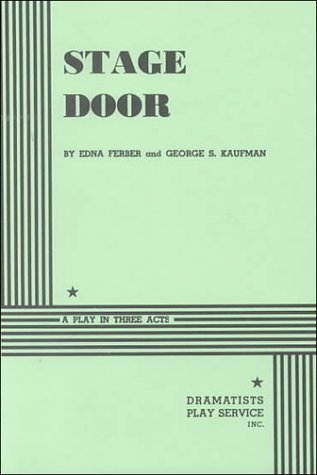
Seventy-five years, ago, today, the TV movie Stage Door aired. The information on this movie is limited but, there is a record of it in the IMDb. Based on a 1936 stage play, written by Edna Ferber and George S. Kaufman…
[It is] about a group of struggling actresses who room at the Footlights Club, a fictitious theatrical boardinghouse in New York City, modeled after the real-life Rehearsal Club. The three-act comedy opened on Broadway on October 22, 1936, at the Music Box Theatre and ran for 169 performances. The play was adapted into the 1937 film of the same name and was also adapted for television.
Wikipedia Summary
Directed by Ed Sobol, it starred Louisa Horton, Harvey Stephens, Mary Anderson, John Forsythe, Enid Markey and Mary Alice Moore. It was an hour & 30 minutes long and there is no indication as to which network carried it. The 1937 film adaption starred Katharine Hepburn, Ginger Rogers and Lucille Ball.
An additional one-hour television adaption aired on CBS in April of 1955. There are plenty of clips on YouTube from the 1937 movie but, nothing from either television version.
Flashback Friday: Shoshone National Park 1891
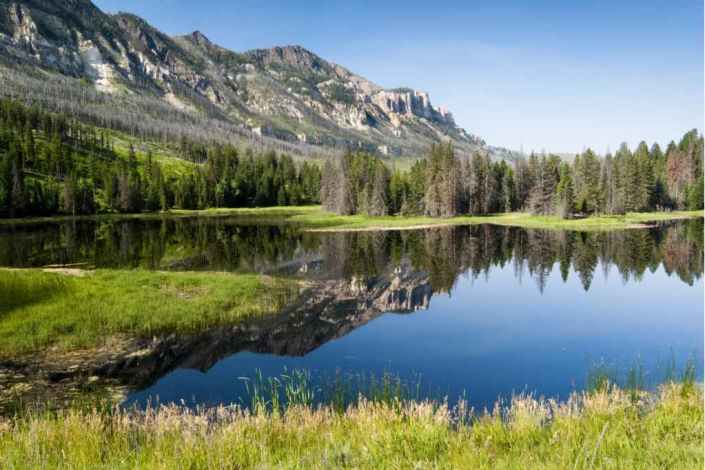
One-hundred, thirty-two years ago, today…
[The] Shoshone National Forest is the first federally protected National Forest in the United States and covers nearly 2,500,000 acres in the state of Wyoming. Originally a part of the Yellowstone Timberland Reserve, the forest is managed by the United States Forest Service and was created by an act of Congress, signed into law by U.S. President Benjamin Harrison in 1891. Native Americans have lived in the region for at least 10,000 years and when the region was first explored by European adventurers, forestlands were occupied by several different tribes. Never heavily settled or exploited, the forest has retained most of its wildness. Shoshone National Forest is a part of the Greater Yellowstone Ecosystem […].
The Absaroka and Beartooth Mountains are partly in the northern section of the forest. The Wind River Range is in the southern portion and contains Gannett Peak, the tallest mountain in Wyoming. [The] Continental Divide separates the forest from its neighbor Bridger-Teton National Forest to the west. The eastern boundary includes privately owned property, lands managed by the U.S. Bureau of Land Management and, the Wind River Indian Reservation, which belongs to the Shoshone and Arapahoe Indians. Custer National Forest along the Montana border is on the northern frontier. The Oregon Trail, the 19th century covered wagon route, passes just south of the forest, where broad and gentle South Pass allowed the migrants to bypass the rugged mountains to the north. The forest is home to the Grizzly bear, Cougar, Moose, tens of thousands of Elk as well as the largest herd of Bighorn sheep in the U.S.

[On] March 3 [of] 1891, Congress enacted, and [President] Harrison signed, the Land Revision Act of 1891. This legislation resulted from a bipartisan desire to initiate reclamation of surplus lands that had been, up to that point, granted from the public domain, for potential settlement or use by railroad syndicates.
The Act reversed previous policy initiatives, such as the Timber Culture Act of 1873, which did not preclude land fraud by wealthy individuals and corporations. The legacy of the General Revision Act of 1891 [Forest Reserve Act/Land Revision Act] is frequently credited as its serving as a catalyst to a series of federal land reform initiatives, notably under President Theodore Roosevelt.
Wikipedia Summaries
As a side note, when my father was a Freshman at N.C. State University in 1963-1964, he studied Forestry. Prior to his death on August 25, 2022, he still remembered most of the Latin terms for all trees and forest plants.
Additional:
♦ Shoshone National Forest (Wyoming State Parks)
♦ America’s First National Forest (Forest Service)
♦ Our First National Forest (National Park Service History)
Tune Tuesday: In The Good Old Summer Time 1903

1896 Publicity Photo
National Phonograph Co.
One hundred, twenty years ago, today, the #1 song in 1903 was In The Good Old Summer Time by the Haydn Quartet. In a previous post, I stated that Tsort has very few charts prior to 1920. Music popularity just wasn’t tracked as closely as it is, today. For music this old, I plug in a date on Playback FM and run with it.
Written by Ren Shields and composed by George “Honey Boy” Evans, it is a Tin Pan Alley song, originally published in 1902. Blanche Ring assisted in having the number added to the 1902 comedy musical The Defender. There is also a John Philip Sousa band version.
The Haydn Quartet was originally formed in 1896 as the Edison Quartet. They eventually changed their name to Haydn, an homage to Joseph Haydn and as a way to record for other companies besides Edison Records.
In The Good Old Summer Time was a very popular song for its time and John Scantlebury MacDonald, a replacement member of the Edison Quartet, went on to record the song, solo. It was the Haydn Quartet’s biggest commercial success while contracted with the Victor Talking Machine Company.
Music Monday: Magnificat 1733

D Major
Language: Latin
Performed: Leipzig 1733
Image Source: Digitalisierte Sammlungen
Two hundred, ninety years ago…Johann Sebastian Bach performs a revised version of his Magnificat in D major, BWV 243, ending the mourning period for Augustus II the Strong, Elector of Saxony and King of Poland.
Johann Sebastian Bach‘s Magnificat, BWV 243, is a musical setting of the biblical canticle Magnificat. It is scored for five vocal parts (two sopranos, alto, tenor and bass) and a Baroque orchestra including trumpets and timpani. It is the first major liturgical composition on a Latin text by Bach. In 1723, after taking up his post as Thomaskantor in Leipzig, Bach set the text of the Magnificat in a twelve movement composition in the key of E-flat major. For a performance at Christmas he inserted four hymns (laudes) related to that feast. This version, including the Christmas interpolations, was given the number 243.1 in the catalogue of Bach’s works.
Likely for the feast of Visitation of 1733 or another feast in or around that year, Bach produced a new version of his Latin Magnificat, without the Christmas hymns…instrumentation of some movements were altered or expanded and, the key changed from E-flat major to D major for performance reasons of the trumpet parts. This version of Bach’s Magnificat is known as BWV 243.2 (previously BWV 243). After publication of both versions in the 19th century, the second became the standard for performance. It is one of Bach’s most popular vocal works.
In Leipzig, the Magnificat was regularly part of Sunday services, sung in German on ordinary Sundays but more elaborately and in Latin on the high holidays (Christmas, Easter and Pentecost) and on the three Marian feasts Annunciation, Visitation and Purification.
Apart from an early setting of the Kyrie, on a mixed Greek and German text (BWV 233a), all of Bach’s known liturgical compositions in Latin were composed during his tenure as Thomaskantor in Leipzig, from 1723 until his death in 1750. Compared to Lutheran practice elsewhere, an uncharacteristic amount of Latin was used in church services in Leipzig. An early account of Bach showing interest in liturgical practices in Leipzig dates from 1714 when he noted down the order of the service on the first Sunday in Advent during a visit to the town.
Bach assumed the position of Thomaskantor on May 30, 1723, the first Sunday after Trinity, performing an ambitious cantata in 14 movements, Die Elenden sollen essen, BWV 75, followed by a comparable cantata, Die Himmel erzählen die Ehre Gottes, BWV 76 the next Sunday.
Wikipedia Summary & History
POTD: Crimson Clover
In the Fabaceae family, Trifolium Incarnatum is also known as Italian Clover.

Click for a larger view.
Picture of the Day
Addendum: This just naturally reminded me of Tommy James and the Shondells (throwing no shade on Joan Jett). I couldn’t resist… ~Vic
Military Monday: Bach Mai Hospital Bombing Acknowledged 1973

Flickr
Hanoi 1973
Click for a larger view.
Fifty years ago, today…
The Pentagon acknowledged for the first time that Bạch Mai Hospital and Gia Lam Airport in Hanoi had been accidentally damaged during December’s Operation Linebacker II bombing raids but, without clarifying if the damage was caused by bombing, falling debris or anti-aircraft weapons.
During Nixon’s Christmas bombing, Operation Linebacker II, on December 22, 1972, American bombs struck the hospital, obliterating the building, […] killing 28 hospital staff members and an unconfirmed number of patients.
On the 22nd, a wing of the Bach Mai Hospital, located in the southern suburbs of Hanoi, was struck by a stick of bombs from a B-52. The US military claimed that the hospital “frequently housed anti-aircraft positions.” The civilian deaths were criticized by the North Vietnamese and U.S. peace activists. The hospital sat one kilometer from the runway of [the] Bach Mai Airfield and a major fuel storage facility was only 180 metres (200 yds) away. While the patients of the hospital wing had been evacuated from the city, 28 doctors, nurses and pharmacists were killed.
A Pentagon spokesman confirmed today for the first time reports of damage to the Bach Mai Hospital and Gia Lam Airport in Hanoi during heavy air raids last month over North Vietnam but, he denied that the damage was either massive or intentional. Jerry W. Friedheim, Pentagon spokesman, said at a morning news briefing:
“It appears that some limited accidental damage has occurred to some facilities at Gia Lam Airport and at a hospital the enemy calls Bach Mai. The exact extent of this damage is uncertain, as is its cause. Our information does not square with Hanoi’s propaganda claims of massive destruction at these sites.”
Report of Damage to Hanoi Hospital Confirmed By U.S.
New York Times
Anthony Ripley
January 2, 1973
The True Story of the Christmas Bombing in North Vietnam 1972 (Americong/Roger Canfield/November 11, 2011)
Vietnam Christmas Bombings: 1972 Mutiny of B-52 Crews (The Veteran/VVAW/Summer 1977)
Throwback Thursday: Eastern Airlines Flight 401 1972

Date: March 1972
Author: Jon Proctor
Source: Airline Fan
Fifty years ago, today…
Eastern Air Lines Flight 401 was a scheduled flight from [New York] JFK to [Miami/Wilcox Field] MIA. Shortly before midnight on December 29, 1972, the Lockheed L-1011-1 TriStar crashed into the Florida Everglades, causing 101 total fatalities. Three of the [four] cockpit crew members, two of the [ten] flight attendants and 96 of the 163 passengers were killed. [T]here were 75 survivors.
Flight 401 departed JFK Airport […] at 9:20pm EST. The flight was routine until 11:32pm EST, when the plane began its approach into Miami International Airport. After lowering the [landing] gear, First Officer Stockstill noticed that the landing gear indicator (nose gear is properly locked) had not illuminated (burned out bulb). [Captain] Loft, who was working the radio during this leg of the flight, told the tower that they would discontinue their approach to their airport and requested to enter a holding pattern. The approach controller cleared the flight to climb to 2,000 feet and then hold west over the Everglades.
Fifty seconds after reaching their assigned altitude, Captain Loft instructed First Officer Stockstill to put the L-1011 on autopilot. For the next 80 seconds, the plane maintained level flight. Then, it dropped 100 feet and, then, again, flew level for two more minutes, after which it began a descent so gradual, it could not be perceived by the crew.
Wikipedia Summary
The plane continued to drop, triggering the altitude warning. The CVR did not record any indication that the pilots heard the warning chimes. As Stockstill started another turn [of] 180°, he noticed the discrepancy. The CVR captured the last, confused conversation between Stockstill and Loft. Less than ten seconds later, the plane crashed into the Everglades. ~Vic
Additional:
Giant Jetliner Goes Down (The Bulletin)
Jet’s Fall Cushioned By Swamp (Reading Eagle)
Accident Investigation Report (Aviation Safety Network)
Borman Praises Survivors’ Calm (The Associated Press)
Wayback Wednesday: Challenger Expedition 1872
University of Washington
Author: William Frederick Mitchell
One hundred and fifty years ago, today…
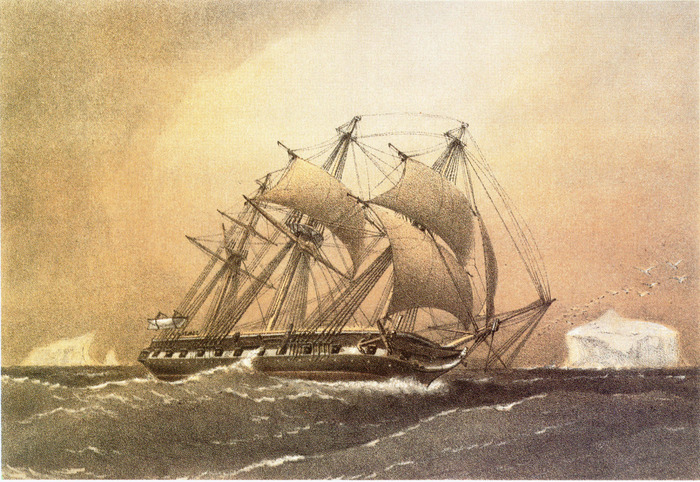
The Challenger expedition of 1872–1876 was a scientific program that made many discoveries to lay the foundation of oceanography. The expedition was named after the naval vessel that undertook the trip, HMS Challenger.
The expedition, initiated by William Benjamin Carpenter, was placed under the scientific supervision of Sir Charles Wyville Thomson of the University of Edinburgh and Merchiston Castle School, assisted by five other scientists, including Sir John Murray, a secretary-artist and, a photographer. The Royal Society of London obtained the use of Challenger from the Royal Navy and, in 1872, modified the ship for scientific tasks, equipping it with separate laboratories for natural history & chemistry. The expedition, led by Captain Sir George Strong Nares, sailed from Portsmouth, England, on [December 21, 1872]. Other naval officers included Commander John Maclear.
Under the scientific supervision of Thomson himself, the ship traveled approximately 68,890 nautical miles (79,280 miles/127,580 kilometres) surveying and exploring. The result was the Report of the Scientific Results of the Exploring Voyage of H.M.S. Challenger during the years 1873–76 which, among many other discoveries, catalogued over 4,000 previously unknown species. John Murray, who supervised the publication, described the report as “the greatest advance in the knowledge of our planet since the celebrated discoveries of the fifteenth and sixteenth centuries.” Challenger sailed close to Antarctica but, not within sight of it. However, it was the first scientific expedition to take pictures of icebergs.
Wikipedia Summary
Additional:
From Deep Sea to Laboratory (The First Explorations of the Deep Sea by H.M.S. Challenger 1872-1876)/ISTE UK Website
Then & Now: The HMS Challenger Expedition & the Mountains in the Sea Expedition/NOAA Ocean Explorer/2003
HMS Challenger Expedition/Natural History Museum UK/2014 (Web Archive)
HMS Challenger/USCD Aquarium/2008 (Web Archive)
POTD: Cypress
This is a Cypress of some sort but, it is definitely a Chamaecyparis. Pl@ntNet can’t really pinpoint the exact species. It seems to think it is a Lawsoniana. The picture on Wikipedia isn’t helpful, either. ~Vic

Click for a larger view.
Picture of the Day
TV Tuesday: Friday The 13th 1957

Sixty-five years ago, today, the British comedy Friday the 13th aired on BBC1. There is very little information on this thirty minute broadcast. It’s simple storyline states:
Ted Ray presents a lighthearted look at superstitions.
Written by John Junkin and Terry Nation, produced by George Inns, the only cast listed is Ted Ray and June Whitfield. IMDb states that it was shown in black & white. The British Comedy Guide reflects “colour.” As best as I can tell, it aired at 7:30pm and it definitely was on a Friday the 13th.
I love British comedy. I wish I could find a YouTube clip or some still photographs. There is just nothing, other than a vague Internet memory of its existence. ~Vic
Flick Friday: Enchanted 2007

Fifteen years ago, today, the #1 movie at the box office was Enchanted. Directed by Kevin Lima and written by Bill Kelly, it starred Amy Adams (Giselle), Patrick Dempsey, James Marsden, Timothy Spall, Idina Menzel, Rachel Covey, Susan Sarandon (Queen Narissa) and Julie Andrews (The Narrator).
The beautiful Princess Giselle is banished by evil Queen Narissa from her magical, musical, animated land and finds herself in the gritty reality of the streets of modern-day Manhattan. Shocked by this strange new environment, that doesn’t operate on a “happily ever after” basis, Giselle is now adrift in a chaotic world, badly in need of enchantment. [When] Giselle begins to fall in love with a charmingly flawed divorce lawyer, who has come to her aid, even though she is already promised to a perfect fairy tale Prince back home, she has to wonder…can a storybook view of romance survive in the real world?
IMDb Storyline
In the animated fairy tale kingdom of Andalasia, Narissa, the corrupt, ruthless queen and dark sorceress, schemes to protect her claim to the throne, which she will lose once her stepson, Prince Edward, finds his true love and marries. Giselle, a young woman, dreams of meeting a prince and experiencing a “happily ever after”. Edward hears Giselle singing and sets off to find her. She and Edward are instantly attracted to each other and plan to be married the following day. Disguised as an old hag, Narissa intercepts Giselle on her way to the wedding and pushes her into a well, where Giselle is magically transformed into a live-action version of herself, [then] transported to New York’s Times Square in the real reality.
Partial Wikipedia Summary
Trivia Bits:
♦ The actresses who provided the voices for three previous animated Disney Princesses made appearances in this movie…Jodi Benson (Ariel/The Little Mermaid 1989), Paige O’Hara (Belle/Beauty and the Beast 1991) and Judy Kuhn (Pocahontas/Singing Voice 1995). Also, Dame Julie Andrews, who starred as the title character in Disney’s live-action Mary Poppins 1964, provided her voice as The Narrator and Idina Menzel, who played Nancy, voiced Queen Elsa in Disney’s Frozen 2013 and Frozen II 2019.
♦ One of the elderly male dancers appeared in Mary Poppins 1964 as a chimney sweep.
♦ Disney had originally planned to add Giselle to the Disney Princess line-up. [The] Giselle doll was featured with packaging, declaring her with Disney Princess status. [Disney] decided against it when they realized they would have to pay for life-long rights to Amy Adams’ image.
I’ve never seen this but, it looks cute. The sequel came out on November 18, 2022. ~Vic
Trailer 2007
Sequel Trailer 2022
Tune Tuesday: Tell Me Pretty Maiden 1902
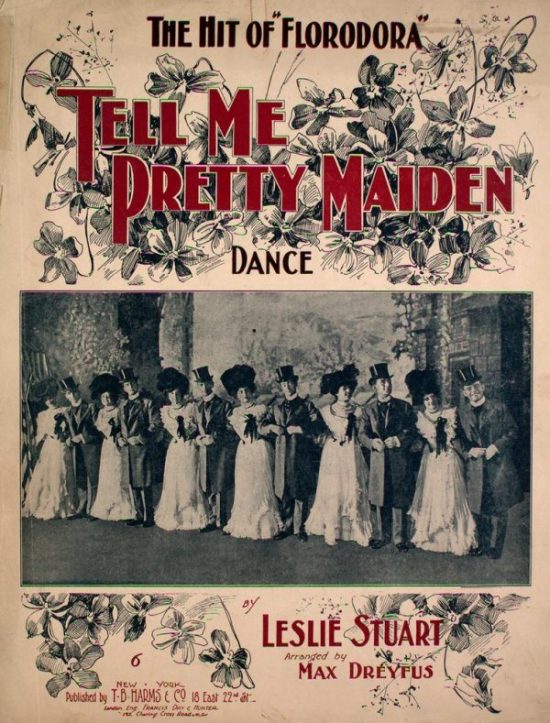
One hundred & twenty years ago, the #1 song of 1902 was Tell Me Pretty Maiden by Byron G. Harlan, whistler Joe Belmont and the Florodora Girls. According to Tsort, there are almost NO charts from before 1920. I plugged in today’s date on Playback FM and this is what I got. You can peruse Tsort’s Site Generation Page, describing source charts and consolidation. They seem to have their own method for old stuff and, apparently, Playback FM agrees.

Florodora is an Edwardian musical comedy. After its long run in London, it became one of the first successful Broadway musicals of the 20th Century. The book was written by Jimmy Davis, under the pseudonym Owen Hall, the music was by Leslie Stuart with additional songs by Paul Rubens and, the lyrics were by Ernest Boyd-Jones, George Arthurs and Rubens.
The original London production opened in 1899, where it ran for a very successful 455 performances. The New York production, which opened the following year, was even more popular, running for 552 performances. After this, the piece was produced throughout the English-speaking world and beyond. The show was famous for its double sextet and its chorus line of “Florodora Girls“.
Wikipedia Summary
It appears that the Harlan & Belmont version, with the Florodora Girls was very, very popular. Second Hand Songs also lists a Frank Stanley as part of the team. UC Santa Barbara lists Frank Banta on piano and calls the group the Edison Sextette.
Flashback Friday: St. Elizabeth’s Flood 1421
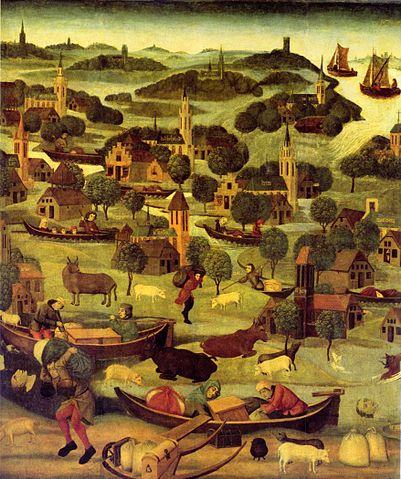
Circa 1490 to 1495
Collection: Amsterdam Museum
Source: Museum Site
Six hundred & one year, ago, today…
The St. Elizabeth’s flood of 1421 was a flooding of the Grote Hollandse Waard, an area in what is now the Netherlands. It takes its name from the feast day of Saint Elisabeth of Hungary which was formerly [November 19th]. It ranks 20th on the list of worst floods in history. During the night of [November 18th-19th] 1421, a heavy storm near the North Sea coast caused the dikes to break in a number of places and the lower-lying polder land was flooded. A number of villages were swallowed by the flood and were lost, causing between 2,000 and 10,000 casualties. The dike breaks and floods caused widespread devastation in Zeeland and Holland.
This flood separated the cities of Geertruidenberg and Dordrecht, which had previously fought against each other during the Hook and Cod (civil) wars. Most of the land remains flooded even since that day.
Most of the area remained flooded for several decades. Reclaimed parts are the island of Dordrecht, the Hoeksche Waard island and north-western North Brabant. Most of the Biesbosch area has been flooded since.
The cause of the flood was a powerful extratropical cyclone. Water from the storm in the North Sea surged up the rivers causing the dikes to overflow and break through. The flood reached a large sea arm between south Holland and Zeeland, destroying the Grote Hollandse Waard.
Wikipedia
I tried to find a video about this but, all I got was a creepy AI voice reading what I posted, above. As an interesting addendum, there was a St. Elizabeth’s flood of 1404, on or about November 19, also, affecting Holland, Zeeland and Flanders. History Calendar on Twitter posted about it, too. ~Vic
Additional:
♦ Zuiderzee Floods (Britannica/November 11, 2022)
♦ Elizabeth and the Flood (Codart/May 8, 2022)
♦ Katje the Windmill Cat (Atozmom’s BSF Blog/March 1, 2014)
Music Monday: Händel Solo Sonatas 1732

Collection: National Portrait Gallery
Date: Between 1726 & 1728
Wikipedia
George Frideric Händel was a German-British Baroque composer well known for his operas, oratorios, anthems, concerti grossi and organ concertos. Händel received his training in Halle and worked as a composer in Hamburg and Italy before settling in London in 1712, where he spent the bulk of his career and became a naturalised British subject in 1727. He was strongly influenced both by the middle-German polyphonic choral tradition and by composers of the Italian Baroque. In turn, Händel’s music forms one of the peaks of the “high baroque” style, bringing Italian opera to its highest development, creating the genres of English oratorio and organ concerto and introducing a new style into English church music. He is consistently recognized as one of the greatest composers of his age. Händel started three commercial opera companies to supply the English nobility with Italian opera. In 1737, he had a physical breakdown, changed direction creatively, addressed the middle class and made a transition to English choral works. After his success with Messiah (1742), he never composed an Italian opera again. Almost blind, he died in 1759, a respected and rich man, and was given a state funeral at Westminster Abbey.
Händel Summary
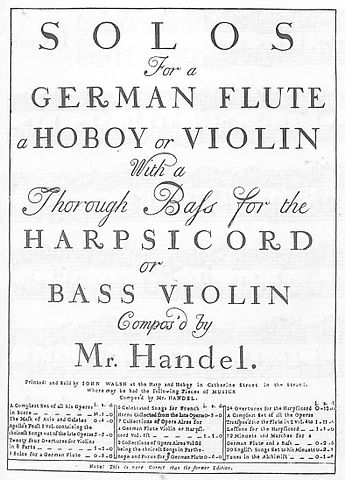
Source: IMSLP
Author: Händel
Two hundred, ninety years ago, Händel Solo Sonatas was published by John Walsh in 1732. It contains a set of twelve sonatas, for various instruments, composed by George Frideric Händel. The 63 page publication includes the sonatas that are generally known as Händel’s Opus 1. The 1732 edition was mostly reprinted from the plates of an earlier 1730 publication […]. Each sonata displays the melody and bass lines […]. By modern-day standards, the music in the publication has a primitive appearance, with squashed notes and irregular spacings, stems and bar widths […]. Despite the titles in both editions, four of the sonatas in each are for a fourth instrument: the Recorder.
John Walsh Summary
Table List of the 12 Händel Sonatas
List of Händel Solo Sonatas
George Frideric Händel Britannica Biography
George Frideric Händel ~ Biography Channel
I can’t seem to find one video with all of the twelve sonatas, combined, so I will post the first three. ~Vic
Flute Sonata E Minor (HWV 359b)
Recorder Sonata G Minor (HWV 360)
Violin Sonata A Major (HWV 361)
 Cosmic-Observation