youtube
Song Sunday: Radar Love

“I’ve been drivin’ all night, my hands wet on the wheel…There’s a voice in my head that drives my heel…
Submitted for your approval, returning to my Samsung playlist, I present Radar Love by Golden Earring, a Dutch hard-rock/progressive rock band. I can’t imagine that anyone out there hasn’t heard this song at least once. Founded in 1961 in The Hague, Netherlands, most of their extensive material didn’t even chart in the US. In the 60 years of their existence, they made 25 studio albums, eight live albums, two compilation albums and an impressive 74 singles. Originally named The Tornadoes…
Golden Earring was formed in 1961 in The Hague by 13-year-old George Kooymans and his 15-year-old neighbour, Rinus Gerritsen. Originally called The Tornados, the name was changed to Golden Earrings, when they discovered that The Tornados was already in use by another group.
They [achieved] their first success in 1965 with “Please Go,” as a pop rock band with Frans Krassenburg as lead singer. By 1969, the rest of the lineup had stabilized, with lead vocalist and multi-instrumentalist Barry Hay and drummer Cesar Zuiderwijk. By ’71, they [were] a regular presence on Dutch charts and [were] starting to climb up the ladder in Germany. They [signed] on to the Who’s Track label, which released a compilation of Dutch singles, Hearing Earring, helping the group break through in England.
Golden Earring
Prog Related/Netherlands
Prog Archives
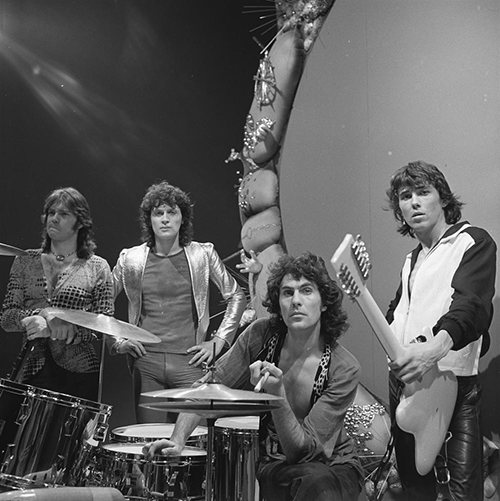
Date: April 19, 1974
Author: AVRO
Source: Netherlands Wiki
Image Credit: Wikipedia
The young group initially baptizes itself as The Tornadoes but, when that name turns out to have already been claimed by another band, they switch to The Golden Earrings – loosely based on a song by the British band The Hunters.
While most Dutch pop bands from the sixties stumble over the threshold to the seventies, the Golden Earring – as the band has come to call itself – emerges from the decade strong and confident.
In 1973, Golden Earring aspires to make an album that is of international allure both artistically and commercially. A lot of time is put into writing and recording what will eventually become Moontan. The mission succeeds brilliantly. Candy’s Going Bad, Radar Love, Just Like Vince Taylor and The Vanilla Queen are among the best the band has written to date.
Both Moontan’s first single Radar Love are a resounding success. First in the Netherlands, then in the rest of Europe and finally in America – where the album was released in 1974. Radar Love even becomes a big hit, with a 13th place as the highest listing. In the following years, however, the song will mainly grow into one of the ultimate car songs, which can still be heard daily on American radio stations. Radar Love has been covered by hundreds of international acts over the decades, including U2, White Lion, Ministry and Def Leppard. Both the single and the album are an undisputed milestone in Dutch pop history.
Golden Earring Biography Page (Google will have to translate.)

It’s not really normal for a band eight albums into their career to suddenly enjoy a worldwide breakout. And, for it to happen with a track over six minutes long with elongated instrumental passages and a somewhat mysterious narrative is even stranger. “…the song most likely to inspire a speeding ticket some 47 years after it was first released.” Barry Hay, the group’s lead singer and lyricist, explained in a recent interview with American Songwriter that a record company push gave then some hope.
“We signed up with Track records, the label of The Who,” Hay says. “And, they really put an effort into it, because they had a sort of monkey wrench. If they could put us together on tour in Europe, they could put us together in Madison Square Garden. So, [we’re] sort of the sons of the Who.”
“At first, the opening line was ‘I’m sitting in a bathtub.’ And, I thought, ‘That’s hardly masculine.’ Then, I came up with sitting in a car.”
“…Hay managed to come up with effortless couplets […] while tying them together in a resonant story of a mystical connection between two separated lovers. […] I remember, in those days, I was really interested in ESP. I read some shit about it. […] Like there’s an accident but, these people still have ESP, they still have contact in a way. Which is sort of a magical thing…
It also inspired a million interpretations but, Hay says that the tragic one is correct. “The guy actually dies,” he says of the song’s narrator. “That’s the gist of the whole thing. In a way, she still has contact with him. There is an afterlife.”
Behind The Song: Radar Love
American Songwriter
Jim Beviglia (Written three years ago)
Unfortunately, Golden Earring is no more:
Golden Earring Co-Founder George Kooymans Retires After ALS Diagnosis
The Band Calls It Quits ~Vic
Additional:
♦ The Virgin Encyclopedia of Heavy Rock (Colin Larkin/1999/Internet Archive/Pages 187-188/Sign-In Required)
♦ It’s Prog Jim, But Not As We Know It: Golden Earring (Louder Sound/Prog/Malcolm Dome/10-28-2014)
Tune Tuesday: In The Good Old Summer Time 1903

1896 Publicity Photo
National Phonograph Co.
One hundred, twenty years ago, today, the #1 song in 1903 was In The Good Old Summer Time by the Haydn Quartet. In a previous post, I stated that Tsort has very few charts prior to 1920. Music popularity just wasn’t tracked as closely as it is, today. For music this old, I plug in a date on Playback FM and run with it.
Written by Ren Shields and composed by George “Honey Boy” Evans, it is a Tin Pan Alley song, originally published in 1902. Blanche Ring assisted in having the number added to the 1902 comedy musical The Defender. There is also a John Philip Sousa band version.
The Haydn Quartet was originally formed in 1896 as the Edison Quartet. They eventually changed their name to Haydn, an homage to Joseph Haydn and as a way to record for other companies besides Edison Records.
In The Good Old Summer Time was a very popular song for its time and John Scantlebury MacDonald, a replacement member of the Edison Quartet, went on to record the song, solo. It was the Haydn Quartet’s biggest commercial success while contracted with the Victor Talking Machine Company.
POTD: Crimson Clover
In the Fabaceae family, Trifolium Incarnatum is also known as Italian Clover.

Click for a larger view.
Picture of the Day
Addendum: This just naturally reminded me of Tommy James and the Shondells (throwing no shade on Joan Jett). I couldn’t resist… ~Vic
POTD: New Year’s Eve 2022
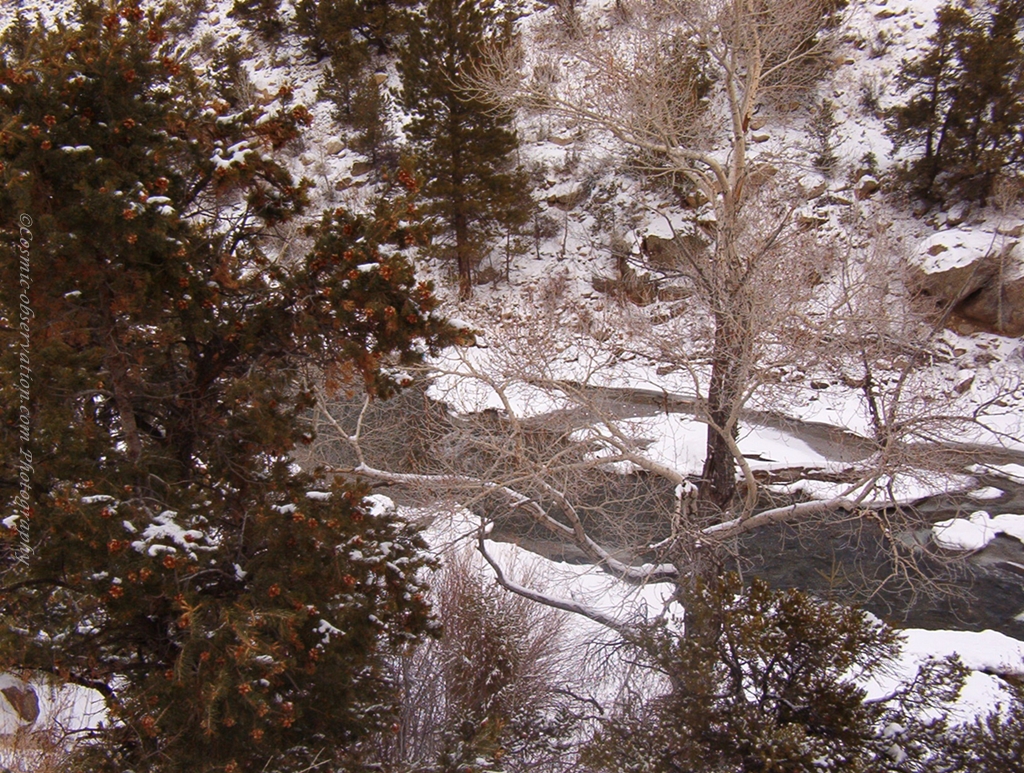
Buena Vista, CO
Christmastime 2008
Click for a larger view.
This was my view from the backdoor of our room. The lodge backed up to the Arkansas River. It was a wonderful place to vacation for Christmas and New Year’s. Sadly, the lodge had to close, permanently, due to the Plandemic/Scamdemic. It’s heartbreaking. And, as far as I am concerned, good riddance to 2022. I have hopes that 2023 will be better but…it’s not likely. I will be raising a glass of bubbly to the awakening of humanity. ~Vic
Quick edit…this is a companion piece to Walsenburg.
From October 2014
From May 2015
Throwback Thursday: Eastern Airlines Flight 401 1972

Date: March 1972
Author: Jon Proctor
Source: Airline Fan
Fifty years ago, today…
Eastern Air Lines Flight 401 was a scheduled flight from [New York] JFK to [Miami/Wilcox Field] MIA. Shortly before midnight on December 29, 1972, the Lockheed L-1011-1 TriStar crashed into the Florida Everglades, causing 101 total fatalities. Three of the [four] cockpit crew members, two of the [ten] flight attendants and 96 of the 163 passengers were killed. [T]here were 75 survivors.
Flight 401 departed JFK Airport […] at 9:20pm EST. The flight was routine until 11:32pm EST, when the plane began its approach into Miami International Airport. After lowering the [landing] gear, First Officer Stockstill noticed that the landing gear indicator (nose gear is properly locked) had not illuminated (burned out bulb). [Captain] Loft, who was working the radio during this leg of the flight, told the tower that they would discontinue their approach to their airport and requested to enter a holding pattern. The approach controller cleared the flight to climb to 2,000 feet and then hold west over the Everglades.
Fifty seconds after reaching their assigned altitude, Captain Loft instructed First Officer Stockstill to put the L-1011 on autopilot. For the next 80 seconds, the plane maintained level flight. Then, it dropped 100 feet and, then, again, flew level for two more minutes, after which it began a descent so gradual, it could not be perceived by the crew.
Wikipedia Summary
The plane continued to drop, triggering the altitude warning. The CVR did not record any indication that the pilots heard the warning chimes. As Stockstill started another turn [of] 180°, he noticed the discrepancy. The CVR captured the last, confused conversation between Stockstill and Loft. Less than ten seconds later, the plane crashed into the Everglades. ~Vic
Additional:
Giant Jetliner Goes Down (The Bulletin)
Jet’s Fall Cushioned By Swamp (Reading Eagle)
Accident Investigation Report (Aviation Safety Network)
Borman Praises Survivors’ Calm (The Associated Press)
VOTD: Siblings
It’s always the younger, smaller sibling that takes the junk from the others. For some reason, this video will not play in Russia. If you can’t see this video, send me an email and I will give you another link. ~Vic
Video of the Day
Wayback Wednesday: Challenger Expedition 1872
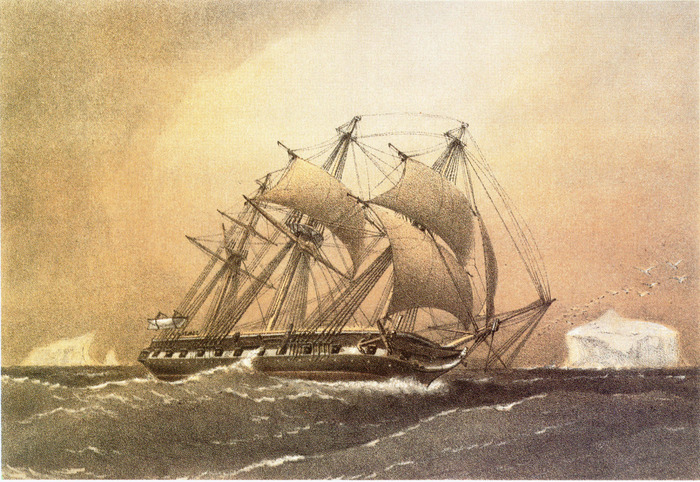
University of Washington
Author: William Frederick Mitchell
One hundred and fifty years ago, today…
The Challenger expedition of 1872–1876 was a scientific program that made many discoveries to lay the foundation of oceanography. The expedition was named after the naval vessel that undertook the trip, HMS Challenger.
The expedition, initiated by William Benjamin Carpenter, was placed under the scientific supervision of Sir Charles Wyville Thomson of the University of Edinburgh and Merchiston Castle School, assisted by five other scientists, including Sir John Murray, a secretary-artist and, a photographer. The Royal Society of London obtained the use of Challenger from the Royal Navy and, in 1872, modified the ship for scientific tasks, equipping it with separate laboratories for natural history & chemistry. The expedition, led by Captain Sir George Strong Nares, sailed from Portsmouth, England, on [December 21, 1872]. Other naval officers included Commander John Maclear.
Under the scientific supervision of Thomson himself, the ship traveled approximately 68,890 nautical miles (79,280 miles/127,580 kilometres) surveying and exploring. The result was the Report of the Scientific Results of the Exploring Voyage of H.M.S. Challenger during the years 1873–76 which, among many other discoveries, catalogued over 4,000 previously unknown species. John Murray, who supervised the publication, described the report as “the greatest advance in the knowledge of our planet since the celebrated discoveries of the fifteenth and sixteenth centuries.” Challenger sailed close to Antarctica but, not within sight of it. However, it was the first scientific expedition to take pictures of icebergs.
Wikipedia Summary
Additional:
From Deep Sea to Laboratory (The First Explorations of the Deep Sea by H.M.S. Challenger 1872-1876)/ISTE UK Website
Then & Now: The HMS Challenger Expedition & the Mountains in the Sea Expedition/NOAA Ocean Explorer/2003
HMS Challenger Expedition/Natural History Museum UK/2014 (Web Archive)
HMS Challenger/USCD Aquarium/2008 (Web Archive)
VOTD: Do You Believe?
I picked this up from another blog. I loved The Conjuring franchise movies. Were Ed & Lorraine Warren for real? Are the hauntings real? The guy who posted this video stated that he knew someone that was friends with a family that lived in the Amityville house in the 1990s. They reported nothing weird. He also stated that he had another friend that knew Ronald Defeo, Jr. and that person stated that Defeo was totally messed up. Apologies, up front, for all the adverts…and that stupid fish. Submitted for your approval… ~Vic
Video of the Day
VOTD: Purring Baby
This was originally posted on June 5. I uploaded the video to WordPress, only to have it malfunction in the Reader…another victim of the “Pro Plan”. This is another video that is stuck as an echo in the Reader (browser) and I can’t get it out. ~Vic
Video of the Day
Thanksgiving 2022
I won’t be cooking a traditional turkey this year. I am going for a pork loin, just to be different. I will have a small gathering. Peace, love and hugs to everyone. May we all gather in joy. ~Vic

Tune Tuesday: Tell Me Pretty Maiden 1902
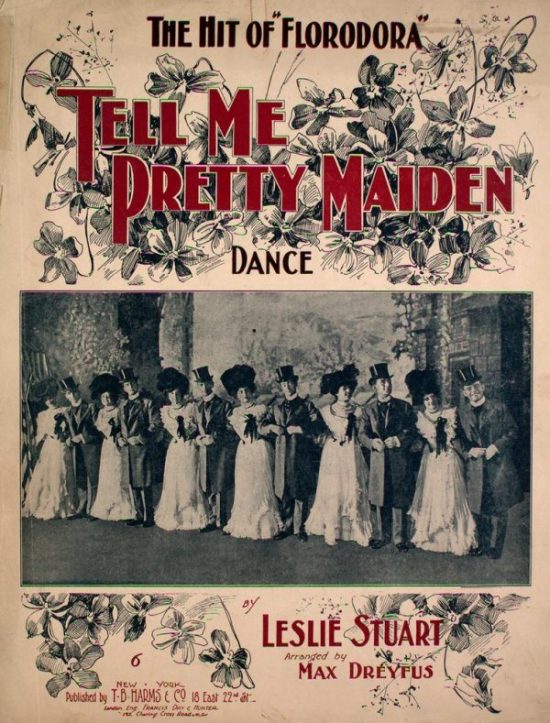
One hundred & twenty years ago, the #1 song of 1902 was Tell Me Pretty Maiden by Byron G. Harlan, whistler Joe Belmont and the Florodora Girls. According to Tsort, there are almost NO charts from before 1920. I plugged in today’s date on Playback FM and this is what I got. You can peruse Tsort’s Site Generation Page, describing source charts and consolidation. They seem to have their own method for old stuff and, apparently, Playback FM agrees.
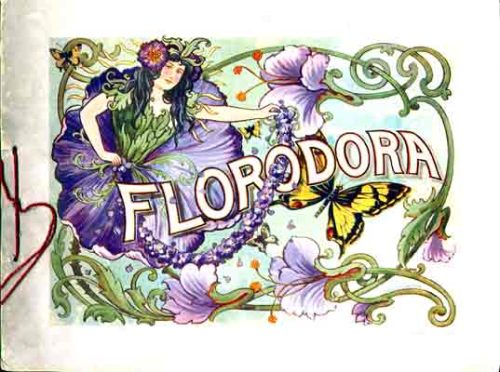
Florodora is an Edwardian musical comedy. After its long run in London, it became one of the first successful Broadway musicals of the 20th Century. The book was written by Jimmy Davis, under the pseudonym Owen Hall, the music was by Leslie Stuart with additional songs by Paul Rubens and, the lyrics were by Ernest Boyd-Jones, George Arthurs and Rubens.
The original London production opened in 1899, where it ran for a very successful 455 performances. The New York production, which opened the following year, was even more popular, running for 552 performances. After this, the piece was produced throughout the English-speaking world and beyond. The show was famous for its double sextet and its chorus line of “Florodora Girls“.
Wikipedia Summary
It appears that the Harlan & Belmont version, with the Florodora Girls was very, very popular. Second Hand Songs also lists a Frank Stanley as part of the team. UC Santa Barbara lists Frank Banta on piano and calls the group the Edison Sextette.
VOTD: Sgt. Kitten Takes Point
This was originally posted on June 9. I uploaded the video to WordPress, only to have it malfunction in the Reader. The “Pro Plan” was a complete disaster, which is why it isn’t available, anymore. The server migration that was being done for the stupid plan made crazy echoes of uploaded videos, as all the previously listed links in posts were broken. I have several posts with videos, stuck in my Reader, that won’t play and, even after I delete the post, the echo of the post remains in my Reader feed. Way to go, Happiness Engineers! ~Vic
Video of the Day
Music Monday: Händel Solo Sonatas 1732

Collection: National Portrait Gallery
Date: Between 1726 & 1728
Wikipedia
George Frideric Händel was a German-British Baroque composer well known for his operas, oratorios, anthems, concerti grossi and organ concertos. Händel received his training in Halle and worked as a composer in Hamburg and Italy before settling in London in 1712, where he spent the bulk of his career and became a naturalised British subject in 1727. He was strongly influenced both by the middle-German polyphonic choral tradition and by composers of the Italian Baroque. In turn, Händel’s music forms one of the peaks of the “high baroque” style, bringing Italian opera to its highest development, creating the genres of English oratorio and organ concerto and introducing a new style into English church music. He is consistently recognized as one of the greatest composers of his age. Händel started three commercial opera companies to supply the English nobility with Italian opera. In 1737, he had a physical breakdown, changed direction creatively, addressed the middle class and made a transition to English choral works. After his success with Messiah (1742), he never composed an Italian opera again. Almost blind, he died in 1759, a respected and rich man, and was given a state funeral at Westminster Abbey.
Händel Summary
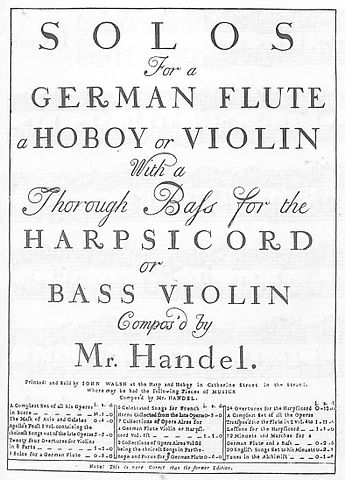
Source: IMSLP
Author: Händel
Two hundred, ninety years ago, Händel Solo Sonatas was published by John Walsh in 1732. It contains a set of twelve sonatas, for various instruments, composed by George Frideric Händel. The 63 page publication includes the sonatas that are generally known as Händel’s Opus 1. The 1732 edition was mostly reprinted from the plates of an earlier 1730 publication […]. Each sonata displays the melody and bass lines […]. By modern-day standards, the music in the publication has a primitive appearance, with squashed notes and irregular spacings, stems and bar widths […]. Despite the titles in both editions, four of the sonatas in each are for a fourth instrument: the Recorder.
John Walsh Summary
Table List of the 12 Händel Sonatas
List of Händel Solo Sonatas
George Frideric Händel Britannica Biography
George Frideric Händel ~ Biography Channel
I can’t seem to find one video with all of the twelve sonatas, combined, so I will post the first three. ~Vic
Flute Sonata E Minor (HWV 359b)
Recorder Sonata G Minor (HWV 360)
Violin Sonata A Major (HWV 361)
 Cosmic-Observation