The song tells the story of a child attempting to call her father in No Man’s Land. She is unable to reach him over the telephone because her father has been killed fighting on the Western Front.
Wikipedia Summary
There is very little else written about this song. When I have gone to the Tsort charts, with these older pieces, I have usually chosen whatever was at the top of the particular chart, for the particular year. This time, I looked, specifically, for this month in 1918. According to (old) US Billboard 1, this song was on the chart for eight weeks. ~Vic
On May 17, 1673, Louis Jolliet and Jacques Marquette departed from St. Ignace, Michigan, with two canoes and five other voyageurs of French-Indian ancestry. The group sailed to Green Bay. They paddled upstream (southward) on the Fox River to the site now known as Portage, Wisconsin. There, they portaged a distance of slightly less than two miles through marsh and oak forest to the Wisconsin River. Europeans eventually built a trading post at that shortest convenient portage between the Great Lakes and Mississippi River basins. On June 17, the canoeists ventured onto the Mississippi River near present-day Prairie du Chien, Wisconsin.
The Jolliet-Marquette expedition paddled along the west bank of the Mississippi until mid-July. When they passed the mouth of the Arkansas River, they became satisfied that they had established that the Mississippi flowed into the Gulf of Mexico.
The voyageurs then followed the Mississippi back to the mouth of the Illinois River, which friendly natives told them was a shorter route back to the Great Lakes. Following the Illinois river upstream, they turned up its tributary, the Des Plaines River near modern-day Joliet, Illinois. They continued up the Des Plaines River and portaged their canoes, and gear, at the Chicago Portage. They followed the Chicago River downstream until they reached Lake Michigan near the location of modern-day Chicago. Father Marquette stayed at the mission of St. Francis Xavier at the southern end of Green Bay, which they reached in August. Jolliet returned to Quebec to relate the news of their discoveries. On his way through the Lachine Rapids, Jolliet’s canoe overturned and his records were lost. His brief narrative, written from memory, is in essential agreement with Marquette’s, the chief account of the journey.
While Hernando de Soto was the first European to make official note of the Mississippi River by discovering its southern entrance in 1541, Jolliet and Marquette were the first to locate its upper reaches and, travel most of its length, about 130 years later. De Soto had named the river Rio del Espiritu Santo but, tribes along its length called it “Mississippi”, meaning “Great River” in the Algonquian languages.
Hanspostcard has a song draft challenge. This is my Round Two pick.
I grew up around lots of music. My dad had his tastes, my mom had hers and I got some exposure to my grandparents music, too. There was plenty of Elvis, Buddy Holly, Everly Brothers, Ricky Nelson, Gene Pitney, Chuck Berry, Johnny Cash, Johnny Horton, The Ventures, The Beach Boys, instrumental music (think Hugo Montenegro or Paul Mauriat), funny stuff like Ben Colder/Sheb Wooley, Ray Stevens or David Seville (my dad’s stuff), The Four Seasons, Motown, soul music, beach music (my mom’s stuff), big band music (my paternal grandparents) and, bluegrass, country and Latin/jazz (maternal grandparents). One song, in particular, that reminds me of my dad the most is Cathy’s Clown. When I was a kid, my dad liked to just get in the car, drive around and listen to the radio. It was, literally, No Particular Place To Go. When I became an adult, we’d still get in the car and cruise. He and I would sing Cathy’s Clown, together, with me taking Phil’s harmony. I still own my dad’s original 45. ~Vic
Written by Don, it was recorded in March and released in April 1960. It was recorded live, in a single take, with both brothers sharing a microphone. Floyd Cramer was on piano, Floyd Chance on bass and Buddy Harman on drums. An odd song, it has a chorus and bridges but, no verses. It was their first single for Warner Bros. It spent five weeks at #1 on Billboard’s Hot 100 chart, one week on the Billboard’s R&B chart and seven weeks at #1 on UK’s Singles chart. It was their biggest selling single and their last #1 after Wake Up Little Susie and All I Have to Do Is Dream.
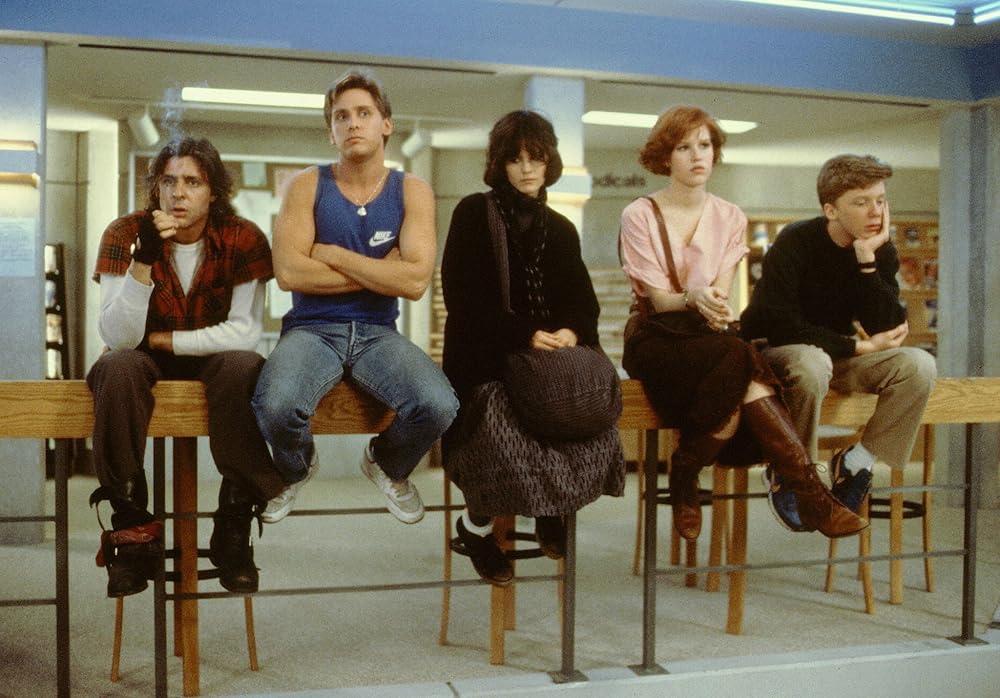
“Saturday, March 24, 1984. Shermer High School, Shermer, Illinois, 60062 (fictional town). […] You see us as you want to see us… […] You see us as a brain, an athlete, a basket case, a princess and a criminal. […] That’s the way we saw each other at 7:00 this morning. We were brainwashed.”
This is my graduating class…the class of 1984 (despite the age of some of the actors). Released February 15, 1985, I was in my freshman year of college and it was a bittersweet revisit. I knew these characters…every single one of them. My high school even had a library that resembled that set. This movie was made with only a one million budget but, brought in $51 million and, in 2016, was selected for preservation with the National Film Registry of the Library of Congress. There is no CGI or special effects. There are no sweeping views of beautiful locations. There are no “shoot-em-up-bang-bang” sequences. There is some action with the cast running through the hallways, dancing while high and Judd Nelson (John Bender/The Criminal) falling through the ceiling tiles. This is, primarily, a study of human nature, parental influence, peer influence, subtle & overt abuse and the struggle to understand. It’s heartbreaking, it’s hilarious and it is so Generation X. ~Vic
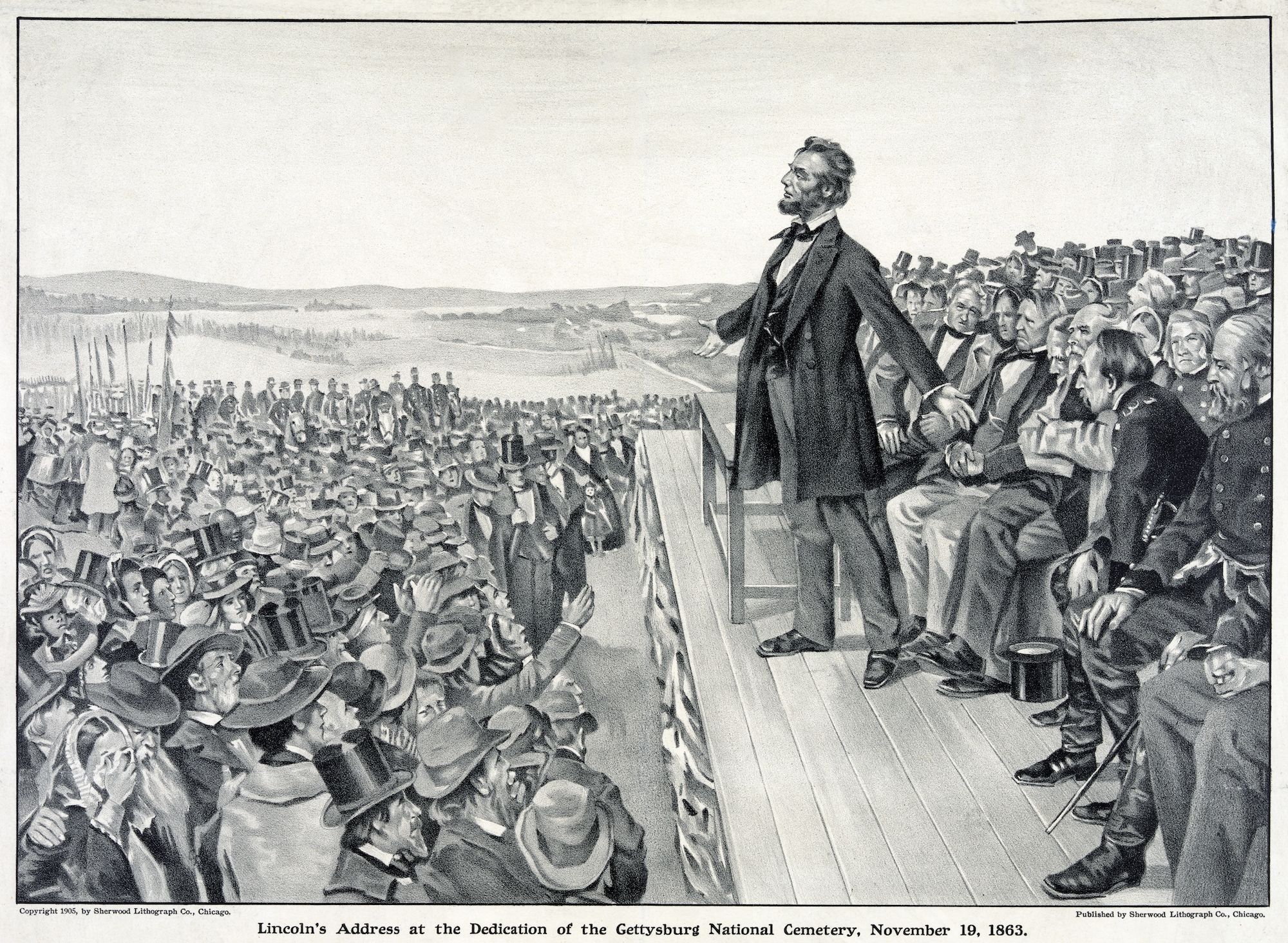
Four score and seven years ago our fathers brought forth on this continent, a new nation, conceived in Liberty, and dedicated to the proposition that all men are created equal.
Now we are engaged in a great civil war, testing whether that nation, or any nation so conceived and so dedicated, can long endure. We are met on a great battle-field of that war. We have come to dedicate a portion of that field, as a final resting place for those who here gave their lives that that nation might live. It is altogether fitting and proper that we should do this.
But, in a larger sense, we can not dedicate — we can not consecrate — we can not hallow — this ground. The brave men, living and dead, who struggled here, have consecrated it, far above our poor power to add or detract. The world will little note, nor long remember what we say here, but it can never forget what they did here. It is for us the living, rather, to be dedicated here to the unfinished work which they who fought here have thus far so nobly advanced. It is rather for us to be here dedicated to the great task remaining before us — that from these honored dead we take increased devotion to that cause for which they gave the last full measure of devotion — that we here highly resolve that these dead shall not have died in vain—that this nation, under God, shall have a new birth of freedom — and that government of the people, by the people, for the people, shall not perish from the earth.
Photo Credit: Library of Congress
Historic American Buildings Survey
February 1965
Twin Chimneys, so named for the paired chimneys in each gable end, is sited on a hill on West King Street, directly across from the Colonial Inn and the Parks-Richmond House […]. An iron gate from Stewart Iron Works in Cincinnati, Ohio, separates the house from the pedestrian traffic of the sidewalk. [It] is reputedly a pre-Revolutionary house, however, the exact date of construction is not known. It is important to note that a house is sited at the exact location on the 1768 Sauthier Map of Hillsborough but, it cannot be assumed that the houses are the same.
05-20-201907-14-2020Left side gate.
Photo Credit: Pinterest
This is a most delightful old house, with four huge chimneys and a second-floor balcony, from which a view of the busy thoroughfare, King Street, may have been enjoyed down through the years. The lot on which it stands was once owned by Edmund Fanning.
It is interesting to know that this house was the setting for the old romantic novel, “Joscelyn Cheshire.” According to the story, the heroine concealed her lover in the attic to protect him from Cornwallis’ army. The house served at one time as Hillsborough’s Post Office.
Archibald DeBow Murphey was a North Carolina politician known as the “Father of Education” in his state for his proposals that benefited public works and public education. [Murphey] died at Twin Chimneys in Hillsborough on February 1, 1832. He is buried at the Presbyterian Church […]. The town of Murphy, North Carolina (despite its spelling) was named after him.
USS Princeton 1843-1849
Image Credits: Lithograph by N. Currier, New York, 1844
U.S. Naval History & Heritage Command history.navy.mil
wikipedia.org & wikimedia.org
President Tyler hosted a public reception for Stockton in the White House on February 27, 1844. On February 28, [the] USS Princeton departed Alexandria, Virginia, on a demonstration cruise down the Potomac with Tyler, members of his cabinet, former First Lady Dolley Madison, Senator Thomas Hart Benton of Missouri and about 400 guests. Captain Stockton decided to fire the larger of her two long guns, Peacemaker, to impress his guests. Peacemaker was fired three times on the trip downriver and was loaded to fire a salute to George Washington as the ship passed Mount Vernon on the return trip. The guests aboard viewed the first set of firings, [then] retired below decks for lunch and refreshments.
Awful Explosion of the Peacemaker on board the
U.S. steam frigate Princeton on Wednesday, 28 Feb. 1844
Image Credits: Lithograph by N. Currier/Currier & Ives
Gale Research
Library of Congress
wikipedia.org & wikimedia.org
Secretary [of the Navy] [Thomas Walker] Gilmer urged those aboard to view a final shot with the Peacemaker. When Captain Stockton pulled the firing lanyard, the gun burst. Its left side had failed, spraying hot metal across the deck and shrapnel into the crowd. Instantly killed were Gilmer, Secretary of State [Abel P.] Upshur, Captain Beverley Kennon, who was Chief of the Bureau of Construction [Equipment] and Repairs, Virgil Maxcy (a Maryland attorney with decades of experience as a state and federal officeholder), David Gardiner (a New York lawyer and politician) and the President’s valet, a black slave named Armistead. Another 16 to 20 people were injured, including several members of the ship’s crew, Senator Benton and Captain Stockton. The president was below decks and not injured.
The disaster on board the Princeton killed more top U.S. government officials in a single day than any other tragedy in American history.
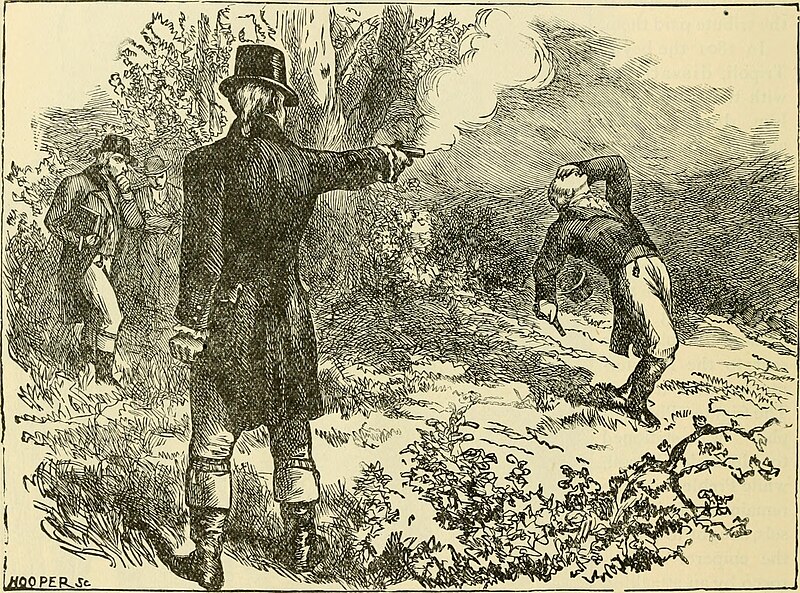
Two-hundred, fifteen years ago, today, Vice President Aaron Burr shot former Secretary of the Treasury Alexander Hamilton in a duel in Weehawken, New Jersey.
At dawn on the morning of July 11, […] political antagonists, and personal enemies, Alexander Hamilton and Aaron Burr met on the heights of Weehawken […], to settle their longstanding differences with a duel. The participants fired their pistols in close succession. Burr’s shot met its target immediately, fatally wounding Hamilton and leading to his death the following day. Burr escaped unharmed. This tragically extreme incident reflected the depth of animosity aroused by the first emergence of the nation’s political party system. Both men were political leaders in New York: Burr, a prominent Republican, and Hamilton, leader of the opposing Federalist Party. Burr had found himself the brunt of Hamilton’s political maneuvering on several occasions, including the unusual presidential election of 1800, in which vice-presidential candidate Burr almost defeated his running mate, presidential candidate Thomas Jefferson. In 1804, Hamilton opposed Burr’s closely fought bid for governor of New York. On the heels of this narrow defeat, Burr challenged Hamilton to a duel on the grounds that Hamilton had publicly maligned his character.
Alexander Hamilton, the chief architect of America’s political economy, was born on the Caribbean island of Nevis [and] came to the American colonies in 1773 as a poor immigrant. (There is some controversy as to the year of his birth, but it was either 1755 or 1757.) In 1776, he joined the Continental Army in the American Revolution and his […] remarkable intelligence brought him to the attention of General George Washington. Aaron Burr, born into a prestigious New Jersey family in 1756, was also intellectually gifted and [..] graduated from the College of New Jersey (later Princeton) at the age of 17. He joined the Continental Army in 1775 […]. In 1790, he defeated Alexander Hamilton’s father-in-law in a race for the U.S. Senate. Hamilton came to detest Burr, whom he regarded as a dangerous opportunist, and […] often spoke ill of him.
In the 1800 election, Jefferson and Burr became running mates […]. Under the electoral procedure then prevailing, president and vice president were voted for, separately. […] the candidate who received the most votes was elected president, and the second in line, vice president. What at first seemed but an electoral technicality […] developed into a major constitutional crisis when Federalists in the lame-duck Congress threw their support behind Burr. After a remarkable 35 tie votes, a small group of Federalists changed sides and voted in Jefferson’s favor. Alexander Hamilton, who had supported Jefferson as the lesser of two evils, was instrumental in breaking the deadlock.
The duel was fought at a time when the practice was being outlawed in the northern United States and it had immense political ramifications. Burr survived the duel and was indicted for murder in both New York and New Jersey, though these charges were later either dismissed or resulted in acquittal. The harsh criticism and animosity directed toward him following the duel brought an end to his political career. The Federalist Party was already weakened by the defeat of John Adams in the presidential election of 1800 and was further weakened by Hamilton’s death.
[Burr] spent [many] years in Europe. He finally returned to New York City in 1812, where he resumed his law practice and spent the remainder of his life in relative obscurity.
A vignette of a bar-room/liquor-store in the West [with] no plot, per se. However, this short is usually regarded as the first “Western” in the sense that it depicts a western scene.
Shows tap room of the “Miners Arms”, stout lady at the bar and three men playing stud horse. Old toper with a silk hat asleep by the stove. Rough miner enters, bar maid serves him with Red Eye Whiskey and he proceeds to clean out the place. Barmaid takes a hand with a siphon of vichy and, bounces the intruder with the help of the card players, who line up before the bar and take copious drinks on the house.
An actual Cripple Creek, Colorado, bar.
Photo Credit: silentology.wordpress.com & pinterest.com
So the film’s supposed to be set in one of the rough mining towns that were part of the Wild West. Also, it was definitely named “Cripple Creek” for a reason. Cripple Creek, Colorado, was a real-life ranch town that experienced a major gold rush in the late 19th century. In 1890, Robert Miller Womack struck gold and, six years later, the town had swelled from a mere 500 souls to well over 30,000 gold-fevered prospectors. All in all, something in the range of a half-billion dollars worth of gold would be extracted from the area.
The Black Maria was completed in early 1893 in West Orange, NJ and, when Edison built a new, rooftop movie studio in New York City, it ceased operation in January 1901. It was torn down in 1903.
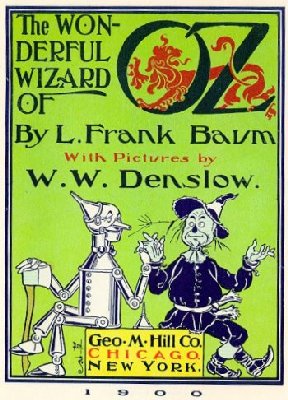
The story chronicles the adventures of a young farm girl named Dorothy in the magical Land of Oz after she and her pet dog Toto are swept away from their Kansas home by a cyclone.
The book is one of the best-known stories in American literature and has been widely translated. The Library of Congress has declared it “America’s greatest and best-loved homegrown fairytale.” Its groundbreaking success and the success of the Broadway musical adapted from the novel led Baum to write thirteen additional Oz books that serve as official sequels to the first story.
Baum dedicated the book “to my good friend & comrade, My Wife,” Maud Gage Baum. In January 1901, George M. Hill Company completed printing the first edition, a total of 10,000 copies, which quickly sold out. It sold three million copies by the time it entered the public domain in 1956.
Image Credit: wikipedia.org
The Wonderful Wizard of Oz is considered the first American fairy tale because of its references to clear American locations such as Kansas and Omaha. Baum agreed with authors such as Carroll that fantasy literature was important for children, along with numerous illustrations but, he also wanted to create a story that had recognizable American elements in it such as farming and industrialization. Baum did not offer any conclusive proof that he intended his novel to be a political allegory.
The Wonderful Wizard of Oz has become an established part of multiple cultures, spreading from its early young American readership to becoming known throughout the world. It has been translated or adapted into well over fifty languages, at times being modified in local variations. For instance, in some abridged Indian editions, the Tin Woodman was replaced with a horse. In Russia, a translation by Alexander Melentyevich Volkov produced six books, The Wizard of the Emerald City series, which became progressively distanced from the Baum version, as Ellie and her dog Totoshka travel throughout the Magic Land. More recently, the story has become an American stage production (The Wiz) with an all-black cast, set in the context of modern African-American culture.
Here in North Carolina, we have the Land of Oz at Beech Mountain. I went there in 1973 with my parents and, again, in 2017. ~Vic








 Cosmic-Observation