Photo Credit: Ken Lund
History & Headlines
Wikimedia
This was going to be a post on the highest recorded heat level, listed in the Guinness (Book) of World Records. Supposedly, one-hundred and seven years ago, today, Death Valley got up to 134.4℉. I read Wikipedia, I read Guinness and I read History & Headlines. If it made it into Guinness, someone must have thought it was legitimate. Well, after taking a dive into Weather Underground‘s investigation of this record (this is a very long read), posted by weather historian Christopher Burt on October 24, 2016, I’m not so sure this event ever happened.
I have contacted Guinness for a challenge. We shall see how this plays out. ~Vic
Update:
As it turns out, thanks to Pl@ntNet, this is an Iberis Umbellata or, Globe Candytuft. I think it may have already bloomed and the center colors are all that is left. It appears to be the same thing as my previous post.
This looks like a tiny bird nest with eggs. If anyone knows what this is, let me know. ~Vic
The adjective kaput:
“ruined, done for, out of order”
is used only in [a] predicate position, not in [an] attributive position. [T]hat is, you can only say “My car is kaput” but, not “I’ve got a kaput car.”
Kaput comes from the German colloquial adjective kaputt:
“broken, done for, out of order, (of food) spoiled”
which was taken from the German idiom capot machen, a partial translation of the French idioms faire capot and être capot:
“to win (or lose) all the tricks (in the card game piquet).”
Faire capot literally means “to make a bonnet or hood” and its usage in Piquet may be from an image of throwing a hood over or hoodwinking one’s opponent. Unsurprisingly, kaput became widely used in English early in World War I.
I find the word’s description, above, apropos to today’s insanity. And, if you are so inclined, a video for five minutes of your time. ~Vic
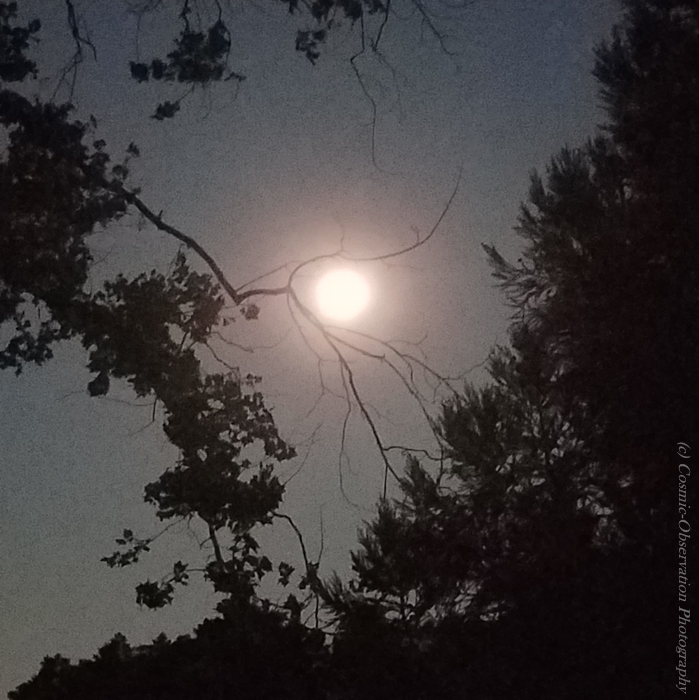
This is my first Buck Moon post. I totally missed 2019 & 2018. There was also a penumbral lunar eclipse happening, as well. Full illumination occurred at 12:44am EDT. Howl for me! ~Vic
Skeleton Tree Hand
Waxing Gibbous
07-03-2020
The Full Moon in July is the Buck Moon, named after the new antlers that emerge from a buck’s forehead around this time of the year. It is also called Thunder Moon, Hay Moon and Wort Moon. For farmers, high summer [is] the time to cut and cure hay to put away for winter feed.
Spooky trees.
One of the more common names for this month’s Full Moon is the Thunder Moon, a tribute from the Algonquin to a time of year when spectacular electrical storms rake the northern forests. The Chinese deserve credit for an equally ominous name. The moon coincides with the Hungry Ghost Festival, a time when the living honor the dead by leaving food and drink to the ancestors. Their name? The Moon of the Hungry Ghosts.
From the parking deck.
07-14-2020
Wort Moon [indicates] that July is the time to gather herbs (worts) to dry and use as spices and remedies. Additional names are Halfway Summer Moon (Ojibwe/Chippewa), Blueberry Moon (Ojibwe), Raspberry Moon (Ojibwe), Flying Moon (Ojibwe), Thunderstorm Moon (Catawba), Corn in Tassel [Moon] (Eastern Band Cherokee), Honey Bee Moon (Stockbridge-Munsee Band of Wisconsin), String Bean Moon (Oneida) and Little Sister of the Summer Moon (Tunica-Biloxi Tribe of Louisiana).
As far as I am concerned, there is nothing to celebrate. I wake up everyday hoping the worldwide madness has ended. Nope. Same shit, different day. I await the latest Walking Dead episodes (whenever they resume) with the zombies wearing masks. Oh. Look. Art imitates life… *sigh*
I am posting a favorite song of mine, appropriate for the day, from a powerful voice. I sincerely hope that there will be a day of reckoning for what has been done. ~Vic
“Let freedom ring, let the white dove sing
Let the whole world know that today, is a day of reckoning
Let the weak be strong, let the right be wrong
Roll the stone away, let the guilty pay, it’s Independence Day”
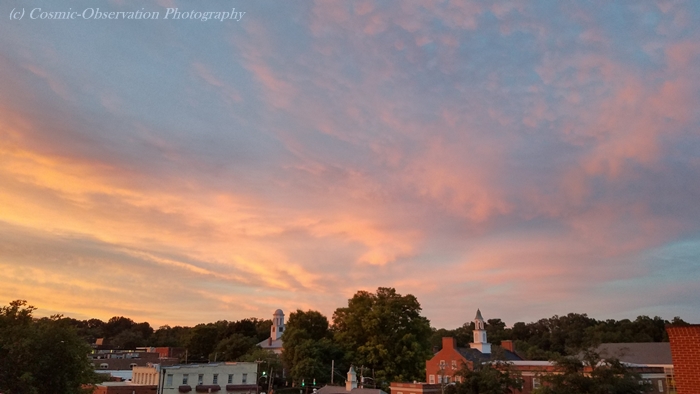
These are companion shots to my POTD: Sunset post, as well as previous Sky Gazing posts. This town can have some of the most glorious sunsets and quirky cloud formations. ~Vic
Standing on the bridge over the Eno River.
06-24-2020Walking up to the parking garage.On top of the garage and the colors develop.Sweeping over the adjacent building.Looking out across the town.Breathtaking rich colors and contrasts.
A 25-year-old man clad in “Joker” makeup “menacingly waved” a pocketknife at several teenagers as he drove past them Tuesday in Haddon Township, authorities said. Assoumou Diby was stopped a short time [after] cruising past the group on the 400 block of West Crystal Lake Avenue on Tuesday, the Camden County Prosecutor’s Office and Haddon Township police said in a statement Wednesday.
It’s blurry but, here’s a visual…a man in joker makeup arrested by Haddon Twp, NJ, police after allegedly waving a pocketknife at children. The arrest followed days of sightings, scares and calls to police, who say, until last night, the behavior wasn’t criminal. @FOX29philly
Diby, of Haddon Township, was charged with unlawful possession of a weapon following his arrest. Earlier in the week, police said they received multiple reports from people who saw a man in Joker makeup walking around town, noting it’s not a crime [to] simply do that.
Diby is due to make a first appearance in municipal court July 16.
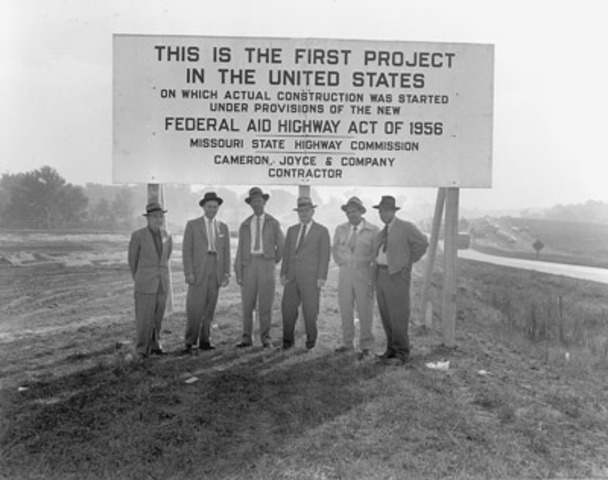
Also known as the Federal Aid Highway Act of 1956 (Public Law 84-627), [it] was enacted on June 29, 1956, when President Dwight D. Eisenhower signed the bill into law. With an original authorization of $25 billion for the construction of 41,000 miles (66,000 km) of the Interstate Highway System, supposedly over a 10-year period, it was the largest public works project in American history [at] that time.
The addition of the term defense in the act’s title was for two reasons. First, some of the original cost was diverted from defense funds. Secondly, most U.S. Air Force bases have a direct link to the system. One of the stated purposes was to provide access in order to defend the United States during a conventional or nuclear war with the Soviet Union and its communist allies. All of these links were in the original plans, [though] some, such as Wright Patterson AFB, were not connected […] in the 1950s but, [were] later.
Photo Credit: Timetoast
The money for the Interstate […] and Defense Highways was [drawn from] a Highway Trust Fund that paid for 90% of highway construction costs, with the states required to pay the remaining [10%]. It was expected that the money would be generated through new taxes on fuel, automobiles, trucks and tires. As a matter of practice, the federal portion of the cost of the Interstate Highway System has been paid for by taxes on gasoline and diesel fuel.
Eisenhower‘s support of the Federal Aid Highway Act of 1956 can be directly attributed to his experiences in 1919 as a participant in the U.S. Army’s first Transcontinental Motor Convoy across the United States on the historic Lincoln Highway, which was the first road across America. The convoy was memorable enough for a young Army officer, 28-year-old Lieutenant Colonel Dwight David Eisenhower, to include a chapter about the trip, titled Through Darkest America With Truck and Tank in his book At Ease: Stories I Tell to Friends (Doubleday and Company, Inc., 1967).
Following completion of the highways, the cross-country journey that took the convoy two months in 1919 was cut down to five days.
Photo Credit: Paul Durham (the blond)
June 1998
Wikipedia
“Somehow I see, there are ships in her eyes…”
This Sunday’s playlist submission was never released as a single and it never charted…anywhere. It’s the last track, number 12, on the original 1997 debut release of Your Body Above Me by Black Lab. An alternative rock band founded in San Franciso, CA, in 1995 by Paul Durham, the band’s name is an amalgam of band names Black Sabbath and Stereolab. The album did have two hits, one of which peaked at #6 on the BillboardMainstream Rock chart.
There is not a bad song on this album and I nearly wore out my CD. I took notice of them when an alternative rock station showcased their first track (the #6 hit). I love Paul Durham‘s voice and, the band has had many songs used in movies and television, most notably Spider-Man (2002), Blade: Trinity and Transformers.
This is clearly a newspaper clipping from back in the day. I can’t for the life of me remember where I picked this up but, I have had it for years. My, we have come a long way. ~Vic




















 Cosmic-Observation