You’ve probably heard of ChatGPT, a computer program that is trained to follow your instruction and provide a variety of wide ranging responses. As someone that has spent some time actually using the AI, I have to say, the results it produces can be eerily human but, did you know that computer scientists have been working alongside chatbots as early as the 1960s?
It was the late 1960’s and Joseph Weizenbaum, an MIT computer scientist, had just completed work on his revolutionary chatbot ELIZA. Weizenbaum was born in Berlin, Germany, in 1923 and fled the country with his family in 1935 to escape the political turmoil. Weizenbaum came to the United States where his road to computer science would ultimately begin. After time spent in the Air Force, Weizenbaum would go on to study as a computer scientist and eventually work in the industry. You have to remember, computers at that time were not portable devices that could fit in our pockets. In fact, they often barely fit into a room! As an associate Professor at MIT, Weizenbaum became obsessed with the way computers could directly interact with humans through language. It was this early through line between computers and human language that would work to lay the foundation for his own chatbot and eventually lay the groundwork for the AI development of programs such as ChatGPT, Siri and Alexa.
Eliza was completed in 1966 and Weizenbaum offered MIT students the opportunity to interact with the chatbot. This process consisted of messages typed into the computer by students and, responses would then be provided by ELIZA, […] routed to an electronic typewriter and printer. Weizenbaum was initially happy with the response that was garnered from users’ experience with ELIZA but, there was one thing he did begin to notice that he viewed as considerably concerning. Overtime, Weizenbaum made note of users starting to divulge deep personal information, looking for help similar to that of a therapy session. This observation ended up pushing Weizenbaum to advocate for caution when relying too heavily on computers for human thought…
“There are aspects to human life that a computer cannot understand—cannot. It’s necessary to be a human being. Love and loneliness have to do with the deepest consequences of our biological constitution. That kind of understanding is in principle impossible for the computer.”
Shortly after midnight on July 12, 1973, a fire was reported at the National Personnel Records Center’sMilitary Personnel Records Building, [a branch of the NPRC], in St. Louis County, Missouri. The fire burned out of control for 22 hours and it took two days before firefighters were able to re-enter the building. Due to the extensive damage, investigators were never able to determine the source of the fire.
The National Archives focused its immediate attention on salvaging as much as possible and quickly resuming operations at the facility. Even before the final flames were out, staff at the NPRC had begun work towards these efforts, as vital records were removed from the burning building for safekeeping.
“In terms of loss to the cultural heritage of our nation, the 1973 NPRC fire was an unparalleled disaster. In the aftermath of the blaze, recovery and reconstruction efforts took place at an unprecedented level. Thanks to such recovery efforts and, the use of alternate sources to reconstruct files, today’s NPRC is able to continue its primary mission of serving our country’s military and civil servants.”
The estimated loss of Army personnel records, for those discharged from November 1, 1912, to January 1, 1950, was about 80 percent. In addition, approximately 75 percent of Air Force personnel records, for those discharged from September 25, 1947, through January 1, 1964, were also destroyed in the catastrophe [all records after the last name Hubbard].
As I sit here and watch the Twilight Zone 4th of July marathon and listen to the fireworks going off in the neighborhood, I was thinking about July 4 posts I had made, previously. There is one…my hissing rant from 2020. I was some kind of pissed off. It’s three years later, now and the world is still insane but, the reckoning has started. ~Vic
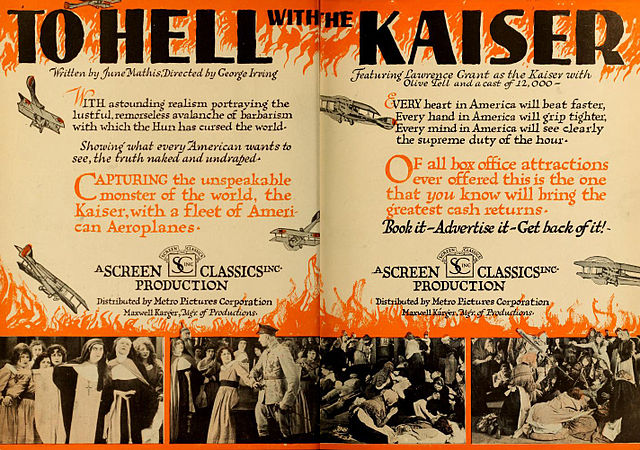
Following the death of his father, Frederick III of Germany, Wilhelm Hohenzollern becomes the German Kaiser and forms a pact with the devil that, he will conquer the globe in exchange for his soul. During the Kaiser’s invasion of Belgium, the Crown Prince enters a church and rapes Ruth Monroe, the daughter of an American inventor who has perfected a noiseless communications device. When the professor denounces the Crown Prince, he immediately is shot, whereupon his other daughter Alice vows to obtain revenge. While Alice’s sweetheart, Winslow Dodge, fights with the Americans as an aviator, she arranges to meet the Crown Prince through her friend Robert Graubel, an actor who impersonates the Kaiser at public functions. With her father’s wireless [device], Alice informs Winslow of the Kaiser’s whereabouts and, as he captures the German emperor, she kills the Crown Prince. Now a prisoner, the Kaiser drowns himself and wakes up in Hell, where Satan abdicates in his favor, saying that the Kaiser’s tortures are more fiendish than any he ever devised.
Lawrence Grant, who spent his lengthy career playing odious villains, appeared in the dual role of Kaiser Wilhelm II and his look-alike, German actor Robert Graubel. Terrified of being assassinated, the Kaiser hires Graubel to impersonate him at various political functions. In the film, the Kaiser achieves military success through an infernal pact with Satan. Once this is established, the film concentrates on the seemingly endless tally of misdeeds perpetrated by the Kaiser during his quarter-century reign over Germany. His “partner in crime” is the Crown Prince […], who thinks nothing of casually raping convent girls and gunning down protesting nuns. The Crown Prince’s latest conquest is Ruth Monroe […], the daughter of an American inventor. When Ruth’s father protests this outrage, he is brutally murdered, whereupon Ruth’s sister Alice […] vows revenge. Using her father’s newest invention, a wireless machine whose coded messages cannot be intercepted, Alice directs a battalion of planes to bomb the small German village where the Kaiser is hiding. Captured by the Allies, the Kaiser is ignominiously dumped in a POW camp but, not before enduring a well-aimed sock on the jaw from a pugnacious dough-boy. In despair, the Kaiser commits suicide and sends his soul to hell. In hell, the devil […] gives up his throne, confessing that the Kaiser is far more sinister than he could ever hope to be.
[On June 8, 1918], Motography ran a Screen Classics press release explaining that To Hell With The Kaiser “reveals the machinations of Europe’s military monster before and during the war, his contempt for Americans […], his elaborate plans to crush France, […] destroy Russia, […] partition the world, […] his [order] to employ deadly gases in the war, the true circumstances under which he ordered the sinking of the Lusitania, the raiding of hospitals […].” Years before the war, Mr. Grant’s physical likeness to the German ruler was noted by a high official of the Kaiser’s court and a proposition was made for Grant to play the Kaiser in a dramatization […]. The war broke out before discussions went any further.
Actor John Sunderland, playing American pilot Winslow Dodge, was himself “an aviator who has seen service in Belgium.”
[It] had been released in the press that Kaiser Wilhelm II had half a dozen doubles who were employed to pose for him in various parts of the country, where there might be danger of assassination, while the real Kaiser, himself, remained safe behind this cloak.
To Hell With The Kaiser opened in New York City at the Broadway Theatre on June 30, 1918, immediately after it had emerged from the cutting and editing rooms […].
The film turned out to be an effective propaganda tool […]. Not only has the picture been shown in munitions plants and training camps […] but, this power has now been demonstrated in a new way…to convert conscientious objectors.
The National Film Preservation Board (NFPB) included this film on its list of Lost U.S. Silent Feature Films as of February 2021.
I found the building of this post fascinating. What started out as a simple movie post, turned into a history lesson. It’s a shame that it is lost. There are photographs of still pictures on IMDb. ~Vic
A runaway bull, that was spotted running down Main Street in Kutztown (Pennsylvania), prompted the Kutztown UniversityPolice Department to issue an aggressive cow alert after the animal made its way onto campus, Sunday night. The bovine appeared scared because it was unfamiliar with its surroundings, police said in the alert that went out via its emergency notification system, about 7:15p. It advised recipients to avoid the North Campus and to not approach the bull, if encountered.
About 30 minutes later, campus police sent an update saying the animal’s owner, from the Fleetwood area, was on his way to retrieve the runaway. A third update, sent about 8:45p, indicated the threat to the campus community had ended but, the bull was, reportedly, still on the loose, last seen in Fleetwood. A video taken by Aaron Merkel and, shared to YouTube, showed the bovine as it trotted down Main Street in Kutztown, trailed by a police car. It could not be verified Monday morning with Fleetwood Police whether there were any livestock sightings in the borough and whether the bull was back in its owner’s possession.
The bovine’s owner was contacted but, the cow left the scene before it could be captured. University spokesman Matt Santos said the cow made a second visit to campus on Tuesday night. He said police caught up with the animal near Lytle Hall but, it fled into the nearby woods before it could be wrangled.
When Irish Eyes Are Smiling is a lighthearted song in tribute to Ireland and was very popular in June 1913. Its lyrics were written by Chauncey Olcott and George Graff, Jr., set to music composed by Ernest Ball, for Olcott’s production of The Isle O’ Dreams and, Olcott sang the song in the show. It was first published in 1912, at a time when songs in tribute to a romanticised Ireland were very numerous […], both in Britain and the United States. During the First World War, the famous tenor John McCormack recorded the song.
The song continued to be a familiar standard for generations. Decades later, it was used as the opening song on the radio show Duffy’s Tavern. The song has been recorded on over 200 singles and albums, by many famous singers, including Bing Crosby, Connie Francis and Roger Whittaker.
Wikipedia Summary
As I have stated in previous posts, Billboard’s charting abilities, in the early 20th Century, is difficult to navigate. My first stop, for these early pieces, is the Tsort site. Playback FM is very helpful, too. Digging around in the Wayback Machine can be a complete rat maze. The data is there but, how much time do you devote to searching for it.
There was a Shamrock Summit in March 1985, apparently, in Canada (which I don’t remember). Starting on St. Patrick’s Day, Prime Minister Brian Mulroney and President Ronald Reagan met & talked for two days. Remember the Acid Rain Scare back then? It was seen as a Turning Point in U.S.-Canada Relations (both Trudeaus don’t play well with others?) and the closing ceremonies were televised, with the men & their wives singing the song (Mulroney & Reagan are Irish surnames). I find the meeting in Quebec City and the singing of an Irish song, ironic and amusing. ~ Vic
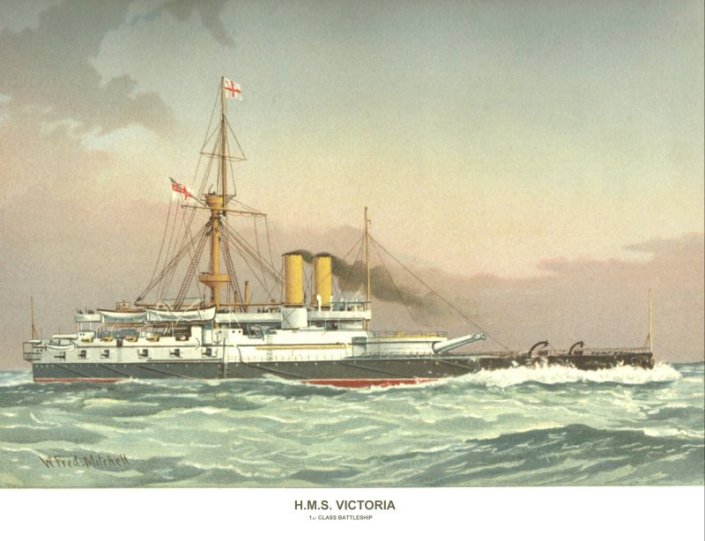
Victoria was constructed at a time of innovation and rapid development in ship design. Her name was originally to be Renown but, this was changed to Victoria while still under construction to celebrate Queen Victoria‘s Golden Jubilee, which took place the year the ship was launched. Her arrival was accompanied by considerable publicity. She was the largest, fastest and most powerful ironclad afloat, with the heaviest guns. Despite the ship’s many impressive features, compromises in the design meant that she proved less than successful in service.
Scale Model As Launched In Elswick 1887
Discovery Museum
Newcastle-Upon-Tyne
Image Credit: Hammersfan
May 18, 2015
A detailed model of the ship was exhibited at the Royal Navy exhibition in 1892 and another in silver was given to Queen Victoria by the officers of the Royal Navy and Royal Marines as a Jubilee gift.
The ship was nicknamed The Slipper (or when with her sister ship, [the] HMS Sans Pareil […] The Pair of Slippers) because of a tendency for her low fore-deck to disappear from view, in even slight seas, especially as a result of the low forward deck and raised aft superstructure…the two ships [had a] humorously perceived resemblance to the indoor footwear.
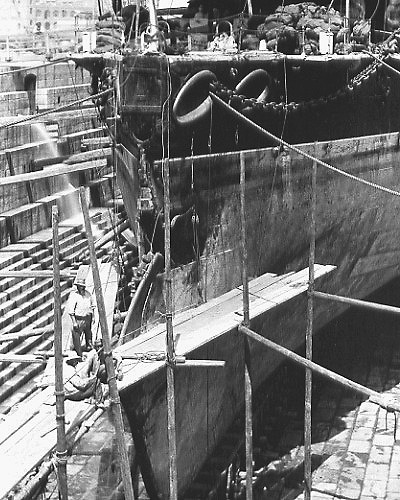
HMS Camperdown’s Bow Damage
Source: Royal Navy
1893
Image Credit: Wikimedia
The officer in command, Vice Admiral Sir George Tryon, was a fearsome martinet with a reputation as a master of complicated ship handling. He had an elaborate plan for bringing his fleet to anchor, providing onlookers a spectacle of precision maneuvering. [Ten] battleships of the Mediterranean fleet were drawn up in two parallel columns, 1200 yards apart, heading directly away from port out to sea. Tryon then ordered a crash 180-degree turn in succession. The intention, apparently, was for each pair of ships…in order…to turn inwards and create a breathtaking view of the ships’ wakes fanning out, while the ships came about, only 400 yards from each other, [then proceeding] in the opposite direction from their original course, heading towards the land. Then, the ships were to turn 90 degrees to form one column and anchor in unison.
[The] Victoria capsized just 13 minutes after the collision, rotating to starboard with a terrible crash, as her boats and anything, free fell to the side and, as water, entering the funnels, caused explosions when it reached the boilers. With her keel uppermost, she slipped down into the water, bow first, propellers still rotating and threatening anyone near them. Most of the crew managed to abandon ship, although those in the engine room never received orders to leave their posts and were drowned. Those who escaped had to contend with the suction from the sinking ship. A circular wave spread out from it which repeatedly drew down those in the water. All manner of items broke loose from the ship as it sank and came shooting up among the men. Onlookers watched as the number of live men in the water steadily reduced.
[On August 22, 2004], the wreck of the Victoria was discovered by Lebanese-Austrian diver Christian Francis, aided by British diver Mark Ellyatt. She was found in [460 feet] of water off the coast near Tripoli […] and was located using sonar. The most amazing aspect of the wreck is that, unlike all others, she sits vertically with about two thirds of her above the sea bed. The upright position is assumed to have been caused by the huge weight of her fore guns, which would have dragged her down, bow first. The wreck has already been declared a war grave and an exclusion zone has been imposed around her, while the English and Lebanese authorities determine her legal status.
Returning to my Samsung playlist…submitted for your approval. ~Vic
“My love is strong enough to last when things are rough, It’s magic…”
I have loved ABBA since their music showed up on the radio. Their first album in 1973 didn’t make it to the US. They finally got noticed, here, with their second album in 1974. I clearly remember hearing Waterloo during the summer after second grade (I was seven). I was permanently hooked. I still love them and I am in my middle 50s.
English duo Erasure did a version of the song, released in June of 1992. It was the third track on their album Abba-esque. I am not fond of the remake but, I am including two videos, below.
I was also lucky to come across an actual live version of them singing this on a 1978 Olivia Newton-John television special. Most “live” videos are them lip-synching.
Sixty years, ago, today, the British TV Series Wisden Trophy debuted.
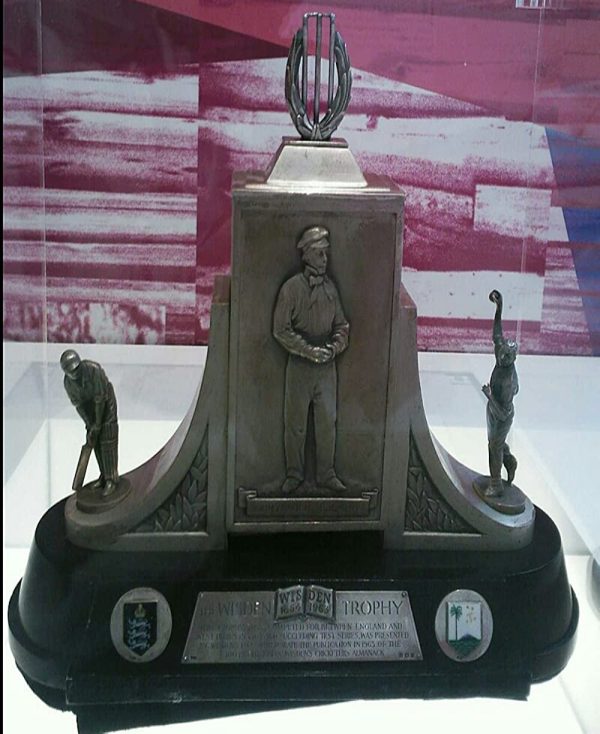
The trophy is named after the famous cricketing publisher Wisden and was presented by John Wisden & Co. after gaining the approval of the Marylebone Cricket Club (MCC) and the West Indies Cricket Board (WICB). The [trophy] was presented to the victorious team as a symbol of its victory but, then, returned to the MCC Museum at Lord’s.
The [trophy was] awarded to the winner of the Test cricket series, played between England and the West Indies. It was first awarded in 1963 to commemorate the hundredth edition of Wisden Cricketers’ Almanack. Series were played in accordance with the future tours programme, with varying lengths of time between tours. If a series was drawn, then, the country holding the [trophy] retained it. In 2020, it was announced that the trophy would be replaced by the Richards–Botham Trophy, named after Sir Vivian Richards and Sir Ian Botham.
Virtuous Mabel rejects the improper advances of a villainous cad. The furious villain, and his henchmen, then seize Mabel and chain her to a railroad track. Mabel’s anxious boyfriend turns for help to the great Barney Oldfield, who jumps in his racing car and speeds to the rescue.
IMDb Storyline
A lady, Mabel Sweet and Lovely, is courted by a gentleman, A Bashful Suitor. He offers her a corsage, which she accepts. They coyly share a kiss. After the Suitor leaves, the Villain appears and grabs the lady. She hits him and escapes. This angers the Villain and he vows to get his way. At the next opportunity, the Villain, once again, kidnaps the lady, this time with the help of two henchmen and chains her to the railway tracks.
The three villains travel by handcar to the station, where they assault two workers and steal a locomotive engine. The villains drive the train back towards the location of Mabel, who is still tied to the tracks. The railyard worker alerts the Suitor about the situation, who then rushes to ask his friend, racecar driver, Barney Oldfield for help.
The two friends jump in the automobile and race the speeding hi-jacked locomotive to rescue the damsel in distress. Mabel is dramatically saved at the last moment and is carried away to safety. The foiled villain kills his accomplice and shoots five Keystone Cops arriving by handcar to arrest him. Finally, he turns the gun on himself but, upon discovering the bullet chamber empty, he drops dead in a rage.
It was one of a series of moon-related Tin Pan Alley songs of the era. The song was debuted by Bayes and Norworth in the Ziegfeld Follies of 1908 to great acclaim. It became a pop standard and, continues to be performed and recorded in the 21st Century. During the vaudeville era, songs were often sold outright and the purchaser would be credited as the songwriter. John Kenrick credits the song’s writers as Edward Madden and Gus Edwards. However, David Ewen credits Dave Stamper, who contributed songs to 21 editions of the Ziegfeld Follies and was Bayes’ pianist from 1903 to 1908. Vaudeville comic Eddie Cantor also credited Stamper.
The song has had a long history with Hollywood movies. In 1932, animation great Dave Fleischer directed a short titled Shine On Harvest Moon. A 1938 Roy Rogers western was named after the song, as was a 1944 biographical film about Bayes and Norworth. The song has been featured in dozens of movies from 1933 to 1978. There was also a popular British 1980s comedy drama called Shine on Harvey Moon.
Wikipedia Summary Excerpts
I am not entirely sure why this Jones & Murray piece is listed as 1909, as Tsort lists it as 1908. There must be some lost data, somewhere. ~Vic
John Lennon bought a 1964 Mulliner Park WardPhantom V, finished in [Valentine Black]. Everything was black except for the radiator, even the wheels. Lennon asked for the radiator to be black as well but, Rolls-Royce refused. Originally, the car was customised from Park Ward with black leather upholstery, cocktail cabinet with fine-wood trim, writing table, reading lamps, a seven-piece his-and-hers black-hide luggage set and a Perdio portable television. A refrigeration system was put in the boot and it was one of the first cars in England to have tinted windows. In December 1965, Lennon made a seven-page list of changes […].
“You swine! How dare you do that to a Rolls-Royce!”…so screamed an outraged Englishwoman as John Lennon’s Phantom V cruised past on London’s posh Piccadilly promenade in the Summer of 1967. The ornately decorated limousine, sprayed an electric yellow and bedecked with colorful floral tendrils, Romany scrolls and, zodiac symbols like a hallucinatory gypsy caravan, so offended her sensibilities that she briefly attacked it with an umbrella…or, at least, that’s the way Lennon always told the story.
Much as the length of the Beatles’ mop-tops had done, Lennon’s choice to express himself through his automobile triggered a generational clash, enraging those who felt the tripped-out paintjob had subverted a British icon.
In the 50 years since it outraged the Establishment, Lennon’s Rolls-Royce Phantom V is now embraced as a masterpiece of design and a jewel of the Swinging Sixties.
For all of the paperwork accumulated during the car’s construction, the total price of the vehicle is not recorded. [With] publicity at a premium and Lennon being one of the most famous people on the planet, odds are good that he received some sort of Beatle discount. Ironic considering the significant expenditure, Lennon was unable to drive when he first ordered the Phantom V. He wouldn’t pass his “L-Test” until February 15th, 1965 at age 24, becoming the last Beatle to do so. That same day, the Beatles began work on a new song, Ticket to Ride, a prophetic title considering the number of citations Lennon eventually racked up during his road hours. By all accounts, including his own, he was a horrendous driver, far too myopic to read signs, too distracted to recall routes and too impractical to troubleshoot even the simplest mechanical issue.
Exactly how Lennon decided on the lurid Romany floral/zodiac hybrid is subject to some debate. [Les] Anthony recalls Ringo Starr planting the seed of the idea during a drive in early 1967. However, others say the idea was suggested by Marijke Koger, of the Dutch design collective The Fool, who would also paint Lennon’s piano that summer, after Lennon commissioned a refurbished 1874 gypsy caravan as a present for his young son, Julian.
After spraying the body of the car yellow, local artist Steve Weaver was tasked with painting the red, orange, green & blue art nouveau swirls, floral side panels and Lennon’s astrological symbol, Libra, on the roof. On May 24th, Weaver submitted an invoice for 290 pounds and, the following day [May 25], the car was ready for pickup.
“John Lennon chose an automotive piece as his canvas, using all the symbols of wealth and other messages that go along with the Rolls-Royces of that period. He was certainly getting fed up with conforming at that time. It was a classic artistic statement.”
Reactions were mixed, depending on which side of the generation gap you happened to stand. The Daily Mail reported that the shrieking yellow vehicle elicited jeers from the assembled crowd and Beatles Book Monthly [July 1967] claimed that a local traffic official feared the loud colors would be a dangerous distraction to drivers on the road. Delivered days before the Sgt. Pepper’s Lonely Hearts Club Band was issued, its official maiden voyage took place on May 28th, leading a fleet of friends to Epstein’s new country home for a combined album release party and housewarming.
On May 17, 1673, Louis Jolliet and Jacques Marquette departed from St. Ignace, Michigan, with two canoes and five other voyageurs of French-Indian ancestry. The group sailed to Green Bay. They paddled upstream (southward) on the Fox River to the site now known as Portage, Wisconsin. There, they portaged a distance of slightly less than two miles through marsh and oak forest to the Wisconsin River. Europeans eventually built a trading post at that shortest convenient portage between the Great Lakes and Mississippi River basins. On June 17, the canoeists ventured onto the Mississippi River near present-day Prairie du Chien, Wisconsin.
The Jolliet-Marquette expedition paddled along the west bank of the Mississippi until mid-July. When they passed the mouth of the Arkansas River, they became satisfied that they had established that the Mississippi flowed into the Gulf of Mexico.
The voyageurs then followed the Mississippi back to the mouth of the Illinois River, which friendly natives told them was a shorter route back to the Great Lakes. Following the Illinois river upstream, they turned up its tributary, the Des Plaines River near modern-day Joliet, Illinois. They continued up the Des Plaines River and portaged their canoes, and gear, at the Chicago Portage. They followed the Chicago River downstream until they reached Lake Michigan near the location of modern-day Chicago. Father Marquette stayed at the mission of St. Francis Xavier at the southern end of Green Bay, which they reached in August. Jolliet returned to Quebec to relate the news of their discoveries. On his way through the Lachine Rapids, Jolliet’s canoe overturned and his records were lost. His brief narrative, written from memory, is in essential agreement with Marquette’s, the chief account of the journey.
While Hernando de Soto was the first European to make official note of the Mississippi River by discovering its southern entrance in 1541, Jolliet and Marquette were the first to locate its upper reaches and, travel most of its length, about 130 years later. De Soto had named the river Rio del Espiritu Santo but, tribes along its length called it “Mississippi”, meaning “Great River” in the Algonquian languages.








 Cosmic-Observation