Month: July 2021
POTD: Hydrangea
Hydrangea Quercifolia, Oakleaf Hydrangea or Oak-Leaved Hydrangea. ~Vic

Picture of the Day
Chris Thomas: Chemtrails
A Forum Blog Post From: The Chris Thomas Files

At the end of 2009, the British government very reluctantly acknowledged that they were chemically seeding the atmosphere “as a means of combating global warming” (see later).
However, the dumping of chemicals into the atmosphere goes back many years. For more details of this and the underlying reasons, see my book, written with Dave Morgan, called Project Human Extinction (sadly, out of print) which has chapters and appendices detailing the use of chemicals and biological agents either as weapons testing or population control. Also see numerous articles on the internet which detail the kinds of chemicals that are being dumped into our atmosphere by both military and civilian aircraft.
The first use of air-borne biological agents was by the Japanese in 1941 and 1942 when they sprayed the Chinese mainland with bubonic plague from aircraft. This spraying from aircraft was noted by the American Military who began their own testing programmes on their own populations. In 1949, the US Army began a 20 year programme of simulated germ warfare attacks against American cities, conducting at least 293 open air tests. These are the first known use of “chemtrails”.
The effect of the chemicals was studied by the vivisection of farm animals, most notably cattle and, this is the actual reason for the animal mutilations which have been blamed on UFOs. They are nothing to do with UFOs, with the military involvement being confirmed by a secret FBI investigation published under the Freedom of Information Act a few years ago.
Added to this biological weapons use is the deliberate destruction of the bee population. Bees are the planet’s primary pollinators but, are not needed for Genetically Modified crops. Therefore, as far as the GM companies are concerned, if there are no bees, no crops will grow and people will turn to GM to feed themselves. I have a personal experience of this, in that, in September 2009, I woke up to find the sky over my house had a grid pattern of chemtrails. In that September, there had been a glut of fruit and an extremely high wasp and bee population. Three days after the grid pattern chemtrails, there was not a bee or a wasp to be seen. Nexus magazine published a letter of mine at the time of this incident which produced a crop of letters from others confirming similar experiences. A similar letter was published in Nexus in October of last year (2010) written by someone in Yorkshire giving exactly the same story…a grid pattern of chemtrails with a noticeable death of bees.
The problem does not only relate to bees. [A]ll insects have been affected and this is one of the major reasons for the decline in bird numbers as there are not enough insects for them to eat. There’s a simple way of checking this. Twenty years ago, if you drove anywhere rural at night, you had to wash the windscreen, headlamps and radiator grille of the car to clear off all of the dead bugs. [T]his is no longer necessary as there are no longer enough insects to cause this problem.

So, what is the purpose of chemtrails? There seem to be several reasons apart from the testing of biological weapons. From some of the chemical analysis reports I have read, some of the chemicals are specifically designed to reduce soil fertility. In other words, to destroy the production of food crops. Again, this seems to tie in with the wants of the GM companies.
However, there is also the question of population control. In 1992, The United Nations Conference on Environment and Development Earth Summit took place in Rio de Janeiro. Out of this summit came the Biodiversity Treaty and Agenda 21. The stated aim of these agendas is to reduce the world’s human population to “a sustainable 500,000,000” (five hundred million…see The Georgia Guidestones). Given that the official world population figure puts the global human population as around 6,500,000,000 (six billion, five hundred million) it means that the global population must be reduced by six billion people by the year 2050, the date given at the summit, that is 350,000 people per day or 128 million per year.
The way in which chemtrails work in respect to the Rio Summit is to make people susceptible to illness. The chemicals sprayed are designed to give people the “first half” of an illness. [F]or example, some of the chemtrails have contained chemicals which affected the lungs. This lung weakness then made the body more receptive to illnesses such as Bird Flue, Avian Flue (different strain to bird flue) and Swine Flue. The “second half” of these illnesses would be given either by further chemtrails or by annual flue vaccinations (or Covid?).
To return to climate control…
We have had steadily climbing global temperatures since 1850. [T]his is an undisputed fact. However, the reason for this temperature rise is not anthropogenic (man-made). Despite Al Gore’s infamous hockey stick graph (which has been legally proven a fake…Al Gore “averaged out” the actual figures to give a deliberately misleading graph) which most people have assumed to show actual climate change, the truth is (from official and Met Office figures) that, when temperatures began to rise in about 1800, the cause of the rise was due to increased sun activity.
Between the years of about 1450 and 1850, the average global temperature was below freezing. In 1850, the temperature began to rise above freezing and continued climbing until 2000 where temperatures stopped rising. Since 2000, global temperatures have actually dropped slightly, by only about 0.1 of a degree, so, we do not have “runaway global warming” caused by human production of carbon dioxide. [W]hat we do have is an increase in Sun activity since the early 1800s and this increased Sun activity stopped in 2000 where the Sun entered a period known as a Maunder Minimum (see my book Synthesis for more detail on this…still in print). The Friends of the Earth produced their own figures for annual carbon dioxide production and found that “human activities” produce about 26 million tonnes whilst the Earth naturally produces about 980 tonnes.
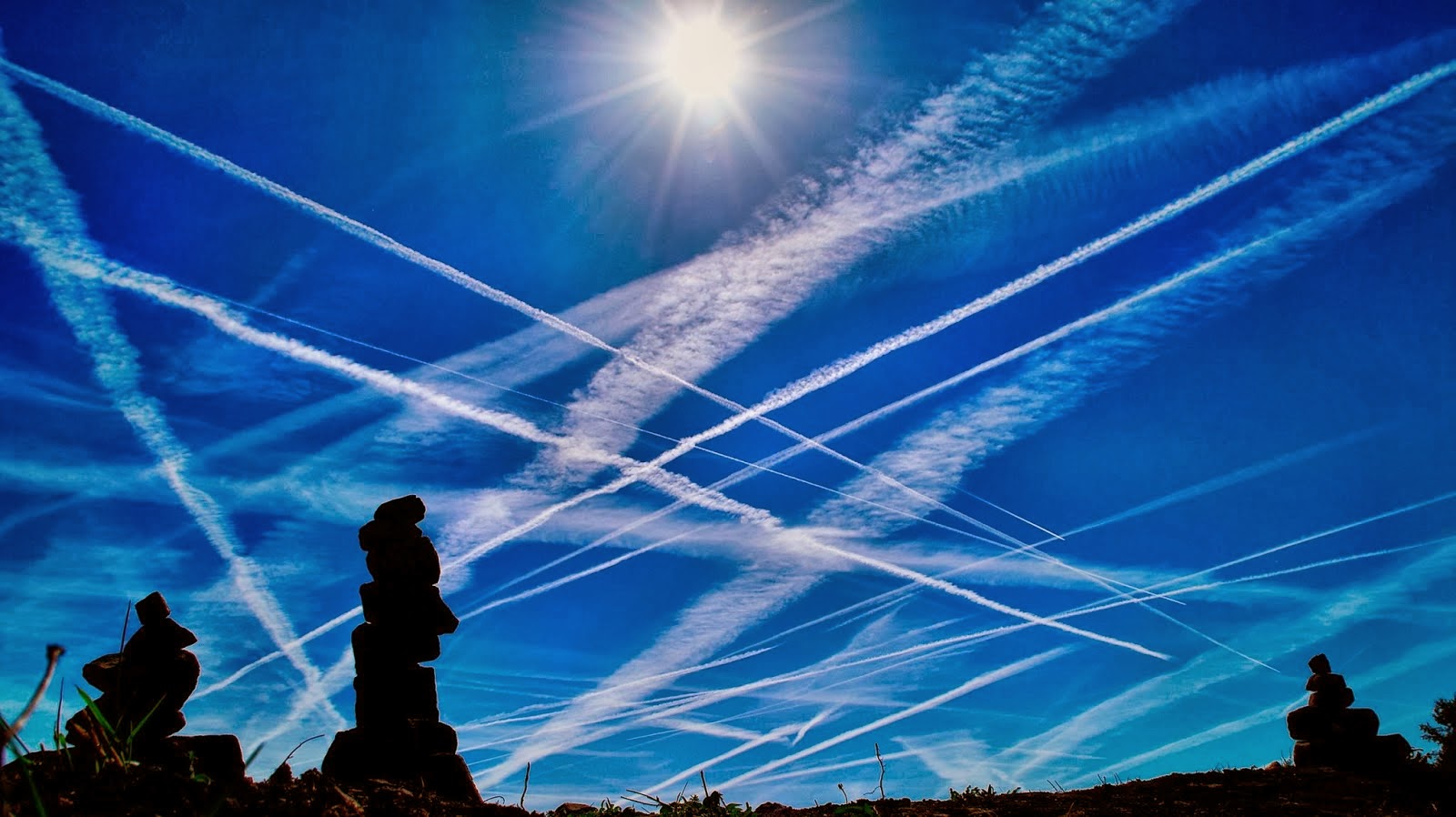
The British government has stated that they are “chemically seeding” the atmosphere to combat global warming. The main ingredient of this “seeding” is water vapour, or by another name, clouds. The argument is that by increasing cloud cover, global warming can be combated by reflecting the Sun’s heat back out into space. But, cloud cover actually causes global warming by trapping hot air close to the Earth’s surface. As an example…think of a winter’s night, the sky is clear and we have a severe frost. The following night is cloudy but, there is no frost as the cloud cover acts like a duvet and holds the heat close to the surface (see reports and studies by the likes of Professor David Bellamy for more detail on this).
So, the British government policy of cloud seeding will not combat global warming but, will, in fact, increase it. Why would they want to do this? In order to make us believe that global warming is happening and that all of the other ludicrous policies that go with their strategies are necessary and to keep us in a state of fear[?] [A] population living in fear is easily manipulated, their health suffers and the process of consciousness reintegration is slowed, if not stopped.
In summary: The reason for chemtrails is population control and population reduction as well as promoting GM crops. In addition to the use of chemtrails, there is the fluoridation of drinking water. This is not natural Calcium Fluoride, as most believe, but, chemically produced Sodium Fluoride (Hexafluorosilicic Acid), a known carcinogen and the cause of many other health problems. It is more toxic than lead. The increased uses of pharmaceutical drugs […] are known to be harmful. The British Medical Association states that in Britain, 250,000 people per year are hospitalised by drug reactions of which 10,000 die every year. The American Medical Association states that in America 136,000 people die each year directly from adverse effects of prescribed drugs. The AMA also states, in its 5 year study published in 2008, that medical treatment (of all kinds) is responsible for killing two and three quarter million people per year in America alone. [T]he global death rate is probably in the region of 10 million at least. This is a long way from the Hippocratic Oath…“First, do no harm!”
© Chris Thomas 2011
[Original Posting/Mount Zion 144 Ning Forum Blog Post 2011/Defunct]
Download the PDF & Share
See Also:
Documents Prove Chemtrails (USA Watchdog/Greg Hunter/10-25-2015)
Geoengineering Watch
POTD: Thunder Moon 2021
Also known as the Buck Moon or Hay Moon, I grabbed this shot around 9:00pm. Full illumination occurred on the 23rd at 10:37pm. Here is my previous post. ~Vic

07-22-2021
Picture of the Day
Funny Friday: Cat Humor
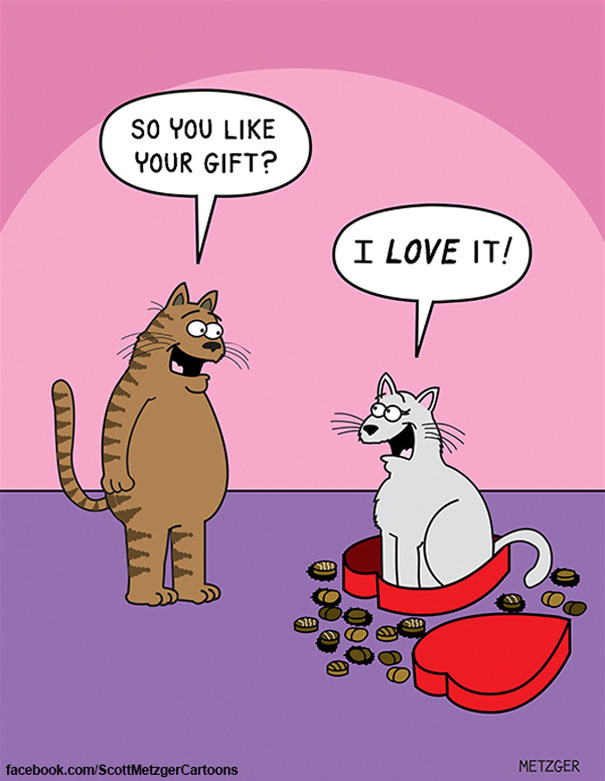
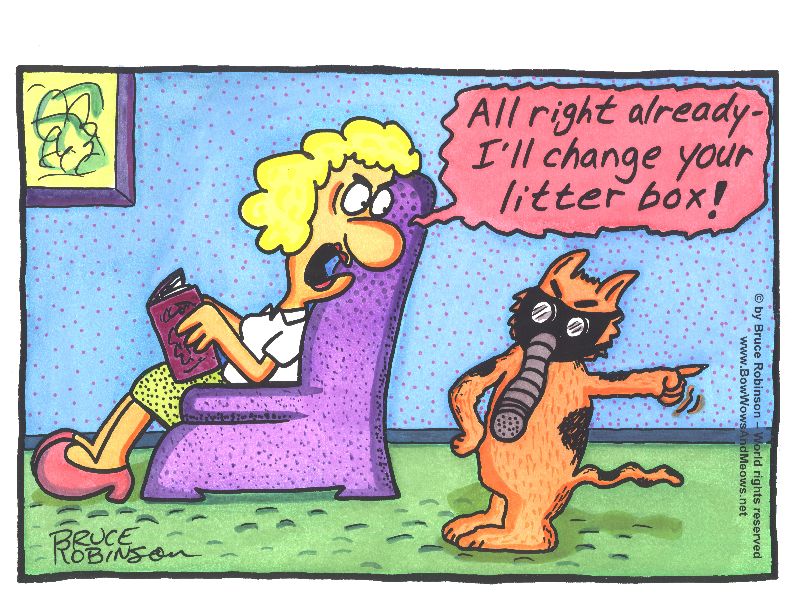
Yes, I have a cat… He’s orange and has thumbs. ~Vic

Hans 2021 Song Draft: Round Two-Pick Two-Cathy’s Clown-Everly Brothers (1960)

Hanspostcard has a song draft challenge. This is my Round Two pick.
I grew up around lots of music. My dad had his tastes, my mom had hers and I got some exposure to my grandparents music, too. There was plenty of Elvis, Buddy Holly, Everly Brothers, Ricky Nelson, Gene Pitney, Chuck Berry, Johnny Cash, Johnny Horton, The Ventures, The Beach Boys, instrumental music (think Hugo Montenegro or Paul Mauriat), funny stuff like Ben Colder/Sheb Wooley, Ray Stevens or David Seville (my dad’s stuff), The Four Seasons, Motown, soul music, beach music (my mom’s stuff), big band music (my paternal grandparents) and, bluegrass, country and Latin/jazz (maternal grandparents). One song, in particular, that reminds me of my dad the most is Cathy’s Clown. When I was a kid, my dad liked to just get in the car, drive around and listen to the radio. It was, literally, No Particular Place To Go. When I became an adult, we’d still get in the car and cruise. He and I would sing Cathy’s Clown, together, with me taking Phil’s harmony. I still own my dad’s original 45. ~Vic
Written by Don, it was recorded in March and released in April 1960. It was recorded live, in a single take, with both brothers sharing a microphone. Floyd Cramer was on piano, Floyd Chance on bass and Buddy Harman on drums. An odd song, it has a chorus and bridges but, no verses. It was their first single for Warner Bros. It spent five weeks at #1 on Billboard’s Hot 100 chart, one week on the Billboard’s R&B chart and seven weeks at #1 on UK’s Singles chart. It was their biggest selling single and their last #1 after Wake Up Little Susie and All I Have to Do Is Dream.
The song is ranked at #150 Rolling Stone’s 500 Greatest Songs of All Time and it was added to the National Recording Registry of the Library of Congress in 2013. Covers have been done by Reba McEntire and Neil Sedaka (1983) with McEntire’s version reaching #1 on Billboard’s Hot Country Songs chart and Canada’s RPM Country Tracks chart in 1989. There is even a Jan and Dean version on Filet Of Soul Redux: The Rejected Master Recordings (2017).
“We owe those guys everything. They started it all.” ~Bob Dylan
Additional Reading & References:
The Everly Brothers: That Sibling Sound (BBC News/2014)
Cathy’s Clown ~ The Everly Brothers (Library of Congress/PDF)
Recording Cathy’s Clown (Steve Hoffman Music Forum)
Saturday Night Beech-Nut Show 1960
Music Monday: Wachet! Betet! Betet! Wachet! 1716

Collection: Bach-Archiv_Leipzig
Source: Dave’s J. S. Bach Page
Photographer: David J. Grossman
Johann Sebastian Bach was a German composer and organist. The most important member of the Bach family, his genius combined outstanding performing musicianship with supreme creative powers in which forceful and original inventiveness, technical mastery and intellectual control, are perfectly balanced. While it was in the former capacity, as a keyboard virtuoso, that in his lifetime he acquired an almost legendary fame, it is the latter virtues and accomplishments, as a composer, that, by the end of the 18th century, earned him a unique historical position. His musical language was distinctive and extraordinarily varied, drawing together and surmounting the techniques, the styles and the general achievements, of his own and earlier generations, and leading on to new perspectives, which later ages have received, and understood, in a great variety of ways.
Wachet! Betet! Betet! Wachet! (Watch! Pray! Pray! Watch!) is the title of two church cantatas by Johann Sebastian Bach. He composed a first version, BWV 70a, in Weimar for the second Sunday in Advent of 1716 and expanded it in 1723 in Leipzig to BWV 70, a cantata in two parts for the 26th Sunday after Trinity.
On [March] 2, 1714, Bach was appointed concertmaster of the Weimar court capelle of the co-reigning dukes Wilhelm Ernst and Ernst August of Saxe-Weimar. As concertmaster, he assumed the principal responsibility for composing new works, specifically cantatas for the Schlosskirche (palace church), on a monthly schedule. Bach originally wrote this cantata in his last year there […].
The instrumentation of the Weimar cantata is lost.
Bach first performed the cantata on [December] 6, 1716.
Wikipedia Summaries
Additional Reading:
Bach Cantata Translations (Emmanuel Music Organization Website)
Chapter 28 BWV 70 (The Cantatas of Johann Sebastian Bach by Julian Mincham)
Bach-Collegium Stuttgart
Gächinger Kantorei Choir
Helmuth Rilling
Dvořák Hall Prague
Monteverdi Choir
John Eliot Gardiner
POTD: Fire Department
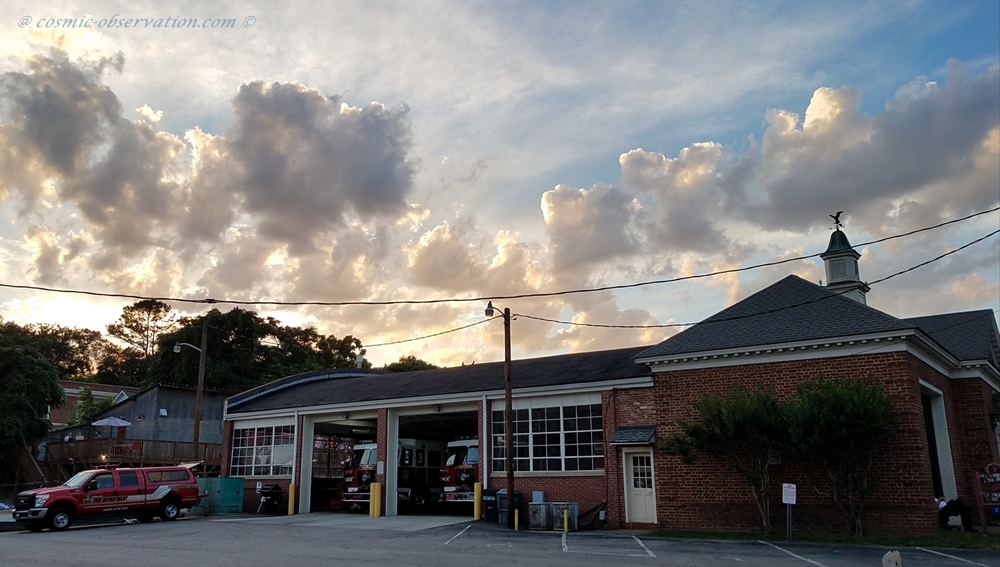
Our little town’s Fire Department, captured with cool cloud formations. ~Vic
Picture of the Day
Throwback Thursday: John Ball & The Peasants’ Revolt 1381

Image Credit: British Library
Wikipedia & Wikimedia
John Ball was an English priest who took a prominent part in the Peasants’ Revolt of 1381. Ball […] actively [preached] “articles contrary to the faith of the church” […]. Ball trained as a priest in York and referred to himself […] as “Seynte Marie priest of York”. [During his time], England was exhausted by death on a massive scale and crippling taxes. The Black Death was followed by years of war, which had to be paid for. The population was nearly halved by disease, and overworked, and onerous flat-rate poll taxes were imposed.
Ball was imprisoned in Maidstone, Kent, at the time of the […] Revolt. He […] gained considerable fame as a roving preacher without a parish or any link to the established order […] and [was known] especially [for] his insistence on social equality. He delivered radical sermons in many places […]. His utterances brought him into conflict with Simon of Sudbury, Archbishop of Canterbury, and he was thrown in prison on several occasions. He also appears to have been excommunicated […] and, in 1366, it was forbidden for anyone to hear him preach. These measures, however, did not moderate his opinions, nor diminish his popularity, and he took to speaking to parishioners in churchyards after official services.
Shortly after the Peasants’ Revolt began, Ball was released by the Kentish rebels from his prison. He preached to them at Blackheath in an open-air sermon that included the following:
“When Adam delved and Eve span, Who was then the gentleman? From the beginning all men by nature were created alike, and our bondage or servitude came in by the unjust oppression of naughty men. For if God would have had any bondmen from the beginning, He would have appointed who should be bond, and who free. And therefore I exhort you to consider that now the time is come, appointed to us by God, in which ye may (if ye will) cast off the yoke of bondage, and recover liberty.”
When the rebels had dispersed, Ball was taken prisoner at Coventry, given a trial in which, unlike most, he was permitted to speak. (Six hundred, forty years ago) [he] was hanged, drawn and quartered at St Albans in the presence of King Richard II on July 15, 1381. His head was displayed stuck on a pike on London Bridge and the quarters of his body were displayed at four different towns. Ball, who was called […] “the mad priest of Kent” seems to have possessed the gift of rhyme. He voiced the feelings of a section of the discontented lower orders of society at that time, who chafed at villeinage and the lords’ rights of unpaid labour, or corvée.
Wikipedia Summary
Hmmm…it appears that we are still in bondage all these centuries later and censorship still reigns supreme from the overlords. There are a lot of parallels to today in the above. And, there are those that would like to see others cancelled (or, hanged, drawn & quartered) for refusing to be poisoned. ~Vic
POTD: Papaver Rhoeas
In the family of Papaveraceae, this is the common poppy, red poppy, field poppy, corn poppy, corn rose or the wonderful Flanders poppy. ~Vic

Picture of the Day
Snapshots Sunday: Old Car 2.0
More shots from Georgetown, Texas. Here is my previous post. ~Vic

Washington State & Michigan
Notice the toolbox?
04-09-2011

Beautiful paint job.

My friend Denise in the reflection.

Love a stick shift.

1931 Model A


Hans 2021 Song Draft: Round One-Pick Three-There Goes My Baby-Drifters (1959)

Hanspostcard has a song draft challenge. This is my Round One pick. I will be posting these per decade.
Having grown up on the East Coast/Mid-Atlantic, one thing my state is known for is shagging (for the Brits, no, that is not what it means). While my grandparents did the Jitterbug as youths, my parents shagged (a descendant of the Jitterbug), as did my classmates and I. This song, in particular, was my favorite to shag to, though I enjoyed many beach music songs. ~Vic
Released either in May (per Rolling Stone Magazine) or April 24, 1959 (per Wikipedia), it was written by Benjamin Nelson (Ben E. King), Lover Patterson and George Treadwell. Produced by Jerry Leiber and Mike Stoller, the song hit #1 on Billboard’s Hot R&B chart (July) and, #2 on Billboard’s Hot 100 (August).
This is the second version of The Drifters under Treadwell’s management, crafted from the Five Crowns: Ben E. King, Charlie Thomas, Doc Green and Elsbeary Hobbs with James “Poppa” Clark being rejected for alcohol issues. With this line-up, There Goes My Baby was their first single and King’s debut as lead singer. It was unusual for its time, being the first commercial R&B/Soul recording with strings, arranged by Stan Applebaum, and a Brazilian Baiãon groove. Phil Spector studied the production style under Leiber & Stoller.
The song is ranked at #196 on Rolling Stone’s 500 Greatest Songs of All Time. Donna Summer did a version that was released in July 1984 and peaked at #21 on Billboard’s Hot 100.
Additional:
Ben E. King and The Drifters (The Vocal Group Hall of Fame Foundation/Inducted 2000)
John Gilliland’s Pop Chronicles (The Drifters & Ritchie Valens/Track 2/University of North Texas Digital Library)
There Goes My Baby (The Art of Rock Music Listening Guide/University of Albany/PDF)
Things You Didn’t Know About The Drifters (Pop, Rock & Doo Wopp/Joe Mirrione/April 10, 2020)
Movie Monday: Portraits In Dramatic Time 2011

Ten years ago, today, the film Portraits In Dramatic Time was released. Directed by David Michalek and Paul Warner, it starred William H. Macy, Holly Hunter, Liev Schreiber, Alison Pill, Lili Taylor, Patti LuPone, Marianne Jean-Baptiste, Alan Rickman, Ludivine Sagnier & William Mapother.
[This was] a series of 40 art films created by artist David Michalek. [It was] a free, public installation that [could] be seen on the facade of the David H. Koch Theatre, between July 5-31, 2011, nightly, from 8:45pm-11:45pm, as part of the 2011 Lincoln Center Festival. Each video depicts a dramatic scene shot in just 10 seconds and played back in hyper-slow motion, extending the length to about 7 minutes. The scenes vary from solos by famous actors […]. The extreme slowness allows the viewer to witness details of movement, such as muscles [or] facial expressions, revealing the gradual progression and in-between moments of developing emotions. Veteran film and theatre director, Paul Warner served as executive creative consultant and assisted in coaching and directing the actors.
Alan Rickman Video (David Michalek Site)
Participating Artists (David Michalek Site)
Trailer
POTD: Dianthus
There are so many variations of Dianthus. Judging by Pl@ntNet, this is a D. Barbatus species or a Sweet William verson. ~Vic

Picture of the Day
 Cosmic-Observation