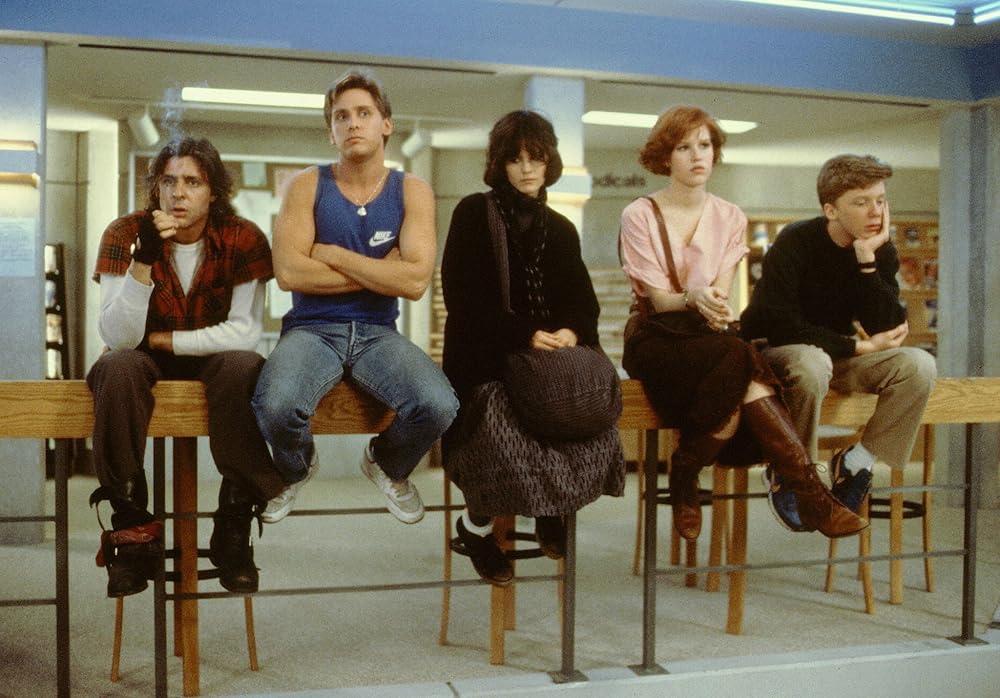
“Saturday, March 24, 1984. Shermer High School, Shermer, Illinois, 60062 (fictional town). […] You see us as you want to see us… […] You see us as a brain, an athlete, a basket case, a princess and a criminal. […] That’s the way we saw each other at 7:00 this morning. We were brainwashed.”
This is my graduating class…the class of 1984 (despite the age of some of the actors). Released February 15, 1985, I was in my freshman year of college and it was a bittersweet revisit. I knew these characters…every single one of them. My high school even had a library that resembled that set. This movie was made with only a one million budget but, brought in $51 million and, in 2016, was selected for preservation with the National Film Registry of the Library of Congress. There is no CGI or special effects. There are no sweeping views of beautiful locations. There are no “shoot-em-up-bang-bang” sequences. There is some action with the cast running through the hallways, dancing while high and Judd Nelson (John Bender/The Criminal) falling through the ceiling tiles. This is, primarily, a study of human nature, parental influence, peer influence, subtle & overt abuse and the struggle to understand. It’s heartbreaking, it’s hilarious and it is so Generation X. ~Vic
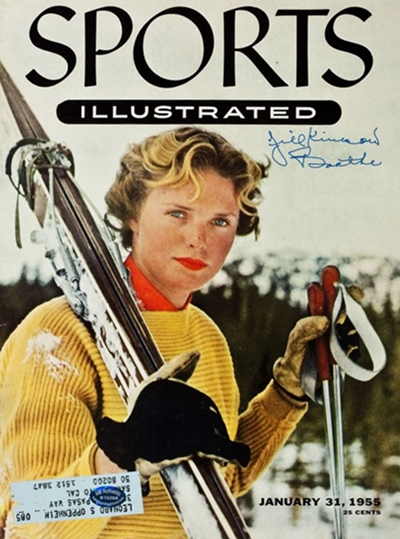
The film spans Jill’s slalom races to her national championship, her best friend’s polio contraction, her accident while attempting to win the Alta, UT, Snow Cup, her hospital stay, her slow rehabilitation, her heartbreak from the losses of two dear men and her triumph at becoming a teacher.
Released July 25, 1975, the film was panned by critics for being too much of a tear-jerker. That may be true but, she did have a really hard time. The sequel was released February 10, 1978 and was panned even worse. I saw them in reverse order. I was only nine years old when the first movie came out so, I didn’t get to see it until I was an adult. I saw Part II, first, when it was released to television. I enjoyed both films despite the bad reviews. Sometimes, bringing someone’s life story to the big screen is handled poorly. Jill passed away February 9, 2012.
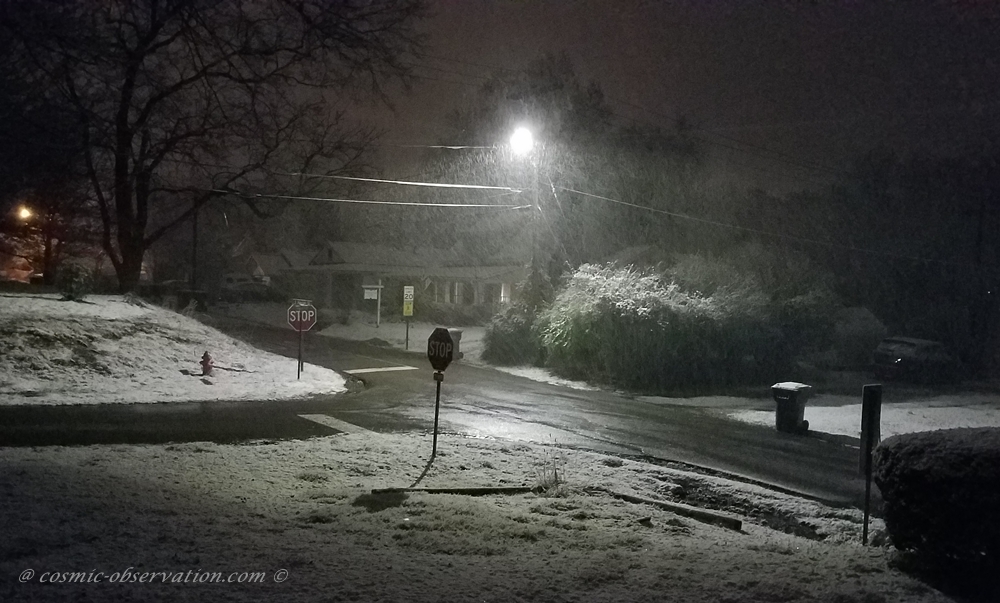
We don’t get the snow like we used to when I was a kid. I remember lots of snow and ice in the 70s. There were some decent snows in the middle 80s. There was one big snowstorm in early 1996 and that was the last one I saw until the two snow bombs in 2018. I spent nearly a decade in Texas and, I saw one small snow covering and two minor ice storms. That was it.
A little dusting on the trucks.
01-28-2021
Click for a larger view.Cold little Dogwood.
Click for a larger view.Snowy street corner.
Click for a larger view.
Some folks see a weed. I see two incredible flowers in the bright yellow blooms and the fuzzy seed ball. I also see delicious tea and tasty greens (good for the gallbladder). ~Vic
The Gunpowder Plot of 1605, […] often called the Gunpowder Treason Plot or the Jesuit Treason [in earlier centuries], was a failed assassination attempt against King James I by a group of provincial English Catholics led by Robert Catesby.
The plot was revealed to the authorities in an anonymous letter sent to William Parker, 4th Baron Monteagle, on [October] 26, 1605. During a search of the House of Lords in the evening on [November] 4, 1605, Fawkes was discovered guarding 36 barrels of gunpowder, enough to reduce the House of Lords to rubble, and [was] arrested. Most of the conspirators fled from London as they learned of the plot’s discovery, trying to enlist support along the way. Several made a stand against the pursuing Sheriff of Worcester and his men at Holbeche House […]. [In] the ensuing battle, Catesby was one of those shot and killed. At their trial on [January] 27 1606, four hundred, fifteen years ago, today, eight of the survivors, including Fawkes, were convicted and sentenced to be hanged, drawn and quartered.
The thwarting of the Gunpowder Plot was commemorated for many years afterwards by special sermons and other public events such as the ringing of church bells, which evolved into the British variant of Bonfire Night of today.
I can’t for the life of me figure out what the hell this thing is supposed to be. It appears to be iron and looks like something that would exist in Alice in Wonderland. It also reminds me of the strange plants in the Stargate episode One False Step. I’m calling it a weed…Iron Weed. ~Vic
07-21-2020
Picture of the Day
These plants grew when they were sung to in the Stargate episode.
Photo Credit: Pinterest
Change is upon us. The problem is that most of us are too busy fire-fighting our lives that we have difficulty sorting out just how we are changing. In order to understand ourselves and, our place within this change, we need to return to some of the basic truths of who and what we are. In this way, we will be better able to steer our way to the future. As humans, we are used to thinking of ourselves as physical bodies with some kind of extra bit we call a soul but, this is a false impression. What we really are is a soul that is 100 million years old and our soul has built for itself many physical bodies over the course of human history. As each of our many lifetimes has ended, we have merged with our higher soul aspect to review our successes and failures in the physical life we have just ended. With that process of review completed, we then plan our next physical life.
Everyone who is alive on Earth has undergone this process many times, with each successive lifetime planned to provide […] new experiences, as well as to re-live some of our past failures, in order that we complete the lesson our soul chose to learn. In this way, each new physical life is lived as a mixture of clearing out past failures, lessons we did not learn, as well as learning from the new experiences our next life will provide us with. Nobody directs the actions our souls take. Every action is chosen with full and free choice. It is how we, the physical body, react to our soul’s choices, as we encounter them in life, that determines how straight forwards our lives are. If we stray from our soul’s chosen path, we receive hints from our higher self in the guise of an illness. We return to our chosen path and the symptoms heal themselves.
All of the main choices we are faced with in life are chosen by our higher selves before we are re-born into our new bodies as babies. Babies and children are souls of the same age as we are, they just inhabit younger bodies until they become adults. Who our parents are, who our siblings are, the country we are born into, our way of life, our means of earning an income, who our lovers will be…all of the main aspects of our new lives are worked out before we are born.
This is something that we really have forgotten about. Everything we do in life, our way of life, our nationality, is all pre-determined BEFORE we are born. It is very easy to become distracted by the plight of those who live in other countries as we often compare their way of life with ours. If we consider that they have less than we in the west do, we become concerned. In doing this, we are making a judgement on the lives those others are living and who are we to make judgements in this way? The old Native American saying is something we really need to pay attention to: “Before you judge someone, walk a mile in their moccasins.”
This is not to say that we should not be compassionate or that we should not care. What we should be doing is finding a balance. Having spent thirty years working with people’s health problems, there have been many times where it was very tempting to step over the line and try to take on the problems my clients were having in their lives but, I had to draw back. No matter how much I might have wanted to cross that line, the reality is that, the situations that had arisen in my client’s lives were as a result of their soul’s choices and all that I could ever do was to help them understand the choices that they were faced with whilst doing everything I could to heal their ailments.
As we undergo this process of change, we become more and more aware of the plight of others and it becomes increasingly tempting to try to step in and solve their problems for them or allow the compassion we feel to distract us from sorting out our own problems. What we need to do is to find the correct balance. To give an example: The farmers in India have been under huge pressures by the [GMO] companies to only grow [GMO] crops. The Indian government, and banks, increased that pressure by insisting that bank loans to buy seeds were only granted to farmers who agreed to plant [GMO] crops. Traditional seeds (non-GMO) are 10,000 times cheaper than [GMO] seeds but, faced with bank and government pressure, Indian farmers planted [GMO] instead of traditional crops. Consistently, the [GMO] crops failed or produced much lower yields whilst at the same time requiring 300 percent more water and, huge quantities of herbicides and insecticides. Many thousands of farmers became bankrupt and committed suicide by drinking pesticides. But, by people in Europe rejecting [GMO] products, the pressure has now come off the farmers and they are able to re-plant using their traditional seeds. This is where balance lies. [By] rejecting to buy [GMO] products, we in the west have helped to save the lives of Indian farmers and improve their lives, immeasurably. This is compassion in action. We are not physically able to step in and alter the lives of these farmers, no matter how much we might want to but, by forcing the [GMO] companies to cut back on their crops, lives have been saved and livelihoods saved.
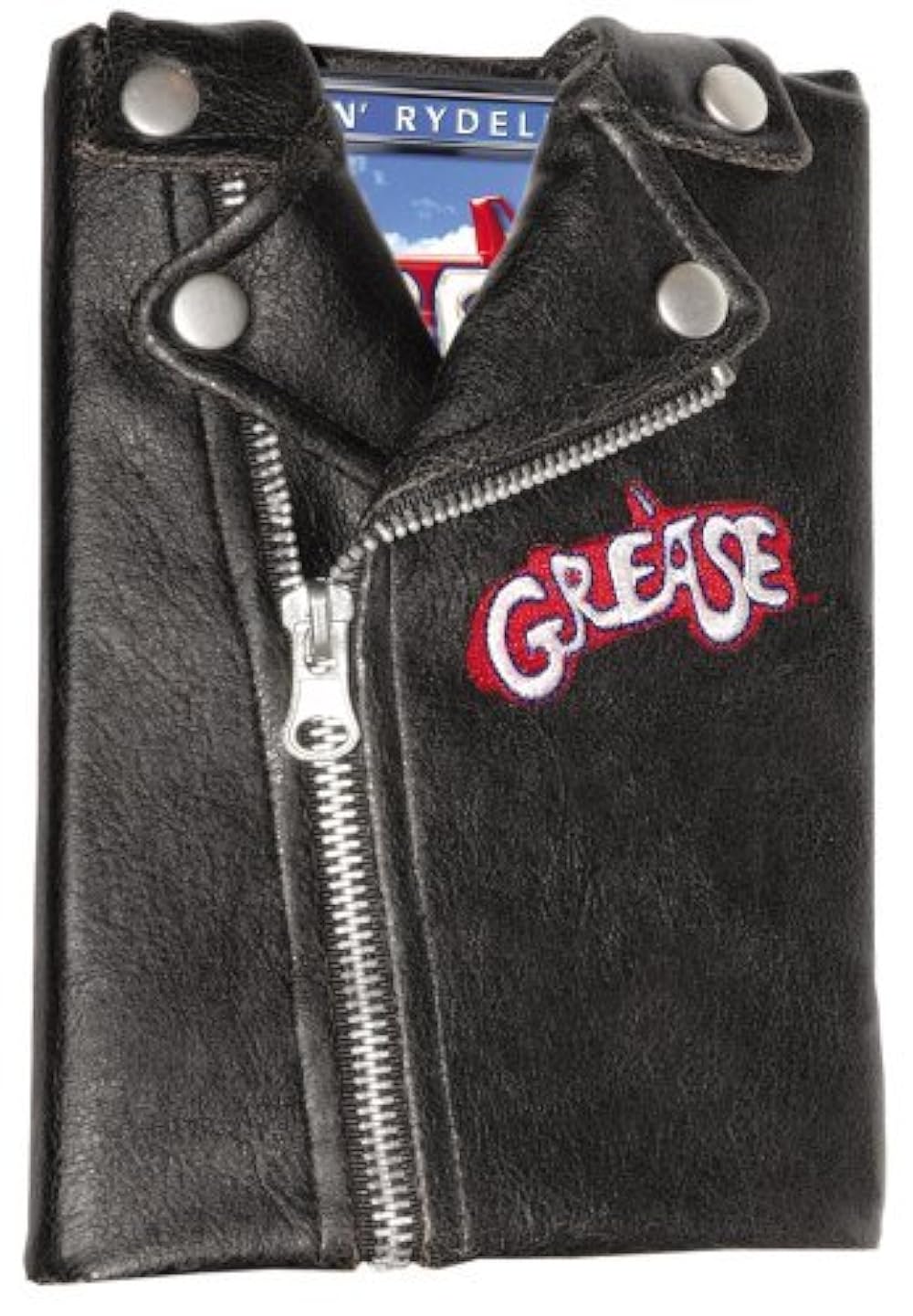
I don’t think I need to provide a trailer or to hack out a plot or synopsis on this one but, you might find the trivia interesting. I did my own post back in 2018.
I was 11 years old when it was released. I was such an Olivia Newton-John fan. I begged my mom to buy me the album soundtrack. I nearly wore it out. I still have it to this day. And, I remember those shoes. I was headed to seventh grade that year and ALL the girls had to have a pair of the Candies that Sandy made famous. Can you imagine a bunch of ‘tween girls in the late 70s trying to change classes, going up and down stairs in Sandy’s Candies? Oh, my… ~Vic
Trivia Bits:
♦ Rizzo’s hickeys were real. Stockard Channing said in an interview that Jeff Conaway insisted on applying them himself.
♦ Hopelessly Devoted to You was written and recorded after the movie had wrapped.
♦ Elvis Presley turned down the role of The Guardian Angel in the Beauty School Drop-Out scene.
♦ Due to a zipper breaking, Olivia Newton-John had to be sewn into the trousers she wears in the last sequence (the carnival at Rydell).
♦ Jeff Conaway was so infatuated with Olivia Newton-John, he was tongue-tied whenever she was around. He later married Olivia’s sister, Rona Newton-John.
♦ Danny’s blue windbreaker at the beginning of the film was intended as a nod to Rebel Without a Cause.
♦ Jamie Donnelly had prematurely grey hair, which she dyed black to play Jan. Her hair grew really quickly, so her roots had to be colored in daily with a black crayon.
♦ Rydell High is a reference to teen idol Bobby Rydell who had a million selling hit with Swingin’ School in 1960.
♦ The “blonde pineapple” line was improvised by Barry Pearl.
♦ Olivia Newton-John insisted on a screen test for the role of Sandy. She was concerned that she didn’t have the acting skills and would look too old to be a high school student. The part was originally meant for Susan Dey, who turned it down on her manager’s advice.
The soundtrack was certified 14x Platinum in Australia, Diamond in Canada and 8x Platinum in the UK & the US.
A rare documentary by Scottish folk singer Donovan P. Leitch. Insights into his life with rare recordings from the beginning of his career as a folk singer. Portions of the film was [sic] filmed on St. Ives, Cornwall on Porthminster [B]each in 1966.
It shows Donovan’s life before becoming famous, when he was busking and living in Saint Ives with his friend Gypsy Dave. And, then, when the fame came in with Ready Steady Go! Donovan and his friends are seen smoking marihuana [sic], very shocking for its time. This warned the police to keep him under surveillance and ended up arresting him for drugs [sic] possession in mid-1966.
Born Donovan Philips Leitch in Glasgow, Scotland on May 10, 1946, Donovan was part of the British folk scene and the British music invasion in America. His style was distinctive and incredibly eclectic. As a child, Donovan was vaccinated with the polio vaccine and contracted polio. Though the vaccine was later made safer with the Sabin oral vaccine, the disease and treatment left Donovan with a limp. The public never knew this.
[E]arly on, he was compared with Bob Dylan […]. By 1966, [he] had become one of the first British pop musicians to adopt the flower power image. His music contained many drug references during this time. His recordings were also the first pop music to contain the sound of the sitar, later copied by other famed music groups. [He] was the first high-profile British pop star to be arrested for possession of marijuana. Though Donovan’s drug use appeared to have been moderate, and his drug use was not on the scale of others such as Jimi Hendrix and Brian Jones who later died from overdoses, his use of LSD is referred to in many of his lyrics. Public attention was drawn to his drug use by [the] TV documentary, A Boy Called Donovan, which was broadcast during that year and newspaper coverage of the drug scene in England.
The Hurdy Gurdy Man of the Psychedelic Sixties: Donovan Leitch Felice Prager
I’m pretty sure this is an Oxalis Articulata or pink sorrel but, it could also be Oxalis Debilis. Either way, it is definitely a Shamrock and it’s in my front yard. ~Vic
Marie is a French TV journalist that has a near death experience after nearly drowning during a tsunami. George is a psychic medium but, works in a factory and tries to avoid talking to dead people. Twins Jason & Marcus have a drug-addicted, alcoholic mom and, when Jason is killed, accidentally, Marcus is sent to a foster home. Melanie meets George in a cooking class and a psychic reading ends badly. When George is laid off, his brother Billy tries to get him to revive his psychic practice. After an impromptu trip to London, George crosses paths with Marie and Marcus. Death surrounds the three main characters and their reactions to it unfolds, slowly.
Clint Eastwood’s Hereafter considers the idea of an afterlife with tenderness, beauty and a gentle tact. I was surprised to find it enthralling. I don’t believe in woo-woo but, then, neither, I suspect, does Eastwood. This is a film about the afterlife that carefully avoids committing itself on such a possibility. The closest it comes is the idea of consciousness after apparent death. This is plausible. Many near-death survivors report the same memories, of the white light, the waiting figures and a feeling of peace.
I absolutely love this movie. It’s a thoughtful drama, without being over-the-top, with an inherent mystery built into the story line. I’m not a big Damon fan but, I am an Eastwood fan. ~Vic














 Cosmic-Observation