Destroyer Escort USS Harmon
Circa August 1943
Image was censored and retouched.
Radar antennas removed.
Pennant added in its place.
Released for publication March 1944
Photo Credit: Naval History & Heritage Command
Wikipedia & Wikimedia
The USS Harmon was a U.S. NavyBuckley class destroyer escort named after Leonard Roy Harmon, a Mess Attendant (Messman) First Class that served aboard the USS San Francisco. It was the first U.S. warship to be named after a Black American. It was launched July 25, 1943, by Bethlehem Steel Company in Quincy, MA, sponsored by Harmon’s mother and, seventy-seven years ago, today, it was commissioned. She spent nearly a year serving as an escort ship near New Caledonia. After a short period at Pearl Harbor, she joined the Luzon Reinforcement Group. By March 1945, she was an escort and an anti-submarine screen off Iwo Jima. She returned to Pearl Harbor for training, then to Mare Island for a weapons upgrade and, when the war was over, she conducted training operations with submarines.
Decommissioned March 25, 1947, she joined the Atlantic Reserve Fleet. She was stricken August 1, 1965 and sold for scrap January 30, 1967. She received three battle stars for her World War II service.
*************
Leonard Roy Harmon, born in Cuero, Texas, on January 21, 1917, enlisted in the U.S. Navy on June 10, 1939, as a Mess Attendant Third Class. He trained at the Naval Training Station, Naval Operating Base, Norfolk, Virginia and reported to [the] San Francisco (CA-38) on October 28, 1939. On November 12, 1942, [the] San Francisco was covering a force of transports disembarking reinforcements off Guadalcanal when Japanese land attack planes, carrying torpedoes, attacked. [The] enemy aircraft crashed into the ship causing “considerable damage and intense fires” that put the after anti-aircraft director and radar out of commission. One officer and 15 men were either killed outright or died of their injuries. Harmon rushed in to evacuate the wounded. He was then assigned to assist Pharmacist’s Mate Lynford Bondsteel in evacuating and caring for the wounded. While the ship was being raked by enemy gunfire, Harmon deliberately shielded Bondsteel in order to protect his wounded shipmate. Although Bondsteel managed to get his courageous shipmate below, Harmon died of his wounds soon afterward.
Harmon was awarded a Purple Heart and, in March 1943, the Navy Cross.
Citation Excerpt:
The President of the United States of America takes pride in presenting the Navy Cross (Posthumously) to Mess Attendant First Class Leonard Roy Harmon (NSN: 3600418), United States Navy, for extraordinary heroism and devotion to duty in action against the enemy while serving on board the Heavy Cruiser U.S.S. San Francisco (CA-38) […]. With persistent disregard of his own personal safety, […] Harmon rendered invaluable assistance in caring for the wounded and assisting them to a dressing station. In addition to displaying unusual loyalty [on] behalf of the injured Executive Officer, he deliberately exposed himself to hostile gunfire in order to protect a shipmate and, as a result of this courageous deed, was killed in action. He gallantly gave his life for his country.
“[The] lock of hair and telegram, which provides details of Lincoln’s assassination in 1865, are expected to fetch up to $75,000.”
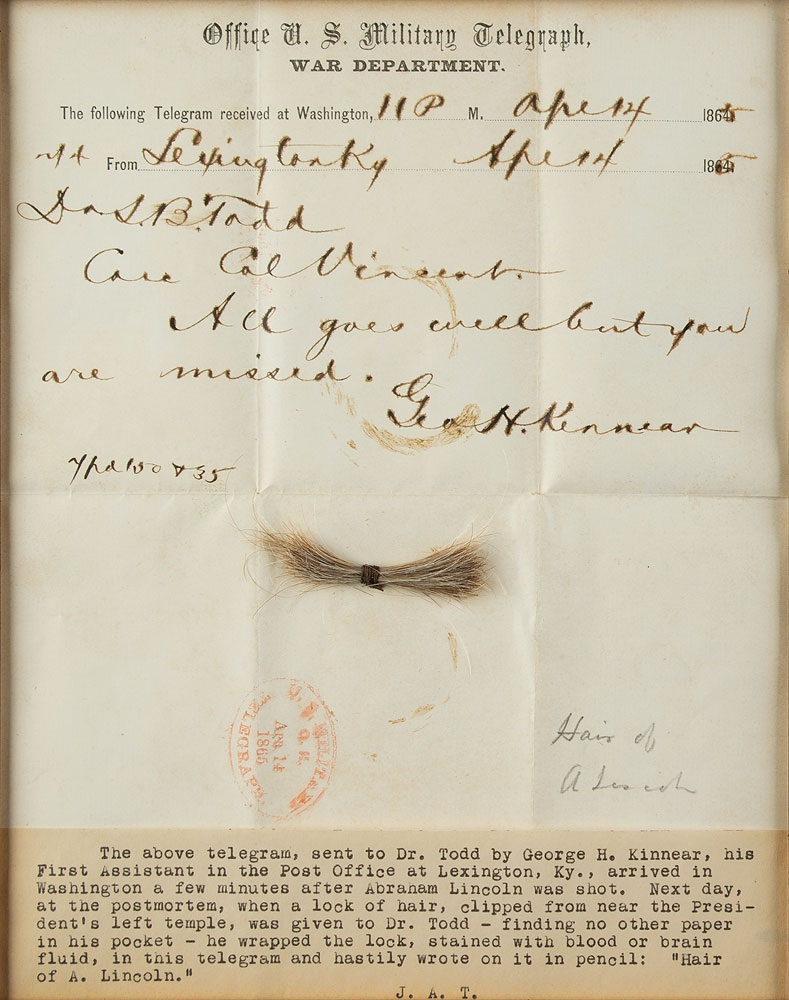
A lock of Abraham Lincoln’s hair wrapped in a telegram stained with the 16th president’s blood is up for auction online. [From RR Auction, based in Boston], [the two} inches of Lincoln’s hair was removed during his postmortem examination after the president was fatally shot by John Wilkes Booth.
The hair ended up in the custody of Dr. Lyman Beecher Todd, a cousin of Lincoln’s widow, Mary Todd Lincoln. The doctor was present at the postmortem examination and is believed to have wrapped the lock of hair in the telegram which had been sent to him the previous day by his assistant, George Kinnear. The telegram is stained with what is believed to be the slain president’s blood.
The hair is mounted to an official War Department manuscript telegram sent to Dr. Todd by George H. Kinnear, his assistant in the Post Office at Lexington, Kentucky, received in Washington at 11:00pm on April 14, 1865 […]. [A] typed caption prepared by Dr. Todd’s son reads, in part: “The above telegram […] arrived in Washington a few minutes after Abraham Lincoln was shot.
Image Credit: Kentucky Kindred Genealogy
Next day, at the postmortem, when a lock of hair, clipped from near the President’s left temple, was given to Dr. Todd. [Finding] no other paper in his pocket […] he wrapped the lock, stained with blood or brain fluid, in this telegram and hastily wrote on it in pencil […] ‘Hair of A. Lincoln.’”
Dr. Lyman Beecher Todd‘s own account of the autopsy, now preserved in an 1895 manuscript held in the Ida Tarbell collection of Lincoln papers at Allegheny College in Meadville, PA, differs slightly from his son’s, noting that he clipped the lock himself: “When all was over, General Hardin entered and handed me a pair of scissors, requesting me to cut a few locks of hair for Mrs. Lincoln. I carefully cut and delivered them to General Hardin and, then, secured one for myself which I have preserved as a sacred relic.”
A member of the Acanthaceae family, this could be a Ruellia Simplex or Mexican Petunia, Mexican Bluebell or Britton’s Wild Petunia. It could be a Ruellia Tuberosa or Minnieroot, Fever Root, Snapdragon Root or Sheep Potato. Honestly, they look the same to me. ~Vic
“A report warns that fleets of new communication satellites in low-Earth orbit will spoil some astronomical observations, even if all known mitigation strategies are taken.”
Astronomers and the operators of new, thousands-strong […] low-orbiting satellites will have to work together to prevent them from having a devastating impact on ground-based observations of planets, stars and other celestial objects, says a [recent] report […]. Even then, there is no escaping some harm from the fleets of commercial orbiters.
“All optical and infrared observatories will be affected to some degree,” [stated] astronomer Anthony Tyson of the University of California, Davis, […] at a briefing on the report.
The satellites, designed to provide internet access in remote areas, now number in the hundreds. [Following] the launch of the first batch by SpaceX in May 2019, astronomers were alarmed by how bright they appear in the sky. If all the planned [launches] go ahead, the number of satellites will grow beyond 100,000. Since last year, there have been a number of independent studies of [satellites’] possible impact. [The] workshop’s report is the first time the satellite companies, and those who would be affected (astronomers to the agencies that fund them and their telescopes), have pooled their results and worked out a strategy for the future.
The satellite trails are very bright, and out of focus slightly, so they’re wide and cover several pixels on images taken with a test version of the (soon to open Vera C.) Rubin Observatory’s camera, notes Tyson. [Telescopes] that need to work during twilight will also run into problems. Because the satellites are in low orbits, they will often be seen close to the horizon and will be most visible when they are still in sunlight but, the observer is not. If, however, satellite operators choose orbits above 600 kilometers, the situation gets worse because, then, their spacecraft are visible for more of the night, and in [the] summer, all night long. Astronomers should also develop software tools to remove satellite trails from images and the companies should make accurate orbital data available for their orbiters so telescopes can try to avoid them.
The only measure the report could offer to totally eliminate the damage to astronomy was to launch fewer or no low-orbiting satellites…likely not an option given the financial investments the companies are making in the [satellites] and the lucrative market they foresee.
Tyson and his colleagues have been working with SpaceX engineers to modify their satellites to reduce their brightness. His team has also modeled trying to steer the Rubin Observatory telescope to avoid passing satellites but, Tyson says there are simply too many. Astronomers are already actively pursuing image processing solutions but, he says “the jury’s out” on how much that can help.
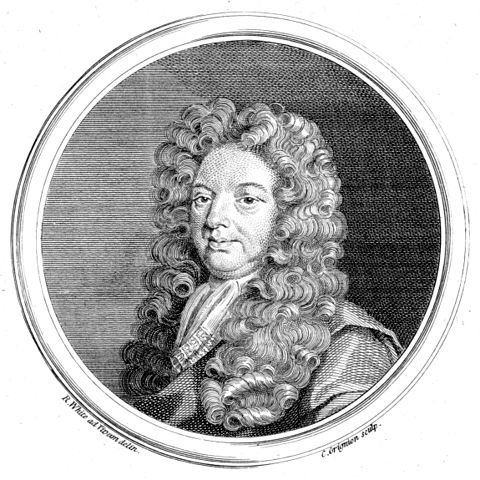
Three hundred, fifty-five years ago, John Blow, an English Baroque organist, composed the “club anthem” I Will Always Give Thanks, collaborating with Pelham Humfrey and William Turner. There is not a lot written about this song but, there are two suggestions of it either being an honoring of the victory over the Dutch in 1665 or a simple commemoration of the three men working together.
It took me a while to find this one. Even Pl@ntNet had trouble. At first, I thought it was a Coreopsis but, the petals didn’t match. Then, I thought it might be a Cosmos but, the petals still didn’t match. This is a Bidens Trichosperma. I think there has been some classification shuffling but, they are all in the Asteraceae family or Sunflower family. ~Vic
As a companion piece to the Fort Sumner post, my ex-Marine and I headed north, still on our way to Liar’s Lodge. We headed into snow and landed in Walsenburg, Colorado, in Huerfano County, a town smaller than the one I am living in and, as of 2019, continues to hemorrhage people from a peak of 5,855 in 1940. We arrived after dark and stopped to eat. There’s not much there, back then or now. ~Vic
Driving north on I-25 through New Mexico.
Click for a larger view.Las Vegas, New Mexico, by the way…The snow showed up.
Click for a larger view.Continuing north.
Click for a larger view.This is from December 2008 but,
the diner looks like it’s from 1974. Alpine Rose Cafe
Click for a larger view.It was open but, deserted.
We had a decent meal. It’s still there as of 2018.
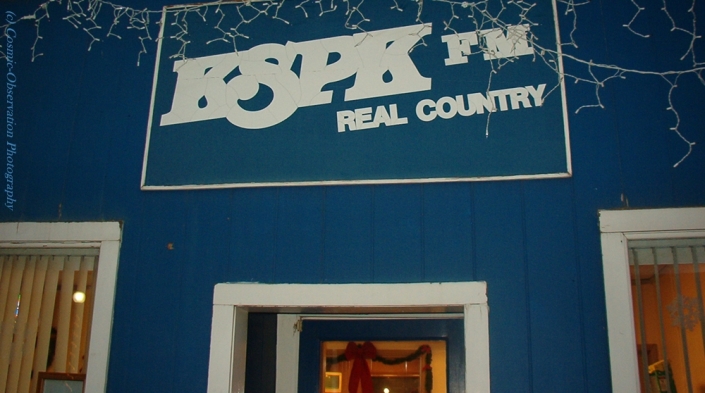
Click for a larger view.KSPK
It appears to still be there.
It is the only home of Colorado Rockies Baseball
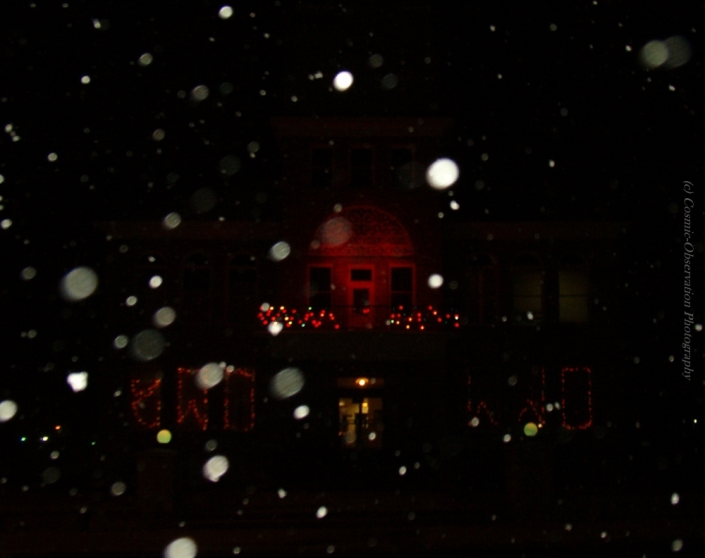
in Southern Colorado.County courthouse and jail all lit up.
The lights in the windows are odd.
Click for a larger view.It started to snow, again,
while I was attempting another picture.
These four furries showed up at one of our local Farmers’ Markets on October 18, 2014. Why they appeared there, I have no clue. Their costumes were really cute. Digeri was the only one that spoke. The pictures turned out surprisingly well from my old flip phone. Click on each image for a larger view. ~Vic
Digeri The CatI think the dog may be a Husky
with the different colored eyes.Siku The FoxThe Group Shot
One of the farmers assisted.
I wasn’t expecting to see this. I was a bit startled and thought I might scare the bird. The small creek was quite a bit of a steep drop. This may be hard to look at but, the carrion eaters are the necessary clean-up crew. At first, I thought it might be a deer but, the tail appears to be too long. Click on the picture to see a larger shot, if you wish. ~Vic
Biopic of the wartime exploits of Audie Murphy (played by himself), the most decorated US soldier in World War II. Starting with his boyhood in Texas, where he became the head of his family at a young age, the story follows his enrollment in [the] Army where he was assigned to the 3rd Division. He fought in North Africa, Sicily and Italy, before landing in southern France and, eventually, fighting in Germany. A Medal of Honor recipient, he also received battle honors from the French and Belgian government.
The highly variable Audie Murphy delivers his best screen performance as “himself” in Universal‘s To Hell and Back. Based on the star’s autobiography, this is the story of how Murphy became America’s most-decorated soldier during WW II. After dwelling a bit on Murphy’s hard-scrabble Texas upbringing, the story moves ahead to 1942, when, as a teenager, Audie joined the army. Within a year, he was a member of the 7th Army, serving in North Africa, Italy, France and, ultimately, Germany and Austria. One by one, the members of Murphy’s Company B are killed in the war, until only three men from the original company are left. [The] others appear at the finale as ghostly images […]. The bulk of the film is given over to Murphy’s conspicuous acts of combat bravery and his killing of 240 enemy soldiers. Highlighted by excellent battle sequences, To Hell and Back is a serviceable tribute to a most complex individual.
Date: 1948
Photo Author: Fort Detrick
Wikipedia & Wikimedia















 Cosmic-Observation