A dog from Olathe, that went missing, showed up at her old home about 60 miles away […].
“Where did the dog come from?” said [Colton Michael’s wife].
The 4-year-old Labrador, named Cleo, feels right at home on the front porch. The only thing is, it’s not her front porch, anymore and hasn’t been for nearly two years. As it turns out, Cleo’s owners had posted on Facebook a week earlier about the missing dog. They couldn’t believe it when Michael called and said Cleo had walked home. “It’s the most bizarre story. Really, she’s everything to us and to my mother,” said Drew, Cleo’s owner. It is 57 miles door-to-door from Olathe to Lawson and neither family knows exactly how Cleo made the trip. “That’s a hike for anybody,” Michael said. “Now that we know who she belongs to, if she pops up again, we know who to call.”
Both said they may never know anything about her journey.
A dog named Cleo, who disappeared from her home in Kansas earlier this month, turned up a few days later at her old home in Missouri […]. Colton Michael told television station KMBC that the 4-year-old Labrador [R]etriever-[Border Collie] mix showed up on the front porch of his family’s home in Lawson […]. “At first, she wouldn’t let anyone get near her,” said Michael, who has lived in the home for nearly two years. “She finds her way home and there’s some strangers living in it. That would be scary for anybody,” he said. Eventually, he was able to gain Cleo’s trust and to get her checked for a microchip, which showed that she belonged to the former owners of his house.
It’s a tale as old as time for any early ’90s child. An adventurous golden retriever worries that they will never see their home again, embarking on a treacherous wilderness journey to find their way back. Believe It or Not!, the plot of Homeward Bound: The Incredible Journey just turned from fiction to fact. [Both] parties are at a loss trying to explain Cleo’s long journey. [She] would have had to cross a river to make it back…just like in the movie!
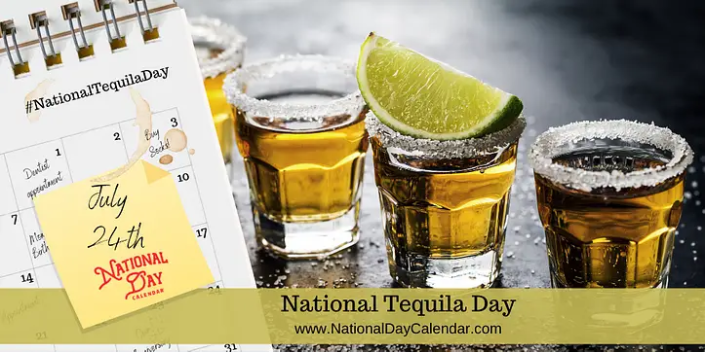
Well (scratching head), Flick Friday is a complete bust. There are no movie releases for today from 1950. Instead, I will highlight National Tequila Day. No, I’m not kidding. As a side note to the below, the listed Mamasita or Mamacita appears to be a Rum drink, not Tequila. But, who am I to argue. Drink up! ~Vic
Image Credit: National Day Calendar
One tequila, two tequila, three tequila, floor!
On July 24th, commemorate National Tequila Day with a little lime and salt. Mix up a Margarita, Paloma or a Mamasita to celebrate the day! People have been making Tequila for centuries and it was once known as mezcal wine. In fact, Tequila is mezcal but, mezcal isn’t Tequila. That’s because Tequila is distilled from a specific type of agave plant. Also, the law protects its production. Take a sip and we’ll travel into Tequila’s history.
History
It all started around the 16th century. Cortez [sic] arrived on the North American continent with his Spanish conquistadors. They didn’t care much for the fermented mezcal wine served to them. However, the Spanish introduced copper stills to the population. Enter the distilling process.
Image Credit: Win Calendar
Now, our story takes us to Tequila, Jalisco, Mexico. Located in a valley west of Guadalajara in Jalisco, Mexico, the town made a name for themselves by distilling Blue Agave. Even though a variety of succulents in Mexico produce mezcal, only one delivers the nectar to distill Tequila. Blue Agave grows in the highland region. Indeed, the unique growing conditions contribute to a larger size and sweeter tasting agave. In contrast, agave grown in the lowland regions taste and smell more herbal. In Mexico, the law protects the production of Tequila. The rule states Tequila is only Tequila if it is made within Jalisco. Additionally, the law limits production to regions in the states of Guanajuato, Michoacan, Nayarit and Tamaulipas. However, the same ingredients distilled anywhere else cannot be labeled Tequila.
Interestingly, many names in the Tequila business, today, were the very first commercial producers of Tequila. For example, José Antonio Cuervo held the first license for making the favored beverage. He kept a well-known company, too. Two other names include Don Cenobio Sauza and Félix López, whose businesses continue in some form today. Equally enjoyed in cocktails such as the margarita or Tequila Sunrise, connoisseurs savor a good Tequila like a good whiskey. As a result, savvy drinkers experience the smooth renaissance of Tequila. Surprisingly, it’s not the firewater they remember from their youth.
The Treaty of Union is the name usually, now, given to the agreement which led to the creation of the new state of Great Britain [.] [It stated] that England, which already included Wales, and Scotland were to be “United into one Kingdom by the name of Great Britain[.]” At the time it, was more often referred to as the Articles of Union. The details of the treaty were agreed on [July 22], 1706 and separate Acts of Union were then passed by the parliaments of England and Scotland to put the agreed articles into effect. The political union took effect on [May 1], 1707.
Queen Elizabeth I of England and Ireland, last monarch of the Tudor dynasty, died without issue on [March 24], 1603 and the throne fell at once […] to her first cousin twice removed, James VI of Scotland, a member of House of Stuart and the only son of Mary, Queen of Scots. By the Union of the Crowns in 1603, he assumed the throne of the Kingdom of England and the Kingdom of Ireland as King James I. This personal union lessened the constant English fears of Scottish cooperation with France in a feared French invasion of England. After [the] union, the new monarch, James I and VI, sought to unite the Kingdom of Scotland and the Kingdom of England into a state which he referred to as “Great Britain”. Nevertheless, Acts of Parliament attempting to unite the two countries failed in 1606, 1667 and 1689.
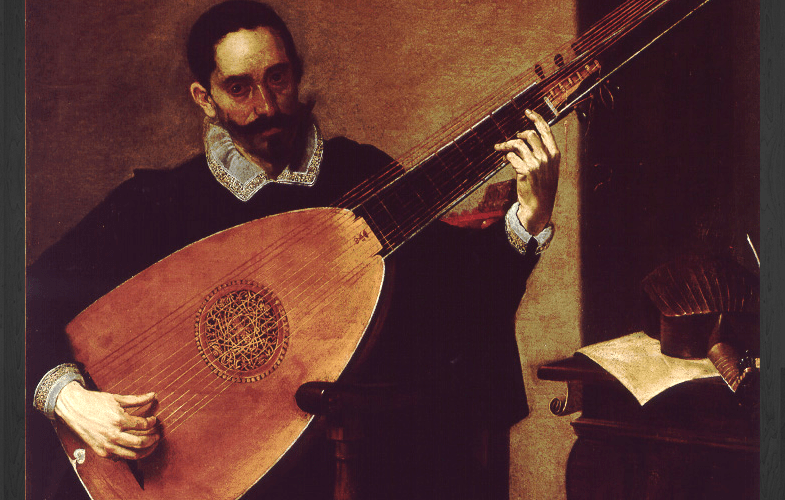
Some of his contemporaries, including Landi, criticized Kapsberger’s composing skill. Due to his unusual rhythmic groupings, sharp contrasts and non-conforming to the rules of counterpoint, it was suggested that he was an inferior composer. A current lutenist, Rolf Lislevand commented in liner notes in 1993:
“Kapsberger was as bad a composer as he was a fine instrumentalist […]. The ideas are often badly developed and are freely associated with one another […]. [N]o real musical discourse is built up […] the rhythm, even after serious efforts at fathoming it, wavers between inspired cleverness and total confusion.
Despite the above complaints, Kapsberger greatly contributed towards advancing European plucked string instruments of the time. At least six collections were published during his lifetime, two of which are currently lost.
There is very little else written about this specific composition. ~Vic
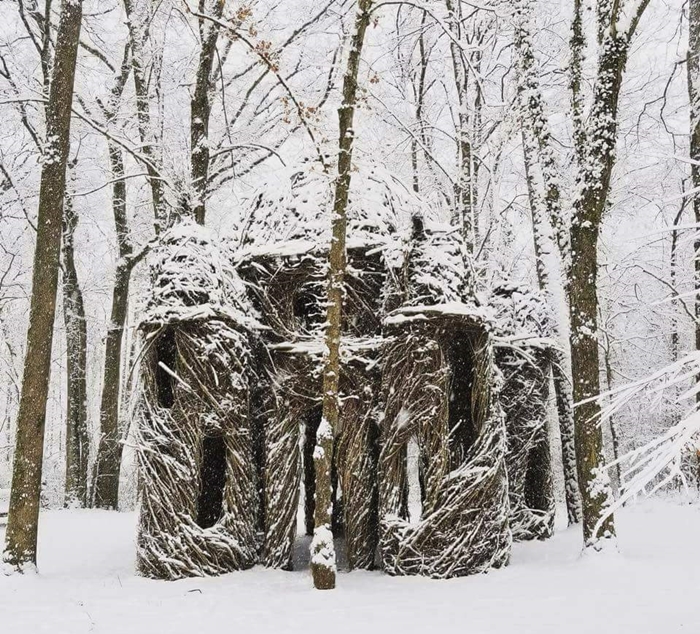
I’ve posted this sculpture twice, before…here & here. This will be my last installment as I only had a few shots and this shot isn’t even mine. This photo was part of a larger group of snow shots I posted about here & here.
Since it is SO HOT outside, I thought I would cool your mind a bit. ~Vic
Photo Credit: Tim Woody
(I have no idea who he is despite searching.)
From the January 2018 Snow Bomb
01-18-2018
Local cattle farm.
Lovely rolling hills.
09-04-2019Curious little one.
Moo.What?
05-02-2020Gotta go!Well…hello!
05-25-2020This little guy watched me walk by him. I got within six feet of him.
Photo Credit: monash.edu CTIE
Wikipedia & Wikimedia
One-hundred, ten years ago, today…
The Duigan […] biplane was an early aircraft which made the first powered flight by an Australian-designed and built machine when it flew in Victoria in 1910. The aircraft was constructed by John Duigan, with help from his brother Reginald, on their family farm at Mia Mia. The effort was especially significant in that the brothers built the aircraft almost entirely by themselves and without input from the pioneering aviation community. [A] photo-postcard of the Wright Flyer inspired the design and Sir Hiram Maxim‘s book Artificial and Natural Flight provided the theoretical basis. The only components not built by the Duigans themselves were the engine, made by the J. E. Tilley Engineering Company of Melbourne and the propeller. However, both of these components were extensively modified by John before they could be used.
Photo Credit: Memorial near Mia Mia Dolphin 51
Wikipedia & Wikimedia
The aircraft flew for the first time on July 16, 1910, taking off under its own power and flying [24 feet] (7 meters). Within two months, this had been extended to [300 feet] (90 meters) and, soon thereafter, to [590 feet with an altitude of 12 feet] (180 meters [with] an altitude of 3.5 meters). By the end of the year, Duigan had made a flight of [nearly a mile] (1 km) at an altitude of [100 feet] (30 meters).
Duigan informed the Department of Defence of his achievements, hoping to claim a £5,000 prize that had been offered in September 1909 for the construction of an aircraft suitable for military purposes. Duigan was ineligible for the prize, which had expired at the end of March 1910 but, was asked to demonstrate his aircraft for the military anyway. He also flew it in a public demonstration in front of a crowd of 1,000 spectators at Bendigo Racecourse in January 1911. In 1920, Duigan donated the aircraft to the Industrial and Technological Museum of Victoria, which was later absorbed into Museum Victoria.
Museum Victoria also preserves a flying replica of the Duigan biplane built by Ronald Lewis and flown in 1990. It was donated to the museum in 2000.
Image Credit: meantone.altervista.org
Wikipedia & Wikimedia
Coming to 1635…
Fiori musicali (Musical Flowers) is a collection of liturgical organ music by Girolamo Frescobaldi, first published in 1635. It contains three organ masses and two secularcapriccios. Generally acknowledged as one of Frescobaldi’s best works, Fiori Musicali influenced composers during at least two centuries. Johann Sebastian Bach was among its admirers and parts of it were included in the celebrated Gradus ad Parnassum, a highly influential 1725 treatise by Johann Joseph Fux which was in use even in the 19th century.
Fiori Musicali was first published in Venice in 1635, when Frescobaldi was working as [the] organist of St. Peter’s Basilica in Rome, under the patronage of Pope Urban VIII and his nephew Cardinal Francesco Barberini. It may have been conceived as music for St. Mark’s Basilica or a similarly important church. The collection was printed by Giacomo Vincenti (a celebrated publisher who had previously published reprints of Frescobaldi’s capriccios) and dedicated to Cardinal Antonio Barberini, Francesco‘s younger brother.
The full title of Frescobaldi’s work is Fiori musicali di diverse compositioni, toccate, kyrie, canzoni, capricci, e recercari, in partitura. Before Fiori musicali, Frescobaldi seldom published liturgical music. The organ mass was still in its infancy and composers seldom published such music. [It] is one of the most influential collections of music in European history. Frescobaldi’s collection was studied by Henry Purcell and Johann Sebastian Bach (the latter copied the entire work for his own use).
Update:
“The hammer finally fell at £2,500 and the item was purchased by a private UK buyer.”
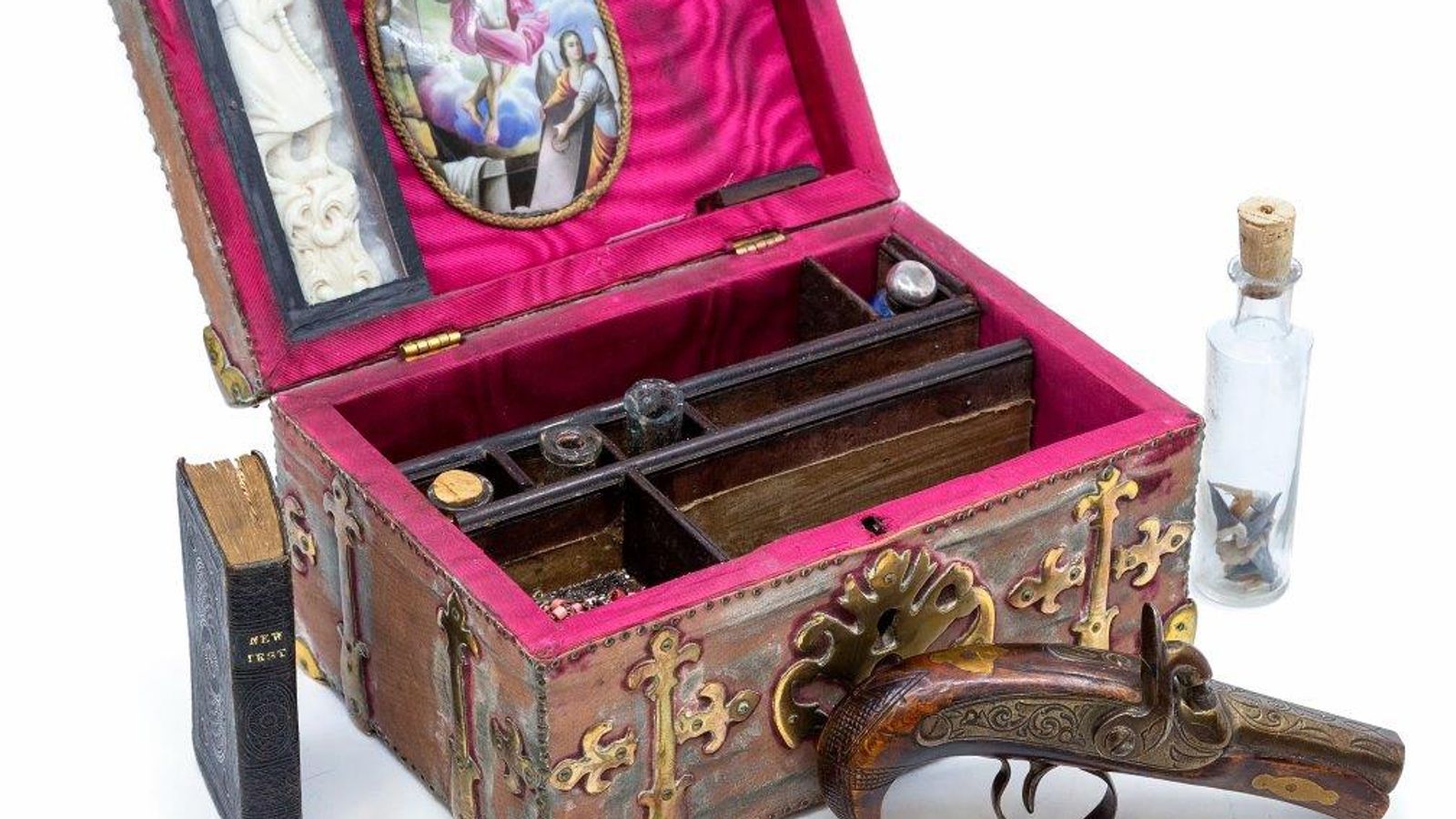
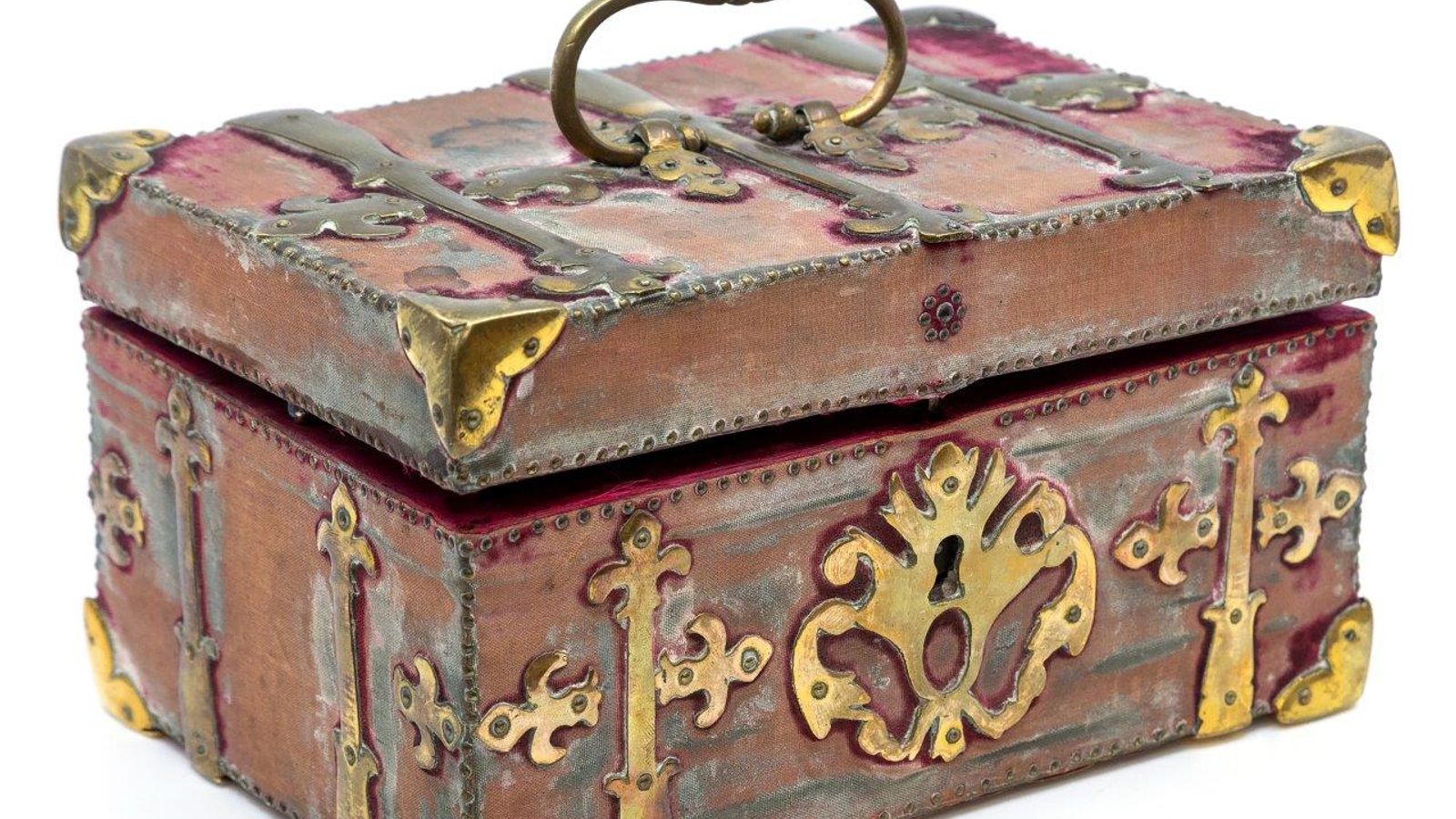
“The box has been valued at up to £3,000 and, includes a glass phial with unknown contents and a bottle of shark’s teeth.”
A “vampire-slaying kit”, containing a pocket-sized pistol and a 19th century copy of the New Testament, is going under the hammer. The gothic-looking container, worth between £2,000 and £3,000, also comes packed with pliers, [a] rosary and a bottle of shark’s teeth. Also inside the metal-bound box is an ivory-robed wolf carrying rosary beads, as well as a blue phial with mysterious contents, and a silver-bladed pocket knife. And inside the lid is an oval enamel painting that depicts the resurrection of Jesus Christ.
There’s no record of the box’s origin but, the 1842 copy of the New Testament within does bear the inscription of an Isabella Swarbrick. The current owner from the West Midlands, who wishes to remain anonymous, said that they do not know very much about its history. “I have had it in my own collection for three years now,” they said. “I bought it from a large antiques fair in Newark-on-Trent. I loved the look of the Gothic box and, when I opened it, I just had to have it. I thought it was so interesting…a great conversation piece.”
Photo Credit: news.sky.com
Charles Hanson, owner of the Derbyshire-based Hansons Auctioneers, the firm selling the box, said: “People are fascinated by stories of vampires, hence their continued appearance in films and on TV today. They have been part of popular culture for more than 200 years. The publication of John Polidori‘s The Vampyre in 1819 had a major impact and that was followed by Bram Stoker‘s 1897 classic Dracula.”
He added: “However, a belief in vampires and strange superstitions goes back even further and persists to this day. The task of killing a vampire was extremely serious and historical accounts suggested the need for particular methods and tools. Items of religious significance, such as crucifixes and Bibles, were said to repel these monsters, hence their strong presence in the kit we have found.”
The box will be sold online on [July 16] as part of a five-day-long antiques and collector’s auction.













 Cosmic-Observation