History
Throwback Thursday: Frank Eugene Corder 1994


Thirty years ago, today, Frank Eugene Corder stole a Cessna 150 and crashed it on the South Lawn of White House. He did not survive.
Born in Perry Point, Maryland, he was the son of an aircraft mechanic. Dropping out of high school in the 11th grade, he enlisted in the Army in October 1974 and was stationed in Kentucky & Colorado, trained as a mechanic. Honorably discharged in 1975, he was a truck driver from 1976 until 1993. Arrested for theft & drug dealing in the same year, he spent 90 days in rehabilitation. His third wife left him, shortly thereafter.
Apparently, Corder wanted the attention of, then, President Bill Clinton. It was speculated that Corder was trying to emulate Mathias Rust. On September 11, Corder, severely intoxicated, stole the plane from Hartford County Airport and was picked up by radar at Reagan National Airport just minutes before he steered into the White House wall. He died on impact at 1:49am. This event brought procedures to the forefront, as Corder was in restricted airspace.
Clinton was not in the White House at the time, due to renovations. He was staying at the Blair House.
Additional:
♦ Frank Eugene Corder: Crashing His Cessna (History On The Net)
♦ Crash At The White House (NYTimes)
♦ Suicide Suspected In Plane Crash (Los Angeles Times).
Story Sunday: Panjandrum Weapon

The Great Panjandrum at Westward Ho!
Wacky WW2-Era Failed Weapon
In 1941, the Government of the United Kingdom established a temporary wartime body called the Department of Miscellaneous Weapons Development (DMWD) to find new and unconventional ways to kill the enemy. Efforts from this department led to such useful inventions such as the Hedgehog anti-submarine weapon and Squid anti-submarine mortar, as well as the Holman Projector, an anti-aircraft rocket battery—and a system of degaussing used to protect ships against magnetic mines. It also led to the invention of the bouncing bomb that could skip across water to avoid torpedo nets and was used in the very successful Dambusters Raid of 1943. Above all, it played an important role in developing parts of the Mulberry Harbour used in the D-Day landings.
Despite these successes, not all of the DMWD’s projects were fruitful. An attempt to conceal the River Thames from German bombers, by covering it with soot, failed due to the effects of wind and tides, although it did cause some confusion when the coal-covered waters were mistaken for [a] tarmac during blackouts. The most disastrous project, however, was the Panjandrum. With a name inspired by a character in a nonsensical piece of prose from the 18th-century British dramatist Samuel Foote, the Great Panjandrum was doomed from inception. Constructed as a pair of large wheels, each approximately 10 feet in diameter, it featured a central steel drum carrying over a ton of explosives. Around the rims of the wheels were cordite rocket charges, designed to spin the entire device, propelling it towards the concrete beach defenses along the French coast with the intent of creating a substantial breach. The designers estimated that a fully loaded, 1,800-kg Panjandrum could reach speeds of around 60 mph (100 km/h), with enough momentum to crash through any obstacles between its launch point and target.
Trials began with only a handful of cordite rockets attached to the wheels and the payload was simulated by an equivalent weight of sand. The rockets were ignited and the Panjandrum catapulted itself forward, out of the landing craft used as a launchpad […] a fair distance up the beach. However, a number of rockets on one of the wheels failed, causing the weapon to careen off course. Despite several further attempts with more rockets, the Panjandrum consistently lost control before reaching the end of the beach.
Amusing Planet
Kaushik Patowary
July 5, 2024
Throwback Thursday: Edward III 1327

Author: William Bruges (1375-1450)
Date: 1430 to 1440
Description: Illuminated Manuscript Miniature
Six hundred, ninety-seven years ago, today…
Edward III, also known as Edward of Windsor before his accession, was King of England from January 25, 1327, until his death in 1377. He is noted for his military success and for restoring royal authority after the disastrous and unorthodox reign of his father, Edward II. Edward III transformed the Kingdom of England into one of the most formidable military powers in Europe. His fifty-year reign was one of the longest in English history and saw vital developments in legislation & government, in particular, the evolution of the English Parliament, as well as the ravages of the Black Death. He outlived his eldest son, Edward the Black Prince and the throne passed to his grandson Richard II.
Edward was crowned at age fourteen after his father was deposed by his mother, Isabella of France and her lover Roger Mortimer. At the age of seventeen, he led a successful coup d’état against Mortimer, the de facto ruler of the country and began his personal reign. After a successful campaign in Scotland, he declared himself rightful heir to the French throne, starting the Hundred Years’ War. The first phase of the war […] would become known as the Edwardian War. Victories at Crécy and Poitiers led to the highly favorable Treaty of Brétigny […] and Edward renounced his claim to the French throne. Edward’s later years were marked by international failure and domestic strife, largely as a result of his inactivity and poor health.
Edward was born at Windsor Castle on November 13, 1312 and was described in a contemporary prophecy as “the boar that would come out of Windsor“.Wiki Summary
Wayback Wednesday: Invasion Of Grenada 1983

Getty Image
Phil Kukielski
IINSTP
Forty years ago, today…this happened during my senior year of high school. I remember it well. I also enjoyed Heartbreak Ridge in 1986, even though the scene with the pay telephone and the credit card call for fire support, that actually happened, was the 82nd Airborne Division, not the Marines. ~Vic
The United States Invasion of Grenada began at dawn on October 25, 1983. The United States and a coalition of six Caribbean nations invaded the island nation of Grenada, 100 miles north of Venezuela. Code-named Operation Urgent Fury by the U.S. military, it resulted in military occupation within a few days. It was triggered by the strife within the People’s Revolutionary Government, which resulted in the house arrest and execution of the previous leader, [the] second Prime Minister of Grenada, Maurice Bishop, [leading to] the establishment of the Revolutionary Military Council, with Hudson Austin as chairman. The invasion resulted in the appointment of an interim government, followed by elections in 1984.
Wikipedia Summary
Grenada gained independence in 1974. Maurice Bishop became [Prime Minister] as a result of a coup in 1979 and, he had pursued left-wing policies with Soviet and Cuban aid since then. In Washington, D.C., he was seen as a communist collaborator and a new airport under construction in Grenada was deemed a transfer point for weapons destined for Latin American revolutionaries. Bishop’s assassination, by a more hard-line Military Revolutionary Council on October 19, 1983, was taken as the signal to act. Publicly justified by the need to protect U.S. students in Grenada, Operation Urgent Fury was hastily thrown together. The only resistance was likely to come from a contingent of Cubans, claimed to be construction workers by Havana.
♦ The Invasion of Grenada (The History Guy/April 20, 2019)
♦ Operation Urgent Fury: The 1983 US Invasion of Grenada (War History Online/Nikola Budanovic/December 2, 2017)
♦ How Grenada Reshaped The US Military (Informal Institute For National Security Thinkers & Practitioners/Phil Kukielski/September 8, 2013)
US Invades Grenada AP Archive
Heartbreak Ridge Trailer
Throwback Thursday: Londonderry March 1968
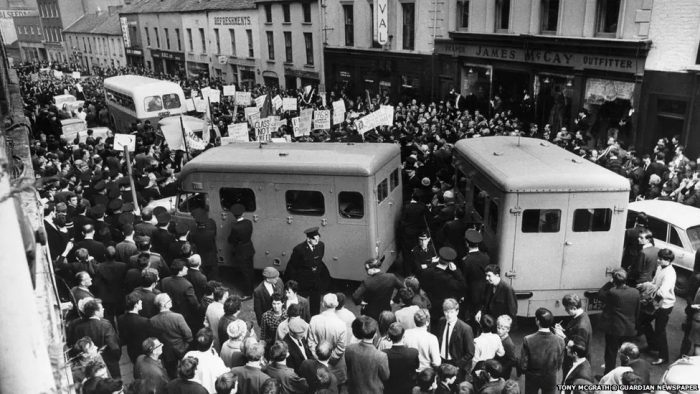
Fifty-five years, ago, today… ~Vic
Police have used batons and water cannons to break up a civil rights march in Londonderry, Northern Ireland. At least 30 people, including MP Gerard Fitt and some children, have been injured. Reports say police tried to disperse the protesters by using their batons indiscriminately and spraying water from hoses on armoured trucks. The demonstrators retaliated with petrol bombs. A number of bonfires were lit in the Bogside area and when a fire engine arrived, the crowd turned on it and threatened to set it alight.
“These were stormtrooper tactics at their worst.”
MP Gerard FittThe march, organised with the support of the Northern Ireland Civil Rights Association (NICRA), was held in protest at alleged discrimination against the majority Nationalist (and mainly catholic) population in Londonderry by the mainly Protestant Unionist-controlled local authority. The trouble began when the march headed for Duke Street, a road declared out of bounds by the Northern Ireland Minister of Home Affairs, William Craig.
When the protesters turned into the street they were confronted by a barricade of police officers, in rows three deep, all armed with batons. Loudspeakers urged the crowds to disperse but the calls went unheeded. Violent skirmishes broke out and very quickly the street was filled with police wielding batons against men, women and children.
In the chaos the Stormont and Westminster Republican Labour MP for Belfast west, Gerry Fitt, was struck down by a baton. He was hurried to a police car with blood pouring from his head and taken to hospital, where he later received stitches.
Mr. Fitt told reporters: “I was a marked man before the march started. These were stormtrooper tactics at their worst. They hit me once, but that wasn’t enough – they had to have another go, and this was the cause of the wound which had to be stitched.”
Mr Craig has said he is satisfied there was no unnecessary brutality. He rejected suggestions that police had used their batons improperly. NICRA formed in February 1967 to call for a number of reforms, including an end to the perceived discrimination against Catholics in the allocation of council housing and public sector jobs.
It wants the introduction of one man-one vote, rather than one vote per household, which was also seen as discriminatory against Catholic homes with multiple occupancy and an an end to gerrymandering electoral boundaries which in Nationalist areas like Londonderry has led to the return of Unionist-led authorities. And, it wants the repeal of the Special Powers Act, which was aimed at suppressing the IRA and gave police the power to search any property, and was therefore seen as discriminatory against Catholics.
BBC News
On This Day
October 5th
Londonderry: 1968 March Galvanized Civil Rights
Cameron Report: Disturbances In Northern Ireland (Web Archive)
Wayback Wednesday: Leaning Tower Of Pisa 1173

Photographer
Source
Wikimedia Commons
04-02-2022
Eight hundred, fifty years ago, today…
The Leaning Tower of Pisa (torre pendente di Pisa…in Italian) is the campanile or freestanding bell tower of Pisa Cathedral. It is known for its nearly four-degree lean, the result of an unstable foundation. The tower is one of three structures in the Pisa’s Cathedral Square, which includes the cathedral and Pisa Baptistry. The tower has 296 or 294 steps. [The] seventh floor has two fewer steps on the north-facing staircase.
The tower began to lean during construction in the 12th century, due to soft ground, which could not properly support the structure’s weight. It worsened through the completion of construction in the 14th century. By 1990, the tilt had reached 5.5 degrees. The structure was stabilized by remedial work between 1993 and 2001, which reduced the tilt to 3.97 degrees.
Construction of the tower occurred in three stages over 199 years. On January 5, 1172, Donna Berta di Bernardo, a widow and resident of the house of dell’Opera di Santa Maria, bequeathed sixty soldi to the Opera Campanilis petrarum Sancte Marie. The sum was then used toward the purchase of a few stones which still form the base of the bell tower. On August 9, 1173, the foundations of the tower were laid. Work on the ground floor of the white marble campanile began on August 14 of the same year, during a period of military success and prosperity.
The tower began to sink after construction had progressed to the second floor in 1178. This was due to a mere three-meter foundation, set in weak, unstable subsoil, a design that was flawed from the beginning. Construction was subsequently halted for the better part of a century, as the Republic of Pisa was almost continually engaged in battles with Genoa, Lucca and Florence. This allowed time for the underlying soil to settle […], [otherwise], the tower would almost certainly have toppled.
There has been controversy surrounding the identity of the architect […]. For many years, the design was attributed to Guglielmo and Bonanno Pisano […]. A 2001 study seems to indicate Diotisalvi was the original architect, due to the time of construction and affinity with other Diotisalvi works, notably the bell tower of San Nicola and the Baptistery, both in Pisa.
Between 1589 and 1592, Galileo Galilei, who lived in Pisa at the time, is said to have dropped two cannonballs of different masses from the tower to demonstrate that their speed of descent was independent of their mass, in keeping with the law of free fall.
During World War II, the Allies suspected that the Germans were using the tower as an observation post. Leon Weckstein, a U.S. Army sergeant sent to confirm the presence of German troops in the tower, was impressed by the beauty of the cathedral, and its campanile and […] refrained from ordering an artillery strike, sparing it from destruction.
The tower has survived at least four strong earthquakes since 1280. A 2018 engineering investigation concluded that the tower withstood the tremors because of dynamic soil-structure interaction. [The] height and stiffness of the tower, combined with the softness of the foundation soil, influences the tower’s vibrational characteristics in such a way that it does not resonate with earthquake ground motion. The same soft soil, that caused the leaning and brought the tower to the verge of collapse, helped it survive.
Wikipedia Summary
***The ceremony, for the 850th anniversary of the foundation of the Tower of Pisa, was started, today and runs all year to August 9, 2024.
850th Anniversary (Turismo.Pisa.it)
OPE (Opapisa.it/en/)
The Leaning Tower Of Pisa Was Once Tilting Dangerously (CNN/Sharon Braithwaite/August 9, 2023)
Flick Friday: [The] Forbidden Lover 1923

One hundred years, ago, today, the black & white silent film [The] Forbidden Lover was released. Brackets around “THE” is a product of the differences of the title from data sources. This film is an edited version of The Power of Love, the very first 3-D movie, released on September 27, 1922 at the Ambassador Hotel Theater in Los Angeles. Both films are believed lost.
Directed by Nat G. Deverich and, written by Kate Corbaley & Caroline Crawford, it starred Elliot Sparling, Barbara Bedford, Noah Beery, Aileen Manning, Albert Prisco and John Herdman.
Yankee sea captain lands on the coast during the old Spanish days to trade with the ranch owners. He meets a girl who is betrothed to a man she loathes. After a series of adventures and narrow escapes, he shows up the unscrupulous ranch owner and wins the girl.
IMDb [The] Forbidden Lover Storyline
Motion Picture News Booking Guide
October 1923
Production Company: Sierra Productions
Tagline: A Romance Of Early California
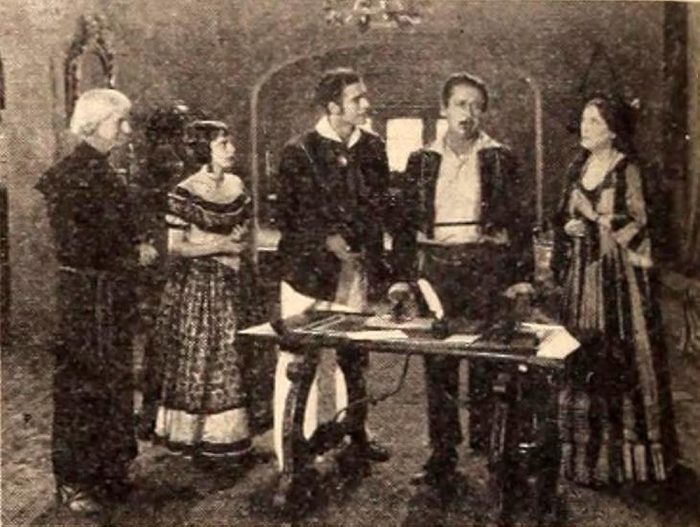
The Power Of Love
Image Credit: IMDb & Amazon
Because of his financial trouble, Don Almeda promises his daughter, Maria, to Don Alvarez but, Maria does not love [him]. In fact, she falls in love with Terry O’Neil, a stranger who has been wounded by robbers associated with Alvarez. O’Neil takes Alvarez’s place at a masked ball. Alvarez, in turn, robs the old Padre of some pearls and stabs him to death with O’Neil’s knife. He then accuses O’Neil of the murder and tries to shoot him but, wounds Maria instead, having thrown herself in front of him. Maria recovers and, after proving that Alvarez is a thief and a killer, weds O’Neil.
IMDb The Power of Love Storyline
Moving Picture World
October 1922
Production Company: Perfect Pictures
Tagline: A pair of spectacles will be handed to you as you enter the theatre, through which you will view the new sterescopic pictures.
The Power of Love was screened in front of a live audience at the Ambassador Hotel Theater […]. It was projected dual-strip in the red/green anaglyph format, making it both the earliest known film that utilized dual strip projection and the earliest known film in which anaglyph glasses were used. The camera rig used to shoot the film was made by the producers themselves and as you can imagine, it was far from perfect. Simply put, the film was not a success. It was screened, again, for exhibitors, and press, in New York City and, then, almost immediately fell out of sight. It was not booked again by other exhibitors. Unfortunately, we may never see what this movie looked like.
3-D TV & Movies
The first stereoscopic image dates to 1844, which makes 3-D images as old as the art of photography. [No] less a personage than Queen Victoria was photographed in 1854 in stereoscopic 3-D. 3-D stereoscopic moving images date to the 1850s with what was called the Kinetamatoscope [sic]. The first public display of a 3-D movie came in 1922 with The Power of Love […]. The film received a decent review in Moving Pictures World, then promptly disappeared from history by changing its title to Forbidden Lover and touring the country in a 2-D version. It was too complex and costly at the time to take 3-D on the road.
Randome
Looking Up/My Daily Plant Blogspot (Blogger)
Cirque de 3-D
March 6, 2009
What Was The First 3D Movie? (3D TV & Movies/Web Archive/06-02-2011)
A Tour Through The History Of 3-D Movies (Reelz/Jeff Otto/01-22-2009/Web Archive/07-20-2012)
Forbidden Lover (Silent Era/06-08-2013)
The Power of Love (Silent Era/10-16-2011)
Forbidden Lover (TCM)
The Forbidden Lover (AFI Catalog)
The Power of Love (AFI Catalog)
The Shot Of The Year (The Dissolve/Calum Marsh/12-19-2014)
Throwback Thursday: Japan Airlines Flight 404 1973

Date: August 19, 1983
Source: Air Britain Photo Library
Similar plane to the hijacked one.
Acquired: Wikimedia Commons
Fifty years ago, today…
Japan Air Lines Flight 404 was a passenger flight which was hijacked by Palestinian and Japanese terrorists on July 20, 1973. The flight departed Amsterdam-Schiphol International Airport, Netherlands, […], en route to Tokyo International Airport […], Japan, via Anchorage International Airport, Alaska. The aircraft was a Boeing 747-246B, with 123 passengers and 22 crew members on board. The passenger complement included five terrorists, led by Osamu Maruoka, a member of the Japanese Red Army and the other four were members of the Popular Front for the Liberation of Palestine.
The flight was hijacked shortly after takeoff from Schiphol. In the course of the hijacking, a grenade carried by one of the skyjackers detonated, killing her and injuring the flight’s chief purser. The lead hijacker […] immediately announced himself to air traffic control as El Kassar, hijacking the aircraft in the name of the Palestinian Liberation movement. After several Middle Eastern governments refused to permit Flight 404 to land, the plane eventually touched down in Dubai, in the United Arab Emirates. After several days on the ground, the terrorists demanded the release of Kozo Okamoto, survivor of the JRA’s attack on Tel Aviv’s Lod Airport.
After the Israeli government refused to release Okamoto, the hijackers flew the aircraft first to Damascus, Syria, and then to Benghazi, in Libya. On July 23, 89 hours after the hijacking began, the passengers and crew were released. [The] hijackers then blew up the aircraft, making the incident the second hull loss of a Boeing 747. The first hull-loss was also the result of hijackers. Maruoka escaped and in 1977, led the hijacking of Japan Air Lines Flight 472. He remained a fugitive, until 1987, when he was arrested in Tokyo after entering Japan on a forged passport. Given a life sentence, he died in prison on May 29, 2011.
Wikipedia Summary
The Skyjackers Strike Again (Time Magazine/07-30-1973/Wayback Machine)
Skyjackers: Part II (Time Magazine/07-30-1973/Wayback Machine)
Chronology Of Aviation Terrorism: 1968-2004 (Skyjack Chronology/Dr. Hillel Avihai/Wayback Machine)
Aviation Safety Network Database (JL404/Aviation Letter 184/07-23-1973)
Ex-Red Army Member Maruoka Dies (The Japan Times/05-30-2011)
July 22
July 25
July 26
Wayback Wednesday: National Personnel Records Center Fire 1973

Fifty years, ago, today…

Larger Image
Image Credit: National Archives & Wikipedia
Shortly after midnight on July 12, 1973, a fire was reported at the National Personnel Records Center’s Military Personnel Records Building, [a branch of the NPRC], in St. Louis County, Missouri. The fire burned out of control for 22 hours and it took two days before firefighters were able to re-enter the building. Due to the extensive damage, investigators were never able to determine the source of the fire.
The National Archives focused its immediate attention on salvaging as much as possible and quickly resuming operations at the facility. Even before the final flames were out, staff at the NPRC had begun work towards these efforts, as vital records were removed from the burning building for safekeeping.
“In terms of loss to the cultural heritage of our nation, the 1973 NPRC fire was an unparalleled disaster. In the aftermath of the blaze, recovery and reconstruction efforts took place at an unprecedented level. Thanks to such recovery efforts and, the use of alternate sources to reconstruct files, today’s NPRC is able to continue its primary mission of serving our country’s military and civil servants.”
Archivist of the United States David S. Ferriero
The estimated loss of Army personnel records, for those discharged from November 1, 1912, to January 1, 1950, was about 80 percent. In addition, approximately 75 percent of Air Force personnel records, for those discharged from September 25, 1947, through January 1, 1964, were also destroyed in the catastrophe [all records after the last name Hubbard].
Archives Recalls Fire That Claimed Millions Of Military Personnel Files
National Archives News
Kerri Lawrence
2018
Flick Friday: To Hell With The Kaiser! 1918
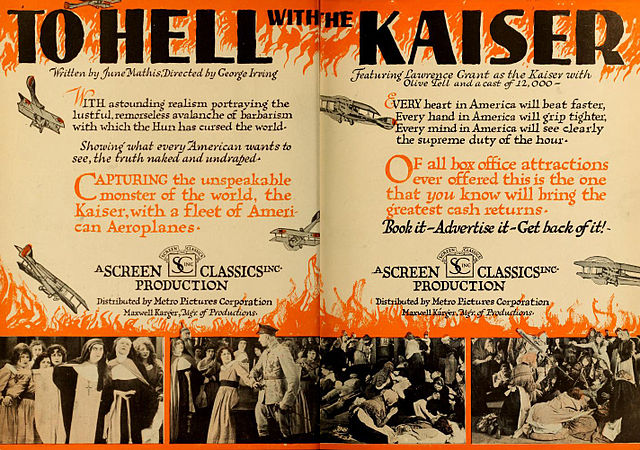
Source: Archive Image
Author: Metro Pictures/Screen Classics, Inc.
One-hundred, five years, ago, today…the silent black & white, comedy-drama To Hell With The Kaiser! was released. Written by June Mathis and directed by George Irving, it starred Lawrence Grant (as The Kaiser/actor Robert Graubel), Olive Tell, Betty Howe, John Sunderland, Earl Schenck (as the Crown Prince), Mabel Wright, Frank Currier, Karl Dane and Walter P. Lewis as Satan.
Following the death of his father, Frederick III of Germany, Wilhelm Hohenzollern becomes the German Kaiser and forms a pact with the devil that, he will conquer the globe in exchange for his soul. During the Kaiser’s invasion of Belgium, the Crown Prince enters a church and rapes Ruth Monroe, the daughter of an American inventor who has perfected a noiseless communications device. When the professor denounces the Crown Prince, he immediately is shot, whereupon his other daughter Alice vows to obtain revenge. While Alice’s sweetheart, Winslow Dodge, fights with the Americans as an aviator, she arranges to meet the Crown Prince through her friend Robert Graubel, an actor who impersonates the Kaiser at public functions. With her father’s wireless [device], Alice informs Winslow of the Kaiser’s whereabouts and, as he captures the German emperor, she kills the Crown Prince. Now a prisoner, the Kaiser drowns himself and wakes up in Hell, where Satan abdicates in his favor, saying that the Kaiser’s tortures are more fiendish than any he ever devised.
IMDb Storyline

Lobby Poster
IMDb & Amazon
Lawrence Grant, who spent his lengthy career playing odious villains, appeared in the dual role of Kaiser Wilhelm II and his look-alike, German actor Robert Graubel. Terrified of being assassinated, the Kaiser hires Graubel to impersonate him at various political functions. In the film, the Kaiser achieves military success through an infernal pact with Satan. Once this is established, the film concentrates on the seemingly endless tally of misdeeds perpetrated by the Kaiser during his quarter-century reign over Germany. His “partner in crime” is the Crown Prince […], who thinks nothing of casually raping convent girls and gunning down protesting nuns. The Crown Prince’s latest conquest is Ruth Monroe […], the daughter of an American inventor. When Ruth’s father protests this outrage, he is brutally murdered, whereupon Ruth’s sister Alice […] vows revenge. Using her father’s newest invention, a wireless machine whose coded messages cannot be intercepted, Alice directs a battalion of planes to bomb the small German village where the Kaiser is hiding. Captured by the Allies, the Kaiser is ignominiously dumped in a POW camp but, not before enduring a well-aimed sock on the jaw from a pugnacious dough-boy. In despair, the Kaiser commits suicide and sends his soul to hell. In hell, the devil […] gives up his throne, confessing that the Kaiser is far more sinister than he could ever hope to be.
[On June 8, 1918], Motography ran a Screen Classics press release explaining that To Hell With The Kaiser “reveals the machinations of Europe’s military monster before and during the war, his contempt for Americans […], his elaborate plans to crush France, […] destroy Russia, […] partition the world, […] his [order] to employ deadly gases in the war, the true circumstances under which he ordered the sinking of the Lusitania, the raiding of hospitals […].” Years before the war, Mr. Grant’s physical likeness to the German ruler was noted by a high official of the Kaiser’s court and a proposition was made for Grant to play the Kaiser in a dramatization […]. The war broke out before discussions went any further.
Actor John Sunderland, playing American pilot Winslow Dodge, was himself “an aviator who has seen service in Belgium.”
[It] had been released in the press that Kaiser Wilhelm II had half a dozen doubles who were employed to pose for him in various parts of the country, where there might be danger of assassination, while the real Kaiser, himself, remained safe behind this cloak.
To Hell With The Kaiser opened in New York City at the Broadway Theatre on June 30, 1918, immediately after it had emerged from the cutting and editing rooms […].
The film turned out to be an effective propaganda tool […]. Not only has the picture been shown in munitions plants and training camps […] but, this power has now been demonstrated in a new way…to convert conscientious objectors.
The National Film Preservation Board (NFPB) included this film on its list of Lost U.S. Silent Feature Films as of February 2021.
I found the building of this post fascinating. What started out as a simple movie post, turned into a history lesson. It’s a shame that it is lost. There are photographs of still pictures on IMDb. ~Vic
Throwback Thursday: The Sinking Of HMS Victoria 1893
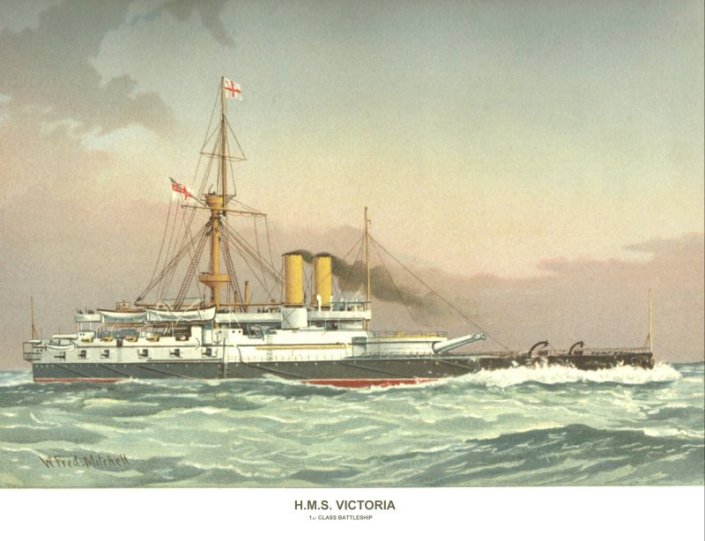
Author: William Frederick Mitchell
Wayback Machine Echo
Image Credit: Wikimedia
I certainly like her name! ~Vic
One-hundred, thirty years, ago, today…
[The] HMS Victoria was the lead ship in her class of two battleships of the Royal Navy. On June 22, 1893, she collided with [the] HMS Camperdown near Tripoli […] during maneuvers and quickly sank, killing 358 crew members, including the commander of the British Mediterranean Fleet, Vice-Admiral Sir George Tryon. One of the survivors was executive officer John Jellicoe, later commander-in-chief of the British Grand Fleet at the Battle of Jutland.
Victoria was constructed at a time of innovation and rapid development in ship design. Her name was originally to be Renown but, this was changed to Victoria while still under construction to celebrate Queen Victoria‘s Golden Jubilee, which took place the year the ship was launched. Her arrival was accompanied by considerable publicity. She was the largest, fastest and most powerful ironclad afloat, with the heaviest guns. Despite the ship’s many impressive features, compromises in the design meant that she proved less than successful in service.

Discovery Museum
Newcastle-Upon-Tyne
Image Credit: Hammersfan
May 18, 2015
A detailed model of the ship was exhibited at the Royal Navy exhibition in 1892 and another in silver was given to Queen Victoria by the officers of the Royal Navy and Royal Marines as a Jubilee gift.
The ship was nicknamed The Slipper (or when with her sister ship, [the] HMS Sans Pareil […] The Pair of Slippers) because of a tendency for her low fore-deck to disappear from view, in even slight seas, especially as a result of the low forward deck and raised aft superstructure…the two ships [had a] humorously perceived resemblance to the indoor footwear.
In clear, sunny weather, off the coast of Syria…
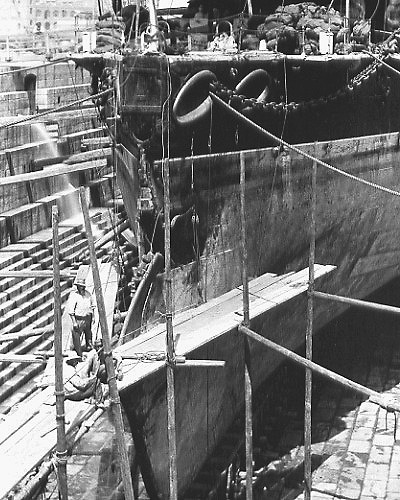
Source: Royal Navy
1893
Image Credit: Wikimedia
The officer in command, Vice Admiral Sir George Tryon, was a fearsome martinet with a reputation as a master of complicated ship handling. He had an elaborate plan for bringing his fleet to anchor, providing onlookers a spectacle of precision maneuvering. [Ten] battleships of the Mediterranean fleet were drawn up in two parallel columns, 1200 yards apart, heading directly away from port out to sea. Tryon then ordered a crash 180-degree turn in succession. The intention, apparently, was for each pair of ships…in order…to turn inwards and create a breathtaking view of the ships’ wakes fanning out, while the ships came about, only 400 yards from each other, [then proceeding] in the opposite direction from their original course, heading towards the land. Then, the ships were to turn 90 degrees to form one column and anchor in unison.
[The] Victoria capsized just 13 minutes after the collision, rotating to starboard with a terrible crash, as her boats and anything, free fell to the side and, as water, entering the funnels, caused explosions when it reached the boilers. With her keel uppermost, she slipped down into the water, bow first, propellers still rotating and threatening anyone near them. Most of the crew managed to abandon ship, although those in the engine room never received orders to leave their posts and were drowned. Those who escaped had to contend with the suction from the sinking ship. A circular wave spread out from it which repeatedly drew down those in the water. All manner of items broke loose from the ship as it sank and came shooting up among the men. Onlookers watched as the number of live men in the water steadily reduced.
[On August 22, 2004], the wreck of the Victoria was discovered by Lebanese-Austrian diver Christian Francis, aided by British diver Mark Ellyatt. She was found in [460 feet] of water off the coast near Tripoli […] and was located using sonar. The most amazing aspect of the wreck is that, unlike all others, she sits vertically with about two thirds of her above the sea bed. The upright position is assumed to have been caused by the huge weight of her fore guns, which would have dragged her down, bow first. The wreck has already been declared a war grave and an exclusion zone has been imposed around her, while the English and Lebanese authorities determine her legal status.
Additional:
♦ H.M.S. Victoria (City of Art/Web Archive/12-03-2014)
♦ Portsmouth City Centre/HMS Victoria (Memorials & Monuments In Portsmouth/Web Archive/08-24-2015)
Maritime Horrors
Christian Francis Finding HMS Victoria
Wayback Wednesday: International Webloggers Day 2004

International Weblogger’s Day, also known as InWeDay, is celebrated on June 14 every year. This unofficial holiday was created to bring together bloggers from around the world and, to promote blogging as a way to express yourself and engage in dialogue with people from different countries and backgrounds.
A blog (short for “weblog“) is an online diary consisting of discrete, often informal entries called posts. Most blogs are primarily textual but, they may include other types of content such as images, videos, music and audio.
The term “weblog” was coined [by Jorn Barger] in 1997 [December 17] and its short form, “blog“, was first used [by Peter Merholz when he playfully broke the word into “we blog“] in 1999. That same year, Pyra Labs launched Blogger, one of the first blog-publishing platforms that allow users to create and run blogs for free without any programming background.
In 2004, around 500 bloggers from over 40 countries supported the idea of creating a holiday that would unite blogging enthusiasts from around the world. The inaugural International Weblogger’s Day was held on June 14, 2004. On the occasion of the holiday, bloggers write special posts for their online diaries. In some cities, special meetings are organized where bloggers can meet “offline”.
Unfortunately, the popularity of International Weblogger’s Day has decreased considerably over the recent years.
Anyday Guide
Additional:
♦ Peter Merholz (Blog)
♦ Blogs Turn 10 ~ Who’s The Father (CNET News/Declan McCullagh/Anne Broache/March 20, 2007/ Web Archive Version)
♦ It’s The Links, Stupid (The Economist/Special Report/April 22, 2006)
♦ Robot Wisdom Weblog (Jorn Barger/Wayback Machine/August 15, 2000)
♦ Carolyn’s Diary (Early Online Diary/Carolyn Burke/April 1997)
♦ Scripting News (Longest Running Weblog/Dave Winer/September 1997)
♦ Blogger (Created By Three Friends/San Francisco Pyra Labs/August 1999)
♦ Weblog Awards (Bloggies/2001)
♦ WordPress Available Now (First Official Version/Matt Mullenweg/May 27, 2003)
♦ Steve Garfield (Early Video Blog/January 2004)
♦ AOL Snaps Up Weblogs (CNET/Dawn Kawamoto/October 7, 2005)
♦ Full Time Blogger Kottke Throws In The Towel (CNET/Graeme Wearden/February 23, 2006)
Throwback Thursday: Lennon’s Psychedelic Rolls Royce 1967

Image Credit: Reddit
Fifty-six years ago, today…
John Lennon bought a 1964 Mulliner Park Ward Phantom V, finished in [Valentine Black]. Everything was black except for the radiator, even the wheels. Lennon asked for the radiator to be black as well but, Rolls-Royce refused. Originally, the car was customised from Park Ward with black leather upholstery, cocktail cabinet with fine-wood trim, writing table, reading lamps, a seven-piece his-and-hers black-hide luggage set and a Perdio portable television. A refrigeration system was put in the boot and it was one of the first cars in England to have tinted windows. In December 1965, Lennon made a seven-page list of changes […].
Wikipedia Summary
Lennon’s Phantom V

“You swine! How dare you do that to a Rolls-Royce!”…so screamed an outraged Englishwoman as John Lennon’s Phantom V cruised past on London’s posh Piccadilly promenade in the Summer of 1967. The ornately decorated limousine, sprayed an electric yellow and bedecked with colorful floral tendrils, Romany scrolls and, zodiac symbols like a hallucinatory gypsy caravan, so offended her sensibilities that she briefly attacked it with an umbrella…or, at least, that’s the way Lennon always told the story.
Much as the length of the Beatles’ mop-tops had done, Lennon’s choice to express himself through his automobile triggered a generational clash, enraging those who felt the tripped-out paintjob had subverted a British icon.
In the 50 years since it outraged the Establishment, Lennon’s Rolls-Royce Phantom V is now embraced as a masterpiece of design and a jewel of the Swinging Sixties.
For all of the paperwork accumulated during the car’s construction, the total price of the vehicle is not recorded. [With] publicity at a premium and Lennon being one of the most famous people on the planet, odds are good that he received some sort of Beatle discount. Ironic considering the significant expenditure, Lennon was unable to drive when he first ordered the Phantom V. He wouldn’t pass his “L-Test” until February 15th, 1965 at age 24, becoming the last Beatle to do so. That same day, the Beatles began work on a new song, Ticket to Ride, a prophetic title considering the number of citations Lennon eventually racked up during his road hours. By all accounts, including his own, he was a horrendous driver, far too myopic to read signs, too distracted to recall routes and too impractical to troubleshoot even the simplest mechanical issue.

Exactly how Lennon decided on the lurid Romany floral/zodiac hybrid is subject to some debate. [Les] Anthony recalls Ringo Starr planting the seed of the idea during a drive in early 1967. However, others say the idea was suggested by Marijke Koger, of the Dutch design collective The Fool, who would also paint Lennon’s piano that summer, after Lennon commissioned a refurbished 1874 gypsy caravan as a present for his young son, Julian.
After spraying the body of the car yellow, local artist Steve Weaver was tasked with painting the red, orange, green & blue art nouveau swirls, floral side panels and Lennon’s astrological symbol, Libra, on the roof. On May 24th, Weaver submitted an invoice for 290 pounds and, the following day [May 25], the car was ready for pickup.
“John Lennon chose an automotive piece as his canvas, using all the symbols of wealth and other messages that go along with the Rolls-Royces of that period. He was certainly getting fed up with conforming at that time. It was a classic artistic statement.”
Giles Taylor
Design Director
Rolls RoyceReactions were mixed, depending on which side of the generation gap you happened to stand. The Daily Mail reported that the shrieking yellow vehicle elicited jeers from the assembled crowd and Beatles Book Monthly [July 1967] claimed that a local traffic official feared the loud colors would be a dangerous distraction to drivers on the road. Delivered days before the Sgt. Pepper’s Lonely Hearts Club Band was issued, its official maiden voyage took place on May 28th, leading a fleet of friends to Epstein’s new country home for a combined album release party and housewarming.
Rolling Stone (The Complete Article)
Jordan Runtagh
July 27, 2017
Additional:
♦ The Story Behind John Lennon’s Psychedelic Rolls-Royce Phantom V (Vintage News Daily/January 6, 2019)
♦ How John Lennon’s Rolls Royce Limousine Ended Up In This British Columbia Museum (Reader’s Digest Canada/Mike Lane)
♦ John Lennon’s Rolls-Royce (Royal BC Museum/April 30, 2020)
Wayback Wednesday: Jolliet-Marquette Upper Mississippi Exploration 1673

Date: 1681
Based on the 1673 Expedition
Source: Library of Congress
Author: Melchisédech Thévenot
Image Credit: Wikimedia Commons
Three hundred, fifty years ago, today…
On May 17, 1673, Louis Jolliet and Jacques Marquette departed from St. Ignace, Michigan, with two canoes and five other voyageurs of French-Indian ancestry. The group sailed to Green Bay. They paddled upstream (southward) on the Fox River to the site now known as Portage, Wisconsin. There, they portaged a distance of slightly less than two miles through marsh and oak forest to the Wisconsin River. Europeans eventually built a trading post at that shortest convenient portage between the Great Lakes and Mississippi River basins. On June 17, the canoeists ventured onto the Mississippi River near present-day Prairie du Chien, Wisconsin.
The Jolliet-Marquette expedition paddled along the west bank of the Mississippi until mid-July. When they passed the mouth of the Arkansas River, they became satisfied that they had established that the Mississippi flowed into the Gulf of Mexico.
The voyageurs then followed the Mississippi back to the mouth of the Illinois River, which friendly natives told them was a shorter route back to the Great Lakes. Following the Illinois river upstream, they turned up its tributary, the Des Plaines River near modern-day Joliet, Illinois. They continued up the Des Plaines River and portaged their canoes, and gear, at the Chicago Portage. They followed the Chicago River downstream until they reached Lake Michigan near the location of modern-day Chicago. Father Marquette stayed at the mission of St. Francis Xavier at the southern end of Green Bay, which they reached in August. Jolliet returned to Quebec to relate the news of their discoveries. On his way through the Lachine Rapids, Jolliet’s canoe overturned and his records were lost. His brief narrative, written from memory, is in essential agreement with Marquette’s, the chief account of the journey.
While Hernando de Soto was the first European to make official note of the Mississippi River by discovering its southern entrance in 1541, Jolliet and Marquette were the first to locate its upper reaches and, travel most of its length, about 130 years later. De Soto had named the river Rio del Espiritu Santo but, tribes along its length called it “Mississippi”, meaning “Great River” in the Algonquian languages.
Wikipedia Summary
Additional:
♦ Louis Jolliet (Britannica)
♦ Louis Jolliet (Dictionary of Canadian Biography)
♦ Jacques Marquette (Britannica)
♦ Jacques Marquette (Biography)
♦ The Explorers (Canadian Museum of History)
♦ Archdiocese of Chicago (New Advent Catholic Encyclopedia/James Marquette)
Louis Jolliet & Jacques Marquette: PBS World Explorers
Marquette and Jolliet: The Beginning of the Voyage to the Mississippi
Flashback Friday: Shoshone National Park 1891
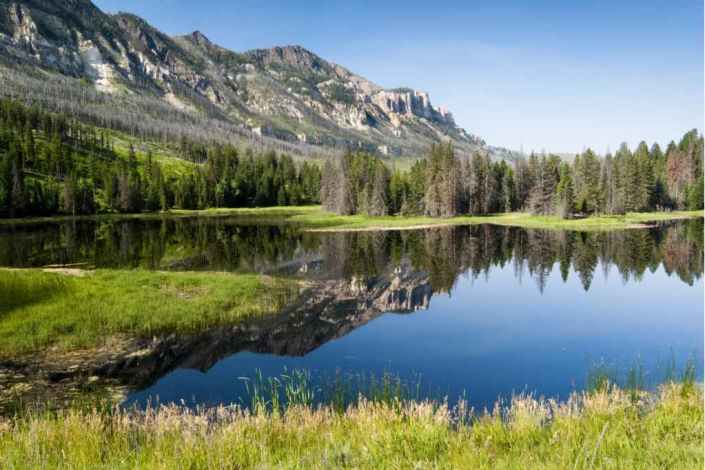
One-hundred, thirty-two years ago, today…
[The] Shoshone National Forest is the first federally protected National Forest in the United States and covers nearly 2,500,000 acres in the state of Wyoming. Originally a part of the Yellowstone Timberland Reserve, the forest is managed by the United States Forest Service and was created by an act of Congress, signed into law by U.S. President Benjamin Harrison in 1891. Native Americans have lived in the region for at least 10,000 years and when the region was first explored by European adventurers, forestlands were occupied by several different tribes. Never heavily settled or exploited, the forest has retained most of its wildness. Shoshone National Forest is a part of the Greater Yellowstone Ecosystem […].
The Absaroka and Beartooth Mountains are partly in the northern section of the forest. The Wind River Range is in the southern portion and contains Gannett Peak, the tallest mountain in Wyoming. [The] Continental Divide separates the forest from its neighbor Bridger-Teton National Forest to the west. The eastern boundary includes privately owned property, lands managed by the U.S. Bureau of Land Management and, the Wind River Indian Reservation, which belongs to the Shoshone and Arapahoe Indians. Custer National Forest along the Montana border is on the northern frontier. The Oregon Trail, the 19th century covered wagon route, passes just south of the forest, where broad and gentle South Pass allowed the migrants to bypass the rugged mountains to the north. The forest is home to the Grizzly bear, Cougar, Moose, tens of thousands of Elk as well as the largest herd of Bighorn sheep in the U.S.
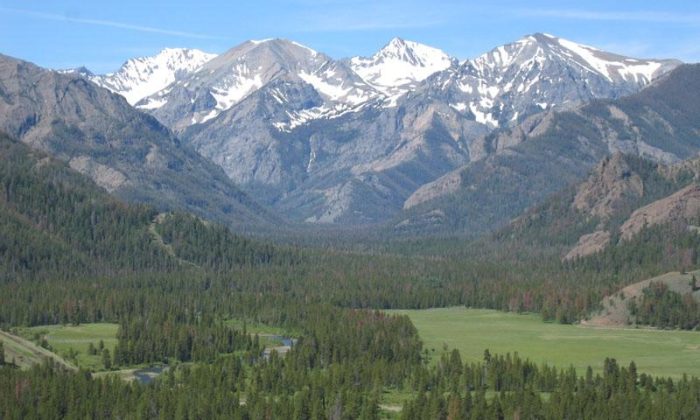
[On] March 3 [of] 1891, Congress enacted, and [President] Harrison signed, the Land Revision Act of 1891. This legislation resulted from a bipartisan desire to initiate reclamation of surplus lands that had been, up to that point, granted from the public domain, for potential settlement or use by railroad syndicates.
The Act reversed previous policy initiatives, such as the Timber Culture Act of 1873, which did not preclude land fraud by wealthy individuals and corporations. The legacy of the General Revision Act of 1891 [Forest Reserve Act/Land Revision Act] is frequently credited as its serving as a catalyst to a series of federal land reform initiatives, notably under President Theodore Roosevelt.
Wikipedia Summaries
As a side note, when my father was a Freshman at N.C. State University in 1963-1964, he studied Forestry. Prior to his death on August 25, 2022, he still remembered most of the Latin terms for all trees and forest plants.
Additional:
♦ Shoshone National Forest (Wyoming State Parks)
♦ America’s First National Forest (Forest Service)
♦ Our First National Forest (National Park Service History)
 Cosmic-Observation