I was planning to do a Flick Friday for 1954. No such luck. In fact, sticking with Friday and sticking with 1954, there are no releases until well into December. *sigh* So, you gets pix! All photos are my personal collection. ~Vic
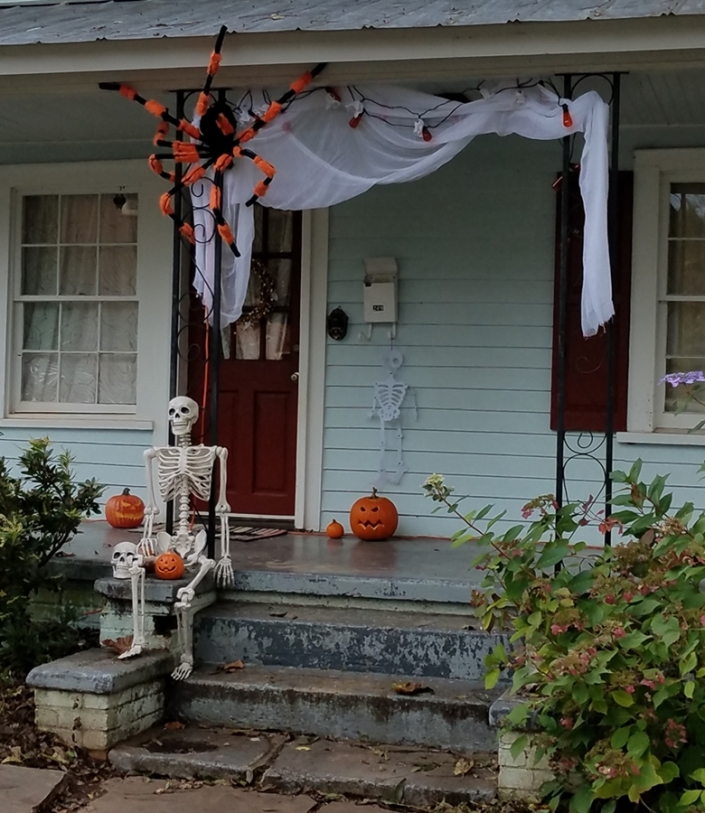
Minimalist decorations for a home originally built in 1860.
Taken: 10-27-2018Rest in pieces. Love the black rose.
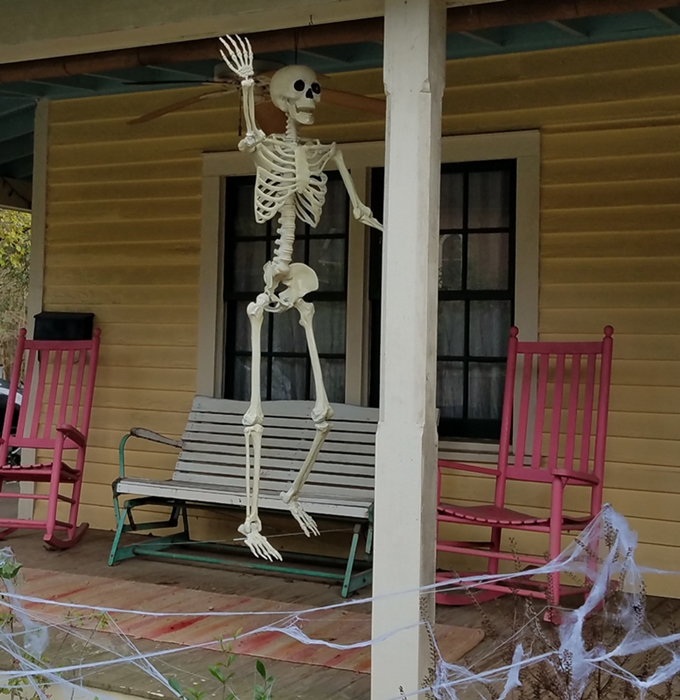
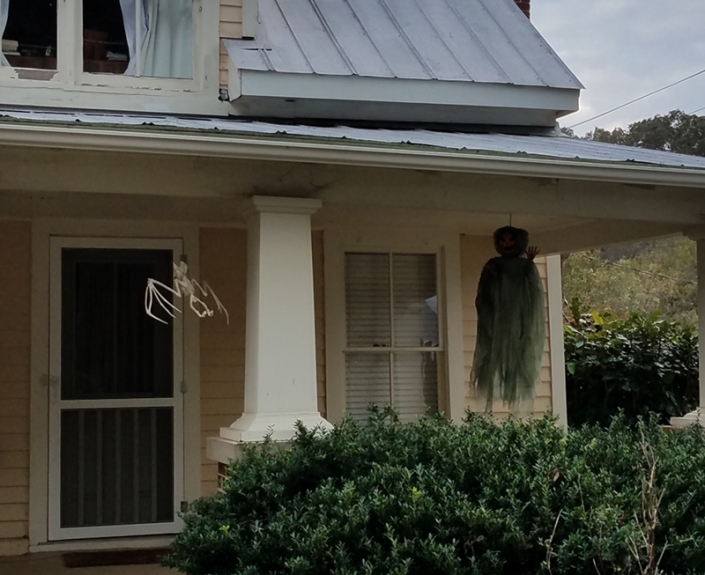
Taken: 10-28-2018Opposite side. Twins?I think this is supposed to be a ghost/skeleton mix. Not totally sure…Just hanging out on the porch with the dog…and a gargoyle.Hanging around.
Lovely home built in 1936.That is one big spider.
Can you see the barbie doll and the two baby spiders?Let me out!
Taken: 10-30-2018Skeletons can garden, too.Resting under the tree.
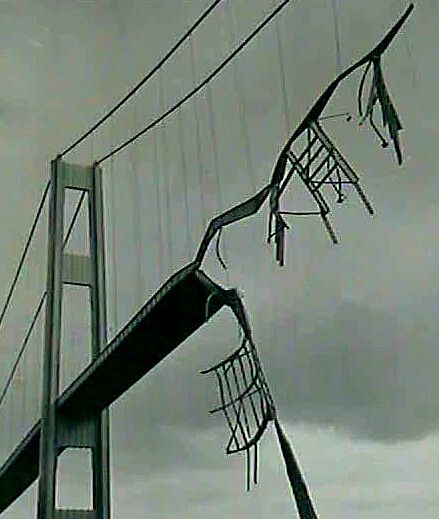
On July 1, 1940, the Tacoma Narrows Bridge was opened to traffic. This picture, taken from the air during dedication ceremonies, plainly shows three unusual characteristics of design: (1) Extremely narrow deck – 39′; (2) extreme length of suspension span – 2800′; (3) the solid stiffening girders used in the place of orthodox truss girders. Use of the solid girders is commonly blamed for the collapse.
Image Credit: tacomanarrowsbridge.org
Notice the view of the car in the center of the twist.
Construction began in September 1938. From the time the deck was built, it began to move vertically in windy conditions, so, construction workers nicknamed the bridge Galloping Gertie. The motion continued after the bridge opened to the public, despite several damping measures. The bridge’s main span finally collapsed in 40-mile-per-hour (64 km/h) winds on the morning of November 7, 1940. Efforts to replace the bridge were delayed by the United States’ entry into World War II […]. The portion of the bridge that fell into the water now serves as an artificial reef.
The bridge’s collapse had a lasting effect on science and engineering. In many physics textbooks, the event is presented as an example of elementary forced resonance. [The] bridge collapsed because normal speed winds produced aeroelastic flutter that matched the bridge’s natural frequency. The collapse boosted research into bridge aerodynamics-aeroelastics, which has influenced the designs of all later long-span bridges.
I saw the Narrows bridge die today and only by the grace of God, escaped dying with it…
I drove on the bridge and started across. Just as I drove past the towers, the bridge began to sway violently from side to side. Before I realized it, the tilt became so violent that I lost control of the car…I jammed on the brakes and got out, only to be thrown onto my face against the curb. Around me I could hear concrete cracking. The car, itself, began to slide from side to side on the roadway. I decided the bridge was breaking up and my only hope was to get back to shore. On hands and knees most of the time, I crawled 500 yards or more to the towers. My breath was coming in gasps…my knees were raw and bleeding, my hands bruised and swollen from gripping the concrete curb. Toward the last, I risked rising to my feet and running a few yards at a time. Safely back at the toll plaza, I saw the bridge in its final collapse and saw my car plunge into the Narrows.
Some Bridge Facts:
♦ [The] entire 1940 bridge did not collapse into the water, though most of the center span did fall. The side spans were badly damaged and the 2 big towers got bent beyond repair […]. It would be 10 years before the bridge was replaced.
♦ [Due] to the undulating motions up and down […], you could be driving across it and, the car ahead of you might dip out of view. Sometimes the roadway would rise above the height of a car […].
♦ The 1940 bridge remains at the bottom of the water have provided a place for sealife [sic] that was not there, before and much of the life includes the giant Pacific octopus as well as lingcod, wolf eels and black seabass [sic].
♦ (Referencing the image at the very top…) Did a ship go under the bridge for opening day in 1940? Yes, it is true…the ship Atlanta was a Coast Guard Cutter. Ironically, not only was it the first ship to go under the bridge on opening day July 1, 1940, it was also the last ship to travel under the bridge before it collapsed […]. When the concrete started to crumble and fall off, the ship was underneath and pieces fell on her deck. Luckily, no pieces were big enough to cause any damage to the ship and the ship’s Commander was one of the first to report the collapse.
William the Conqueror established the system of Norman law, proclaiming forests as ‘preserves’, restricting hunting and use by local inhabitants not of the monarchy or aristocracy. Grasslands and wetlands were included, as well as villages and towns that resided within. His heirs continued to enforce the laws. King Richard I and King John extended the forests, taking larger and larger areas, eventually covering one third of southern England.
This charter re-established free men rights of access, alleviating the hardship on the common people to farm, hunt, forage and generally use, and tend to, the land they lived on. It was reissued in 1225 with wording changes and then joined with the Magna Carta in the Confirmation of Charters (Confirmatio Cartarum) in 1297 by King Edward I.
The two-part TV movie Cross of Fire is set in the 1920s, when the Ku Klux Klan was at the height of its political power in Indiana. Part One, originally telecast November 5, 1989, details the resurgence of the Klan (which had been created during the Reconstruction era) under the leadership of David “Steve” Stephenson […]. Cloaking himself in the twin veils of patriotism and morality, Stephenson rails against such “deviates” as blacks, Jews and Catholics, gaining political clout and financial kickbacks as his “invisible empire” grows. Part Two […], telecast November 6, traces the fall of Stephenson…not because his followers have wised up but, because of a 1925 rape and murder charge.
♠ The scandal reached the governor. He was indicted and tried but, the conclusion was a hung jury. He wasn’t retried due to the statute of limitations but, left office disgraced with his political career destroyed.
A suicide bomber drives a truck packed with explosives into the U.S. Marine barracks in Beirut, killing 241 U.S. military personnel. That same morning, 58 French soldiers were killed in their barracks two miles away in a separate suicide terrorist attack. The U.S. Marines were part of a multinational force sent to Lebanon in August 1982 to oversee the Palestinian withdrawal from Lebanon.
In 1975, a bloody civil war erupted in Lebanon, with Palestinian and leftist Muslim guerrillas battling militias of the Christian Phalange Party, the Maronite Christian community and other groups. During the next few years, Syrian, Israeli and United Nations interventions failed to resolve the factional fighting and, on August 20, 1982, a multinational force including 800 U.S. Marines was ordered to Beirut to help coordinate the Palestinian withdrawal.
[Following] the massacre of Palestinian refugees by a Christian militia, [the] next day, the first U.S. Marine to die during the mission was killed while defusing a bomb. Other Marines fell prey to snipers. On April 18, 1983, a suicide bomber driving a van devastated the U.S. embassy in Beirut, killing 63 people, including 17 Americans. Then, on October 23, a Lebanese terrorist plowed his bomb-laden truck through three guard posts, a barbed-wire fence and into the lobby of the Marines Corps headquarters in Beirut. [He] detonated a massive bomb killing 241 Marine, Navy and Army personnel. The bomb, which was made of a sophisticated explosive enhanced by gas, had an explosive power equivalent to 18,000 pounds of dynamite. The identities of the embassy and barracks bombers were not determined but, they were suspected to be Shiite terrorists associated with Iran.
Serious questions also arose over the quality of security in the American sector of war-torn Beirut. The U.S. peacekeeping force occupied an exposed area near the airport but, for political reasons, the Marine Commander had not been allowed to maintain a completely secure perimeter before the attack.
On February 26, 1984, the main force of Marines left Lebanon, leaving just a small contingent to guard the U.S. embassy in Beirut.
This one hits home. One of the Marines killed in that bombing graduated from my high school. He graduated in 1982 (two years ahead of me) and I never got to meet him but, I knew his younger brother whom was a year behind me. Many years later, I wound up married to the Corps for 12 years. My ex and I visited the Beirut Bombing Memorial in Jacksonville when he returned from Iraq War duty. I took pictures but, I don’t remember what happened to them. ~Vic
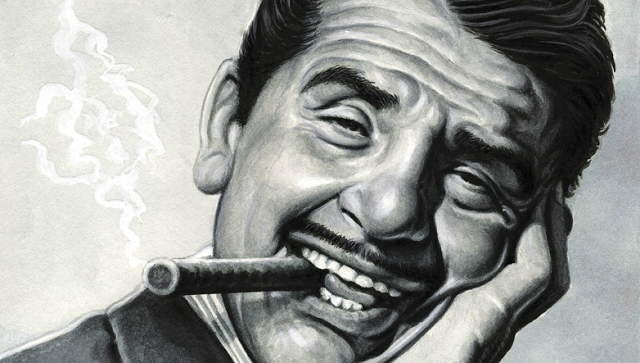
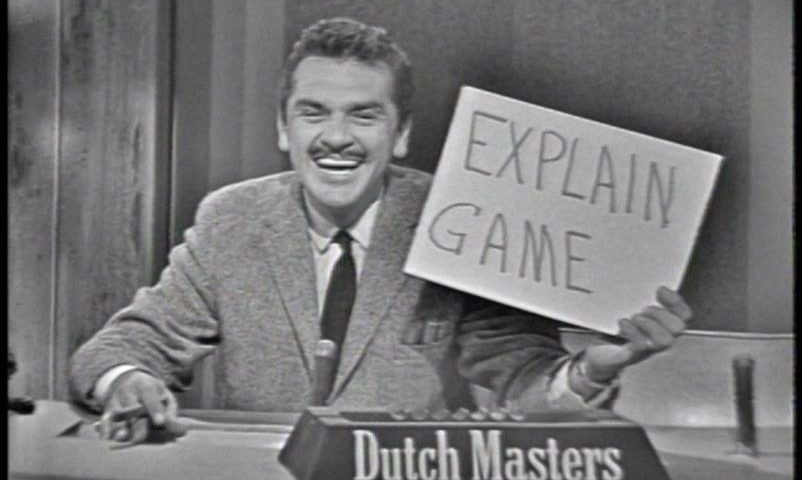
Sixty years ago, today, the game show Take a Good Lookdebuted on ABC. Created by Ernie Kovacs, it ran for two seasons with 53 episodes. Designed as a parody of Goodson-Todman panel games, celebrities were to guess the secret of the person brought before them. The clues provided were short video clips or skits and were extremely vague. The people brought on stage were regular folks that had an interesting area of expertise, had experienced extraordinary events in their lives or had been in the news.
Kovacs was a guest panelist on What’s My Line? (10 appearances) and a mystery guest (two appearances). This is probably where the idea for his show came from.
Thirty years ago, today, Real Love by the R&B band Skyydebuted on the Billboard Hot R&B/Hip-Hop chart (called Hot Black Singles back in 1989), entering at #80. The third release from the album Start of a Romance, it spent 16 weeks on the chart, reaching #1 for one week and, also peaked at #47 on the Billboard Hot 100 chart.
Lyrics (via LyricFind): I said I would get over you
Now I’m here out on my own
Trying to live my life
And now you wanna come back
But I don’t need no brand new lies, listen up
I want a love that’s serious
No time to play love games
I don’t wanna be nobody’s fool
So if you wanna be with me
You gotta give it up
Real love
I know I wanna have one
Real love
Gonna try and get some
Real love
Everybody needs one
Real love
Got to have real love
All my friends are telling me
I should give you another try
But I don’t need opinions
To deal with what I have on my mind, listen up
I want a love that’s serious
No time to play love games
I don’t wanna be nobody’s fool
So if you wanna be with me
You gotta give it up
Real love
I know I wanna have one
Real love
Gonna try and get some
Real love
Everybody needs one
Real love
Got to have real love
This was Lisa M. Harrison‘s second phone interview with Chris (round-table discussion with a group) on BlogTalkRadio. The first interview was posted on October 13.
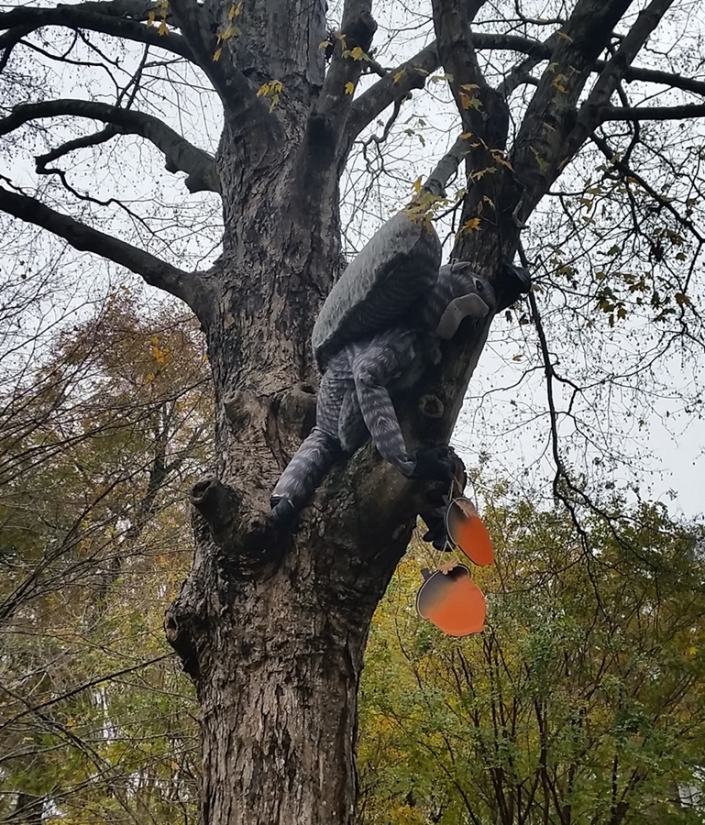
I *think* this is a stuffed squirrel.
11-03-2015Hamilton vs Burr
10-23-2016Another angle of the crazy skeleton from last year’s post.
11-05-2017I love the bat.
11-05-2017“I’m coming to take you away, ha-ha!”
10-28-2018This bat isn’t as well fed as the last one.
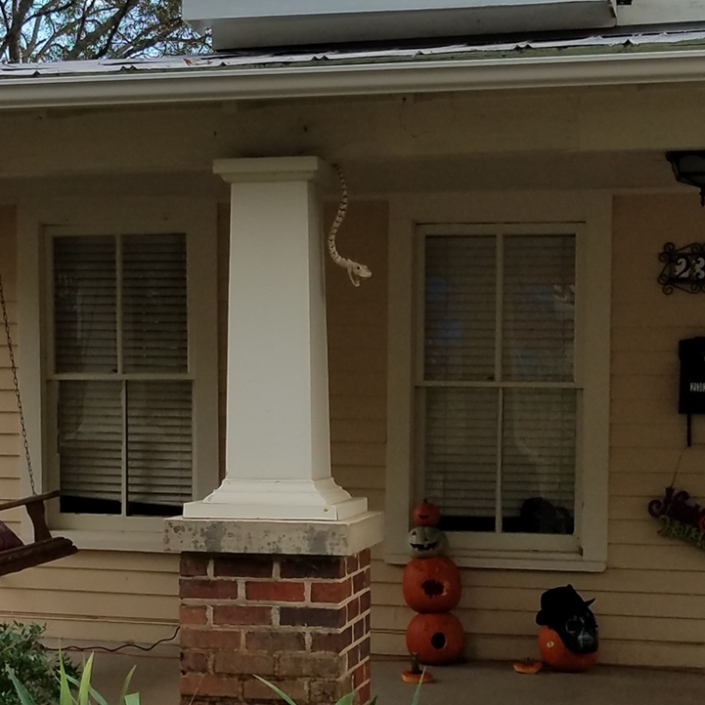
10-28-2018The snake skeleton is pretty creepy.
10-28-2018It’s Frankenstein Jack!
10-28-2018Spider in the bushes and EEK on the mailbox.
10-28-2018That is a big spider.
10-28-2018
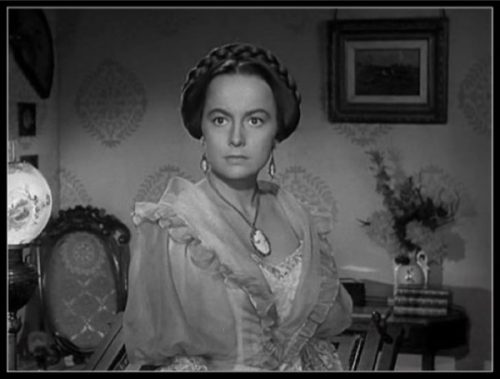
Catherine Sloper is a shy and backwards young woman who lives with her father, Dr. Austin Sloper, in 1849 New York. By all accounts, Catherine’s mother was a beautiful and graceful creature with the charm of queens. Catherine never knew her mother since she died while in childbirth but, her father often reminds her of all the things her mother was and that she is not. Catherine inherited a great deal of money after her mother passed and will inherit twice as much more at the passing of her father. So, when a poor but handsome and well-bred man, Morris Townsend, begins to court Catherine, her father becomes suspicious that he must be after her money. After all, Catherine is plain and boring. What could she possibly offer to this young man other than her money? When she refuses to give up her new beau, her father threatens to disinherit her. Will her father eventually convince her to give him up and wait for a suitable husband? Will Catherine and Morris elope and, live on the money left to her by her mother? Or, could it be that Catherine finally finds all the grace and charm of her mother only to use it against the men in her life?
Trivia Bits:
♦ Montgomery Clift was so unhappy with his performance, he walked out of the Premiere.
♦ Cary Grant was interested in playing Morris Townsend but, William Wyler turned him down.
♦ Montgomery Clift took some piano lessons for the scene where he sings “Plaisir d’Amour” to Olivia de Havilland.
♦ William Wyler wanted Erroll Flynn for the role of Morris Townsend.
♦ This movie was selected to the National Film Registry, Library of Congress, in 1996.
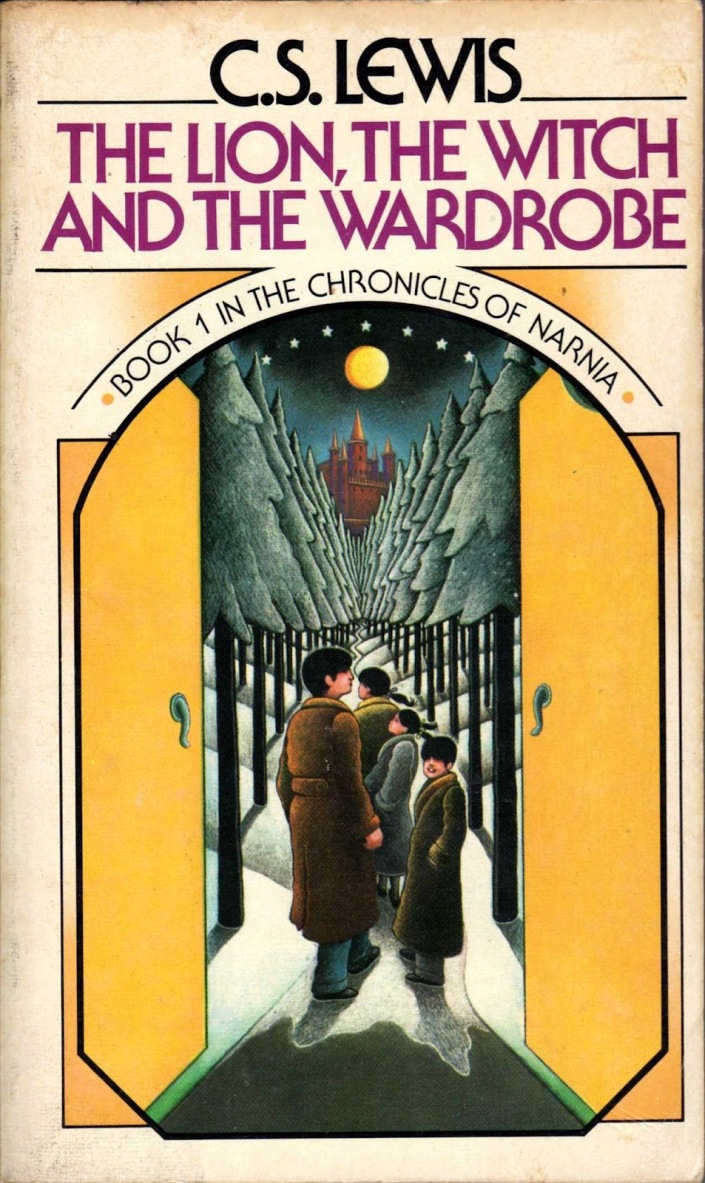
Most of the novel is set in Narnia, a land of talking animals and mythical creatures that is ruled by the evil White Witch. In the frame story, four English children are relocated to a large, old country house following a wartime evacuation. The youngest, Lucy, visits Narnia three times via the magic of a wardrobe in a spare room. Lucy’s three siblings are with her on her third visit to Narnia. In Narnia, the siblings seem fit to fulfill an old prophecy and find themselves adventuring to save Narnia and their own lives. The lion Aslan gives his life to save one of the children. He, later, rises from the dead, vanquishes the White Witch and crowns the children Kings and Queens of Narnia.
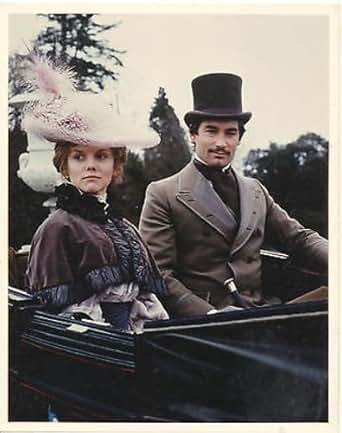
This sudsy made-for-TV melodrama is based on a Barbara Cartland novel and follows the romantic exploits of an American heiress who sets sail for exciting Paris at the turn-of-the-century. She is traveling there to meet her fiance but, ends up falling in love with a French journalist.
Reluctant to accept her arranged marriage to an English Duke she has never met, beautiful, young, American oil heiress, Emmeline Nevada Holtz, nicknamed “Vada” after the state, travels to Paris to buy her trousseau before meeting her husband-to-be. When her travelling companion, Nancy Sparling, has an accident and hurts her leg, Vada assumes her name to avoid unwelcome attention. [She] travels on with just her elderly maid, determined to make the most of her last chance to explore Bohemian Paris and, the wonders of the city that she had heard and read so much about. At her hotel she finds a handsome intruder in her suite, not a thief as she at first thinks but, a journalist looking to interview the famous heiress Emmeline. Smitten by this charismatic Frenchman and his talk of poetry, Vada finds herself agreeing to go with him to the Soleil d’Or, wellspring of the Symbolist movement. Soon, they are deeply and uncontrollably in love, a love that is surely doomed by her deception, her betrothal to the Duke and, now, a terrifying ordeal at a Satanist Black Mass on the dark side of the City of Light.
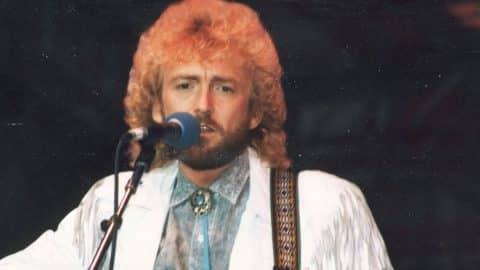
Thirty years ago, today, It Ain’t Nothin’ by American country singer Keith Whitleydebuted on the Billboard Hot Country chart, entering at #59. The second release from the album I Wonder Do You Think of Me, it was written by Tony Haselden and Keith was a co-producer. Released posthumously, it spent 17 weeks on the chart and became a #1 hit January 13, 1990, seven months after his death. It also reached #1 on Canada’s RPM Country chart February 3, 1990.
Lyrics (via LyricFind): My boss is the boss’s son and that makes for a real long day.
When that day is finally done I’m facing 40 thousand cars on the interstate.
Feeling lower than a well diggers shoes
knee deep in a mess of blues.
But those blues just fade away
When I hear my baby say.
[Chorus] It ain’t nothin a little bit of love won’t fix
It ain’t nothin but a scratch, a little bit of love can’t stitch.
It ain’t nothin a little bit of love can’t heal.
Your love makes me feel.
No matter what hands me — it ain’t nothin, it ain’t nothin.
It was written all over her face she was about to climb the walls.
She said you gotta get me out of this place cause even
Cindarella got to go to the ball.
If you multiply hell times three that’s what this day has been like for me.
I said honey we’ll do the town.
Just don’t let it get you down.
Cause……
[Chorus]
[Chorus] It ain’t nothin, it ain’t nothin, it ain’t nothin, naugh it ain’t nothin, it ain’t nothin














 Cosmic-Observation