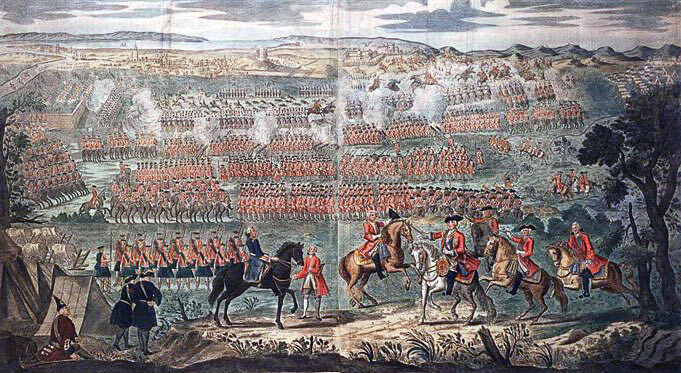
The battle was a total and bloody defeat for the Jacobites which effectively marked the end of almost sixty years of the Jacobite struggle, as never again would an armed uprising be used in the attempt to return the Stuarts to the throne. The government victory also paved the way for a sustained programme to destroy the power base of the rebel clans.
Culloden (pronounced culawden, with the emphasis on ‘oden‘) is one of the most important battles in the history of the British Isles and has international significance. It is the final battle fought on the British mainland and brings to an end more than half a century […] of Jacobite conflict, itself played out against a background of wider international wars. Its aftermath transforms the Highlands, bringing to an end the traditional way of life of the area and contributing to the subsequent clearances. The battle also holds a prominent place within the Scottish cultural legacy, frequently depicted, and commemorated, in art, music, literature and film. The battlefield, itself, is one of the most visited tourist sites in the Highlands […]. [T]he site holds a particularly high significance, and emotional connection, to many within Scotland and to the ancestors of the Scottish Diaspora.
The official return for British Army casualties (government troops) was 50 officers, and men, killed and 259 wounded [with] one missing (a proportion of the wounded later died of their wounds). Jacobite fatalities have been estimated at between 1,200-1,500 with between 400 and 500 prisoners taken in the immediate aftermath and many more in the days which followed. Only the Irish and Scottish troops in French service were treated as bona fide prisoners of war, the rest as rebels.
Image Credit: britishbattles.com
The battle, which lasted only 40 minutes, resulted in bitter defeat for the heavily outnumbered Jacobites. Led by the Duke of Cumberland, son of King George II, [the] devastating slaughter of the Jacobites was the result of the opening British cannonade and, subsequent tactics of the Redcoats during the attack […] when each British soldier, instead of attacking the Highlander directly in front of him, bayoneted the exposed side of the man to his right. The Highlanders finally broke and fled […].
Hunted by troops and spies, Prince Charles wandered over Scotland for five months before escaping to France and final exile. The [battle] […] marked the end of any serious attempt by the Jacobites to restore the Stuart dynasty to the British throne.
A generation before, a previous Jacobite rebellion had been thwarted by the king’s officer, George Wade, who had “pacified” and “disarmed” the highland clans. So concerned was the English establishment, and relieved by Wade’s actions, that an additional verse to the National Anthem was penned: God grant the Marshal Wade
May be thy Mighty aid,
Victory bring;
May he sedition hush,
And like a torrent rush,
Rebellious Scots to crush,
God save the king
Addendum: “Culloden is viewed by the Scottish people as a war grave. To my fellow Americans, stepping onto the Culloden battlefield would be like visiting Gettysburg or Normandy. And, since Scotland views it as a grave, you could also liken it to Arlington Cemetery. You don’t simply walk onto any of these places with a light spirit.” ~Brit At Heart
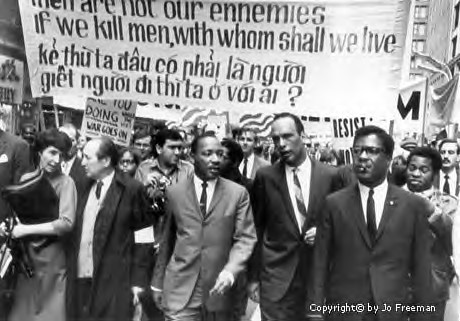
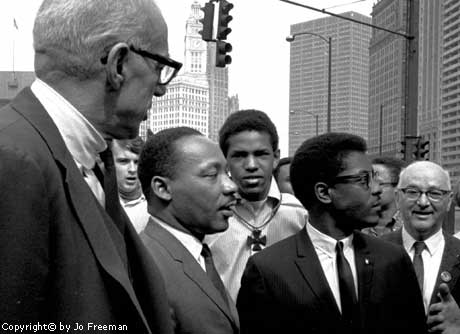
In addition to his moral objections to the war, he argued that the war diverted money and attention from domestic programs to aid the black poor. He was strongly criticized by other prominent civil rights leaders for attempting to link civil rights and the antiwar movement.
Dr. Benjamin Spock joins Dr. King
and Bernard Lee in the front line.
Photo Credit: jofreeman.com
Dr. King had never been neutral on the war in Vietnam but, he had been silent. He felt, as did the leaders of most other civil rights organizations, that the movement should concentrate on the domestic struggle. They were concerned that opposition to President Johnson’s foreign policy would result in loss of support for passing and enforcing civil rights laws at home. On July 5 1965, Dr. King told a college audience in Virginia that “the war in Vietnam must be stopped.” His friends and contacts in the Johnson Administration told him he was treading in dangerous waters and should back off.
By 1967, Dr. King was ready to speak his mind publicly. His first statement was made on February 25 at an anti-war conference in California, along with several Senators who also opposed the war. He said it was immoral and, also, took money and attention from the anti-poverty program. After the walk down State Street on March 25, Dr. King addressed a rally.
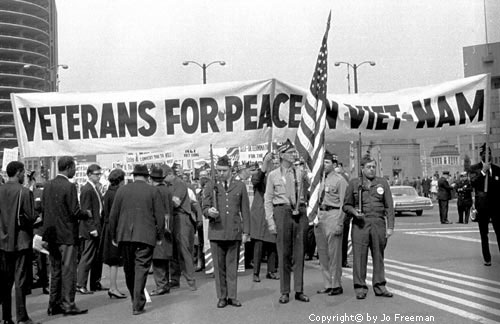
Veterans for Peace get ready to march.
Photo Credit: jofreeman.com
There are videos of March 25, 1965 and videos of April 1, 1967 but, nothing for this date. ~Vic
USS Princeton 1843-1849
Image Credits: Lithograph by N. Currier, New York, 1844
U.S. Naval History & Heritage Command history.navy.mil
wikipedia.org & wikimedia.org
President Tyler hosted a public reception for Stockton in the White House on February 27, 1844. On February 28, [the] USS Princeton departed Alexandria, Virginia, on a demonstration cruise down the Potomac with Tyler, members of his cabinet, former First Lady Dolley Madison, Senator Thomas Hart Benton of Missouri and about 400 guests. Captain Stockton decided to fire the larger of her two long guns, Peacemaker, to impress his guests. Peacemaker was fired three times on the trip downriver and was loaded to fire a salute to George Washington as the ship passed Mount Vernon on the return trip. The guests aboard viewed the first set of firings, [then] retired below decks for lunch and refreshments.
Awful Explosion of the Peacemaker on board the
U.S. steam frigate Princeton on Wednesday, 28 Feb. 1844
Image Credits: Lithograph by N. Currier/Currier & Ives
Gale Research
Library of Congress
wikipedia.org & wikimedia.org
Secretary [of the Navy] [Thomas Walker] Gilmer urged those aboard to view a final shot with the Peacemaker. When Captain Stockton pulled the firing lanyard, the gun burst. Its left side had failed, spraying hot metal across the deck and shrapnel into the crowd. Instantly killed were Gilmer, Secretary of State [Abel P.] Upshur, Captain Beverley Kennon, who was Chief of the Bureau of Construction [Equipment] and Repairs, Virgil Maxcy (a Maryland attorney with decades of experience as a state and federal officeholder), David Gardiner (a New York lawyer and politician) and the President’s valet, a black slave named Armistead. Another 16 to 20 people were injured, including several members of the ship’s crew, Senator Benton and Captain Stockton. The president was below decks and not injured.
The disaster on board the Princeton killed more top U.S. government officials in a single day than any other tragedy in American history.
Two months ago, on December 7, 2019, I visited Alamance Battleground with my buddy Ray. I posted the first batch of pictures on December 8, intending to post the rest on December 14. For obvious reasons, that didn’t happen so, here are the rest.
The Colonial Column Monument
Originally located at Guilford Courthouse Military Park
Moved in 1962, “on indefinite loan.”Colonial Column MarkerFront Plaque
It is claimed that the battle was the first of the Revolutionary War.
It was actually the last battle of the War of Regulation,
which lead to the Revolutionary War.Right Side James Hunter
General of the RegulatorsBack Side
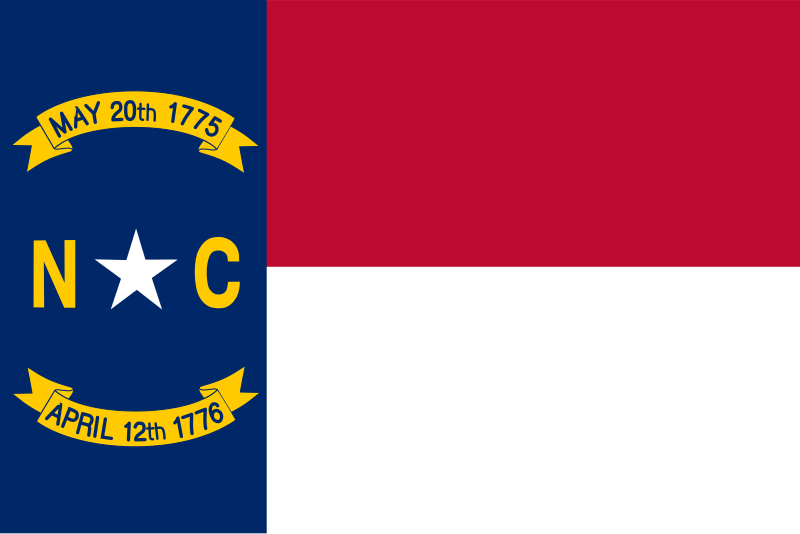
North Carolina Timeline 1774 North Carolina Provincial Congress The Mecklenburg Declaration 1775 Battle of Moore’s Creek Bridge 1776 North Carolina is the first to call for independence
with the Halifax Resolves 1776Twelve Regulators Condemned At Hillsboro
Six were executed.
“Our blood will be as good seed in good ground,
that will soon produce one hundred fold.” James Pugh June 19, 1771Bridge over the creek.View across the highway.Image Credit: wikipedia.org & wikimedia.org
Dates reflect the Mecklenburg Declaration of Independence (disputed but,
possibly Mecklenburg Resolves) and
the Halifax Resolves.
The B-47 bomber was on a simulated combat mission from Homestead Air Force Base in Florida. It was carrying a single 7,600-pound bomb. At about 2:00am EST, an F-86 fighter collided with the B-47. The F-86 crashed after the pilot ejected from the plane. The damaged B-47 remained airborne, plummeting 18,000 feet from 38,000 feet when [the pilot] regained flight control. The crew requested permission to [drop] the bomb in order to reduce weight and prevent the bomb from exploding during an emergency landing. Permission was granted and the bomb was jettisoned at 7,200 feet […]. The crew did not see an explosion when the bomb struck the sea. They managed to land the B-47 safely at […] Hunter Air Force Base. The pilot, a Colonel Howard Richardson, was awarded the Distinguished Flying Cross after this incident.
Some sources describe the bomb as a functional nuclear weapon but, others describe it as disabled. If it had a plutonium nuclear core installed, it was a fully functional weapon. If it had a dummy core installed, it was incapable of producing a nuclear explosion but, could still produce a conventional explosion. […] The Air Force maintains that its nuclear capsule, used to initiate the nuclear reaction, was removed before its flight aboard B-47. […] the bomb contained a simulated 150-pound cap made of lead. However, according to 1966 Congressional testimony by Assistant Secretary of Defense W.J. Howard, the Tybee Island bomb was a “complete weapon, a bomb with a nuclear capsule” and one of two weapons lost that contained a plutonium trigger. Nevertheless, a study of the Strategic Air Command documents indicates that Alert Force test flights in February 1958 with the older Mark 15 payloads were not authorized to fly with nuclear capsules on board.
The collision, and its aftermath, also drives the plot of the novel Three Chords & The Truth by Craig McDonald, published in November 2016.
Back in May, I did a post on the Battle of Alamance so, I won’t revisit the historical details. Yesterday, I visited the actual battleground with my buddy, Ray. They were having German Heritage Day with authentic German food for visitors. I was so glad we had a beautiful day. It was chilly but, there was a really good turnout. I hadn’t been to this site in nearly 45 years.
Battle map behind the Visitor Center Museum, facing the battleground.3-D Map of NC Militia troops and the Regulators.The rock in the 3-D battle map and
the small creek/tributary of Beaver Creek/Big Alamance Creek/Lake Mackintosh.Field cannon.Facing Inscription:
“HERE WAS FOUGHT THE BATTLE OF ALAMANCE
MAY 18, 1771
BETWEEN THE BRITISH AND
THE REGULATORSLeft Inscription:
Crossed Cannons & LIBERTY
Right Inscription:
FIRST BATTLE OF THE REVOLUTIONBattleground Sun
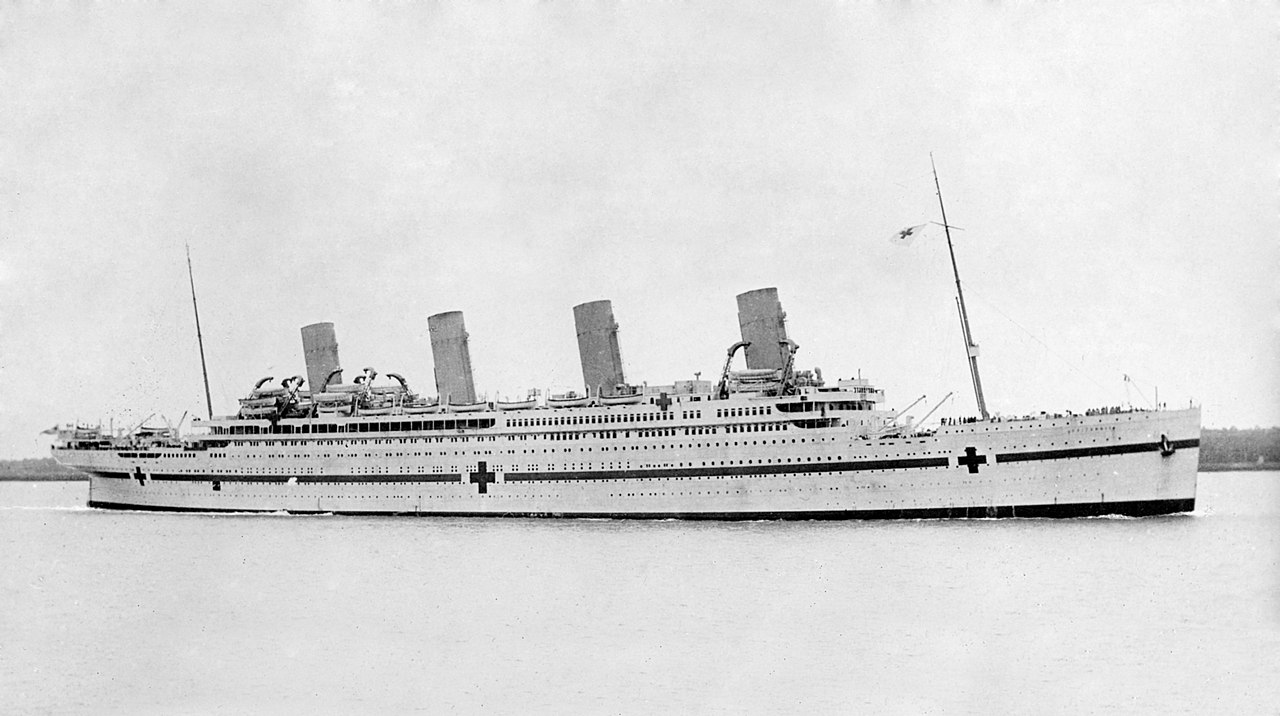
One-hundred, three years ago, today, the HMHS Britannic, sister ship to the RMS Titanic, sank in the Aegean Sea. On its way to pick up more wounded soldiers near the Gulf of Athens, a loud explosion shook the ship at 8:12am.
In the wake of the Titanic disaster on April 14, 1912, the White Star Line made several modifications in the construction of its already-planned sister ship. First, the name was changed from Gigantic to Britannic and the design of the hull was altered to make it less vulnerable to icebergs. In addition, it was mandated that there be enough lifeboats on board to accommodate all passengers, which had not been the case with the Titanic.
Postcard of the Britannic showing her intended purpose. Image Credit: wikipedia.org & wikimedia.org & ibiblio.org
[Immediately after the explosion], Captain Bartlett ordered the closure of the watertight doors and sent out a distress signal. However, the blast had already managed to flood six whole compartments, even more extensive damage than that which had sunk the Titanic. Still, the Britannic had been prepared for such a disaster and would have stayed afloat except for two critical matters.
First, Captain Bartlett decided to try to run the Britannic aground on the nearby island of Kea. This might have been successful but, earlier, the ship’s nursing staff had opened the portholes to air out the sick wards. Water poured in through the portholes as the Britannic headed towards Kea. Second, the disaster was compounded when some of the crew attempted to launch lifeboats without orders. Since the ship was still moving as fast as it could, the boats were sucked into the propellers, killing those on board.
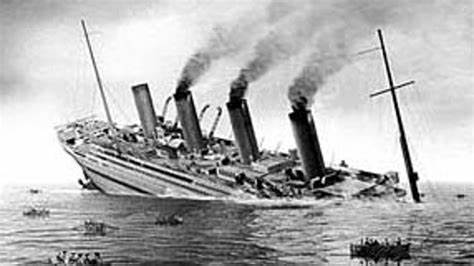
Less than 30 minutes later, Bartlett realized that the ship was going to sink and ordered it abandoned. The lifeboats were launched and even though the Britannic sank at 9:07, less than an hour after the explosion, nearly 1,100 people managed to make it off the ship. In fact, most of the 30 people who died were in the prematurely launched lifeboats.
Violet Jessop (who was also one of the survivors of Britannic’s sister-ship Titanic and had even been on the third sister, Olympic, when it collided with HMS Hawke) described the last seconds:
“She dipped her head a little, then a little lower and still lower. All the deck machinery fell into the sea like a child’s toys. Then, she took a fearful plunge, her stern rearing hundreds of feet into the air until with a final roar, she disappeared into the depths, the noise of her going resounding through the water with undreamt-of violence…”
Britannic was the largest ship lost in the First World War.
The cause, whether it was a torpedo from an enemy submarine or a mine, was not apparent. It would later be revealed that the mines were planted in the Kea Channel on October 12, 1916, by SM U-73 under the command of Gustav Sieß (German language link).
One hundred, nine years ago, today, aviatorEugene Ely made naval aviation history, taking off from a wooden platform secured to the bow of the light cruiserUSS Birmingham. Captain Washington Chambers, USN, was tasked by the Secretary of the Navy George von Lengerke Meyer to investigate uses for aviation in the Navy. Ely successfully took off in a Curtiss Pusher from the Birmingham, barely. The airplane rolled off the platform, plunged downward, skipping the water, which damaged the propeller but, he managed to stay airborne, landing two and a half miles away on Willoughby Spit. Two months later, on January 18, 1911, Ely landed his Curtiss Pusher airplane on a platform on the armored cruiserUSS Pennsylvania anchored in San Francisco Bay.
Ely communicated with the United States Navy requesting employment but, United States naval aviation was not yet organized. Ely continued flying in exhibitions while Captain Chambers promised to “keep him in mind” if Navy flying stations were created.
On October 19, 1911, while flying at an exhibition in Macon, Georgia, his plane was late pulling out of a dive and crashed. Ely jumped clear of the wrecked aircraft but, his neck was broken and he died a few minutes later.
On February 16, 1933, Congress awarded the Distinguished Flying Cross posthumously to Ely, “for extraordinary achievement as a pioneer civilian aviator and for his significant contribution to the development of aviation in the United States Navy.”
Last year, I did a post on World War I for Veterans Day as it had been 100 years, exactly, since the end of that war. I also covered how other countries memorialize and/or celebrate and, ended the post with two poems. I’ve written in a previous post about my almost Army brat status and referred to my significant other in this post.
Hargrave Military Academy Circa 1958
Ken’s first foray into the ‘military’ was the Hargave Military Academy in Virginia. His mother sent him there for summer school to assist with grades after a poor eighth grade year. He stayed for his ninth grade year and did very well. Unfortunately, it was extremely expensive and he returned to regular high school for tenth grade.
At the end of his junior year, he’d had enough of regular high school and made it clear to his mother that he wanted to go into the Navy. The military was all he was interested in. So, at the tender age of 17, his mother signed him into service. He went into the reserves for two years and began to train as a Corpsman. His sea duties were aboard the USS Robinson (DD-562), a Fletcher Class destroyer, the second ship in the Navy to be named after Captain Isaiah Robinson (Continental Navy). The “Robbie” received eight battle stars for World War II service and appeared in the movie Away All Boats.
The Robbie
Circa 1953Circa 1961
After two years of training, he went active duty…and the Navy lost its mind. Orders to report to his new ship in hand, he was sent to Charleston, SC, to be assigned to the USS Canisteo (AO-99), a Cimarron Class fleet oiler, named for the Canisteo River in New York and the only ship to bear that name. It’s crew received nine medals.
Unfortunately, upon his arrival, there was no ship to board. The Charleston Naval Base had no record of it being there and, in the meantime, he was sent to the transit barracks. While waiting, he volunteered to be a lifeguard for a week. The remaining time was spent waiting at the barracks. After three weeks, the Navy adjusted his orders and sent him to Norfolk Naval Base, the home port of the Canisteo. Upon arrival, no ship. He was, again, assigned to the transit barracks…until they could find the ship. After a four-day wait, the Navy adjusted his orders a second time and he was sent to the Brooklyn Naval Shipyard. The shipyard had no record of the Canisteo being there so, he was sent…a-gain…to the transit barracks. His ship was finally found at the Todd Shipyards in Red Hook Brooklyn, a civilian shipyard. With his orders in hand (now, a rather large portfolio of paperwork), stamped by the Navy (adjusted a third time), he headed to his ship. He reported to the Officer of the Deck and was told that he had been reported AWOL. The OOD examined the orders, informed him that his Corpsman striker slot had been filled due to his (unintended) absence and, just like that, he was transformed into part of the deck force, wiping out two years of training. He became a Bosun’s Mate striker. *facepalm*
The Canisteo
Circa 1961Circa 1962
While on board the Canisteo, he participated in the Cuban Blockade
He left active service in 1964 and rolled into the IRR, waiting for the end of his contract to expire. On March 8, 1965, Marines landed near Da Nang, marking the beginning of the ground war in Vietnam. Ken was working a full time job and was watching what was going on. By the summer of 1966, he decided that he was going to go back to the Navy, interested in the River Patrol (and PBRs) and went to see a prior service recruiter. The recruiter told him that the Navy would not give him his rank back. Ken left his office and was stopped by a Marine recruiter in the hallway. He told him to go back in and ask about the Seabees. He did so and the Navy prior service recruiter changed his tune. Off he went to Camp Endicott in Rhode Island for training. He was assigned to Naval Mobile Construction Battalion 74 and sent to Gulfport, Home of the Seabees.
He arrived in Vietnam in July of 1967. His base was Camp Haskins on Red Beach in Da Nang. The Marines were on Monkey Mountain across the bay and at Da Nang Air Base in the opposite direction, across the highway. At the beginning of the Tet Offensive, the bombing of the Air Base in January of 1968 nearly knocked Ken out of a guard tower. He was designated a builder and did his share of such but, spent most of his time running patrols with the Marines.
Gulfport, MS
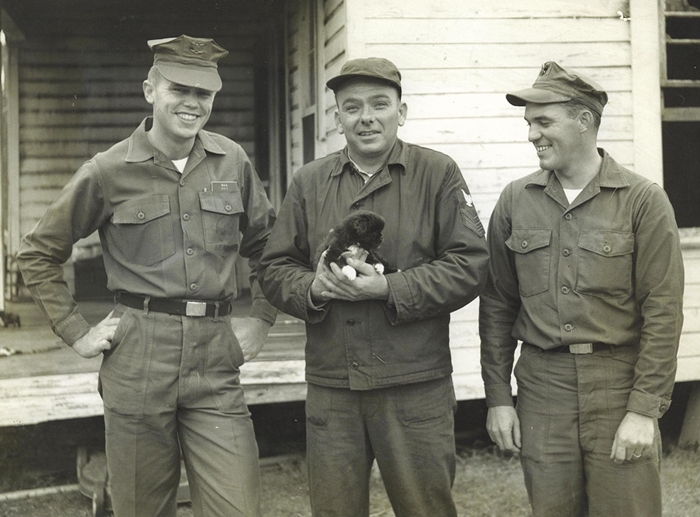
Ken on the left.
The puppy had been rescued from a house fire.
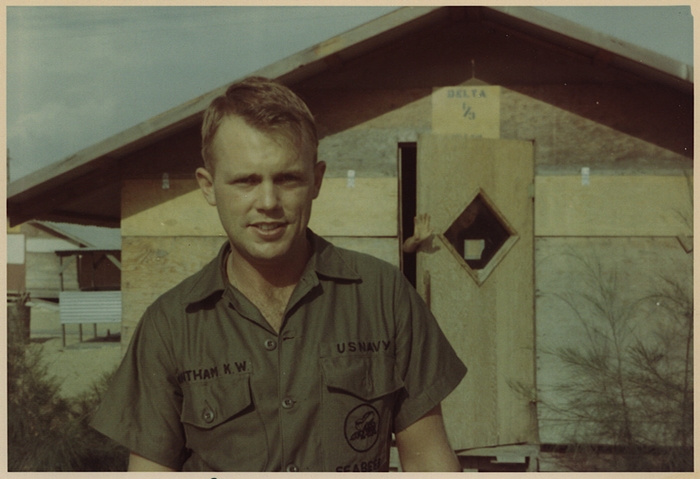
Circa 1967Camp Haskins
Notice the guy waving in the background.
On November 3, 1967, a fellow Seabee had an accident with a saw while cutting some wood. A sawhorse shifted and the man injured himself, accidentally. The blade cut an artery in his thigh and Ken’s Corpsman training kicked in. He, literally, stuck his hand into the guy’s thigh to clamp the artery with his thumb and forefinger. When the rescue helicopter arrived, the coagulated blood on Ken’s arm prevented him from being able to remove his hand from the guy’s thigh. Ken got a free ride in the helicopter to the hospital with his charge. A life was saved (the actual details are pretty gruesome).
A life saved…
And, this concludes my long-ass tribute to my Fleet Navy/Vietnam Seabee veteran. If you have a veteran in your life…hug them. ~Vic
[Addendum: When I moved in with Ken some years ago, I was looking at his DD-214. He swore he only had one and I saw from the data that he had two. We sent off for his records and, sure enough, there were two. I discovered that, when he went to the prior service recruiter, the guy didn’t bother to check to see if Ken was still on contract. He was and, had he checked, Ken could have returned to the Navy, with rank intact, and left for Vietnam as part of the Brown Water Navy…and most likely died. The life span of PBR guys was fairly short.]
On July 1, 1940, the Tacoma Narrows Bridge was opened to traffic. This picture, taken from the air during dedication ceremonies, plainly shows three unusual characteristics of design: (1) Extremely narrow deck – 39′; (2) extreme length of suspension span – 2800′; (3) the solid stiffening girders used in the place of orthodox truss girders. Use of the solid girders is commonly blamed for the collapse.
Image Credit: tacomanarrowsbridge.org
Notice the view of the car in the center of the twist.
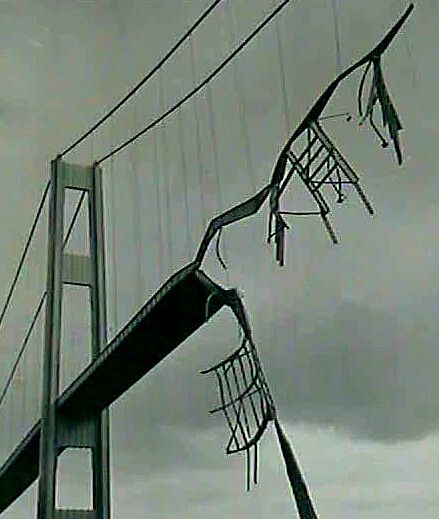
Construction began in September 1938. From the time the deck was built, it began to move vertically in windy conditions, so, construction workers nicknamed the bridge Galloping Gertie. The motion continued after the bridge opened to the public, despite several damping measures. The bridge’s main span finally collapsed in 40-mile-per-hour (64 km/h) winds on the morning of November 7, 1940. Efforts to replace the bridge were delayed by the United States’ entry into World War II […]. The portion of the bridge that fell into the water now serves as an artificial reef.
The bridge’s collapse had a lasting effect on science and engineering. In many physics textbooks, the event is presented as an example of elementary forced resonance. [The] bridge collapsed because normal speed winds produced aeroelastic flutter that matched the bridge’s natural frequency. The collapse boosted research into bridge aerodynamics-aeroelastics, which has influenced the designs of all later long-span bridges.
I saw the Narrows bridge die today and only by the grace of God, escaped dying with it…
I drove on the bridge and started across. Just as I drove past the towers, the bridge began to sway violently from side to side. Before I realized it, the tilt became so violent that I lost control of the car…I jammed on the brakes and got out, only to be thrown onto my face against the curb. Around me I could hear concrete cracking. The car, itself, began to slide from side to side on the roadway. I decided the bridge was breaking up and my only hope was to get back to shore. On hands and knees most of the time, I crawled 500 yards or more to the towers. My breath was coming in gasps…my knees were raw and bleeding, my hands bruised and swollen from gripping the concrete curb. Toward the last, I risked rising to my feet and running a few yards at a time. Safely back at the toll plaza, I saw the bridge in its final collapse and saw my car plunge into the Narrows.
Some Bridge Facts:
♦ [The] entire 1940 bridge did not collapse into the water, though most of the center span did fall. The side spans were badly damaged and the 2 big towers got bent beyond repair […]. It would be 10 years before the bridge was replaced.
♦ [Due] to the undulating motions up and down […], you could be driving across it and, the car ahead of you might dip out of view. Sometimes the roadway would rise above the height of a car […].
♦ The 1940 bridge remains at the bottom of the water have provided a place for sealife [sic] that was not there, before and much of the life includes the giant Pacific octopus as well as lingcod, wolf eels and black seabass [sic].
♦ (Referencing the image at the very top…) Did a ship go under the bridge for opening day in 1940? Yes, it is true…the ship Atlanta was a Coast Guard Cutter. Ironically, not only was it the first ship to go under the bridge on opening day July 1, 1940, it was also the last ship to travel under the bridge before it collapsed […]. When the concrete started to crumble and fall off, the ship was underneath and pieces fell on her deck. Luckily, no pieces were big enough to cause any damage to the ship and the ship’s Commander was one of the first to report the collapse.
A suicide bomber drives a truck packed with explosives into the U.S. Marine barracks in Beirut, killing 241 U.S. military personnel. That same morning, 58 French soldiers were killed in their barracks two miles away in a separate suicide terrorist attack. The U.S. Marines were part of a multinational force sent to Lebanon in August 1982 to oversee the Palestinian withdrawal from Lebanon.
In 1975, a bloody civil war erupted in Lebanon, with Palestinian and leftist Muslim guerrillas battling militias of the Christian Phalange Party, the Maronite Christian community and other groups. During the next few years, Syrian, Israeli and United Nations interventions failed to resolve the factional fighting and, on August 20, 1982, a multinational force including 800 U.S. Marines was ordered to Beirut to help coordinate the Palestinian withdrawal.
[Following] the massacre of Palestinian refugees by a Christian militia, [the] next day, the first U.S. Marine to die during the mission was killed while defusing a bomb. Other Marines fell prey to snipers. On April 18, 1983, a suicide bomber driving a van devastated the U.S. embassy in Beirut, killing 63 people, including 17 Americans. Then, on October 23, a Lebanese terrorist plowed his bomb-laden truck through three guard posts, a barbed-wire fence and into the lobby of the Marines Corps headquarters in Beirut. [He] detonated a massive bomb killing 241 Marine, Navy and Army personnel. The bomb, which was made of a sophisticated explosive enhanced by gas, had an explosive power equivalent to 18,000 pounds of dynamite. The identities of the embassy and barracks bombers were not determined but, they were suspected to be Shiite terrorists associated with Iran.
Serious questions also arose over the quality of security in the American sector of war-torn Beirut. The U.S. peacekeeping force occupied an exposed area near the airport but, for political reasons, the Marine Commander had not been allowed to maintain a completely secure perimeter before the attack.
On February 26, 1984, the main force of Marines left Lebanon, leaving just a small contingent to guard the U.S. embassy in Beirut.
This one hits home. One of the Marines killed in that bombing graduated from my high school. He graduated in 1982 (two years ahead of me) and I never got to meet him but, I knew his younger brother whom was a year behind me. Many years later, I wound up married to the Corps for 12 years. My ex and I visited the Beirut Bombing Memorial in Jacksonville when he returned from Iraq War duty. I took pictures but, I don’t remember what happened to them. ~Vic
The Battle of Largs was an indecisive engagement between the kingdoms of Norway and Scotland, on the Firth of Clyde near Largs, Scotland. The conflict formed part of the Norwegian expedition against Scotland in 1263, in which Haakon Haakonsson, King of Norway, attempted to reassert Norwegian sovereignty over the western seaboard of Scotland. Since the beginning of the 12th century, this region had lain within the Norwegian realm, ruled by magnates who recognised the overlordship of the Kings of Norway. In the mid-13th century, two Scottish kings, Alexander II and his son, Alexander III, attempted to incorporate the region into their own realm. Following failed attempts to purchase the islands from the Norwegian king, the Scots launched military operations. Haakon responded to the Scottish aggression by leading a massive fleet from Norway, which reached the Hebrides in the summer of 1263. By the end of September, Haakon’s fleet occupied the Firth of Clyde, and when negotiations between the kingdoms broke down, he brought the bulk of his fleet to anchor off The Cumbraes.
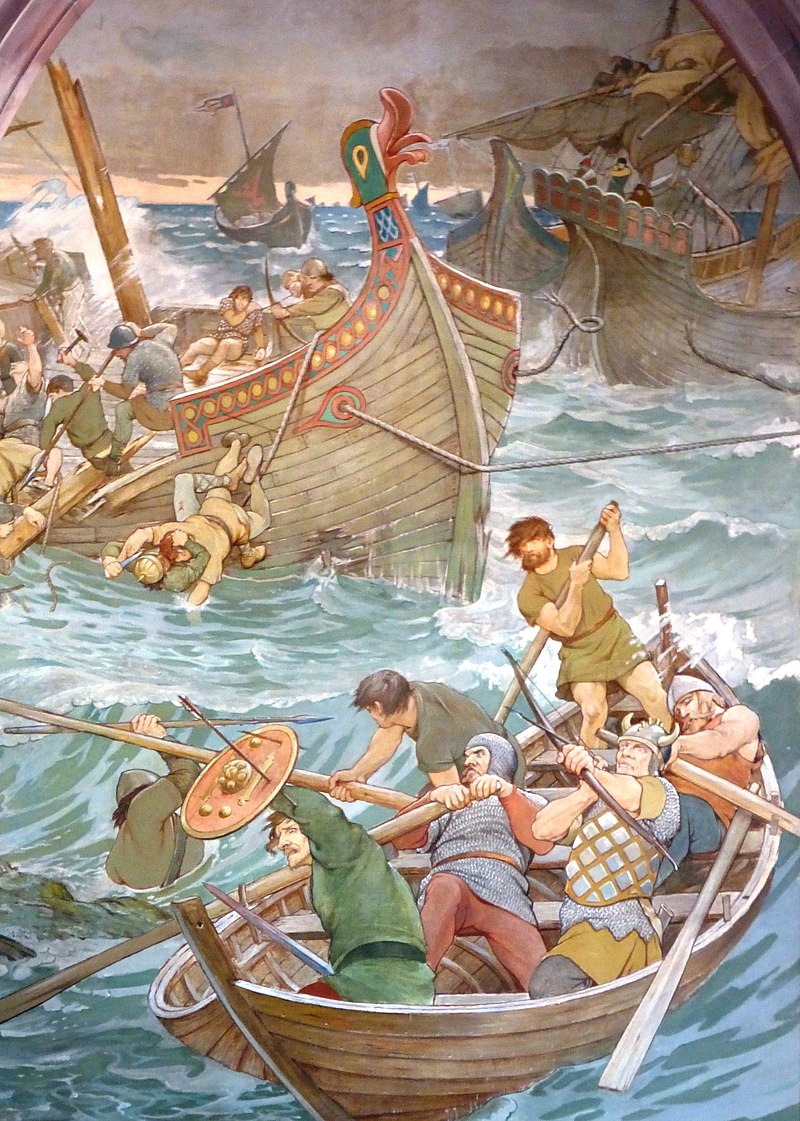
On the night of September 30, during a bout of stormy weather, several Norwegian vessels were driven aground on the Ayrshire coast, near present-day Largs. On October 2 , while the Norwegians were salvaging their vessels, the main Scottish army arrived on the scene. Composed of infantry and cavalry, the Scottish force was commanded by Alexander of Dundonald, Steward of Scotland. The Norwegians were gathered in two groups:
the larger main force on the beach and a small contingent atop a nearby mound.
The advance of the Scots threatened to divide the Norwegian forces, so the contingent on the mound ran to rejoin their comrades on the beach below. Seeing them running from the mound, the Norwegians on the beach believed they were retreating, and fled back towards the ships. There was fierce fighting on the beach, and the Scots took up a position on the mound formerly held by the Norwegians. Late in the day, after several hours of skirmishing, the Norwegians recaptured the mound. The Scots withdrew from the scene and the Norwegians re-boarded their ships. They returned the next morning to collect their dead. With the weather deteriorating, Haakon’s fleet sailed to Orkney to overwinter.
The Battle of Largs has been romanticised by [some] later historians as a great Scottish victory but, it only involved a small part of the Norwegian fleet. [Another] saga described the Norwegian campaign as a triumph [but], in reality, it had not achieved anything […]. With his fleet and forces intact, Haakon planned to continue to campaign after spending the winter in Orkney but, he was unexpectedly taken ill and, died there before he had the chance to resume operations. The campaign had started too late and the Scottish king had successfully prolonged negotiations to his own advantage. With Haakon’s death, his successor, Magnus Haakonarson, King of Norway, signed the Treaty of Perth three years after the battle (July 2, 1266), leasing Scotland’s western seaboard to Alexander III in return for a yearly payment. This lease became permanent but, the Kingdom of Scotland eventually stopped paying the Norwegian crown for the islands when Norway became distracted by civil wars.
One-hundred, ninety-nine years ago, today, the realDaniel Boone passed away. Two days prior, I posted about the television show Daniel Boone that was hardly accurate in its portrayal or his frame of life despite being a popular show.
On September 26, 1820 the great pioneering frontiersman Daniel Boone dies quietly in his sleep at his son’s home near present-day Defiance, Missouri.
The indefatigable voyager was 86. Boone was born in 1734 (he has two different dates of birth due to the 1752 Gregorian calendar switch) to Quaker parents living in Berks County, Pennsylvania. Following a squabble with the Pennsylvania Quakers, Boone’s family decided to head south and west for less crowded regions and they eventually settled in the Yadkin Valley of North Carolina. There the young Daniel Boone began his life-long love for wilderness, spending long days exploring the still relatively unspoiled forests and mountains of the region. An indifferent student who never learned to write more than a crude sentence or two, Boone’s passion was for the outdoors, and he quickly became a superb marksman, hunter and woodsman. (It should be noted here that historian John Mack Faragher stated that Boone “acquired a level of literacy that was the equal of most men of his times. He was often the only literate person in groups of frontiersmen.”)
In May of 1769, Boone and five companions crossed over the Cumberland Gap and explored along the south fork of the Kentucky River. Boone returned in 1773 with his family, hoping to establish a permanent settlement. An Indian attack prevented that first attempt from succeeding (Boone’s eldest son James and, William Russell‘s son Henry were captured and tortured to death, a prelude to Dunmore’s War.) but, Boone returned two years later to open the route that became known as Boone’s Trace (or the Wilderness Road) between the Cumberland Gap and a new settlement along the Kentucky River called Fortress Boonesboro. Boonesboro eventually became one of the most important gateways for the early American settlement of the Trans-Appalachian West.
After the French and Indian War (1754–1763) broke out between the French and British, and their respective Indian allies, North Carolina Governor Matthew Rowan called up a militia, for which Boone volunteered. He served under Captain Hugh Waddell on the North Carolina frontier. Waddell’s unit was assigned to serve in the command of General Edward Braddock […].
Boone served in the North Carolina militia during [the] “Cherokee Uprising“. His militia expeditions went deep into Cherokee territory beyond the Blue Ridge Mountains and he was separated from his wife for about two years.
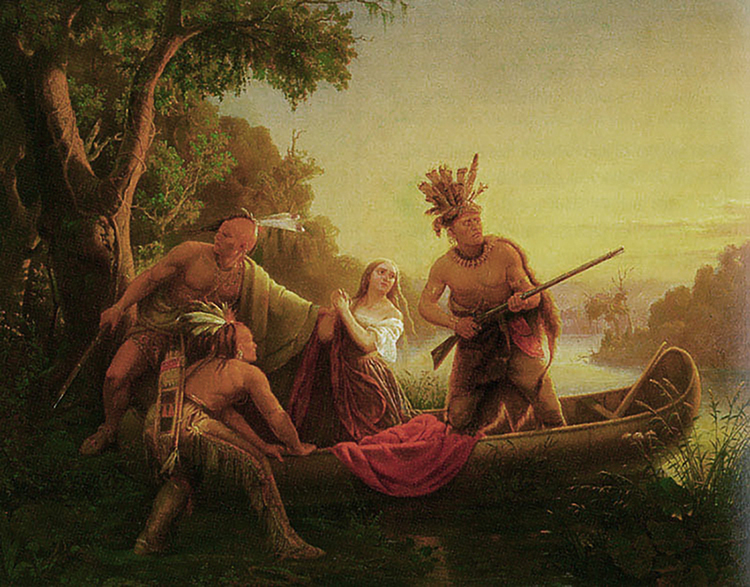
On December 22, 1769, Boone and a fellow hunter, Benjamin Cutbirth, were captured by a party of Shawnees, who confiscated all of their skins and told them to leave and never return.
Image Credit: wikipedia.org & wikimedia.org Charles Wimar 1853
[During the Revolutionary War], Boone’s daughter Jemima and two other teenaged girls were captured outside Boonesborough by an Indian war party on July 5, 1776. The incident became the most celebrated event of Boone’s life. James Fenimore Cooper created a fictionalized version of the episode in his classic novel The Last of the Mohicans (1826).
He lived quite an eventful life.
♦ In February 1778, Boone was adopted into the Shawnee tribe as a prisoner to replace a fallen warrior (a Shawnee custom) and was named Sheltowee (Big Turtle), eventually escaping.
♦ In September 1778, he was court-martialed due to misunderstandings during the Siege of Boonesborough.
♦ There is some indication that Boone crossed paths with Abraham Lincoln’s grandfather.
♦ In 1780, Boone was [a] Lieutenant Colonel in the Fayette County militia. In October, his brother Ned was killed by Shawnees and beheaded for a trophy, as the they thought they had killed Boone.
♦ In 1781, he was elected as a representative to the Virginia General Assembly.
♦ [Traveling] to Richmond to take his seat in the legislature, […] British dragoons under Banastre Tarleton captured Boone and several other legislators near Charlottesville. The British released Boone on parole several days later.
♦ In 1782, he was elected sheriff of Fayette County.
♦ By 1787, he owned seven slaves.
♦ In 1798, a warrant was issued for Boone’s arrest after he ignored a summons to testify in a court case, although the sheriff never found him.
♦ Also in 1798, the Kentucky assembly named Boone County in his honor.
♦ From 1799 to 1804, he served as syndic and commandant, appointed by the Spanish governor of Spanish Louisiana (now St. Charles County, Missouri).
♦ American painter John James Audubon claimed to have gone hunting with Boone in the woods of Kentucky around 1810 (some historians believe Boone visited his brother Squire near Kentucky in 1810).
♦ Boone died of natural causes at his son Nathan’s home. He was 85.
Much like June 14, June 28 is also a very interesting day. It marks the beginning and ending of The Great War or, The War to End All Wars. Though true that the guns fell silent on the eleventh hour of the eleventh day of the eleventh month with the signing of the Armistice in a railroad car in Compiègne, France, today’s date serves as solid markers in the timeline. ~Vic
Image Credit: smithsonianmag.com
On this day in 1914, Archduke Franz Ferdinand of Austria and his wife Sophie are shot to death by a Bosnian Serb nationalist during an official visit to the Bosnian capital of Sarajevo. The archduke traveled to Sarajevo […] to inspect the imperial armed forces in Bosnia and Herzegovina, annexed by Austria-Hungary in 1908. The annexation had angered Serbian nationalists, who believed the territories should be part of Serbia. A group of young nationalists hatched a plot to kill the archduke during his visit to Sarajevo and, after some missteps, 19-year-old Gavrilo Princip was able to shoot the royal couple at point-blank range, while they traveled in their official procession, killing both, almost instantly.
The assassination set off a rapid chain of events, as Austria-Hungary immediately blamed the Serbian government for the attack. As large, powerful Russia supported Serbia, Austria asked for assurances that Germany would step in on its side against Russia, and its allies, including France and possibly Great Britain. On July 28, Austria-Hungary declared war on Serbia and the fragile peace between Europe’s great powers collapsed, beginning the devastating conflict now known as the First World War.
World War I officially ended with the signing of the Treaty of Versailles [on this day in] 1919. The treaty, negotiated between January and June […] in Paris, was written by the Allies with almost no participation by the Germans. The negotiations revealed a split between the French, who wanted to dismember Germany to make it impossible for it to renew war with France and, the British and Americans, who did not want to create pretexts for a new war. The eventual treaty included 15 parts, […] 440 articles, […] reassigned German boundaries and assigned liability for reparations.
The German government signed the treaty under protest. The U.S. Senate refused to ratify the treaty and the U.S. government took no responsibility for most of its provisions.
For five years the French and the Belgians tried to enforce the treaty quite rigorously […]. In 1924, however, Anglo-American financial pressure compelled France to scale down its goals and end the occupation. […] The French assented to modifying important provisions of the treaty in a series of new agreements. Germany in 1924, and 1929, agreed to pay reparations under the Dawes Plan and the Young Plan but, the Great Depression led to the cancellation of reparations in 1932. Hitler denounced the treaty altogether in 1935.
One can never know whether either rigorous Franco-British enforcement of the original treaty or a more generous treaty would have avoided a new war.
June 14 was a banner day for the countries of France, Lithuania and Poland. Except for reading the words, we, today, have no clue what these people went through. ~Vic
Paris started mobilizing for war in September 1939 when Nazi Germany, and their allied Soviet Union, according to the Ribbentrop-Molotov Treaty, invaded Poland. […] the war seemed far away until May 10, 1940, when the Germans attacked France and quickly defeated the French army. The French government departed Paris on June 10 and the Germans occupied the city on June 14.
In the spring of 1939, war with Germany already seemed inevitable. On March 10, the city began to distribute gas masks to civilians and on March 19, signs were posted guiding Parisians to the nearest shelters. On August 31, anticipating bombardment, the French government began to evacuate 30,000 children out of the city […]. On September 1, news reached Paris that Germany had invaded Poland, and France, as expected, promptly declared war on Germany. […] in February 1940, ration cards for food were issued [..].
The French defense plan was purely passive, waiting for the Germans to attack. After eight months of relative calm, […] the Germans struck France on May 10, 1940, bypassing the Maginot Line and slipping through the Ardennes. On June 3, the Germans bombed Paris and its suburbs for the first time […]. On June 8, the sound of distant artillery fire could be heard in the capital. On 10 June, the French government fled Paris […]. On June 12, the French government, in Tours, declared Paris to be an open city [and] that there would be no resistance. At 5:30 in the morning of June 14, the first German advance guard entered the city […]. By the end of the afternoon, the Germans had hung a swastika flag at the Arc de Triomphe […].
Image Credit: wikipedia.org & Renata3
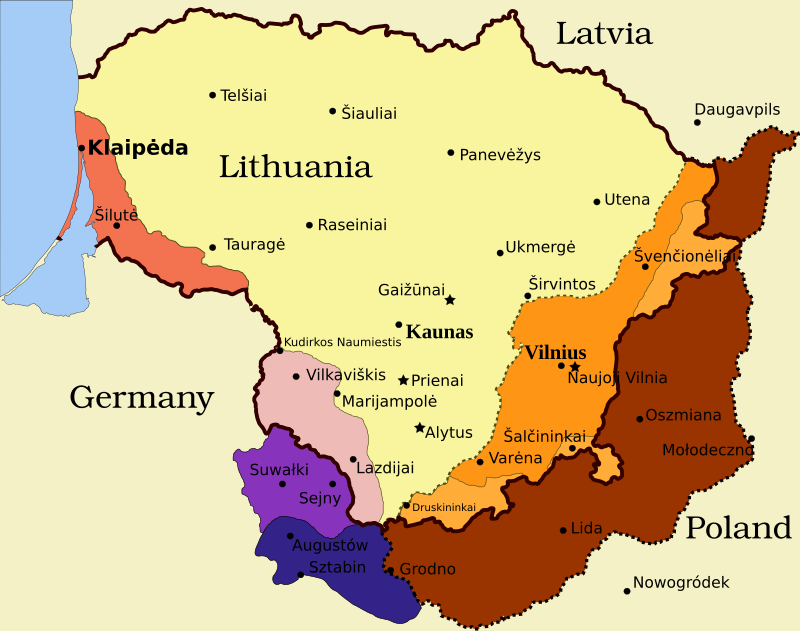
According to the Soviet–Lithuanian Mutual Assistance Treaty, Lithuania agreed to allow Soviet military bases (marked in black stars) in exchange for a portion of the Vilnius Region (in orange).
The Soviet Union issued an ultimatum to Lithuania before midnight of June 14, 1940. The Soviets, using a formal pretext, demanded to allow an unspecified number of Soviet soldiers to enter the Lithuanian territory and to form a new pro-Soviet government […]. The ultimatum and subsequent incorporation of Lithuania into the Soviet Union stemmed from the division of Eastern Europe into the German and Russian spheres of influence in the Molotov–Ribbentrop Pact of August 1939. Lithuania, along with Latvia and Estonia, fell into the Russian sphere. Despite the threat to the independence, Lithuanian authorities did little to plan for contingencies and were unprepared for the ultimatum. With Soviet troops already stationed in the country according to the Mutual Assistance Treaty, it was impossible to mount effective military resistance. On June 15, Lithuania unconditionally accepted the ultimatum and lost its independence.
The first mass transport of prisoners by Nazi Germany to Auschwitz Concentration Camp was organized in occupied Poland on June 14, 1940, during World War II. The transport departed from the southern Polish city of Tarnów and, consisted of 728 Poles and 20 Polish Jews. They were dubbed ‘political prisoners’ and members of the Polish resistance. Most were Catholics, since the mass deportations of Jews had not yet begun. All were sent to Auschwitz by the German Security Police. They were transported there from a regular prison in Tarnów where they had been incarcerated as enemies of the Nazi regime. Numbers were tattooed on the prisoners’ arms in the order of their arrival […]. These inmates were assigned the numbers 31 through 758, with numbers 1 through 30 having been reserved for a group of German criminals who were brought to Auschwitz from Sachsenhausen on May 20 and became the first Auschwitz kapos.



















 Cosmic-Observation