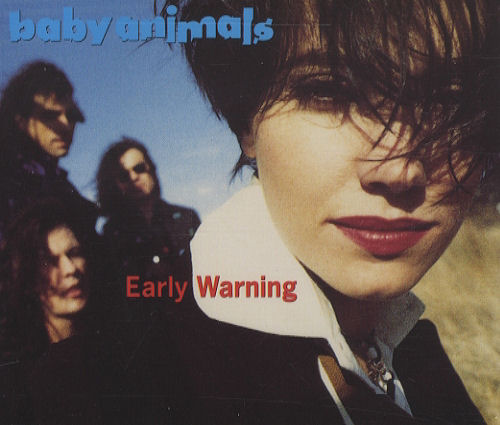
I discovered this band when their third track Painless was released in the US in November 1991. Suze’s voice is stunning and powerful and, her band is as hard rocking as any from Downunder. I bought the CD and there’s not a bad song on it. It deserved Album of the Year. They broke up in 1996 but, reformed in 2007. They continue to perform and record.
Image Credit: Doubleday Philip K. Dick 1974
First Edition Hardcover
wikipedia.org & wikimedia.org
Lyrics:
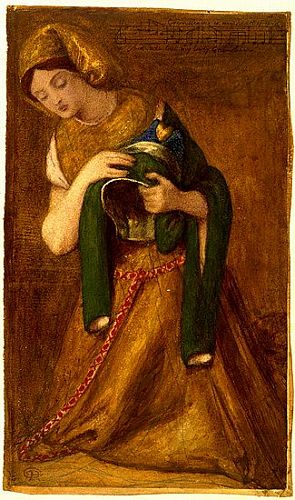
Flow, my tears, fall from your springs!
Exiled for ever, let me mourn;
Where night’s black bird her sad infamy sings,
There let me live forlorn.
Down vain lights, shine you no more!
No nights are dark enough for those
That in despair their last fortunes deplore.
Light doth but shame disclose.
Never may my woes be relieved,
Since pity is fled;
And tears and sighs and groans my weary days, my weary days
Of all joys have deprived.
From the highest spire of contentment
My fortune is thrown;
And fear and grief and pain for my deserts, for my deserts
Are my hopes, since hope is gone.
Hark! you shadows that in darkness dwell,
Learn to contemn light
Happy, happy they that in hell
Feel not the world’s despite.
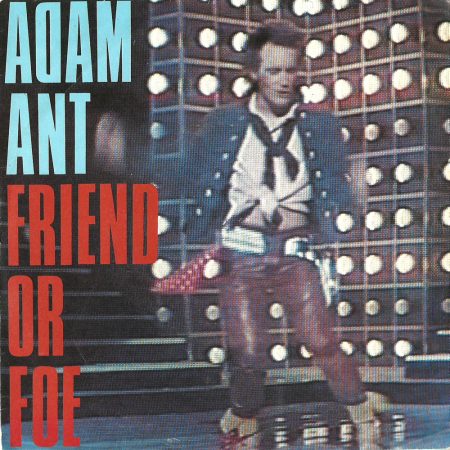
Rolling down the Samsung playlist for a Sunday evening submission, we come to Adam Ant or, Stuart Leslie Goddard and Desperate But Not Serious. The fourth track from the album Friend or Foe, it was co-written by Goddard and Marco Pirroni and, released November 19, 1982, the third single from his solo debut. This is the album that brought us Goody Two Shoes that went to number #1 in Australia and the UK. Desperate didn’t fare as well peaking at #33 in the UK and #66 on Billboard’s Hot 100.
I bought the album as a cassette and nearly wore it out. This is what I term as eclectic music. It’s different, it’s catchy, Goddard has a crazy voice that he plays to the hilt and the writing is very coy and, tongue-in-cheek. He will be at The Paramount Theatre in Austin, Texas, April 28, 2021. I’ve been to that venue many times. I would love to see him there. ~Vic
A widespread belief exists that the song Greensleeves was composed by none other than King Henry VIII following an early rejection of his love by his future wife Anne Boleyn. The lyrics of this song of unrequited love have been seen to relate to his courtship of Anne in the 1520s. Many of the verses of Greensleeves imply a rich and extravagant courtship […]. Henry VIII was a composer and musician of some merit […]. [C]ourt officials […] attribute to Henry many compositions which were not his and the consensus of expert opinion, today, is that Greensleeves was composed rather later in the Tudor era, during the reign of Anne Boleyn’s daughter, Queen Elizabeth I. [T]he piece is based on an Italian style of composition that did not reach England until after Henry’s death […].
Origins
A broadside ballad […] was registered at the London Stationer’s Company in September [of] 1580, by [a] Richard Jones, as A Newe Northern Dittye of ye Ladye Greene Sleves. Six more ballads followed in less than a year, one on the same day […]. Needless to say the rights to the song were in very hot dispute. It was in 1584 that Jones printed his final version of the melody and this is the one we know today. It was titled A New Courtly Sonnet of the Lady Green Sleeves […].
[W]hy would anyone be named for their green sleeves? Interpretations […] usually have a sexual connotation, most notably in the phrase “a green gown”, a reference to the grass stains on a woman’s dress from engaging in sexual intercourse outdoors. Was this lady a prostitute? [T]he song lyrics mention a “discourteous” rejection of the singer’s advances, suggesting to some that the lady in question was actually virtuous but, perhaps, was mistaken for a prostitute as a result of her green sleeves. [A]nother explanation is quite the opposite to promiscuity […]. [I]n heraldry, colour also had symbolisms and green indicated truth and fidelity […]. [A] knight may give a green armband to his true love to wear to show his devotion to her, giving rise to the familiar phrase “wearing your heart on your sleeve” meaning, to show your true feelings.
None of these theories, however, really seem to reflect the song’s true meaning, which clearly expresses an unrequited love by a rich man for a fair lady. All that we can confidently deduce, is that “Lady Greensleeves” is a nickname, not a title. Exactly who she was, remains a mystery.
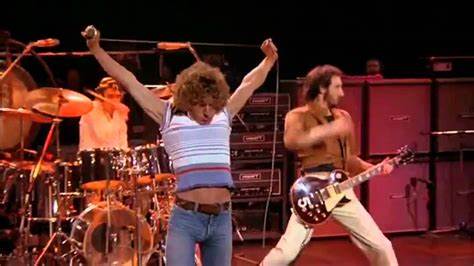
A blending of two names, Meher Baba and Terry Riley (philosophical and musical mentors to Pete Townsend), Baba O’Riley was introduced to the world in August 1971 and was the lead track on the album Who’s Next. Written by Townsend, it was originally intended for his Lifehouse rock opera, a future follow-up to Tommy. That never came to pass but, a Lifehouse Chronicles box set was released in 2000.
Update:
The blog continues to evolve and Song Saturday has changed to Song Sunday. ~Vic
“It’s gonna take a lot to drag me away from you…”
Changing things a bit. I’ve got Music Mondays and I’ve had Tune Tuesdays (I may return to that) that showcase music by release date, in five year increments (if I can). Early on, I listed number ones, only. There was also my jump into the 30-Day Song Challenge back in December 2018. Now, I’m stretching Saturday out a bit for some music, too…an idea I got from the Nostalgic Italian. I might even stretch it to Sunday, if I take a notion to. It just depends upon my mood. All blogs evolve and, I’m always looking for new and different things.
This is a song on my playlist on my phone. I have a lot of music on my phone…things that I love to hear when I go out for my afternoon and evening walks or, just sitting in my Adirondack chair, watching the sunset. ~Vic
Paich recalls writing Africa on his living room piano.
“Over many years, I had been taken by the UNICEF ads with the pictures of Africa and the starving children. I had always wanted to do something to connect with that and bring more attention to the continent. I wanted to go there, too, so, I sort of invented a song that put me in Africa. I was hearing the melody in my head and, I sat down and played the music in about 10 minutes. And, then, the chorus came out. I sang the chorus out as you hear it. It was like God channeling it. I thought, ‘I’m talented but, I’m not that talented. Something just happened here!'”
Paich, then, proceeded to work on the lyrics for another six months. He brought the skeleton to drummer Jeff Porcaro with the idea of having percussion being an integral part of the composition.
“Jeff got out African sticks with bottle caps that his dad (Joe Porcaro) and Emil Richards (both percussionists) used on National Geographic films. He brought in a marimba and a wooden xylophone kind of thing. This was pre-synthesizer. We didn’t have samples back then. You’re hearing bass marimba, that other instrument and you’re hearing, probably, one of the first loops that was ever done.”
Sadly, Jeff Porcaro passed away nearly ten years later.
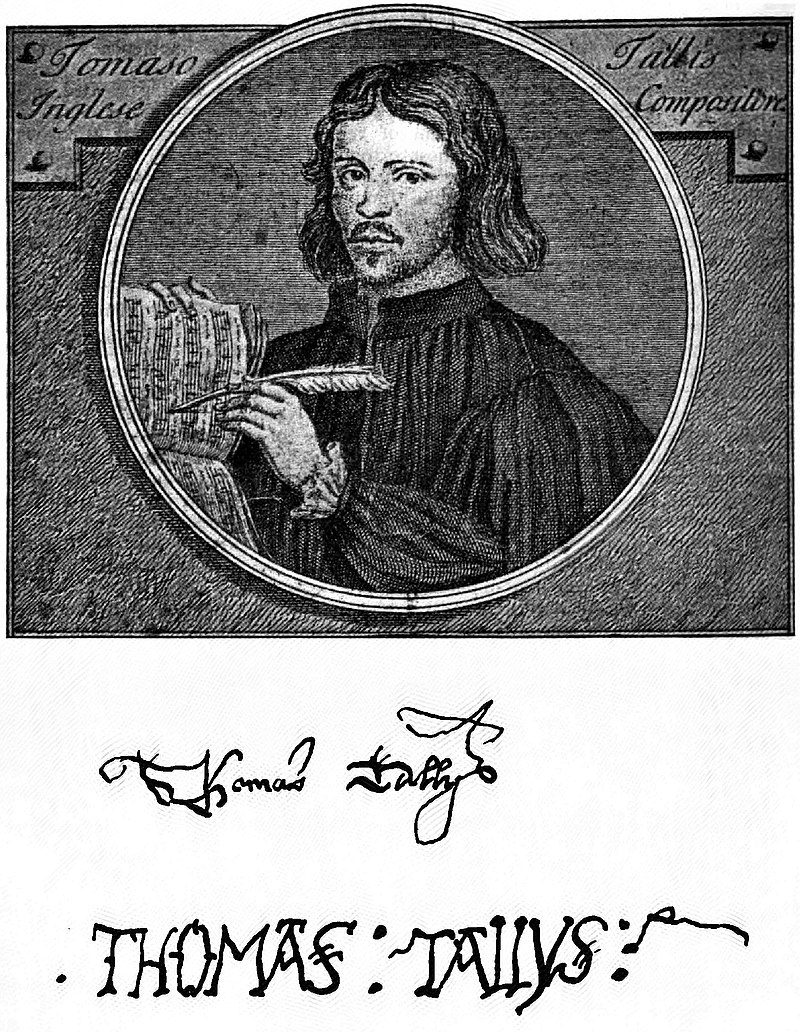
Spem in Alium is Latin for “hope in any other” or “hope in another”. A 40-part Renaissance Motet, it was composed in 1570 (thereabouts) by Thomas Tallis (Tallys). Written for eight choirs of five voices each, meaning there are 40 separate voices singing individual lines of music, it is considered to be Tallis’s greatest achievement and, possibly, one of the finest compositions of all time.
Information on where it was first performed is scarce. There appears to be some confusion regarding where it took place, as two locations…Nonsuch Palace, a royal Tudor palace in Surrey built by Henry VIII (not to be confused with Nonsuch Mansion) and Arundel House, a London townhouse originally for the Bishops of Bath & Wells…were both owned by Henry Fitzalan, the 12th/19th Earl of Arundel at one time. Most of what I have read leans towards Arundel House but, truly, I don’t think anyone really knows. It’s all a big guess. And, it is pure speculation as to why he wrote it. Some suggestions include a challenge due to an Italian composer doing same, Elizabeth’s 40th birthday or, perhaps for Mary as he was Catholic. Again, no one really knows.
The music, below, is soul stirring. ~Vic
Artist: Wenceslaus Hollar Arundel House
Image Credit: wikipedia.org & wikimedia.org
Spem in alium nunquam habui
Praeter in te, Deus Israel
Qui irasceris et propitius eris
et omnia peccata hominum
in tribulatione dimittis
Domine Deus
Creator caeli et terrae
respice humilitatem nostram
Artist: Georg Hoefnagel 1568
Watercolour of the south frontage of Nonsuch Palace
Image Credit: wikipedia.org & wikimedia.org
English Translation:
I have never put my hope in any other
but in Thee, God of Israel
who canst show both wrath and graciousness,
and who absolves all the sins
of man in suffering
Lord God,
Creator of Heaven and Earth
Regard our humility
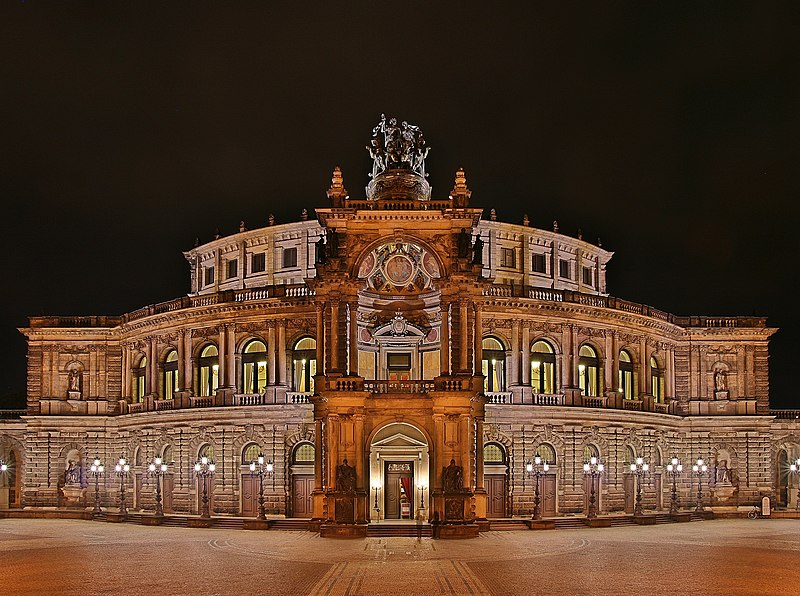
Die Semperoper in Dresden bei Nacht
The Semper Opera in Dresden at Night
Photo Credit: Sese Ingolstadt
wikipedia.org & wikimedia.org
Leaving the 1520s and entering the 1540s…
Formally known as the Sächsische Staatskapelle Dresden, the Staatskapelle Dresden is a Dresden-based German orchestra, one of the world’s oldest. Maurice, the Elector of Saxony (Prince Elector Moritz von Sachsen) founded it in 1548. Its precursor ensemble was Die Kurfürstlich-Sächsische und Königlich-Polnische Kapelle (The Electoral Saxon and Royal Polish Orchestra). The orchestra is the musical body of the Staatsoper Dresden (Dresden State Opera). The venue of the orchestra is the Semperoper.
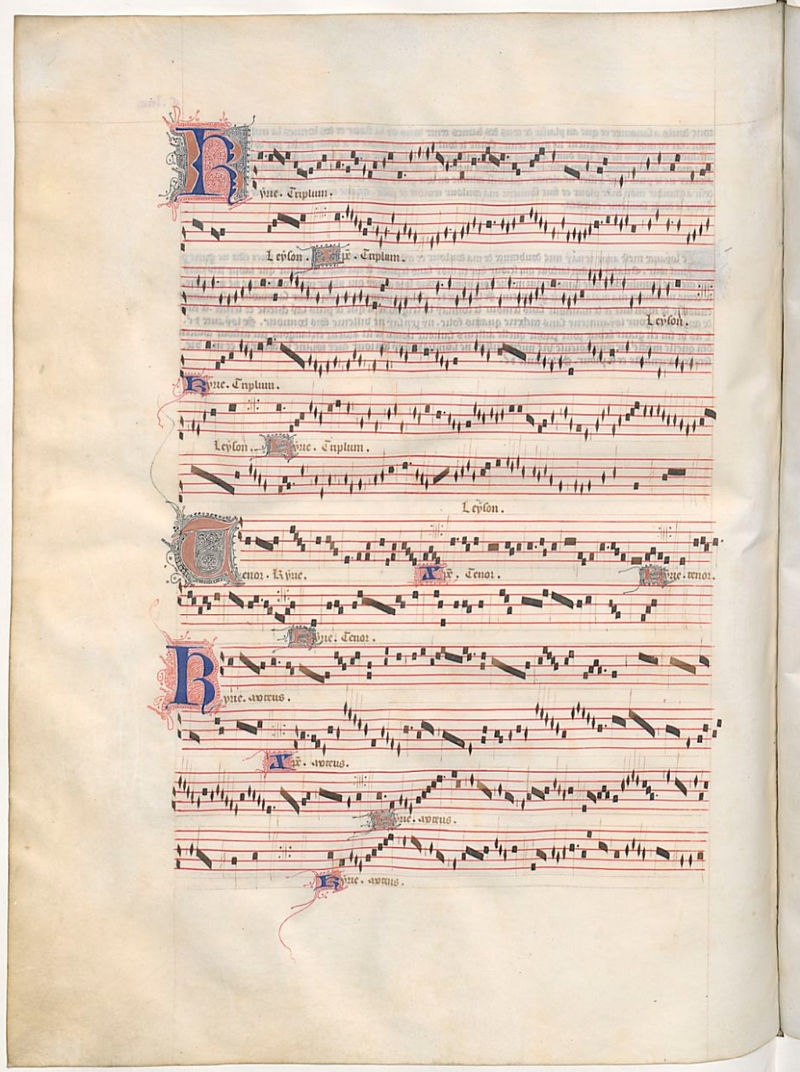
Messe de Nostre Dame (Mass of Our Lady) is a polyphonicmass composed before 1365 by French poet and composer Guillaume de Machaut […]. Widely regarded as one of the masterpieces of medieval music, and of all religious music, it is historically notable as the earliest complete setting of the Ordinary of the Mass attributable to a single composer […].
The Messe de Nostre Dame consists of 5 movements: the Kyrie (Eleison…”Lord, have mercy”), Gloria (in Excelsis Deo…”Glory to God in the highest”), Credo (Nicene Creed), Sanctus (“Holy”) and Agnus Dei (“Lamb of God”), followed by the dismissal Ite, missa est (Mass Response: Deo Gratias or “Thanks be to God”). The tenor of the Kyrie is based on Vatican Kyrie IV, the Sanctus and Agnus correspond to Vatican Mass XVII and the Ite is on Sanctus VIII. The Gloria and Credo have no apparent chant basis, although they are stylistically related to one another. Machaut’s Messe de Nostre Dame is for four voices rather than the more common three. Machaut added a contratenor voice that moved in the same low range as the tenor, sometimes replacing it as the lowest voice.
The information is rather wonky and, not only have I never studied music theory, my education on Catholic Mass is limited to a short stint as a member in an Anglican church in Austin, TX, a decade ago. That being said, what I find fascinating about this composition is that Machaut combined each part into an artistic whole, the earliest known example of it unified. Previously, the items were performed non-consecutively and, separated by prayers and chants.
[Instrumental Version of The Kyrie by Guillaume de Machaut]
[Modern Take on Kyrie by Patrick Lenk]
And, just because I could, I’m ending with Mr. Mister.
I’ve been digging around, looking for something interesting. Back in September 2019, I posted about Billboard locking down/wiping out their online charts behind a paywall. I don’t know if this is a fluke or if they got a lot of blow-back for what they did but, the charts have reappeared (their Hot 100 era). Ok. Good. Time will tell if they stay. And, I hope they did get some blow-back. Assholes.
Now that I got that off my chest, on to other stuff.
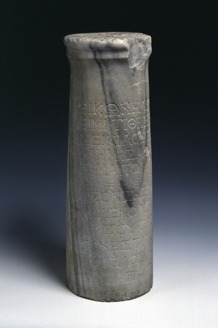
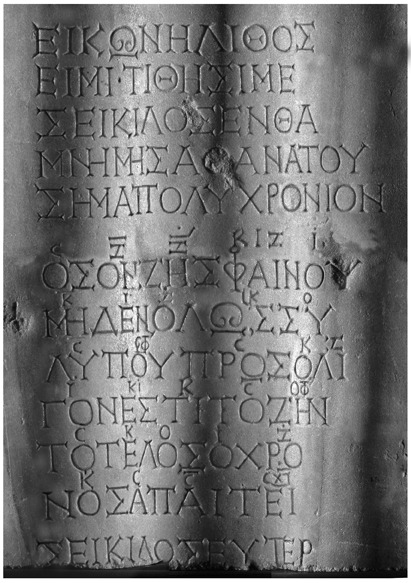
Wikipedia has a timeline of musical events (Yeah. I know. Wikipedia is hardly a bastion of truth but, seems to be a bit less haphazard with music, plants, animals, cars and finding a U.S. town.) I stumbled across the Seikilos Epitaph, a short, little marble tombstone with poetry/lyrics/text, with musical notation, written in Greek. It is unusual and unique because it is the oldest, intact musical composition in the world. It was found in Tralles, Turkey, an ancient, Hellenistic town where Aydin exists, now. The lyrics:
Εἰκὼν ἤ λίθος εἰμί. τίθησί με Σεικίλος ἔνθα μνήμης ἀθανάτου σῆμα πολυχρόνιον.
eikṑn ḗ líthos eimí. títhēsí me Seikílos éntha mnḗmēs athanátou sêma polukhrónion.
“I am a tombstone, an image. Seikilos placed me here as a long-lasting sign of deathless remembrance.”
The dating of the tombstone has proven elusive. The range is from the first century B.C to the first or second century A.D. based upon paleography.
Take a listen:
Here is another version, based upon the inscription being dedicated to a wife: Song of Seikilos (Classic FM website)
[Note: I originally posted this, yesterday, just before midnight. In researching the data, I stumbled across Bill Owens, a photographer that was at Altamont. He was hired by the Associated Press to cover the concert. I emailed him, reference the two photos of his I posted. I hit ‘publish’ before I found his contact page and statement about photos for sale. In my haste to get this up while it was still Friday, I jumped the gun and quickly made the post private. I asked Bill what the price would be to use two of his pictures. As a photographer myself, I understand copyright issues but, I also recognize the gray area that many a blogger operate in, in the blogosphere….Fair Use (link on that, below). Anyway, this very kind gentleman has allowed my one-time use for this 50th anniversary post. He also provided me with a copy of an interview, conducted by Tony D’Souza in April 2019, covering his Altamont experience and other questions regarding his career. I will post an excerpt and attach the full interview, below. ~Vic]
[It’s] not every day that a rock and roll band’s performance, let alone the Rolling Stones’, is accompanied by a knifing, stomping murder within a scream of the stage.
“The violence,” Keith Richard told the London Evening Standard, “just in front of the stage was incredible. Looking back, I don’t think it was a good idea to have [Hells] Angels there. But, we had them at the suggestion of the Grateful Dead. The trouble is, it’s a problem for us either way. If you don’t have them to work for you as stewards, they come, anyway and cause trouble. But, to be fair, out of the whole 300 Angels working as stewards, the vast majority did what they were supposed to do, which was to regulate the crowds as much as possible without causing any trouble. But, there were about ten or twenty who were completely out of their minds…trying to drive their motorcycles through the middle of the crowds.”
The Maysles Brothers, the film company which had shot the whole Stones’ tour, complete with its violent climax at Altamont, had gotten some remarkable footage of Hunter’s killing.
Robert Hiatt, a medical resident at the Public Health Hospital in San Francisco, was the first doctor to reach 18-year-old Meredith Hunter after the fatal wounds. He was behind the stage and responded to Jagger’s call from the stage for a doctor. When Hiatt got to the scene, people were trying to get Hunter up on the stage, apparently in the hope that the Stones would stop playing and help could get through quicker.
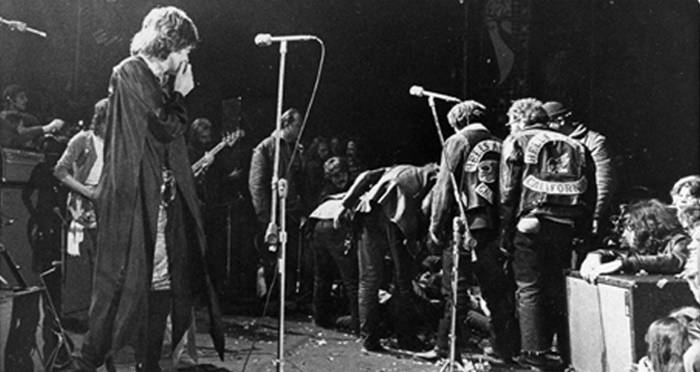
Stones on stage with Hells Angels.
Photo Credit: allthatsinteresting.com
Three others […] died (two in a hit-and-run accident, another by drowning) and, countless more were injured and wounded during the course of this daylong “free” concert. It was such a bad trip that it was almost perfect. All it lacked was mass rioting and the murder of one or more musicians.
All these things happened, and worse. Altamont was the product of diabolical egotism, hype, ineptitude, money manipulation and, at base, a fundamental lack of concern for humanity.
Bill Owens took iconic photos of the Hells Angels beating concertgoers with pool cue sticks at the Rolling Stones’ performance during the Altamont Speedway Free Festival four months after Woodstock on December 6, 1969. Altamont, which included violence almost all day and one stabbing death, is considered by historians as the end of the Summer of Love and the overall 1960’s youth ethos. This series of photos include panoramas of the massive, unruly crowd, Grace Slick and Carlos Santana on stage with the press of humanity so close in, they’re clearly performing under duress.
Of that day, Owens has written: “I got a call from a friend, she said the Associated Press wanted to hire me for a day to cover a rock and roll concert. I road my motorcycle to the event. I had two Nikons, three lenses, thirteen rolls of film, a sandwich, and a jar of water.”
Owens was so fearful of retribution by the Hells Angels that he published the photos under pseudonyms. Some of the negatives were later stolen…Owens believes by the Angels. He continues to have conflicted feelings about Altamont. He had no interest in violence and took no pride in photographing it.
In 1972, Owens released a book of black and white photography called Suburbia, also, now, an American icon. Irascible, stubborn, funny, grouchy, ornery and deeply rooted in small town life, Owens is built like a middleweight puncher and wears his hair as though he was a Marine. Indeed, Owens was never a hippie but, a clean-cut newspaper photographer, husband and father, who joined the Peace Corps to serve his country and “do good.” Turning 80 this September, Owens has also had noted careers as a craft beer brewer and pub owner, a magazine publisher many times over and, is now a distiller. His books include Suburbia, Working, Leisure and many others. He is the recipient of a Guggenheim and two NEAs. His work is collected in leading museums the world over, including the Smithsonian. Recent coverage of Owens includes an April retrospective in the New York Times (link above) of his Altamont photos for the event’s impending 50th anniversary. The photos are available for viewing at Owens’ website (link above and below).
I first met Owens at the defunct Rostel Gallery in remote and far northern Dunsmuir, CA, in late August or early September of 2008 (I remember because my daughter had just been born and the event was the first outing of her life), where they were showing images from Suburbia. These are images of people embarking on a new, modern way of life that they look excited by, but also confused, as though technology and the modish styles of the time were costumes they were still getting comfortable in. Owens’ photograph of a young suburban boy wearing cowboy boots, carrying a toy rifle and riding a Big Wheel, “Ritchie,” has always haunted me, though I couldn’t say precisely why.
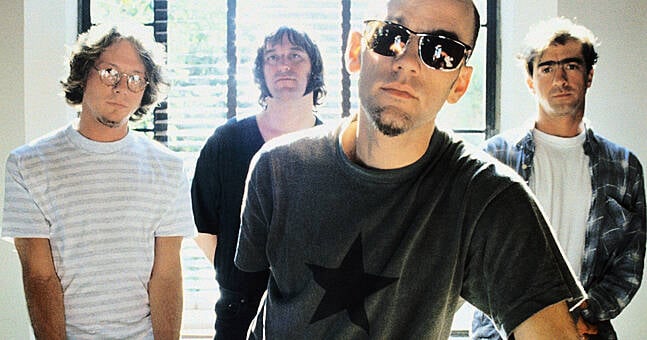
Twenty-five years ago, this week (November 26/December 2, 1994) the song Bang and Blame by R.E.M.debuted on the Billboard Alternative Songs chart (Page 119/called Modern Rock Tracks in 1994), entering at #8, making it to #1 on December 17. Released October 31, it was the second single from the album Monster, their ninth studio album. Co-produced by the band and Scott Litt, all song writing credits are the band members. The song also made it to #1 in Canada on February 20, 1995, and peaked in the top ten in the Billboard Mainstream Rock chart (Album Rock Tracks in 1994), Billboard Mainstream Top 40 chart and, in Finland, Iceland and Poland.
Lyrics (from LyricFind): If you could see yourself now, baby
It’s not my fault, you used to be so in control
You’re going to roll right over this one
Just roll me over, let me go
You’re laying blame
Take this as no, no, no, no, no
You bang, bang, bang, bang, bang
Then blame, blame, blame
You bang, bang, bang, bang, bang
It’s not my thing, so let it go
If you could see yourself now, baby
The tables have turned, the whole world hinges on your swings
Your secret life of indiscreet discretions
I’d turn the screw and leave the screen
Don’t point your finger
You know that’s not my thing
You came to bang, bang, bang, bang, bang
To blame, blame, blame
Bang, bang, bang, bang, bang
It’s not my thing, so let it go now
You’ve got a little worry
I know it all too well
I’ve got your number
But so does every kiss and tell
Who dares to cross your threshold
Happens on you way
Stop laying blame
You know that’s not my thing
You know that’s not my thing
You came to bang, bang, bang, bang, bang
Then blame, blame, blame
Bang, bang, bang, bang, bang
It’s not my thing so let it go, you
Bang, bang, bang, bang, bang
Then blame, blame, blame
Bang, bang, bang, bang, bang
It’s not my thing so let it go
You kiss on me
Tug on me
Rub on me
Jump on me
You bang on me
Beat on me
Hit on me
Let go on me
You let go on me
On the day before gathering around the turkey, gather around the nearest jukebox to celebrate National Jukebox Day! As Americans flock to their hometowns for Thanksgiving, many will head out to neighborhood bars and restaurants. They’ll catch up with friends and family and, celebrate by playing great songs on their local jukebox.
Image Credit: pinterest.com
The name jukebox is thought to originate from places called juke houses or jook joints. In the early 1900s, people congregated in these establishments to drink and listen to music. Throughout history, the jukebox continued to evolve with the times. While the Blue Grass Boys played to sold-out audiences in the Grand Ole Opry, guys and gals danced the night away by playing their song over and over, again, on the jukebox at a local pub. With the advancement of technology, today’s jukebox is more versatile than ever before. Throughout each era, from big band, jazz, country and blues, to rock & roll, acoustic, and electric, and everything in between, the jukebox has played it all.
History…
In 1889, Louis Glass and his partner William S. Arnold invented the first coin-operated player in San Francisco. They were both managers of the Pacific Phonograph Co. Formally known as the nickel-in-the-slot machine, the player included a coin operation feature on an Edison phonograph. However, it played a limited selection of songs without any amplification.
1946 ushered in “The Silver Age” for jukeboxes as market demand for the newest and greatest technology soared. Fashionable and sleek, jukeboxes weren’t just music players, they were centerpieces often flamboyant with color and chrome. Neon and sci-fi became a tremendous influence on style as well.
Modern Era…
The 1960s was the start of a new modern age for jukeboxes. Designs of coin-operated models went through radical changes, not only because of the availability of new materials, such as plastic but also because of the need to accommodate customer demand for more song selection.
In 1989, compact-disc mechanisms replaced the older record style players as newer technology became affordable and rapidly implemented among the general population. Jukeboxes started to become more of a novelty than a necessity.
TouchTunes founded National Jukebox Day to celebrate the iconic jukebox and the powerful memories it evokes in people.
Twenty-five years ago, this week (November 19/25, 1994), the song Spin the Black Circle by Pearl Jamdebuted on the Billboard Mainstream Rock chart (Page 79/ called Album Rock Tracks in 1994), entering at #16 (also its peak). Released November 8, it was the first single from their third album Vitalogy. Produced by Brendan O’ Brien, it was written by Eddie Vedder and Stone Gossard.
The most [Vedder] will do is proselytize against the extinction of the LP, as he does in “Spin the Black Circle,” one of the few songs from Seattle in which a needle has nothing to do with heroin.
Vitalogy has a number of gripping songs that match the soaring anthems of Ten. The first three tracks are a promising start: “Last Exit,” “Not for You” and especially “Spin the Black Circle,” a revvedup thrash tribute to vinyl, rock harder than anything Pearl Jam have ever done.
Pearl Jam still hasn’t developed an individual style to match that of its profoundly uptight singer, Eddie Vedder. Guitarists Stone Gossard and Mike McCready continue to play sloppy, characterless riffs. [T]heir punk song, ”Spin the Black Circle,” is a little flabby, like dinosaur rockers trying to prove they’re into Green Day.
The song peaked at #18 November 26 on the Billboard Hot 100 and was the first Pearl Jam single to enter this chart. It also peaked at #11 on the Billboard Alternative chart (called Modern Rock Tracks in 1994). It peaked in the top five in Australia, New Zealand and Norway.
I don’t know what this means. I don’t think it means anything.
Lyrics (From LyricFind) See this needle
Oh see my hand
Drop, drop, dropping it down
oh so gently
here it comes
touch the flame
Turn me up
won’t turn you away
Spin, spin
spin the black circle
Spin, spin
spin the black, spin the black
Spin, spin
spin the black circle
Spin, spin
whoa
Pull it out
a paper sleeve
Oh my joy
only you deserve conceit
Oh I’m so big
and my whole world
I’d rather you
rather you, than her
Spin, spin
spin the black circle
Spin, spin
spin the black, spin the black
Spin, spin
spin the black circle
Spin, spin
whoa
Oh you’re so warm
oh, the ritual
as I lay down your crooked arm
Spin, spin
spin the black circle
Spin, spin
spin the black, spin the black
Spin, spin
spin the black circle
Spin, spin










 Cosmic-Observation