In 1879, London was the center of the photographic and business world. George Eastman went there to obtain a patent on his plate-coating machine. An American patent was granted the following year. In April 1880, Eastman leased the third floor of a building on State Street in Rochester and began to manufacture dry plates for sale. Success of the dry plate venture so impressed businessman Henry A. Strong, that he invested some money in the infant concern. On January 1, 1881, Eastman and Strong formed a partnership called The Eastman Dry Plate Company. While actively managing all phases of the firm’s activities, [Eastman] continued research in an effort to simplify photography.
In 1883, Eastman startled the trade with the announcement of film in rolls, with the roll holder adaptable to nearly every plate camera on the market. [By] 1884, the Eastman-Strong partnership had given way to a new firm…the Eastman Dry Plate and Film Company with 14 shareowners.
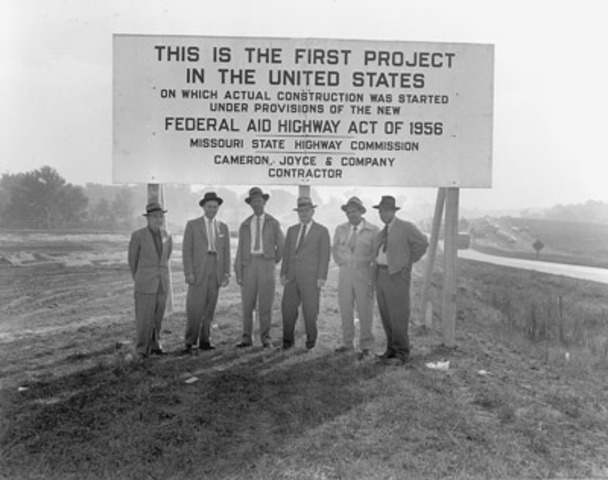
Also known as the Federal Aid Highway Act of 1956 (Public Law 84-627), [it] was enacted on June 29, 1956, when President Dwight D. Eisenhower signed the bill into law. With an original authorization of $25 billion for the construction of 41,000 miles (66,000 km) of the Interstate Highway System, supposedly over a 10-year period, it was the largest public works project in American history [at] that time.
The addition of the term defense in the act’s title was for two reasons. First, some of the original cost was diverted from defense funds. Secondly, most U.S. Air Force bases have a direct link to the system. One of the stated purposes was to provide access in order to defend the United States during a conventional or nuclear war with the Soviet Union and its communist allies. All of these links were in the original plans, [though] some, such as Wright Patterson AFB, were not connected […] in the 1950s but, [were] later.
Photo Credit: Timetoast
The money for the Interstate […] and Defense Highways was [drawn from] a Highway Trust Fund that paid for 90% of highway construction costs, with the states required to pay the remaining [10%]. It was expected that the money would be generated through new taxes on fuel, automobiles, trucks and tires. As a matter of practice, the federal portion of the cost of the Interstate Highway System has been paid for by taxes on gasoline and diesel fuel.
Eisenhower‘s support of the Federal Aid Highway Act of 1956 can be directly attributed to his experiences in 1919 as a participant in the U.S. Army’s first Transcontinental Motor Convoy across the United States on the historic Lincoln Highway, which was the first road across America. The convoy was memorable enough for a young Army officer, 28-year-old Lieutenant Colonel Dwight David Eisenhower, to include a chapter about the trip, titled Through Darkest America With Truck and Tank in his book At Ease: Stories I Tell to Friends (Doubleday and Company, Inc., 1967).
Following completion of the highways, the cross-country journey that took the convoy two months in 1919 was cut down to five days.
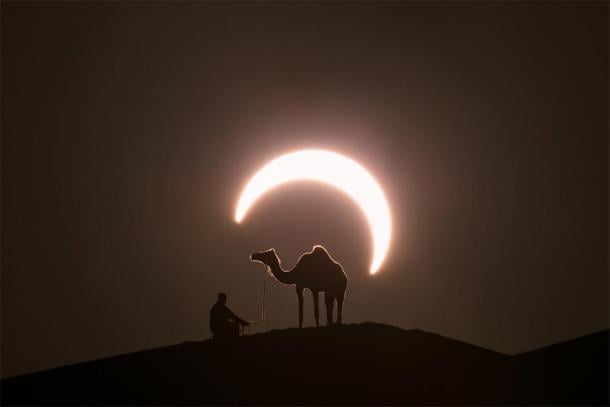
According to Herodotus, the appearance of the eclipse was interpreted as an omen and, interrupted a battle in a long-standing war between the Medes and the Lydians. The fighting immediately stopped and they agreed to a truce. Because astronomers can calculate the dates of historical eclipses, Isaac Asimov described this battle as the earliest historical event whose date is known with precision to the day and described the prediction as the birth of science.
Photo Credit: Ancient Origins
The Mechanics of a Monumentally Difficult Prediction
The reason this astronomical event is thought of as being so important is that predicting a solar eclipse, compared with a lunar eclipse, is exceptionally difficult. The astronomer must not only calculate when it will occur but, where on Earth’s surface it will be visible […]. [In] a lunar eclipse, the moon passes through the Earth’s sun shadow and the phenomena is visible on the whole side of the Earth that is in night-time […]. [They] often last longer than an hour. In solar eclipses, however, the moon’s shadow falls across the Earth in a comparatively narrow path, with a maximum duration, at any given location, of about 7 1/2 minutes.
[What] makes Thales’ prediction [an] historical mystery is that historians know early Greeks, at large, didn’t have this essential lunar data and there are no other records of Greek astronomers in this period accurately predicting any other eclipses. Thus, it is thought by historians that the only place Thales’ advanced astronomical knowledge could have come from was Egypt. [It’s] known [that] Thales studied Egyptian techniques for measuring sections of land with rope […].
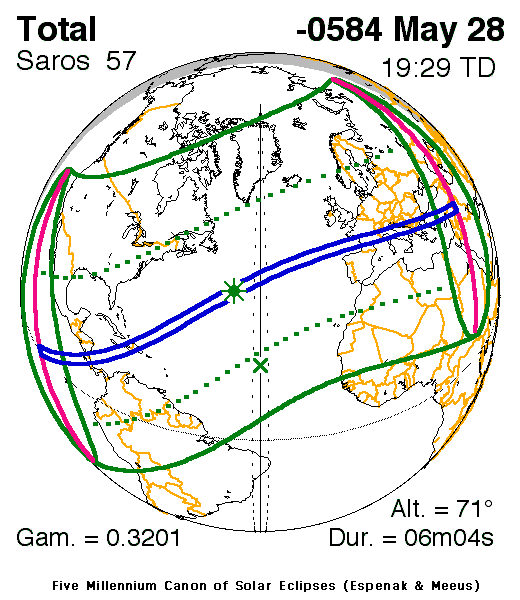
Returning [to] the war (mentioned above), after 15 years of fighting, on May 28, 585 BC, the armies of King Aylattes of Lydia were in battle with the forces of King Cyaxares of Medes (or, possibly, Astyages, his son), near the River Halys in what is, today, central Turkey. Chroniclers noted the heavens darkening and soldiers on both sides laying down their weapons in awe of the spectacle […]. [The] event ended both the battle and the war.
[A] Wired article says this famous astronomical event has been debated by hundreds of scholars for nearly two millennia and that some authorities believe Thales’ eclipse may have occurred 25 years earlier in 610 BC. But, the reason most agree with the 585 BC date is the record of the famous battle in Asia Minor ending when the day was suddenly turned to night.
The battle was a total and bloody defeat for the Jacobites which effectively marked the end of almost sixty years of the Jacobite struggle, as never again would an armed uprising be used in the attempt to return the Stuarts to the throne. The government victory also paved the way for a sustained programme to destroy the power base of the rebel clans.
Culloden (pronounced culawden, with the emphasis on ‘oden‘) is one of the most important battles in the history of the British Isles and has international significance. It is the final battle fought on the British mainland and brings to an end more than half a century […] of Jacobite conflict, itself played out against a background of wider international wars. Its aftermath transforms the Highlands, bringing to an end the traditional way of life of the area and contributing to the subsequent clearances. The battle also holds a prominent place within the Scottish cultural legacy, frequently depicted, and commemorated, in art, music, literature and film. The battlefield, itself, is one of the most visited tourist sites in the Highlands […]. [T]he site holds a particularly high significance, and emotional connection, to many within Scotland and to the ancestors of the Scottish Diaspora.
The official return for British Army casualties (government troops) was 50 officers, and men, killed and 259 wounded [with] one missing (a proportion of the wounded later died of their wounds). Jacobite fatalities have been estimated at between 1,200-1,500 with between 400 and 500 prisoners taken in the immediate aftermath and many more in the days which followed. Only the Irish and Scottish troops in French service were treated as bona fide prisoners of war, the rest as rebels.
Image Credit: britishbattles.com
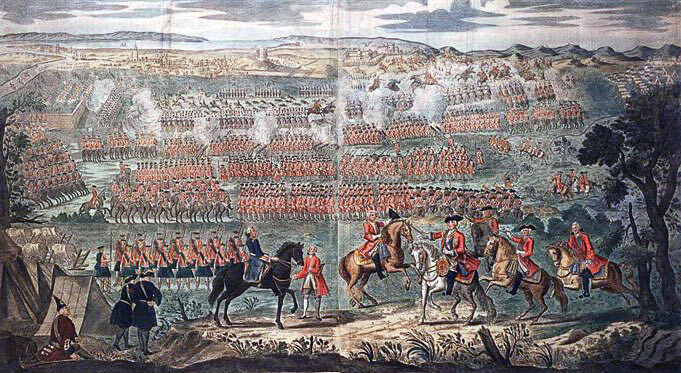
The battle, which lasted only 40 minutes, resulted in bitter defeat for the heavily outnumbered Jacobites. Led by the Duke of Cumberland, son of King George II, [the] devastating slaughter of the Jacobites was the result of the opening British cannonade and, subsequent tactics of the Redcoats during the attack […] when each British soldier, instead of attacking the Highlander directly in front of him, bayoneted the exposed side of the man to his right. The Highlanders finally broke and fled […].
Hunted by troops and spies, Prince Charles wandered over Scotland for five months before escaping to France and final exile. The [battle] […] marked the end of any serious attempt by the Jacobites to restore the Stuart dynasty to the British throne.
A generation before, a previous Jacobite rebellion had been thwarted by the king’s officer, George Wade, who had “pacified” and “disarmed” the highland clans. So concerned was the English establishment, and relieved by Wade’s actions, that an additional verse to the National Anthem was penned: God grant the Marshal Wade
May be thy Mighty aid,
Victory bring;
May he sedition hush,
And like a torrent rush,
Rebellious Scots to crush,
God save the king
Addendum: “Culloden is viewed by the Scottish people as a war grave. To my fellow Americans, stepping onto the Culloden battlefield would be like visiting Gettysburg or Normandy. And, since Scotland views it as a grave, you could also liken it to Arlington Cemetery. You don’t simply walk onto any of these places with a light spirit.” ~Brit At Heart
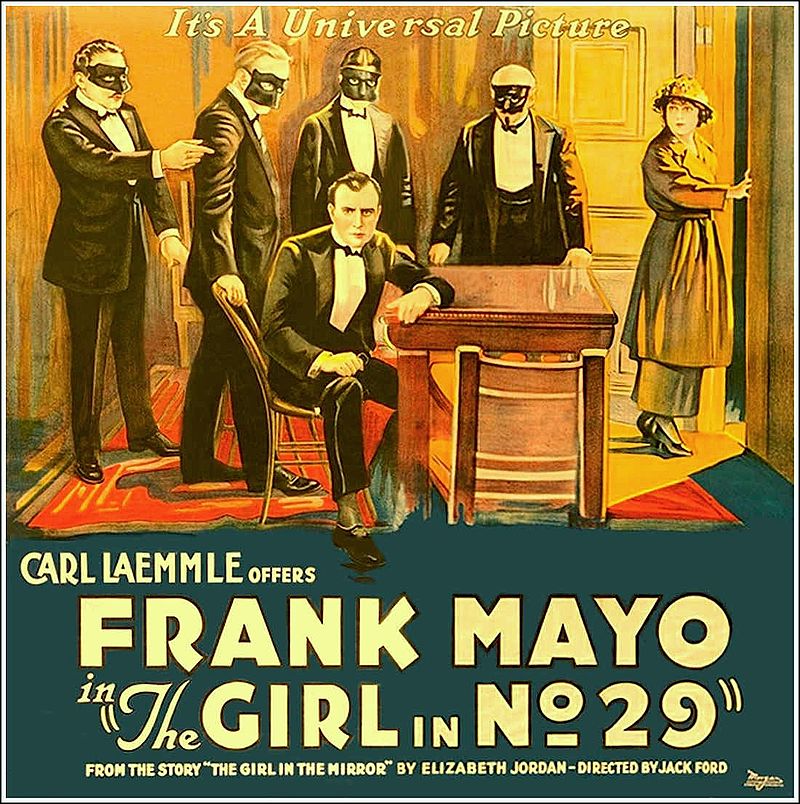
After turning out a successful drama, young playwright Laurie Devon settles down to a life of idleness. Alarmed and disgusted, his friends make every effort to get him to work again but, he refuses. One evening, while glancing into his mirror, Laurie sees a beautiful girl in the apartment across the way, holding a revolver to her head. Dashing out of his apartment house, he prevents her from pulling the trigger. He learns that her name is Doris Williams and discovers that her plight is caused by a man named Shaw. Soon after, Shaw and his thugs abduct her, and Laurie comes to her rescue, shooting her tormentor. Returning home, he confesses his crime to his sister and friends, and learns that the whole incident was a trick to restore his interest in life. The plot succeeds and Laurie writes another hit play in which his new wife Doris is the star.
Laurie Devon (Mayo) is a New York playwright who, having had one success, refuses to work on another play. One night he sees a woman (Anderson) in an apartment across the street take out a gun and place it to her forehead. He reaches her in time to save her and she tells him that she is under some terrible evil influence, which she will not disclose. Devon attempts to untangle the mystery and is led on an adventure. The woman is taken to a house on Long Island, where Devon, after a fight, rescues her. He takes out the revolver and shoots one of the pursuers, who falls to the ground. On returning home, he is heartbroken and tells his sister Barbara (Fair) and his friends that he is a murderer. His sister, and two of his friends, then confess that the whole thing was a frame-up. [T]hey had hired some actors to stage everything and that it was an attempt to get the ambitionless [sic] author to write again. The revolver used in the suicide attempt by the woman, and in the later shooting, had blanks. Devon and the woman from the apartment melt into each other’s arms at the final fade-out.
Perhaps the most attractive feature of this picture is the reproduction of early Roman costumes and Roman surroundings. It is a story of political intrigue, with all the contests and disagreeable features, connected therewith in the ancient city. But, the reproduction of manners and customs and, the historically correct scenery and settings, add immensely to the interest and, insure attention when, perhaps, the mere political story would scarcely be considered. The greatest service the motion picture can do is in the direction of educating the people, and a film like this, which faithfully illustrates long past and, perhaps, partially forgotten life, is of vast importance and, deserves a cordial reception. The Selig players have brought enthusiasm to their work and, have put much ability and life into the interpretation of this play.
This film may have been based on the 1835 novel Rienzi, the Last of the Tribunes, by Edward Bulgar-Lytton [sic]. An advertisement in the [February] 19, 1910, Film Index billed Bosworth above the title, “Hobart Bosworth in The Roman,” and labeled the movie “Film De Art of the Classics,” declaring: “Its teachings are based upon the scriptures and traditions of the early history of the eternal city.” The advertisement also suggested that theater owners book The Roman as a “Special Lenten Picture.”
A young woman [orders] her girl slave to deposit in the waters of the Tiber a child which she has cause to be rid of. The infant is found by one of the aristocracy and adopted. In later years she is betrothed but, just before the wedding, the ruler of the land claims the young woman, on the ground that she was born in slavery. By military force, she is torn from the arms of her foster father and taken to the ruling house where she is held captive for only a few hours, as the father and young lover, have aroused a popular rebellion which overthrows the ruler, end[ing] in his death and the defeat of his defenders. (Variety February 19, 1910)
One Trivia Bit:
♦ Per [Hobart] Bosworth, first picture made at Selig’s (Studio at 1845 Allesandro Street, now Glendale Blvd.) in the Edendale (now Silver Lake) plant of Los Angeles.
[There was not much written about this film and no video clip(s). The image, above, doesn’t seem to jive with the TCM synopsis. But, that is all I could find.
Addendum: I continued to dig and found the, above, write-ups via the Internet Archive database and AFI. Turner Classic Movies synopsis was WAY off. ~Vic]
Image Credit: americanmovieawards.com & The Wayback Machine
Screen Capture
Forty years ago, today, the very first American Movie Awards was televised on NBC. Filmed at the Wilshire Theatre, the ceremony honored film, actors, directors, screenwriters, music, favorites and a special recognition. Co-hosts were David Frost (also Executive Producer) and Dudley Moore with Angie Dickinson as Co-Hostess. Susan Anton was a performer. Judging by what few images I could find, the trophy was designed to resemble the Empire State Building.
Winners:
♦ Best Film: Rocky II
♦ Best Actor: Alan Alda (The Seduction of Joe Tynan)
♦ Best Actress: Sally Field (Norma Rae)
♦ Best Supporting Actor: Robert Duvall (Apocalypse Now)
♦ Best Supporting Actress: Meryl Streep (The Deer Hunter)
♦ Best Director: Michael Cimino (The Deer Hunter)
♦ Best Screenplay: The China Syndrome
♦ Best Original Song: Every Which Way But Loose (Every Which Way But Loose)
♦ Favorite Film Star-Female: Jane Fonda
♦ Favorite Film Star-Male: Burt Reynolds
♦ Special Marquee: Clint Eastwood (Distinguished and Continuing Career)
There was another ceremony in March 1982 at a different location and a relaunch in 2013 with ceremonies in 2014, 2015, 2016, 2017 and 2018 focusing mainly on Independent Film. I doubt there will be anymore ceremonies as the website was taken down last year. There are no videos of the event on YouTube, either.
Oh deary, deary me. What a fine mess we seem to have gotten ourselves into. Just as we were beginning to believe all the messages that we are changing for the better, we seem to be surrounded by more and more chaos and, confusion. If we are changing, raising our energy frequencies, how come everything seems to be becoming worse?
As we undergo our ‘changes’, what we are actually doing is bringing more and more of our soul energy into the body, until we once again become a true human being. Let me explain: For the past 7,000 years our human form has been divided into a ‘physical self’ and a ‘higher self’. The physical self, that which we refer to as the human body, has only contained about one-quarter of our total consciousness, our total soul. The higher self has made up the other three-quarters.
At long, long last we have found the way to reintegrate the whole, to bring the whole soul back into the physical body. That is why I always explain to people that we are not ‘ascending’ anywhere. We are just becoming ‘whole’, we are just becoming human. This is what is meant by change.
Always remember that, fundamentally, we are energy. Einstein’s Theory of Relativity is correct: all things ‘physical’ are made of energy and that energy cannot be destroyed, it can only be altered. The same applies to consciousness energy, the energy that is the soul. Consciousness is not just seated within one small region of the brain, as current scientific thinking is suggesting. The energy that is the soul infuses all the cells of the body and, extends via the chakras and aura far beyond the physical confines of the body.
We began this process of soul reintegration back in 1996 and, as we did so, we began to realise that we had a great deal of accumulated emotional debris to clear. Our state of seeming chaos is entirely brought about by the amount of emotional debris we have built up over the past seven thousand years.
We have become used to not being us. We have become used to wearing masks, presenting faces to the world that we think the world wants to see. We have become so un-used to showing our true selves and, we have kept our true selves so hidden that, even we do not know who we truly are any longer. We have become accustomed to believing the web of falsities we have woven around ourselves and the journey to re-discovering who we really are is proving uncomfortable. This is the reason for the chaos. This is the reason for the confusion.
Image Credit: pinterest.com
The simple answer is that we have become used to not being honest and this lack of honesty has led to all the confusion (conflicts, wars and prejudice) that we are currently experiencing.
As we reintegrate the higher elements of consciousness, our higher selves are requesting us to become more and more honest with ourselves and, with those with whom we share our lives. The further we progress through the process of re-integration, the more this request becomes an imperative and the less we can hide from the requirements of the higher self, the requirements of the soul.
We have also begun to realise that truth has its own vibration. Words spoken to us by others become recognised for what they are: the truth or not. This ‘feeling’ for truth is also adding to our confusion. Conventions or ideologies we accepted as truth in the past are now being seen as less than truth.
What we, now, need to do is to bring all our new understanding, of what is honest and what is not, to bear on all aspects of our lives. The way to remove the chaos from our lives, and from humanity as a whole, is to be as honest as possible within every situation…honest with ourselves and honest with those around us. This is how we complete our process of change…by being totally honest in everything we do. If we all became totally honest tomorrow, we could all complete our reintegrations the day after. The truth is that powerful!
Becoming honest begins with little steps. If someone asks you a question, reply in as honest a way as possible. This does not mean forgetting about diplomacy but, it does mean expressing your truth. If someone makes you angry or sad, or upsets you in any way, let them know as honestly as possible what their actions have done. It is no good trying to ‘let it go with love’ any longer, as that is a false situation and, it will only lead to resentment and a delay in your personal development. Neither is it good to think that, by being honest, you will ‘hurt the other person’s feelings’. You are assuming that your honest reaction is going to be hurtful but, how are you able to judge what price the other person has put on their feelings? Being dishonest, by not expressing your true feelings, always creates more harm and damage than being honest does. Of course we need to be as diplomatic as the situation or person warrants but, we all need to begin to realise that we cannot pre-judge someone else’s reactions. Do not forget that being honest with someone gives them full permission to be honest in return and that builds a stronger relationship.
The soul, the higher self, is not a hard taskmaster. All that it requires of us is that we be ourselves and be as honest as it is possible to be in any given situation. It is not a question of being rude or unthinking, just of being who we truly are without masks.
The end of 2011 is the date we humans have set ourselves to finally complete our process of reintegration. Every single person on the planet has the potential and capability to fulfil the task we have set ourselves. Whilst time seems short, all that is needed is honest communication…with ourselves and others. Once honest communication in all aspects of our lives is achieved, individually and collectively, we automatically and, without further effort, become more than we have ever dreamed possible.
Update:
Some of the links, below, became broken and I’ve had to re-gather some information as Mr. Barrett has done his best to wipe out his history. If links become broken again, I have provided PDF screen captures of the data.
[Note: This is a re-post from an old blog, originally posted on February 27, 2010. I think it’s worth sharing because I find this man to be dangerous. He’s a liar and a bully and, I’m shining the light on him.]
This guy, Stephen Barrett…he’d have you believe that he is the foremost expert in all things quackery. To him, anything other than mainstream-AMA-backed medicine is useless.
Photo Credit: Anaximperator Blog
Although he is free to present his opinion, much like the rest of us out here blogging (me, included), do not be fooled by the ‘M.D.’ at the end of his name. I think he even wrote his own biography on Wikipedia. However, that being expressed, he has gotten himself into quite a bit of trouble in the courts for repeatedly suing people and claiming he was a ‘retired psychiatrist’. Carlos F. Negrete of Negrete Law and Health Freedom Law, attorney for Tedd Koren, D.C., got the awful truth out of Mr. Barrett…
At trial, under a heated cross-examination by Negrete, Barrett conceded that he was not a Medical Board Certified psychiatrist because he had failed the certification exam. This was a major revelation since Barrett had provided supposed “expert testimony” as a psychiatrist and had testified in numerous court cases. Barrett also had said that he was a “legal expert” even though he had no formal legal training.
That cross-examination (screen capture PDF) took place in 2005 in Allentown, PA…Mr. Barrett’s longtime residence (he was born in New York City in 1933). In 2007, a higher court in Pennsylvania backed up the lower court’s decision to dismiss his frivolous lawsuit (original screen capture PDF) (updated screen capture PDF). It was at that point he decided to relocate to Chapel Hill, NC. Perhaps Allentown folks got tired of his crap? I find it amusing that he decided to move to an area that is a hotbed of the very alternative medicine he rails against. The Triangle of North Carolina (Raleigh-Durham-Chapel Hill) contains a plethora of natural, homeopathic and holistic practitioners. I’m pretty sure he didn’t move to the area to get warm fuzzies from the locals. I think he saw an opportunity to make money harassing and ambulance-chasing gifted healers. He does have legal bills he needs cover.
A Patrick Pontillo operated a now-defunct website (screen capture PDF) on chemical sensitivities (a subject that I know something about). He maintains an additional, similar website, Blue Marble Album. He has an extensive history on Mr. Barrett.
Tim Bolen has his own history of Barrett (screen capture PDF & Web Archived Page) from his website and wrote an article on the Doctor’s Data vs Barrett case. Judging by this posted 2016 legal decision, the case was nearly a stalemate but, Barrett’s National Council Against Health Fraud (NCAHF) dissolved after the lawsuit began and Quackwatch dissolved before the case came to trial…even though the website is still active and full of hysterical mainstream medical nonsense. “Googling” this case (I really, really dislike that term but, it is, now, part of our language…for better or worse…) will return links stating that the case was “settled, amicably, out of court”. Translation: Both parties were tired of fighting after six years. A lawsuit of this size and scope costs money…and time. And, Stephen Barrett is in his 80s. The briefing notes clearly state that both parties were free to re-file and start new court proceedings. That means…more money and more time.
Be very careful when you read this man’s so-called “facts”. He is no expert. He merely has an opinion and he has tried to beat people over the head with it. Believing that this man is a seasoned doctor with many, many practicing years of experience would be as ridiculous as believing that I am an experienced journalist. I am not and would never claim to be.













 Cosmic-Observation