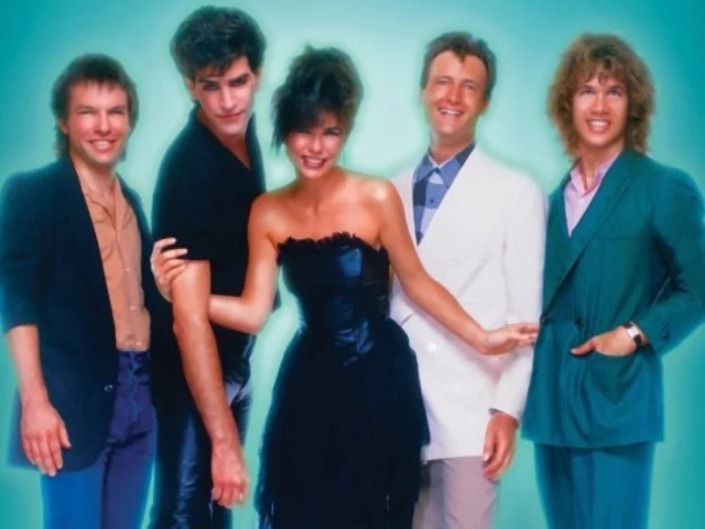
This Sunday night’s playlist submission was never released. The 8th track from her album Fumbling Towards Ecstasy, it has no chart information. Sarah was already a star in her native Canada but, this album was her breakthrough in the US, exploding on the scene when her first track, Possession, was released. Born in Halifax, Nova Scotia in 1968, she was playing music, early, starting with a ukulele at age four. In high school, she was the singer for the short-lived band The October Game and, after finishing a year in college, signed a recording contract with Nettwerk without having written a single song.
This is another album/CD I have worn out. I can remember when Possession showed up on the radio and I first heard it. I was driving home from work and immediately went looking for her album. Her music has been used in many television shows and I remember her being on Charmed. Notable movies using her songs are City of Angels, Message in a Bottle, The Brave One and Four Christmases.
Well (scratching head), Flick Friday is a complete bust. There are no movie releases for today from 1950. Instead, I will highlight National Tequila Day. No, I’m not kidding. As a side note to the below, the listed Mamasita or Mamacita appears to be a Rum drink, not Tequila. But, who am I to argue. Drink up! ~Vic
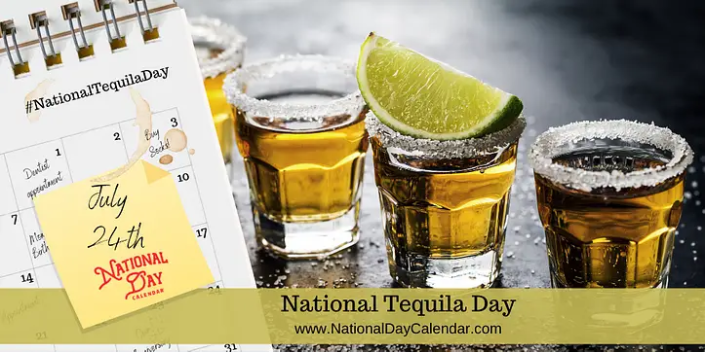
Image Credit: National Day Calendar
One tequila, two tequila, three tequila, floor!
On July 24th, commemorate National Tequila Day with a little lime and salt. Mix up a Margarita, Paloma or a Mamasita to celebrate the day! People have been making Tequila for centuries and it was once known as mezcal wine. In fact, Tequila is mezcal but, mezcal isn’t Tequila. That’s because Tequila is distilled from a specific type of agave plant. Also, the law protects its production. Take a sip and we’ll travel into Tequila’s history.
History
It all started around the 16th century. Cortez [sic] arrived on the North American continent with his Spanish conquistadors. They didn’t care much for the fermented mezcal wine served to them. However, the Spanish introduced copper stills to the population. Enter the distilling process.
Image Credit: Win Calendar
Now, our story takes us to Tequila, Jalisco, Mexico. Located in a valley west of Guadalajara in Jalisco, Mexico, the town made a name for themselves by distilling Blue Agave. Even though a variety of succulents in Mexico produce mezcal, only one delivers the nectar to distill Tequila. Blue Agave grows in the highland region. Indeed, the unique growing conditions contribute to a larger size and sweeter tasting agave. In contrast, agave grown in the lowland regions taste and smell more herbal. In Mexico, the law protects the production of Tequila. The rule states Tequila is only Tequila if it is made within Jalisco. Additionally, the law limits production to regions in the states of Guanajuato, Michoacan, Nayarit and Tamaulipas. However, the same ingredients distilled anywhere else cannot be labeled Tequila.
Interestingly, many names in the Tequila business, today, were the very first commercial producers of Tequila. For example, José Antonio Cuervo held the first license for making the favored beverage. He kept a well-known company, too. Two other names include Don Cenobio Sauza and Félix López, whose businesses continue in some form today. Equally enjoyed in cocktails such as the margarita or Tequila Sunrise, connoisseurs savor a good Tequila like a good whiskey. As a result, savvy drinkers experience the smooth renaissance of Tequila. Surprisingly, it’s not the firewater they remember from their youth.
The Treaty of Union is the name usually, now, given to the agreement which led to the creation of the new state of Great Britain [.] [It stated] that England, which already included Wales, and Scotland were to be “United into one Kingdom by the name of Great Britain[.]” At the time it, was more often referred to as the Articles of Union. The details of the treaty were agreed on [July 22], 1706 and separate Acts of Union were then passed by the parliaments of England and Scotland to put the agreed articles into effect. The political union took effect on [May 1], 1707.
Queen Elizabeth I of England and Ireland, last monarch of the Tudor dynasty, died without issue on [March 24], 1603 and the throne fell at once […] to her first cousin twice removed, James VI of Scotland, a member of House of Stuart and the only son of Mary, Queen of Scots. By the Union of the Crowns in 1603, he assumed the throne of the Kingdom of England and the Kingdom of Ireland as King James I. This personal union lessened the constant English fears of Scottish cooperation with France in a feared French invasion of England. After [the] union, the new monarch, James I and VI, sought to unite the Kingdom of Scotland and the Kingdom of England into a state which he referred to as “Great Britain”. Nevertheless, Acts of Parliament attempting to unite the two countries failed in 1606, 1667 and 1689.
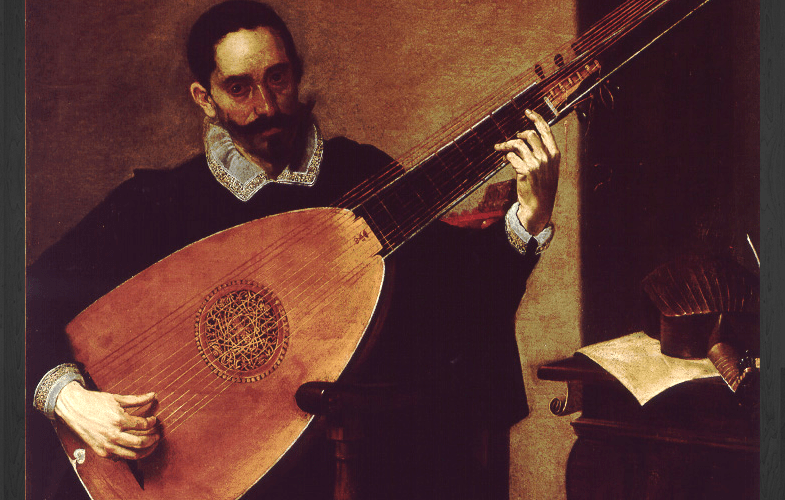
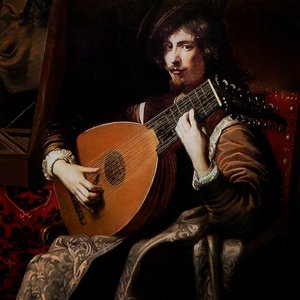
Some of his contemporaries, including Landi, criticized Kapsberger’s composing skill. Due to his unusual rhythmic groupings, sharp contrasts and non-conforming to the rules of counterpoint, it was suggested that he was an inferior composer. A current lutenist, Rolf Lislevand commented in liner notes in 1993:
“Kapsberger was as bad a composer as he was a fine instrumentalist […]. The ideas are often badly developed and are freely associated with one another […]. [N]o real musical discourse is built up […] the rhythm, even after serious efforts at fathoming it, wavers between inspired cleverness and total confusion.
Despite the above complaints, Kapsberger greatly contributed towards advancing European plucked string instruments of the time. At least six collections were published during his lifetime, two of which are currently lost.
There is very little else written about this specific composition. ~Vic
Image Credit: meantone.altervista.org
Wikipedia & Wikimedia
Coming to 1635…
Fiori musicali (Musical Flowers) is a collection of liturgical organ music by Girolamo Frescobaldi, first published in 1635. It contains three organ masses and two secularcapriccios. Generally acknowledged as one of Frescobaldi’s best works, Fiori Musicali influenced composers during at least two centuries. Johann Sebastian Bach was among its admirers and parts of it were included in the celebrated Gradus ad Parnassum, a highly influential 1725 treatise by Johann Joseph Fux which was in use even in the 19th century.
Fiori Musicali was first published in Venice in 1635, when Frescobaldi was working as [the] organist of St. Peter’s Basilica in Rome, under the patronage of Pope Urban VIII and his nephew Cardinal Francesco Barberini. It may have been conceived as music for St. Mark’s Basilica or a similarly important church. The collection was printed by Giacomo Vincenti (a celebrated publisher who had previously published reprints of Frescobaldi’s capriccios) and dedicated to Cardinal Antonio Barberini, Francesco‘s younger brother.
The full title of Frescobaldi’s work is Fiori musicali di diverse compositioni, toccate, kyrie, canzoni, capricci, e recercari, in partitura. Before Fiori musicali, Frescobaldi seldom published liturgical music. The organ mass was still in its infancy and composers seldom published such music. [It] is one of the most influential collections of music in European history. Frescobaldi’s collection was studied by Henry Purcell and Johann Sebastian Bach (the latter copied the entire work for his own use).
As far as I am concerned, there is nothing to celebrate. I wake up everyday hoping the worldwide madness has ended. Nope. Same shit, different day. I await the latest Walking Dead episodes (whenever they resume) with the zombies wearing masks. Oh. Look. Art imitates life… *sigh*
I am posting a favorite song of mine, appropriate for the day, from a powerful voice. I sincerely hope that there will be a day of reckoning for what has been done. ~Vic
“Let freedom ring, let the white dove sing
Let the whole world know that today, is a day of reckoning
Let the weak be strong, let the right be wrong
Roll the stone away, let the guilty pay, it’s Independence Day”
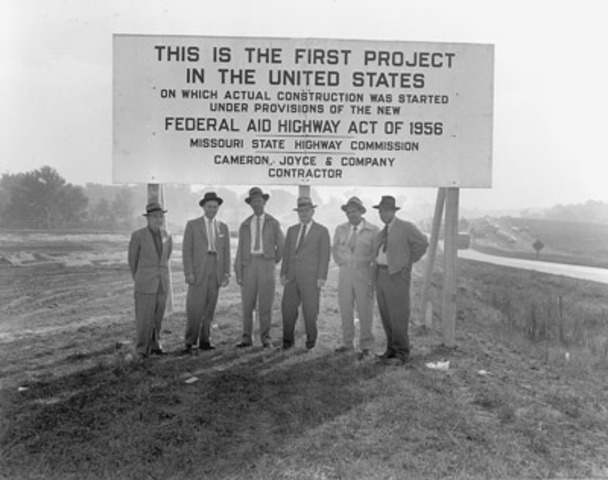
Also known as the Federal Aid Highway Act of 1956 (Public Law 84-627), [it] was enacted on June 29, 1956, when President Dwight D. Eisenhower signed the bill into law. With an original authorization of $25 billion for the construction of 41,000 miles (66,000 km) of the Interstate Highway System, supposedly over a 10-year period, it was the largest public works project in American history [at] that time.
The addition of the term defense in the act’s title was for two reasons. First, some of the original cost was diverted from defense funds. Secondly, most U.S. Air Force bases have a direct link to the system. One of the stated purposes was to provide access in order to defend the United States during a conventional or nuclear war with the Soviet Union and its communist allies. All of these links were in the original plans, [though] some, such as Wright Patterson AFB, were not connected […] in the 1950s but, [were] later.
Photo Credit: Timetoast
The money for the Interstate […] and Defense Highways was [drawn from] a Highway Trust Fund that paid for 90% of highway construction costs, with the states required to pay the remaining [10%]. It was expected that the money would be generated through new taxes on fuel, automobiles, trucks and tires. As a matter of practice, the federal portion of the cost of the Interstate Highway System has been paid for by taxes on gasoline and diesel fuel.
Eisenhower‘s support of the Federal Aid Highway Act of 1956 can be directly attributed to his experiences in 1919 as a participant in the U.S. Army’s first Transcontinental Motor Convoy across the United States on the historic Lincoln Highway, which was the first road across America. The convoy was memorable enough for a young Army officer, 28-year-old Lieutenant Colonel Dwight David Eisenhower, to include a chapter about the trip, titled Through Darkest America With Truck and Tank in his book At Ease: Stories I Tell to Friends (Doubleday and Company, Inc., 1967).
Following completion of the highways, the cross-country journey that took the convoy two months in 1919 was cut down to five days.
In World War II, while serving as a United States Army Air Forces officer, famed World War I pilot Eddie Rickenbacker (Fred MacMurray) is assigned to tour South Pacific bases. On October 21, 1942, his Boeing B-17 Flying Fortress has to ditch at sea, forcing Rickenbacker, pilot Lt. James Whittaker (Lloyd Nolan), co-pilot Capt. Bill Cherry (Richard Crane) and other crew members to survive for 19 days on a tiny rubber raft. While awaiting their rescue, Rickenbacker recalls his other adventures that have highlighted a remarkable life.
It seems as though someone is kidding…kidding in more ways than one. For Captain Eddie, which came yesterday to the Roxy, is not the story it promises to be of Capt. Eddie Rickenbacker, ace of World War I and commercial airline executive who holds some rather rigid social views. Nor is it precisely the saga of the middle-aged flier who was lost at sea two years ago in the South Pacific and spent three harrowing weeks on a raft. It is just another sentimental comedy about a kid who jumped off the barn in his youthful passion for flying and courted his girl in a merry Oldsmobile. [This] is not the story of Rickenbacker…not the significant story, anyhow.
Trivia Bits:
♦ Crash survivor Lt. James Whittaker was […] temporarily assigned to the production to serve as a technical advisor.
♦ The film’s premiere was held in Rickenbacker’s hometown of Columbus, Ohio. In attendance were politicians and celebrities, including Carole Landis, as well as family members.
Anonymous Artist Vlad III
Image Credit: Wikipedia & Wikimedia
The conflict initially started with Vlad‘s refusal to pay the jizya (tax on non-Muslims subjects charged at 2.5%) to the sultan and [it] intensified when Vlad invaded Bulgaria. In response, Mehmed raised a great army with the objective to conquer Wallachia and annex it to his empire. The two leaders fought a series of skirmishes, the most notable one being the Night Attack where Vlad attacked the Turkish camp in the night in an attempt to kill Mehmed. The assassination attempt failed and Mehmed marched to the Wallachian capital of Târgoviște, where he found a few men with cannons. After leaving the capital, Mehmed discovered 23,844 impaled Turks whom Vlad had killed during his invasion of Bulgaria. The number is mentioned by Vlad himself in a letter to Matthias Corvinus (Matthias I). The sultan, and his troops, then sailed to Brăila and burned it to the ground before retreating to Adrianople. Both sides claimed victory in the campaign and Mehmed’s forces returned home with many captured slaves, horses and cattle.
The famous fairy tale is musicalized and given a modern 1940s spin with the principal characters (Cinderella, Prince Charming and the Wicked Step Sisters) all played by children.
Trivia Bit:
♦ This short was produced toward the tail end of Shirley Temple‘s reign as Hollywood’s #1 box office star and it’s reasonable to assume it was made to showcase young talent that Warner Brothers may have thought had a shot at replicating Temple’s success.
I’d never heard of Mazzy Star or heard this song when it originally came out. I am late to the party finding this, just discovering them a few years ago. Sadly, David Robackpassed away February 24, 2020, from cancer.
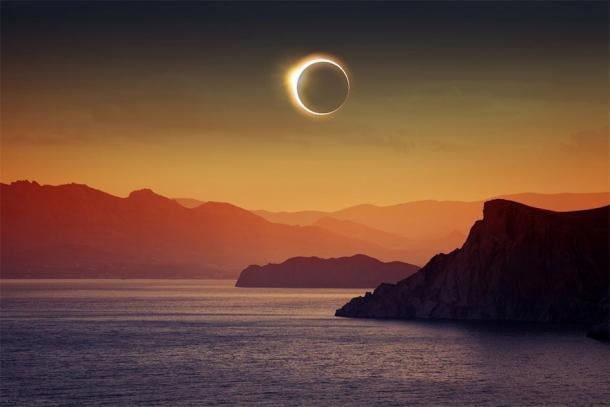
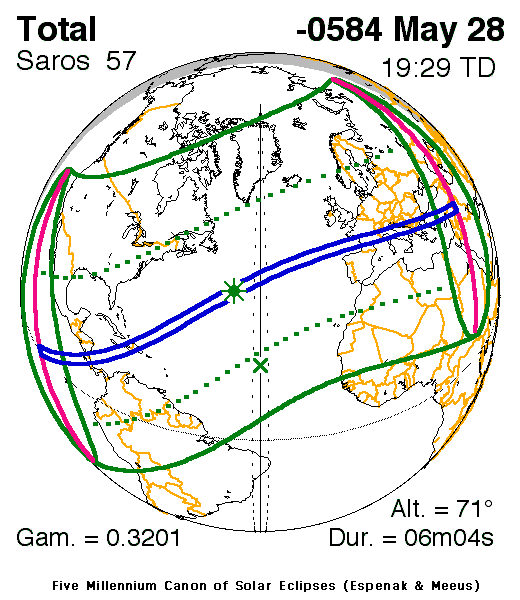
According to Herodotus, the appearance of the eclipse was interpreted as an omen and, interrupted a battle in a long-standing war between the Medes and the Lydians. The fighting immediately stopped and they agreed to a truce. Because astronomers can calculate the dates of historical eclipses, Isaac Asimov described this battle as the earliest historical event whose date is known with precision to the day and described the prediction as the birth of science.
Photo Credit: Ancient Origins
The Mechanics of a Monumentally Difficult Prediction
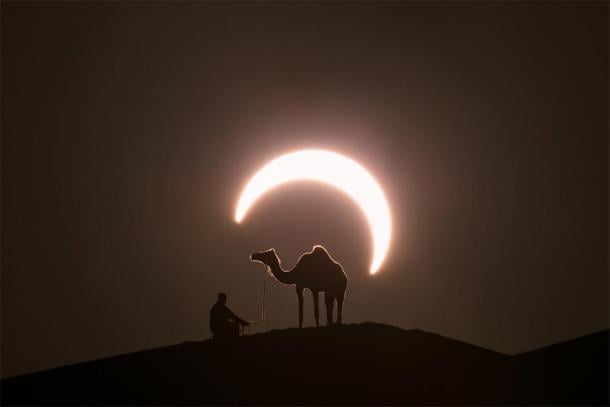
The reason this astronomical event is thought of as being so important is that predicting a solar eclipse, compared with a lunar eclipse, is exceptionally difficult. The astronomer must not only calculate when it will occur but, where on Earth’s surface it will be visible […]. [In] a lunar eclipse, the moon passes through the Earth’s sun shadow and the phenomena is visible on the whole side of the Earth that is in night-time […]. [They] often last longer than an hour. In solar eclipses, however, the moon’s shadow falls across the Earth in a comparatively narrow path, with a maximum duration, at any given location, of about 7 1/2 minutes.
[What] makes Thales’ prediction [an] historical mystery is that historians know early Greeks, at large, didn’t have this essential lunar data and there are no other records of Greek astronomers in this period accurately predicting any other eclipses. Thus, it is thought by historians that the only place Thales’ advanced astronomical knowledge could have come from was Egypt. [It’s] known [that] Thales studied Egyptian techniques for measuring sections of land with rope […].
Returning [to] the war (mentioned above), after 15 years of fighting, on May 28, 585 BC, the armies of King Aylattes of Lydia were in battle with the forces of King Cyaxares of Medes (or, possibly, Astyages, his son), near the River Halys in what is, today, central Turkey. Chroniclers noted the heavens darkening and soldiers on both sides laying down their weapons in awe of the spectacle […]. [The] event ended both the battle and the war.
[A] Wired article says this famous astronomical event has been debated by hundreds of scholars for nearly two millennia and that some authorities believe Thales’ eclipse may have occurred 25 years earlier in 610 BC. But, the reason most agree with the 585 BC date is the record of the famous battle in Asia Minor ending when the day was suddenly turned to night.
There is a LOT of data on this siege and I’m not re-writing history. This will serve as a highlight, only. I will provide links to more information, below. ~Vic
Four hundred, fifty-five years ago, today, the island of Malta was attacked and nearly invaded by the Ottoman Empire, it’s second attempt.
If it had not taken place, the Great Siege would no doubt have been dreamt up for the screenplay of an epic film. Few other historic episodes rival it for sheer heroism, the bloodshed of war and military strategy. The story of the siege is interwoven with the tale of two adversaries, the ageing Grand MasterJean Parisot de la Valette, and his contemporary, the Barbary CorsairDragut Reis who commanded the fleet of Sultan Suleiman the Magnificent. It is also the story of thousands of lives of Maltese Islanders, men at arms to the Knights of St. John.
The years leading up to the siege saw the Islands under constant threat from the Ottoman Turks […]. The Knights knew they were vulnerable in Malta despite the harbours and their two forts […]. Grand Master La Valette had done his best to build defences and had requested extra forces from the Emperor Charles V, the Pope and the Viceroy of Sicily. But, no help came. In May, 1565, a vast Ottoman fleet, some 40,000 men, lay siege to the Islands.
The Knights were heavily outnumbered with a mere 700 or so men and around 8000 Maltese regular troops. The Islanders took refuge in the fortified towns [..] destroying crops and poisoning wells as they fled.
Image Credit: medievalists.net
The Ottomans first decided to attack isolated Fort St. Elmo […]. Repeated assaults were launched over 36 days but, the small garrison of Knights held on to the fort for far longer than Suleiman‘s men anticipated. After four weeks, they finally overran St. Elmo but, at a heavy price […]. The Turkish commander Dragut was fatally injured during the taking […].
It is the battle for [Fort] St. Angelo which saw some of the bloodiest episodes of this Holy War. It was to [be] the basis of legends for centuries to come. [Some] 10 attacks [were launched] on [its] walls [and], when a huge part of the defences were breached, the Ottomans failed to take the Fort.
At one point in the battle, the Ottomans floated the headless corpses of captured Knights across Grand Harbour. The act was returned in kind [as] Valette ordered all Ottoman prisoners to be executed and their heads used as ‘cannon balls’ to fire back toward their compatriots in St. Elmo.
[Valette]’s long-awaited relief forces [finally] appeared […] and took control of high ground inland. [The] Ottoman troops retreated […].
The Turks fled to their ships, and from the islands, on September 13 (almost four months had passed). Malta had survived the Turkish assault, and throughout Europe, people celebrated what would turn out to be the last epic battle involving Crusader Knights.
Malta’s magnificent capital, Valletta, was founded by and named after Grand Master Jean de la Valette. Valette, himself, was buried in the city some three years later.









 Cosmic-Observation