I am battling something that I am not totally sure I will survive. I don’t mean to come across as dramatic but, I need to let readers of this blog know why I won’t be posting. I may return…I may not. I don’t honestly know.
This is, now, effectively, a static blog. I encourage you to read all of my Chris Thomas posts. I have sporadically posted years ago, so, I do have some older posts going back to 2013, I think. Peruse if you wish.
Thank you to all of my readers. You are so appreciated.
~Vic
[Addendum: I’m not taking this post down as I put it up for a reason. That being said, I am alive and well…and doing the best I can. ~Vic]
Back in May, I did a post on the Battle of Alamance so, I won’t revisit the historical details. Yesterday, I visited the actual battleground with my buddy, Ray. They were having German Heritage Day with authentic German food for visitors. I was so glad we had a beautiful day. It was chilly but, there was a really good turnout. I hadn’t been to this site in nearly 45 years.
Battle map behind the Visitor Center Museum, facing the battleground.3-D Map of NC Militia troops and the Regulators.The rock in the 3-D battle map and
the small creek/tributary of Beaver Creek/Big Alamance Creek/Lake Mackintosh.Field cannon.Facing Inscription:
“HERE WAS FOUGHT THE BATTLE OF ALAMANCE
MAY 18, 1771
BETWEEN THE BRITISH AND
THE REGULATORSLeft Inscription:
Crossed Cannons & LIBERTY
Right Inscription:
FIRST BATTLE OF THE REVOLUTIONBattleground Sun
[Note: I originally posted this, yesterday, just before midnight. In researching the data, I stumbled across Bill Owens, a photographer that was at Altamont. He was hired by the Associated Press to cover the concert. I emailed him, reference the two photos of his I posted. I hit ‘publish’ before I found his contact page and statement about photos for sale. In my haste to get this up while it was still Friday, I jumped the gun and quickly made the post private. I asked Bill what the price would be to use two of his pictures. As a photographer myself, I understand copyright issues but, I also recognize the gray area that many a blogger operate in, in the blogosphere….Fair Use (link on that, below). Anyway, this very kind gentleman has allowed my one-time use for this 50th anniversary post. He also provided me with a copy of an interview, conducted by Tony D’Souza in April 2019, covering his Altamont experience and other questions regarding his career. I will post an excerpt and attach the full interview, below. ~Vic]
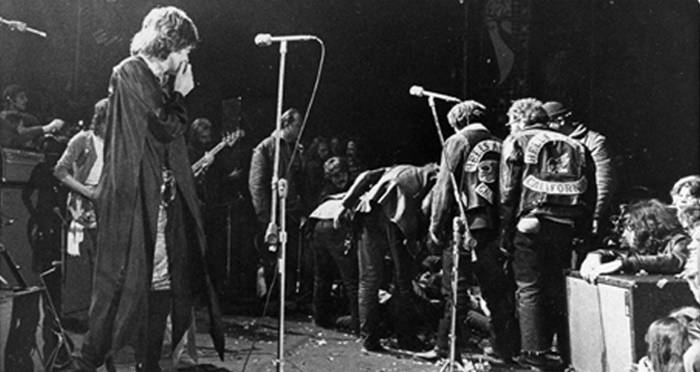
[It’s] not every day that a rock and roll band’s performance, let alone the Rolling Stones’, is accompanied by a knifing, stomping murder within a scream of the stage.
“The violence,” Keith Richard told the London Evening Standard, “just in front of the stage was incredible. Looking back, I don’t think it was a good idea to have [Hells] Angels there. But, we had them at the suggestion of the Grateful Dead. The trouble is, it’s a problem for us either way. If you don’t have them to work for you as stewards, they come, anyway and cause trouble. But, to be fair, out of the whole 300 Angels working as stewards, the vast majority did what they were supposed to do, which was to regulate the crowds as much as possible without causing any trouble. But, there were about ten or twenty who were completely out of their minds…trying to drive their motorcycles through the middle of the crowds.”
The Maysles Brothers, the film company which had shot the whole Stones’ tour, complete with its violent climax at Altamont, had gotten some remarkable footage of Hunter’s killing.
Robert Hiatt, a medical resident at the Public Health Hospital in San Francisco, was the first doctor to reach 18-year-old Meredith Hunter after the fatal wounds. He was behind the stage and responded to Jagger’s call from the stage for a doctor. When Hiatt got to the scene, people were trying to get Hunter up on the stage, apparently in the hope that the Stones would stop playing and help could get through quicker.
Stones on stage with Hells Angels.
Photo Credit: allthatsinteresting.com
Three others […] died (two in a hit-and-run accident, another by drowning) and, countless more were injured and wounded during the course of this daylong “free” concert. It was such a bad trip that it was almost perfect. All it lacked was mass rioting and the murder of one or more musicians.
All these things happened, and worse. Altamont was the product of diabolical egotism, hype, ineptitude, money manipulation and, at base, a fundamental lack of concern for humanity.
Bill Owens took iconic photos of the Hells Angels beating concertgoers with pool cue sticks at the Rolling Stones’ performance during the Altamont Speedway Free Festival four months after Woodstock on December 6, 1969. Altamont, which included violence almost all day and one stabbing death, is considered by historians as the end of the Summer of Love and the overall 1960’s youth ethos. This series of photos include panoramas of the massive, unruly crowd, Grace Slick and Carlos Santana on stage with the press of humanity so close in, they’re clearly performing under duress.
Of that day, Owens has written: “I got a call from a friend, she said the Associated Press wanted to hire me for a day to cover a rock and roll concert. I road my motorcycle to the event. I had two Nikons, three lenses, thirteen rolls of film, a sandwich, and a jar of water.”
Owens was so fearful of retribution by the Hells Angels that he published the photos under pseudonyms. Some of the negatives were later stolen…Owens believes by the Angels. He continues to have conflicted feelings about Altamont. He had no interest in violence and took no pride in photographing it.
In 1972, Owens released a book of black and white photography called Suburbia, also, now, an American icon. Irascible, stubborn, funny, grouchy, ornery and deeply rooted in small town life, Owens is built like a middleweight puncher and wears his hair as though he was a Marine. Indeed, Owens was never a hippie but, a clean-cut newspaper photographer, husband and father, who joined the Peace Corps to serve his country and “do good.” Turning 80 this September, Owens has also had noted careers as a craft beer brewer and pub owner, a magazine publisher many times over and, is now a distiller. His books include Suburbia, Working, Leisure and many others. He is the recipient of a Guggenheim and two NEAs. His work is collected in leading museums the world over, including the Smithsonian. Recent coverage of Owens includes an April retrospective in the New York Times (link above) of his Altamont photos for the event’s impending 50th anniversary. The photos are available for viewing at Owens’ website (link above and below).
I first met Owens at the defunct Rostel Gallery in remote and far northern Dunsmuir, CA, in late August or early September of 2008 (I remember because my daughter had just been born and the event was the first outing of her life), where they were showing images from Suburbia. These are images of people embarking on a new, modern way of life that they look excited by, but also confused, as though technology and the modish styles of the time were costumes they were still getting comfortable in. Owens’ photograph of a young suburban boy wearing cowboy boots, carrying a toy rifle and riding a Big Wheel, “Ritchie,” has always haunted me, though I couldn’t say precisely why.
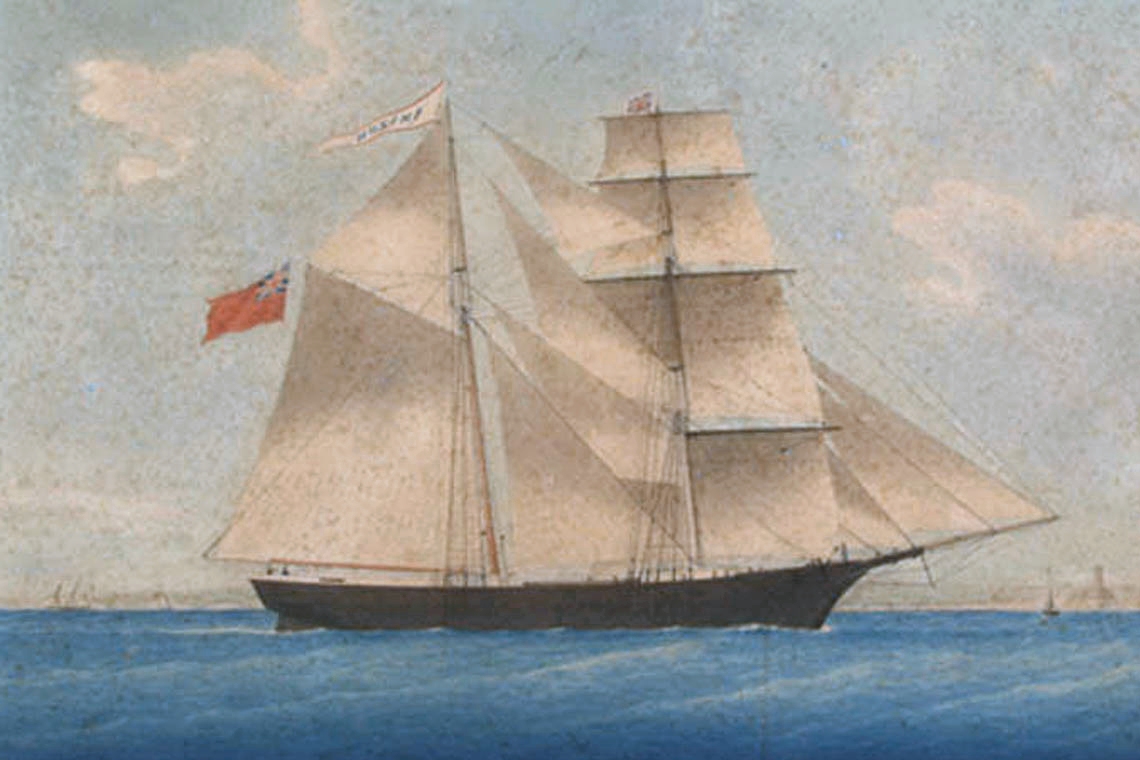
A merchant brigantine, the Mary Celeste was built at Spencer’s Island, Nova Scotia and launched under British registration as Amazon in 1861. She was transferred to American ownership and registration in 1868 when she acquired her new name. Thereafter, she sailed, uneventfully, until her 1872 voyage.
[She was] discovered adrift and deserted in the Atlantic Ocean off the Azores Islands on December 4, 1872. The Canadian brigantine Dei Gratia found her in a disheveled but seaworthy condition under partial sail and with her lifeboat missing. The last entry in her log was dated ten days earlier.
She left New York City for Genoa on November 7 and [the] Dei Gratia departed for Gibraltar on November 15, following the same general route eight days [later]. [She] was still amply provisioned when found. Her cargo of denatured alcohol was intact and, the captain’s and crew’s personal belongings were undisturbed. None of those who had been on board were ever heard from again.
Image Credit: gutenberg.org
At the salvage hearings in Gibraltar following her recovery, the court’s officers considered various possibilities of foul play, including mutiny by Mary Celeste’s crew, piracy by the Dei Gratia crew or others and conspiracy to carry out insurance or salvage fraud. No convincing evidence supported these theories but, unresolved suspicions led to a relatively low salvage award.
The inconclusive nature of the hearings fostered continued speculation as to the nature of the mystery and, the story has repeatedly been complicated by false detail and fantasy. Hypotheses that have been advanced include the effects on the crew of alcohol fumes rising from the cargo, submarine earthquakes (seaquakes), waterspouts, attack by a giant squid and paranormal intervention. The story of her 1872 abandonment has been recounted and dramatized many times in documentaries, novels, plays and films and, the name of the ship has become a byword for unexplained desertion.
[Were] it not for Dr. Arthur Conan Doyle, struggling to establish himself as a writer prior to creating Sherlock Holmes, perhaps the world would not have ever known or cared [about the ship]. Conan Doyle’s short story about the ‘Marie Celeste‘ (he changed the name from Mary) turned a minor puzzle into one of the most famous legends of the sea. Nevertheless, we should recognise it was fiction, for which his editor paid 30 Pounds, […] a respectable sum in 1884.
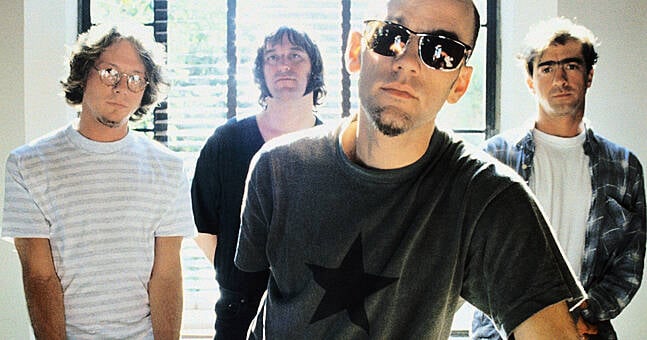
Twenty-five years ago, this week (November 26/December 2, 1994) the song Bang and Blame by R.E.M.debuted on the Billboard Alternative Songs chart (Page 119/called Modern Rock Tracks in 1994), entering at #8, making it to #1 on December 17. Released October 31, it was the second single from the album Monster, their ninth studio album. Co-produced by the band and Scott Litt, all song writing credits are the band members. The song also made it to #1 in Canada on February 20, 1995, and peaked in the top ten in the Billboard Mainstream Rock chart (Album Rock Tracks in 1994), Billboard Mainstream Top 40 chart and, in Finland, Iceland and Poland.
Lyrics (from LyricFind): If you could see yourself now, baby
It’s not my fault, you used to be so in control
You’re going to roll right over this one
Just roll me over, let me go
You’re laying blame
Take this as no, no, no, no, no
You bang, bang, bang, bang, bang
Then blame, blame, blame
You bang, bang, bang, bang, bang
It’s not my thing, so let it go
If you could see yourself now, baby
The tables have turned, the whole world hinges on your swings
Your secret life of indiscreet discretions
I’d turn the screw and leave the screen
Don’t point your finger
You know that’s not my thing
You came to bang, bang, bang, bang, bang
To blame, blame, blame
Bang, bang, bang, bang, bang
It’s not my thing, so let it go now
You’ve got a little worry
I know it all too well
I’ve got your number
But so does every kiss and tell
Who dares to cross your threshold
Happens on you way
Stop laying blame
You know that’s not my thing
You know that’s not my thing
You came to bang, bang, bang, bang, bang
Then blame, blame, blame
Bang, bang, bang, bang, bang
It’s not my thing so let it go, you
Bang, bang, bang, bang, bang
Then blame, blame, blame
Bang, bang, bang, bang, bang
It’s not my thing so let it go
You kiss on me
Tug on me
Rub on me
Jump on me
You bang on me
Beat on me
Hit on me
Let go on me
You let go on me
This was Robert Stanley‘s second phone interview with Chris for his Unicus Radio Hour. This interview was broken down into five segments. I retrieved them from a forum.
This is Chris’s last interview and, by October 31, 2013, Chris stopped writing as well.
Eight-four years ago, today, Austrian physicist Erwin Schrödinger published his first of three essays on a Thought Experiment regarding a hypothetical cat:
[A] cat, a flask of poison and a radioactive source are placed in a sealed box. If an internal monitor (e.g. Geiger counter) detects radioactivity (i.e. a single atom decaying), the flask is shattered, releasing the poison, which kills the cat. The Copenhagen interpretation of quantum mechanics implies that, after a while, the cat is simultaneously alive and dead. Yet, when one looks in the box, one sees the cat either alive or dead, not both alive and dead. This poses the question of when, exactly, quantum superposition ends and reality collapses into one possibility or the other.
[Schrödinger] intended the example [above] to illustrate the absurdity of the existing view of quantum mechanics:
One can even set up quite ridiculous cases. A cat is penned up in a steel chamber, along with the following device (which must be secured against direct interference by the cat): in a Geiger counter, there is a tiny bit of radioactive substance, so small, that perhaps in the course of the hour one of the atoms decays, but also, with equal probability, perhaps none. [If] it happens, the counter tube discharges and, through a relay, releases a hammer that shatters a small flask of hydrocyanic acid. If one has left this entire system to itself for an hour, one would say that the cat still lives if, meanwhile, no atom has decayed. The first atomic decay would have poisoned it. The psi-function of the entire system would express this by having in it the living and dead cat (pardon the expression) mixed or smeared out in equal parts.
It is typical of these cases that an indeterminacy originally restricted to the atomic domain becomes transformed into macroscopic indeterminacy, which can then be resolved by direct observation. That prevents us from so naively accepting as valid a “blurred model” for representing reality. In itself, it would not embody anything unclear or contradictory. There is a difference between a shaky or out-of-focus photograph and a snapshot of clouds and fog banks.
Schrödinger’s famous thought experiment poses the question, “when does a quantum system stop existing as a superposition of states and become one or the other?”
As I type this, I am nearly comatose from the tryptophan overload. I’m glad I went for a walk before I ate as I would never have been able to get off the couch. I didn’t prepare a full size turkey as there was only three of us eating. I slow cooked a turkey breast in my crock pot. I did have the usual mashed potatoes, green beans, cranberry sauce and my lumpy mushroom gravy. With a small gathering, no traditional dressing but, stove top stuffing instead. I’ve struggled for years to make non-lumpy gravy. It just ain’t happening. *sigh*
Many well wishes and, safe travels to family and friends. The weather is a mess in many parts of the US. *yawn* ~Vic
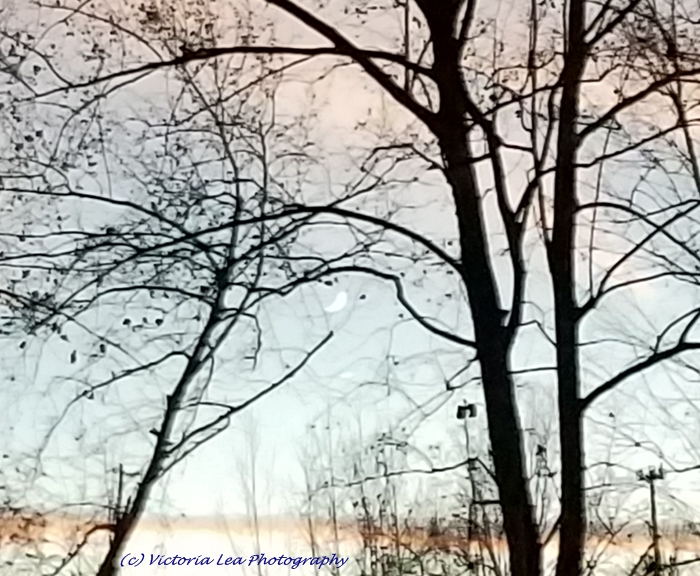
I was actually trying to capture not only the sun setting but,
the crescent moon as well.You can just see the crescent moon in the center.
Just below it, hard to see, is Venus.
It’s a truly slim crescent but, my phone always blurs Moon.
On the day before gathering around the turkey, gather around the nearest jukebox to celebrate National Jukebox Day! As Americans flock to their hometowns for Thanksgiving, many will head out to neighborhood bars and restaurants. They’ll catch up with friends and family and, celebrate by playing great songs on their local jukebox.
Image Credit: pinterest.com
The name jukebox is thought to originate from places called juke houses or jook joints. In the early 1900s, people congregated in these establishments to drink and listen to music. Throughout history, the jukebox continued to evolve with the times. While the Blue Grass Boys played to sold-out audiences in the Grand Ole Opry, guys and gals danced the night away by playing their song over and over, again, on the jukebox at a local pub. With the advancement of technology, today’s jukebox is more versatile than ever before. Throughout each era, from big band, jazz, country and blues, to rock & roll, acoustic, and electric, and everything in between, the jukebox has played it all.
History…
In 1889, Louis Glass and his partner William S. Arnold invented the first coin-operated player in San Francisco. They were both managers of the Pacific Phonograph Co. Formally known as the nickel-in-the-slot machine, the player included a coin operation feature on an Edison phonograph. However, it played a limited selection of songs without any amplification.
1946 ushered in “The Silver Age” for jukeboxes as market demand for the newest and greatest technology soared. Fashionable and sleek, jukeboxes weren’t just music players, they were centerpieces often flamboyant with color and chrome. Neon and sci-fi became a tremendous influence on style as well.
Modern Era…
The 1960s was the start of a new modern age for jukeboxes. Designs of coin-operated models went through radical changes, not only because of the availability of new materials, such as plastic but also because of the need to accommodate customer demand for more song selection.
In 1989, compact-disc mechanisms replaced the older record style players as newer technology became affordable and rapidly implemented among the general population. Jukeboxes started to become more of a novelty than a necessity.
TouchTunes founded National Jukebox Day to celebrate the iconic jukebox and the powerful memories it evokes in people.
Forty years ago, today, Part I of the mini-series Beggarman, Thief aired on NBC. Based on the novel of the same name by Irwin Shaw, it was the sequel to the novel and mini-series Rich Man, Poor Man that aired from February through March 1976 on ABC. An additional sequel, Rich Man, Poor Man Book II aired from September 1976 to March 1977, also on ABC but, was not based on the actual sequel novel.
This sequel to “Rich Man, Poor Man” is set in the ’60s and focuses on wannabe Hollywood filmmaker Gretchen, black-sheep Army officer Billy and, Billy’s cousin Wesley, who’s tracking his father’s killer in France.
The two-part, four-hour sequel to Irwin Shaw’s “Rich Man, Poor Man” and the vastly successful mini-series made from it (and the subsequent, less-successful short-lived series, “Rich Man, Poor Man Book II,” during the 1976-77 season). Moviemaker Gretchen Jordache, the sister not seen in either of the predecessors, strives to pull the family together after the murder of brother Tom (in the mini-series) and the disappearance of brother Rudy (in the later series), by first re-establishing contact with her soldier son and, then, patching things up with her sister-in-law, Kate, Tom’s widow.
Twenty-five years ago, this week (November 19/25, 1994), the song Spin the Black Circle by Pearl Jamdebuted on the Billboard Mainstream Rock chart (Page 79/ called Album Rock Tracks in 1994), entering at #16 (also its peak). Released November 8, it was the first single from their third album Vitalogy. Produced by Brendan O’ Brien, it was written by Eddie Vedder and Stone Gossard.
The most [Vedder] will do is proselytize against the extinction of the LP, as he does in “Spin the Black Circle,” one of the few songs from Seattle in which a needle has nothing to do with heroin.
Vitalogy has a number of gripping songs that match the soaring anthems of Ten. The first three tracks are a promising start: “Last Exit,” “Not for You” and especially “Spin the Black Circle,” a revvedup thrash tribute to vinyl, rock harder than anything Pearl Jam have ever done.
Pearl Jam still hasn’t developed an individual style to match that of its profoundly uptight singer, Eddie Vedder. Guitarists Stone Gossard and Mike McCready continue to play sloppy, characterless riffs. [T]heir punk song, ”Spin the Black Circle,” is a little flabby, like dinosaur rockers trying to prove they’re into Green Day.
The song peaked at #18 November 26 on the Billboard Hot 100 and was the first Pearl Jam single to enter this chart. It also peaked at #11 on the Billboard Alternative chart (called Modern Rock Tracks in 1994). It peaked in the top five in Australia, New Zealand and Norway.
I don’t know what this means. I don’t think it means anything.
Lyrics (From LyricFind) See this needle
Oh see my hand
Drop, drop, dropping it down
oh so gently
here it comes
touch the flame
Turn me up
won’t turn you away
Spin, spin
spin the black circle
Spin, spin
spin the black, spin the black
Spin, spin
spin the black circle
Spin, spin
whoa
Pull it out
a paper sleeve
Oh my joy
only you deserve conceit
Oh I’m so big
and my whole world
I’d rather you
rather you, than her
Spin, spin
spin the black circle
Spin, spin
spin the black, spin the black
Spin, spin
spin the black circle
Spin, spin
whoa
Oh you’re so warm
oh, the ritual
as I lay down your crooked arm
Spin, spin
spin the black circle
Spin, spin
spin the black, spin the black
Spin, spin
spin the black circle
Spin, spin
I am an avid herbal tea drinker. My favorite brand is Traditional Medicinals. They always put inspirational thoughts and quotes on the tea bag tag. I love this one. ~Vic

















 Cosmic-Observation