The flight was hijacked shortly after takeoff from Schiphol. In the course of the hijacking, a grenade carried by one of the skyjackers detonated, killing her and injuring the flight’s chief purser. The lead hijacker […] immediately announced himself to air traffic control as El Kassar, hijacking the aircraft in the name of the Palestinian Liberation movement. After several Middle Eastern governments refused to permit Flight 404 to land, the plane eventually touched down in Dubai, in the United Arab Emirates. After several days on the ground, the terrorists demanded the release of Kozo Okamoto, survivor of the JRA’s attack on Tel Aviv’s Lod Airport.
After the Israeli government refused to release Okamoto, the hijackers flew the aircraft first to Damascus, Syria, and then to Benghazi, in Libya. On July 23, 89 hours after the hijacking began, the passengers and crew were released. [The] hijackers then blew up the aircraft, making the incident the second hull loss of a Boeing 747. The first hull-loss was also the result of hijackers. Maruoka escaped and in 1977, led the hijacking of Japan Air Lines Flight 472. He remained a fugitive, until 1987, when he was arrested in Tokyo after entering Japan on a forged passport. Given a life sentence, he died in prison on May 29, 2011.
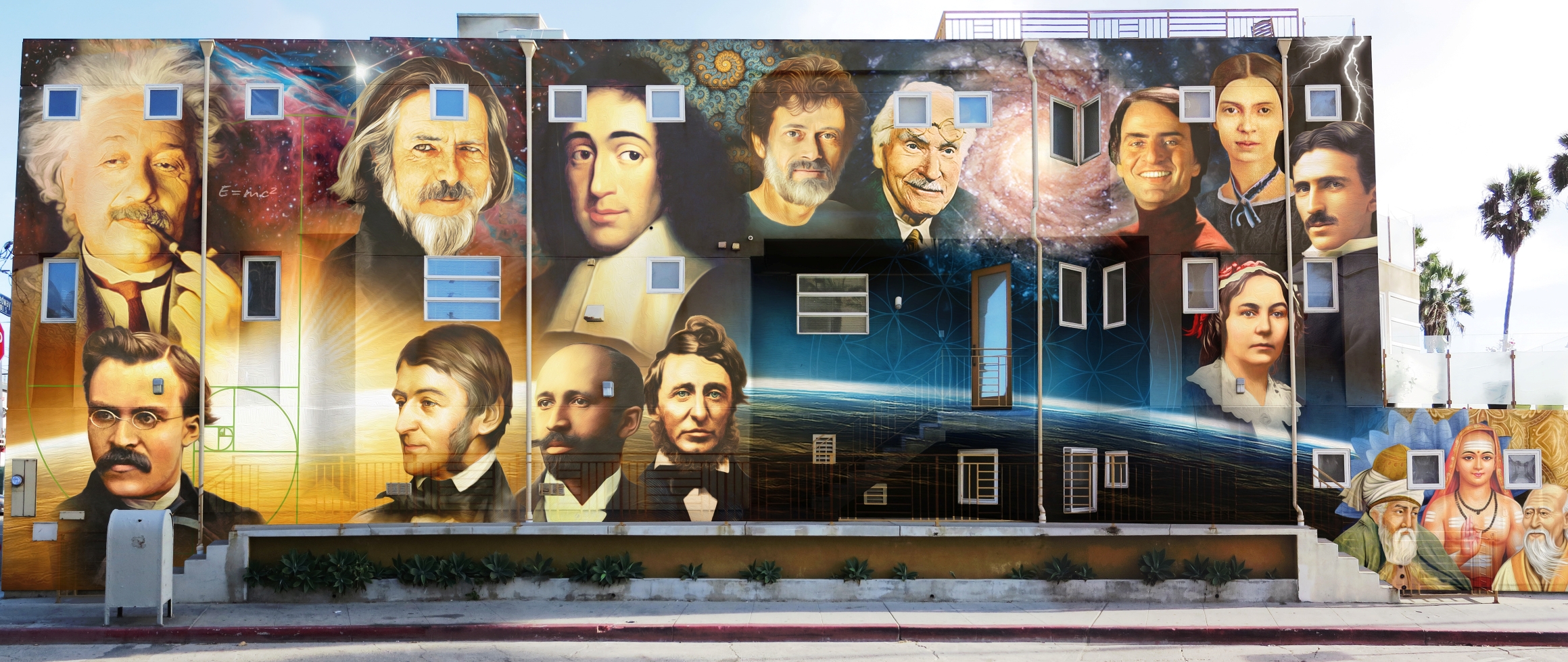
Update: After doing some digging, it turns out that this mural was commissioned in 2015 by the The Paradise Project. American artist Levi Ponce created the 75 foot long masterpiece on The Paradise Project’s headquarters in Venice, CA. The name of this creation is called Luminaries of Pantheism. That would make this a Pantheism Meme.
I only recognized five of these people…Einstein, Watts, McKenna, Sagan and Tesla. I originally requested help with the others but, I have the complete list, now. LOL! ~Vic
Returning to my Samsung playlist, submitted for your approval…
“I’ll be coming home, wait for me…”
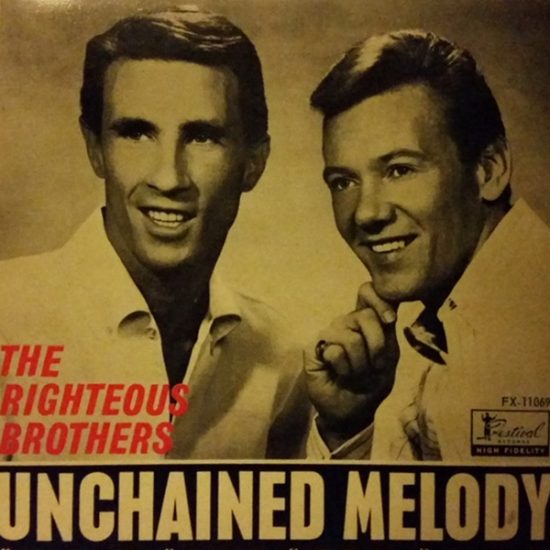
This song is older than I am. My dad liked the Righteous Brothers and their music was in my house, growing up. This is one of my favorites. It has an interesting background. Composed by Alex North in 1955 (a song he’d written in the 1930s), the lyrics were written by Hy Zaret. It was the theme to the movie Unchained, a film about a convict in a medium-security prison, wanting desperately to escape and go home to his wife. This was the movie’s “Melody.” Todd Duncan was the singer for the soundtrack.
There are over 1,500 recordings of this song, with the most notable being the Righteous Brothers’ version. Recorded by the duo in 1965 for Philles Records, Bobby Hatfield won a coin toss to sing it solo on their fifth albumJust Once In My Life, according to Bill Medley. [Note: According to the Encyclopedia of Great Popular Song Recordings (Google Books), Just Once In My Life is listed as their fourth album. This reflects, otherwise.] Hatfield changed the song a bit during recordings. He decided to sing “I need your love…” in the final verse much higher than previous singers.
Ken Sharp: “Bobby’s vocals on Unchained Melody […] are stunning. Did he recognize his gift?”
Medley: “I don’t think he knew how good he was. I don’t think either one of us were thinking…are we good or not? I think we were just saying…thank God people enjoy what we’re doing. We admired so many other people and we certainly didn’t feel we were above anyone but, Bobby was sensational.
I happened to produce Unchained Melody. I know a lot of people think Phil (Spector) did it but, I produced and arranged it. I had the arrangement all done and, Bobby came in, sang it twice and that was it. I played piano and sang vocal background on it. [If] I knew that it was gonna be a hit, I certainly would have brought in a better piano player [laughing].”
Recorded on the “B” side of the single Hung On You from the album Back To Back, radio DJs weren’t interested in it and flipped the record over. Per Medley, producer Phil Spector was so pissed off, he began calling the radio stations to make them stop playing the wrong song. Thankfully, he was unsuccessful and the song made it to #4 on Billboard’s Hot 100, the week of September 4, 1965. It re-appeared in the Billboard charts in 1990 when the movie Ghost was released July 13. Two versions of the song wound up in the charts at the same time, the original 1965 version and a new recording by Hatfield. [They] became the first act to have two versions of the same song in the Top 20 at the same time.
You’ve probably heard of ChatGPT, a computer program that is trained to follow your instruction and provide a variety of wide ranging responses. As someone that has spent some time actually using the AI, I have to say, the results it produces can be eerily human but, did you know that computer scientists have been working alongside chatbots as early as the 1960s?
It was the late 1960’s and Joseph Weizenbaum, an MIT computer scientist, had just completed work on his revolutionary chatbot ELIZA. Weizenbaum was born in Berlin, Germany, in 1923 and fled the country with his family in 1935 to escape the political turmoil. Weizenbaum came to the United States where his road to computer science would ultimately begin. After time spent in the Air Force, Weizenbaum would go on to study as a computer scientist and eventually work in the industry. You have to remember, computers at that time were not portable devices that could fit in our pockets. In fact, they often barely fit into a room! As an associate Professor at MIT, Weizenbaum became obsessed with the way computers could directly interact with humans through language. It was this early through line between computers and human language that would work to lay the foundation for his own chatbot and eventually lay the groundwork for the AI development of programs such as ChatGPT, Siri and Alexa.
Eliza was completed in 1966 and Weizenbaum offered MIT students the opportunity to interact with the chatbot. This process consisted of messages typed into the computer by students and, responses would then be provided by ELIZA, […] routed to an electronic typewriter and printer. Weizenbaum was initially happy with the response that was garnered from users’ experience with ELIZA but, there was one thing he did begin to notice that he viewed as considerably concerning. Overtime, Weizenbaum made note of users starting to divulge deep personal information, looking for help similar to that of a therapy session. This observation ended up pushing Weizenbaum to advocate for caution when relying too heavily on computers for human thought…
“There are aspects to human life that a computer cannot understand—cannot. It’s necessary to be a human being. Love and loneliness have to do with the deepest consequences of our biological constitution. That kind of understanding is in principle impossible for the computer.”
Shortly after midnight on July 12, 1973, a fire was reported at the National Personnel Records Center’sMilitary Personnel Records Building, [a branch of the NPRC], in St. Louis County, Missouri. The fire burned out of control for 22 hours and it took two days before firefighters were able to re-enter the building. Due to the extensive damage, investigators were never able to determine the source of the fire.
The National Archives focused its immediate attention on salvaging as much as possible and quickly resuming operations at the facility. Even before the final flames were out, staff at the NPRC had begun work towards these efforts, as vital records were removed from the burning building for safekeeping.
“In terms of loss to the cultural heritage of our nation, the 1973 NPRC fire was an unparalleled disaster. In the aftermath of the blaze, recovery and reconstruction efforts took place at an unprecedented level. Thanks to such recovery efforts and, the use of alternate sources to reconstruct files, today’s NPRC is able to continue its primary mission of serving our country’s military and civil servants.”
The estimated loss of Army personnel records, for those discharged from November 1, 1912, to January 1, 1950, was about 80 percent. In addition, approximately 75 percent of Air Force personnel records, for those discharged from September 25, 1947, through January 1, 1964, were also destroyed in the catastrophe [all records after the last name Hubbard].
I can’t, for the life of me, remember where in the hell I got this. I have just collected things, electronically, over the years. Pretty amazing landing, considering. It reminds me of Captain Chesley “Sully” Sullenberger’s landing…sans water. ~Vic
Nolon House
2008
Click for a larger view.Christmas wreaths in the window.
Click for a larger view.Information Station
Click for a larger view.Beautiful sun prism. Sun dog?
Click for a larger view.Out driving.
Click for a larger view.Beautiful landscape.
Click for a larger view.
As I sit here and watch the Twilight Zone 4th of July marathon and listen to the fireworks going off in the neighborhood, I was thinking about July 4 posts I had made, previously. There is one…my hissing rant from 2020. I was some kind of pissed off. It’s three years later, now and the world is still insane but, the reckoning has started. ~Vic
My original Buck/Thunder Moon post is here. I won’t repeat the data. Full illumination occurs at 7:38am EDT. Howl for me! ~Vic
Image Credit: Moon GiantSamsung A12
07-02-2023 11:55pm
From the Front Porch
Click for a larger view.Nikon CoolPix
07-03-2023 12:09am
Click for a larger view.
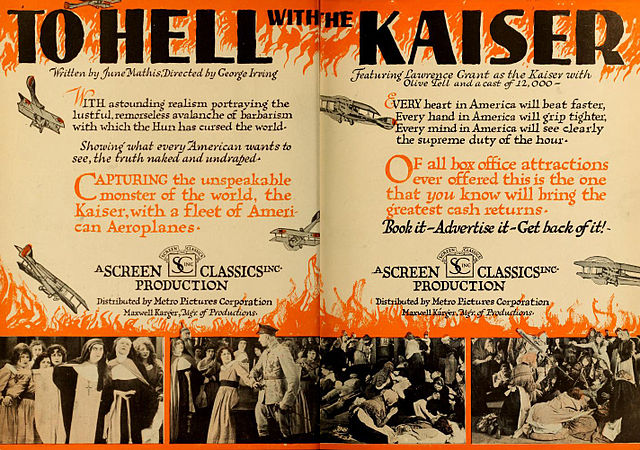
Following the death of his father, Frederick III of Germany, Wilhelm Hohenzollern becomes the German Kaiser and forms a pact with the devil that, he will conquer the globe in exchange for his soul. During the Kaiser’s invasion of Belgium, the Crown Prince enters a church and rapes Ruth Monroe, the daughter of an American inventor who has perfected a noiseless communications device. When the professor denounces the Crown Prince, he immediately is shot, whereupon his other daughter Alice vows to obtain revenge. While Alice’s sweetheart, Winslow Dodge, fights with the Americans as an aviator, she arranges to meet the Crown Prince through her friend Robert Graubel, an actor who impersonates the Kaiser at public functions. With her father’s wireless [device], Alice informs Winslow of the Kaiser’s whereabouts and, as he captures the German emperor, she kills the Crown Prince. Now a prisoner, the Kaiser drowns himself and wakes up in Hell, where Satan abdicates in his favor, saying that the Kaiser’s tortures are more fiendish than any he ever devised.
Lawrence Grant, who spent his lengthy career playing odious villains, appeared in the dual role of Kaiser Wilhelm II and his look-alike, German actor Robert Graubel. Terrified of being assassinated, the Kaiser hires Graubel to impersonate him at various political functions. In the film, the Kaiser achieves military success through an infernal pact with Satan. Once this is established, the film concentrates on the seemingly endless tally of misdeeds perpetrated by the Kaiser during his quarter-century reign over Germany. His “partner in crime” is the Crown Prince […], who thinks nothing of casually raping convent girls and gunning down protesting nuns. The Crown Prince’s latest conquest is Ruth Monroe […], the daughter of an American inventor. When Ruth’s father protests this outrage, he is brutally murdered, whereupon Ruth’s sister Alice […] vows revenge. Using her father’s newest invention, a wireless machine whose coded messages cannot be intercepted, Alice directs a battalion of planes to bomb the small German village where the Kaiser is hiding. Captured by the Allies, the Kaiser is ignominiously dumped in a POW camp but, not before enduring a well-aimed sock on the jaw from a pugnacious dough-boy. In despair, the Kaiser commits suicide and sends his soul to hell. In hell, the devil […] gives up his throne, confessing that the Kaiser is far more sinister than he could ever hope to be.
[On June 8, 1918], Motography ran a Screen Classics press release explaining that To Hell With The Kaiser “reveals the machinations of Europe’s military monster before and during the war, his contempt for Americans […], his elaborate plans to crush France, […] destroy Russia, […] partition the world, […] his [order] to employ deadly gases in the war, the true circumstances under which he ordered the sinking of the Lusitania, the raiding of hospitals […].” Years before the war, Mr. Grant’s physical likeness to the German ruler was noted by a high official of the Kaiser’s court and a proposition was made for Grant to play the Kaiser in a dramatization […]. The war broke out before discussions went any further.
Actor John Sunderland, playing American pilot Winslow Dodge, was himself “an aviator who has seen service in Belgium.”
[It] had been released in the press that Kaiser Wilhelm II had half a dozen doubles who were employed to pose for him in various parts of the country, where there might be danger of assassination, while the real Kaiser, himself, remained safe behind this cloak.
To Hell With The Kaiser opened in New York City at the Broadway Theatre on June 30, 1918, immediately after it had emerged from the cutting and editing rooms […].
The film turned out to be an effective propaganda tool […]. Not only has the picture been shown in munitions plants and training camps […] but, this power has now been demonstrated in a new way…to convert conscientious objectors.
The National Film Preservation Board (NFPB) included this film on its list of Lost U.S. Silent Feature Films as of February 2021.
I found the building of this post fascinating. What started out as a simple movie post, turned into a history lesson. It’s a shame that it is lost. There are photographs of still pictures on IMDb. ~Vic
A runaway bull, that was spotted running down Main Street in Kutztown (Pennsylvania), prompted the Kutztown UniversityPolice Department to issue an aggressive cow alert after the animal made its way onto campus, Sunday night. The bovine appeared scared because it was unfamiliar with its surroundings, police said in the alert that went out via its emergency notification system, about 7:15p. It advised recipients to avoid the North Campus and to not approach the bull, if encountered.
About 30 minutes later, campus police sent an update saying the animal’s owner, from the Fleetwood area, was on his way to retrieve the runaway. A third update, sent about 8:45p, indicated the threat to the campus community had ended but, the bull was, reportedly, still on the loose, last seen in Fleetwood. A video taken by Aaron Merkel and, shared to YouTube, showed the bovine as it trotted down Main Street in Kutztown, trailed by a police car. It could not be verified Monday morning with Fleetwood Police whether there were any livestock sightings in the borough and whether the bull was back in its owner’s possession.
The bovine’s owner was contacted but, the cow left the scene before it could be captured. University spokesman Matt Santos said the cow made a second visit to campus on Tuesday night. He said police caught up with the animal near Lytle Hall but, it fled into the nearby woods before it could be wrangled.
When Irish Eyes Are Smiling is a lighthearted song in tribute to Ireland and was very popular in June 1913. Its lyrics were written by Chauncey Olcott and George Graff, Jr., set to music composed by Ernest Ball, for Olcott’s production of The Isle O’ Dreams and, Olcott sang the song in the show. It was first published in 1912, at a time when songs in tribute to a romanticised Ireland were very numerous […], both in Britain and the United States. During the First World War, the famous tenor John McCormack recorded the song.
The song continued to be a familiar standard for generations. Decades later, it was used as the opening song on the radio show Duffy’s Tavern. The song has been recorded on over 200 singles and albums, by many famous singers, including Bing Crosby, Connie Francis and Roger Whittaker.
Wikipedia Summary
As I have stated in previous posts, Billboard’s charting abilities, in the early 20th Century, is difficult to navigate. My first stop, for these early pieces, is the Tsort site. Playback FM is very helpful, too. Digging around in the Wayback Machine can be a complete rat maze. The data is there but, how much time do you devote to searching for it.
There was a Shamrock Summit in March 1985, apparently, in Canada (which I don’t remember). Starting on St. Patrick’s Day, Prime Minister Brian Mulroney and President Ronald Reagan met & talked for two days. Remember the Acid Rain Scare back then? It was seen as a Turning Point in U.S.-Canada Relations (both Trudeaus don’t play well with others?) and the closing ceremonies were televised, with the men & their wives singing the song (Mulroney & Reagan are Irish surnames). I find the meeting in Quebec City and the singing of an Irish song, ironic and amusing. ~ Vic
An old Simon’s Cat video from 2007, that I just found on my laptop. I had a little trouble uploading this to YouTube. I re-formatted it and, so far, so good. If it gets snatched down, like YouTube likes to do, I will re-upload another way. ~Vic















 Cosmic-Observation