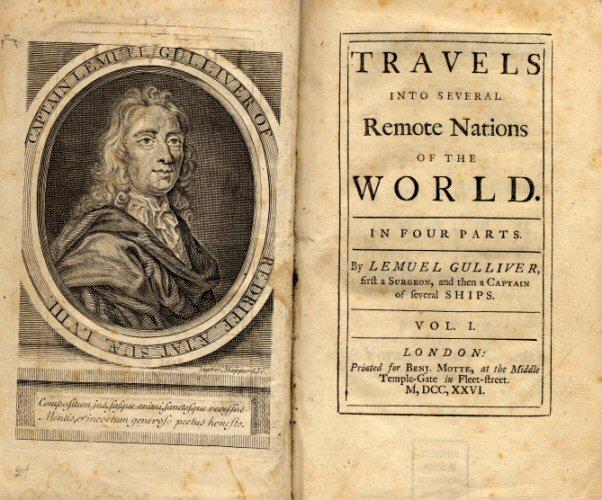
Two-hundred, ninety-four years ago, today, the book of satirical stories, Gulliver’s Travels was published. Written by Irish clergyman Jonathan Swift, the original title was Travels into Several Remote Nations of the World. In Four Parts. By Lemuel Gulliver, First a Surgeon, and then a Captain of Several Ships. That has to be the longest book title in existence. I’ve never read any of it, nor have I seen the various movies that have been put out. That being said, there are several well written summaries and opinions on the material and, I’m not reinventing the wheel. ~Vic
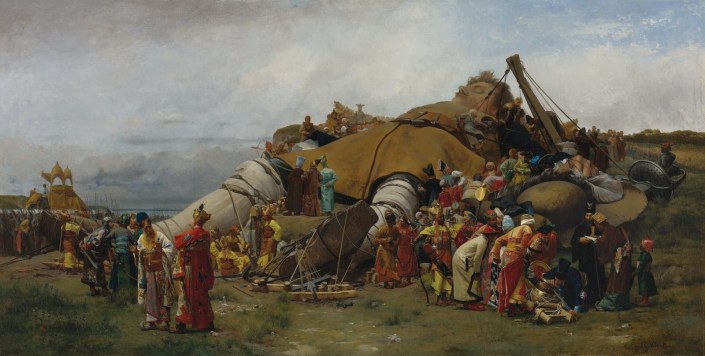
Gulliver’s name probably is an allusion to King Lemuel of Proverbs 31, who was a weak-minded prophet. Swift may also be connecting his character to a common mule, a half-ass, half-horse animal that is known for being stubborn and stupid. A gull is a person who is easily fooled or gullible. At the same time, Gulliver represents the everyman with his average intelligence and general good humor. The reader is able to identify with him and join him in his travels. Even though Swift constantly alludes to events that were happening while he was alive, the story rings true today, bringing light to our own societal issues and to patterns of human nature. Throughout Gulliver’s voyages, Swift goes to great lengths to scrutinize, parody, and satire various aspects of human, and often English, society.
A mock work of travel literature, Jonathan Swift’s famous novel is a far deeper work than one of just Juvenalian and Horatian satire. It is an indictment against the prevailing spirit of Enlightenment philosophy and utopianism, an esoteric defense of Christianity against its Enlightenment critics, and a prophetic vision into the future degeneration of humanity in following the dictates of the natural philosophers of modernity. Swiftian irony is one of the great joys of the work. [Where] traditional literary narrative has the travelling protagonist return home to comfort and love, Swift’s Gulliver returns home deranged and a hater of humanity.
Finding specific information on this film has been difficult. It appears that this was based upon a French terrorist organization’s bombings and assassinations that took place in Germany in September 1956, June 1957, October 1958, March 1959 and November 1959. IMDb doesn’t have a summary or synopsis but, I did find a translated plot from the German side of Wikipedia (Translate The Web Link):
This arms dealer drama takes place in Germany and Switzerland […] during the Cold War.
Manora Khan, consul of an unspecified Asian country, intends to hunt down his Cuban colleague Maria Gomez’s supply of weapons intended for her country. To this end, he orders the help of the smart Johnny Zamaris, with whom he has a common past: Johnny had once [been involved with] his great love, the actress Violetta Scotoni. [It] soon becomes apparent that no one is what he seems to be […]. Consul Khan turns out to be the leader of a secret organization called “The Red Hand” that deliberately kills competing gun-pushers. Competitor Johnny is more than just a smart Sonnyboy [sic]. [In] truth, he works as a defensive officer in his country, with the task of smashing “The Red Hand” again. Both men, who once competed for Violetta, die while serving in their respective [fatherlands], with Johnny being knocked down in the back of a black sedan with a machine gun after a final tender embrace with Violetta.
The writer and producer of this film was born in Austria but, emigrated to France after Anschluss. Unhappy with a Der Spiegel report, he wrote an opposite viewpoint. Der Speigel, in turn, panned the film.
Destroyer Escort USS Harmon
Circa August 1943
Image was censored and retouched.
Radar antennas removed.
Pennant added in its place.
Released for publication March 1944
Photo Credit: Naval History & Heritage Command
Wikipedia & Wikimedia
The USS Harmon was a U.S. NavyBuckley class destroyer escort named after Leonard Roy Harmon, a Mess Attendant (Messman) First Class that served aboard the USS San Francisco. It was the first U.S. warship to be named after a Black American. It was launched July 25, 1943, by Bethlehem Steel Company in Quincy, MA, sponsored by Harmon’s mother and, seventy-seven years ago, today, it was commissioned. She spent nearly a year serving as an escort ship near New Caledonia. After a short period at Pearl Harbor, she joined the Luzon Reinforcement Group. By March 1945, she was an escort and an anti-submarine screen off Iwo Jima. She returned to Pearl Harbor for training, then to Mare Island for a weapons upgrade and, when the war was over, she conducted training operations with submarines.
Decommissioned March 25, 1947, she joined the Atlantic Reserve Fleet. She was stricken August 1, 1965 and sold for scrap January 30, 1967. She received three battle stars for her World War II service.
*************
Leonard Roy Harmon, born in Cuero, Texas, on January 21, 1917, enlisted in the U.S. Navy on June 10, 1939, as a Mess Attendant Third Class. He trained at the Naval Training Station, Naval Operating Base, Norfolk, Virginia and reported to [the] San Francisco (CA-38) on October 28, 1939. On November 12, 1942, [the] San Francisco was covering a force of transports disembarking reinforcements off Guadalcanal when Japanese land attack planes, carrying torpedoes, attacked. [The] enemy aircraft crashed into the ship causing “considerable damage and intense fires” that put the after anti-aircraft director and radar out of commission. One officer and 15 men were either killed outright or died of their injuries. Harmon rushed in to evacuate the wounded. He was then assigned to assist Pharmacist’s Mate Lynford Bondsteel in evacuating and caring for the wounded. While the ship was being raked by enemy gunfire, Harmon deliberately shielded Bondsteel in order to protect his wounded shipmate. Although Bondsteel managed to get his courageous shipmate below, Harmon died of his wounds soon afterward.
Harmon was awarded a Purple Heart and, in March 1943, the Navy Cross.
Citation Excerpt:
The President of the United States of America takes pride in presenting the Navy Cross (Posthumously) to Mess Attendant First Class Leonard Roy Harmon (NSN: 3600418), United States Navy, for extraordinary heroism and devotion to duty in action against the enemy while serving on board the Heavy Cruiser U.S.S. San Francisco (CA-38) […]. With persistent disregard of his own personal safety, […] Harmon rendered invaluable assistance in caring for the wounded and assisting them to a dressing station. In addition to displaying unusual loyalty [on] behalf of the injured Executive Officer, he deliberately exposed himself to hostile gunfire in order to protect a shipmate and, as a result of this courageous deed, was killed in action. He gallantly gave his life for his country.
Destroyer Escort USS Harmon
Circa August 1943
Image was censored and retouched.
Radar antennas removed.
Pennant added in its place.
Released for publication March 1944
Photo Credit: Naval History & Heritage Command
Wikipedia & Wikimedia
The USS Harmon was a U.S. NavyBuckley class destroyer escort named after Leonard Roy Harmon, a Mess Attendant (Messman) First Class that served aboard the USS San Francisco. It was the first U.S. warship to be named after a Black American. It was launched July 25, 1943, by Bethlehem Steel Company in Quincy, MA, sponsored by Harmon’s mother and, seventy-seven years ago, today, it was commissioned. She spent nearly a year serving as an escort ship near New Caledonia. After a short period at Pearl Harbor, she joined the Luzon Reinforcement Group. By March 1945, she was an escort and an anti-submarine screen off Iwo Jima. She returned to Pearl Harbor for training, then to Mare Island for a weapons upgrade and, when the war was over, she conducted training operations with submarines.
Decommissioned March 25, 1947, she joined the Atlantic Reserve Fleet. She was stricken August 1, 1965 and sold for scrap January 30, 1967. She received three battle stars for her World War II service.
*************
Leonard Roy Harmon, born in Cuero, Texas, on January 21, 1917, enlisted in the U.S. Navy on June 10, 1939, as a Mess Attendant Third Class. He trained at the Naval Training Station, Naval Operating Base, Norfolk, Virginia and reported to [the] San Francisco (CA-38) on October 28, 1939. On November 12, 1942, [the] San Francisco was covering a force of transports disembarking reinforcements off Guadalcanal when Japanese land attack planes, carrying torpedoes, attacked. [The] enemy aircraft crashed into the ship causing “considerable damage and intense fires” that put the after anti-aircraft director and radar out of commission. One officer and 15 men were either killed outright or died of their injuries. Harmon rushed in to evacuate the wounded. He was then assigned to assist Pharmacist’s Mate Lynford Bondsteel in evacuating and caring for the wounded. While the ship was being raked by enemy gunfire, Harmon deliberately shielded Bondsteel in order to protect his wounded shipmate. Although Bondsteel managed to get his courageous shipmate below, Harmon died of his wounds soon afterward.
Harmon was awarded a Purple Heart and, in March 1943, the Navy Cross.
Citation Excerpt:
The President of the United States of America takes pride in presenting the Navy Cross (Posthumously) to Mess Attendant First Class Leonard Roy Harmon (NSN: 3600418), United States Navy, for extraordinary heroism and devotion to duty in action against the enemy while serving on board the Heavy Cruiser U.S.S. San Francisco (CA-38) […]. With persistent disregard of his own personal safety, […] Harmon rendered invaluable assistance in caring for the wounded and assisting them to a dressing station. In addition to displaying unusual loyalty [on] behalf of the injured Executive Officer, he deliberately exposed himself to hostile gunfire in order to protect a shipmate and, as a result of this courageous deed, was killed in action. He gallantly gave his life for his country.
Three hundred, fifty-five years ago, John Blow, an English Baroque organist, composed the “club anthem” I Will Always Give Thanks, collaborating with Pelham Humfrey and William Turner. There is not a lot written about this song but, there are two suggestions of it either being an honoring of the victory over the Dutch in 1665 or a simple commemoration of the three men working together.
Biopic of the wartime exploits of Audie Murphy (played by himself), the most decorated US soldier in World War II. Starting with his boyhood in Texas, where he became the head of his family at a young age, the story follows his enrollment in [the] Army where he was assigned to the 3rd Division. He fought in North Africa, Sicily and Italy, before landing in southern France and, eventually, fighting in Germany. A Medal of Honor recipient, he also received battle honors from the French and Belgian government.
The highly variable Audie Murphy delivers his best screen performance as “himself” in Universal‘s To Hell and Back. Based on the star’s autobiography, this is the story of how Murphy became America’s most-decorated soldier during WW II. After dwelling a bit on Murphy’s hard-scrabble Texas upbringing, the story moves ahead to 1942, when, as a teenager, Audie joined the army. Within a year, he was a member of the 7th Army, serving in North Africa, Italy, France and, ultimately, Germany and Austria. One by one, the members of Murphy’s Company B are killed in the war, until only three men from the original company are left. [The] others appear at the finale as ghostly images […]. The bulk of the film is given over to Murphy’s conspicuous acts of combat bravery and his killing of 240 enemy soldiers. Highlighted by excellent battle sequences, To Hell and Back is a serviceable tribute to a most complex individual.
Date: 1948
Photo Author: Fort Detrick
Wikipedia & Wikimedia
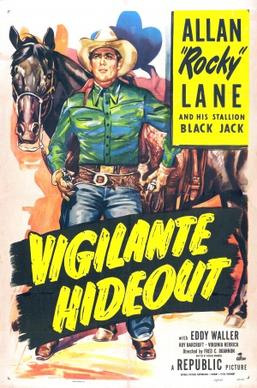
Rocky (Lane), a Range Detective, arrives to help Nugget (Waller) with rustlers. When he learns Nugget owns only three cows, he stays on, anyway and, soon, becomes involved in Benson’s attempt to blow open the bank’s safe. When Rocky upsets his plans, Benson (Don Haggerty), supposedly, gets rid of him by having him declared an outlaw, wanted dead or alive. Then, Benson takes a load of explosives into an old mine located directly under the bank vault.
Double-barreled justice catches up with a cold-blooded killer when “Rocky” takes up the chase! Cattle detective, Rocky Lane, arrives in town to investigate cattle disappearances only to realize just three cows, owned by eccentric inventor Nugget Clark, are involved. However, the disappearances lead to a deeper mystery involving dynamite explosions, rampaging cowboys and a water shortage.
Lane and his trusty black stallion are on hand to help old-timer Waller find water for a town which is threatening to fold up due to drought. Some crooked townsfolk don’t want the water to be found because they want to collect on the $25,000 being stashed away for an aqueduct. Lane’s job is to make sure these people don’t pose too much of a problem, while Waller goes about finding the water. The characterization of Waller as a crazed inventor of gadgets is an added attraction to this oater with a realistic bent.
The Treaty of Union is the name usually, now, given to the agreement which led to the creation of the new state of Great Britain [.] [It stated] that England, which already included Wales, and Scotland were to be “United into one Kingdom by the name of Great Britain[.]” At the time it, was more often referred to as the Articles of Union. The details of the treaty were agreed on [July 22], 1706 and separate Acts of Union were then passed by the parliaments of England and Scotland to put the agreed articles into effect. The political union took effect on [May 1], 1707.
Queen Elizabeth I of England and Ireland, last monarch of the Tudor dynasty, died without issue on [March 24], 1603 and the throne fell at once […] to her first cousin twice removed, James VI of Scotland, a member of House of Stuart and the only son of Mary, Queen of Scots. By the Union of the Crowns in 1603, he assumed the throne of the Kingdom of England and the Kingdom of Ireland as King James I. This personal union lessened the constant English fears of Scottish cooperation with France in a feared French invasion of England. After [the] union, the new monarch, James I and VI, sought to unite the Kingdom of Scotland and the Kingdom of England into a state which he referred to as “Great Britain”. Nevertheless, Acts of Parliament attempting to unite the two countries failed in 1606, 1667 and 1689.
Photo Credit: monash.edu CTIE
Wikipedia & Wikimedia
One-hundred, ten years ago, today…
The Duigan […] biplane was an early aircraft which made the first powered flight by an Australian-designed and built machine when it flew in Victoria in 1910. The aircraft was constructed by John Duigan, with help from his brother Reginald, on their family farm at Mia Mia. The effort was especially significant in that the brothers built the aircraft almost entirely by themselves and without input from the pioneering aviation community. [A] photo-postcard of the Wright Flyer inspired the design and Sir Hiram Maxim‘s book Artificial and Natural Flight provided the theoretical basis. The only components not built by the Duigans themselves were the engine, made by the J. E. Tilley Engineering Company of Melbourne and the propeller. However, both of these components were extensively modified by John before they could be used.
Photo Credit: Memorial near Mia Mia Dolphin 51
Wikipedia & Wikimedia
The aircraft flew for the first time on July 16, 1910, taking off under its own power and flying [24 feet] (7 meters). Within two months, this had been extended to [300 feet] (90 meters) and, soon thereafter, to [590 feet with an altitude of 12 feet] (180 meters [with] an altitude of 3.5 meters). By the end of the year, Duigan had made a flight of [nearly a mile] (1 km) at an altitude of [100 feet] (30 meters).
Duigan informed the Department of Defence of his achievements, hoping to claim a £5,000 prize that had been offered in September 1909 for the construction of an aircraft suitable for military purposes. Duigan was ineligible for the prize, which had expired at the end of March 1910 but, was asked to demonstrate his aircraft for the military anyway. He also flew it in a public demonstration in front of a crowd of 1,000 spectators at Bendigo Racecourse in January 1911. In 1920, Duigan donated the aircraft to the Industrial and Technological Museum of Victoria, which was later absorbed into Museum Victoria.
Museum Victoria also preserves a flying replica of the Duigan biplane built by Ronald Lewis and flown in 1990. It was donated to the museum in 2000.
Photo Credit: Ken Lund
History & Headlines
Wikimedia
This was going to be a post on the highest recorded heat level, listed in the Guinness (Book) of World Records. Supposedly, one-hundred and seven years ago, today, Death Valley got up to 134.4℉. I read Wikipedia, I read Guinness and I read History & Headlines. If it made it into Guinness, someone must have thought it was legitimate. Well, after taking a dive into Weather Underground‘s investigation of this record (this is a very long read), posted by weather historian Christopher Burt on October 24, 2016, I’m not so sure this event ever happened.
I have contacted Guinness for a challenge. We shall see how this plays out. ~Vic
Anonymous Artist Vlad III
Image Credit: Wikipedia & Wikimedia
The conflict initially started with Vlad‘s refusal to pay the jizya (tax on non-Muslims subjects charged at 2.5%) to the sultan and [it] intensified when Vlad invaded Bulgaria. In response, Mehmed raised a great army with the objective to conquer Wallachia and annex it to his empire. The two leaders fought a series of skirmishes, the most notable one being the Night Attack where Vlad attacked the Turkish camp in the night in an attempt to kill Mehmed. The assassination attempt failed and Mehmed marched to the Wallachian capital of Târgoviște, where he found a few men with cannons. After leaving the capital, Mehmed discovered 23,844 impaled Turks whom Vlad had killed during his invasion of Bulgaria. The number is mentioned by Vlad himself in a letter to Matthias Corvinus (Matthias I). The sultan, and his troops, then sailed to Brăila and burned it to the ground before retreating to Adrianople. Both sides claimed victory in the campaign and Mehmed’s forces returned home with many captured slaves, horses and cattle.
There are two extant ballads […], both of which narrate the same story. As ballads existed within oral tradition[s] before being written down, other versions of this once popular song also may have existed. Moreover, other ballads used its tune without necessarily referring to [this particular ballad].
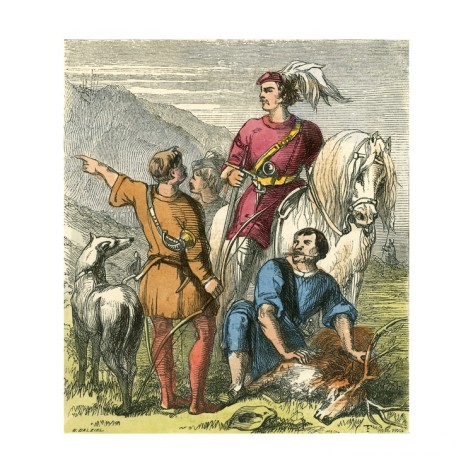
This ballad was entered in the Stationers’ Register in 1624. The title is alternatively spelled Chevy Chace. The ballad is generally thought to describe the Battle of Otterburn. Some of the verses correspond to that battle but, not all. The Battle of Otterburn took place in 1388. At that [b]attle, Henry Percy (Hotspur) was captured, not killed. He was killed in 1403 in an uprising against Henry IV.
The death of Earl Douglas
Author: John Frederick Tayler
Image Credit: All Posters & Wikimedia
[A]nother possibility [was] border warfare between a Percy and a Douglas in 1435 or 1436. Henry Percy of Northumberland made a raid into Scotland with 4,000 men. He was met by William Douglas, Earl of Angus at Piperden. There were great losses on each side but, the Scots prevailed.
Over time, and the various evolutions of the ballad, events and personages have gotten confused.
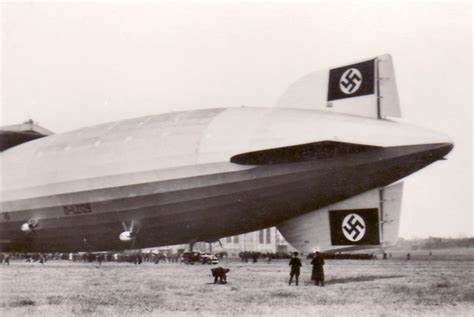
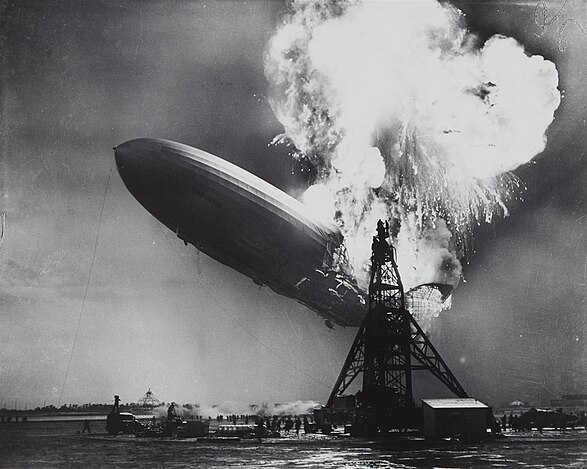
[T]he largest dirigible ever built, [it burst] into flames upon touching its mooring mast […]. There were 35 fatalities (13 passengers and 22 crewmen) from the 97 people on board (36 passengers and 61 crewmen) and an additional fatality on the ground.
The rigid airship, often known as the Zeppelin after the last name of its innovator, Count Ferdinand von Zeppelin, was developed by the Germans in the late 19th century. [It] had a light framework of metal girders that protected a gas-filled interior [of] highly flammable hydrogen gas, vulnerable to explosion.
On May 3, the Hindenburg left Frankfurt, Germany, for a journey across the Atlantic to Lakehurst’s Navy Air Base. While attempting to moor, […] the airship suddenly burst into flames, probably after a spark ignited its hydrogen core. Rapidly falling 200 feet to the ground, the hull of the airship incinerated within seconds. [M]ost of the survivors suffered substantial injuries.
The disaster was the subject of newsreel coverage, photographs and [radio announcer] Herbert Morrison‘s recorded […] eyewitness reports from the landing field, which were broadcast the next day. He is known for his famous emotional declaration “Oh, the humanity!”
A variety of hypotheses have been put forward for both the cause of ignition and the initial fuel for the ensuing fire. The event shattered public confidence in the giant, passenger-carrying rigid airship and marked the abrupt end of [that] era.
Image Credit: Doubleday Philip K. Dick 1974
First Edition Hardcover
wikipedia.org & wikimedia.org
Lyrics:
Flow, my tears, fall from your springs!
Exiled for ever, let me mourn;
Where night’s black bird her sad infamy sings,
There let me live forlorn.
Down vain lights, shine you no more!
No nights are dark enough for those
That in despair their last fortunes deplore.
Light doth but shame disclose.
Never may my woes be relieved,
Since pity is fled;
And tears and sighs and groans my weary days, my weary days
Of all joys have deprived.
From the highest spire of contentment
My fortune is thrown;
And fear and grief and pain for my deserts, for my deserts
Are my hopes, since hope is gone.
Hark! you shadows that in darkness dwell,
Learn to contemn light
Happy, happy they that in hell
Feel not the world’s despite.









 Cosmic-Observation