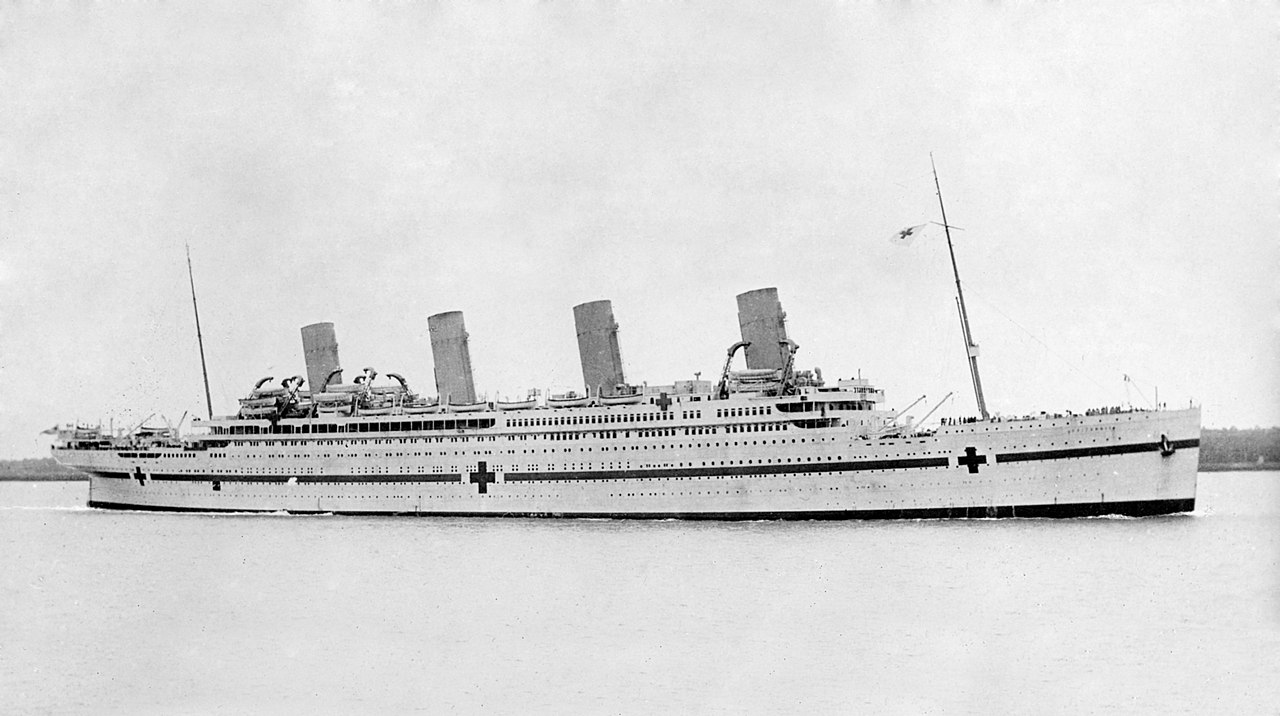
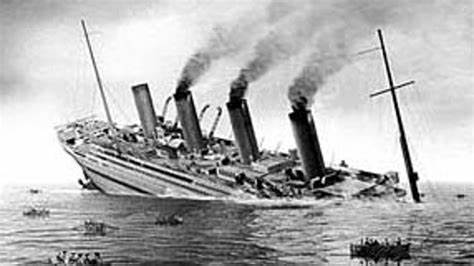
One-hundred, three years ago, today, the HMHS Britannic, sister ship to the RMS Titanic, sank in the Aegean Sea. On its way to pick up more wounded soldiers near the Gulf of Athens, a loud explosion shook the ship at 8:12am.
In the wake of the Titanic disaster on April 14, 1912, the White Star Line made several modifications in the construction of its already-planned sister ship. First, the name was changed from Gigantic to Britannic and the design of the hull was altered to make it less vulnerable to icebergs. In addition, it was mandated that there be enough lifeboats on board to accommodate all passengers, which had not been the case with the Titanic.
Postcard of the Britannic showing her intended purpose. Image Credit: wikipedia.org & wikimedia.org & ibiblio.org
[Immediately after the explosion], Captain Bartlett ordered the closure of the watertight doors and sent out a distress signal. However, the blast had already managed to flood six whole compartments, even more extensive damage than that which had sunk the Titanic. Still, the Britannic had been prepared for such a disaster and would have stayed afloat except for two critical matters.
First, Captain Bartlett decided to try to run the Britannic aground on the nearby island of Kea. This might have been successful but, earlier, the ship’s nursing staff had opened the portholes to air out the sick wards. Water poured in through the portholes as the Britannic headed towards Kea. Second, the disaster was compounded when some of the crew attempted to launch lifeboats without orders. Since the ship was still moving as fast as it could, the boats were sucked into the propellers, killing those on board.
Less than 30 minutes later, Bartlett realized that the ship was going to sink and ordered it abandoned. The lifeboats were launched and even though the Britannic sank at 9:07, less than an hour after the explosion, nearly 1,100 people managed to make it off the ship. In fact, most of the 30 people who died were in the prematurely launched lifeboats.
Violet Jessop (who was also one of the survivors of Britannic’s sister-ship Titanic and had even been on the third sister, Olympic, when it collided with HMS Hawke) described the last seconds:
“She dipped her head a little, then a little lower and still lower. All the deck machinery fell into the sea like a child’s toys. Then, she took a fearful plunge, her stern rearing hundreds of feet into the air until with a final roar, she disappeared into the depths, the noise of her going resounding through the water with undreamt-of violence…”
Britannic was the largest ship lost in the First World War.
The cause, whether it was a torpedo from an enemy submarine or a mine, was not apparent. It would later be revealed that the mines were planted in the Kea Channel on October 12, 1916, by SM U-73 under the command of Gustav Sieß (German language link).
There is very little written about this special, save a New York Times Article, written the next day (No writer credited):
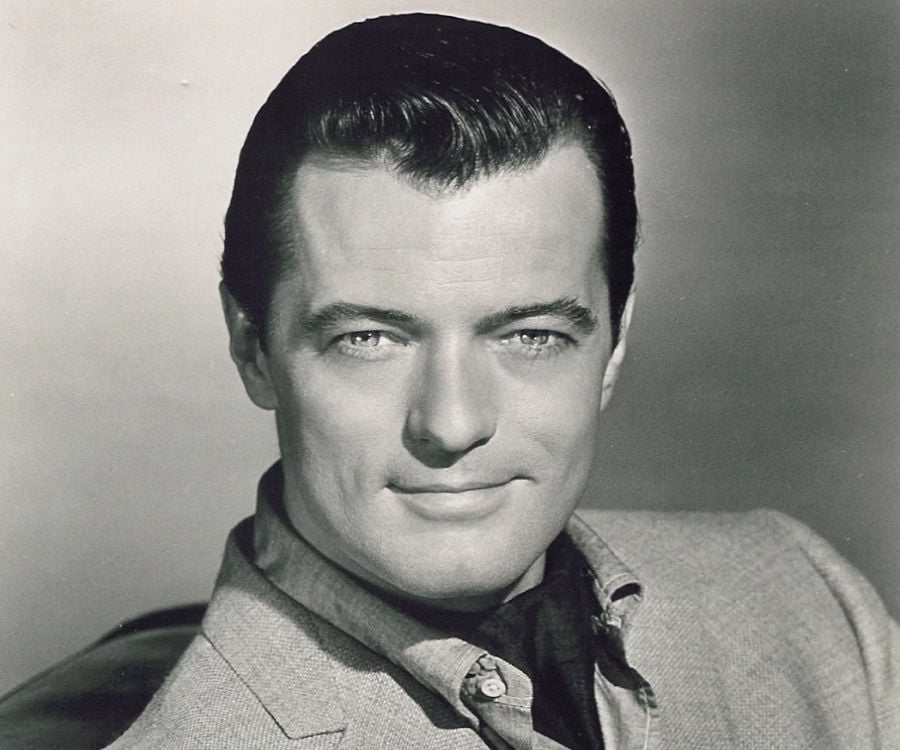
ONE of the tiredest gimmicks of variety shows was coupled last night with a fresh idea on “The Robert Goulet Hour.” When the tenor turned his profile toward the sun on a southern California beach and a light wind ruffled his perfectly groomed hair as he sang “Lost in the Stars,” his program consciously aimed for the creative touch. Few singers are willing to compete with the Pacific Ocean.
But when Mr. Goulet was on the sound stage of C.B.S. Television City in Hollywood, he was engulfed in that shopworn gag of pretending to be rehearsing a musical special for TV. Leslie Caron joined him in “Call Me Irresponsible” and then said “no,” she simply would not sing on his show. Peter Gennaro demonstrated a possible dance step and Fredd Wynne [sic] agonized over material for Mr. Goulet and sketches for Miss Caron. Even the ad‐libs were planned.
Visiting the University of California at Los Angeles, Mr. Goulet and company held a press conference for tanned Tammys and Gidgets, who watched Terry‐Thomas mug shamelessly as a fine arty professor. The atypical students acted like graduates of the Hollywood Professional School.
When the script permitted Mr. Goulet to forget the script, his show had possibilities. Still, the evening’s honors must go to Miss Caron, who, impersbnating [sic] Marlene Dietrich as the Blue Angel, tackled a chair with the finesse of an Olympic champion.
IMDB states that it was filmed at the Wilshire Boulevard Brown Derby. The second video, below, appears to be from a Robert Goulet channel that was set up by his widow, Vera Novak. Written below the video:
Robert Goulet Live From Sahara Hotel In Las Vegas was filmed as part of “An Hour With Robert Goulet” TV special in 1964 and produced by our company Rogo Productions, Inc. This is a rare gem and wonderful historical footage of a remarkable entertainer showcasing live entertainment in Las Vegas during 1960s. In this clip, Robert sings a “Medley Of Old Songs” written by Jerry Bresler and Lyn Duddy, which was also recorded in 1963 on Columbia Records “Robert Goulet in Person“.
One hundred, nine years ago, today, aviatorEugene Ely made naval aviation history, taking off from a wooden platform secured to the bow of the light cruiserUSS Birmingham. Captain Washington Chambers, USN, was tasked by the Secretary of the Navy George von Lengerke Meyer to investigate uses for aviation in the Navy. Ely successfully took off in a Curtiss Pusher from the Birmingham, barely. The airplane rolled off the platform, plunged downward, skipping the water, which damaged the propeller but, he managed to stay airborne, landing two and a half miles away on Willoughby Spit. Two months later, on January 18, 1911, Ely landed his Curtiss Pusher airplane on a platform on the armored cruiserUSS Pennsylvania anchored in San Francisco Bay.
Ely communicated with the United States Navy requesting employment but, United States naval aviation was not yet organized. Ely continued flying in exhibitions while Captain Chambers promised to “keep him in mind” if Navy flying stations were created.
On October 19, 1911, while flying at an exhibition in Macon, Georgia, his plane was late pulling out of a dive and crashed. Ely jumped clear of the wrecked aircraft but, his neck was broken and he died a few minutes later.
On February 16, 1933, Congress awarded the Distinguished Flying Cross posthumously to Ely, “for extraordinary achievement as a pioneer civilian aviator and for his significant contribution to the development of aviation in the United States Navy.”
The two-part TV movie Cross of Fire is set in the 1920s, when the Ku Klux Klan was at the height of its political power in Indiana. Part One, originally telecast November 5, 1989, details the resurgence of the Klan (which had been created during the Reconstruction era) under the leadership of David “Steve” Stephenson […]. Cloaking himself in the twin veils of patriotism and morality, Stephenson rails against such “deviates” as blacks, Jews and Catholics, gaining political clout and financial kickbacks as his “invisible empire” grows. Part Two […], telecast November 6, traces the fall of Stephenson…not because his followers have wised up but, because of a 1925 rape and murder charge.
♠ The scandal reached the governor. He was indicted and tried but, the conclusion was a hung jury. He wasn’t retried due to the statute of limitations but, left office disgraced with his political career destroyed.
DeFaria is a guitarist/composer who has worked on a number of movies and TV shows. Casas and Ostwald are longtime collaborators with Gloria and Emilio Estefan and members of the late ’80s iteration of Miami Sound Machine (Casas the bass player, Ostwald on keyboards).
Estefan had several bigger hits but, Get On Your Feet became her signature song and the name of her 1989 tour, her first as a solo artist. That tour was cut short in March 1990 when she was badly injured in a tour bus accident. Estefan fractured vertebrae in her spine and had two metal rods placed in her back during surgery. During her recovery, this song took on new meaning, as it was a long struggle for Estefan to literally get back on her feet.
Lyrics (via LyricFind): You say I know it’s a waste of time
There’s no use trying
So scared that life’s gonna pass you by
Your spirit dying
Not long ago
I could feel your strength and your devotion
What was so clear, is now overcast
With mixed emotions
Deep in your heart is the answer
Find it, I know it will pull you through
Get on your feet
Get up and make it happen
Get on your feet
Stand up and take some action
I think it’s true that we’ve all been through
Some nasty weather
Let’s understand that we’re here
To handle things together
You gotta keep looking onto tomorrow
There’s so much in life
That’s meant for you
Get on your feet
Get up and make it happen
Get on your feet
Stand up and take some action
Get on your feet
Don’t stop before it’s over
Get on your feet
The weight is off your shoulder
Get up and make it happen
Stand up, stand up, stand up and take some action
Gotta get on your feet, yeah, yeah
Don’t stop before it’s over
Get on your feet
The weight is off your shoulder
Get on your feet
Get up, get up, get up and make it happen
Get on your feet
Stand up, stand up and take some action
Get on your feet
Get up, stand up
Don’t stop before it’s over
You got to get on your feet yeah yeah
The weight is off your shoulder
The Battle of Largs was an indecisive engagement between the kingdoms of Norway and Scotland, on the Firth of Clyde near Largs, Scotland. The conflict formed part of the Norwegian expedition against Scotland in 1263, in which Haakon Haakonsson, King of Norway, attempted to reassert Norwegian sovereignty over the western seaboard of Scotland. Since the beginning of the 12th century, this region had lain within the Norwegian realm, ruled by magnates who recognised the overlordship of the Kings of Norway. In the mid-13th century, two Scottish kings, Alexander II and his son, Alexander III, attempted to incorporate the region into their own realm. Following failed attempts to purchase the islands from the Norwegian king, the Scots launched military operations. Haakon responded to the Scottish aggression by leading a massive fleet from Norway, which reached the Hebrides in the summer of 1263. By the end of September, Haakon’s fleet occupied the Firth of Clyde, and when negotiations between the kingdoms broke down, he brought the bulk of his fleet to anchor off The Cumbraes.
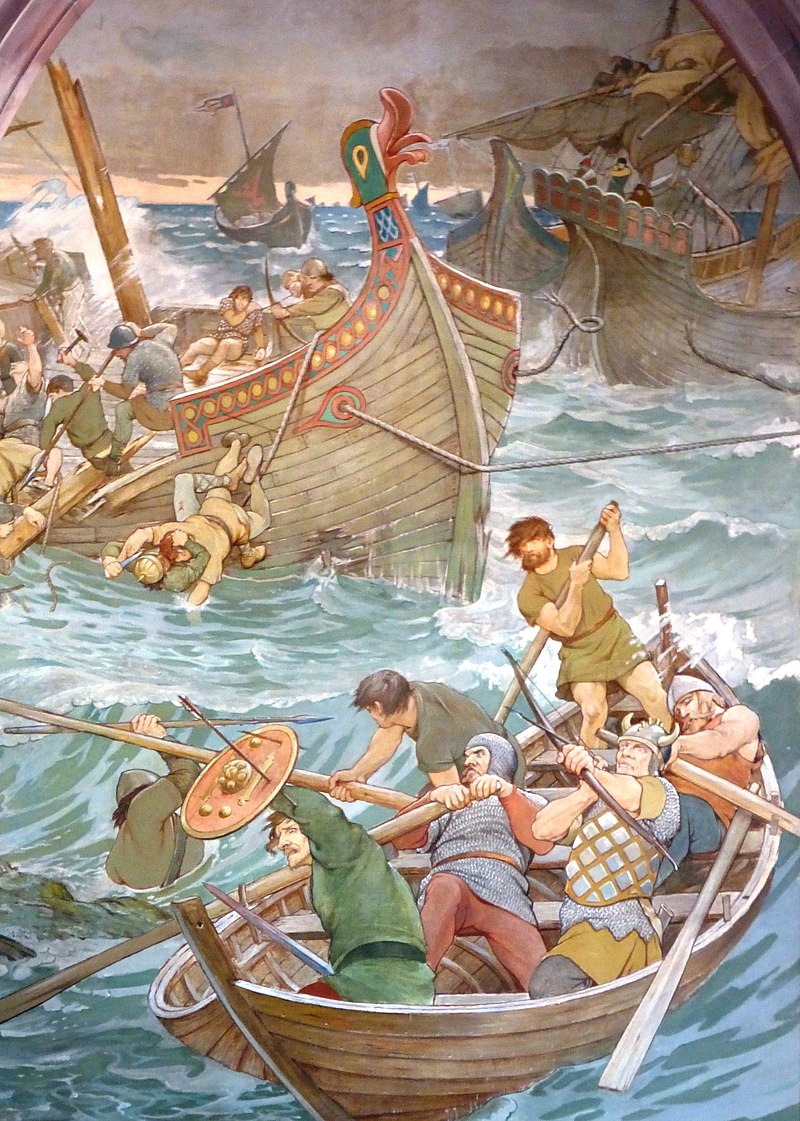
On the night of September 30, during a bout of stormy weather, several Norwegian vessels were driven aground on the Ayrshire coast, near present-day Largs. On October 2 , while the Norwegians were salvaging their vessels, the main Scottish army arrived on the scene. Composed of infantry and cavalry, the Scottish force was commanded by Alexander of Dundonald, Steward of Scotland. The Norwegians were gathered in two groups:
the larger main force on the beach and a small contingent atop a nearby mound.
The advance of the Scots threatened to divide the Norwegian forces, so the contingent on the mound ran to rejoin their comrades on the beach below. Seeing them running from the mound, the Norwegians on the beach believed they were retreating, and fled back towards the ships. There was fierce fighting on the beach, and the Scots took up a position on the mound formerly held by the Norwegians. Late in the day, after several hours of skirmishing, the Norwegians recaptured the mound. The Scots withdrew from the scene and the Norwegians re-boarded their ships. They returned the next morning to collect their dead. With the weather deteriorating, Haakon’s fleet sailed to Orkney to overwinter.
The Battle of Largs has been romanticised by [some] later historians as a great Scottish victory but, it only involved a small part of the Norwegian fleet. [Another] saga described the Norwegian campaign as a triumph [but], in reality, it had not achieved anything […]. With his fleet and forces intact, Haakon planned to continue to campaign after spending the winter in Orkney but, he was unexpectedly taken ill and, died there before he had the chance to resume operations. The campaign had started too late and the Scottish king had successfully prolonged negotiations to his own advantage. With Haakon’s death, his successor, Magnus Haakonarson, King of Norway, signed the Treaty of Perth three years after the battle (July 2, 1266), leasing Scotland’s western seaboard to Alexander III in return for a yearly payment. This lease became permanent but, the Kingdom of Scotland eventually stopped paying the Norwegian crown for the islands when Norway became distracted by civil wars.
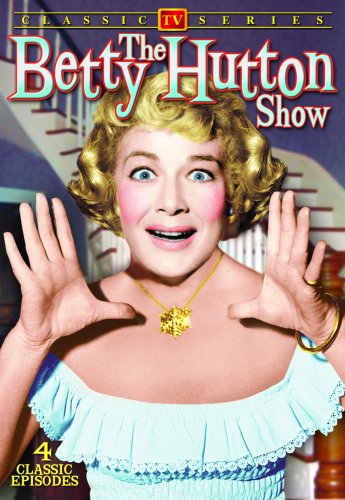
Hutton stars as Goldie, a showgirl-turned-manicurist. One of Goldie’s regular customers is a millionaire, Mr. Strickland. After he suddenly dies, Goldie discovers that he has left everything he owns, including his $60 million fortune and his three children, to her.
Although Hutton was a popular actress, the show only lasted for thirty episodes before being cancelled, mainly because it was scheduled opposite ABC‘s popular series The Donna Reed Show.
The track found on Oh Mercy is an April 1989 re-working of a take recorded the previous month. Originally recorded as “Broken Days” in March 1989, Dylan had re-written the song entirely by April, giving it its current name.
In an interview with Nigel Williamson (the author of The Rough Guide to Bob Dylan) and Oh Mercy’s producer, Daniel Lanois, he described how Dylan would rework his songs over and over again:
“I sat next to him for two months while he wrote [Oh Mercy] and it was extraordinary. Bob overwrites. He keeps chipping away at his verses. He has a place for all his favorite couplets and those couplets can be interchangeable. I’ve seen the same lyrics show up in two or three different songs as he cuts and pastes them around, so, it’s not quite as sacred ground as you might think.”
“Most of them [the songs on “Oh Mercy”] are stream-of-consciousness songs, the kind that come to you in the middle of the night, when you just want to go back to bed. The harder you try to do something, the more it evades you. These weren’t like that.”
~Bob Dylan (to Edna Gundersen, September 21, 1989)
“While it would be unfair to compare ‘Oh Mercy’ to Dylan’s Sixties recordings, it sits well alongside his impressive body of work.”
~Clinton Heylin (Behind The Shades)
[While] promoting The Traveling Wilburys in the fall of 1988, George Harrison discussed some of Dylan’s upcoming work. Harrison [was] enthused about Dylan’s new songs…informing a skeptical world that the experience of recording the Wilburys had given him the urge to write again.
[Bono], lead singer of U2, paid Dylan a visit at his home. When he asked Dylan if he had written any new songs, Dylan showed him the ones stored in his drawer. Bono urged him to record the songs but, Dylan was reluctant.
Lyrics [via LyricFind] Broken lines, broken strings
Broken threads, broken springs
Broken idols, broken heads
People sleeping in broken beds
Ain’t no use jiving
Ain’t no use joking
Everything is broken
Broken bottles, broken plates
Broken switches, broken gates
Broken dishes, broken parts
Streets are filled with broken hearts
Broken words never meant to be spoken
Everything is broken
Bridge: Seem like every time you stop and turn around
Something else just hit the ground
Broken cutters, broken saws
Broken buckles, broken laws
Broken bodies, broken bones
Broken voices on broken phones
Take a deep breath, feel like you’re chokin’
Everything is broken
Every time you leave and go off someplace
Things fall to pieces in my face
Broken hands on broken ploughs
Broken treaties, broken vows
Broken pipes, broken tools
People bending broken rules
Hound dog howling, bull frog croaking
Everything is broken
One-hundred, ninety-nine years ago, today, the realDaniel Boone passed away. Two days prior, I posted about the television show Daniel Boone that was hardly accurate in its portrayal or his frame of life despite being a popular show.
On September 26, 1820 the great pioneering frontiersman Daniel Boone dies quietly in his sleep at his son’s home near present-day Defiance, Missouri.
The indefatigable voyager was 86. Boone was born in 1734 (he has two different dates of birth due to the 1752 Gregorian calendar switch) to Quaker parents living in Berks County, Pennsylvania. Following a squabble with the Pennsylvania Quakers, Boone’s family decided to head south and west for less crowded regions and they eventually settled in the Yadkin Valley of North Carolina. There the young Daniel Boone began his life-long love for wilderness, spending long days exploring the still relatively unspoiled forests and mountains of the region. An indifferent student who never learned to write more than a crude sentence or two, Boone’s passion was for the outdoors, and he quickly became a superb marksman, hunter and woodsman. (It should be noted here that historian John Mack Faragher stated that Boone “acquired a level of literacy that was the equal of most men of his times. He was often the only literate person in groups of frontiersmen.”)
In May of 1769, Boone and five companions crossed over the Cumberland Gap and explored along the south fork of the Kentucky River. Boone returned in 1773 with his family, hoping to establish a permanent settlement. An Indian attack prevented that first attempt from succeeding (Boone’s eldest son James and, William Russell‘s son Henry were captured and tortured to death, a prelude to Dunmore’s War.) but, Boone returned two years later to open the route that became known as Boone’s Trace (or the Wilderness Road) between the Cumberland Gap and a new settlement along the Kentucky River called Fortress Boonesboro. Boonesboro eventually became one of the most important gateways for the early American settlement of the Trans-Appalachian West.
After the French and Indian War (1754–1763) broke out between the French and British, and their respective Indian allies, North Carolina Governor Matthew Rowan called up a militia, for which Boone volunteered. He served under Captain Hugh Waddell on the North Carolina frontier. Waddell’s unit was assigned to serve in the command of General Edward Braddock […].
Boone served in the North Carolina militia during [the] “Cherokee Uprising“. His militia expeditions went deep into Cherokee territory beyond the Blue Ridge Mountains and he was separated from his wife for about two years.
On December 22, 1769, Boone and a fellow hunter, Benjamin Cutbirth, were captured by a party of Shawnees, who confiscated all of their skins and told them to leave and never return.
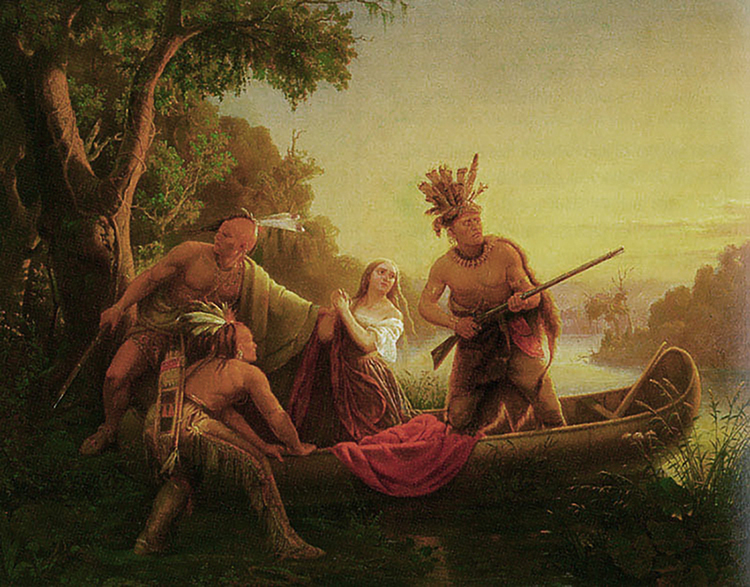
Image Credit: wikipedia.org & wikimedia.org Charles Wimar 1853
[During the Revolutionary War], Boone’s daughter Jemima and two other teenaged girls were captured outside Boonesborough by an Indian war party on July 5, 1776. The incident became the most celebrated event of Boone’s life. James Fenimore Cooper created a fictionalized version of the episode in his classic novel The Last of the Mohicans (1826).
He lived quite an eventful life.
♦ In February 1778, Boone was adopted into the Shawnee tribe as a prisoner to replace a fallen warrior (a Shawnee custom) and was named Sheltowee (Big Turtle), eventually escaping.
♦ In September 1778, he was court-martialed due to misunderstandings during the Siege of Boonesborough.
♦ There is some indication that Boone crossed paths with Abraham Lincoln’s grandfather.
♦ In 1780, Boone was [a] Lieutenant Colonel in the Fayette County militia. In October, his brother Ned was killed by Shawnees and beheaded for a trophy, as the they thought they had killed Boone.
♦ In 1781, he was elected as a representative to the Virginia General Assembly.
♦ [Traveling] to Richmond to take his seat in the legislature, […] British dragoons under Banastre Tarleton captured Boone and several other legislators near Charlottesville. The British released Boone on parole several days later.
♦ In 1782, he was elected sheriff of Fayette County.
♦ By 1787, he owned seven slaves.
♦ In 1798, a warrant was issued for Boone’s arrest after he ignored a summons to testify in a court case, although the sheriff never found him.
♦ Also in 1798, the Kentucky assembly named Boone County in his honor.
♦ From 1799 to 1804, he served as syndic and commandant, appointed by the Spanish governor of Spanish Louisiana (now St. Charles County, Missouri).
♦ American painter John James Audubon claimed to have gone hunting with Boone in the woods of Kentucky around 1810 (some historians believe Boone visited his brother Squire near Kentucky in 1810).
♦ Boone died of natural causes at his son Nathan’s home. He was 85.
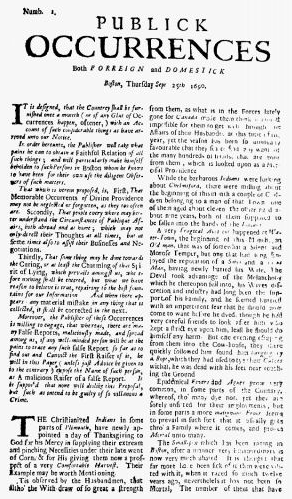
Three hundred, twenty-nine years ago, today, the multi-page newspaperPublick Occurrences Both Forreign and Domestick was published in the Americas. Edited by Benjamin Harris and printed by Richard Pierce, it was the first of its kind.
Before [the multi-page], single-page newspapers, called broadsides, were published in the English colonies and printed in Cambridge in 1689. The first edition was published September 25, 1690, in Boston, then a city in the Dominion of New England, and was intended to be published monthly, “or, if any Glut of Occurrences happen, oftener.”
No second edition was printed because the paper was shut down by the Colonial government on September 29, 1690, who issued an order as follows:
“Whereas some have lately presumed to Print and Disperse a Pamphlet, Entitled, Publick Occurrences, both Forreign and Domestick: Boston, Thursday, Septemb. 25th, 1690. Without the least Privity and Countenace of Authority. The Governour and Council having had the perusal of said Pamphlet, and finding that therein contained Reflections of a very high nature: As also sundry doubtful and uncertain Reports, do hereby manifest and declare their high Resentment and Disallowance of said Pamphlet, and Order that the same be Suppressed and called in; strickly forbidden any person or persons for the future to Set forth any thing in Print without License first obtained from those that are or shall be appointed by the Government to grant the same.”
Without a license, it was closed down after a single issue, Harris was jailed, and the next newspaper did not appear until 1704, when John Campbell’s Boston News-Letter was the first American newspaper to last beyond the first issue.
Benjamin Harris [was an] English bookseller and writer who was the first journalist in the British-American colonies. An ardent Anabaptist and Whig, Harris published argumentative pamphlets in London, especially ones attacking Roman Catholics and Quakers […]. His newspaper, Publick Occurrences, Both Foreign and Domestick (Sept. 25, 1690), the first newspaper printed in the colonies, was suppressed by Boston authorities after one issue. Harris returned to London and journalism in 1695. His London Post appeared regularly from 1699 to 1706.
I was struck by the spelling of the times when I stumbled across this. The fact that he was shut down by the government for daring to speak out (in London & in Boston) also caught my attention. The more things change, the more they stay the same. ~Vic
Daniel Boone was one of two significant historical figures played by Fess Parker. He previously appeared as Davy Crockett in a series of episodes of the Walt Disney anthology television series […]. Efforts had been made to secure the rights to Crockett from Walt Disney but, Disney refused to sell, so, the series wound up being about Boone instead. In contrast, Parker’s Boone was less of an explorer and more a family man than Parker’s Crockett. Parker as Crockett also generally wore a light beard, whereas his Boone was predominantly clean-shaven.
The series is set in the 1770s and 1780s, just before, during and after the American Revolution and, mostly centered on adventures in, and about, Boonesborough, Kentucky. Some aspects of the show were less than historically faithful, which, at one point, led the Kentucky legislature to condemn the inaccuracies. The series’ story line does not follow historical events. Instead, story lines run back and forth concerning historical events.
Photo Credit: imdb.com
[Ed Ames] role as Mingo led to a famous tomahawk-throwing demonstration on The Tonight Show, that was rerun on anniversary clip shows for decades afterward, in which Ames threw a tomahawk at a target of a man and the hatchet landed between the cutout’s legs, much to host Johnny Carson‘s amusement.
Trivia Bits:
♦ According to an interview with Veronica Cartwright, she left the series because the producers wanted to have her character of Jemima Boone involved in more mature situations, such as budding romantic relationships. Patricia Blair did not like this because it made her feel too old, so she threatened to leave the series if Cartwright was not let go from the series.
♦ Israel Boone was one of seventy-two killed at the Battle of Blue Licks, one of the last battles of the Revolutionary War, on August 19, 1782. He was twenty-three. His father Daniel was there and saw his son killed. Coincidentally, Darby Hinton, who played Israel, was born on the 175th Anniversary of Israel’s death, August 19, 1957.
♦ [The] Boones [actually] had ten children […].
♦ Unlike Fess Parker [6’5″ 1/2], the real Daniel Boone was only about 5’8″.
An English lady bored with London society brings her [two] children to their country home. Her servant William is also working for a French pirate who holds up with his ship and crew off the coast. They soon meet and she embarks on an adventure with the pirates!
As a beautiful, learned lady of means, Dona St. Columb had it all…and a loveless marriage. After years of being royally subjected to mistreatment, she retreats with her most prized possessions, her two children, to a secluded manor overlooking Britain’s Atlantic shoreline. [She] is enthralled with the tall tales of a scoundrel of a pirate, who has been plundering nearby coastal villages. Full of adventure and fueled by years of neglect, she sets forth to seek him out and, it is not long before she finds him…
Tagline: “A Lady of Fire and Ice…A Rogue of Steel and Gallantry”
Trivia Bits:
♦ The only film featuring Basil Rathbone and Nigel Bruce in which they do not play Sherlock Holmes and Dr. Watson.
♦ To make Arturo de Córdova appear taller than Joan Fontaine, he had to wear lifts in his shoes, causing him to teeter when he walked.
I realize that September 11 is usually reserved for the remembrance of 9/11 but, that seems to be all over the news as it is. There are other things that have happened on September 11. ~Vic
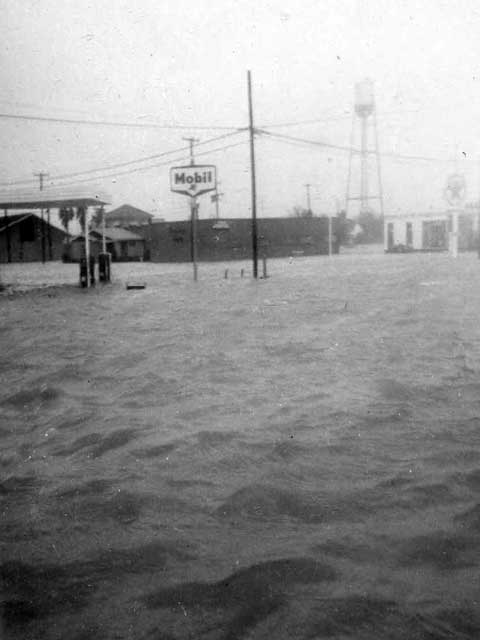
Carla was the most intense hurricane to make landfall on the Texas coast in the 20th century and second in recorded history only to the Indianola hurricane of 1886. Carla was the last of 6 hurricanes to make landfall on the Texas coast as a Category 4 hurricane on the Saffir-Simpson scale, with sustained winds stronger than 130 mph, in the 20th century. Carla ranks as the 9th most intense hurricane to affect the United States since 1851.
Carla made landfall on the afternoon of the 11th on the northeast part of Matagorda Island as a strong Category 4 hurricane […]. The eye of Carla moved across Port O’Connor and Port Lavaca and, then, inland just east of Victoria. Carla weakened to a tropical storm on the morning of the 12th just east of Austin.
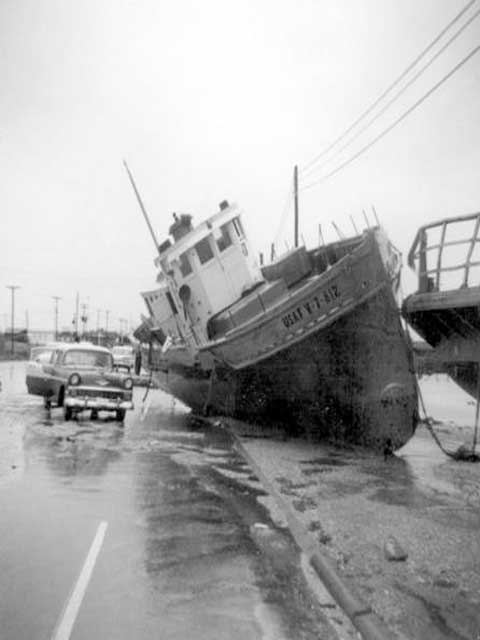
Carla was an extremely large hurricane with devastating effects from the winds and storm surge […]. The extreme tides inundated downtown Port Lavaca with 2 feet of flood water and displaced fishing boats and tug boats on Highway 35. With the slow movement of Carla, the hurricane pushed a storm surge of 22 feet above mean sea level at the head of Lavaca Bay in Port Lavaca. This is the highest storm surge in Texas hurricane history.
[Little-known] newsman Dan Rather reported live from the second floor of a building in Texas City during the storm, an act that would be imitated by later reporters. This marked the first live television broadcast of a hurricane. Rather also alerted the public of the size of Carla in a way that “literally changed the way the world sees hurricanes”, according to a fellow reporter. Broadcasting live at the Weather Bureau Office in Galveston, Rather asked a meteorologist to draw an outline of the Gulf of Mexico on a transparent sheet of plastic. He then held the map over the black and white radar screen, which put the size of Carla into perspective, saying that Carla was the size of the Gulf of Mexico. CBS was so impressed with Rather’s work that he was offered the position of correspondent.
Bill Hastings works for a daily newspaper in a large city. His duties include a lonely hearts column, where he advises everyone on their problems, as “Phoebe”, while trying to deal with his own.
Photo Credit: wikipedia.org & wikimedia.org
Peter Lawford with J. Fred Muggs
Lawford stars as Bill Hastings, a former college professor who becomes the writer of the advice-to-the-lovelorn column at the fictitious Los Angeles Daily Star. Hastings writes under the pseudonym “Miss Phoebe Goodheart”. Marcia Henderson portrayed Mickey Riley, the female sportswriter at the newspaper and Hastings’s own romantic interest. Charles Lane, who later portrayed J. Homer Bedloe in the CBS series Petticoat Junction, played newspaper boss Mr. Fosdick. Joe Corey played Humphrey Humpsteader, a copy boy trying to become a reporter.
A mad doctor named Zanoff uses a drug to bring himself back from the dead after his execution in prison. Dick Tracy sets out to capture Zanoff before he can put his criminal gang back together again.
International spy, Zarnoff, in the employ of “The Three Powers” (presumably a fictionalized reference to the Axis) is captured by Dick Tracy at the start of the serial, [then] tried and sentenced to death. However, through the use of a rare drug embedded by his agents in[to] the evening newspaper, he escapes from the gas chamber. His men pick up his “corpse” by ambushing the hearse and, administering another counter-drug. He continues his espionage plans, while taking the opportunity of revenge on Tracy.
[Dick Tracy serials were] “unexcelled in the action field” [and] “in any listing of serials released after 1930, the four Dick Tracy adventures from Republic must stand out as classics of the suspense detective thrillers and the models for many others to follow.”











 Cosmic-Observation