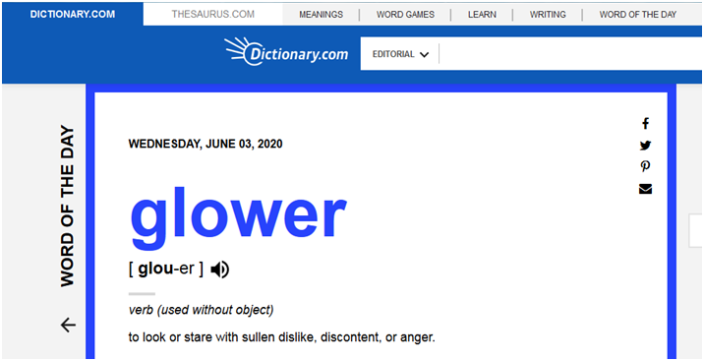
The verb glower, “to look or stare with sullen dislike” comes from Middle English gloren [or] glouren “to shine, gleam, glow, stare, stare at fixedly.” The Middle English forms are mostly from the north (Yorkshire) and Scotland. [T]he sense “to stare at fixedly” is Scottish. The source of gloren and glouren is obscure but, possibly, Scandinavian, e.g., Icelandic [as] glóra “to glow (like a cat’s eyes)” [or] Swedish and Norwegian dialect glora “to glow, stare.” The source of gloren [and] glouren may also be from Middle Low Germanglūren “to be overcast” or Dutchglueren “to leer, peep.” Glower entered English in the 15th century.
This is very similar to our “glaring at someone” which has its roots in Middle English, Middle Dutch and Middle Low German.
I’ve been doing a lot of glowering and glaring, lately. The whole world has gone insane-stupid. ~Vic
Thomas Morley was an English composer, theorist, singer and organist of the Renaissance. He was one of the foremost members of the English Madrigal School. Living in London at the same time as Shakespeare, Morley was the most famous composer of secular music in Elizabethan England. [He] was active in church music as a singer, composer and organist at St Paul’s Cathedral [and] was involved in music publishing. [He] lived for a time in the same parish as Shakespeare and, a connection between the two has been long speculated but, never proven. In addition to his madrigals, [he] wrote instrumental music, including keyboard music […].
Now Is The Month of Maying is one of the most famous of the English ballets […]. It is based on the canzonetSo Ben Mi Chi Ha Bon Tempo used by Orazio Vecchi […]. It was printed in […] Morley’s First Book of Ballets to Five Voyces [in] 1595. The song delights in bawdy double-entendre. It is, apparently, about spring dancing but, this is a metaphor for making love/sex. For example, a barley-break would have suggested outdoor sexual activity (rather like […] a roll in the hay). The use of such imagery and puns increased during the Renaissance.
Lyrics:
Now is the month of maying,
When merry lads are playing,
Fa la la la la la la la la,
Fa la la, etc…
Each with his bonny lass
Upon the greeny grass.
Fa la la, etc…
The Spring, clad all in gladness,
Doth laugh at Winter’s sadness,
Fa la la, etc…
And to the bagpipe’s sound
The nymphs tread out their ground.
Fa la la, etc…
Fie then! Why sit we musing,
Youth’s sweet delight refusing?
Fa la la, etc…
Say, dainty nymphs, and speak,
Shall we play barley break?
Fa la la, etc…
Ray caught this guy on
the side of a wall in Illinois.
I think it is a tree frog.
09-03-2019
Photo Credit: Ray TutterowRiverwalk Toad
These guys come out at dusk
and head towards the river.
09-28-2019Evening walk.
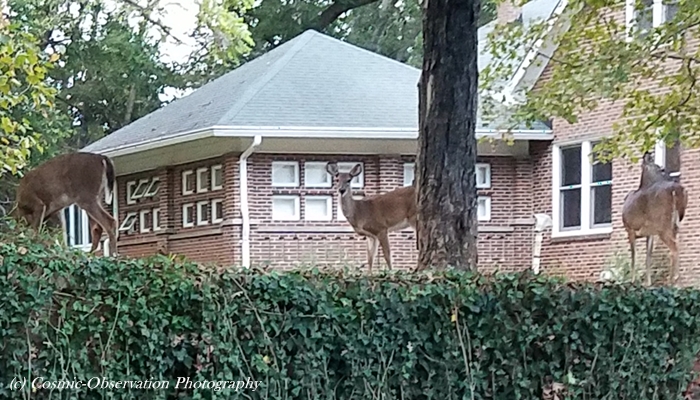
Deer trio.
10-15-2019We got a bunny.
Side Yard
03-27-2020Another poor dead snake.
04-18-2020Barking squirrel.
04-24-2020
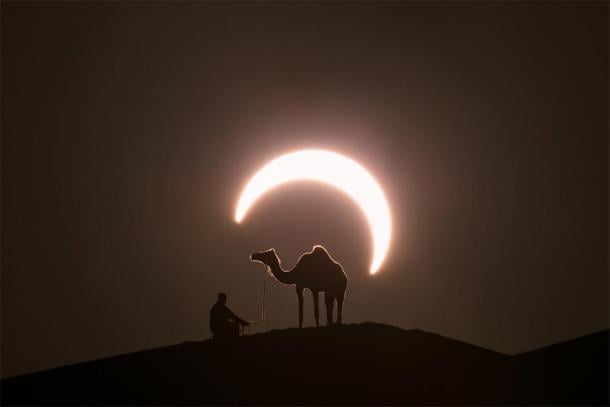
According to Herodotus, the appearance of the eclipse was interpreted as an omen and, interrupted a battle in a long-standing war between the Medes and the Lydians. The fighting immediately stopped and they agreed to a truce. Because astronomers can calculate the dates of historical eclipses, Isaac Asimov described this battle as the earliest historical event whose date is known with precision to the day and described the prediction as the birth of science.
Photo Credit: Ancient Origins
The Mechanics of a Monumentally Difficult Prediction
The reason this astronomical event is thought of as being so important is that predicting a solar eclipse, compared with a lunar eclipse, is exceptionally difficult. The astronomer must not only calculate when it will occur but, where on Earth’s surface it will be visible […]. [In] a lunar eclipse, the moon passes through the Earth’s sun shadow and the phenomena is visible on the whole side of the Earth that is in night-time […]. [They] often last longer than an hour. In solar eclipses, however, the moon’s shadow falls across the Earth in a comparatively narrow path, with a maximum duration, at any given location, of about 7 1/2 minutes.
[What] makes Thales’ prediction [an] historical mystery is that historians know early Greeks, at large, didn’t have this essential lunar data and there are no other records of Greek astronomers in this period accurately predicting any other eclipses. Thus, it is thought by historians that the only place Thales’ advanced astronomical knowledge could have come from was Egypt. [It’s] known [that] Thales studied Egyptian techniques for measuring sections of land with rope […].
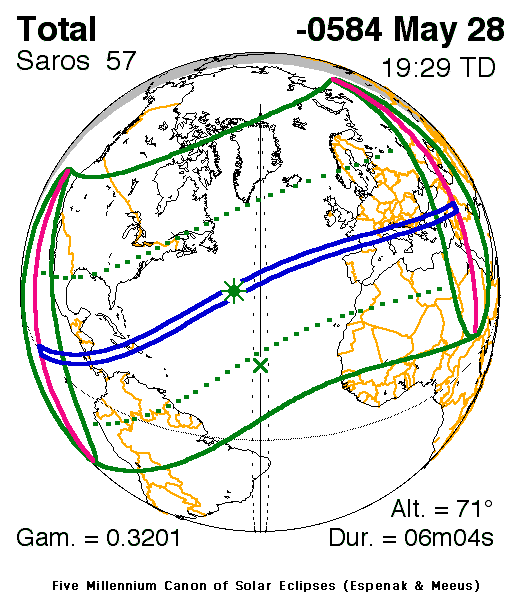
Returning [to] the war (mentioned above), after 15 years of fighting, on May 28, 585 BC, the armies of King Aylattes of Lydia were in battle with the forces of King Cyaxares of Medes (or, possibly, Astyages, his son), near the River Halys in what is, today, central Turkey. Chroniclers noted the heavens darkening and soldiers on both sides laying down their weapons in awe of the spectacle […]. [The] event ended both the battle and the war.
[A] Wired article says this famous astronomical event has been debated by hundreds of scholars for nearly two millennia and that some authorities believe Thales’ eclipse may have occurred 25 years earlier in 610 BC. But, the reason most agree with the 585 BC date is the record of the famous battle in Asia Minor ending when the day was suddenly turned to night.
The structure known today as the Colonial Inn was built on Lot 15 in 1838 as a hotel and was locally called Spencer’s Tavern […] but, was advertised as the Orange Hotel (a name which lasted into the 1880s). The structure was built for Isaac (Isaiah) Spencer (from Hyde County) who had purchased the property in late 1837. In 1841, Richardson Nichols purchased the property from Spencer and expanded the main structure. In 1856, Nichols sold the structure to the “Hillsborough Improvement Company” which consisted of Alfred, Henry and Cave Stroud.
Stroud family history has it that Henry’s wife (Sarah) saved the Inn from looting by Union troops by displaying her husband’s Masonic apron. Upon seeing the apron, a sympathetic Union officer, [whom] was a fellow Mason, protected the site from destruction.
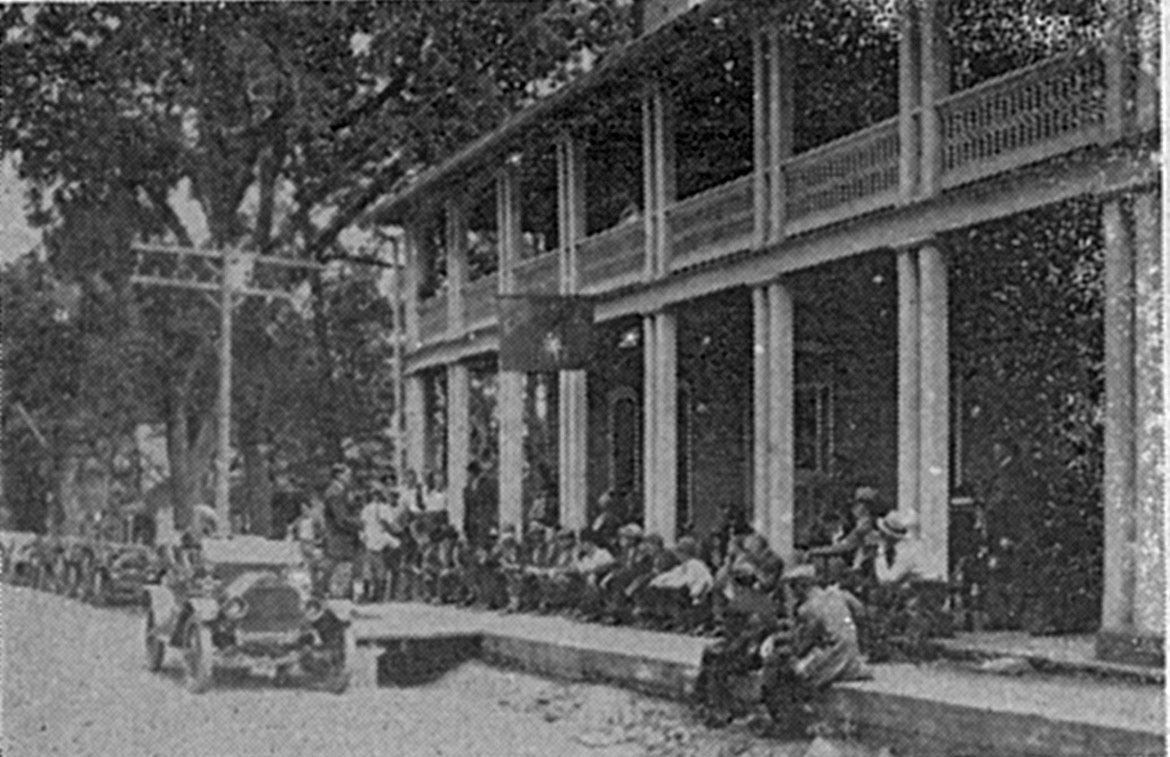
Strayhorn’s Hotel
1870
Image Credit: Rootsweb
William F. Strayhorn may have purchased or, at least, managed the business beginning in 1868 and, the property was purchased by local businessmen Henry N. Brown and Charles M. Latimer (who was also the county treasurer) in 1870. Brown and Latimer apparently lost the property through bankruptcy in 1872, with Strayhorn managing or operating the hotel until at least then. Perhaps related is that Strayhorn had been living in Twin Chimneys across the street from the hotel but, lost it due to financial problems in January 1869. [It] was purchased by David C. Parks in December 1872. In 1885, Parks sold the property to neighboring property owner Emily Pogue, who sold it back to Parks in 1888. [At] this time, it became known as the Occoneechee Hotel.
Looking East
1890s
Image Credit: Rootsweb
In 1908, Thomas A. Corbin purchased the property and renamed the complex the Corbinton Inn. In 1921, W. L. Foushee […] purchased the property from a H. L. Akers and by 1924, renamed the hotel the Colonial Inn. In 1946, Paul Henderson purchased the property from Foushee […].
During Henderson’s ownership, a “fine-dining” restaurant was added within the hotel structure. In December 1952, Charles and Ann Crawford purchased the property and business and, expanded the structure. They operated the business successfully until they, in turn, sold it to James and Maxine Freeland in 1969. The Freelands also expanded the structure and, continued the hotel and restaurant business at the location.
Looking WSW
1960s
Photo Credit: Open Orange
It fell into disrepair for many years. When I moved to this town in 2011, it looked bad.
10-23-201610-23-2016
The good news is, new owners are re-building. ~Vic
“[It can] meow out of one mouth and eat out of the other.”
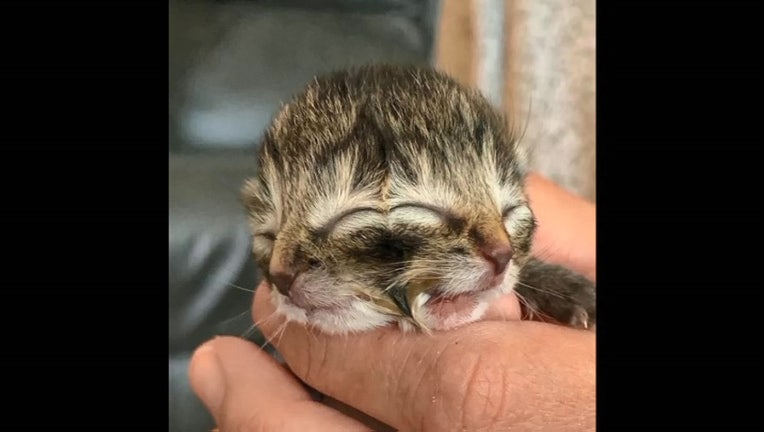
Meet Biscuits & Gravy: The Two-Faced Oregon Kitten
When Kyla King got up Wednesday morning to check on her pregnant cat, she knew there was a good chance she’d find a litter of newborn kittens. She walked outside to the special crate she had put the expectant mother into overnight and noticed four tiny kittens. But, then she noticed two more hiding behind their mom. So, Kyla picked one up and set it down with the rest of the litter. She picked up the last kitten and found herself face-to-face with two tiny noses, four eyes tightly shut and two mewing mouths.
Kyla said she sent a picture to her husband, BJ King, with a text that read: “We have 6-1/3 kitty cats now!”
Kyla reached out to their vet to learn more about the kitten’s condition, how to care for it and its odds of survival. She learned there wasn’t much to be done medically for the tiny creature. All she could do was make it comfortable and help it eat. “It doesn’t really know how to nurse properly because it has two mouths so, I’ve been trying to feed it,” Kyla said. “And, I mean, I’m gonna do the best I can but, these animals don’t usually live too long.”
Photo Credit: dailyhive.com
Cats with two faces are known as Janus cats, after the Roman god Janus, often depicted with two faces in mythology. They suffer from a rare congenital defect called diprosopus, or cranial duplication. Most Janus cats don’t live longer than a day but, one defied the odds. His name was Frank and Louie and he passed away in 2014 at the age of 15. The Guinness Book of World Records named him the world’s longest surviving Janus cat.
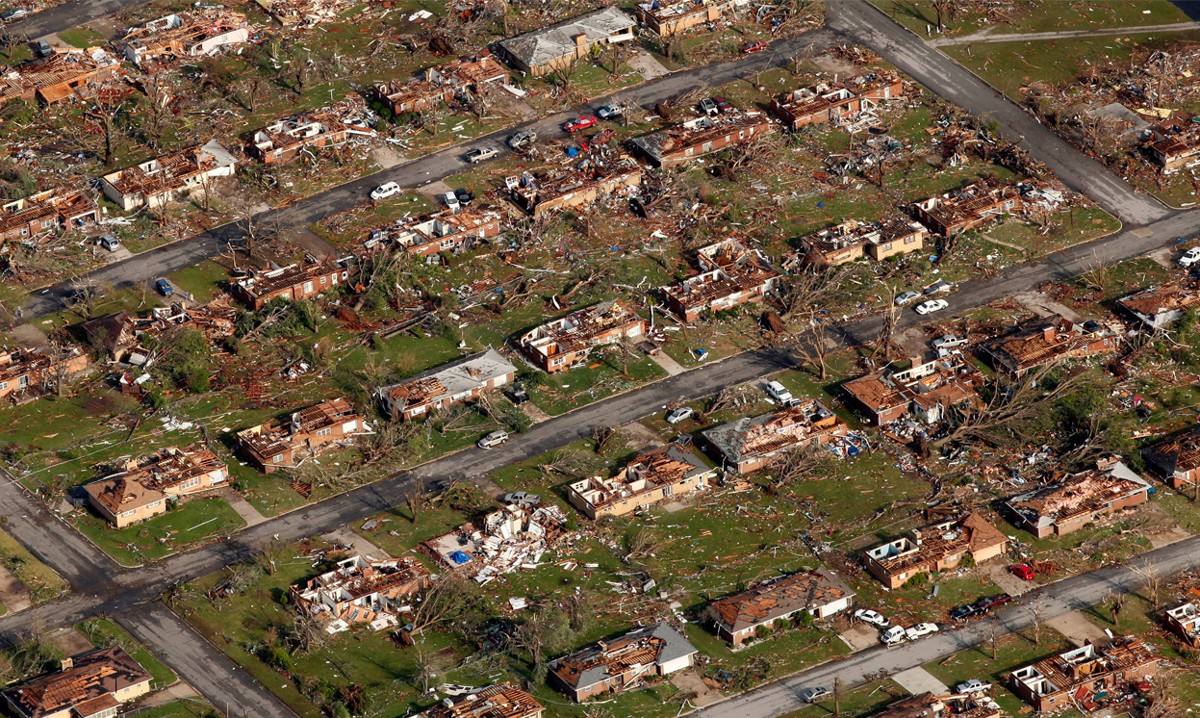
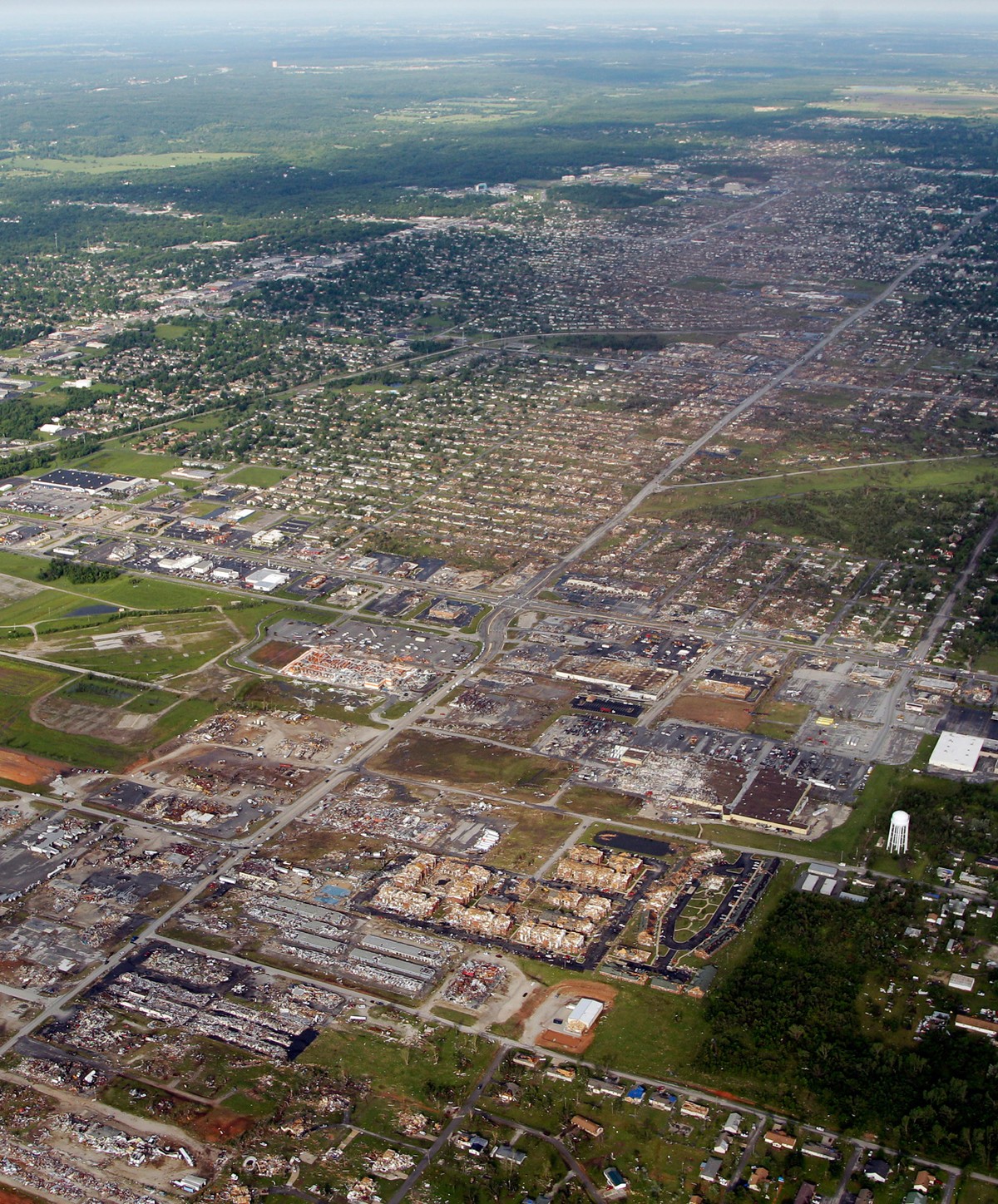
Nine years ago, today, an EF5, multi-vortex tornado slammed into Joplin, Missouri. It formed at 5:34 pm CDT and dissipated at 6:12pm CDT. I remember this one, vividly. I had just moved back to North Carolina from Texas and was, literally, still unpacking. I was shocked at the devastation. ~Vic
[This] was part of a larger, late May tornado outbreak and reached a maximum width of nearly one mile […] during its path through the southern part of the city. This particular tornado was unusual in that it intensified in strength and grew larger in size at a very fast rate. The tornado tracked eastward across the city and, then, continued eastward across Interstate 44 into rural portions of Jasper County and Newton County. It was the third tornado to strike Joplin since May 1971.
Photo Credit: theatlantic.com
[The] tornado killed 158 people (with an additional eight indirect deaths), injured some 1,150 others and caused damages amounting to a total of $2.8 billion. It was the deadliest tornado to strike the United States since the 1947 Glazier–Higgins–Woodward tornadoes, and the seventh-deadliest overall. Along with the Tri-State Tornado and the 1896 St. Louis–East St. Louis tornado, it ranks as one of Missouri’s and America’s deadliest tornadoes […]. It was the first F5/EF5 tornado in Missouri since May 20, 1957 [and] was only the second F5/EF5 tornado in Missouri history dating back to 1950.
It also ranks as the costliest single tornado in U.S. history.
In looking thru odd stories, this caught my attention. From Oddity Central:
A Creepy Art Installation Freaking People Out on Google Maps
By Spooky on May 15th, 2020
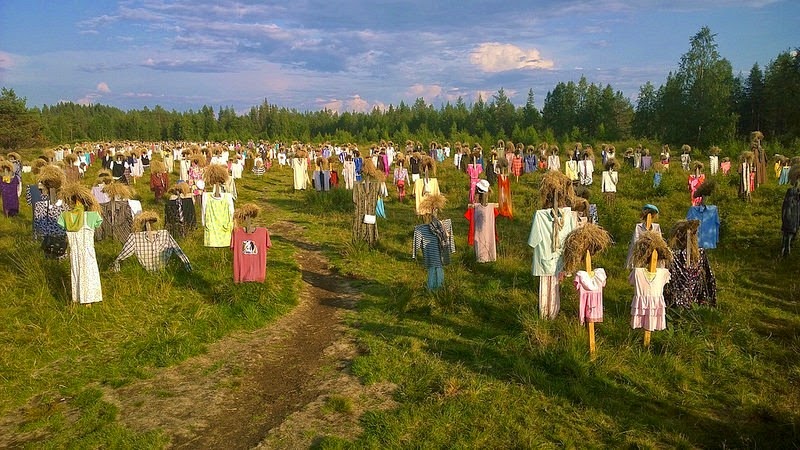
An eerie art installation located in a barren field in the Finnish countryside recently went viral after someone accidentally stumbled upon it while searching on Google Maps. With quarantine and isolation measures still in place in many countries around the world, people are spending a lot of time online looking for cool places to visit once they can travel again. Many are using free tools, like Google Maps, and end [up] going deeper down the rabbit hole than they originally anticipated. That’s probably how some people recently discovered The Silent People, […] creepy-looking [figures] that left them scratching their heads about why anyone would fill a field with hundreds of scarecrows and dress them as real people.
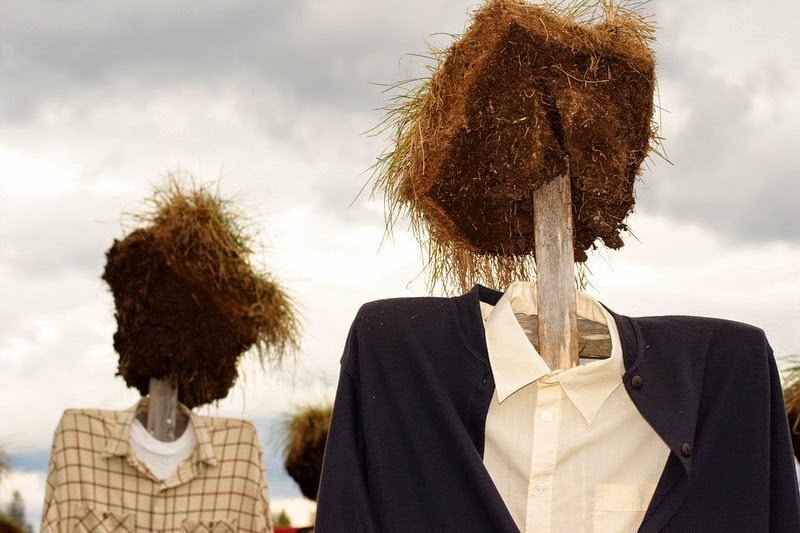
Seen from afar, The Silent People [site] looks like a perfectly still army of people all facing the same way. It’s only when you take a closer look that you realize it’s made up of wooden frames covered in human clothes and heads made of [peat], which does a surprisingly good job of emulating human hair. Even knowing that it’s an art installation, you still feel uneasy looking at the almost one thousand still [bodies] but, knowing absolutely nothing about it and [suddenly] finding it on Google Maps can really freak a person out.
Hiljainen Kansa: The Silent People of Suomussalmi, Finland
By Kaushik Patowary on March 28, 2015
Motorists driving along Highway 5, about 30 km north of the small town of Suomussalmi, in north-eastern Finland, are greeted by a peculiar sight. A crowd of almost a thousand figures stand silently on a field near the road. In the morning with light behind them, this motionless army appears morose, even menacing. But, when a light breeze picks up their colorful dresses and blows them around their still bodies, they appear to have sprung into life.
This army of scarecrow-like figures called “The Silent People” or “Hiljainen Kansa” in Finnish, were the creation of local artist Reijo Kela. They were first displayed in 1988 in a field in Lassila, a neighbourhood of Helsinki. Later in 1994, these were on display in the Market Place of Helsinki’s Senate Square, then on the banks of the river Jalonuoma, Ämmänsaari and finally moved to this location in 1994 itself.
There is a LOT of data on this siege and I’m not re-writing history. This will serve as a highlight, only. I will provide links to more information, below. ~Vic
Four hundred, fifty-five years ago, today, the island of Malta was attacked and nearly invaded by the Ottoman Empire, it’s second attempt.
If it had not taken place, the Great Siege would no doubt have been dreamt up for the screenplay of an epic film. Few other historic episodes rival it for sheer heroism, the bloodshed of war and military strategy. The story of the siege is interwoven with the tale of two adversaries, the ageing Grand MasterJean Parisot de la Valette, and his contemporary, the Barbary CorsairDragut Reis who commanded the fleet of Sultan Suleiman the Magnificent. It is also the story of thousands of lives of Maltese Islanders, men at arms to the Knights of St. John.
The years leading up to the siege saw the Islands under constant threat from the Ottoman Turks […]. The Knights knew they were vulnerable in Malta despite the harbours and their two forts […]. Grand Master La Valette had done his best to build defences and had requested extra forces from the Emperor Charles V, the Pope and the Viceroy of Sicily. But, no help came. In May, 1565, a vast Ottoman fleet, some 40,000 men, lay siege to the Islands.
The Knights were heavily outnumbered with a mere 700 or so men and around 8000 Maltese regular troops. The Islanders took refuge in the fortified towns [..] destroying crops and poisoning wells as they fled.
Image Credit: medievalists.net
The Ottomans first decided to attack isolated Fort St. Elmo […]. Repeated assaults were launched over 36 days but, the small garrison of Knights held on to the fort for far longer than Suleiman‘s men anticipated. After four weeks, they finally overran St. Elmo but, at a heavy price […]. The Turkish commander Dragut was fatally injured during the taking […].
It is the battle for [Fort] St. Angelo which saw some of the bloodiest episodes of this Holy War. It was to [be] the basis of legends for centuries to come. [Some] 10 attacks [were launched] on [its] walls [and], when a huge part of the defences were breached, the Ottomans failed to take the Fort.
At one point in the battle, the Ottomans floated the headless corpses of captured Knights across Grand Harbour. The act was returned in kind [as] Valette ordered all Ottoman prisoners to be executed and their heads used as ‘cannon balls’ to fire back toward their compatriots in St. Elmo.
[Valette]’s long-awaited relief forces [finally] appeared […] and took control of high ground inland. [The] Ottoman troops retreated […].
The Turks fled to their ships, and from the islands, on September 13 (almost four months had passed). Malta had survived the Turkish assault, and throughout Europe, people celebrated what would turn out to be the last epic battle involving Crusader Knights.
Malta’s magnificent capital, Valletta, was founded by and named after Grand Master Jean de la Valette. Valette, himself, was buried in the city some three years later.
I discovered this band when their third track Painless was released in the US in November 1991. Suze’s voice is stunning and powerful and, her band is as hard rocking as any from Downunder. I bought the CD and there’s not a bad song on it. It deserved Album of the Year. They broke up in 1996 but, reformed in 2007. They continue to perform and record.
Most of us are beginning to realise that the commodity least available to us is the truth. Politicised news now has so much spin attached to it, that it is impossible to unravel the knots. Scientific news is proven to be wrong so many times that most have stopped listening. Flu pandemics turn out not to happen and the pharmaceutical responses turn out to have more severe side effects than if we had just put up with a few days of unpleasant symptoms. The sovereignty of every European country has been swept away in Lisbon and, the Copenhagen Conference finished in shambles because the global climate has not changed for the last ten years. With all of these lies and half-truths in the “official” world, is it any wonder that so many are turning to “channelled” sources for information? [T]hen, we find that the likes of “Lord Sananda” and “Lord Metatron” are, at the least, very unreliable, with the best interests of the Earth, and humanity, not being served. Question…why would beings who claim to be at the pinnacle of soul development still have an ego that requires the title “Lord”?
Then, we are urged to take part in mass-meditation exercises which are supposed to help the planet. The first example of this was in 2007 with the cry we must “fire up the grid.” This turned out to be an exercise by those who carry out psychic attacks to see if the population was gullible enough to fall for the ploy. The “grid” in question that everyone was so keen to “fire up” was, in fact, the grid on the United Nations’ flag. Many are drawn to the story of the Annunaki and see them as humanity’s hope but, then, we discover that Lords Sananda and Metatron are Annunaki. These are not our “Gods” but, beings who claim to have built humans as a slave race to serve them. And, on top of all this, 2012 is approaching very rapidly. Is it any wonder that we are concerned and confused? So, where do we go from here? How do we obtain the answers we so desperately need? Believe it or not, the answer is very simple. We have become so used to being told what to do by others that we have forgotten our own inner voice.
Raising Our Energies
Since 1996, we have been changing our energy patterns, raising our personal energies to the point where we connect directly to our Higher Self. As we raise our energies and connect with the greater part of the soul, we begin to realise that we are not as small as we thought we were. With this knowledge also arrives the ability to recognise truth. This is how we can recognise the lies for what they are. A few years ago, we would have accepted what “authority” figures told us without question but, as we begin to fully connect to our own inner reality, our own inner “higher” voice also begins to speak. [We] have begun to recognise that there is an agenda at work which does not seem to serve our best interests.
No, this is not “another conspiracy theory.” All you have to do is to carry out some research for yourselves. What you will find is that you only need to scratch the surface. [You] do not need to dig very deeply and all sorts of half-truths come to light. If you do dig deeper, you will find all sorts of agendas at work, all designed to remove freedom of choice and to exert control over the population. All of this we can counter, if it is what we choose to do. By “we” I mean each and every individual making their own choices and acting on them. It is no good taking to the streets to demonstrate, as all that will do is increase the amount of legislation designed to curtail our freedom to demonstrate.
An Inner Revolution
What we need is a quiet revolution that takes place on an inner level. And, this is what all of these agendas are designed to disrupt…our process of reintegration. We are not “ascending” anywhere. [E]ven the term ascending was coined to deliberately mislead. [W]hat we are doing is bringing the whole of the soul back into the body. Take a deep breath and do it. Start by making a positive affirmation quietly to yourself. This needs to be a clear statement of intent to your higher self saying “I wish to reintegrate my soul without interference.” With that intent sincerely made, the next stage is to make room for the higher self to enter the body. This can only be achieved by clearing space, cleaning out all of the emotional debris we all carry around. The best, and simplest, way of doing this is to use the giveaway (see below).
We all carry emotions from our past and these need to be cleared. You will need to use the giveaway many times, not just once. [Y]ou will know you have cleared a situation when you can think back on an event, think about a relative, a sibling, a parent, ex-partner, employer, etc…and all we see is the event without any emotions attached. If you still feel angry or upset, you will need to do more giveaways. The more of these emotions you clear, the lighter and freer you will feel and, the more you progress. The more you progress, the more you will “know” and the less you will be taken in by misleading information from whatever source.
The Giveaway
Take an old newspaper and a pencil. On the newspaper, write letters to those who have caused you upsets in the past. Once you have finished writing a piece, rip it up and get rid of it, preferably by burning. And, then, start again with a new sheet of newspaper. Do not read it back, otherwise, you will take the emotions back in and have to start again.
[Addendum: Chris has also added that writing on newspaper makes it hard to read back. He suggested low light while writing and…some wine, as well. ~Vic]















 Cosmic-Observation