Music Monday: Greensleeves 1580

Artist: Dante Gabriel Rossetti
Harvard Art Musems
Model: Mrs. W. J. Knewstub
Photographer: Maris Stella
Reverse Image
Image Credit: Wikipedia & Wikimedia
Moving forward to 1580…
Henry VIII
A widespread belief exists that the song Greensleeves was composed by none other than King Henry VIII following an early rejection of his love by his future wife Anne Boleyn. The lyrics of this song of unrequited love have been seen to relate to his courtship of Anne in the 1520s. Many of the verses of Greensleeves imply a rich and extravagant courtship […]. Henry VIII was a composer and musician of some merit […]. [C]ourt officials […] attribute to Henry many compositions which were not his and the consensus of expert opinion, today, is that Greensleeves was composed rather later in the Tudor era, during the reign of Anne Boleyn’s daughter, Queen Elizabeth I. [T]he piece is based on an Italian style of composition that did not reach England until after Henry’s death […].
Origins
A broadside ballad […] was registered at the London Stationer’s Company in September [of] 1580, by [a] Richard Jones, as A Newe Northern Dittye of ye Ladye Greene Sleves. Six more ballads followed in less than a year, one on the same day […]. Needless to say the rights to the song were in very hot dispute. It was in 1584 that Jones printed his final version of the melody and this is the one we know today. It was titled A New Courtly Sonnet of the Lady Green Sleeves […].
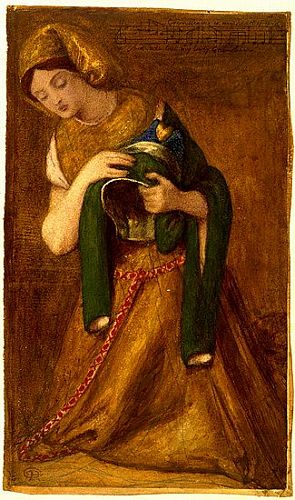
Image Credit: Rossetti Archive
Who was Lady Greensleeves
[W]hy would anyone be named for their green sleeves? Interpretations […] usually have a sexual connotation, most notably in the phrase “a green gown”, a reference to the grass stains on a woman’s dress from engaging in sexual intercourse outdoors. Was this lady a prostitute? [T]he song lyrics mention a “discourteous” rejection of the singer’s advances, suggesting to some that the lady in question was actually virtuous but, perhaps, was mistaken for a prostitute as a result of her green sleeves. [A]nother explanation is quite the opposite to promiscuity […]. [I]n heraldry, colour also had symbolisms and green indicated truth and fidelity […]. [A] knight may give a green armband to his true love to wear to show his devotion to her, giving rise to the familiar phrase “wearing your heart on your sleeve” meaning, to show your true feelings.
None of these theories, however, really seem to reflect the song’s true meaning, which clearly expresses an unrequited love by a rich man for a fair lady. All that we can confidently deduce, is that “Lady Greensleeves” is a nickname, not a title. Exactly who she was, remains a mystery.
Trivia Bits:
♦ In Shakespeare’s The Merry Wives of Windsor, the character Mistress Ford refers, twice, to “the tune of ‘Greensleeves'”.
♦ The tune was the basis for “Home in the Meadow,” a recurring song throughout the 1962 epic film How the West Was Won.
♦ A rendering of the tune, titled the “Lassie Theme”, was used extensively in the Lassie television show, especially the ending credits.
Everyone will remember this tune as What Child Is This? ~Vic
Sources & Additional Reading:
The Folk Song Greensleeves (Greensleeves Hubs)
Dante Gabriel Rossetti (Rossetti Archive)
Lyrics (Six Wives Website)
Greensleeves (Wikipedia)
Amy Nuttall
POTD: Strawberries & Dragon
This is an older photo but, it IS strawberry season. Dragon agrees. ~Vic

04-28-2018
Story Sunday: The Asteroid & The Mask
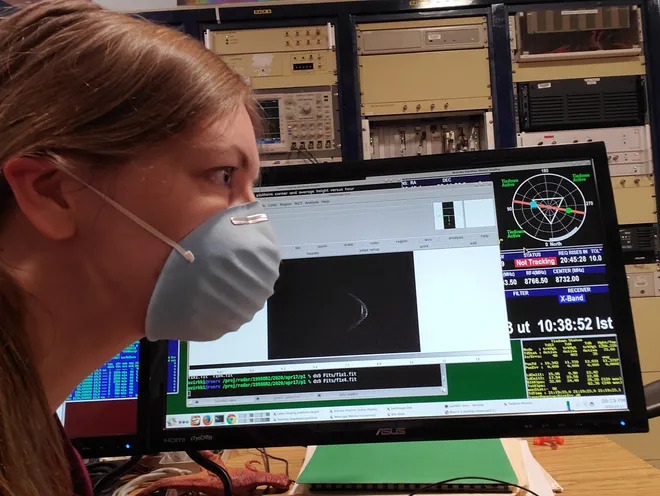
Photo Credit: Arecibo Observatory & USA Today
I haven’t done a Story Sunday since 2014.
It’s funny how every news article out there these days just has to make a tie in with the virus. And, that image doesn’t look like a mask to me. It looks like something else. Just sayin’… ~Vic
An asteroid is hurtling close to the Earth, and with it, a startling reminder of the coronavirus pandemic. The space rock, known as 1998 OR2, will be nearly 4 million miles away from Earth on Wednesday at 5:59am EDT, classifying it as a “potentially hazardous” asteroid, despite the impossibility of it posing a threat to Earth anytime soon.
A newly captured image by [the] Arecibo Observatory in Puerto Rico brings its own surprise. As the asteroid approaches our planet, it looks as if it’s wearing its own mask and may very well be conducting its own social distancing practices. “The small-scale topographic features, such as hills and ridges on one end of asteroid 1998 OR2, are fascinating, scientifically,” Anne Virkki, head of planetary radar at Arecibo Observatory, said in a statement. “But, since we are all thinking about COVID-19, these features make it look like 1998 OR2 remembered to wear a mask.”

It’s classified as a potentially hazardous asteroid because it is more than 500 feet in diameter and closer than 4,650,000 miles to Earth. “Although this asteroid is not projected to impact Earth, it is important to understand the characteristics of these types of objects to improve impact-risk mitigation technologies,” she said.
The asteroid, which is about one mile in diameter, has been traveling at nearly 20,000 mph since its discovery in 1998. Though it may not come anywhere near Earth in the coming weeks, Flaviane Venditti, a researcher at the observatory, said in a statement that, in 2079, it “will pass Earth about 3.5 times closer than it will this year.”
Joshua Bote
USA Today
April 24, 2020
Updated April 26, 2020
Additional Articles:
S-Band Spotlight (National Astronomy & Ionosphere Center)
Rocky Horror (The Sun)
Asteroid Visiting Earth’s Neighborhood Brings Its Own Face Mask (University of Central Florida)
Song Sunday: Call Me (Blondie)

Returning to my phone playlist, I submit for your approval on this chilly Sunday night, Blondie‘s Call Me, the theme from the 1980 movie American Gigolo. I was 13 when this film came out and, with its “R” rating, I wasn’t allowed to see it (I caught it on HBO, later, tho…). The drum beat opens the movie as Richard Gere cruises in a black Mercedes. This movie was so bad-ass (to a teenager) and Siskel & Ebert gave it a decent rating but, the rest of the critics panned it. Oh, well. This was the movie that put Gere on my radar (I hadn’t seen Looking For Mr. Goodbar).
Produced and co-written by Giorgio Moroder, he originally approached Stevie Nicks to assist in composing and performing a song for the soundtrack but, she was prevented by contract to another company. Moroder then asked Debbie Harry and she fashioned lyrics, and the melody, in a few hours.
The song made it to the #1 spot on Billboard’s Hot 100 and stayed there for six weeks. It also made it to #1 in Canada, the UK and in Record World magazine. There are 20 covers of this song with Blondie re-recording it in 2014 and, a live cover done in 2002.
Movie Opening
Single
Extended Version
Flashback Friday: Spain Declares War 1898
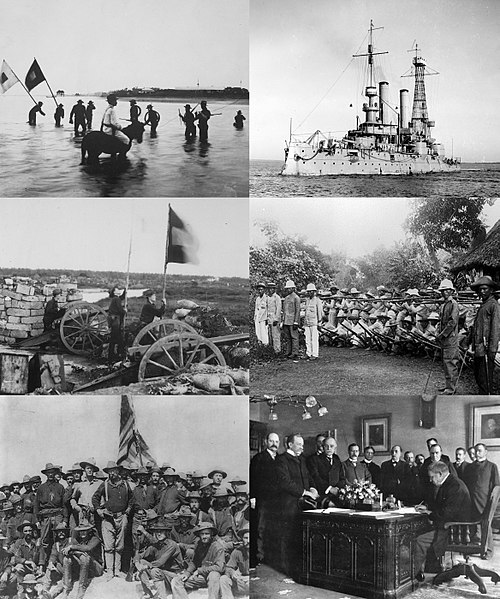
Top Right: USS Iowa
Middle Left: Spanish flag replaced at Fort Malate
Middle Right: Filipino soldiers in Spanish uniforms outside Manila.
Bottom Left: Roosevelt & The Rough Riders @ San Juan Hill
Bottom Right: The signing of the Treaty of Paris (1898)
Collage Credit: Barbudo
Wikipedia & Wikimedia
I posted about Hillsborough’s Old Courthouse this past Tuesday. The first picture was a marker about the Kentucky Expedition, led by Daniel Boone in 1775. The information was fashioned out of metal from the USS Maine, the very ship sunk in Havana Harbor that touched off the Spanish-American War. Spain declared war on the U.S. one-hundred, twenty-two years, ago, today and, the U.S. declared war the following day. Historically, the day of declaration is retroactively moved to April 21 as that was the day Spain severed diplomatic relations and the U.S. Navy began a Cuban blockade (the first of two). At the time of my Town Tuesday post, I didn’t realize that I actually posted it on the same day as the corrected date.
After first landing on an island then called Guanahani, Bahamas (San Salvador), on [October 12], Christopher Columbus commanded his three ships […] to land on Cuba’s northeastern coast on [October 28], 1492. Columbus claimed the island for the new Kingdom of Spain and named it Isla Juana after Juan, Prince of Asturias.
*************
The main issue was Cuban independence. Revolts had been occurring for some years in Cuba against Spanish rule. Hostilities began in the aftermath of the explosion of the USS Maine in Havana Harbor in Cuba, leading to U.S. intervention in the Cuban War of Independence.*************
The growing popular demand for U.S. intervention became an insistent chorus after the (still) unexplained sinking [of the Battleship Maine], which had been sent to protect U.S. citizens and property after anti-Spanish rioting in Havana. [P]olitical pressures from the Democratic Party pushed [President] McKinley into a war that he had wished to avoid. McKinley signed a joint Congressional resolution demanding Spanish withdrawal and authorizing the President to use military force to help Cuba gain independence […].

Image Credit: Artist Victor Gillam
Historical Society of Pennsylvania
May 7, 1898
The ensuing, ten-week war, fought in both the Caribbean and the Pacific, was pathetically one-sided, since Spain had readied neither its army, nor its navy, for a distant war with the formidable power of the United States.
*************
An army of regular troops, and volunteers, under General William Shafter, with Theodore Roosevelt (then, Assistant Secretary of the Navy) and his 1st Volunteer Cavalry, (The Rough Riders), landed on the coast, east of Santiago and, slowly advanced on the city […]. Madrid sued for peace after two Spanish squadrons were sunk in Santiago de Cuba and Manila Bay and a third, more modern, fleet was recalled home to protect the Spanish coasts.*************
The result was the 1898 Treaty of Paris. In it, Spain renounced all claim to Cuba, ceded Guam and Puerto Rico to the United States and, transferred sovereignty over the Philippines to the United States for $20 million.
♦ In 1976, Admiral Hyman G. Rickover commissioned a private investigation into the [USS Maine] explosion and, the National Geographic Society did an investigation in 1999, using computer simulations. All investigations agreed that an explosion of the forward magazines caused the destruction of the ship but, different conclusions were reached as to how the magazines could have exploded.
♦ [T]heodore Roosevelt, who eventually became Vice President and, later, President of the United States […] was, posthumously, awarded the Medal of Honor in 2001 for his actions in Cuba and, became the only U.S. President to win the award.
♦ The defeat and loss of the last remnants of the Spanish Empire was a profound shock to Spain’s national psyche […]. [There was a] philosophical and artistic re-evaluation of Spanish society known as the Generation of ’98.
Sources:
Cuba: Population, History and Resources 1907 (Google Books)
Destruction of the Maine (PDF Library of Congress)
Spain Declares War Against The United States (On This Day Website)
Spanish-American War (The History Channel)
What Destroyed The USS Maine (The Spanish-American War Centennial Site)
Cuba: A New History (Web Archive)
Battle of San Juan Hill (Wikipedia)
Cuban War of Independence (Wikipedia)
Generation of ’89 (Wikipedia)
Spanish-American War (Wikipedia)
Treaty of Paris (1898) (Wikipedia)
The Story of the USS Maine
Smithsonian Channel Explosion of the USS Maine
History Channel Spanish-American War Documentary
Chris Thomas: No More Papering Over The Cracks
A Blog Post From: The Chris Thomas Files

Have you ever been faced with the job of re-decorating a room? You know what it’s like…you strip off the old wallpaper only to find that the plaster is full of cracks. This means either filling in the cracks or re-plastering with all the mess that entails. Well, this is what has been happening for the past months (or years) to everybody, either on a personal level, a government level or nationally.
These are the real symptoms of change. In order to become new, to find out who we truly are, we first have to demolish the old. This process of change we are undergoing requires that everything of the past is cleared out so that we can see the cracks that have been underlying our lives for some time. We cannot become what our potential demands as long as the world, and ourselves, are still layered over with the old paper, old ways of being, which covered up everything.
Through 2007, and particularly 2008, we have seen the removal of many layers of old paper, which have served to blinker our view of reality. As we entered 2009, the blinkers really began to come off and we started to realise that we, as individuals, have to take responsibility for our own lives. We can no longer rely on anyone or any institution to save us. Those who have turned to the ‘quick fix’ for their problems realised, at long last, that there cannot be a quick solution. We cannot just add another layer of wallpaper. We have to face the consequences of re-building from the foundations up.
Taking Positive Action
You know the kinds of conversations we have all had, where you come up with the answer:
“I know I should be doing (whatever it is) but,…”
Well, the result of all of this self-work is that the answer needs to be changed to:
“I know I should be doing (whatever it is) so, I am going to start doing it now.”

This is what the last couple of years have been about…removing the wallpaper and seeing the cracks underneath, to help us to realise that we can no longer paper over these cracks. We have to take positive action and positive action, now. We cannot wait until 2011 or even 2012. If we wait beyond 2009 to take action, we will not be able to make it as far as the end of 2011. This is what the energies for change truly mean. We need to put our own house in order, clear out old emotions, and ways of dealing with the people with whom we share our lives, before we can reach our higher levels of being. And, nobody is going to do it for us.
It’s a nice thought that there are legions of ‘angels’, ET’s or even well meaning ‘orbs’ out there who are going to step in and do all of the work for us. But, the reality is that, while they may be happy to show us what we need to do, it is we, ourselves, who need to do it. [In] that sense, we are on our own. This is our planet and it is our mess we need to clear up. There are those beings ‘out there’ who would love to come and help but, they cannot come and help until we have shown that we are capable of resolving our own problems by making our leap into full consciousness. Until we have made that leap, we are on our own. The two featured books (visible in the blog post as The Universal Soul and The Human Soul) can help you understand where you are in this process of change and how to move forwards.
Consciousness Reintegration
This full consciousness state is that which many have come to call ‘Ascension’ but, we need to remember that we are not actually ‘ascending’ anywhere. We are staying firmly rooted on the planet. What we are supposed to be doing is bringing the ‘Higher Self’ into the physical body. In so doing, we ‘ascend’ to higher levels of consciousness and understanding. Once we have achieved that, we will be greeted by every ‘angel, and ET in the Universe to congratulate us on a job well done. According to the Akashic, there are currently about two million people who have already achieved this full consciousness reintegration world-wide. The majority of these people live in tribal cultures in remote regions of the planet. They have achieved what we all set out to achieve on this amazing Earth. So, during 2009, the rest of us, in the ‘western world’, need to be taking the necessary steps to catch up with them. This can only be achieved by each individual taking responsibility for themselves and not putting off, ’til tomorrow, what they can do today.
© Chris Thomas 2009
[We are LONG overdue to clean up our own houses and evolve. ~Vic]
The Blog Post (Cygnus Review Blog…with the wrong author credited)
Download The PDF & Share
FFTD: Candytuft
I have no idea what this is. If anyone does, speak up. ~Vic
Update: Thanks to Max at Powerpop Blog, I got my answer. This is an Iberis Sempervirens or an Evergreen Candytuft. Thanks, Max!

04-10-2019
Flower for the Day
Word Wednesday: Obstinate

And, yes, another new post heading. I’m stretching things out to keep from being stale or too strict on myself. With Word Wednesday, all are welcome to play along and use the word in a sentence in comments…if you are so inclined. ~Vic
“Evelyn’s two year old daughter, Karen, was being obstinate by refusing to eat her carrots.”
Town Tuesday: Old Courthouse
Yep…another new post heading. I will be doing a series of shots from my town. Hillsborough is one of the oldest towns in North Carolina and was the Capitol for a short time. It’s a very interesting, eclectic place. All photos are my personal collection. © ~Vic
Previous Post: The Town.

March 17, 1775
Tablet metal from the USS Maine
Richard Henderson was the presiding judge when the Regulators attacked the Courthouse.
They burned his home in Williamsborough.
Taken 05-20-2019

Boone Trace or Boone Trail Highway &
The Trading Path 1700

Taken 04-04-2020

Back door.

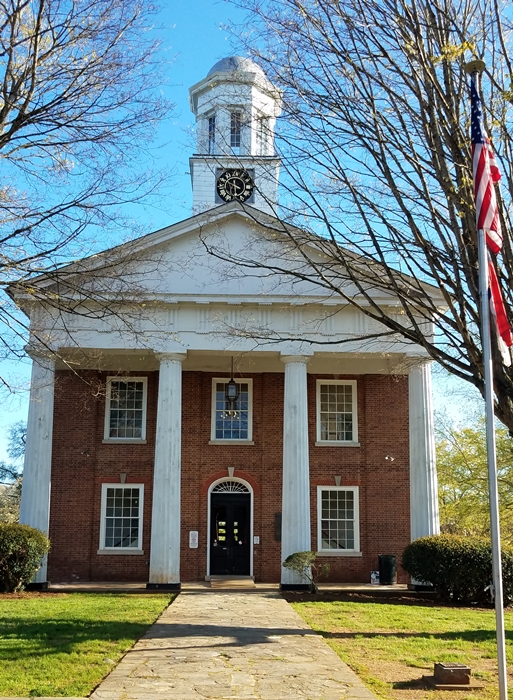
Front door.
The marker, above, is to the right.
Military Monday: The Burning of Gosport Navy Yard 1861

Image Credit: M. W. Robbins Collection &
The Virginian-Pilot
pilotonline.com
I haven’t done a Military Monday since 2018. One-hundred, fifty-nine years ago, today…~Vic
In 1861, Virginia joined the Confederate States of America. Fearing that the Confederacy would take control of the [Navy yard] facility, the shipyard commander Charles Stewart McCauley ordered the burning of the shipyard.
*************
[The USS Pawnee was] dispatched to Norfolk to secure the ships and stores of the Gosport Navy Yard. Arriving at Norfolk the night of [April 20], she found that all ships, save [the] USS Cumberland, had been scuttled […]. [So], an attempt was made to destroy the Naval stores and the dry dock. Their efforts were largely unsuccessful but, she took Cumberland in tow and saved the frigate.*************
On Saturday evening, at 9 o’clock, the Pawnee arrived from Washington with 200 volunteers, and 100 marines, besides her own crew […]. [At] once, the officers and crew of the Pawnee and Cumberland went to the Navy yard and, spiked and disabled the guns, [plus], threw the shot and small arms into the river. At 10 o’clock, the marines, who had been quartered in the barracks, fired them and came on board the Pawnee. A party of officers, [in the] meantime, were going through the different buildings and ships, distributing waste and turpentine, and laying a train, so as to blow up the dry dock. At this time, the scene was indescribably magnificent, all the buildings being in a blaze, and explosions, here and there, scattering the cinders in all directions.The Government vessels had been scuttled in the afternoon before the Pawnee arrived, to prevent their being seized by the Secessionists, who had been in arms in both Norfolk and Portsmouth.

Image Credit: M. W. Robbins Collection &
The Virginian-Pilot
pilotonline.com
The Confederate forces did, in fact, take over the shipyard and did so without armed conflict through an elaborate ruse orchestrated by civilian railroad builder William Mahone (then President of the Norfolk and Petersburg Railroad and soon to become a famous Confederate officer). He bluffed the Federal troops into abandoning the shipyard in Portsmouth by running a single passenger train into Norfolk with great noise and whistle-blowing […]. [T]hen, much more quietly, [he sent] it back west […]. [He returned] the same train, again, creating the illusion of large numbers of arriving troops [with] the Federals listening in Portsmouth across the Elizabeth River (and just barely out of sight).
*************
[In] July, Confederate shipyard workers begin converting the unburned underbelly of the USS Merrimack into the ironclad CSS Virginia in Drydock 1.
Sources:
Burning of Gosport Navy Yard (The New York Times)
The History of Norfolk Naval Shipyard (The Virginian-Pilot Online)
This Day in Naval History (US Navy Website)
How Fear, Deception and Indecision Nearly Destroyed Norfolk Naval Shipyard (USN History)
Norfolk Naval Shipyard (Wikipedia)
Clip from Hearts in Bondage (1936)
Snapshots Sunday: Sky Gazing 4.0
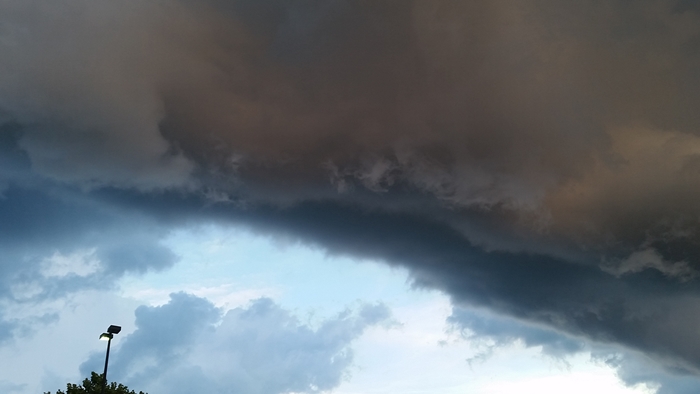
A storm rolled into town in July of 2016. I came out of the Food Lion and was just awestruck. It was scary looking and I kept waiting for the lightening, thunder and rain but, nothing happened except a gorgeous sunset.
All photos are my personal collection. © ~Vic
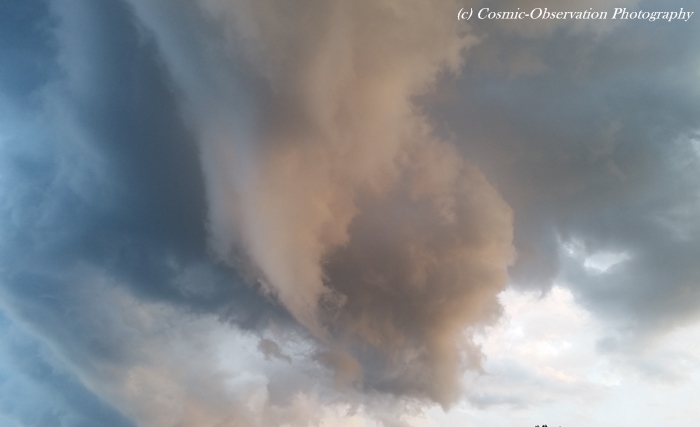
07-12-2016


Scoop Saturday: Navy Master Chief Ocean Protest

businessinsider.com
Yep. New heading. ~Vic
A man wearing the US Navy uniform went to the oceanfront in Emerald Isle, North Carolina, on Thursday, in an apparent protest against the town’s restrictions amid the coronavirus pandemic. The man, who was identified by a witness as a retired US Navy [Master Chief], was seen photographed standing in front of a sign that read “LAND OF THE FREE.” Mike Conner, a longtime resident of Emerald Isle, and a surfer, told Insider the retired sailor stood in the waters for about 10 minutes before he was approached by law enforcement officers. Conner said the man was asked to remove himself from the area but, refused the request. “The sailor eventually left the water on his own accord, without incident”, Conner added.
Hours after the incident, the town announced it would lift the ban on access on Saturday. Surfers, and other residents, previously expressed their disapproval by staging protests throughout the area and were “fired up by the closures”, Conner said. “We’re very happy that Emerald Isle allowed access, not just to us swimmers but, to everybody that uses it as a medium for their exercise,” Connor said. “We don’t want our rights stomped all over.”
The man in the uniform and the Emerald Isle Police Department did not respond to a request for comment.
David Choi
Business Insider
April 17, 2020
Additional Articles:
North Carolina Beach Reopens After Navy Serviceman’s Ocean Protest (National File Website)
Navy Master Chief Stands His Ground (BizPac Review)
Retired Chief Rife
Foto Friday: Virus Humor
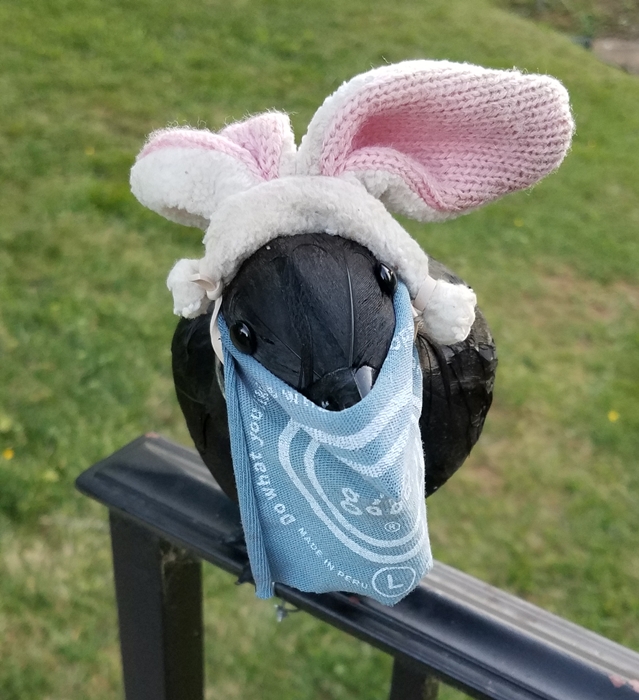
We have a few comedians in town. I can appreciate. These are cute and clever. That being said, I am getting tired of the TV telling me to social distance, stay at home and wash my hands. I heard you the first fifty times. Enough already. All photos are my personal collection. © ~Vic

The homeowners are known for wiring things
to the railing.
04-15-2020

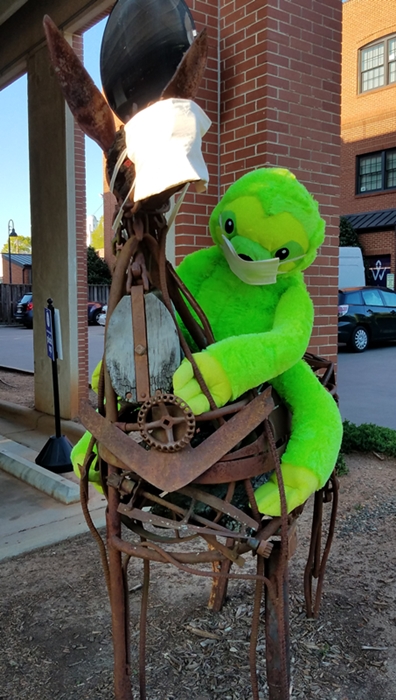
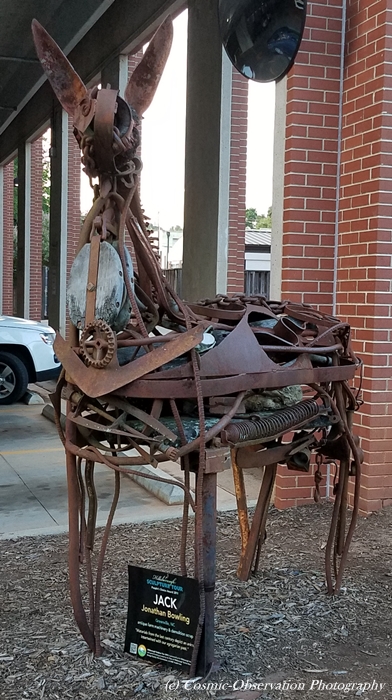
is short for jackass. He is well known
around town. The green critter on his
back is a Disney character, I guess.
04-16-2020
Throwback Thursday: The Battle of Culloden 1746

Two-hundred, seventy-four years ago, today, the Battle of Culloden (east of Inverness), also referred to as the Battle Of Drummossie was the last confrontation of the 1745 Jacobite Rising (Forty-Five Rebellion).
The battle […] is significant as the last pitched battle fought on the British mainland. It was also the last battle of the final Jacobite Rising that commenced in 1745 when Charles Edward Stuart (Bonnie Prince Charlie), grandson of the exiled King James VII & II, arrived in Scotland from France in July and raised his standard at Glenfinnan [in August]. His aim was to put his father on the throne in place of the Hanoverian George II.
The battle was a total and bloody defeat for the Jacobites which effectively marked the end of almost sixty years of the Jacobite struggle, as never again would an armed uprising be used in the attempt to return the Stuarts to the throne. The government victory also paved the way for a sustained programme to destroy the power base of the rebel clans.
Culloden (pronounced culawden, with the emphasis on ‘oden‘) is one of the most important battles in the history of the British Isles and has international significance. It is the final battle fought on the British mainland and brings to an end more than half a century […] of Jacobite conflict, itself played out against a background of wider international wars. Its aftermath transforms the Highlands, bringing to an end the traditional way of life of the area and contributing to the subsequent clearances. The battle also holds a prominent place within the Scottish cultural legacy, frequently depicted, and commemorated, in art, music, literature and film. The battlefield, itself, is one of the most visited tourist sites in the Highlands […]. [T]he site holds a particularly high significance, and emotional connection, to many within Scotland and to the ancestors of the Scottish Diaspora.
The official return for British Army casualties (government troops) was 50 officers, and men, killed and 259 wounded [with] one missing (a proportion of the wounded later died of their wounds). Jacobite fatalities have been estimated at between 1,200-1,500 with between 400 and 500 prisoners taken in the immediate aftermath and many more in the days which followed. Only the Irish and Scottish troops in French service were treated as bona fide prisoners of war, the rest as rebels.
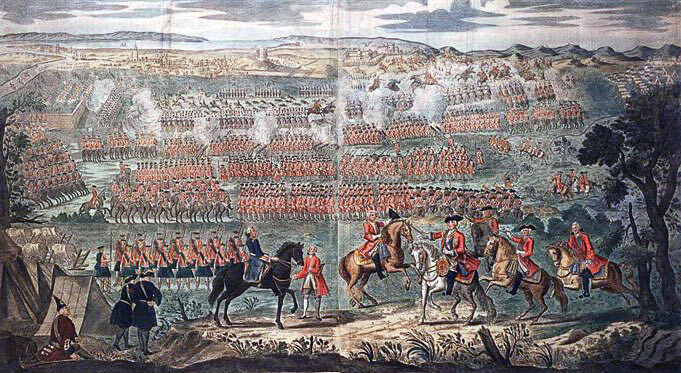
The battle, which lasted only 40 minutes, resulted in bitter defeat for the heavily outnumbered Jacobites. Led by the Duke of Cumberland, son of King George II, [the] devastating slaughter of the Jacobites was the result of the opening British cannonade and, subsequent tactics of the Redcoats during the attack […] when each British soldier, instead of attacking the Highlander directly in front of him, bayoneted the exposed side of the man to his right. The Highlanders finally broke and fled […].
Hunted by troops and spies, Prince Charles wandered over Scotland for five months before escaping to France and final exile. The [battle] […] marked the end of any serious attempt by the Jacobites to restore the Stuart dynasty to the British throne.
A generation before, a previous Jacobite rebellion had been thwarted by the king’s officer, George Wade, who had “pacified” and “disarmed” the highland clans. So concerned was the English establishment, and relieved by Wade’s actions, that an additional verse to the National Anthem was penned:
God grant the Marshal Wade
May be thy Mighty aid,
Victory bring;
May he sedition hush,
And like a torrent rush,
Rebellious Scots to crush,
God save the king
Fallout (Late Add):
The high ranking “rebel lords” were executed on Tower Hill in London. Britain enacted punitive laws to prevent the clans rising, again:
(1) Episcopal clergy were required to swear allegiance to the House of Hanover.
(2) The Heritable Jurisdictions Act 1749 abolished judicial rights of heritors, stripping estates from lords and clan chiefs.
(3) The Act of Proscription 1746 was enacted to destroy the clan system.
(4) The Dress Act 1746 made wearing the Highland Dress illegal in Scotland, except for the military-based kilt wearing of the Black Watch
Addendum: “Culloden is viewed by the Scottish people as a war grave. To my fellow Americans, stepping onto the Culloden battlefield would be like visiting Gettysburg or Normandy. And, since Scotland views it as a grave, you could also liken it to Arlington Cemetery. You don’t simply walk onto any of these places with a light spirit.” ~Brit At Heart
Sources:
Ascanius (Web Archive)
Battle of Culloden (Britannica)
Battle of Culloden (British Battles)
Battle of Culloden (Historic Environment Scotland)
Battle of Culloden (Wikipedia)
Battle of Culloden Moor (Web Archive)
Culloden (National Trust for Scotland)
Culloden 1745 Culloden 2010 (Bluestocking)
Culloden Ghosts (About Aberdeen)
Culloden Moor (Web Archive)
The Battle of Culloden (Historic UK)
2020 Anniversary Lament
Documentary From 1964
 Cosmic-Observation