The Treaty of Union is the name usually, now, given to the agreement which led to the creation of the new state of Great Britain [.] [It stated] that England, which already included Wales, and Scotland were to be “United into one Kingdom by the name of Great Britain[.]” At the time it, was more often referred to as the Articles of Union. The details of the treaty were agreed on [July 22], 1706 and separate Acts of Union were then passed by the parliaments of England and Scotland to put the agreed articles into effect. The political union took effect on [May 1], 1707.
Queen Elizabeth I of England and Ireland, last monarch of the Tudor dynasty, died without issue on [March 24], 1603 and the throne fell at once […] to her first cousin twice removed, James VI of Scotland, a member of House of Stuart and the only son of Mary, Queen of Scots. By the Union of the Crowns in 1603, he assumed the throne of the Kingdom of England and the Kingdom of Ireland as King James I. This personal union lessened the constant English fears of Scottish cooperation with France in a feared French invasion of England. After [the] union, the new monarch, James I and VI, sought to unite the Kingdom of Scotland and the Kingdom of England into a state which he referred to as “Great Britain”. Nevertheless, Acts of Parliament attempting to unite the two countries failed in 1606, 1667 and 1689.
Photo Credit: monash.edu CTIE
Wikipedia & Wikimedia
One-hundred, ten years ago, today…
The Duigan […] biplane was an early aircraft which made the first powered flight by an Australian-designed and built machine when it flew in Victoria in 1910. The aircraft was constructed by John Duigan, with help from his brother Reginald, on their family farm at Mia Mia. The effort was especially significant in that the brothers built the aircraft almost entirely by themselves and without input from the pioneering aviation community. [A] photo-postcard of the Wright Flyer inspired the design and Sir Hiram Maxim‘s book Artificial and Natural Flight provided the theoretical basis. The only components not built by the Duigans themselves were the engine, made by the J. E. Tilley Engineering Company of Melbourne and the propeller. However, both of these components were extensively modified by John before they could be used.
Photo Credit: Memorial near Mia Mia Dolphin 51
Wikipedia & Wikimedia
The aircraft flew for the first time on July 16, 1910, taking off under its own power and flying [24 feet] (7 meters). Within two months, this had been extended to [300 feet] (90 meters) and, soon thereafter, to [590 feet with an altitude of 12 feet] (180 meters [with] an altitude of 3.5 meters). By the end of the year, Duigan had made a flight of [nearly a mile] (1 km) at an altitude of [100 feet] (30 meters).
Duigan informed the Department of Defence of his achievements, hoping to claim a £5,000 prize that had been offered in September 1909 for the construction of an aircraft suitable for military purposes. Duigan was ineligible for the prize, which had expired at the end of March 1910 but, was asked to demonstrate his aircraft for the military anyway. He also flew it in a public demonstration in front of a crowd of 1,000 spectators at Bendigo Racecourse in January 1911. In 1920, Duigan donated the aircraft to the Industrial and Technological Museum of Victoria, which was later absorbed into Museum Victoria.
Museum Victoria also preserves a flying replica of the Duigan biplane built by Ronald Lewis and flown in 1990. It was donated to the museum in 2000.
Photo Credit: Ken Lund
History & Headlines
Wikimedia
This was going to be a post on the highest recorded heat level, listed in the Guinness (Book) of World Records. Supposedly, one-hundred and seven years ago, today, Death Valley got up to 134.4℉. I read Wikipedia, I read Guinness and I read History & Headlines. If it made it into Guinness, someone must have thought it was legitimate. Well, after taking a dive into Weather Underground‘s investigation of this record (this is a very long read), posted by weather historian Christopher Burt on October 24, 2016, I’m not so sure this event ever happened.
I have contacted Guinness for a challenge. We shall see how this plays out. ~Vic
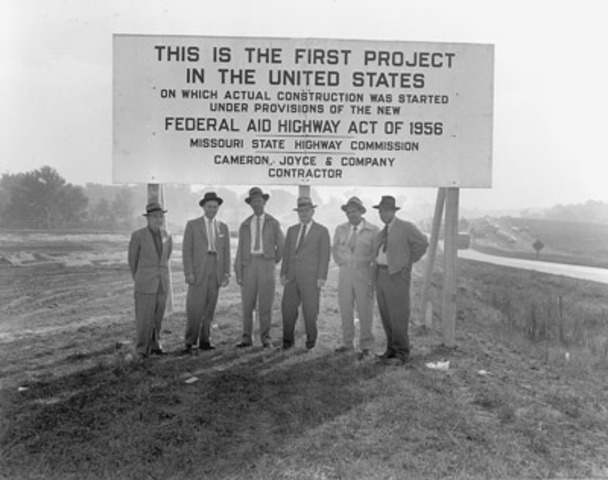
Also known as the Federal Aid Highway Act of 1956 (Public Law 84-627), [it] was enacted on June 29, 1956, when President Dwight D. Eisenhower signed the bill into law. With an original authorization of $25 billion for the construction of 41,000 miles (66,000 km) of the Interstate Highway System, supposedly over a 10-year period, it was the largest public works project in American history [at] that time.
The addition of the term defense in the act’s title was for two reasons. First, some of the original cost was diverted from defense funds. Secondly, most U.S. Air Force bases have a direct link to the system. One of the stated purposes was to provide access in order to defend the United States during a conventional or nuclear war with the Soviet Union and its communist allies. All of these links were in the original plans, [though] some, such as Wright Patterson AFB, were not connected […] in the 1950s but, [were] later.
Photo Credit: Timetoast
The money for the Interstate […] and Defense Highways was [drawn from] a Highway Trust Fund that paid for 90% of highway construction costs, with the states required to pay the remaining [10%]. It was expected that the money would be generated through new taxes on fuel, automobiles, trucks and tires. As a matter of practice, the federal portion of the cost of the Interstate Highway System has been paid for by taxes on gasoline and diesel fuel.
Eisenhower‘s support of the Federal Aid Highway Act of 1956 can be directly attributed to his experiences in 1919 as a participant in the U.S. Army’s first Transcontinental Motor Convoy across the United States on the historic Lincoln Highway, which was the first road across America. The convoy was memorable enough for a young Army officer, 28-year-old Lieutenant Colonel Dwight David Eisenhower, to include a chapter about the trip, titled Through Darkest America With Truck and Tank in his book At Ease: Stories I Tell to Friends (Doubleday and Company, Inc., 1967).
Following completion of the highways, the cross-country journey that took the convoy two months in 1919 was cut down to five days.
This is clearly a newspaper clipping from back in the day. I can’t for the life of me remember where I picked this up but, I have had it for years. My, we have come a long way. ~Vic
Anonymous Artist Vlad III
Image Credit: Wikipedia & Wikimedia
The conflict initially started with Vlad‘s refusal to pay the jizya (tax on non-Muslims subjects charged at 2.5%) to the sultan and [it] intensified when Vlad invaded Bulgaria. In response, Mehmed raised a great army with the objective to conquer Wallachia and annex it to his empire. The two leaders fought a series of skirmishes, the most notable one being the Night Attack where Vlad attacked the Turkish camp in the night in an attempt to kill Mehmed. The assassination attempt failed and Mehmed marched to the Wallachian capital of Târgoviște, where he found a few men with cannons. After leaving the capital, Mehmed discovered 23,844 impaled Turks whom Vlad had killed during his invasion of Bulgaria. The number is mentioned by Vlad himself in a letter to Matthias Corvinus (Matthias I). The sultan, and his troops, then sailed to Brăila and burned it to the ground before retreating to Adrianople. Both sides claimed victory in the campaign and Mehmed’s forces returned home with many captured slaves, horses and cattle.
There are two extant ballads […], both of which narrate the same story. As ballads existed within oral tradition[s] before being written down, other versions of this once popular song also may have existed. Moreover, other ballads used its tune without necessarily referring to [this particular ballad].
This ballad was entered in the Stationers’ Register in 1624. The title is alternatively spelled Chevy Chace. The ballad is generally thought to describe the Battle of Otterburn. Some of the verses correspond to that battle but, not all. The Battle of Otterburn took place in 1388. At that [b]attle, Henry Percy (Hotspur) was captured, not killed. He was killed in 1403 in an uprising against Henry IV.
The death of Earl Douglas
Author: John Frederick Tayler
Image Credit: All Posters & Wikimedia
[A]nother possibility [was] border warfare between a Percy and a Douglas in 1435 or 1436. Henry Percy of Northumberland made a raid into Scotland with 4,000 men. He was met by William Douglas, Earl of Angus at Piperden. There were great losses on each side but, the Scots prevailed.
Over time, and the various evolutions of the ballad, events and personages have gotten confused.
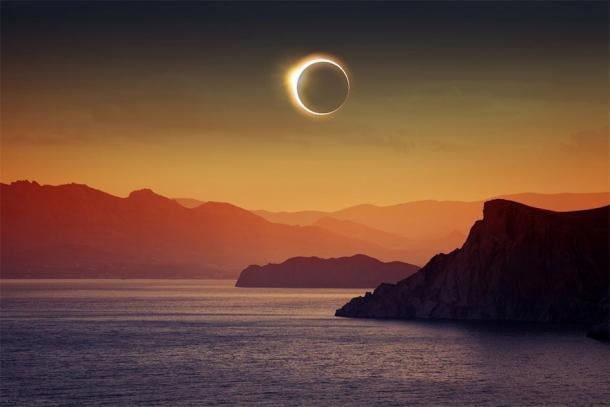
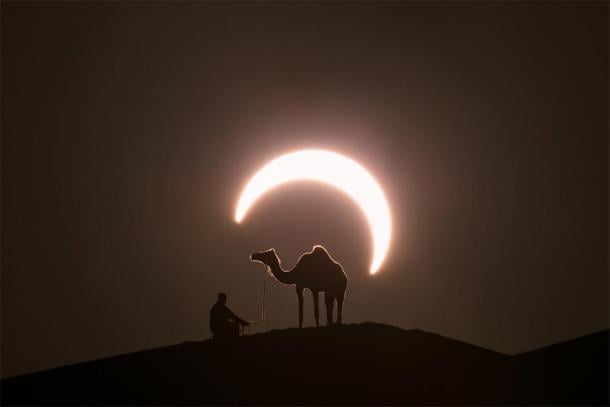
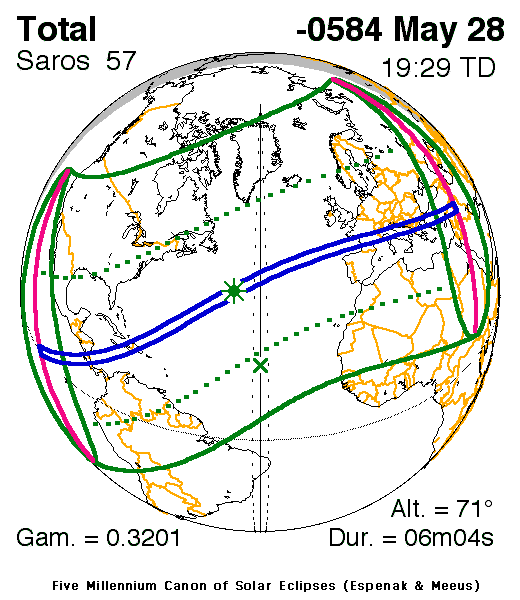
According to Herodotus, the appearance of the eclipse was interpreted as an omen and, interrupted a battle in a long-standing war between the Medes and the Lydians. The fighting immediately stopped and they agreed to a truce. Because astronomers can calculate the dates of historical eclipses, Isaac Asimov described this battle as the earliest historical event whose date is known with precision to the day and described the prediction as the birth of science.
Photo Credit: Ancient Origins
The Mechanics of a Monumentally Difficult Prediction
The reason this astronomical event is thought of as being so important is that predicting a solar eclipse, compared with a lunar eclipse, is exceptionally difficult. The astronomer must not only calculate when it will occur but, where on Earth’s surface it will be visible […]. [In] a lunar eclipse, the moon passes through the Earth’s sun shadow and the phenomena is visible on the whole side of the Earth that is in night-time […]. [They] often last longer than an hour. In solar eclipses, however, the moon’s shadow falls across the Earth in a comparatively narrow path, with a maximum duration, at any given location, of about 7 1/2 minutes.
[What] makes Thales’ prediction [an] historical mystery is that historians know early Greeks, at large, didn’t have this essential lunar data and there are no other records of Greek astronomers in this period accurately predicting any other eclipses. Thus, it is thought by historians that the only place Thales’ advanced astronomical knowledge could have come from was Egypt. [It’s] known [that] Thales studied Egyptian techniques for measuring sections of land with rope […].
Returning [to] the war (mentioned above), after 15 years of fighting, on May 28, 585 BC, the armies of King Aylattes of Lydia were in battle with the forces of King Cyaxares of Medes (or, possibly, Astyages, his son), near the River Halys in what is, today, central Turkey. Chroniclers noted the heavens darkening and soldiers on both sides laying down their weapons in awe of the spectacle […]. [The] event ended both the battle and the war.
[A] Wired article says this famous astronomical event has been debated by hundreds of scholars for nearly two millennia and that some authorities believe Thales’ eclipse may have occurred 25 years earlier in 610 BC. But, the reason most agree with the 585 BC date is the record of the famous battle in Asia Minor ending when the day was suddenly turned to night.
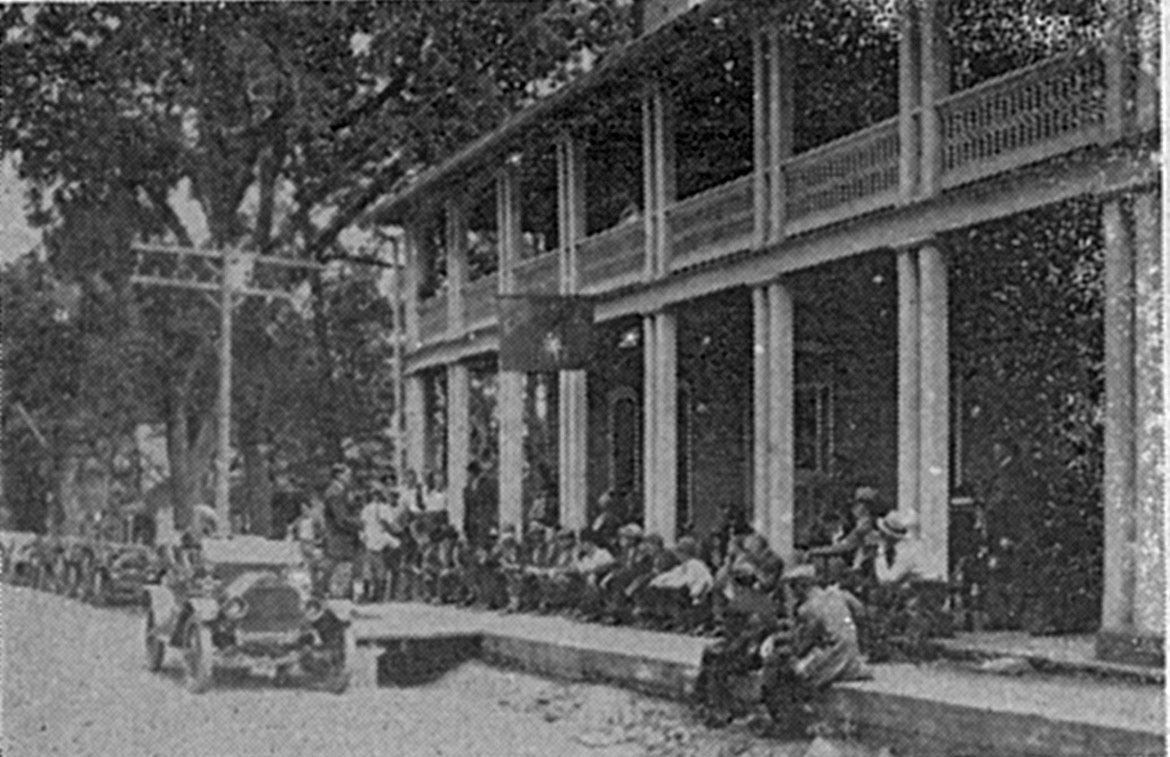
The structure known today as the Colonial Inn was built on Lot 15 in 1838 as a hotel and was locally called Spencer’s Tavern […] but, was advertised as the Orange Hotel (a name which lasted into the 1880s). The structure was built for Isaac (Isaiah) Spencer (from Hyde County) who had purchased the property in late 1837. In 1841, Richardson Nichols purchased the property from Spencer and expanded the main structure. In 1856, Nichols sold the structure to the “Hillsborough Improvement Company” which consisted of Alfred, Henry and Cave Stroud.
Stroud family history has it that Henry’s wife (Sarah) saved the Inn from looting by Union troops by displaying her husband’s Masonic apron. Upon seeing the apron, a sympathetic Union officer, [whom] was a fellow Mason, protected the site from destruction.
Strayhorn’s Hotel
1870
Image Credit: Rootsweb
William F. Strayhorn may have purchased or, at least, managed the business beginning in 1868 and, the property was purchased by local businessmen Henry N. Brown and Charles M. Latimer (who was also the county treasurer) in 1870. Brown and Latimer apparently lost the property through bankruptcy in 1872, with Strayhorn managing or operating the hotel until at least then. Perhaps related is that Strayhorn had been living in Twin Chimneys across the street from the hotel but, lost it due to financial problems in January 1869. [It] was purchased by David C. Parks in December 1872. In 1885, Parks sold the property to neighboring property owner Emily Pogue, who sold it back to Parks in 1888. [At] this time, it became known as the Occoneechee Hotel.
Looking East
1890s
Image Credit: Rootsweb
In 1908, Thomas A. Corbin purchased the property and renamed the complex the Corbinton Inn. In 1921, W. L. Foushee […] purchased the property from a H. L. Akers and by 1924, renamed the hotel the Colonial Inn. In 1946, Paul Henderson purchased the property from Foushee […].
During Henderson’s ownership, a “fine-dining” restaurant was added within the hotel structure. In December 1952, Charles and Ann Crawford purchased the property and business and, expanded the structure. They operated the business successfully until they, in turn, sold it to James and Maxine Freeland in 1969. The Freelands also expanded the structure and, continued the hotel and restaurant business at the location.
Looking WSW
1960s
Photo Credit: Open Orange
It fell into disrepair for many years. When I moved to this town in 2011, it looked bad.
10-23-201610-23-2016
The good news is, new owners are re-building. ~Vic
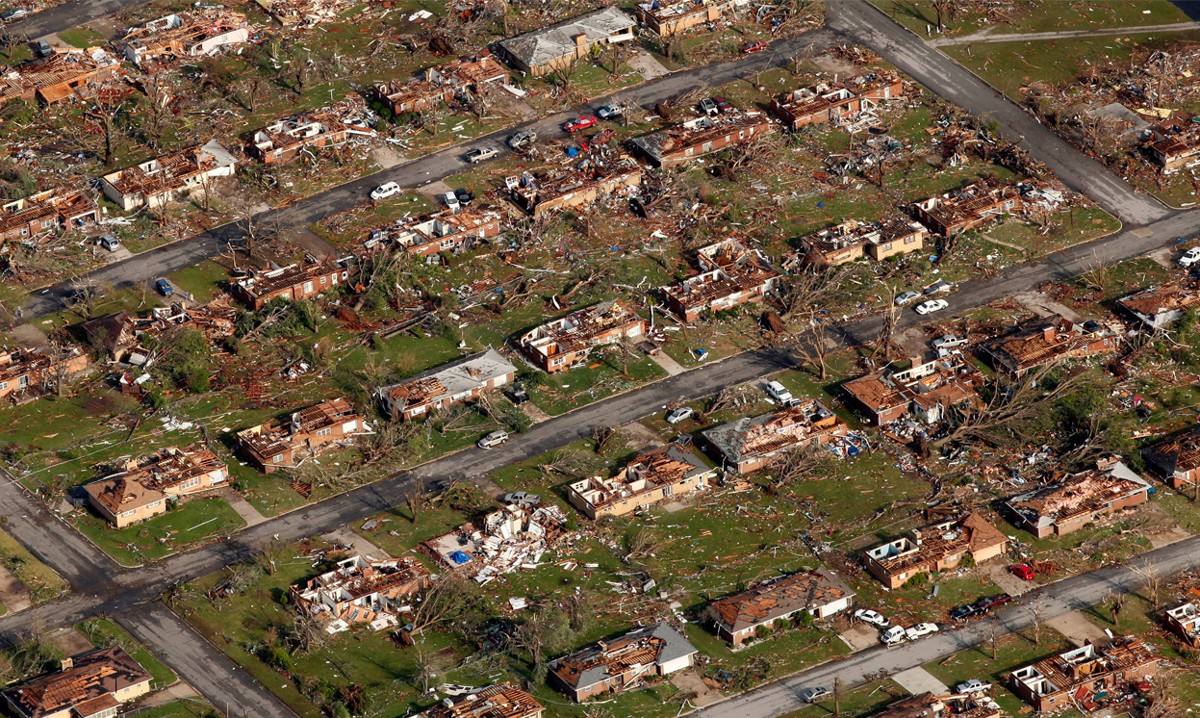
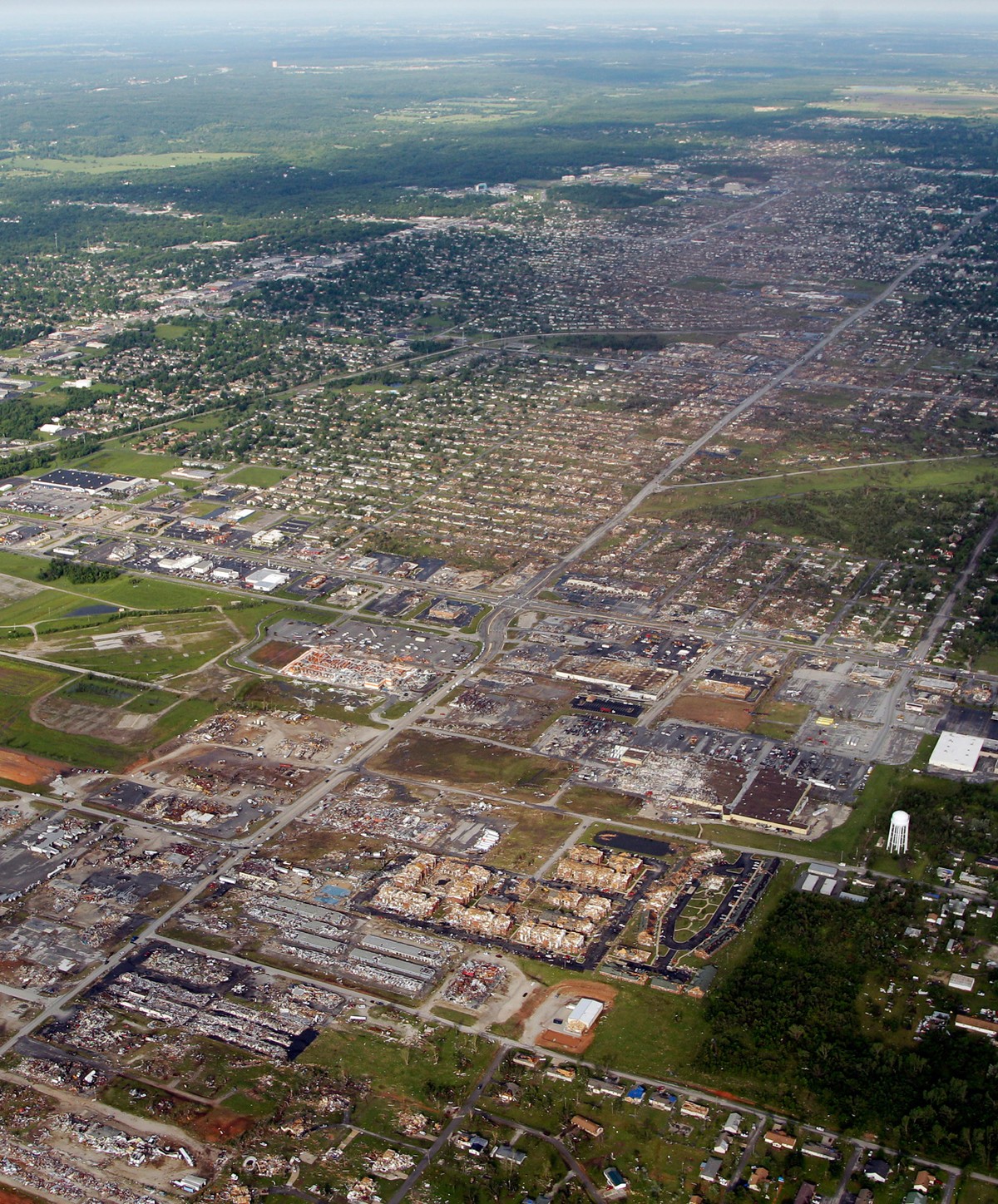
Nine years ago, today, an EF5, multi-vortex tornado slammed into Joplin, Missouri. It formed at 5:34 pm CDT and dissipated at 6:12pm CDT. I remember this one, vividly. I had just moved back to North Carolina from Texas and was, literally, still unpacking. I was shocked at the devastation. ~Vic
[This] was part of a larger, late May tornado outbreak and reached a maximum width of nearly one mile […] during its path through the southern part of the city. This particular tornado was unusual in that it intensified in strength and grew larger in size at a very fast rate. The tornado tracked eastward across the city and, then, continued eastward across Interstate 44 into rural portions of Jasper County and Newton County. It was the third tornado to strike Joplin since May 1971.
Photo Credit: theatlantic.com
[The] tornado killed 158 people (with an additional eight indirect deaths), injured some 1,150 others and caused damages amounting to a total of $2.8 billion. It was the deadliest tornado to strike the United States since the 1947 Glazier–Higgins–Woodward tornadoes, and the seventh-deadliest overall. Along with the Tri-State Tornado and the 1896 St. Louis–East St. Louis tornado, it ranks as one of Missouri’s and America’s deadliest tornadoes […]. It was the first F5/EF5 tornado in Missouri since May 20, 1957 [and] was only the second F5/EF5 tornado in Missouri history dating back to 1950.
It also ranks as the costliest single tornado in U.S. history.
There is a LOT of data on this siege and I’m not re-writing history. This will serve as a highlight, only. I will provide links to more information, below. ~Vic
Four hundred, fifty-five years ago, today, the island of Malta was attacked and nearly invaded by the Ottoman Empire, it’s second attempt.
If it had not taken place, the Great Siege would no doubt have been dreamt up for the screenplay of an epic film. Few other historic episodes rival it for sheer heroism, the bloodshed of war and military strategy. The story of the siege is interwoven with the tale of two adversaries, the ageing Grand MasterJean Parisot de la Valette, and his contemporary, the Barbary CorsairDragut Reis who commanded the fleet of Sultan Suleiman the Magnificent. It is also the story of thousands of lives of Maltese Islanders, men at arms to the Knights of St. John.
The years leading up to the siege saw the Islands under constant threat from the Ottoman Turks […]. The Knights knew they were vulnerable in Malta despite the harbours and their two forts […]. Grand Master La Valette had done his best to build defences and had requested extra forces from the Emperor Charles V, the Pope and the Viceroy of Sicily. But, no help came. In May, 1565, a vast Ottoman fleet, some 40,000 men, lay siege to the Islands.
The Knights were heavily outnumbered with a mere 700 or so men and around 8000 Maltese regular troops. The Islanders took refuge in the fortified towns [..] destroying crops and poisoning wells as they fled.
Image Credit: medievalists.net
The Ottomans first decided to attack isolated Fort St. Elmo […]. Repeated assaults were launched over 36 days but, the small garrison of Knights held on to the fort for far longer than Suleiman‘s men anticipated. After four weeks, they finally overran St. Elmo but, at a heavy price […]. The Turkish commander Dragut was fatally injured during the taking […].
It is the battle for [Fort] St. Angelo which saw some of the bloodiest episodes of this Holy War. It was to [be] the basis of legends for centuries to come. [Some] 10 attacks [were launched] on [its] walls [and], when a huge part of the defences were breached, the Ottomans failed to take the Fort.
At one point in the battle, the Ottomans floated the headless corpses of captured Knights across Grand Harbour. The act was returned in kind [as] Valette ordered all Ottoman prisoners to be executed and their heads used as ‘cannon balls’ to fire back toward their compatriots in St. Elmo.
[Valette]’s long-awaited relief forces [finally] appeared […] and took control of high ground inland. [The] Ottoman troops retreated […].
The Turks fled to their ships, and from the islands, on September 13 (almost four months had passed). Malta had survived the Turkish assault, and throughout Europe, people celebrated what would turn out to be the last epic battle involving Crusader Knights.
Malta’s magnificent capital, Valletta, was founded by and named after Grand Master Jean de la Valette. Valette, himself, was buried in the city some three years later.
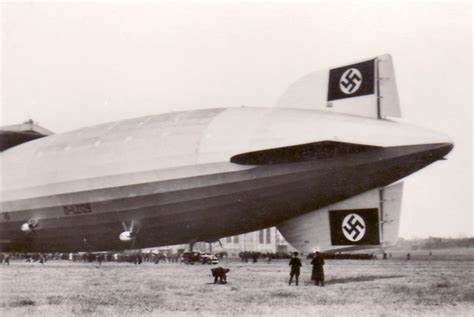
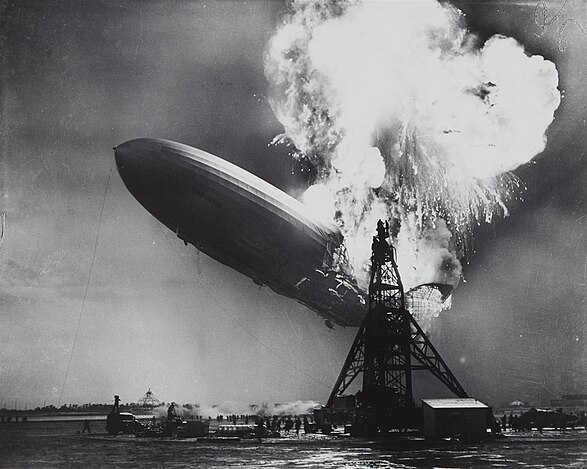
[T]he largest dirigible ever built, [it burst] into flames upon touching its mooring mast […]. There were 35 fatalities (13 passengers and 22 crewmen) from the 97 people on board (36 passengers and 61 crewmen) and an additional fatality on the ground.
The rigid airship, often known as the Zeppelin after the last name of its innovator, Count Ferdinand von Zeppelin, was developed by the Germans in the late 19th century. [It] had a light framework of metal girders that protected a gas-filled interior [of] highly flammable hydrogen gas, vulnerable to explosion.
On May 3, the Hindenburg left Frankfurt, Germany, for a journey across the Atlantic to Lakehurst’s Navy Air Base. While attempting to moor, […] the airship suddenly burst into flames, probably after a spark ignited its hydrogen core. Rapidly falling 200 feet to the ground, the hull of the airship incinerated within seconds. [M]ost of the survivors suffered substantial injuries.
The disaster was the subject of newsreel coverage, photographs and [radio announcer] Herbert Morrison‘s recorded […] eyewitness reports from the landing field, which were broadcast the next day. He is known for his famous emotional declaration “Oh, the humanity!”
A variety of hypotheses have been put forward for both the cause of ignition and the initial fuel for the ensuing fire. The event shattered public confidence in the giant, passenger-carrying rigid airship and marked the abrupt end of [that] era.
On April 30, 1993, four years after publishing a proposal for “an idea of linked information systems,” computer scientist Tim Berners-Lee released the source code for the world’s first web browser and editor. Originally called Mesh, the browser that he dubbed WorldWideWeb became the first royalty-free, easy-to-use means of browsing the emerging information network that developed into the internet as we know it today.
Berners-Lee was a fellow at CERN, the research organization headquartered in Switzerland. Other research institutions like the Massachusetts Institute of Technology and Stanford University had developed complex systems for internally sharing information and Berners-Lee sought a means of connecting CERN’s system to others. He outlined a plan for such a network in 1989 and developed it over the following years. [He] wrote and published the first web page, a simplistic outline of the WorldWideWeb project, in 1991. Simple Web browsers like Mosaic appeared a short time later and, before long, the Web had become by far the most popular system of its kind.
The creation and globalization of the web is widely considered one of the most transformational events in human history.
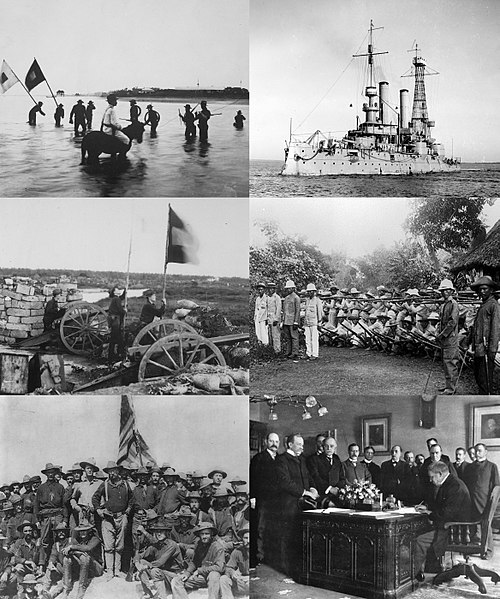
Top Left:Signal Corps extending telegraph lines. Top Right:USS Iowa Middle Left:Spanish flag replaced at Fort Malate Middle Right: Filipino soldiers in Spanish uniforms outside Manila. Bottom Left:Roosevelt & The Rough Riders @ San Juan Hill Bottom Right: The signing of the Treaty of Paris (1898)
Collage Credit: Barbudo
Wikipedia & Wikimedia
I posted about Hillsborough’s Old Courthouse this past Tuesday. The first picture was a marker about the Kentucky Expedition, led by Daniel Boone in 1775. The information was fashioned out of metal from the USS Maine, the very ship sunk in Havana Harbor that touched off the Spanish-American War. Spain declared war on the U.S. one-hundred, twenty-two years, ago, today and, the U.S. declared war the following day. Historically, the day of declaration is retroactively moved to April 21 as that was the day Spain severed diplomatic relations and the U.S. Navy began a Cuban blockade (the first of two). At the time of my Town Tuesday post, I didn’t realize that I actually posted it on the same day as the corrected date.
After first landing on an island then called Guanahani, Bahamas (San Salvador), on [October 12], Christopher Columbus commanded his three ships […] to land on Cuba’s northeastern coast on [October 28], 1492. Columbus claimed the island for the new Kingdom of Spain and named it Isla Juana after Juan, Prince of Asturias.
*************
The main issue was Cuban independence. Revolts had been occurring for some years in Cuba against Spanish rule. Hostilities began in the aftermath of the explosion of the USS Maine in Havana Harbor in Cuba, leading to U.S. intervention in the Cuban War of Independence.
*************
The growing popular demand for U.S. intervention became an insistent chorus after the (still) unexplained sinking [of the Battleship Maine], which had been sent to protect U.S. citizens and property after anti-Spanish rioting in Havana. [P]olitical pressures from the Democratic Party pushed [President] McKinley into a war that he had wished to avoid. McKinley signed a joint Congressional resolution demanding Spanish withdrawal and authorizing the President to use military force to help Cuba gain independence […].
The ensuing, ten-week war, fought in both the Caribbean and the Pacific, was pathetically one-sided, since Spain had readied neither its army, nor its navy, for a distant war with the formidable power of the United States.
*************
An army of regular troops, and volunteers, under General William Shafter, with Theodore Roosevelt (then, Assistant Secretary of the Navy) and his 1st Volunteer Cavalry, (The Rough Riders), landed on the coast, east of Santiago and, slowly advanced on the city […]. Madrid sued for peace after two Spanish squadrons were sunk in Santiago de Cuba and Manila Bay and a third, more modern, fleet was recalled home to protect the Spanish coasts.
*************
The result was the 1898 Treaty of Paris. In it, Spain renounced all claim to Cuba, ceded Guam and Puerto Rico to the United States and, transferred sovereignty over the Philippines to the United States for $20 million.
♦ In 1976, Admiral Hyman G. Rickover commissioned a private investigation into the [USS Maine] explosion and, the National Geographic Society did an investigation in 1999, using computer simulations. All investigations agreed that an explosion of the forward magazines caused the destruction of the ship but, different conclusions were reached as to how the magazines could have exploded.
♦ [T]heodore Roosevelt, who eventually became Vice President and, later, President of the United States […] was, posthumously, awarded the Medal of Honor in 2001 for his actions in Cuba and, became the only U.S. President to win the award.
♦ The defeat and loss of the last remnants of the Spanish Empire was a profound shock to Spain’s national psyche […]. [There was a] philosophical and artistic re-evaluation of Spanish society known as the Generation of ’98.













 Cosmic-Observation