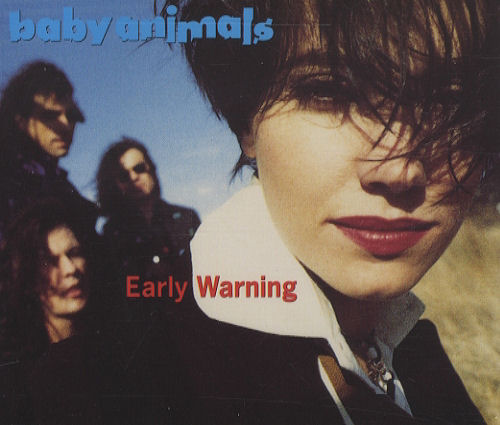
I discovered this band when their third track Painless was released in the US in November 1991. Suze’s voice is stunning and powerful and, her band is as hard rocking as any from Downunder. I bought the CD and there’s not a bad song on it. It deserved Album of the Year. They broke up in 1996 but, reformed in 2007. They continue to perform and record.
After approximately eight minutes on screen and a quick promotional plug for his new film G.I. Blues, Presley was gone. The remainder of the special consisted of performances by the additional guest stars. Excerpts from this show appear in Warner Bros. 1981 documentary film This Is Elvis.
Trivia Bit:
♦ Elvis got paid an at the time incredible sum of $125,000 for only a few minutes of onscreen time.
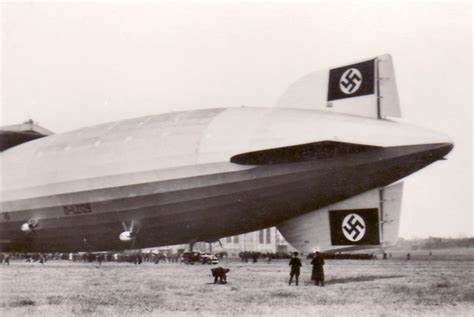
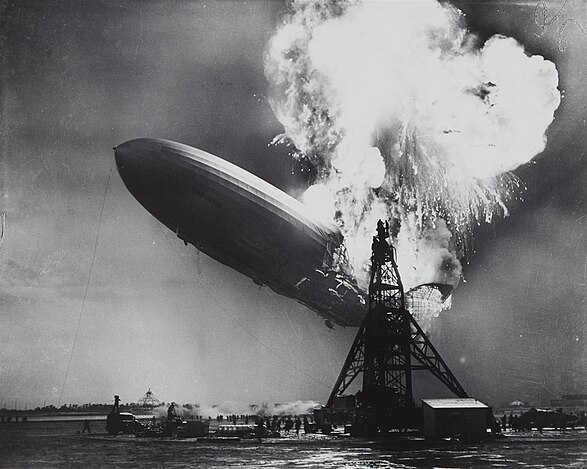
[T]he largest dirigible ever built, [it burst] into flames upon touching its mooring mast […]. There were 35 fatalities (13 passengers and 22 crewmen) from the 97 people on board (36 passengers and 61 crewmen) and an additional fatality on the ground.
The rigid airship, often known as the Zeppelin after the last name of its innovator, Count Ferdinand von Zeppelin, was developed by the Germans in the late 19th century. [It] had a light framework of metal girders that protected a gas-filled interior [of] highly flammable hydrogen gas, vulnerable to explosion.
On May 3, the Hindenburg left Frankfurt, Germany, for a journey across the Atlantic to Lakehurst’s Navy Air Base. While attempting to moor, […] the airship suddenly burst into flames, probably after a spark ignited its hydrogen core. Rapidly falling 200 feet to the ground, the hull of the airship incinerated within seconds. [M]ost of the survivors suffered substantial injuries.
The disaster was the subject of newsreel coverage, photographs and [radio announcer] Herbert Morrison‘s recorded […] eyewitness reports from the landing field, which were broadcast the next day. He is known for his famous emotional declaration “Oh, the humanity!”
A variety of hypotheses have been put forward for both the cause of ignition and the initial fuel for the ensuing fire. The event shattered public confidence in the giant, passenger-carrying rigid airship and marked the abrupt end of [that] era.
Image Credit: Doubleday Philip K. Dick 1974
First Edition Hardcover
wikipedia.org & wikimedia.org
Lyrics:
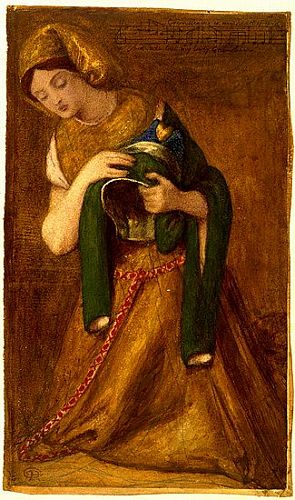
Flow, my tears, fall from your springs!
Exiled for ever, let me mourn;
Where night’s black bird her sad infamy sings,
There let me live forlorn.
Down vain lights, shine you no more!
No nights are dark enough for those
That in despair their last fortunes deplore.
Light doth but shame disclose.
Never may my woes be relieved,
Since pity is fled;
And tears and sighs and groans my weary days, my weary days
Of all joys have deprived.
From the highest spire of contentment
My fortune is thrown;
And fear and grief and pain for my deserts, for my deserts
Are my hopes, since hope is gone.
Hark! you shadows that in darkness dwell,
Learn to contemn light
Happy, happy they that in hell
Feel not the world’s despite.
On April 30, 1993, four years after publishing a proposal for “an idea of linked information systems,” computer scientist Tim Berners-Lee released the source code for the world’s first web browser and editor. Originally called Mesh, the browser that he dubbed WorldWideWeb became the first royalty-free, easy-to-use means of browsing the emerging information network that developed into the internet as we know it today.
Berners-Lee was a fellow at CERN, the research organization headquartered in Switzerland. Other research institutions like the Massachusetts Institute of Technology and Stanford University had developed complex systems for internally sharing information and Berners-Lee sought a means of connecting CERN’s system to others. He outlined a plan for such a network in 1989 and developed it over the following years. [He] wrote and published the first web page, a simplistic outline of the WorldWideWeb project, in 1991. Simple Web browsers like Mosaic appeared a short time later and, before long, the Web had become by far the most popular system of its kind.
The creation and globalization of the web is widely considered one of the most transformational events in human history.
A widespread belief exists that the song Greensleeves was composed by none other than King Henry VIII following an early rejection of his love by his future wife Anne Boleyn. The lyrics of this song of unrequited love have been seen to relate to his courtship of Anne in the 1520s. Many of the verses of Greensleeves imply a rich and extravagant courtship […]. Henry VIII was a composer and musician of some merit […]. [C]ourt officials […] attribute to Henry many compositions which were not his and the consensus of expert opinion, today, is that Greensleeves was composed rather later in the Tudor era, during the reign of Anne Boleyn’s daughter, Queen Elizabeth I. [T]he piece is based on an Italian style of composition that did not reach England until after Henry’s death […].
Origins
A broadside ballad […] was registered at the London Stationer’s Company in September [of] 1580, by [a] Richard Jones, as A Newe Northern Dittye of ye Ladye Greene Sleves. Six more ballads followed in less than a year, one on the same day […]. Needless to say the rights to the song were in very hot dispute. It was in 1584 that Jones printed his final version of the melody and this is the one we know today. It was titled A New Courtly Sonnet of the Lady Green Sleeves […].
[W]hy would anyone be named for their green sleeves? Interpretations […] usually have a sexual connotation, most notably in the phrase “a green gown”, a reference to the grass stains on a woman’s dress from engaging in sexual intercourse outdoors. Was this lady a prostitute? [T]he song lyrics mention a “discourteous” rejection of the singer’s advances, suggesting to some that the lady in question was actually virtuous but, perhaps, was mistaken for a prostitute as a result of her green sleeves. [A]nother explanation is quite the opposite to promiscuity […]. [I]n heraldry, colour also had symbolisms and green indicated truth and fidelity […]. [A] knight may give a green armband to his true love to wear to show his devotion to her, giving rise to the familiar phrase “wearing your heart on your sleeve” meaning, to show your true feelings.
None of these theories, however, really seem to reflect the song’s true meaning, which clearly expresses an unrequited love by a rich man for a fair lady. All that we can confidently deduce, is that “Lady Greensleeves” is a nickname, not a title. Exactly who she was, remains a mystery.
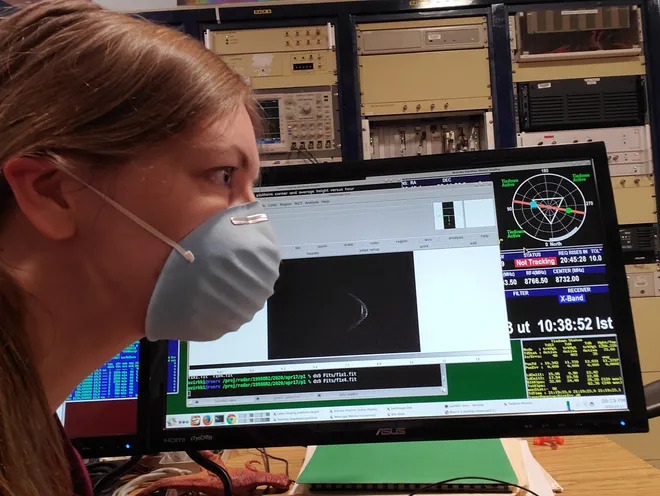
It’s funny how every news article out there these days just has to make a tie in with the virus. And, that image doesn’t look like a mask to me. It looks like something else. Just sayin’… ~Vic
An asteroid is hurtling close to the Earth, and with it, a startling reminder of the coronavirus pandemic. The space rock, known as 1998 OR2, will be nearly 4 million miles away from Earth on Wednesday at 5:59am EDT, classifying it as a “potentially hazardous” asteroid, despite the impossibility of it posing a threat to Earth anytime soon.
A newly captured image by [the] Arecibo Observatory in Puerto Rico brings its own surprise. As the asteroid approaches our planet, it looks as if it’s wearing its own mask and may very well be conducting its own social distancing practices. “The small-scale topographic features, such as hills and ridges on one end of asteroid 1998 OR2, are fascinating, scientifically,” Anne Virkki, head of planetary radar at Arecibo Observatory, said in a statement. “But, since we are all thinking about COVID-19, these features make it look like 1998 OR2 remembered to wear a mask.”
Image Credit: Arecibo Observatory & USA Today
It’s classified as a potentially hazardous asteroid because it is more than 500 feet in diameter and closer than 4,650,000 miles to Earth. “Although this asteroid is not projected to impact Earth, it is important to understand the characteristics of these types of objects to improve impact-risk mitigation technologies,” she said.
The asteroid, which is about one mile in diameter, has been traveling at nearly 20,000 mph since its discovery in 1998. Though it may not come anywhere near Earth in the coming weeks, Flaviane Venditti, a researcher at the observatory, said in a statement that, in 2079, it “will pass Earth about 3.5 times closer than it will this year.”
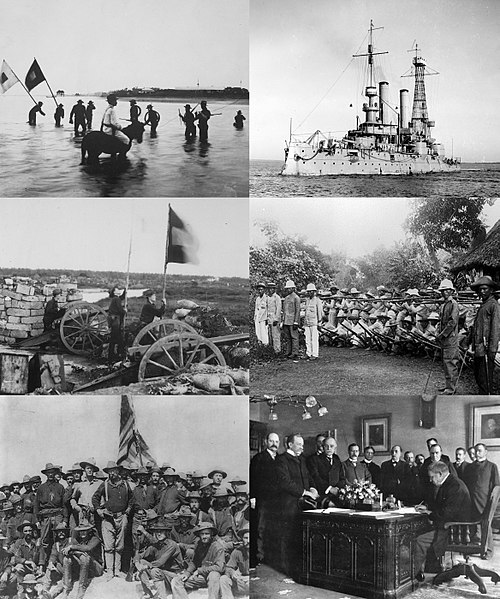
Top Left:Signal Corps extending telegraph lines. Top Right:USS Iowa Middle Left:Spanish flag replaced at Fort Malate Middle Right: Filipino soldiers in Spanish uniforms outside Manila. Bottom Left:Roosevelt & The Rough Riders @ San Juan Hill Bottom Right: The signing of the Treaty of Paris (1898)
Collage Credit: Barbudo
Wikipedia & Wikimedia
I posted about Hillsborough’s Old Courthouse this past Tuesday. The first picture was a marker about the Kentucky Expedition, led by Daniel Boone in 1775. The information was fashioned out of metal from the USS Maine, the very ship sunk in Havana Harbor that touched off the Spanish-American War. Spain declared war on the U.S. one-hundred, twenty-two years, ago, today and, the U.S. declared war the following day. Historically, the day of declaration is retroactively moved to April 21 as that was the day Spain severed diplomatic relations and the U.S. Navy began a Cuban blockade (the first of two). At the time of my Town Tuesday post, I didn’t realize that I actually posted it on the same day as the corrected date.
After first landing on an island then called Guanahani, Bahamas (San Salvador), on [October 12], Christopher Columbus commanded his three ships […] to land on Cuba’s northeastern coast on [October 28], 1492. Columbus claimed the island for the new Kingdom of Spain and named it Isla Juana after Juan, Prince of Asturias.
*************
The main issue was Cuban independence. Revolts had been occurring for some years in Cuba against Spanish rule. Hostilities began in the aftermath of the explosion of the USS Maine in Havana Harbor in Cuba, leading to U.S. intervention in the Cuban War of Independence.
*************
The growing popular demand for U.S. intervention became an insistent chorus after the (still) unexplained sinking [of the Battleship Maine], which had been sent to protect U.S. citizens and property after anti-Spanish rioting in Havana. [P]olitical pressures from the Democratic Party pushed [President] McKinley into a war that he had wished to avoid. McKinley signed a joint Congressional resolution demanding Spanish withdrawal and authorizing the President to use military force to help Cuba gain independence […].
The ensuing, ten-week war, fought in both the Caribbean and the Pacific, was pathetically one-sided, since Spain had readied neither its army, nor its navy, for a distant war with the formidable power of the United States.
*************
An army of regular troops, and volunteers, under General William Shafter, with Theodore Roosevelt (then, Assistant Secretary of the Navy) and his 1st Volunteer Cavalry, (The Rough Riders), landed on the coast, east of Santiago and, slowly advanced on the city […]. Madrid sued for peace after two Spanish squadrons were sunk in Santiago de Cuba and Manila Bay and a third, more modern, fleet was recalled home to protect the Spanish coasts.
*************
The result was the 1898 Treaty of Paris. In it, Spain renounced all claim to Cuba, ceded Guam and Puerto Rico to the United States and, transferred sovereignty over the Philippines to the United States for $20 million.
♦ In 1976, Admiral Hyman G. Rickover commissioned a private investigation into the [USS Maine] explosion and, the National Geographic Society did an investigation in 1999, using computer simulations. All investigations agreed that an explosion of the forward magazines caused the destruction of the ship but, different conclusions were reached as to how the magazines could have exploded.
♦ [T]heodore Roosevelt, who eventually became Vice President and, later, President of the United States […] was, posthumously, awarded the Medal of Honor in 2001 for his actions in Cuba and, became the only U.S. President to win the award.
♦ The defeat and loss of the last remnants of the Spanish Empire was a profound shock to Spain’s national psyche […]. [There was a] philosophical and artistic re-evaluation of Spanish society known as the Generation of ’98.
*************
[The USS Pawnee was] dispatched to Norfolk to secure the ships and stores of the Gosport Navy Yard. Arriving at Norfolk the night of [April 20], she found that all ships, save [the] USS Cumberland, had been scuttled […]. [So], an attempt was made to destroy the Naval stores and the dry dock. Their efforts were largely unsuccessful but, she took Cumberland in tow and saved the frigate.
*************
On Saturday evening, at 9 o’clock, the Pawnee arrived from Washington with 200 volunteers, and 100 marines, besides her own crew […]. [At] once, the officers and crew of the Pawnee and Cumberland went to the Navy yard and, spiked and disabled the guns, [plus], threw the shot and small arms into the river. At 10 o’clock, the marines, who had been quartered in the barracks, fired them and came on board the Pawnee. A party of officers, [in the] meantime, were going through the different buildings and ships, distributing waste and turpentine, and laying a train, so as to blow up the dry dock. At this time, the scene was indescribably magnificent, all the buildings being in a blaze, and explosions, here and there, scattering the cinders in all directions.
The Government vessels had been scuttled in the afternoon before the Pawnee arrived, to prevent their being seized by the Secessionists, who had been in arms in both Norfolk and Portsmouth.
The Merrimack Conversion
Image Credit: M. W. Robbins Collection &
The Virginian-Pilot
pilotonline.com
The Confederate forces did, in fact, take over the shipyard and did so without armed conflict through an elaborate ruse orchestrated by civilian railroad builder William Mahone (then President of the Norfolk and Petersburg Railroad and soon to become a famous Confederate officer). He bluffed the Federal troops into abandoning the shipyard in Portsmouth by running a single passenger train into Norfolk with great noise and whistle-blowing […]. [T]hen, much more quietly, [he sent] it back west […]. [He returned] the same train, again, creating the illusion of large numbers of arriving troops [with] the Federals listening in Portsmouth across the Elizabeth River (and just barely out of sight).
*************
[In] July, Confederate shipyard workers begin converting the unburned underbelly of the USS Merrimack into the ironclad CSS Virginia in Drydock 1.
The battle was a total and bloody defeat for the Jacobites which effectively marked the end of almost sixty years of the Jacobite struggle, as never again would an armed uprising be used in the attempt to return the Stuarts to the throne. The government victory also paved the way for a sustained programme to destroy the power base of the rebel clans.
Culloden (pronounced culawden, with the emphasis on ‘oden‘) is one of the most important battles in the history of the British Isles and has international significance. It is the final battle fought on the British mainland and brings to an end more than half a century […] of Jacobite conflict, itself played out against a background of wider international wars. Its aftermath transforms the Highlands, bringing to an end the traditional way of life of the area and contributing to the subsequent clearances. The battle also holds a prominent place within the Scottish cultural legacy, frequently depicted, and commemorated, in art, music, literature and film. The battlefield, itself, is one of the most visited tourist sites in the Highlands […]. [T]he site holds a particularly high significance, and emotional connection, to many within Scotland and to the ancestors of the Scottish Diaspora.
The official return for British Army casualties (government troops) was 50 officers, and men, killed and 259 wounded [with] one missing (a proportion of the wounded later died of their wounds). Jacobite fatalities have been estimated at between 1,200-1,500 with between 400 and 500 prisoners taken in the immediate aftermath and many more in the days which followed. Only the Irish and Scottish troops in French service were treated as bona fide prisoners of war, the rest as rebels.
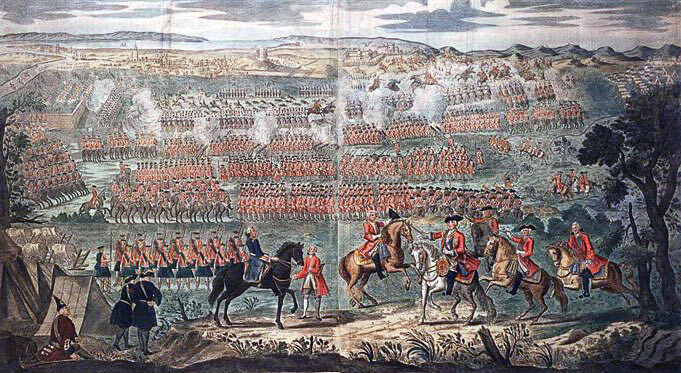
Image Credit: britishbattles.com
The battle, which lasted only 40 minutes, resulted in bitter defeat for the heavily outnumbered Jacobites. Led by the Duke of Cumberland, son of King George II, [the] devastating slaughter of the Jacobites was the result of the opening British cannonade and, subsequent tactics of the Redcoats during the attack […] when each British soldier, instead of attacking the Highlander directly in front of him, bayoneted the exposed side of the man to his right. The Highlanders finally broke and fled […].
Hunted by troops and spies, Prince Charles wandered over Scotland for five months before escaping to France and final exile. The [battle] […] marked the end of any serious attempt by the Jacobites to restore the Stuart dynasty to the British throne.
A generation before, a previous Jacobite rebellion had been thwarted by the king’s officer, George Wade, who had “pacified” and “disarmed” the highland clans. So concerned was the English establishment, and relieved by Wade’s actions, that an additional verse to the National Anthem was penned: God grant the Marshal Wade
May be thy Mighty aid,
Victory bring;
May he sedition hush,
And like a torrent rush,
Rebellious Scots to crush,
God save the king
Addendum: “Culloden is viewed by the Scottish people as a war grave. To my fellow Americans, stepping onto the Culloden battlefield would be like visiting Gettysburg or Normandy. And, since Scotland views it as a grave, you could also liken it to Arlington Cemetery. You don’t simply walk onto any of these places with a light spirit.” ~Brit At Heart
Lady Gwen, the last of the sporting Grayles, falls in love with Donald MacAllan, a bright young medical student far below her station. Gwen’s father, who opposes the match, introduces her to Prince Carlos, who wishes to marry her in order to pay off his creditors.
Photo Credit: imdb.com & amazon.com
Donald enlists during the World War and Carlos continues his courtship. When Donald returns from the fighting, Carlos tells him that he is engaged to Gwen and Donald, therefore, makes no attempt to see her. Gwen mistakes Donald’s seeming indifference for contempt and seeks to forget him by living riotously in several European capitals. Having exhausted her fortune, and ruined her health, Gwen returns to Scotland and goes to live in the same cottage where Donald used to study. She becomes ill and, in delirium, calls for Donald. Her old nurse goes to fetch him at the Grayle estate, which, having become wealthy, he has just bought. Donald rescues Gwen, who has wandered out in a storm, and nurses her back to health.
A Hollywood conception of Scotsmen who wear the kilt but, whose complexions betray nary a sign of the ruddy ruggedness due to Highland rain and wind, is to be seen at the Capitol this week in a picture called “The Sporting Venus” […]. [There] is a question [of] whether the Wallaces, the Bruces, the Watts and the McTavishes will smile with any satisfaction upon it. Not that they are intentionally maligned in this story but, that the men from the land of the heather are portrayed with studio-blanched complexions and, in one or two instances, wearing brocaded silk dressing gowns.
Marshall Neilan, the director of this celluloid effusion, in his desire to depict Lady Grayle (Blanche Sweet) as a plucky person at the eleventh hour of a fast life, shows her ladyship smoking a cigarette before she breathes her last. Ronald Colman is undoubtedly a bonnie actor but, you just know that he never was born to wear a kilt, [though], he does for a few scenes. He impersonates Donald McAllen, frequently alluded to as a commoner.
Donald and the capricious lassie, Lady Gwendolyn, are happy in Scotland until the coming of Prince Carlos […]. This Prince, played by Lew Cody, is a man of many debts and a faithful valet. His creditors see only one way to get back their money and that is to have the oily gentleman marry a wealthy wife. Donald goes to France to fight, and when he returns on leave, [believes] the Prince’s story […] that [he], more or less, is to wed Lady Gwendolyn.
Lady Gwendolyn […] becomes […] a flighty young woman who gambles in millions. The young hero goes back to France, and as a surgeon, makes a great name for himself. He purchases Grayloch, the great estate of the Grayles.
With the background of Scotland, Mr. Neilan ought to have been able to make a production far stronger than this effort, which, at best, is only a mediocre diversion. It is true that it has some beautiful scenery and the settings are quite pleasing.
This film survived but, I can’t find any clips of it. Silent Era states that a premiere took place on May 10, 1925, at the Capitol Theatre in New York City and was released May 17, 1925. AFI disagrees. ~Vic
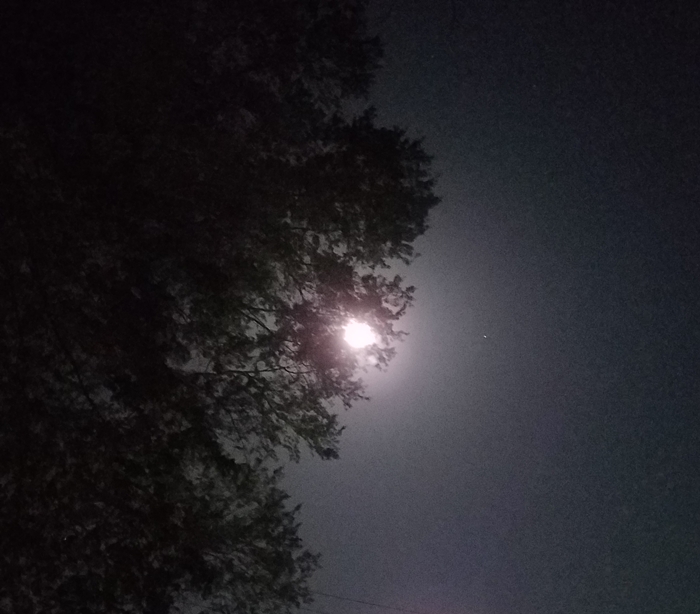
Our full moon this month is a Super Moon, as was last month‘s…which I totally missed. I did a Pink Moon post last year with all the different names so, I won’t repeat them here.
Spooky
04-10-2017Peek-a-boo!
04-28-2018Waxing Gibbous four days earlier.
Not sure why I didn’t post this last year.
04-15-2019Last night’s walk.
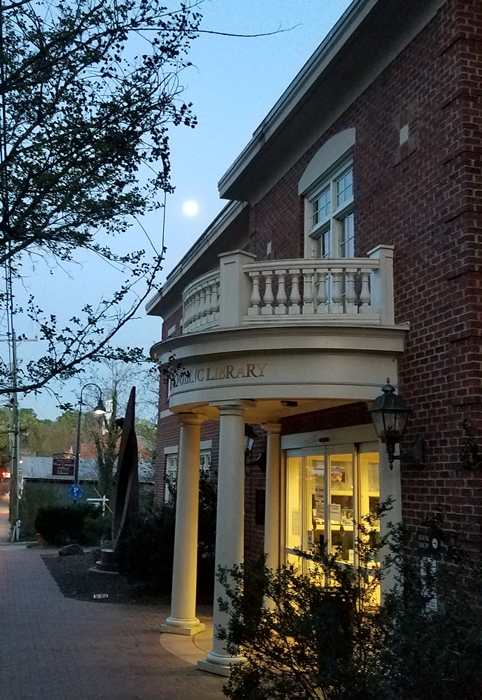
Moon over the Library.
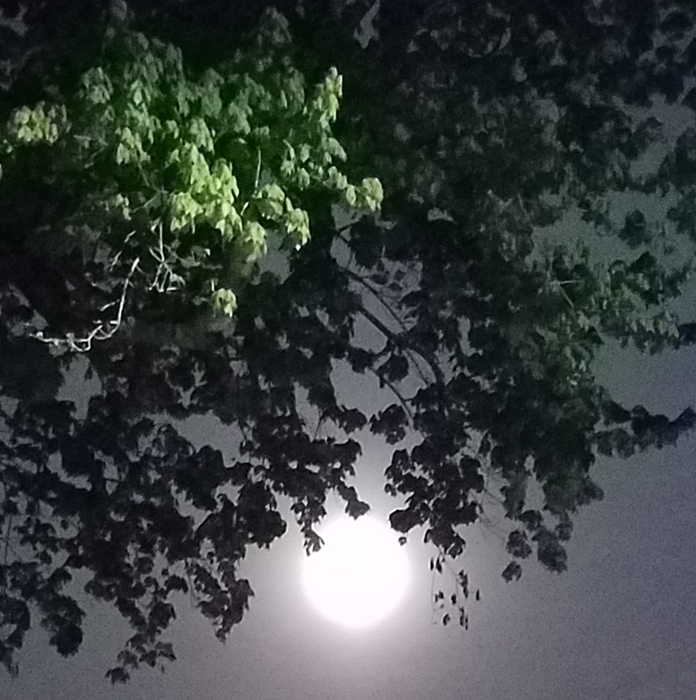
04-06-2020Got this standing in the middle of the street.
The tree is holding on.
04-07-2020
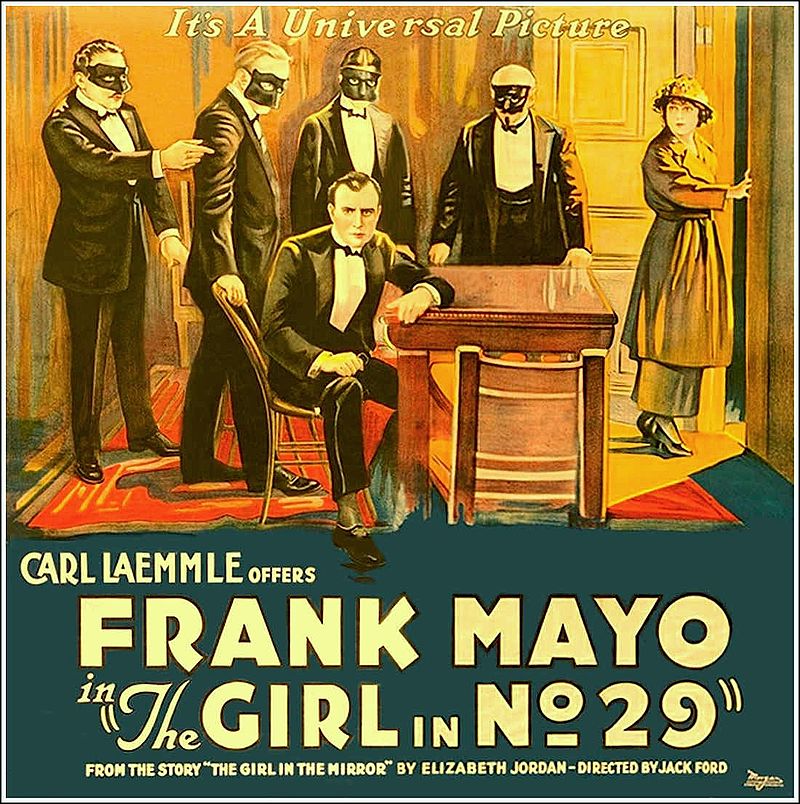
After turning out a successful drama, young playwright Laurie Devon settles down to a life of idleness. Alarmed and disgusted, his friends make every effort to get him to work again but, he refuses. One evening, while glancing into his mirror, Laurie sees a beautiful girl in the apartment across the way, holding a revolver to her head. Dashing out of his apartment house, he prevents her from pulling the trigger. He learns that her name is Doris Williams and discovers that her plight is caused by a man named Shaw. Soon after, Shaw and his thugs abduct her, and Laurie comes to her rescue, shooting her tormentor. Returning home, he confesses his crime to his sister and friends, and learns that the whole incident was a trick to restore his interest in life. The plot succeeds and Laurie writes another hit play in which his new wife Doris is the star.
Laurie Devon (Mayo) is a New York playwright who, having had one success, refuses to work on another play. One night he sees a woman (Anderson) in an apartment across the street take out a gun and place it to her forehead. He reaches her in time to save her and she tells him that she is under some terrible evil influence, which she will not disclose. Devon attempts to untangle the mystery and is led on an adventure. The woman is taken to a house on Long Island, where Devon, after a fight, rescues her. He takes out the revolver and shoots one of the pursuers, who falls to the ground. On returning home, he is heartbroken and tells his sister Barbara (Fair) and his friends that he is a murderer. His sister, and two of his friends, then confess that the whole thing was a frame-up. [T]hey had hired some actors to stage everything and that it was an attempt to get the ambitionless [sic] author to write again. The revolver used in the suicide attempt by the woman, and in the later shooting, had blanks. Devon and the woman from the apartment melt into each other’s arms at the final fade-out.
Forty-one years ago, today, spores of anthrax were accidentally released from a Soviet military research facility near the city of Sverdlovsk, Russia (now Yekaterinburg/Ekaterinburg).
On April 2, 1979, there was an unusual anthrax outbreak, which affected 94 people and killed at least 64 of them, in the Soviet city of Sverdlovsk, roughly 850 miles east of Moscow. The first victim died after four days. [T]he last one died six weeks later. The Soviet government claimed the deaths were caused by intestinal anthrax from tainted meat, a story some influential American scientists found believable. However, officials in the Carter Administration suspected the outbreak was caused by an accidental release of anthrax spores from a suspected Soviet biological weapons facility located in the city (Military Compound 19). The US believed that the Soviet Union was violating the Biological Weapons Convention signed in 1972 and made their suspicions public. But, the Soviets denied any activities relating to biological weapons and, at numerous international conferences, tried to prove their contaminated meat story. It wasn’t until thirteen years later, in 1992, that President Boris Yeltsin admitted, without going into details, that the anthrax outbreak was the result of military activity at the facility. [Russia] allowed a team of Western scientists to go to Sverdlovsk to investigate the outbreak. The team visited Sverdlovsk in June 1992 and August 1993 […].
Photo Credit: Topwar
Although the KGB had confiscated hospital and other records after the incident, the Western scientists were able to track where all the victims had been at the time of the anthrax release. Their results showed that on the day of the incident, all the victims were clustered along a straight line downwind from the military facility. Livestock in the same area also died of anthrax. After completing their investigation, the team concluded the outbreak was caused by a release of an aerosol of anthrax pathogen at the military facility. But, they were unable to determine what caused the release or what specific activities were conducted at the facility.
“Clogged filter, I removed it. Replace the filter”. [A] reminder on a piece of paper left [by a] factory worker […] to his mate when he went home on Friday evening…
Colonel Nicholas Cheryshev, shift supervisor at the plant, […] was in a hurry to go home and, for some unknown reason, was not aware of the lack of filter. In the end, the workers on the night shift, finding entries in the log window, quietly launched [the] equipment. [For] more than three hours, the plant was [throwing], into the air [of] the night sky of […] Sverdlovsk, portions [of] dried culture of anthrax. When the lack of bio-security was discovered, production was urgently stopped, […] the filter [replaced] and [they], quietly, continued working.
It was an accident at a clandestine biological weapons lab that allowed deadly anthrax spores to contaminate Sverdlovsk’s air, as evidence unearthed later would show. Over the years, as DNA sequencing technology has improved, scientists have been piecing together more and more information about the anthrax strain.
This facility has not been closed. It just went underground…literally. ~Vic
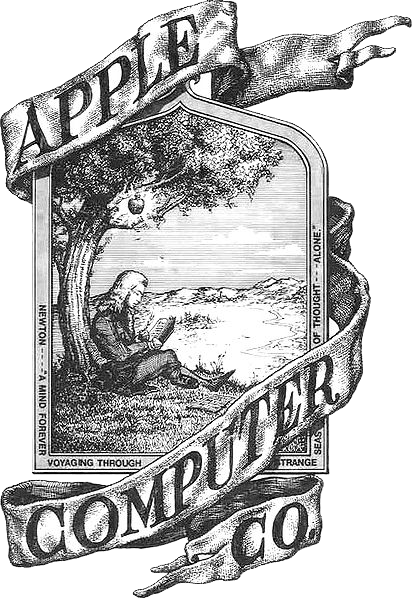
Designed by Ronald Wayne Isaac Newton under an apple tree.
Image Credit: wikimedia.org & wikipedia.org
Forty-four years ago, today, the Apple Computer Company was founded by Steve Jobs, Steve Wozniak and Ronald Wayne, though Wayne sold his share back within 12 days. Headquartered in Cupertino, California, it grew from the “two Steves” into a multinational company. Jobs and Wozniak met in 1971 via mutual friend Bill Fernandez. Their partnership began with autodidact Wozniak’s blue boxes build and Jobs salesmanship. Jobs split the blue box profits with Wozniak.
Wozniak designed a video terminal and, new microcomputers, such as the Altair 8800 and the IMSAI, inspired [him] to build a microprocessor into his video terminal and have a complete computer. [He] designed computers on paper, waiting for the day he could afford a CPU. When MOS Technology released its 6502 chip in 1976, Wozniak wrote a version of BASIC for it, then began to design a computer for it to run on. When Jobs saw Wozniak’s computer, which would later become known as the Apple I, he was immediately interested in its commercial potential.
Initially, Wozniak intended to share schematics of the machine for free but, Jobs insisted that they should, instead, build and sell bare printed circuit boards for the computer. Jobs eventually convinced Wozniak to go into business together and start a new company of their own. According to Wozniak, Jobs proposed the name “Apple Computer” when he had just come back from Robert Friedland’s All-One Farm in Oregon. Jobs told Walter Isaacson that he was “…on one of my fruitarian diets…” when he conceived of the name and thought “…it sounded fun, spirited and not intimidating…plus, it would get us ahead of Atari in the phone book.”
The information on Apple, Jobs & Wozniak is extensive. This post is a mere highlight of its beginnings. I won’t be reinventing the wheel, here. I will say, though, that the very first computer I ever programmed on in 1983, using BASIC, was an Apple II. ~Vic



















 Cosmic-Observation