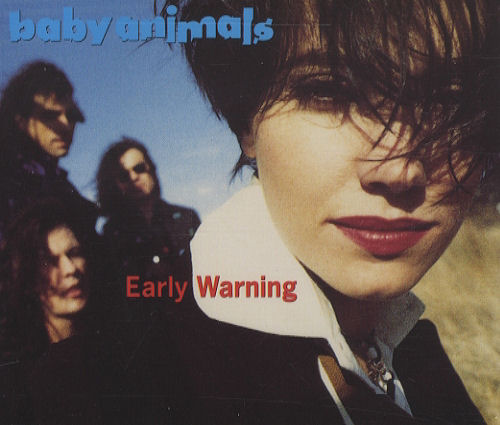
I discovered this band when their third track Painless was released in the US in November 1991. Suze’s voice is stunning and powerful and, her band is as hard rocking as any from Downunder. I bought the CD and there’s not a bad song on it. It deserved Album of the Year. They broke up in 1996 but, reformed in 2007. They continue to perform and record.
After approximately eight minutes on screen and a quick promotional plug for his new film G.I. Blues, Presley was gone. The remainder of the special consisted of performances by the additional guest stars. Excerpts from this show appear in Warner Bros. 1981 documentary film This Is Elvis.
Trivia Bit:
♦ Elvis got paid an at the time incredible sum of $125,000 for only a few minutes of onscreen time.
Image Credit: Doubleday Philip K. Dick 1974
First Edition Hardcover
wikipedia.org & wikimedia.org
Lyrics:
Flow, my tears, fall from your springs!
Exiled for ever, let me mourn;
Where night’s black bird her sad infamy sings,
There let me live forlorn.
Down vain lights, shine you no more!
No nights are dark enough for those
That in despair their last fortunes deplore.
Light doth but shame disclose.
Never may my woes be relieved,
Since pity is fled;
And tears and sighs and groans my weary days, my weary days
Of all joys have deprived.
From the highest spire of contentment
My fortune is thrown;
And fear and grief and pain for my deserts, for my deserts
Are my hopes, since hope is gone.
Hark! you shadows that in darkness dwell,
Learn to contemn light
Happy, happy they that in hell
Feel not the world’s despite.
Returning to my phone playlist, I submit for your approval on this chilly Sunday night, Blondie‘s Call Me, the theme from the 1980 movie American Gigolo. I was 13 when this film came out and, with its “R” rating, I wasn’t allowed to see it (I caught it on HBO, later, tho…). The drum beat opens the movie as Richard Gere cruises in a black Mercedes. This movie was so bad-ass (to a teenager) and Siskel & Ebert gave it a decent rating but, the rest of the critics panned it. Oh, well. This was the movie that put Gere on my radar (I hadn’t seen Looking For Mr. Goodbar).
The song made it to the #1 spot on Billboard’s Hot 100 and stayed there for six weeks. It also made it to #1 in Canada, the UK and in Record World magazine. There are 20 covers of this song with Blondie re-recording it in 2014 and, a live cover done in 2002.
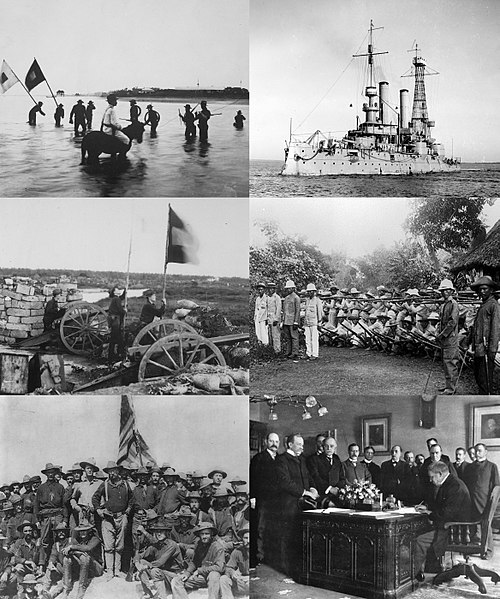
Top Left:Signal Corps extending telegraph lines. Top Right:USS Iowa Middle Left:Spanish flag replaced at Fort Malate Middle Right: Filipino soldiers in Spanish uniforms outside Manila. Bottom Left:Roosevelt & The Rough Riders @ San Juan Hill Bottom Right: The signing of the Treaty of Paris (1898)
Collage Credit: Barbudo
Wikipedia & Wikimedia
I posted about Hillsborough’s Old Courthouse this past Tuesday. The first picture was a marker about the Kentucky Expedition, led by Daniel Boone in 1775. The information was fashioned out of metal from the USS Maine, the very ship sunk in Havana Harbor that touched off the Spanish-American War. Spain declared war on the U.S. one-hundred, twenty-two years, ago, today and, the U.S. declared war the following day. Historically, the day of declaration is retroactively moved to April 21 as that was the day Spain severed diplomatic relations and the U.S. Navy began a Cuban blockade (the first of two). At the time of my Town Tuesday post, I didn’t realize that I actually posted it on the same day as the corrected date.
After first landing on an island then called Guanahani, Bahamas (San Salvador), on [October 12], Christopher Columbus commanded his three ships […] to land on Cuba’s northeastern coast on [October 28], 1492. Columbus claimed the island for the new Kingdom of Spain and named it Isla Juana after Juan, Prince of Asturias.
*************
The main issue was Cuban independence. Revolts had been occurring for some years in Cuba against Spanish rule. Hostilities began in the aftermath of the explosion of the USS Maine in Havana Harbor in Cuba, leading to U.S. intervention in the Cuban War of Independence.
*************
The growing popular demand for U.S. intervention became an insistent chorus after the (still) unexplained sinking [of the Battleship Maine], which had been sent to protect U.S. citizens and property after anti-Spanish rioting in Havana. [P]olitical pressures from the Democratic Party pushed [President] McKinley into a war that he had wished to avoid. McKinley signed a joint Congressional resolution demanding Spanish withdrawal and authorizing the President to use military force to help Cuba gain independence […].
The ensuing, ten-week war, fought in both the Caribbean and the Pacific, was pathetically one-sided, since Spain had readied neither its army, nor its navy, for a distant war with the formidable power of the United States.
*************
An army of regular troops, and volunteers, under General William Shafter, with Theodore Roosevelt (then, Assistant Secretary of the Navy) and his 1st Volunteer Cavalry, (The Rough Riders), landed on the coast, east of Santiago and, slowly advanced on the city […]. Madrid sued for peace after two Spanish squadrons were sunk in Santiago de Cuba and Manila Bay and a third, more modern, fleet was recalled home to protect the Spanish coasts.
*************
The result was the 1898 Treaty of Paris. In it, Spain renounced all claim to Cuba, ceded Guam and Puerto Rico to the United States and, transferred sovereignty over the Philippines to the United States for $20 million.
♦ In 1976, Admiral Hyman G. Rickover commissioned a private investigation into the [USS Maine] explosion and, the National Geographic Society did an investigation in 1999, using computer simulations. All investigations agreed that an explosion of the forward magazines caused the destruction of the ship but, different conclusions were reached as to how the magazines could have exploded.
♦ [T]heodore Roosevelt, who eventually became Vice President and, later, President of the United States […] was, posthumously, awarded the Medal of Honor in 2001 for his actions in Cuba and, became the only U.S. President to win the award.
♦ The defeat and loss of the last remnants of the Spanish Empire was a profound shock to Spain’s national psyche […]. [There was a] philosophical and artistic re-evaluation of Spanish society known as the Generation of ’98.
*************
[The USS Pawnee was] dispatched to Norfolk to secure the ships and stores of the Gosport Navy Yard. Arriving at Norfolk the night of [April 20], she found that all ships, save [the] USS Cumberland, had been scuttled […]. [So], an attempt was made to destroy the Naval stores and the dry dock. Their efforts were largely unsuccessful but, she took Cumberland in tow and saved the frigate.
*************
On Saturday evening, at 9 o’clock, the Pawnee arrived from Washington with 200 volunteers, and 100 marines, besides her own crew […]. [At] once, the officers and crew of the Pawnee and Cumberland went to the Navy yard and, spiked and disabled the guns, [plus], threw the shot and small arms into the river. At 10 o’clock, the marines, who had been quartered in the barracks, fired them and came on board the Pawnee. A party of officers, [in the] meantime, were going through the different buildings and ships, distributing waste and turpentine, and laying a train, so as to blow up the dry dock. At this time, the scene was indescribably magnificent, all the buildings being in a blaze, and explosions, here and there, scattering the cinders in all directions.
The Government vessels had been scuttled in the afternoon before the Pawnee arrived, to prevent their being seized by the Secessionists, who had been in arms in both Norfolk and Portsmouth.
The Merrimack Conversion
Image Credit: M. W. Robbins Collection &
The Virginian-Pilot
pilotonline.com
The Confederate forces did, in fact, take over the shipyard and did so without armed conflict through an elaborate ruse orchestrated by civilian railroad builder William Mahone (then President of the Norfolk and Petersburg Railroad and soon to become a famous Confederate officer). He bluffed the Federal troops into abandoning the shipyard in Portsmouth by running a single passenger train into Norfolk with great noise and whistle-blowing […]. [T]hen, much more quietly, [he sent] it back west […]. [He returned] the same train, again, creating the illusion of large numbers of arriving troops [with] the Federals listening in Portsmouth across the Elizabeth River (and just barely out of sight).
*************
[In] July, Confederate shipyard workers begin converting the unburned underbelly of the USS Merrimack into the ironclad CSS Virginia in Drydock 1.
A man wearing the US Navy uniform went to the oceanfront in Emerald Isle, North Carolina, on Thursday, in an apparent protest against the town’s restrictions amid the coronavirus pandemic. The man, who was identified by a witness as a retired US Navy [Master Chief], was seen photographed standing in front of a sign that read “LAND OF THE FREE.” Mike Conner, a longtime resident of Emerald Isle, and a surfer, told Insider the retired sailor stood in the waters for about 10 minutes before he was approached by law enforcement officers. Conner said the man was asked to remove himself from the area but, refused the request. “The sailor eventually left the water on his own accord, without incident”, Conner added.
Hours after the incident, the town announced it would lift the ban on access on Saturday. Surfers, and other residents, previously expressed their disapproval by staging protests throughout the area and were “fired up by the closures”, Conner said. “We’re very happy that Emerald Isle allowed access, not just to us swimmers but, to everybody that uses it as a medium for their exercise,” Connor said. “We don’t want our rights stomped all over.”
The man in the uniform and the Emerald Isle Police Department did not respond to a request for comment.
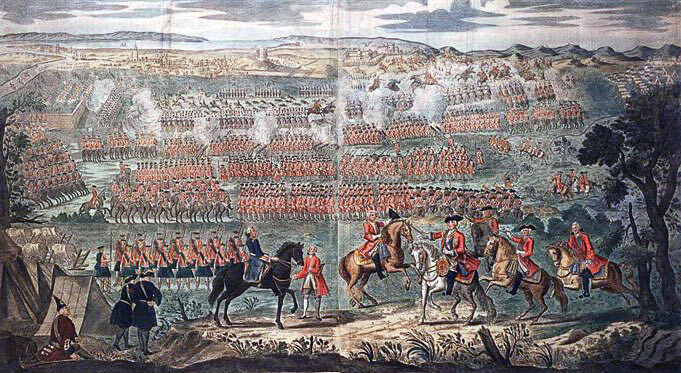
The battle was a total and bloody defeat for the Jacobites which effectively marked the end of almost sixty years of the Jacobite struggle, as never again would an armed uprising be used in the attempt to return the Stuarts to the throne. The government victory also paved the way for a sustained programme to destroy the power base of the rebel clans.
Culloden (pronounced culawden, with the emphasis on ‘oden‘) is one of the most important battles in the history of the British Isles and has international significance. It is the final battle fought on the British mainland and brings to an end more than half a century […] of Jacobite conflict, itself played out against a background of wider international wars. Its aftermath transforms the Highlands, bringing to an end the traditional way of life of the area and contributing to the subsequent clearances. The battle also holds a prominent place within the Scottish cultural legacy, frequently depicted, and commemorated, in art, music, literature and film. The battlefield, itself, is one of the most visited tourist sites in the Highlands […]. [T]he site holds a particularly high significance, and emotional connection, to many within Scotland and to the ancestors of the Scottish Diaspora.
The official return for British Army casualties (government troops) was 50 officers, and men, killed and 259 wounded [with] one missing (a proportion of the wounded later died of their wounds). Jacobite fatalities have been estimated at between 1,200-1,500 with between 400 and 500 prisoners taken in the immediate aftermath and many more in the days which followed. Only the Irish and Scottish troops in French service were treated as bona fide prisoners of war, the rest as rebels.
Image Credit: britishbattles.com
The battle, which lasted only 40 minutes, resulted in bitter defeat for the heavily outnumbered Jacobites. Led by the Duke of Cumberland, son of King George II, [the] devastating slaughter of the Jacobites was the result of the opening British cannonade and, subsequent tactics of the Redcoats during the attack […] when each British soldier, instead of attacking the Highlander directly in front of him, bayoneted the exposed side of the man to his right. The Highlanders finally broke and fled […].
Hunted by troops and spies, Prince Charles wandered over Scotland for five months before escaping to France and final exile. The [battle] […] marked the end of any serious attempt by the Jacobites to restore the Stuart dynasty to the British throne.
A generation before, a previous Jacobite rebellion had been thwarted by the king’s officer, George Wade, who had “pacified” and “disarmed” the highland clans. So concerned was the English establishment, and relieved by Wade’s actions, that an additional verse to the National Anthem was penned: God grant the Marshal Wade
May be thy Mighty aid,
Victory bring;
May he sedition hush,
And like a torrent rush,
Rebellious Scots to crush,
God save the king
Addendum: “Culloden is viewed by the Scottish people as a war grave. To my fellow Americans, stepping onto the Culloden battlefield would be like visiting Gettysburg or Normandy. And, since Scotland views it as a grave, you could also liken it to Arlington Cemetery. You don’t simply walk onto any of these places with a light spirit.” ~Brit At Heart
There were only six episodes that aired between March 31 and June 11 with a seventh episode intended for a May slot, never airing. It’s first episode was on a Friday, the second episode aired the following Wednesday, the third episode went back to Friday, the following week and the fourth episode showed up on a Sunday, the next week. The last two aired episodes were on Sundays in June. [No wonder it failed. ~Vic]
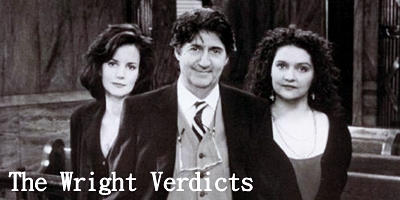
Legal drama with Charles Wright, an Englishman, working as a lawyer in New York City. Sandy Hamar is an ex-NYPD detective who serves as the mandatory private eye and Lydia is the super efficient secretary.
The Wright Verdicts is mature in the best sense. [I]t’s smart, has no false innocence and has the right amount of fun. Criminal lawyer Charles Wright (Tom Conti) will win juries over like clockwork and the series should likewise charm viewers. The character’s chief skill is blarney or, as his investigator puts it, shucking and jiving. Charles is bumbling and self-deprecating one minute, erudite and mischievous the next. Conti brings off Wright’s sense of humor and his status as a ladies’ man. The dynamic between Conti and his two female employees […] needs some work. [T]here’s so much flirtation that the relationships in this office triangle seem headed in only one direction.
The hour has a surplus of spectacular aerial shots of Manhattan.
With crimes revolving around designer drugs and cellular phones, the show poses itself as a Perry Mason for the ’90s. It’s about as conventional and formulaic as that old warhorse. The parlor-game plotting is more than passable but, the writing is undistinguished. Only Conti’s malty voice and trilling accent are enough to elevate the program’s mark a little.
Executive producer Dick Wolf has cannily combined two genres…Murder, She Wrote’s warm coziness and his own Law & Order’s cold, complex cases…and come up with a lukewarm show that’s nonetheless pretty irresistible.
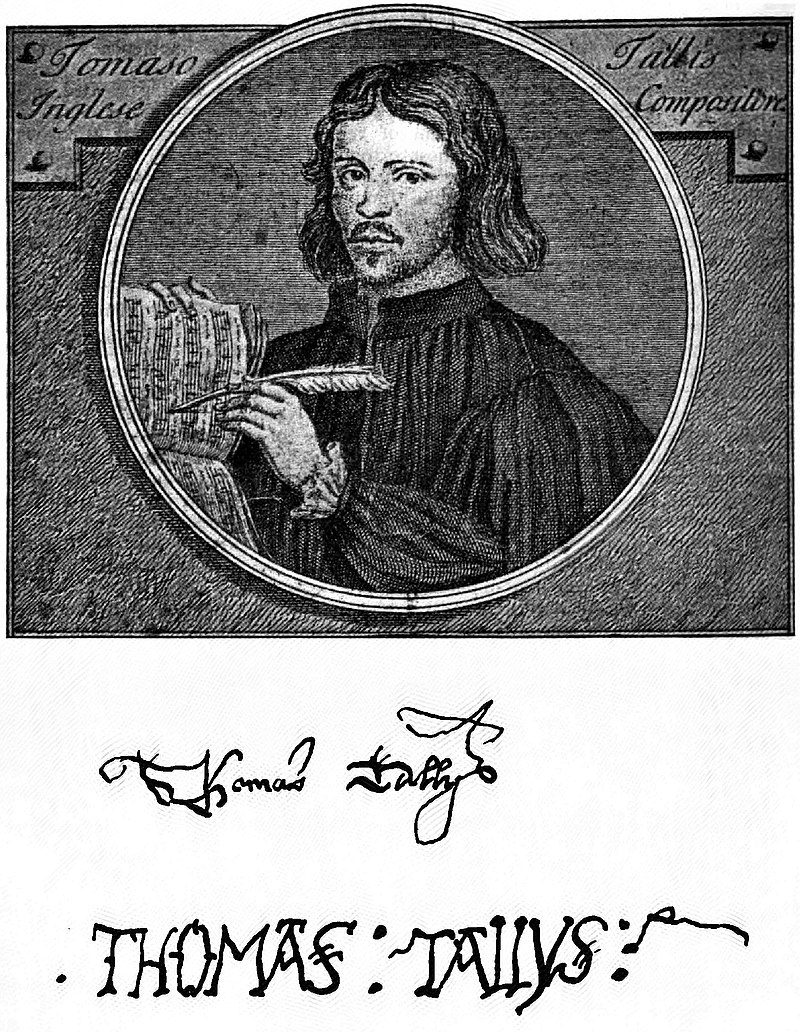
Spem in Alium is Latin for “hope in any other” or “hope in another”. A 40-part Renaissance Motet, it was composed in 1570 (thereabouts) by Thomas Tallis (Tallys). Written for eight choirs of five voices each, meaning there are 40 separate voices singing individual lines of music, it is considered to be Tallis’s greatest achievement and, possibly, one of the finest compositions of all time.
Information on where it was first performed is scarce. There appears to be some confusion regarding where it took place, as two locations…Nonsuch Palace, a royal Tudor palace in Surrey built by Henry VIII (not to be confused with Nonsuch Mansion) and Arundel House, a London townhouse originally for the Bishops of Bath & Wells…were both owned by Henry Fitzalan, the 12th/19th Earl of Arundel at one time. Most of what I have read leans towards Arundel House but, truly, I don’t think anyone really knows. It’s all a big guess. And, it is pure speculation as to why he wrote it. Some suggestions include a challenge due to an Italian composer doing same, Elizabeth’s 40th birthday or, perhaps for Mary as he was Catholic. Again, no one really knows.
The music, below, is soul stirring. ~Vic
Artist: Wenceslaus Hollar Arundel House
Image Credit: wikipedia.org & wikimedia.org
Spem in alium nunquam habui
Praeter in te, Deus Israel
Qui irasceris et propitius eris
et omnia peccata hominum
in tribulatione dimittis
Domine Deus
Creator caeli et terrae
respice humilitatem nostram
Artist: Georg Hoefnagel 1568
Watercolour of the south frontage of Nonsuch Palace
Image Credit: wikipedia.org & wikimedia.org
English Translation:
I have never put my hope in any other
but in Thee, God of Israel
who canst show both wrath and graciousness,
and who absolves all the sins
of man in suffering
Lord God,
Creator of Heaven and Earth
Regard our humility
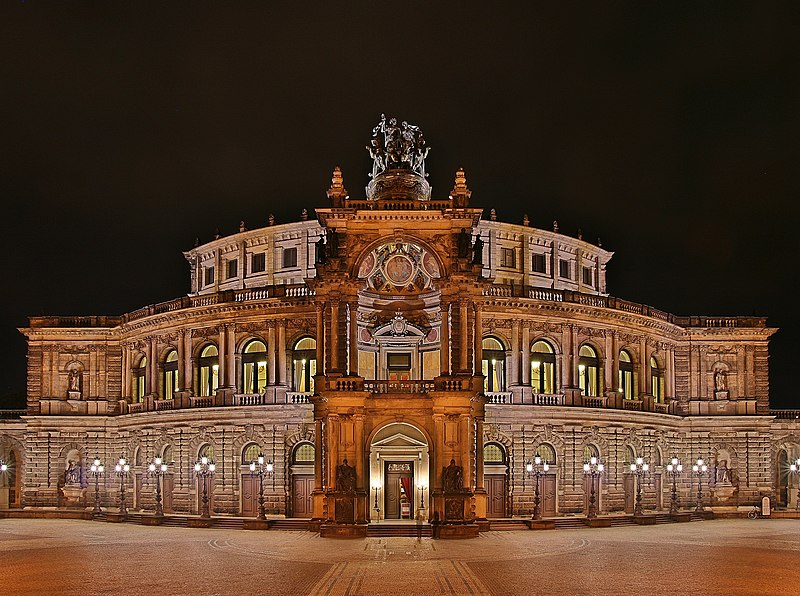
Die Semperoper in Dresden bei Nacht
The Semper Opera in Dresden at Night
Photo Credit: Sese Ingolstadt
wikipedia.org & wikimedia.org
Leaving the 1520s and entering the 1540s…
Formally known as the Sächsische Staatskapelle Dresden, the Staatskapelle Dresden is a Dresden-based German orchestra, one of the world’s oldest. Maurice, the Elector of Saxony (Prince Elector Moritz von Sachsen) founded it in 1548. Its precursor ensemble was Die Kurfürstlich-Sächsische und Königlich-Polnische Kapelle (The Electoral Saxon and Royal Polish Orchestra). The orchestra is the musical body of the Staatsoper Dresden (Dresden State Opera). The venue of the orchestra is the Semperoper.
Sixty years ago, today, the 17th annual Golden Globe Awards ceremony was held and aired on KTTV in Los Angeles (an independent station in 1960). The Globes are given by members of the Hollywood Foreign Press Association, the first gathering in 1944. Recognition is for excellence in film (American and International) and television (American). The 1960 ceremony was honoring work done in 1959.
Winners:
♥ Best Drama Film: Ben Hur
♥ Best Comedy Film: Some Like It Hot
♥ Best Musical Film: Porgy & Bess
♥ Best International (Understanding) Film: The Diary of Anne Frank
♥ Best Drama Actor: Anthony Franciosa
♥ Best Drama Actress: Elizabeth Taylor
♥ Best (Comedy/Musical) Actor: Jack Lemmon
♥ Best (Comedy/Musical) Actress: Marilyn Monroe
♥ Best Supporting Actor: Stephen Boyd
♥ Best Supporting Actress: Susan Kohner
♥ Best Director: William Wyler
♥ Best Original Score: Ernest Gold
♥ Cecil B.deMille Award: Bing Crosby
♥ Television Achievement: Edward R. Murrow
♥ Henrietta Awards (World Film Favorite): Doris Day & Rock Hudson
Trivia Bits:
♦ Two and a half years later, on August 4, 1962, Marilyn Monroe was found dead in her Los Angeles home.
♦ On June 5, 1968, Robert F. Kennedy was shot three times inside the Ambassador Hotel and died 26 hours later.
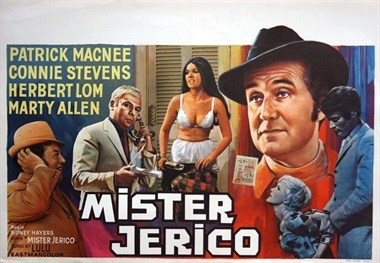
Smooth con man Dudley Jerico sets out to rob corrupt millionaire Victor Rosso [sic] of his legendary Gemini diamond.
A conman hatches a plan to swindle a corrupt millionaire out of his treasured priceless diamond by claiming to have discovered its twin. However, his plot is disrupted by a rival hustler who comes up with the same idea and, the two crooks must each convince their suspicious target that they can be trusted and the other is lying.
Reviews:
This disappointing comedy caper evidently got the green light due to the popularity of Patrick Macnee‘s dapper superspy John Steed in The Avengers. Unfortunately, this attempt to turn Macnee into an equally charismatic jewel thief just can’t compete with its bigger budgeted competition, despite the catchy title track from Lulu and the star’s stunning array of flowery shirts. Herbert Lom is good value as the object of Macnee’s felonious attentions (in a role similar to the one he played in the Michael Caine caper Gambit three years before) but, this lacklustre yarn, ultimately, can’t cut it in the excitement or suspense stakes.
Mister Jerico is one of those charming and fluffy capers that the 1960s did well, quite similar to the higher-budgeted Gambit or How to Steal a Million. The palette is sun-soaked, the plot buoyant and just this side of ridiculous. The second half of the film, in particular, moves along at a nice pace, complicating matters without making anything seem too serious. If you think too deeply about the story, it will all appear very nonsensical but, this is a stylized caper film not intended for deeper scrutiny. It’s a surface film and as such it’s quite enjoyable.
A fun film with a very Avengers feel to it, which should be obvious given the cast and crew. Allen is a little out of place but, Macnee and Lom are great, as is Laurie Johnson‘s score. I’ll even admit, against that, Lulu‘s theme song is catchy. Apparently [it was] intended as a pilot for a Macnee series to follow The Avengers but, instead, [was] released theatrically (though, in the US, it only ended up as a TV movie of the week).
USS Princeton 1843-1849
Image Credits: Lithograph by N. Currier, New York, 1844
U.S. Naval History & Heritage Command history.navy.mil
wikipedia.org & wikimedia.org
President Tyler hosted a public reception for Stockton in the White House on February 27, 1844. On February 28, [the] USS Princeton departed Alexandria, Virginia, on a demonstration cruise down the Potomac with Tyler, members of his cabinet, former First Lady Dolley Madison, Senator Thomas Hart Benton of Missouri and about 400 guests. Captain Stockton decided to fire the larger of her two long guns, Peacemaker, to impress his guests. Peacemaker was fired three times on the trip downriver and was loaded to fire a salute to George Washington as the ship passed Mount Vernon on the return trip. The guests aboard viewed the first set of firings, [then] retired below decks for lunch and refreshments.
Awful Explosion of the Peacemaker on board the
U.S. steam frigate Princeton on Wednesday, 28 Feb. 1844
Image Credits: Lithograph by N. Currier/Currier & Ives
Gale Research
Library of Congress
wikipedia.org & wikimedia.org
Secretary [of the Navy] [Thomas Walker] Gilmer urged those aboard to view a final shot with the Peacemaker. When Captain Stockton pulled the firing lanyard, the gun burst. Its left side had failed, spraying hot metal across the deck and shrapnel into the crowd. Instantly killed were Gilmer, Secretary of State [Abel P.] Upshur, Captain Beverley Kennon, who was Chief of the Bureau of Construction [Equipment] and Repairs, Virgil Maxcy (a Maryland attorney with decades of experience as a state and federal officeholder), David Gardiner (a New York lawyer and politician) and the President’s valet, a black slave named Armistead. Another 16 to 20 people were injured, including several members of the ship’s crew, Senator Benton and Captain Stockton. The president was below decks and not injured.
The disaster on board the Princeton killed more top U.S. government officials in a single day than any other tragedy in American history.















 Cosmic-Observation