A rare documentary by Scottish folk singer Donovan P. Leitch. Insights into his life with rare recordings from the beginning of his career as a folk singer. Portions of the film was [sic] filmed on St. Ives, Cornwall on Porthminster [B]each in 1966.
It shows Donovan’s life before becoming famous, when he was busking and living in Saint Ives with his friend Gypsy Dave. And, then, when the fame came in with Ready Steady Go! Donovan and his friends are seen smoking marihuana [sic], very shocking for its time. This warned the police to keep him under surveillance and ended up arresting him for drugs [sic] possession in mid-1966.
Born Donovan Philips Leitch in Glasgow, Scotland on May 10, 1946, Donovan was part of the British folk scene and the British music invasion in America. His style was distinctive and incredibly eclectic. As a child, Donovan was vaccinated with the polio vaccine and contracted polio. Though the vaccine was later made safer with the Sabin oral vaccine, the disease and treatment left Donovan with a limp. The public never knew this.
[E]arly on, he was compared with Bob Dylan […]. By 1966, [he] had become one of the first British pop musicians to adopt the flower power image. His music contained many drug references during this time. His recordings were also the first pop music to contain the sound of the sitar, later copied by other famed music groups. [He] was the first high-profile British pop star to be arrested for possession of marijuana. Though Donovan’s drug use appeared to have been moderate, and his drug use was not on the scale of others such as Jimi Hendrix and Brian Jones who later died from overdoses, his use of LSD is referred to in many of his lyrics. Public attention was drawn to his drug use by [the] TV documentary, A Boy Called Donovan, which was broadcast during that year and newspaper coverage of the drug scene in England.
The Hurdy Gurdy Man of the Psychedelic Sixties: Donovan Leitch Felice Prager
Marie is a French TV journalist that has a near death experience after nearly drowning during a tsunami. George is a psychic medium but, works in a factory and tries to avoid talking to dead people. Twins Jason & Marcus have a drug-addicted, alcoholic mom and, when Jason is killed, accidentally, Marcus is sent to a foster home. Melanie meets George in a cooking class and a psychic reading ends badly. When George is laid off, his brother Billy tries to get him to revive his psychic practice. After an impromptu trip to London, George crosses paths with Marie and Marcus. Death surrounds the three main characters and their reactions to it unfolds, slowly.
Clint Eastwood’s Hereafter considers the idea of an afterlife with tenderness, beauty and a gentle tact. I was surprised to find it enthralling. I don’t believe in woo-woo but, then, neither, I suspect, does Eastwood. This is a film about the afterlife that carefully avoids committing itself on such a possibility. The closest it comes is the idea of consciousness after apparent death. This is plausible. Many near-death survivors report the same memories, of the white light, the waiting figures and a feeling of peace.
I absolutely love this movie. It’s a thoughtful drama, without being over-the-top, with an inherent mystery built into the story line. I’m not a big Damon fan but, I am an Eastwood fan. ~Vic
After [his] military service, Klavs, [the] son of Martins Viksna, is returning to his native village [of kolkhoz]. After [the] war, his father, the collective farm chairman […], was killed by guerrillas. Even after many years, the remote village of the Latvian countryside is still under agitation from those old days events. Klavs meets and falls in love with Bille [but], Bille is [the] daughter of Ance, his father’s first love. Klavs starts work in [the] collective farm but, after a conflict, however, decides to leave the village. After the death of his mother, Klavs [returns] and [remains in the village]. [This] is his real home.
Klāvs, the son of Mārtiņš Vīksna, the first chairman of the kolkhoz, comes out of the service and starts working in his native kolkhoz but, does not understand his colleagues, so he goes to the city. The chairman of the collective farm agrees that he will eat his hat if Klav does not return. Klava’s mother Ilze dies in the hay meadow and the chairman offers the boy to come in her place as a foreman. Bille is waiting for Klava in Ilze’s house, whose mother, milkman Ance, once loved Klava’s father.
[Thomas] Meredith finds himself the recipient of a very mysterious and unexpected gift…[a] Persian kitten in a basket. More mysterious still, the note accompanying it only reads: For the young man who strokes cats.
Thomas is indeed a cat-lover and, is both delighted and intrigued by his new present. But, before long, things take another strange turn. He receives a mysterious anonymous phone call from a dying woman…and this turns out to be the start of a bizarre nightly telephone romance.
From BBC Genome/Radio Times Magazine (Issue 1672/November 25, 1955):
It has been said that the world is divided into two main classes of people […] those who love cats and those who don’t. Among those who do is Tom, a young man who can’t resist giving a friendly word and a quick stroke to every stray he meets on his way to work, with results that even the most superstitious of black-cat lovers couldn’t possibly have foreseen…
“Oh, it’s Friday night. Let’s run tonight, ’til the morning light…”
Returning to my Samsung playlist, this Sunday’s submission is Keep On Runnin’ by American rock band Journey, formed in San Francisco in 1973 out of former members of Santana and Frumious Bandersnatch. The fourth track from the album Escape (released in July 1981), it was co-written by Jonathan Cain, Steve Perry and Neal Schon and, was never released as a single, though the album, itself, reached #1 on the Billboard 200 on September 12, 1981. The song does show up in the Journey video game from Bally Midway, that came out in March of 1983, with this tagline (one of three):
“The hottest band in the country is about to take over the planet!”
The album got its own Atari 2600video game in 1982. This album, and Frontiers after it, is a musical tapestry to my high school years.
San Antonio/Selma, TX July 2006
Co-Headliner Def Leppard
I got to see the band in concert, twice, in Texas and was lucky enough to get to meet them. This is the tour where Journey dropped Steve Augeri and picked up Jeff Scott Soto for a year. Neither could match Perry but, Augeri was close.
I’m on the far left next to Jonathan Cain. My buddy Monica is in between Cain & Neal Schon. My buddy Amy is in between Deen Castronovo & Ross Valory.
Synopsis from the Looney Tunes Fan Site (possible future broken link as Fandom is in the middle of a migration):
Wile E. Coyote chases Road Runner on foot but, Road Runner produces dust and runs off the side, smacking the coyote against a wall. While lying down on the ground, a paper for Acme War Surplus is blown towards the coyote and he sends a coupon in the mail. He receives a World War I bi-plane kit and plans to catch the Road Runner using it.
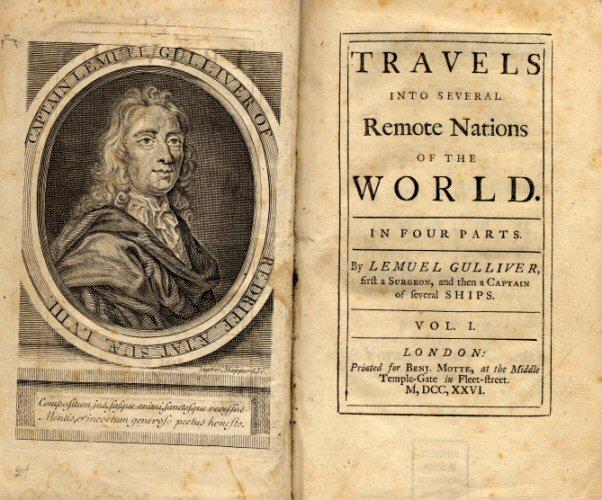
Two-hundred, ninety-four years ago, today, the book of satirical stories, Gulliver’s Travels was published. Written by Irish clergyman Jonathan Swift, the original title was Travels into Several Remote Nations of the World. In Four Parts. By Lemuel Gulliver, First a Surgeon, and then a Captain of Several Ships. That has to be the longest book title in existence. I’ve never read any of it, nor have I seen the various movies that have been put out. That being said, there are several well written summaries and opinions on the material and, I’m not reinventing the wheel. ~Vic
Gulliver’s name probably is an allusion to King Lemuel of Proverbs 31, who was a weak-minded prophet. Swift may also be connecting his character to a common mule, a half-ass, half-horse animal that is known for being stubborn and stupid. A gull is a person who is easily fooled or gullible. At the same time, Gulliver represents the everyman with his average intelligence and general good humor. The reader is able to identify with him and join him in his travels. Even though Swift constantly alludes to events that were happening while he was alive, the story rings true today, bringing light to our own societal issues and to patterns of human nature. Throughout Gulliver’s voyages, Swift goes to great lengths to scrutinize, parody, and satire various aspects of human, and often English, society.
A mock work of travel literature, Jonathan Swift’s famous novel is a far deeper work than one of just Juvenalian and Horatian satire. It is an indictment against the prevailing spirit of Enlightenment philosophy and utopianism, an esoteric defense of Christianity against its Enlightenment critics, and a prophetic vision into the future degeneration of humanity in following the dictates of the natural philosophers of modernity. Swiftian irony is one of the great joys of the work. [Where] traditional literary narrative has the travelling protagonist return home to comfort and love, Swift’s Gulliver returns home deranged and a hater of humanity.
Finding specific information on this film has been difficult. It appears that this was based upon a French terrorist organization’s bombings and assassinations that took place in Germany in September 1956, June 1957, October 1958, March 1959 and November 1959. IMDb doesn’t have a summary or synopsis but, I did find a translated plot from the German side of Wikipedia (Translate The Web Link):
This arms dealer drama takes place in Germany and Switzerland […] during the Cold War.
Manora Khan, consul of an unspecified Asian country, intends to hunt down his Cuban colleague Maria Gomez’s supply of weapons intended for her country. To this end, he orders the help of the smart Johnny Zamaris, with whom he has a common past: Johnny had once [been involved with] his great love, the actress Violetta Scotoni. [It] soon becomes apparent that no one is what he seems to be […]. Consul Khan turns out to be the leader of a secret organization called “The Red Hand” that deliberately kills competing gun-pushers. Competitor Johnny is more than just a smart Sonnyboy [sic]. [In] truth, he works as a defensive officer in his country, with the task of smashing “The Red Hand” again. Both men, who once competed for Violetta, die while serving in their respective [fatherlands], with Johnny being knocked down in the back of a black sedan with a machine gun after a final tender embrace with Violetta.
The writer and producer of this film was born in Austria but, emigrated to France after Anschluss. Unhappy with a Der Spiegel report, he wrote an opposite viewpoint. Der Speigel, in turn, panned the film.
There are no pictures or video of this program and very little has been written about it. I did manage to find an article on Light’s Out host Frank Gallop that referenced Trapped:
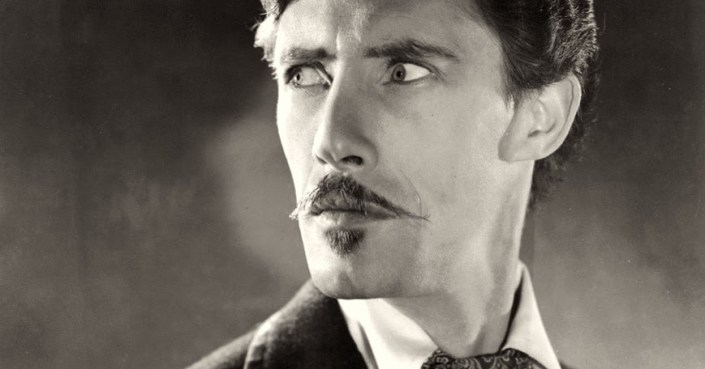
In accordance with Gallop, other hosts who aimed to set a mood of terror at the time included Andy Christopher […] (Mr. Black), James Monks (Tales of the Black Cat […]) and Lee Bowman (Eye Witness […]). Similarly, Jack La Rue (Lights Out), Boris Karloff (The Boris Karloff Mystery Playhouse) and John Carradine (Trapped: Tales of the Supernatural […]) offered external examples of film stars hired for TV hosting roles in which an emphasis was placed on their associations with the horror genre [with] typecasting as villainous and/or monstrous characters as part of their respective series façade. Due to a lack of surviving/missing material associated with some live series pre-1955, in the cases of some hosts, it is not always possible to definitively discern to what extent horror elements were adopted as part of a series persona.
Frank Gallop: The Ghoulish Host of Lights Out Thomas Wilson Taylor & Francis Online Historical Journal of Film, Radio and Television March 20, 2020
Biopic of the wartime exploits of Audie Murphy (played by himself), the most decorated US soldier in World War II. Starting with his boyhood in Texas, where he became the head of his family at a young age, the story follows his enrollment in [the] Army where he was assigned to the 3rd Division. He fought in North Africa, Sicily and Italy, before landing in southern France and, eventually, fighting in Germany. A Medal of Honor recipient, he also received battle honors from the French and Belgian government.
The highly variable Audie Murphy delivers his best screen performance as “himself” in Universal‘s To Hell and Back. Based on the star’s autobiography, this is the story of how Murphy became America’s most-decorated soldier during WW II. After dwelling a bit on Murphy’s hard-scrabble Texas upbringing, the story moves ahead to 1942, when, as a teenager, Audie joined the army. Within a year, he was a member of the 7th Army, serving in North Africa, Italy, France and, ultimately, Germany and Austria. One by one, the members of Murphy’s Company B are killed in the war, until only three men from the original company are left. [The] others appear at the finale as ghostly images […]. The bulk of the film is given over to Murphy’s conspicuous acts of combat bravery and his killing of 240 enemy soldiers. Highlighted by excellent battle sequences, To Hell and Back is a serviceable tribute to a most complex individual.
Date: 1948
Photo Author: Fort Detrick
Wikipedia & Wikimedia
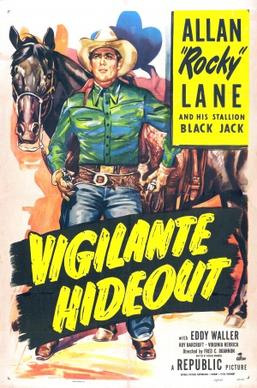
Rocky (Lane), a Range Detective, arrives to help Nugget (Waller) with rustlers. When he learns Nugget owns only three cows, he stays on, anyway and, soon, becomes involved in Benson’s attempt to blow open the bank’s safe. When Rocky upsets his plans, Benson (Don Haggerty), supposedly, gets rid of him by having him declared an outlaw, wanted dead or alive. Then, Benson takes a load of explosives into an old mine located directly under the bank vault.
Double-barreled justice catches up with a cold-blooded killer when “Rocky” takes up the chase! Cattle detective, Rocky Lane, arrives in town to investigate cattle disappearances only to realize just three cows, owned by eccentric inventor Nugget Clark, are involved. However, the disappearances lead to a deeper mystery involving dynamite explosions, rampaging cowboys and a water shortage.
Lane and his trusty black stallion are on hand to help old-timer Waller find water for a town which is threatening to fold up due to drought. Some crooked townsfolk don’t want the water to be found because they want to collect on the $25,000 being stashed away for an aqueduct. Lane’s job is to make sure these people don’t pose too much of a problem, while Waller goes about finding the water. The characterization of Waller as a crazed inventor of gadgets is an added attraction to this oater with a realistic bent.
Up until this point, the only TV shows I have been posting were American. I will be branching out a bit. Naturally, the first non-American show I choose doesn’t have a lot of information written about it…or a video. ~Vic
[This was] an early series from the pen of actor/writer Donald Churchill, focused on Albert Curfew, […] a young man unable to hold down a job for any length of time. The title came from a regular saying of Curfew’s every time he lost his job. Churchill (who also starred as well as wrote the scripts) claimed he based the series on a close friend of his. Guest stars in the single season show included Liz Fraser, Bill Kerr and Kate O’Mara.
In World War II, while serving as a United States Army Air Forces officer, famed World War I pilot Eddie Rickenbacker (Fred MacMurray) is assigned to tour South Pacific bases. On October 21, 1942, his Boeing B-17 Flying Fortress has to ditch at sea, forcing Rickenbacker, pilot Lt. James Whittaker (Lloyd Nolan), co-pilot Capt. Bill Cherry (Richard Crane) and other crew members to survive for 19 days on a tiny rubber raft. While awaiting their rescue, Rickenbacker recalls his other adventures that have highlighted a remarkable life.
It seems as though someone is kidding…kidding in more ways than one. For Captain Eddie, which came yesterday to the Roxy, is not the story it promises to be of Capt. Eddie Rickenbacker, ace of World War I and commercial airline executive who holds some rather rigid social views. Nor is it precisely the saga of the middle-aged flier who was lost at sea two years ago in the South Pacific and spent three harrowing weeks on a raft. It is just another sentimental comedy about a kid who jumped off the barn in his youthful passion for flying and courted his girl in a merry Oldsmobile. [This] is not the story of Rickenbacker…not the significant story, anyhow.
Trivia Bits:
♦ Crash survivor Lt. James Whittaker was […] temporarily assigned to the production to serve as a technical advisor.
♦ The film’s premiere was held in Rickenbacker’s hometown of Columbus, Ohio. In attendance were politicians and celebrities, including Carole Landis, as well as family members.


:format(jpeg):mode_rgb():quality(90)/discogs-images/R-543205-1365450873-9314.jpeg.jpg)











 Cosmic-Observation