There were only six episodes that aired between March 31 and June 11 with a seventh episode intended for a May slot, never airing. It’s first episode was on a Friday, the second episode aired the following Wednesday, the third episode went back to Friday, the following week and the fourth episode showed up on a Sunday, the next week. The last two aired episodes were on Sundays in June. [No wonder it failed. ~Vic]
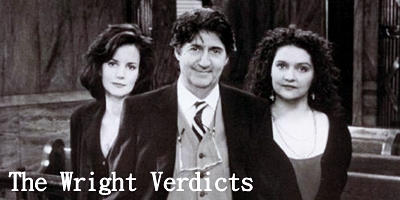
Legal drama with Charles Wright, an Englishman, working as a lawyer in New York City. Sandy Hamar is an ex-NYPD detective who serves as the mandatory private eye and Lydia is the super efficient secretary.
The Wright Verdicts is mature in the best sense. [I]t’s smart, has no false innocence and has the right amount of fun. Criminal lawyer Charles Wright (Tom Conti) will win juries over like clockwork and the series should likewise charm viewers. The character’s chief skill is blarney or, as his investigator puts it, shucking and jiving. Charles is bumbling and self-deprecating one minute, erudite and mischievous the next. Conti brings off Wright’s sense of humor and his status as a ladies’ man. The dynamic between Conti and his two female employees […] needs some work. [T]here’s so much flirtation that the relationships in this office triangle seem headed in only one direction.
The hour has a surplus of spectacular aerial shots of Manhattan.
With crimes revolving around designer drugs and cellular phones, the show poses itself as a Perry Mason for the ’90s. It’s about as conventional and formulaic as that old warhorse. The parlor-game plotting is more than passable but, the writing is undistinguished. Only Conti’s malty voice and trilling accent are enough to elevate the program’s mark a little.
Executive producer Dick Wolf has cannily combined two genres…Murder, She Wrote’s warm coziness and his own Law & Order’s cold, complex cases…and come up with a lukewarm show that’s nonetheless pretty irresistible.
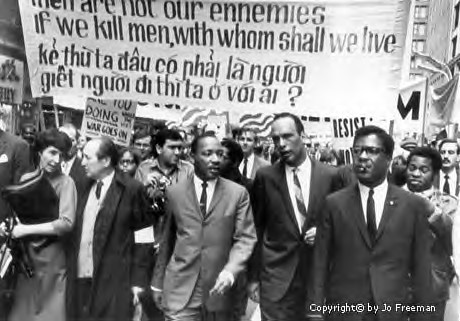
In addition to his moral objections to the war, he argued that the war diverted money and attention from domestic programs to aid the black poor. He was strongly criticized by other prominent civil rights leaders for attempting to link civil rights and the antiwar movement.
Dr. Benjamin Spock joins Dr. King
and Bernard Lee in the front line.
Photo Credit: jofreeman.com
Dr. King had never been neutral on the war in Vietnam but, he had been silent. He felt, as did the leaders of most other civil rights organizations, that the movement should concentrate on the domestic struggle. They were concerned that opposition to President Johnson’s foreign policy would result in loss of support for passing and enforcing civil rights laws at home. On July 5 1965, Dr. King told a college audience in Virginia that “the war in Vietnam must be stopped.” His friends and contacts in the Johnson Administration told him he was treading in dangerous waters and should back off.
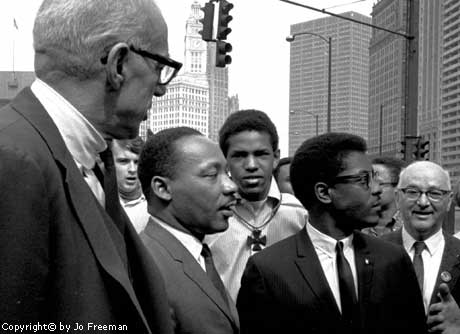
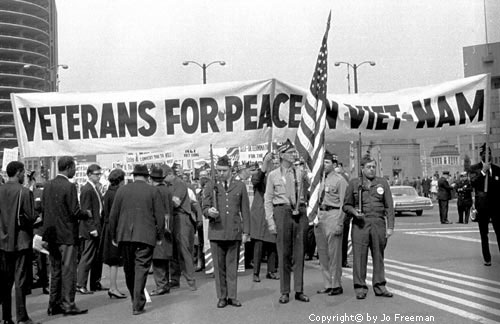
By 1967, Dr. King was ready to speak his mind publicly. His first statement was made on February 25 at an anti-war conference in California, along with several Senators who also opposed the war. He said it was immoral and, also, took money and attention from the anti-poverty program. After the walk down State Street on March 25, Dr. King addressed a rally.
Veterans for Peace get ready to march.
Photo Credit: jofreeman.com
There are videos of March 25, 1965 and videos of April 1, 1967 but, nothing for this date. ~Vic
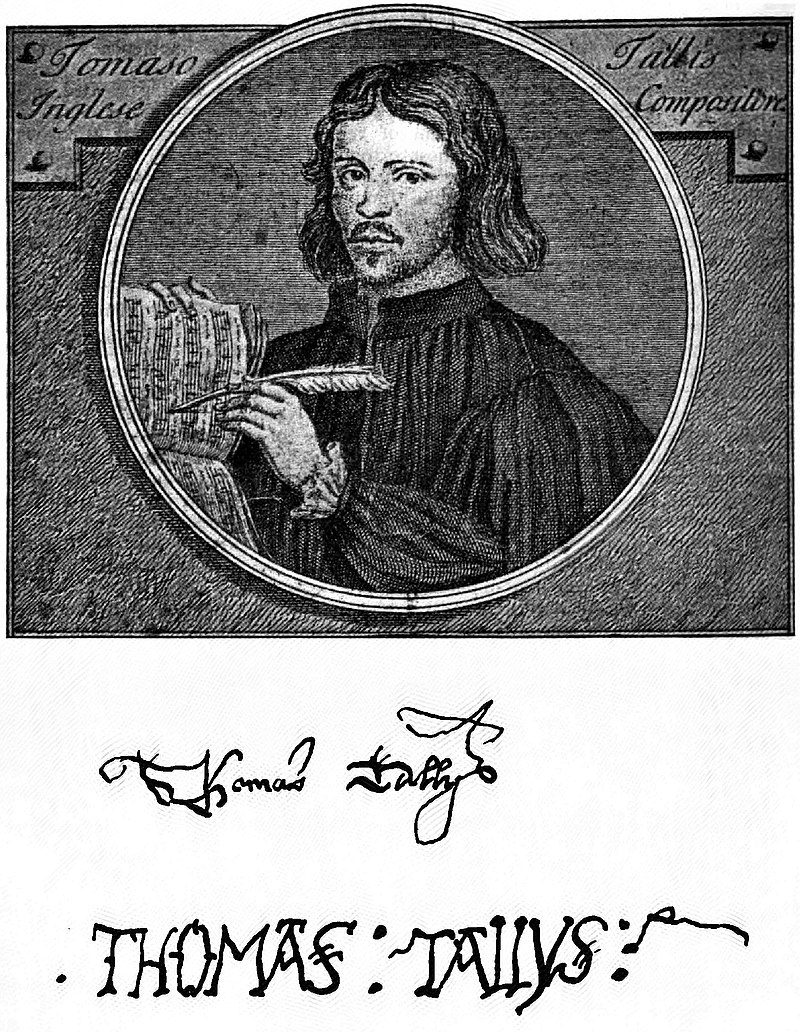
Spem in Alium is Latin for “hope in any other” or “hope in another”. A 40-part Renaissance Motet, it was composed in 1570 (thereabouts) by Thomas Tallis (Tallys). Written for eight choirs of five voices each, meaning there are 40 separate voices singing individual lines of music, it is considered to be Tallis’s greatest achievement and, possibly, one of the finest compositions of all time.
Information on where it was first performed is scarce. There appears to be some confusion regarding where it took place, as two locations…Nonsuch Palace, a royal Tudor palace in Surrey built by Henry VIII (not to be confused with Nonsuch Mansion) and Arundel House, a London townhouse originally for the Bishops of Bath & Wells…were both owned by Henry Fitzalan, the 12th/19th Earl of Arundel at one time. Most of what I have read leans towards Arundel House but, truly, I don’t think anyone really knows. It’s all a big guess. And, it is pure speculation as to why he wrote it. Some suggestions include a challenge due to an Italian composer doing same, Elizabeth’s 40th birthday or, perhaps for Mary as he was Catholic. Again, no one really knows.
The music, below, is soul stirring. ~Vic
Artist: Wenceslaus Hollar Arundel House
Image Credit: wikipedia.org & wikimedia.org
Spem in alium nunquam habui
Praeter in te, Deus Israel
Qui irasceris et propitius eris
et omnia peccata hominum
in tribulatione dimittis
Domine Deus
Creator caeli et terrae
respice humilitatem nostram
Artist: Georg Hoefnagel 1568
Watercolour of the south frontage of Nonsuch Palace
Image Credit: wikipedia.org & wikimedia.org
English Translation:
I have never put my hope in any other
but in Thee, God of Israel
who canst show both wrath and graciousness,
and who absolves all the sins
of man in suffering
Lord God,
Creator of Heaven and Earth
Regard our humility
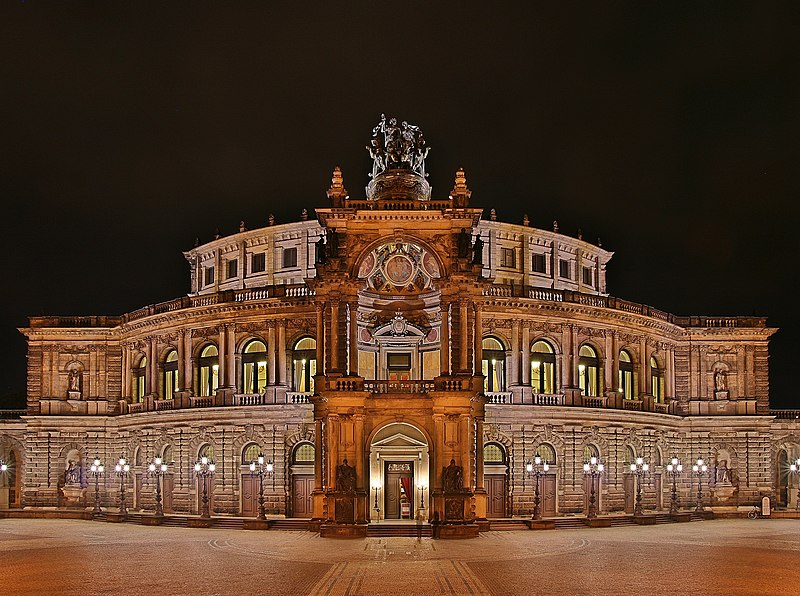
Die Semperoper in Dresden bei Nacht
The Semper Opera in Dresden at Night
Photo Credit: Sese Ingolstadt
wikipedia.org & wikimedia.org
Leaving the 1520s and entering the 1540s…
Formally known as the Sächsische Staatskapelle Dresden, the Staatskapelle Dresden is a Dresden-based German orchestra, one of the world’s oldest. Maurice, the Elector of Saxony (Prince Elector Moritz von Sachsen) founded it in 1548. Its precursor ensemble was Die Kurfürstlich-Sächsische und Königlich-Polnische Kapelle (The Electoral Saxon and Royal Polish Orchestra). The orchestra is the musical body of the Staatsoper Dresden (Dresden State Opera). The venue of the orchestra is the Semperoper.
Sixty years ago, today, the 17th annual Golden Globe Awards ceremony was held and aired on KTTV in Los Angeles (an independent station in 1960). The Globes are given by members of the Hollywood Foreign Press Association, the first gathering in 1944. Recognition is for excellence in film (American and International) and television (American). The 1960 ceremony was honoring work done in 1959.
Winners:
♥ Best Drama Film: Ben Hur
♥ Best Comedy Film: Some Like It Hot
♥ Best Musical Film: Porgy & Bess
♥ Best International (Understanding) Film: The Diary of Anne Frank
♥ Best Drama Actor: Anthony Franciosa
♥ Best Drama Actress: Elizabeth Taylor
♥ Best (Comedy/Musical) Actor: Jack Lemmon
♥ Best (Comedy/Musical) Actress: Marilyn Monroe
♥ Best Supporting Actor: Stephen Boyd
♥ Best Supporting Actress: Susan Kohner
♥ Best Director: William Wyler
♥ Best Original Score: Ernest Gold
♥ Cecil B.deMille Award: Bing Crosby
♥ Television Achievement: Edward R. Murrow
♥ Henrietta Awards (World Film Favorite): Doris Day & Rock Hudson
Trivia Bits:
♦ Two and a half years later, on August 4, 1962, Marilyn Monroe was found dead in her Los Angeles home.
♦ On June 5, 1968, Robert F. Kennedy was shot three times inside the Ambassador Hotel and died 26 hours later.
Oh, it has been work looking for a film for today’s date. IMDB had plenty to choose from but, I couldn’t seem to get any further information from the others…Wikipedia, American Film Institute, Turner Classic Movies… Even the Silent Era site and Silent Hollywood were slim pickings and, Silentology had nothing.
The discovery that detectives are on their trail causes Doyle, Broden and Etzer, counterfeiters, to pack their paraphernalia into a trunk and express it to Lone Point. Upon its arrival at that station, a corner of the trunk is smashed. Helen thus learns of its contents. The telegrapher immediately wires to Savage, a railroad detective. The latter, accompanied by Duncan, a Secret Service detective, hastens to the scene. At their suggestion, Helen arranges a trap for the counterfeiters. When the latter appear, they are set upon by the officers. Etzer is captured but, his pals get away. Doyle eludes pursuit but, Broden later falls into Savage’s hands. Helen, watching the pursuit, ventures on the high trestle which crosses the dry bed of the Loro River. Doyle, who is hiding, sees Helen. Overpowered by a desire for revenge, the man attacks the telegrapher and makes her a prisoner. A rope lies nearby. Binding Helen, Doyle suspends his victim from the trestle and fastens the end of the line around the rails. Duncan sees this from afar. Although he rushes forward, he knows that the Keene local, due any moment, will cut the rope as it crosses the trestle. Meanwhile, Helen, after a tremendous effort, frees her hands. There is one chance for life. The girl commences swinging her body. Each time, she [manages] a wider arc. The train is crossing the trestle when Helen swings toward a beam. The engine wheels sever the rope. Helen flies through the air and reaches the beam. Doyle is captured. Savage and Duncan raise Helen to the tracks and find her uninjured.
Moving Picture World
This is one of the lost pieces so, there isn’t a YouTube clip and I could only find one picture. ~Vic
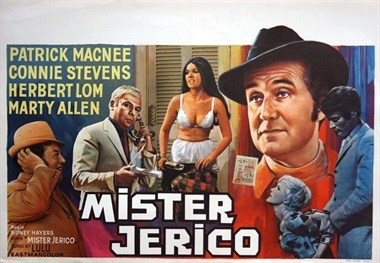
Smooth con man Dudley Jerico sets out to rob corrupt millionaire Victor Rosso [sic] of his legendary Gemini diamond.
A conman hatches a plan to swindle a corrupt millionaire out of his treasured priceless diamond by claiming to have discovered its twin. However, his plot is disrupted by a rival hustler who comes up with the same idea and, the two crooks must each convince their suspicious target that they can be trusted and the other is lying.
Reviews:
This disappointing comedy caper evidently got the green light due to the popularity of Patrick Macnee‘s dapper superspy John Steed in The Avengers. Unfortunately, this attempt to turn Macnee into an equally charismatic jewel thief just can’t compete with its bigger budgeted competition, despite the catchy title track from Lulu and the star’s stunning array of flowery shirts. Herbert Lom is good value as the object of Macnee’s felonious attentions (in a role similar to the one he played in the Michael Caine caper Gambit three years before) but, this lacklustre yarn, ultimately, can’t cut it in the excitement or suspense stakes.
Mister Jerico is one of those charming and fluffy capers that the 1960s did well, quite similar to the higher-budgeted Gambit or How to Steal a Million. The palette is sun-soaked, the plot buoyant and just this side of ridiculous. The second half of the film, in particular, moves along at a nice pace, complicating matters without making anything seem too serious. If you think too deeply about the story, it will all appear very nonsensical but, this is a stylized caper film not intended for deeper scrutiny. It’s a surface film and as such it’s quite enjoyable.
A fun film with a very Avengers feel to it, which should be obvious given the cast and crew. Allen is a little out of place but, Macnee and Lom are great, as is Laurie Johnson‘s score. I’ll even admit, against that, Lulu‘s theme song is catchy. Apparently [it was] intended as a pilot for a Macnee series to follow The Avengers but, instead, [was] released theatrically (though, in the US, it only ended up as a TV movie of the week).
USS Princeton 1843-1849
Image Credits: Lithograph by N. Currier, New York, 1844
U.S. Naval History & Heritage Command history.navy.mil
wikipedia.org & wikimedia.org
President Tyler hosted a public reception for Stockton in the White House on February 27, 1844. On February 28, [the] USS Princeton departed Alexandria, Virginia, on a demonstration cruise down the Potomac with Tyler, members of his cabinet, former First Lady Dolley Madison, Senator Thomas Hart Benton of Missouri and about 400 guests. Captain Stockton decided to fire the larger of her two long guns, Peacemaker, to impress his guests. Peacemaker was fired three times on the trip downriver and was loaded to fire a salute to George Washington as the ship passed Mount Vernon on the return trip. The guests aboard viewed the first set of firings, [then] retired below decks for lunch and refreshments.
Awful Explosion of the Peacemaker on board the
U.S. steam frigate Princeton on Wednesday, 28 Feb. 1844
Image Credits: Lithograph by N. Currier/Currier & Ives
Gale Research
Library of Congress
wikipedia.org & wikimedia.org
Secretary [of the Navy] [Thomas Walker] Gilmer urged those aboard to view a final shot with the Peacemaker. When Captain Stockton pulled the firing lanyard, the gun burst. Its left side had failed, spraying hot metal across the deck and shrapnel into the crowd. Instantly killed were Gilmer, Secretary of State [Abel P.] Upshur, Captain Beverley Kennon, who was Chief of the Bureau of Construction [Equipment] and Repairs, Virgil Maxcy (a Maryland attorney with decades of experience as a state and federal officeholder), David Gardiner (a New York lawyer and politician) and the President’s valet, a black slave named Armistead. Another 16 to 20 people were injured, including several members of the ship’s crew, Senator Benton and Captain Stockton. The president was below decks and not injured.
The disaster on board the Princeton killed more top U.S. government officials in a single day than any other tragedy in American history.
Artist: Joseph-Nicolas Robert Fleury Original Image: library.thinkquest.org Image Credit: wikipedia.org & wikimedia.org
They really wanted Galileo to shut up. Four hundred, four years, today, the Catholic Church was nearly successful with an injunction. Referred to as the Galileo Affair, it started in 1610 and ended in 1633 with the Roman Inquistion.
In 1610, Galileo published his Sidereus Nuncius (Starry Messenger), describing the surprising observations that he had made with [a] new telescope, among them, the Galilean Moons of Jupiter. With these observations, and additional observations that followed, such as the phases of Venus, he promoted the heliocentric theory of Nicolaus Copernicus published in De revolutionibus orbium coelestium in 1543. Galileo’s discoveries were met with opposition within the Catholic Church and, in 1616, the Inquisition declared heliocentrism to be “formally heretical.” Heliocentric books were banned and Galileo was ordered to abstain from holding, teaching or defending heliocentric ideas.
On February 19, 1616, the Inquisition asked a commission of theologians, known as qualifiers, about the propositions of the heliocentric view of the universe. [It was] confirmed that Galileo had advocated the Copernican doctrines of a stationary Sun, and a mobile Earth, and as a consequence, the Tribunal of the Inquisition would have eventually needed to determine the theological status of those doctrines.
On February 24, the Qualifiers delivered their unanimous report:
“[The] proposition that the Sun is stationary at the centre of the universe is foolish and absurd in philosophy and, formally, heretical since it explicitly contradicts, in many places, the sense of Holy Scripture. [The] proposition that the Earth moves and is not at the centre of the universe receives the same judgement in philosophy and … in regard to theological truth, it is at least erroneous in faith.”
At a meeting of the cardinals of the Inquisition on the following day, Pope Paul V instructed [Cardinal] Bellarmine to deliver this result to Galileo and to order him to abandon the Copernican opinions. [Should] Galileo resist the decree, stronger action would be taken. On February 26, Galileo was called to Bellarmine’s residence and ordered:
“[To] abstain completely from teaching or defending this doctrine and opinion or, from discussing it… to abandon completely… the opinion that the [Sun] stands still at the center of the world and the [Earth] moves and, henceforth, not to hold, teach or defend it in any way whatever, either orally or in writing.”
Galileo accepted the order. He didn’t have much choice as his reputation was at stake. Shortly afterwards, all books regarding the Copernican system were banned and Galileo’s works regarding Copernicanism were banned as well. His sentence prevented him from teaching or speaking of the matter further. He remained silent only for so long.
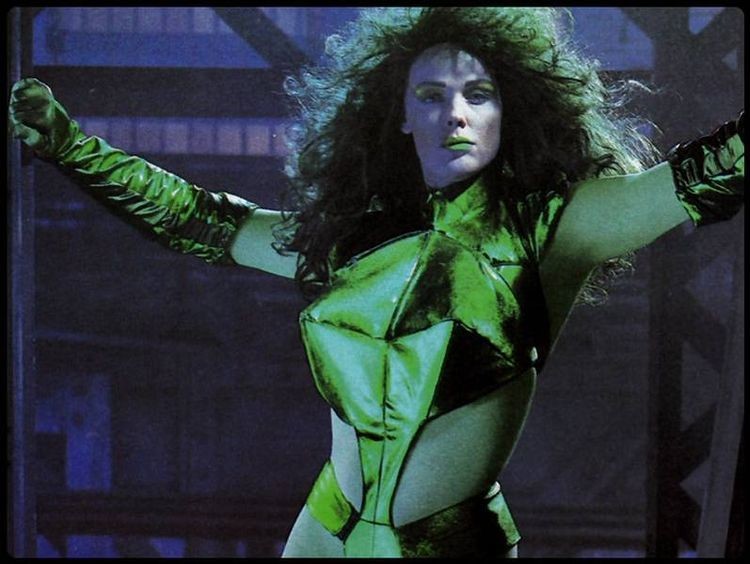
[This was] the finale of the television series about Dr. David Banner, a scientist who transforms into a mighty, larger-than-life creature called the Hulk when he gets angry. Desperately attempting to purge himself of his monster-like alter ego, Banner sneaks into a research laboratory. During the critical experiment to purge him of the Hulk, once and for all, a spy sabotages the laboratory. Banner falls in love with the spy, Jasmin, who performs missions only because her sister is being held hostage by Jasmin’s superiors. Banner and Jasmin attempt to escape from the enemy agents to rebuild their lives together but, the Hulk is never far from them.
The Incredible Hulk Returns and The Trial of the Incredible Hulk actually served as backdoor pilots for possible Thor and Daredevil series that never materialized. The third film, The Death of the Incredible Hulk was originally supposed to be the same sort of experiment, introducing She-Hulk, with Iron Man scheduled for the following film.
Image Credit: imdb.com
[However], when it finally came together, it, instead, served as a swan-song for Bill Bixby and focused on one last attempt at a cure for Banner’s Hulk-itis. Unfortunately, even though it wasn’t intended to really be the end of the Hulk on television (the plan was to have him return from the grave with Banner’s mind in the Hulk body), Bill Bixby’s health went south and he died before a proposed Rebirth of the Incredible Hulk film could get underway.
Photo Credit: syfy.com
Trivia Bits:
♦ After the ratings failure of this film, NBC decided not to continue the series. CBS already wanted nothing to do with The Incredible Hulk, prior to The Incredible Hulk Returns (1989). [For] the planned next installment, […] Bill Bixby tried to reach an agreement with ABC and they turned him down. [Then], he did the same for the Fox Network, who agreed to air another movie. Bixby and Fox were doing business together until Bixby was diagnosed with prostate cancer, causing production […] [to] shut down.
Also known as the Second Treaty of Indian Springs or Treaty with the Creeks, one-hundred, ninety-five years ago, today, it was signed by the Muscogee and the U.S. government at the Indian Springs Hotel (now a museum).
The U.S. and the Muscogee had, previously, signed the Treaty of Indian Springs of 1821. On January 8, the Muscogee agreed to cede their land holdings east of the Flint River to the state of Georgia in exchange for $200,000, paid in installments.
[…] Duncan Campbell and James Meriwether, U.S. Commissioners, [wrote] to Georgia Governor George M. Troup regarding obstacles the commissioners [faced] in treating with the Creeks. They [related] that proceedings [were] being conducted orally since the written method [had] failed. Also, the publication of negotiations held at Tucabatchee (Tuckabatchee or Tuckabatchie) and Pole Cat Springs [had] spread alarm throughout the nation as [had] the persistent “interference” of the Cherokees. Campbell and Meriwether negotiated the Treaty of Indian Springs [of] 1825 that was unauthorized by a majority of Creeks and, later, abrogated by the United States.
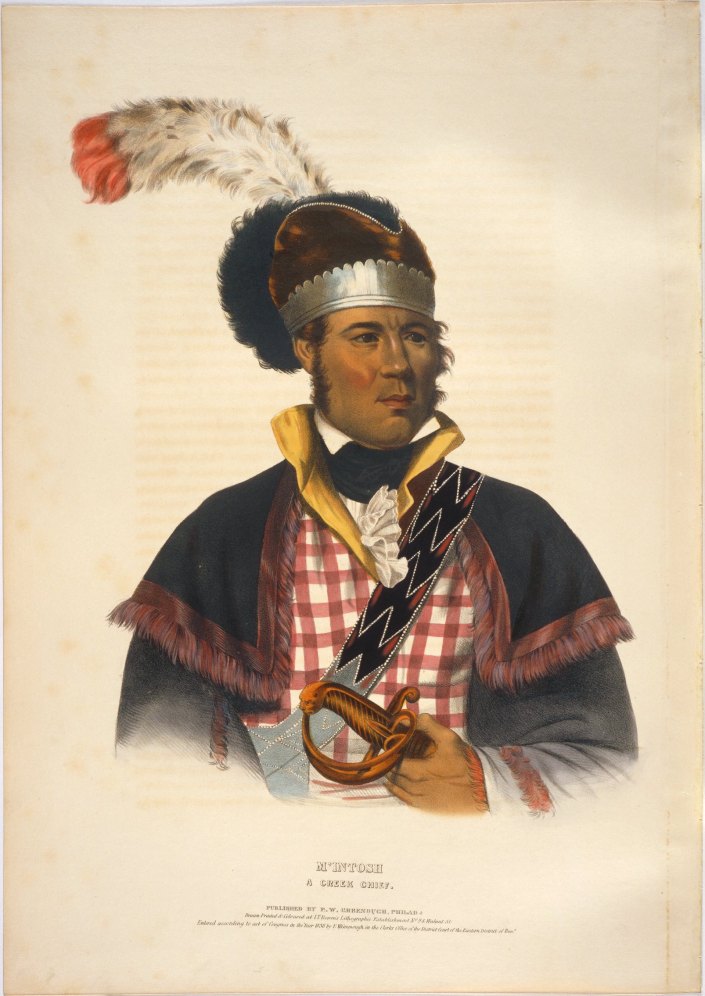
Image Credit: Georgia Encyclopedia William McIntosh
Tustunnuggee Hutke (White Warrior)
The treaty that was agreed [to] was negotiated with six chiefs of the Lower Creek, led by William McIntosh. McIntosh agreed to cede all Muscogee lands east of the Chattahoochee River, including the sacred Ocmulgee National Monument (Historic Park), to Georgia and Alabama and, accepted relocation west of the Mississippi River to an equivalent parcel of land along the Arkansas River. In compensation for the move to unimproved land, and to aid in obtaining supplies, the Muscogee nation would receive $200,000 (again), paid in decreasing installments over a period of years. An additional $200,000 was paid directly to McIntosh.
Outcome:
Governor Troup, and most Georgians, were in favor of the treaty and his inside man was his first cousin…William McIntosh. McIntosh paid the highest price. According to a Creek law, that McIntosh, himself, had supported, a sentence of execution awaited any Creek leader who ceded land to the United States without the full assent of the entire Creek Nation. Just before dawn on April 30, 1825, Upper Creek chief Menawa, accompanied by 200 Creek warriors (The Law Menders), attacked McIntosh at Lockchau Talofau (Acorn Bluff/McIntosh Reserve) to carry out the sentence. They set fire to his home, shot and stabbed him to death and, [killed] the elderly Coweta chief Etomme Tustunnuggee. Chillie McIntosh, the chief’s oldest son, had also been sentenced to die but, he escaped by diving through a window. Later that day, the Law Menders found [Samuel and Benjamin Hawkins, Jr.] (McIntosh’s sons-in-law), who were also signatories. They hanged Samuel and shot Benjamin but, he escaped.
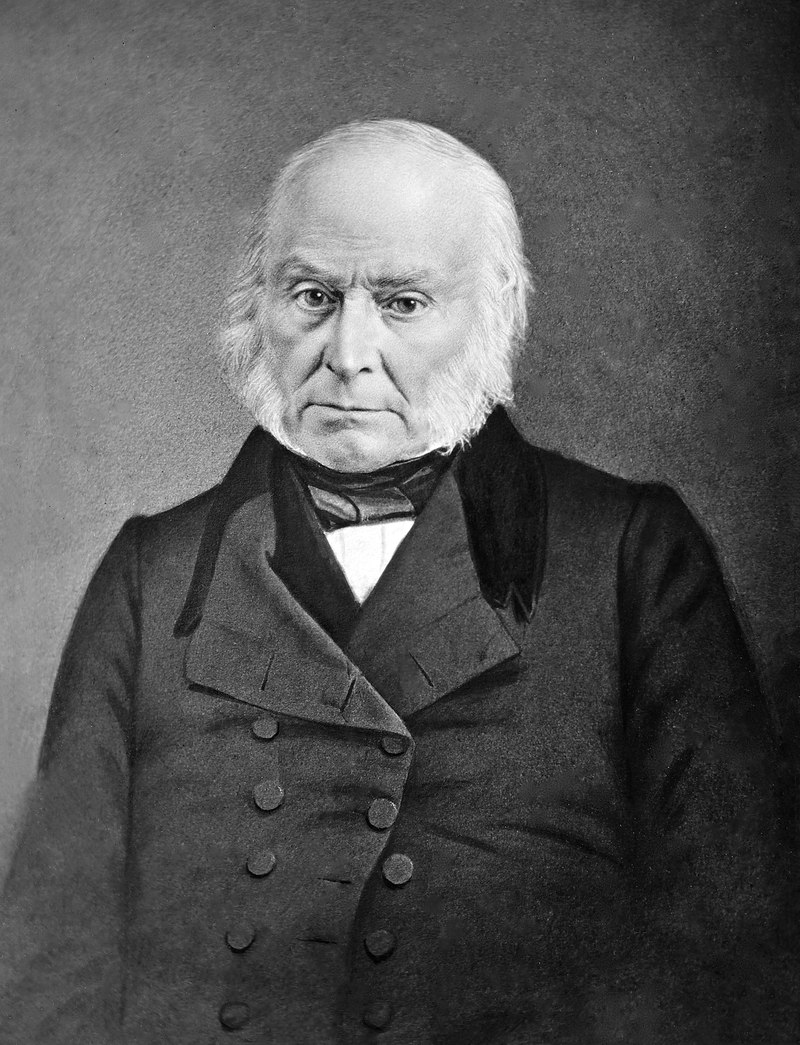
A large majority of chiefs and warriors objected that McIntosh did not have sufficient authority to sign treaties or cede territory. [The] Creek Nation sent a delegation, led by Opothleyahola and [included] Menawa, to lodge an official complaint. Federal investigators (appointed by President John Quincy Adams) agreed and the U.S. government negotiated a new land cession in the 1826 Treaty of Washington. The Creeks did not, however, have their territory restored in the new treaty.
Though the Creek did retain a small tract of land on the Georgia-Alabama border and the Ocmulgee National Monument, Governor Troup refused to recognize the new treaty. [He] authorized all Georgian citizens to evict the Muscogee and ordered the land surveyed for a lottery, including the piece that was to remain in Creek hands. He threatened an attack on Federal troops if they interfered with the [previous] treaty and challenged [the President]. The president intervened with Federal troops but, Troup called out the state militia, and Adams, fearful of a civil war, conceded.
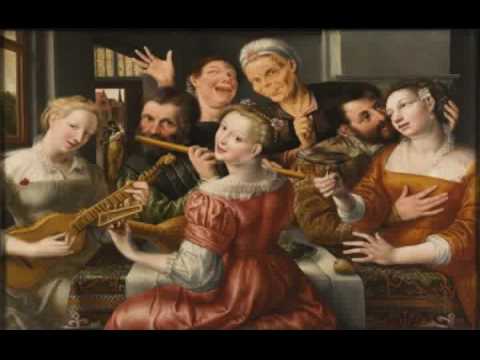
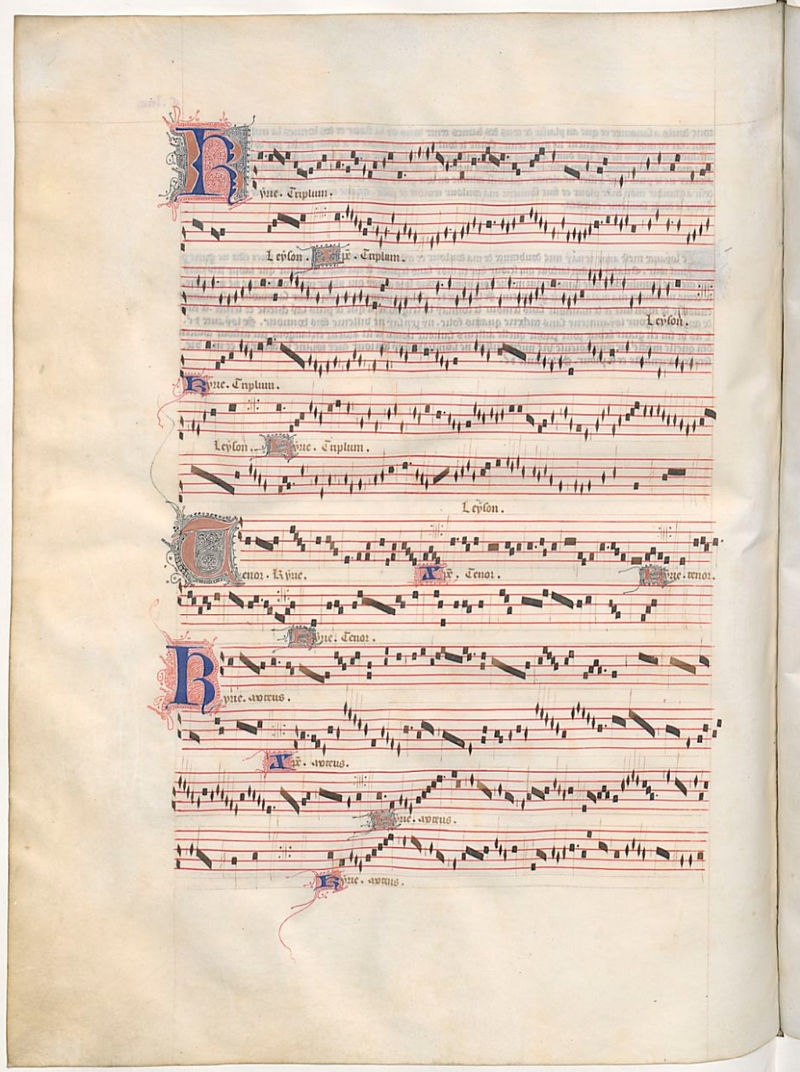
Messe de Nostre Dame (Mass of Our Lady) is a polyphonicmass composed before 1365 by French poet and composer Guillaume de Machaut […]. Widely regarded as one of the masterpieces of medieval music, and of all religious music, it is historically notable as the earliest complete setting of the Ordinary of the Mass attributable to a single composer […].
The Messe de Nostre Dame consists of 5 movements: the Kyrie (Eleison…”Lord, have mercy”), Gloria (in Excelsis Deo…”Glory to God in the highest”), Credo (Nicene Creed), Sanctus (“Holy”) and Agnus Dei (“Lamb of God”), followed by the dismissal Ite, missa est (Mass Response: Deo Gratias or “Thanks be to God”). The tenor of the Kyrie is based on Vatican Kyrie IV, the Sanctus and Agnus correspond to Vatican Mass XVII and the Ite is on Sanctus VIII. The Gloria and Credo have no apparent chant basis, although they are stylistically related to one another. Machaut’s Messe de Nostre Dame is for four voices rather than the more common three. Machaut added a contratenor voice that moved in the same low range as the tenor, sometimes replacing it as the lowest voice.
The information is rather wonky and, not only have I never studied music theory, my education on Catholic Mass is limited to a short stint as a member in an Anglican church in Austin, TX, a decade ago. That being said, what I find fascinating about this composition is that Machaut combined each part into an artistic whole, the earliest known example of it unified. Previously, the items were performed non-consecutively and, separated by prayers and chants.
[Instrumental Version of The Kyrie by Guillaume de Machaut]
[Modern Take on Kyrie by Patrick Lenk]
And, just because I could, I’m ending with Mr. Mister.
It is 1937 and newly qualified vet James Herriot travels to Yorkshire to apply for the post of assistant in Siegfried Farnon’s practice. He soon learns the facts of country life but, struggles to overcome the prejudices of the Darrowby locals who are skeptical of the novice vet’s ability. In between cases, Herriot courts pretty farmer’s daughter Helen Alderson and finally marries her.
A gentle, episodic account of author Herriot’s apprenticeship in the mid-1930s to an eccentric rural English veterinarian and his awkward courtship of a farmer’s daughter.
The story of a young veterinarian’s apprenticeship to a somewhat eccentric, older vet in the English countryside and the young man’s hesitating courtship of the daughter of a local farmer.
Trivia Bits:
♦ Although born in Sunderland, England, James Herriot spent the first twenty-three years of his life in Glasgow, Scotland and never lost the accent, as can be heard in television interviews. Simon Ward however, plays him as a Londoner.
♦ Known to the cast and crew as “All Creatures Grunt and Smell”.
[Note: I originally posted this, yesterday, just before midnight. In researching the data, I stumbled across Bill Owens, a photographer that was at Altamont. He was hired by the Associated Press to cover the concert. I emailed him, reference the two photos of his I posted. I hit ‘publish’ before I found his contact page and statement about photos for sale. In my haste to get this up while it was still Friday, I jumped the gun and quickly made the post private. I asked Bill what the price would be to use two of his pictures. As a photographer myself, I understand copyright issues but, I also recognize the gray area that many a blogger operate in, in the blogosphere….Fair Use (link on that, below). Anyway, this very kind gentleman has allowed my one-time use for this 50th anniversary post. He also provided me with a copy of an interview, conducted by Tony D’Souza in April 2019, covering his Altamont experience and other questions regarding his career. I will post an excerpt and attach the full interview, below. ~Vic]
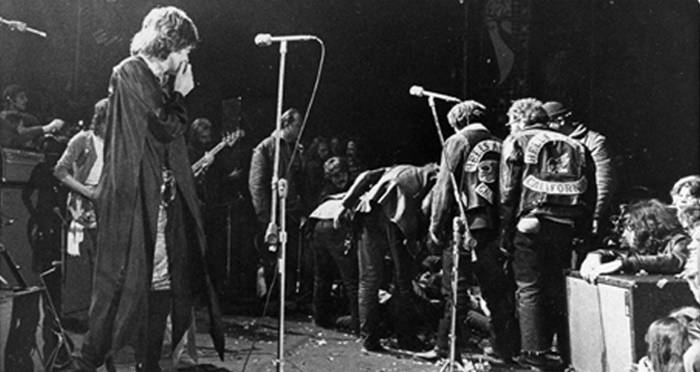
[It’s] not every day that a rock and roll band’s performance, let alone the Rolling Stones’, is accompanied by a knifing, stomping murder within a scream of the stage.
“The violence,” Keith Richard told the London Evening Standard, “just in front of the stage was incredible. Looking back, I don’t think it was a good idea to have [Hells] Angels there. But, we had them at the suggestion of the Grateful Dead. The trouble is, it’s a problem for us either way. If you don’t have them to work for you as stewards, they come, anyway and cause trouble. But, to be fair, out of the whole 300 Angels working as stewards, the vast majority did what they were supposed to do, which was to regulate the crowds as much as possible without causing any trouble. But, there were about ten or twenty who were completely out of their minds…trying to drive their motorcycles through the middle of the crowds.”
The Maysles Brothers, the film company which had shot the whole Stones’ tour, complete with its violent climax at Altamont, had gotten some remarkable footage of Hunter’s killing.
Robert Hiatt, a medical resident at the Public Health Hospital in San Francisco, was the first doctor to reach 18-year-old Meredith Hunter after the fatal wounds. He was behind the stage and responded to Jagger’s call from the stage for a doctor. When Hiatt got to the scene, people were trying to get Hunter up on the stage, apparently in the hope that the Stones would stop playing and help could get through quicker.
Stones on stage with Hells Angels.
Photo Credit: allthatsinteresting.com
Three others […] died (two in a hit-and-run accident, another by drowning) and, countless more were injured and wounded during the course of this daylong “free” concert. It was such a bad trip that it was almost perfect. All it lacked was mass rioting and the murder of one or more musicians.
All these things happened, and worse. Altamont was the product of diabolical egotism, hype, ineptitude, money manipulation and, at base, a fundamental lack of concern for humanity.
Bill Owens took iconic photos of the Hells Angels beating concertgoers with pool cue sticks at the Rolling Stones’ performance during the Altamont Speedway Free Festival four months after Woodstock on December 6, 1969. Altamont, which included violence almost all day and one stabbing death, is considered by historians as the end of the Summer of Love and the overall 1960’s youth ethos. This series of photos include panoramas of the massive, unruly crowd, Grace Slick and Carlos Santana on stage with the press of humanity so close in, they’re clearly performing under duress.
Of that day, Owens has written: “I got a call from a friend, she said the Associated Press wanted to hire me for a day to cover a rock and roll concert. I road my motorcycle to the event. I had two Nikons, three lenses, thirteen rolls of film, a sandwich, and a jar of water.”
Owens was so fearful of retribution by the Hells Angels that he published the photos under pseudonyms. Some of the negatives were later stolen…Owens believes by the Angels. He continues to have conflicted feelings about Altamont. He had no interest in violence and took no pride in photographing it.
In 1972, Owens released a book of black and white photography called Suburbia, also, now, an American icon. Irascible, stubborn, funny, grouchy, ornery and deeply rooted in small town life, Owens is built like a middleweight puncher and wears his hair as though he was a Marine. Indeed, Owens was never a hippie but, a clean-cut newspaper photographer, husband and father, who joined the Peace Corps to serve his country and “do good.” Turning 80 this September, Owens has also had noted careers as a craft beer brewer and pub owner, a magazine publisher many times over and, is now a distiller. His books include Suburbia, Working, Leisure and many others. He is the recipient of a Guggenheim and two NEAs. His work is collected in leading museums the world over, including the Smithsonian. Recent coverage of Owens includes an April retrospective in the New York Times (link above) of his Altamont photos for the event’s impending 50th anniversary. The photos are available for viewing at Owens’ website (link above and below).
I first met Owens at the defunct Rostel Gallery in remote and far northern Dunsmuir, CA, in late August or early September of 2008 (I remember because my daughter had just been born and the event was the first outing of her life), where they were showing images from Suburbia. These are images of people embarking on a new, modern way of life that they look excited by, but also confused, as though technology and the modish styles of the time were costumes they were still getting comfortable in. Owens’ photograph of a young suburban boy wearing cowboy boots, carrying a toy rifle and riding a Big Wheel, “Ritchie,” has always haunted me, though I couldn’t say precisely why.












 Cosmic-Observation