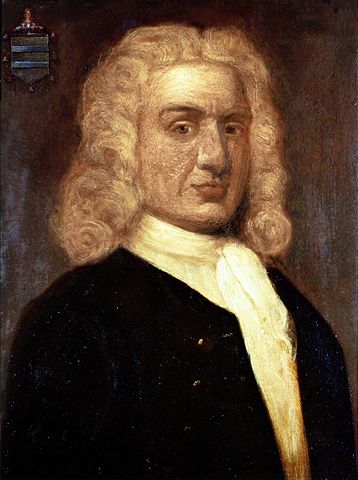
[P]roceedings against [Kidd] had been long and notorious. The actions for which he was tried had been still more notorious, one involving murder and five [involving] piracy. His career had been brief, brilliant in the beginning [but], catastrophic at the end. The general excitement at the time of his execution and, all during his imprisonment in London, had been at [a] fever pitch. Gossip went to work and, the wildest of tales of Kidd’s wickedness and wealth were believed. […] Upon his death, numerous accounts, both factual and fictitious, appeared.
William Hallam Bonner
University of Buffalo
American Literature, Vol. 15, No. 4, Jan. 1944 Journal Storage
Of all the things written and expressed, the ballad Captain Kid’s Farewel to the Seas (or the Famous Pirate’s Lament) was the only thing to survive. It was quite popular in the Colonies where the Captain had a home and may be considered America’s first folk legend. There is a British version and an American version, which changed the Captain’s first name to Robert for some strange reason and, several contemporary covers. The last website, below, has his name as John. He had to be hanged, twice, as the rope broke the first time. ~Vic
In Civil War, the Sokovia Accords is a United Nations version of a registration act to monitor or control the superheroes. Tony Stark (Ironman) agrees with this registration out of remorse for Ultron and the destruction of Sokovia. Steve Rogers (Captain America) disagrees and wants no part of political intervention or any form of registration. Complicating matters, Rogers’ childhood friend Bucky Barnes (Winter Soldier) is responsible for the death of T’Challa’s (Black Panther) father and Stark’s parents. The Avengers split along ideological and loyalty lines. Unlike the comics, Captain America isn’t killed off but, he does walk away from the job. He returns during Infinity War & Endgame.
I find all of the above quite prophetic considering recent insane events taking place. Society, once again, finds itself being driven towards more discrimination, tracking/registration with vaccine passports (shall we return to gold stars on lapels and “your papers, please?”) and possible civil war? Please…wake up. ~Vic
Gore Vidal: […on Truman’s voice…] “To the lucky person who has never heard it, I can only say…imagine what a brussel sprout would sound like, if a brussel sprout could talk.”
Truman Capote: […on Smith & Hickock…] “When you’re talking to them, they seem like perfectly nice boys. To be frank, I’m much more concerned for my safety around Norman Mailer.”
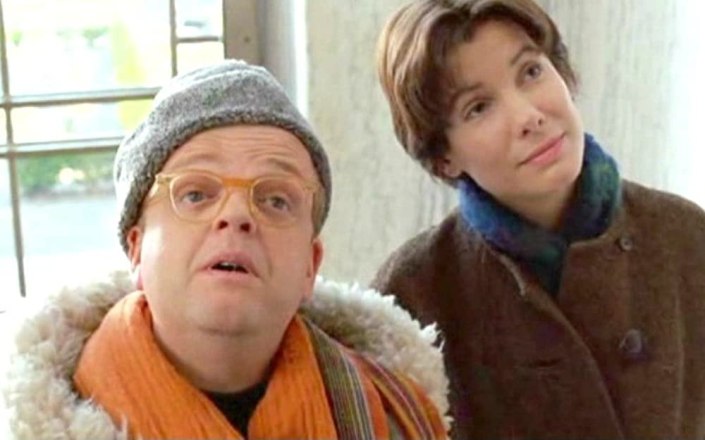
This is the second movie on Truman Capote regarding his foray into the Clutter Family murders. Released August 31, 2006, at the Venice Film Festival and widely on October 13, 2006, this film stood in the shadow of Philip Seymour Hoffman‘s Capote and his Academy Award for Best Actor. Unlike its predecessor, this film, with its $13 million budget, lost money. That being said, despite Hoffman’s turn, Toby Jones is no slouch and his interpretation has its own unique depth. Jones was awarded the London Critics’ Circle Film Award for British Actor of the Year. I found this film to be fascinating and quite entertaining, with parts difficult to watch. Bubbly Sandra Bullock brings forth the subdued, Southern To Kill A Mockingbird novelist Harper Lee. Much of the storytelling is done in mock interviews with the actors, in character, talking about their interactions with Truman. I seem to have a thing for underdog/obscure movies. ~Vic
“Why shouldn’t there be a fizzy, comedic take on the naughty adventures of the Park Avenue gadabout as he fashioned In Cold Blood […]? Why not a movie that concentrates on the contrast between the writer’s frivolous party-boy side and the brutal murders in Kansas, the exotic and colorful tropical specimen who becomes a fish-out-of water when he jumps from his luxurious high-rise swan pond into the Midwestern plains?
[A]fter In Cold Blood, [Capote] never published another major work. Out of career desperation as much as anything else, he sold out his friendships with these […] people, publishing gossipy stories about them in an Esquire excerpt from Answered Prayers in 1976 and was banished from their lives.
[T]he movie centers on the symbiotic relationship between Truman and Perry, pondering the extent of the seduction and, who seduced whom.
Toby Jones inhabits Truman as if he were to the character born, a livelier and more perversely ebullient man than Phillip Seymour Hoffman‘s version in Capote (2005).”
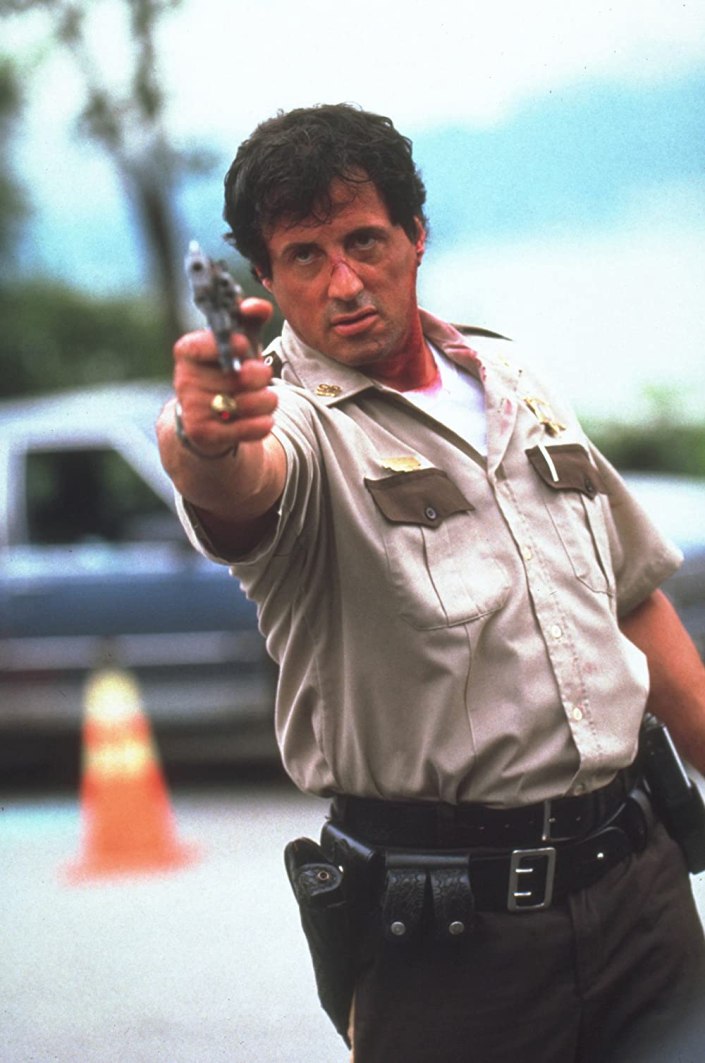
Sylvester Stallone put on 40 pounds to play Nowheresville, N.J., sheriff Freddy Heflin in Cop Land […]. His town is run by Ray Donlan (Keitel) and the other New York cops who have settled there with their families. He wears blinders when it comes to their lawbreaking and mob dealings. Moe Tilden (De Niro), the internal-affairs officer out to get the goods on Cop Land, correctly pegs Freddy as “a man looking for something to do.” Keitel’s [Donlan] exudes dangerous energy. He cares for his own as long as they don’t cross him […]. Robert Patrick brings sly menace to Rucker […]. Ray Liotta […], as Gary Figgis, [is] a tainted cop who sides with Freddy.
Mangold […] has a rare talent for finding the human drama in ordinary lives.
Writer-director James Mangold […] wrangles an impressive cast […] and spins a compelling tale of cancerous corruption among a secretive group of New York’s finest who have settled in the fictional New Jersey burg of Garrison. [Stallone] indeed looks chunky and plays the sleepy, docile Sheriff […] with sluggishness to spare in a largely commendable performance as a half-deaf small-town dreamer. [He] is not given much in the way of memorable dialogue but, he makes the character work […]. [Having] yet to replace his LP of The River with a CD, [he] carries a torch for the local Jersey girl (Sciorra) he saved from drowning…the reason for his loss of hearing in one ear…[he] once longed to be a big-city cop but, had to settle for policing them.
Freddy gradually realizes that he doesn’t like how the town has turned out.
I saw this at the theater when it came out and caught it, again, a few nights ago. I was born and raised in law enforcement and, worked in it, too (non-sworn). I’ve known good cops and I’ve known some really bad ones. I love a well written cop movie and this was an unusual one in that Stallone wasn’t playing a bad ass like Rambo, Cobra, Tango, John Spartan (though I do love that movie) or Ray Quick. This character was different…subdued. His scenes with Annabella Sciorra have Springsteen playing in the background which adds depth and texture to the mood. This is clearly a period piece as all the vehicles, hair cuts and clothing styles are, effectively, early 80s. The River came out in 1980 and music from the Director’s Cut, like Blue Oyster Cult‘s Burnin’ For You came out in 1981. This also manages to cover the Crime category via IMDb and the Film Noir category, simultaneously, via Historical Dictionary of Film Noir (2010). ~Vic
Mississippi: “[…] My name is Alan Bourdillion Traherne.” Cole: “Lord Almighty…”
Sheriff Harrah: “Who is he?” Cole: “Tell him your name, Mississippi.” Mississippi: [sigh] “Alan Bourdillion Traherne.” Sheriff Harrah: “Well, no wonder he carries a knife.”
Mississippi: “Always make you mad, don’t I?” Cole: “Mostly.”
Cole Thornton (Wayne) is a gunslinger for hire and land owner Bart Jason (Asner) has offered him a job. J. P. Harrah (Mitchum) is a Sheriff and an old friend of Cole’s. When Harrah informs Cole of Jason’s intention to use him to push the MacDonald family off of their land for water rights, Cole refuses the job. After shooting the youngest MacDonald son, unintentionally, during a volley of gunfire, Cole is wounded by the MacDonald daughter (Carey), in return, after he brings the deceased boy back home. Cole suffers intermittent paralysis on his right side throughout the rest of the movie. With the help of a gambler (Caan) he crosses paths with and the Sheriff’s deputy (Hunnicutt), Cole straightens out the drunken Sheriff, tangles with another gunslinger (George), derails Jason’s takeover and just might stop his previous ways for his lady, Maudie (Holt).
Mississippi repeats parts of the Edgar Allen Poepoem (except the second stanza) during the film, aggravating Cole somewhat (Caan had trouble with the word “boldly”, slurring it to sound like either “bowlie” or “bodie”). He’s also terrible with a gun and couldn’t hit the broadside of a barn (but, I love that hat!). Cole gets him a shotgun and later regrets it as he has scatter shot in his leg at the end of the movie.
This is my favorite John Wayne movie even though it is an ensemble cast. A close second is The Quiet Man where Wayne played another “Thornton” character. ~Vic
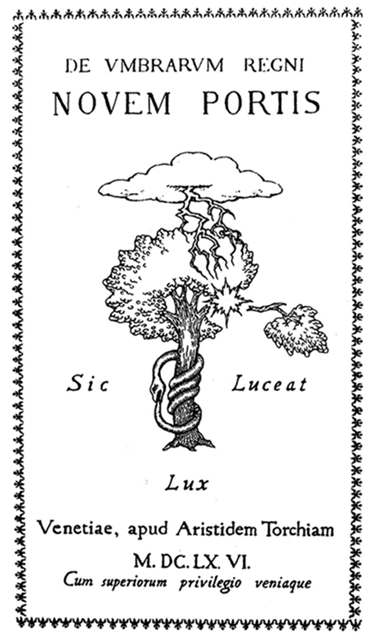
Dean Corso is a bit of a sleazy rare book dealer from New York with questionable ethics. Boris Balkan, a wealthy collector, hires Corso to determine if a book he owns (the book to the left/above) is authentic. The author, supposedly, wrote the book with help from the Devil and only three copies of the book are known to exist after the author was burned at the stake during the Inquisition, along with his works. Corso must find the other two to complete his investigation. Balkan believes that the owner of the book would have the power to summon said Devil. As the skeptical Corso travels and searches, he is followed by a mysterious woman. He eventually becomes obsessed with his task and desires the complete truth. The movie twists and turns to it’s bizarre ending. Depp is a strange cat but, he makes really interesting movies. Visually, Polanski intended for Corso to resemble Philip Marlowe. ~Vic
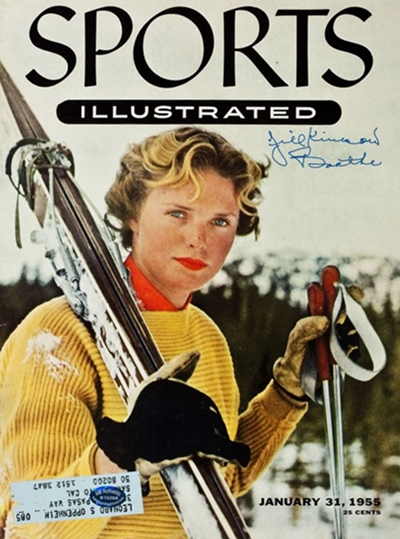
The film spans Jill’s slalom races to her national championship, her best friend’s polio contraction, her accident while attempting to win the Alta, UT, Snow Cup, her hospital stay, her slow rehabilitation, her heartbreak from the losses of two dear men and her triumph at becoming a teacher.
Released July 25, 1975, the film was panned by critics for being too much of a tear-jerker. That may be true but, she did have a really hard time. The sequel was released February 10, 1978 and was panned even worse. I saw them in reverse order. I was only nine years old when the first movie came out so, I didn’t get to see it until I was an adult. I saw Part II, first, when it was released to television. I enjoyed both films despite the bad reviews. Sometimes, bringing someone’s life story to the big screen is handled poorly. Jill passed away February 9, 2012.
The Gunpowder Plot of 1605, […] often called the Gunpowder Treason Plot or the Jesuit Treason [in earlier centuries], was a failed assassination attempt against King James I by a group of provincial English Catholics led by Robert Catesby.
The plot was revealed to the authorities in an anonymous letter sent to William Parker, 4th Baron Monteagle, on [October] 26, 1605. During a search of the House of Lords in the evening on [November] 4, 1605, Fawkes was discovered guarding 36 barrels of gunpowder, enough to reduce the House of Lords to rubble, and [was] arrested. Most of the conspirators fled from London as they learned of the plot’s discovery, trying to enlist support along the way. Several made a stand against the pursuing Sheriff of Worcester and his men at Holbeche House […]. [In] the ensuing battle, Catesby was one of those shot and killed. At their trial on [January] 27 1606, four hundred, fifteen years ago, today, eight of the survivors, including Fawkes, were convicted and sentenced to be hanged, drawn and quartered.
The thwarting of the Gunpowder Plot was commemorated for many years afterwards by special sermons and other public events such as the ringing of church bells, which evolved into the British variant of Bonfire Night of today.
First bars of the Gigue
from Suite #1
Source: IMSLP
Image Credit: Wikipedia & Wikimedia
The six partitas for solo violin by Johann Paul von Westhoff are the earliest known published music for solo violin. Although Westhoff’s compositions were rediscovered by scholars […] in the mid-19th century, this work was not found until the late 20th century.
The collection […] was discovered […] by musicologist Peter P. Várnai. He announced his discovery in a 1971 article […] published in Die Musikforschung, volume 24. The extant copy is dated 1696 (three hundred & twenty-five years, ago) but, it may be a reprint (partial or full) of a much earlier publication by Westhoff…the Erstes Dutzend Allemanden, Couranten, Sarabanden und Giguen Violino Solo sonder Passo Continuo. [That] collection was published in Dresden in 1682 and is considered lost. The first modern edition of the partitas appeared in 1974.
Nothing is known about how or when the partitas were composed. One other work for solo violin by Westhoff survives, a 1683 suite published in an issue of Dresden’s Mercure galant. [It] is entirely possible that the composer had more solo violin works. The […] surviving partitas are historically important works […] and were most probably the inspiration for Johann Sebastian Bach‘s sonatas and partitas for solo violin.
The partitas all consist of four dances, arranged in the standard late Baroque order… an Allemande, the Courante, the Sarabande and the Gigue. The music is technically demanding. [It is] fully polyphonic with frequent instances of tricky double stopping.
Johann Paul von Westhoff was a German Baroque composer and violinist. One of the most important exponents of the Dresden violin school, he was among the highest ranked violinists of his day […].
The video is full of powerful imagery. The lyrics deal with tragedy and triumph, being able to find grace in the most extreme and unnerving circumstances.
“Go figure. Disturbed songs with an air of positivity. Who would have ever thought?
You know, the only way that you get to appreciate the darkness is by contrasting it with light. And it’s been my experience, with people in my life, or friends that I have or have had, that sometimes those periods in our lives that are dark ones can be so daunting and you let them overwhelm you to the extent that you succumb to hopelessness and you succumb to stagnation. And the truth be told, everything is a pathway. Sometimes you have to go through dark periods in your life in order to find the answer that you need, in order to become stronger, in order to see the light… ~David Draiman
If you haven’t finished your holiday shopping, the North Carolina Department of Transportation is offering up a piece of Americana but, it’s going to cost you a pretty penny.
When the Ringling Bros. and Barnum & Bailey Circus closed their doors, NCDOT saw an opportunity to add to its fleet. That plan was derailed before the cars could hit the rails and, now, they’re being put up for public auction.
NCDOT spent just over $380,000 on [the] Ringling Brothers rail cars.
“These cars have a great and amazing history,” said Jason Orthner, director of the NCDOT rail division.
However, plans to refurbish the cars were quickly put on hold when NCDOT calculated the costs. “This was more on the long-term play of really looking into our rail program and how we take it into the future,” said Orthner.
Image Credit: New York Public Library
Wikimedia & Wikipedia
Funding from two federal grants totaling $157 million rendered the rehab of the Ringling Bros. cars obsolete and will soon allow the NCDOT to replace their entire fleet.
“If we hadn’t been successful at winning those grants, we would’ve taken a really hard look at putting these in service,” said Orthner. “We really want to do the best thing for the citizens of North Carolina with the limited funding that we have available.”
That’s why they’re listing the rail-cars on the state surplus site for a minimum price that’s $32,000 more than the NCDOT paid for all of the cars but, without any bids, it’s unclear if anyone will actually buy them.
“Tourist railroad operations, car collectors and other enthusiasts would certainly be interested in these cars,” said Orthner. “There are operations around the country that run train service for excursion purpose, or other purposes, that would be interested in equipment like this.”
This is my last countdown post. I’ve saved my favorite gingerbread house for last. I’ve been inside this place and you can feel its history. Unfortunately, I didn’t take any pictures when I was there. Before the world went insane, Ayr Mount would host Scottish Festivals. ~Vic
Adult Category
12-09-2020
Click for a larger view.Window Insert
Click for a larger view.Photo Credit: memory.loc.gov
February 1965
Wikipedia & Wikimedia
The evergreen Fir Tree has traditionally been used to celebrate winter festivals (Pagan and Christian) for thousands of years. Pagans used branches of it to decorate their homes during the winter solstice, as it made them think of the spring to come. The Romans used Fir Trees to decorate their temples at the festival of Saturnalia. Christians use it as a sign of everlasting life with God.
After [his] military service, Klavs, [the] son of Martins Viksna, is returning to his native village [of kolkhoz]. After [the] war, his father, the collective farm chairman […], was killed by guerrillas. Even after many years, the remote village of the Latvian countryside is still under agitation from those old days events. Klavs meets and falls in love with Bille [but], Bille is [the] daughter of Ance, his father’s first love. Klavs starts work in [the] collective farm but, after a conflict, however, decides to leave the village. After the death of his mother, Klavs [returns] and [remains in the village]. [This] is his real home.
Klāvs, the son of Mārtiņš Vīksna, the first chairman of the kolkhoz, comes out of the service and starts working in his native kolkhoz but, does not understand his colleagues, so he goes to the city. The chairman of the collective farm agrees that he will eat his hat if Klav does not return. Klava’s mother Ilze dies in the hay meadow and the chairman offers the boy to come in her place as a foreman. Bille is waiting for Klava in Ilze’s house, whose mother, milkman Ance, once loved Klava’s father.















 Cosmic-Observation